Questions

3 Marks Question

🎯

Test yourself on this topic

8 questions · timed · auto-graded

Question 13 Marks
Define the term self-inductance. Write its SI unit. Give two factors on which self inductance of an air-core coil depends.
Answer
Self-inductance of a coil is equal to the total magnetic flux linked with the coil, when unit current passes through it. SI unit of self-inductance is Henry (H).
i. number of turns of the coil
ii. area of cross section and length (geometry)
View full question & answer
Question 23 Marks
A horizontal straight wire $10 \ m$ long extending from east to west is falling with a speed of $5.0 ms^{-1}$, at right angles to the horizontal component of the earth's magnetic field, $0.30 \times 10^{-4} Wb m ^{-2}$.
$a.$ What is the instantaneous value of the emf induced in the wire?
$b.$ What is the direction of the emf?
$c.$ Which end of the wire is at the higher electrical potential?
Answer
Length of the wire,$ l = 10 m$
Falling speed of the wire, $v = 5.0 m/s$
Magnetic field strength, $B=0.3 \times 10^{-4} wb m ^{-2}$
$a.$ the instantaneous value of Emf induced in the wire,
$ e =\text { Blv }$
$=0.3 \times 10^{-4} \times 5 \times 10$
$=1.5 \times 10^{-3} V$
$b.$ Using Fleming's right-hand rule, it can be inferred that the direction of the induced emf is from West to East.
$c.$ The eastern end of the wire is at a higher potential.
View full question & answer
Question 33 Marks
The absolute refractive index of air is 1.0003 and the wavelength of yellow light in a vacuum is $6000 \stackrel{\circ}{A}$ . Find the thickness of air column which will contain one more wavelength of yellow light than in the same thickness of vacuum.
Answer
Wavelength of yellow light in vacuum,
$\lambda=6000 \stackrel{\circ}{A}$
Wavelength of yellow light in air
$\lambda^{\prime}=\frac{\lambda}{\mu}=\frac{6000}{1.0003} \stackrel{\circ}{A}$
Let a thickness t of vacuum contain n waves and the same thickness t of air contain n + 1 waves.
Then $n =\frac{t}{\lambda}=\frac{t}{6000 \stackrel{\circ}{A}}$
and $n +1=\frac{t}{\lambda^{\prime}}=\frac{1.0003 t}{6000 \stackrel{\circ}{A}}$
$n +1=\frac{t}{\lambda^{\prime}}=\frac{1.0003 t}{6000 \stackrel{\circ}{A}}$
$\frac{t}{6000 \stackrel{\circ}{A}}+1=\frac{1.003 t}{0.0003}$ or $t +6000 \stackrel{\circ}{A}=1.0003 t$
or $t =\frac{6000}{0.0003}=2 \times 10^7 \stackrel{\circ}{A}=2 mm$.
View full question & answer
Question 43 Marks
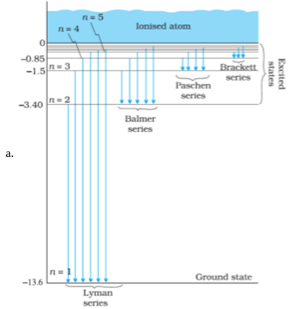
$a.$ Draw the energy level diagram for the line spectra representing Lyman series and Balmer series in the spectrum of hydrogen atom.
$b.$ Using the Rydberg formula for the spectrum of hydrogen atom, calculate the largest and shortest wavelengths of the emission lines of the Balmer series in the spectrum of hydrogen atom. $($ Use the value of Rydberg constant $\left.R =1.1 \times 10^7 m^{-1}\right)$
Answer
Image
$\frac{1}{\lambda_{\text {segget }}}=R\left\{\frac{1}{n_f^2}-\frac{1}{n_C^2}\right\}=R \frac{5}{36}$
$\lambda \max =\frac{36}{5 R}$
$=\frac{36}{5 \times 1.1 \times 10^7} m$
$=6.5 \times 10^{-7} m$
$\frac{1}{\lambda_{\text {Smilut }}}=R\left\{\frac{1}{2^2}-\frac{1}{\infty^2}\right\}$
$=\frac{R}{4}$
$\lambda_{\operatorname{mm}}=\frac{4}{R}=\frac{4}{1.1 \times 10^7} m$
$=3.6 \times 10^{-7} m$
View full question & answer
Question 53 Marks
i. What characteristic property of nuclear force explains the constancy of binding energy per nucleon (BE/A) in the range of mass number $A$ lying $30<A<170$ ?
ii. Show that the density of nucleus over a wide range of nuclei is constant and independent of mass number A
Answer
i. The characteristic property of nuclear force that explains the constancy of binding energy per nucleon is the saturation or short range nature of nuclear forces.
Let, m be the mass of a nucleon,
therefore,
density, $\rho=\frac{ mA }{\frac{4}{3} \pi\left( R _0 A^{1 / 3}\right)^3}=\frac{ mA }{\frac{4}{3} \pi R _0^3 A}=\frac{ m }{\frac{4}{3} \pi R _0^3}$
Thus, we can see that density is constant and independent of mass number A.
View full question & answer
Question 63 Marks
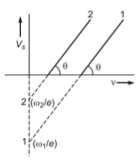
Write Einstein's photoelectric equation in terms of the stopping potential and the threshold frequency for a given photosensitive material. Draw a plot showing the variation of stopping potential vs. the frequency of incident radiation.
Answer
Einstein's photoelectric equation,
$\text{K.E.}$ of photo electron = incident energy of photons $-$ Work function
$\text { or K.E. }= hv - W _0$
$\text { or K.E. }= hv - hv _0$
where $v_0$ is called threshold frequency.
$i.$ Threshold Frequency: For a given metal, there exists a certain minimum frequency of the incident radiation below which no emission of photo electrons takes place. This frequency is called threshold frequency.
$ii.$ Threshold Frequency: For a given metal, there exists a certain minimum frequency of the incident radiation below which no emission of photo electrons takes place. This frequency is called threshold frequency.
Image
View full question & answer
Question 73 Marks
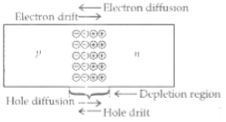
Explain with the help of a diagram, how a depletion layer and barrier potential are formed in a junction diode.
Answer
Image

Due to the diffusion of electrons and holes, from their majority to minority zone, a layer of positive and negative space charge region on either side on the junction is formed. This is called the depletion region. The loss of electrons, from the n-region and the gain of electrons by the p-region, cause a difference of potential across the junction formed. This tends to prevent the further movement of charge carriers across the junction and is, therefore, termed as barrier potential.
View full question & answer
Question 83 Marks
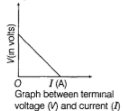
A cell of emf $E$ and internal resistance r is connected across a variable load resistor $R$. Draw the plots of the terminal voltage $V$ versus $(i)$ resistance R and $(ii)$ current $I.$
It is found that when $R=4 \Omega$, the current is $1 A$ and when $R$ is increased to $9 \Omega$, the current reduces to $0.5 A $.Find the values of the emf $E$ and internal resistance r.
Answer
Internal resistance usually means the electrical resistance inside batteries and power supplies that can limit the potential difference that can be supplied to an external load
$\because \quad V=\left(\frac{E}{R+r}\right) R=\frac{E}{1+r / R}$
$\Rightarrow$ with the increase of $R , V$ increases
Graph between terminal voltage$(V)$ and Current $(I)$
Image

When $R=4 \Omega$ and $I =1 A$.
We know that, terminal voltage, $V = E - Ir.$
$\Rightarrow V=I R=4=E-I r$
$\Rightarrow E-r=4 \ldots \text { (i) }$
When $R=9 \Omega$ and $I =0.5 A$, then
$V=I R=0.5 \times 9=E-0.5 r$
$\Rightarrow E-05 r=4.5 \ldots(i i)$
On solving Eqs. $(i)$ and $(ii),$ we get
$r=1 \Omega$ and $E =5 V$
So from the above calculation, it was found that the internal resistance of the cell is $1 \ ohm$ and emf is $5$ volt.
View full question & answer
3 Marks Question - Physics STD 12 Science Questions - Vidyadip