Sample QuestionsMODEL PAPER 4 questions
One sample from each question group in this chapter. Select any group above to see the full set with answer keys.
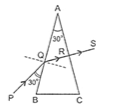
In the diagram, a prism of angle $30^{\circ}$ is used. $A$ ray $PQ$ is incident as shown. An emergent ray $RS$ emerges perpendicular to the second face. The angle of deviation is:
- A
$60^{\circ}$
- B
$0^{\circ}$
- ✓
$30^{\circ}$
- D
$45^{\circ}$
Answer: C.
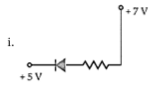
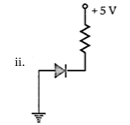
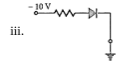
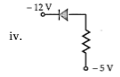
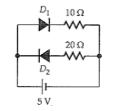
View full solution →Two ideal diodes are connected to a battery as shown in the circuit. The current supplied by the battery is
An electron is moving round the nucleus of a hydrogen atom in a circular orbit of radius r . The Coulomb force $\vec{F}$ between the two is:
- A
$\kappa \frac{e^2}{r^3} \vec{r}$
- B
$-\kappa \frac{e^2}{r^3} \vec{r}$
- C
$-\kappa \frac{e^3}{s^3} \hat{r}$
- D
$\kappa \frac{e^2}{n^3} \hat{r}$
View full solution →The wavefront of a distant source of unknown shape is approximately:
Which of the following has its permeability less than that of free space?
Assertion (A) : The quantity L/R possesses the dimension of time.
Reason (R): In order to reduce the rate of increase of current through a solenoid, we should increase the time constant.
- A
Both A and R are true and R is the correct explanation of A.
- B
Both A and R are true but R is not the correct explanation of A.
- C
A is true but R is false.
- D
A is false but R is true.
View full solution →Assertion (A) : Wavefront emitted by a point source of light in an isotropic medium is spherical.
Reason (R): Isotropic medium has same refractive index in all directions.
- A
Both A and R are true and R is the correct explanation of A.
- B
Both A and R are true but R is not the correct explanation of A.
- C
A is true but R is false.
- D
A is false but R is true.
View full solution →Assertion (A): If the distance between parallel plates a capacitor is halved and dielectric constant is made three times then the capacitance becomes six times.
Reason (R) : Capacitance of the capacitor does not depend upon the nature of the material of the plates of the capacitor.
- A
Assertion and reason both are correct statements and reason is correct explanation for assertion.
- B
Assertion and reason both are correct statements and reason is correct explanation for assertion.
- C
Assertion is correct statement but reason is wrong statement.
- D
Assertion is wrong statement but reason is correct statement.
View full solution →Assertion (A): In process of photoelectric emission, all emitted electrons do not have same kinetic energy.
Reason (R): If radiation falling on the photosensitive surface of metal consists of different wavelengths then energy acquired by electrons absorbing photons of different wavelengths shall be different.
- A
Both A and R are true and R is the correct explanation of A.
- B
Both A and R are true but R is not the correct explanation of A.
- C
A is true but R is false.
- D
A is false but R is true.
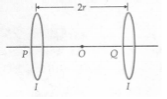
View full solution →Two identical circular loops, P and Q. each of radius r and carrying currents are kept in the parallel planes having a common axis passing through O. The direction of current in P is clockwise and in Q is anti-clockwise as seen from O which is equidistant from the loops P and Q. Find the magnitude of the net magnetic field at O.
A circular coil of $25$ turns and radius $6.0 \ cm,$ carrying a current of $10 A,$ is suspended vertically in a uniform magnetic field of magnitude $1.2 T.$ The field lines run horizontally in the plane of the coil. Calculate the force and the torque on the coil due to the magnetic field. In which direction should a balancing torque be applied to prevent the coil from turning?
View full solution →Suppose you are given a chance to repeat the alpha-particle scattering experiment using a thin sheet of solid hydrogen in place of the gold foil. (Hydrogen is a solid at temperatures below 14 K). What results do you expect?
Magnetic force is always normal to the velocity of a charge and therefore does no work. An iron nail held near a magnet, when released, increases its kinetic energy as it moves to cling to the magnet. What agency is responsible for this increase in kinetic energy if not the magnetic field?
Define the term self-inductance. Write its SI unit. Give two factors on which self inductance of an air-core coil depends.
A horizontal straight wire $10 \ m$ long extending from east to west is falling with a speed of $5.0 ms^{-1}$, at right angles to the horizontal component of the earth's magnetic field, $0.30 \times 10^{-4} Wb m ^{-2}$.
$a.$ What is the instantaneous value of the emf induced in the wire?
$b.$ What is the direction of the emf?
$c.$ Which end of the wire is at the higher electrical potential?
View full solution →The absolute refractive index of air is 1.0003 and the wavelength of yellow light in a vacuum is $6000 \stackrel{\circ}{A}$ . Find the thickness of air column which will contain one more wavelength of yellow light than in the same thickness of vacuum.
View full solution →$a.$ Draw the energy level diagram for the line spectra representing Lyman series and Balmer series in the spectrum of hydrogen atom.
$b.$ Using the Rydberg formula for the spectrum of hydrogen atom, calculate the largest and shortest wavelengths of the emission lines of the Balmer series in the spectrum of hydrogen atom. $($ Use the value of Rydberg constant $\left.R =1.1 \times 10^7 m^{-1}\right)$
View full solution →i. What characteristic property of nuclear force explains the constancy of binding energy per nucleon (BE/A) in the range of mass number $A$ lying $30<A<170$ ?
ii. Show that the density of nucleus over a wide range of nuclei is constant and independent of mass number A
View full solution →A series $\text{LCR}$ circuit is connected to an $a.c$. source having voltage $V=V_m \sin \omega t$. Derive the expression for the instantaneous current $I$ and its phase relationship to the applied voltage. Obtain the condition for resonance to occur. Define power factor. State the conditions under which it is
$i$. maximum and
$ii$. minimum.
View full solution →$i.$ Describe, with the help of a suitable diagram, the working principle of a step$-$up transformer. Obtain the relation between input and output voltages in terms of the number of turns of primary and secondary windings and the currents in the input and output circuits.
$ii.$ Given the input current $15 A$ and the input voltage of $100 V$ for a step$-$up transformer having $90\%$ efficiency, find the output power and the voltage in the secondary if the output current is $3 A.$
View full solution →$a.$ Derive an expression for the potential energy of an electric dipole in a uniform electric field. Explain conditions for stable and unstable equilibrium.
$b.$ Is the electrostatic potential necessarily zero at a point where the electric field is zero? Give an example to support your answer.
View full solution →Two point charges $-q$ and $q$ are located at points $(0, 0, - a)$ and $(0, 0, a)$ respectively.
$i.$ Find the electrostatic potential at $(0, 0, z)$ and $(x, y, 0)$.
$ii$. How much work is done in moving a small test charge from the point $(5, 0, 0)$ to $(- 7, 0, 0)$ along the $x-$ axis?
$iii$. How would your answer change if the path of the test charge between the same points is not along the $x-$ axis but along any other random path?
$iv$. If the above point charges are now placed in the same positions in the uniform external electric field $\vec{E}$, what would be the potential energy of the charging system in its orientation of unstable equilibrium?
Justify your answer in each case
View full solution →Using Huygens' principle, draw a diagram to show propagation of a wavefront originating from a monochromatic point source. Explain briefly.
Coulomb's law states that the electrostatic force of attraction or repulsion acting between two stationary point charges is given by
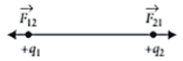
where $F$ denotes the force between two charges $q _1$ and $q _2$ separated by a distance $r$ in free space, $\varepsilon_0$ is a constant known as the permittivity of free space. Free space is a vacuum and may be taken to be air practically. If free space is replaced by a medium, then $\varepsilon_0$ is replaced by $\left(\varepsilon_0 k\right)$ or $\left(\varepsilon_0 \varepsilon_r\right)$ where $k$ is known as dielectric constant or relative permittivity.
$(i)$ In coulomb's law, $F =k \frac{q_1 q_2}{r^2}$, then on which of the following factors does the proportionality constant $k$ depends?
$(a)$ Nature of the medium between the two charges
$(b)$ Distance between the two charges
$(c)$ Electrostatic force acting between the two charges
$(d)$ Magnitude of the two charges
$(ii)$ Dimensional formula for the permittivity constant $\varepsilon_0$ of free space is
$(a) \left[ M ^{-1} L^3 T^2 A^2\right]$
$(b) \left[ ML ^{-3} T^4 A^2\right]$
$(c) \left[ M ^{-1} L^{-3} T^4 A^2\right]$
$(d) \left[ ML ^{-3} T^4 A^{-2}\right]$
$(iii)$ The force of repulsion between two charges of $1 C$ each, kept $1m$ apart in vaccum is
$(a) \frac{1}{9 \times 10^9} N$
$(b) \frac{1}{9 \times 10^{12}} N$
$(c) 9 \times 10^7 N$
$(d) 9 \times 10^9 N$
$(iv)$ Two identical charges repel each other with a force equal to $10$ mgwt when they are $0.6 m$ apart in air.
$(g =10 m s ^{-2} ).$ The value of each charge is
$(a) 2 mC$
$(b) 2 \times 10^{-7} mC$
$(c) 2 \mu C$
$(d) 2 nC$
OR
Coulomb's law for the force between electric charges most closely resembles with
$(a)$ law of conservation of energy
$(b)$ Newton's $2^{nd}$ law of motion
$(c)$ law of conservation of charge .
$(d)$ Newton's law of gravitation View full solution →Electrons oscillating in a circuit give rise to radiowaves. A transmitting antenna radiates most effectively the radiowaves of wavelength equal to the size of the antenna. The infrared waves incident on a substance set into oscillation all its electrons, atoms and molecules. This increases the internal energy and hence the temperature of the substance.
(i) If $v_g, v_X$ and $v_m$ are the speeds of gamma rays, $X$-rays and microwaves respectively in vacuum, then
(a) $v_g>v_X>v_m$
(b) $v_g<v_X<v_m$
(c) $v_g>v_X>v_m$
(d) $v_g=v_X=v_m$
(ii) Which of the following will deflect in electric field?
(a) ultraviolet rays
(b) $\gamma$-rays
(c) X-rays
(d) cathode rays
(iii) $\gamma$-rays are detected by
(a) point contact diodes
(c) thermopiles
(b) ionization chamber
(d) photocells
OR
We consider the radiation emitted by the human body. Which one of the following statements is true?
i. The radiation emitted is in the infrared region
ii. The radiation is emitted only during the day.
iii. The radiation is emitted during the summers and absorbed during the winters.
iv. The radiation emitted lies in the ultraviolet region and hence it is not visible
(a) Option(iv) (iii) (b) Option (ii) (c) Option (d) Option (i)
(iv) The frequency of electromagnetic wave, which best suited to observe a particle of radius $3 \times 10^{-4} cm$ is the order of
(a) $10^{14} Hz$
(b) $10^{12} Hz$
(c) $10^{13} Hz$
(d) $10^{15} Hz$
View full solution →