Questions

M.C.Q (1 Marks)

🎯

Test yourself on this topic

12 questions · timed · auto-graded

MCQ 11 Mark
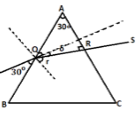
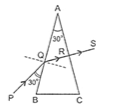
In the diagram, a prism of angle $30^{\circ}$ is used. $A$ ray $PQ$ is incident as shown. An emergent ray $RS$ emerges perpendicular to the second face. The angle of deviation is:
Image
  • A
    $60^{\circ}$
  • B
    $0^{\circ}$
  • $30^{\circ}$
  • D
    $45^{\circ}$
Answer
Correct option: C.
$30^{\circ}$
Image

In $\triangle AQR$
$\angle A +\angle Q +\angle R =180^{\circ}$
$30^{\circ}+90- r +90=180^{\circ}$
$r =30^{\circ}$
$\delta=90^{\circ}-30^{\circ}- r$
$\delta=90^{\circ}-30^{\circ}-30^{\circ}$
$\delta=30^{\circ}$
so angle of deviation is $30$ degree.
View full question & answer
MCQ 21 Mark
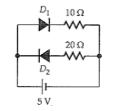
Two ideal diodes are connected to a battery as shown in the circuit. The current supplied by the battery is
Image
  • A
    zero
  • B
    0.5A
  • C
    0.75A
  • D
    0.25A
Answer
(b): 0.5 A
Explanation: Diode $D _1$ conducts as it is forward biased.
Diode $D _2$ does not conduct as it is reverse biased.
$\therefore I=\frac{5 V}{100}=0.5 A$

View full question & answer
MCQ 31 Mark
An electron is moving round the nucleus of a hydrogen atom in a circular orbit of radius r . The Coulomb force $\vec{F}$ between the two is:
  • A
    $\kappa \frac{e^2}{r^3} \vec{r}$
  • B
    $-\kappa \frac{e^2}{r^3} \vec{r}$
  • C
    $-\kappa \frac{e^3}{s^3} \hat{r}$
  • D
    $\kappa \frac{e^2}{n^3} \hat{r}$
Answer
(b): $-\kappa \frac{e^2}{r^3} \vec{r}$
Explanation: Charge on an electron = -e
Charge on nucleus of hydrogen = +e
$\therefore \vec{F}=\kappa \frac{(-e) \times e}{r^2} \hat{r}=-\frac{k e^2}{r^3} \vec{r}$
Here $\hat{r}=\frac{\vec{r}}{r}$ is unit vector along the line joining electron to the nucleus. The negative sign shows that the force is of attraction.
View full question & answer
MCQ 41 Mark
The wavefront of a distant source of unknown shape is approximately:
  • A
    plane
  • B
    elliptical
  • C
    cylindrical
  • D
    spherical
Answer
(a): plane
Explanation: When the point source or linear source of light is a very large distance, a small portion of the spherical or cylindrical wavefront appears to be plane. Such a wavefront is plane wavefront.
View full question & answer
MCQ 51 Mark
Which of the following has its permeability less than that of free space?
  • A
    Copper
  • B
    Nickel
  • C
    Copper chloride
  • D
    Aluminium
Answer
(a): Copper
Explanation: as Copper is diamagnetic substance.
View full question & answer
MCQ 61 Mark
For $\text{MRI}$, a patient is slowly pushed in a time of $10 s$ within the coils of the magnet where magnetic field is $B = 2.0 T$. If the patient's trunk is $0.8 m$ in circumference, the induced emf around the patient's trunk is
  • $10.18 \times 10^{-3} V$
  • B
    $10.18 \times 10^{-2} V$
  • C
    $1.51 \times 10^{-2} V$
  • D
    $9.66 \times 10^2 V$
Answer
Correct option: A.
$10.18 \times 10^{-3} V$
Change in magnetic field in $10 s=2.0 T$
As $\varepsilon=\frac{-d \phi}{d t}=-A \frac{d B}{d t} \quad(\because \phi=B A)$
Circumference of patient's trunk,
$2 \pi r=0.8 m \text { (given) }$
$\therefore r=\frac{0.8}{2 \pi} m=\frac{0.4}{\pi} m$
Area of cross-section,
$A=\pi r^2=\pi\left(\frac{0.4}{\pi}\right)^2=\frac{0.16}{\pi} m^2$
$\therefore|\varepsilon|=\frac{0.16}{\pi} \times \frac{2}{10} V$
$\approx 10.18 \times 10^3 V$
View full question & answer
MCQ 71 Mark
An electron is revolving around a proton in a circular orbit of diameter $0.1 \ nm$ . It produces a magnetic field of $14 Wb / m ^2$ at the proton. What is angular speed of the electron?
  • $4.4 \times 10^{16} rads ^{-1}$
  • B
    $8.8 \times 10^{16} rads ^{-1}$
  • C
    $6.4 \times 10^{16} rads ^{-1}$
  • D
    $1.4 \times 10^{16} rads ^{-1}$
Answer
Correct option: A.
$4.4 \times 10^{16} rads ^{-1}$
The revolving electron is similar to a loop carrying current. Field at the center of the loop of radius $r$ is $B=\frac{\mu_0 I}{2 r}$.
The current due to the revolving electron $I=\frac{B(2 r)}{10}=\frac{14 \times 0.1 \times 10^{-9}}{4 \times 10^{-7}}=\frac{7 \times 10^{-3}}{2 \pi}$
The current can also be written as, $I=\frac{e}{T}$
where, $T$ is the time taken to complete one revolution.
Since $T=\frac{2 \pi}{\omega}$ where $\omega$ is the angular speed of the electron,
$I=\frac{\epsilon}{T}=\frac{\epsilon \omega}{2 \pi}$
$\frac{\epsilon \omega}{2 \pi}=\frac{7 \times 10^{-3}}{2 \pi}$
$\omega=\frac{7 \times 10^{-3}}{\epsilon}=\frac{7 \times 10^{-3}}{1.5 \times 10^{-19}}$
$=4.38 \times 10^{16} \approx 4.4 \times 10^{16} rad / s $
View full question & answer
MCQ 81 Mark
The dimension of $\frac{1}{2} \varepsilon_0 E^2$ where $\varepsilon_0$ is the permittivity of free space and $E$ is the electric field, is
  • A
    $ML ^{-1} T^{-2}$
  • B
    $MLT ^{-1}$
  • C
    $ML ^2 T^{-2}$
  • D
    $ML ^2 T^{-1}$
Answer
(a): $ML ^{-1} T^{-2}$
Explanation: $\left[\frac{1}{2} \varepsilon_0 E^2\right]=$ energy density
$=\frac{ ML ^2 T^{-2}}{L^3}=\left[ ML ^{-1} T ^{-2}\right]$
View full question & answer
MCQ 91 Mark
How does the magnetic susceptibility $\chi$ of a paramagnetic material change with absolute temperature T?
  • A
    $\chi \propto e^T$
  • B
    $\chi \propto e^T$
  • C
    $\chi=$ constant
  • D
    $\chi \propto T^{-1}$
Answer
(d): $\chi \propto T^{-1}$
Explanation: $\chi \propto T^{-1}$
View full question & answer
MCQ 101 Mark
A biconvex lens of focal length f is cut into two identical plano convex lenses. The focal length of each part will be
  • A
    2f
  • B
    $\frac{f}{2}$
  • C
    4f
  • D
    f
Answer
(a): 2f
Explanation: The focal length of each part will be 2f
View full question & answer
MCQ 111 Mark
An electric bulb marked $40 W - 200 V$ is used in a circuit of supply voltage $100 V.$ Now its power is:
  • $10W$
  • B
    $40W$
  • C
    $20W$
  • D
    $100W$
Answer
Correct option: A.
$10W$
$P =\frac{V^2}{R}$
i.e., $P \propto V^2$
or $\frac{P_1}{P_2}=\frac{V_1^2}{V_2^2}$ or $\frac{40}{P_2}=\frac{(200)^2}{(100)^2}$
or $P _2=10 W$
View full question & answer
MCQ 121 Mark
The electrical conductivity of semiconductor increases when electromagnetic radiation of wavelength shorter than 2800 nm is incident on it. The band gap in (eV) for the semiconductor is:
  • A
    0.5 eV
  • B
    0.7 eV
  • C
    2.5 eV
  • D
    1.2 eV
Answer
(a): 0.5 eV
Explanation: $E_g=\frac{h c}{\lambda}=\frac{1240 eVnm }{2800 nm}=0.5 eV$
View full question & answer
M.C.Q (1 Marks) - Physics STD 12 Science Questions - Vidyadip