Questions · Page 4 of 5

M.C.Q

MCQ 1511 Mark
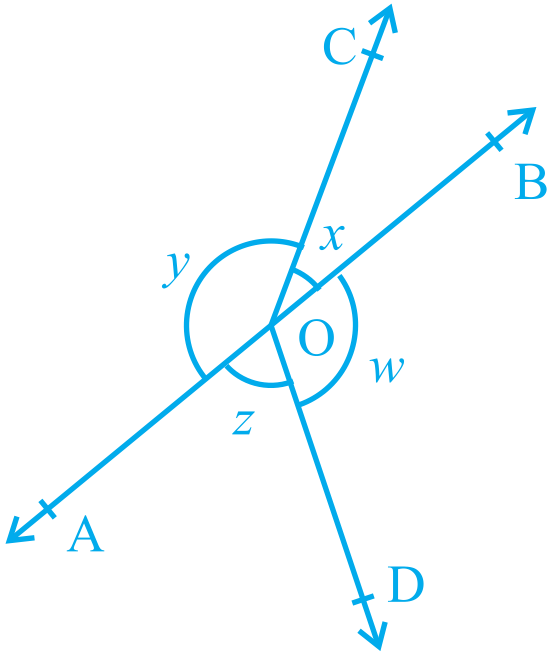
The measurement of Complete angle is:
  • A
    $180^\circ$
  • B
    $0^\circ$
  • $360^\circ$
  • D
    $90^\circ$
Answer
Correct option: C.
$360^\circ$

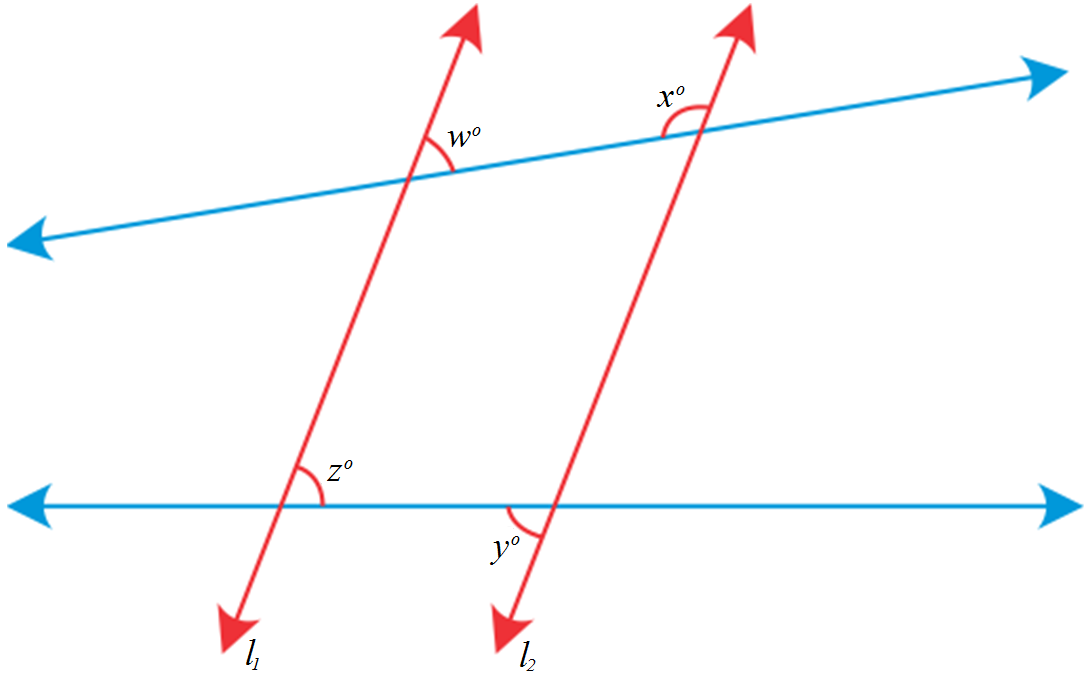
$x + y = 180^\circ $ (Linear Pair)
$w + z = 180^\circ $ (Linear Pair)
On adding above equations
We get, $x + y + w + z = 180^\circ + 180^\circ = 360^\circ $
Sum of all the angles around a point is $360^\circ .$
View full question & answer
MCQ 1521 Mark
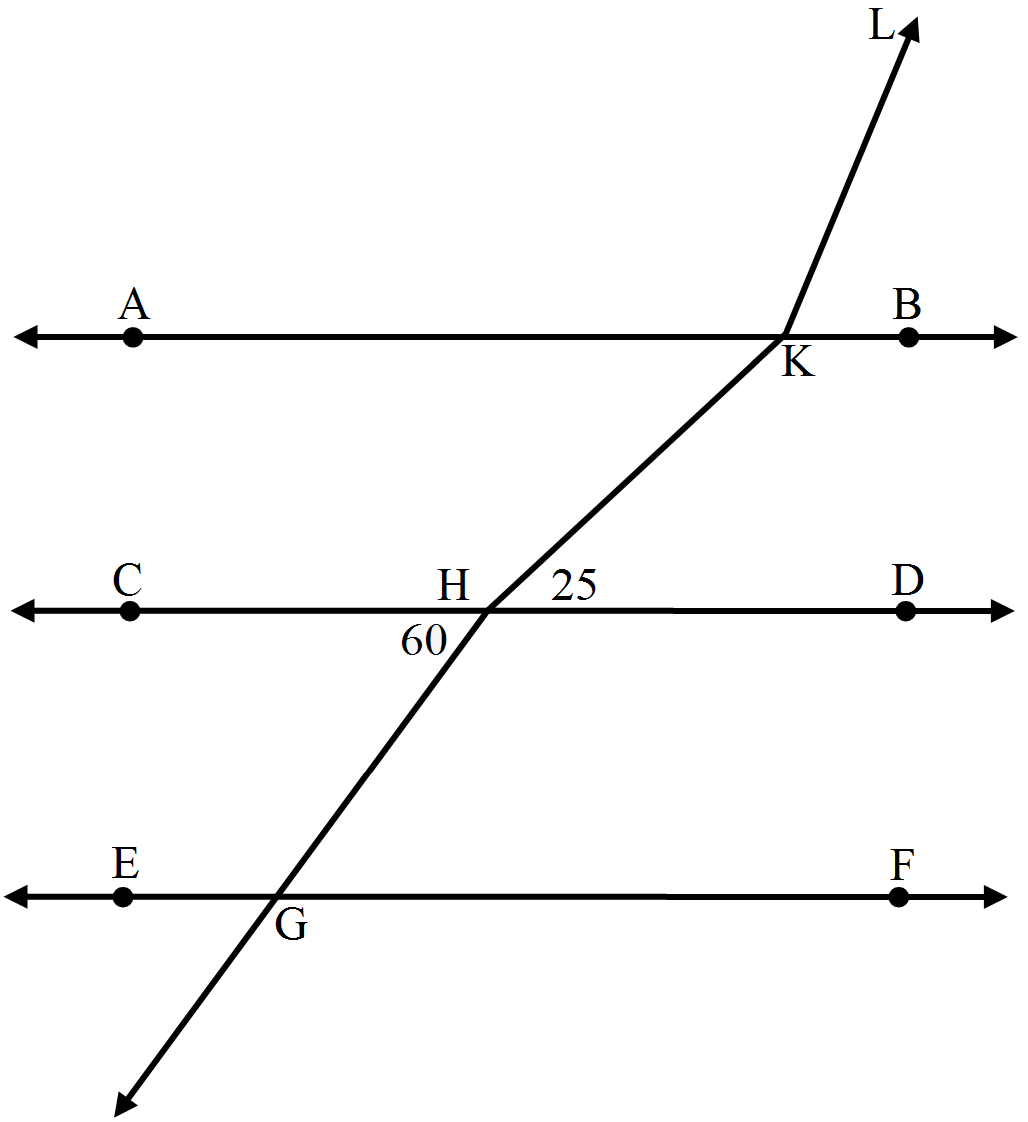
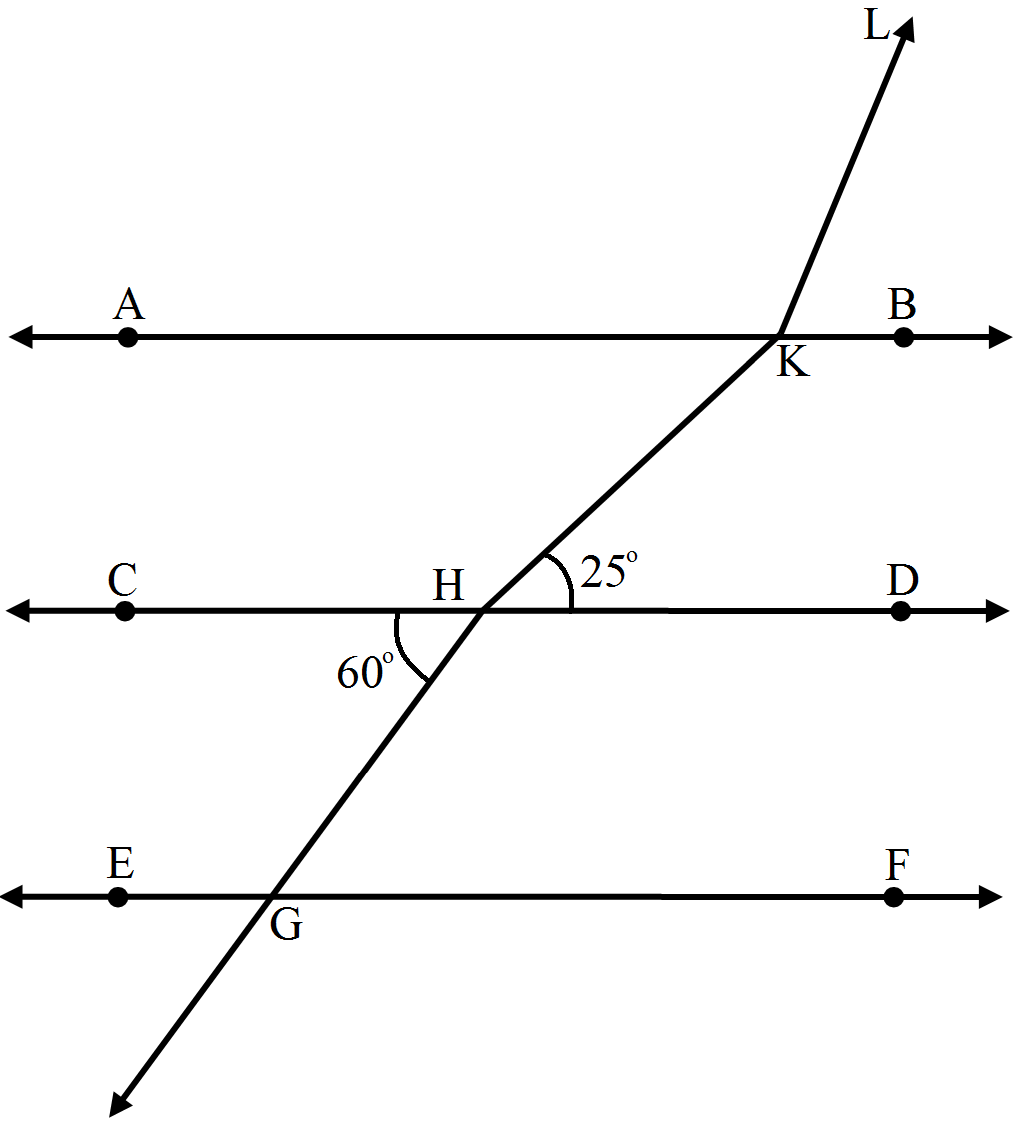
In figure, $AB \| CD \| EF$ and $GH \| KL.$ The measure of $\angle\text{HKL},$ is:
  • A
    $85^\circ$
  • B
    $135^\circ$
  • $145^\circ$
  • D
    $215^\circ$
Answer
Correct option: C.
$145^\circ$

$GH \| KL$
$\Rightarrow\ \angle\text{GHK}=\angle\text{HKL}$ [Interior opposite angles]
Now,
$\angle\text{GHK}=\angle\text{GHD}+\angle\text{DHR}$
$=(180^\circ-\angle\text{GHC})+\angle\text{DHK}$
[$\angle\text{GHC}$ and $\angle\text{GHD}$ are supplementary]
$=180^\circ-60^\circ+25^\circ$
$\Rightarrow\ \angle\text{GHK}=145^\circ$
$\Rightarrow\ \angle\text{HKL}=\angle\text{GHK}=145^\circ$
View full question & answer
MCQ 1531 Mark
In fig if $x = 30^\circ $ then $y =$
  • A
    $210^\circ$
  • B
    $180^\circ$
  • C
    $90^\circ$
  • $150^\circ$
Answer
Correct option: D.
$150^\circ$
$x + y = 180^\circ $ (linear pair)
$x = 30^\circ$
$30^\circ + y = 180^\circ$
$y = 180^\circ - 30^\circ$
$y = 150^\circ .$
View full question & answer
MCQ 1541 Mark
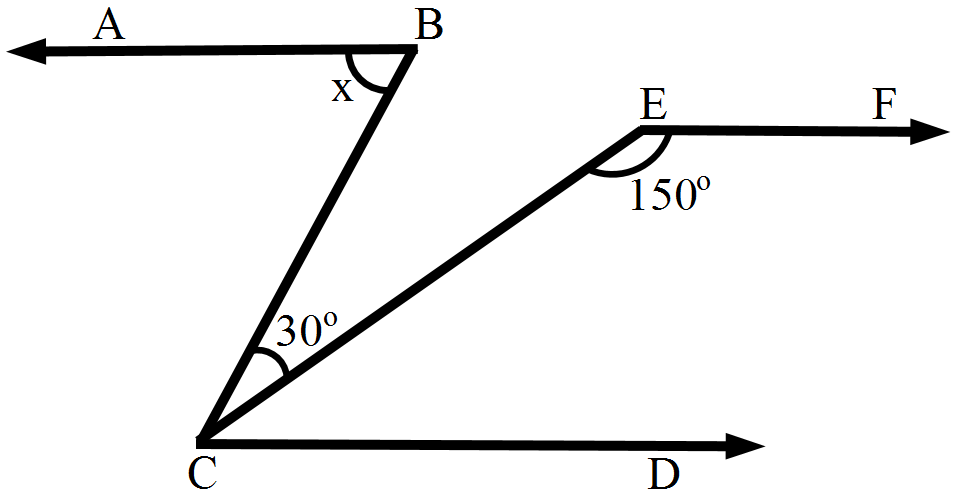
In the adjoining figure, $\text{AB}\parallel\text{CD}$ and $\text{AB}\parallel\text{EF}$ The value of $x$ is:
  • A
    $70^\circ$
  • B
    $40^\circ$
  • $60^\circ$
  • D
    $50^\circ$
Answer
Correct option: C.
$60^\circ$
$\angle\text{FEC}+\angle\text{ECD}=180^\circ$ (sum of 2 supplimentary angles is 180°)
$\angle\text{FEC}+\angle180^\circ-150^\circ=30^\circ$
$\angle\text{X}=\angle\text{BCE}=\angle\text{ECD}$
$\angle\text{X}=30^\circ+30^\circ=60^\circ$
View full question & answer
MCQ 1551 Mark
Two complementary angles are such that two times the measure of one is equal to three times the measure of the other. The measure of the smaller angle is:
  • A
    $45^\circ$
  • B
    $30^\circ$
  • $36^\circ$
  • D
    None of these
Answer
Correct option: C.
$36^\circ$
Let one angle be $\theta$
Then, its complementary $=90-\theta$
According to question,
$2\theta=3(90-\theta)$
$=5\theta=270$
$\theta=54^\circ$
Then, $90-\theta^\circ=36^\circ$
Hence, the smaller angle is $36^\circ .$
View full question & answer
MCQ 1561 Mark
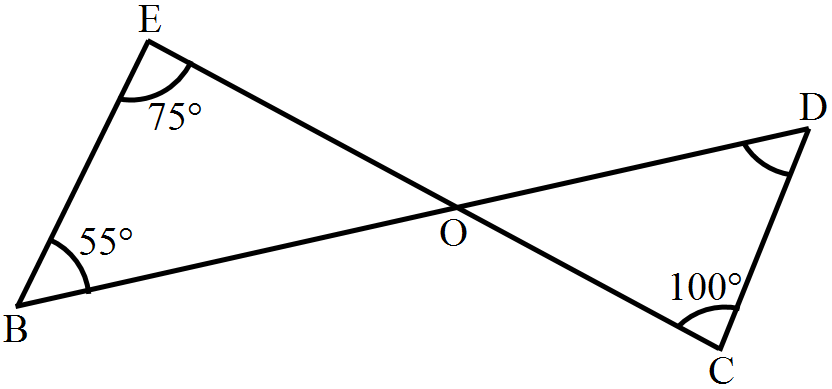
In the given figure, $\angle\text{OEB}=75^\circ,\angle\text{OBE}=55^\circ$ and $\angle\text{OCD}=100^\circ.$ Then $\angle\text{ODC}=?$
  • A
    $25^\circ$
  • $30^\circ$
  • C
    $35^\circ$
  • D
    $20^\circ$
Answer
Correct option: B.
$30^\circ$
In $\triangle\text{OEB}$
$\angle\text{OEB}+\angle\text{EBO}+\angle\text{BOE}=180^\circ$ (Angle sum property)
$75^\circ+55^\circ+\angle\text{BOE}=180^\circ$
$\angle\text{BOE}=50^\circ$
$\angle\text{BOE}=\angle\text{COD}=50^\circ$ (Vertically opposite angle)
In $\triangle\text{ODC}$
$\angle\text{ODC}+\angle\text{DOC}+\angle\text{DCO}=180^\circ$
$\angle\text{ODC}=180^\circ-100^\circ-50^\circ$
$\angle\text{ODC}=30^\circ.$
View full question & answer
MCQ 1571 Mark
An exterior angle of a triangle is $105^\circ $ and its two interior opposite angles are equal. Each of these equal angles is:
  • A
    $37\frac{1}{2}^\circ$
  • $52\frac{1}{2}^\circ$
  • C
    $75^\circ$
  • D
    $72\frac{1}{2}^\circ$
Answer
Correct option: B.
$52\frac{1}{2}^\circ$
Let one of interior angle be $x^\circ $
Sum of two opposite interior angles = Exterior angle
$\therefore x^\circ + x^\circ = 105^\circ $ [ $\therefore$ Exterior angle $= 105^\circ$ (given)]
$\Rightarrow2\text{x}^\circ=105^\circ$
$\therefore\text{x}^\circ=\frac{105^\circ}{2}$
$\Rightarrow\text{x}^\circ=52\frac{1}{2}$
Hence, each angle of a triangle is $52\frac{1}{2}^\circ.$
View full question & answer
MCQ 1581 Mark
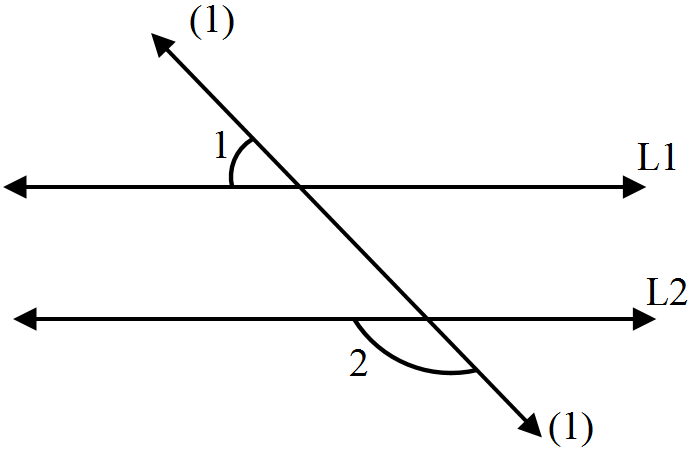
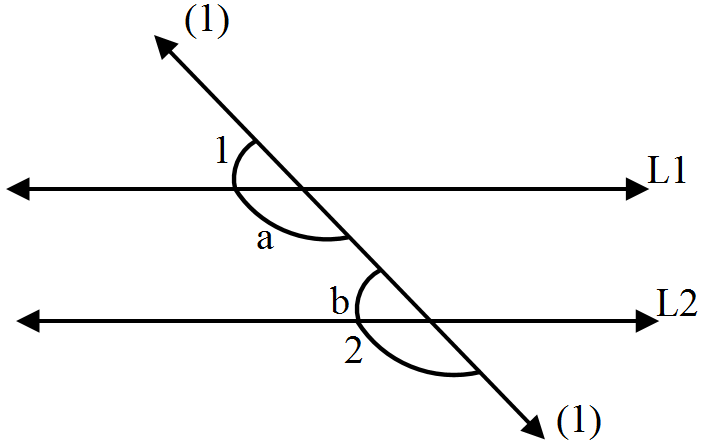
In the given figure $L1 \| L2$ and $\angle1=520.$ Find the measure of $\angle2:$
  • A
    $38^\circ$
  • B
    $48^\circ$
  • $128^\circ$
  • D
    $52^\circ$
Answer
Correct option: C.
$128^\circ$

$\angle1+\angle\text{a}=180^\circ$
$\angle1=52^\circ$
$52^\circ+\angle\text{a}=180^\circ$
$\angle\text{a}=180^\circ-52^\circ$
$\angle\text{a}=128^\circ$
$\angle\text{a}=\angle2$ (Corresponding angles)
Therefore $\angle2=128^\circ.$
View full question & answer
MCQ 1591 Mark
An exterior angle of a triangle is $110^\circ $ and its two interior opposite angles are equal. Each of these equal angles is:
  • A
    $70^\circ$
  • B
    $35^\circ$
  • $55^\circ$
  • D
    $27\frac{1}{2}^\circ$
Answer
Correct option: C.
$55^\circ$
Let the measure of each of the two equal interior opposite angles of the triangle be $x.$
In a triangle, the exterior angle is equal to the sum of the two interior opposite angles.
$\therefore$ $x + x = 110^\circ$
$\Rightarrow 2x = 110^\circ$
$\Rightarrow x = 55^\circ$
Thus, the measure of each of these equal angles is $55^\circ .$
View full question & answer
MCQ 1601 Mark
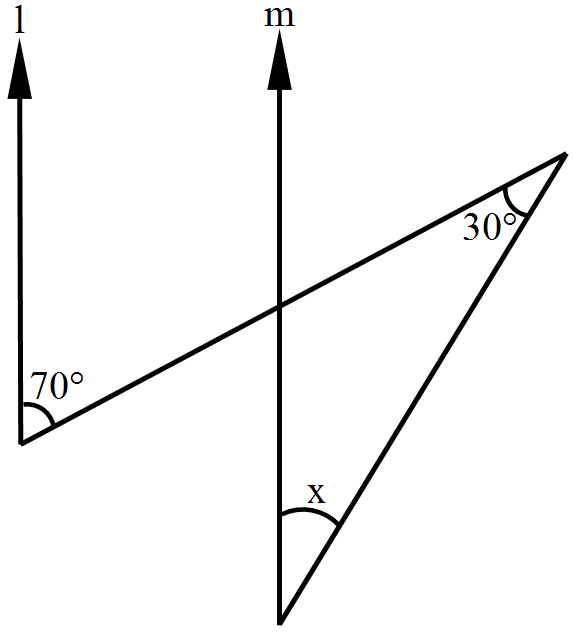
In Fig., if lines $l$ and $m$ are parallel lines, then $x =$
  • A
    $70^{\circ}$
  • $40^{\circ}$
  • C
    $100^{\circ}$
  • D
    $30^{\circ}$
Answer
Correct option: B.
$40^{\circ}$
Given that,
$l \| m$
Let, $l \| m$ and transversal cuts them and
$​​\angle1=70^\circ$
$​\angle3=20^\circ$
$​\angle4=30^\circ$
$​\angle1+​\angle2=180^\circ$ (Interior angle)
$​\angle2=110^\circ\text{(i})$
$\angle​​2=\angle​​5$ (Vertically opposite angle)
$​\angle5=110^\circ\text{(ii)}$
$​\angle5+​\angle3+​\angle4=180^\circ$(Sum of angles of a triangle is $180^{\circ}$)
$110^{\circ} + x + 30^{\circ} = 180^{\circ}$
$x = 40^{\circ}$.
View full question & answer
MCQ 1611 Mark
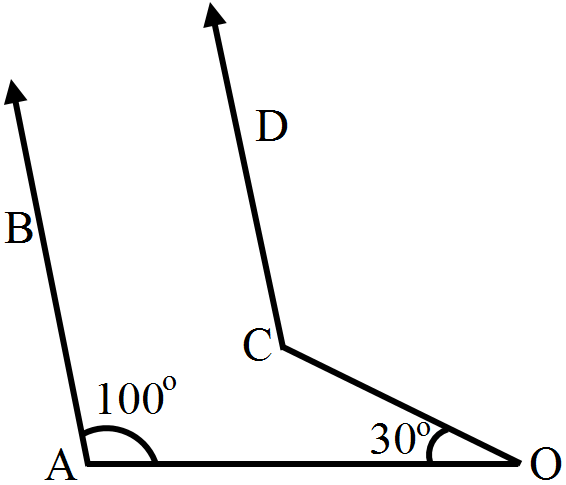
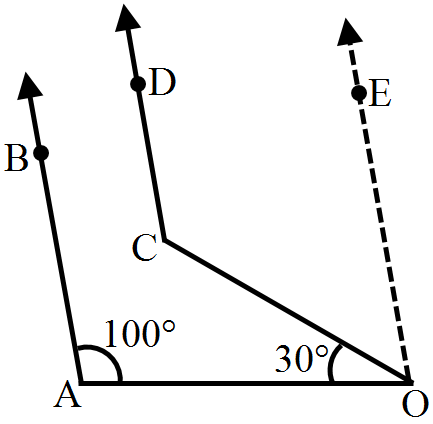
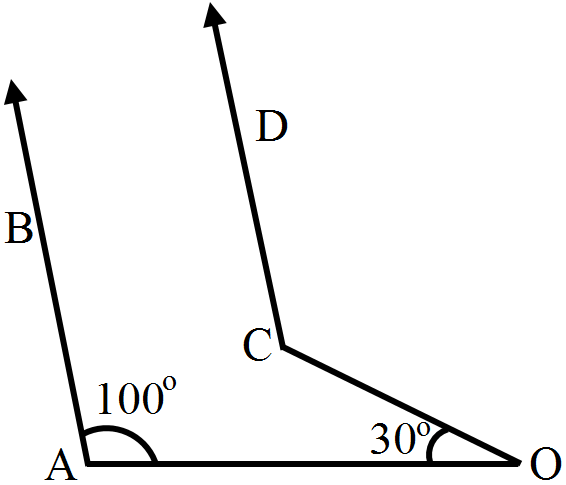
In the given figure, $AB \| CD$. If $\text{AOC}=30^\circ$ and $\angle\text{OAB}=100^\circ$ then $\angle\text{OCD}=?$
  • A
    $150^\circ$
  • B
    $80^\circ$
  • $130^\circ$
  • D
    $100^\circ$
Answer
Correct option: C.
$130^\circ$

Draw $OE \| AB \| CD$
Now, $OE \| AB$ and $OA$ is the transversal.
$\therefore\angle\text{OAB}+\angle\text{AOE}=180^\circ$ [Angles on the same side of a transversal line are supplementary]
$\Rightarrow\angle\text{OAB}+\angle\text{AOC}+\angle\text{COE}=180^\circ$
$\Rightarrow100^\circ+30^\circ+\angle\text{COE}=180^\circ$
$\Rightarrow\angle\text{COE}=50^\circ$
Also,
$OE \| CD$ and $OC$ is the transversal.
$\therefore\angle\text{OCD}+\angle\text{COE}=180^\circ$ [Angles on the same side of a transversal line are supplementary]
$\Rightarrow\angle\text{OCD}+50^\circ=180^\circ$
$\Rightarrow\angle\text{OCD}=130^\circ.$
View full question & answer
MCQ 1621 Mark
Write the correct answer in the following: If one of the angles of a triangle is $130^\circ $, then the angle between the bisectors of the other two angles can be.
  • A
    $50^\circ$
  • B
    $65^\circ$
  • C
    $145^\circ$
  • $155^\circ$
Answer
Correct option: D.
$155^\circ$
In $\Delta\text{ABC},$ we have $\angle\text{A}=130^\circ$OB and $OC$ are the bisectors of the angles $B$ and $C.$
Let $\angle\text{OBC}=\angle\text{OBA}=\text{x}\ \text{and}\angle\text{OCB}=\angle\text{OCA}=\text{y}$
In $\Delta\text{ABC},$
$\angle\text{A}+\angle\text{B}+\angle\text{C}=180^\circ$
$\Rightarrow130^\circ+2\text{x}+2\text{y}=180^\circ$
$\Rightarrow\text{x}+\text{y}=25^\circ$
$\text{i.e}\angle\text{OBC}+\angle\text{OCB}=25^\circ$
Now, In $\Delta\text{BOC}$
$\angle\text{BOC}=180^\circ-\big(\angle\text{OBC}+\angle\text{OCB}\big)$ (Angle sum Property)
$=180^\circ-25^\circ=155^\circ$
Hence, $(d)$ is the correct answer.
View full question & answer
MCQ 1631 Mark
Consider the following statement:When two straight lines intersect:
$i$. Adjacent angles are complementary
$ii$. Adjacent angles are supplementary
$iii$. Opposite angles are equal
$iv$. Opposite angles are supplementary
Of these statements
  • A
    $(i)$ and $(ii)$ are correct
  • $(ii)$ and $(iii)$ are correct
  • C
    $(i)$ and $(iv)$ are correct
  • D
    $(ii)$ and $(iv)$ are correct
Answer
Correct option: B.
$(ii)$ and $(iii)$ are correct

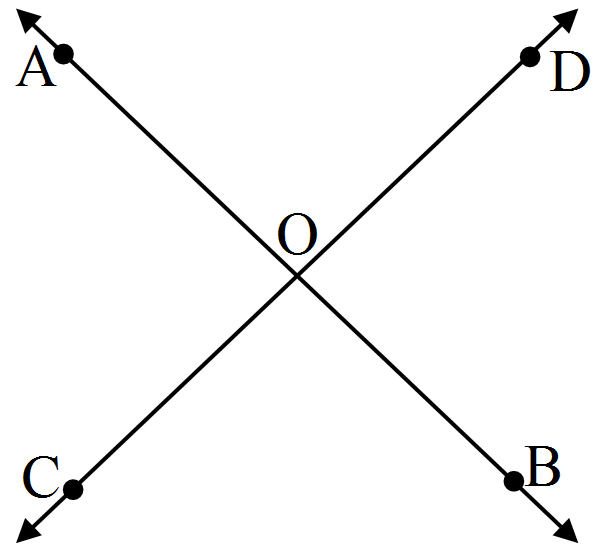
Let two lines $AB$ and $CD$ intersect each other at $O.$
Now,
We can see from fogure any two adjacent angles
$\angle\text{AOD}$ and $\angle\text{DOB},\angle\text{DOB}$ and $\angle\text{BOC}$ etc are supplementary because their sum is $180^\circ .$
$\angle\text{AOD}+\angle\text{DOB}=180^\circ$
$\angle\text{DOB}+\angle\text{BOC}=180^\circ$
So two adjacent angles are always supplementary.
Now,
Two opposite angle like $\angle\text{AOC}$ and $\angle\text{DOB},\angle\text{AOD}$ and $\angle\text{COB}$ are always equal to each other as they are vertically opposite angles
$\angle\text{AOC}=\angle\text{DOB}$
$\angle\text{AOD}=\angle\text{COB}$
Hence statement $(ii)$ and $(iii)$ are correct.
View full question & answer
MCQ 1641 Mark
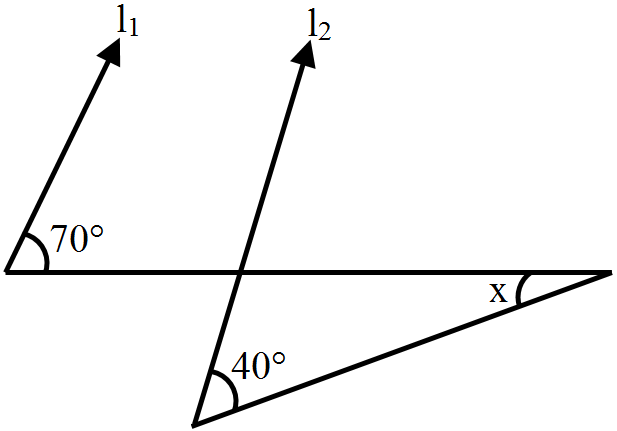
In figure, lines $I_1 \| I_2$. The value of $x$ is:
  • A
    $40^{\circ}$
  • $30^{\circ}$
  • C
    $50^{\circ}$
  • D
    $70^{\circ}$
Answer
Correct option: B.
$30^{\circ}$
40$^{\circ}$ + x = 70$^{\circ}$ (exterior angle)
$\angle\text{x}=70^\circ-40^\circ$
$\angle\text{x}=30^\circ.$
View full question & answer
MCQ 1651 Mark
Write the correct answer in the following: If one angle of a triangle is equal to the sum of the other two angles, then the triangle is.
  • A
    An isosceles triangle.
  • B
    An obtuse triangle.
  • C
    An equilateral triangle.
  • An equilateral triangle.
Answer
Correct option: D.
An equilateral triangle.
Let the angles of $\Delta\text{ABC}\ \text{be}\ \angle\text{A},\angle\text{B}\ \text{and}\ \angle\text{C}$
Given that $\angle\text{A}=\angle\text{B}+\angle\text{C}.....(1)$
But, in any $\Delta\text{ABC},\angle\text{A}+\angle\text{B}+\angle\text{C}=180^\circ....(2)$[Angles sum property of triangle]
From equation (1) and (2), we get
$\angle\text{A}+\angle\text{A}=180^\circ\Rightarrow2\angle\text{A}=180^\circ\Rightarrow\angle\text{A}\frac{180^\circ}{2}=90^\circ$
$\Rightarrow\angle\text{A}=90^\circ$
Hence, the triangle is a right triangle and option $(d)$ is correct.
View full question & answer
MCQ 1661 Mark
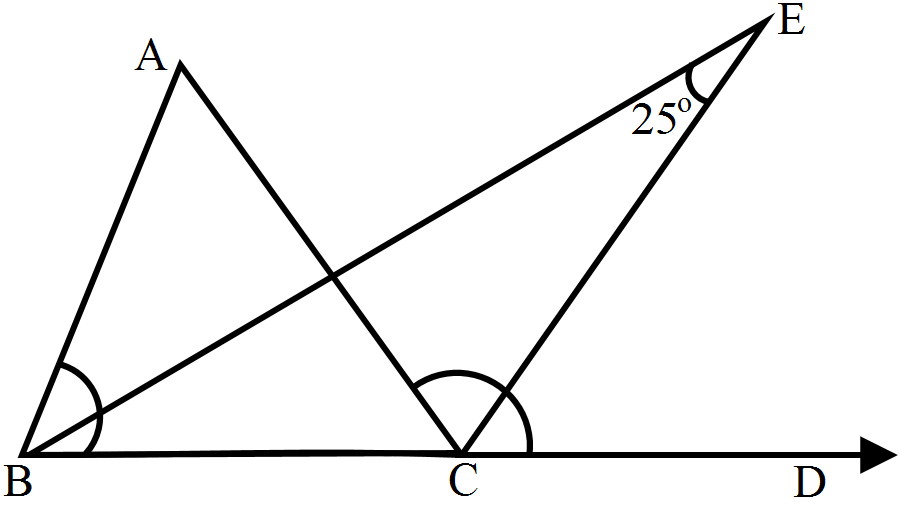
In the adjoining figure, $BE$ and $CE$ are bisectors of $\angle\text{ABC}$ and $\angle\text{ACD}$ respectively. If $\angle\text{BEC}=25^\circ$ then $\angle\text{BAC}$ is equal to :
  • $50^\circ$
  • B
    $25\frac{1}{2}^0$
  • C
    $65^\circ$
  • D
    $12\frac{1}{2}^0$
Answer
Correct option: A.
$50^\circ$
In $\triangle\text{BEC}$
$\angle\text{BEC}+\angle\text{EBC}+\angle\text{ECD}$ (Exterior angle property)
$\angle\text{BEC}=\angle\text{ECD}-\angle\text{EBC}$
In $\triangle\text{ABC}$
$\angle\text{ABC}+\angle\text{BAC}=\angle\text{ACD}$
$\angle\text{ABC}+2\angle\text{EBC}=2\angle\text{ECD}$
$\angle\text{ABC}=2(\angle\text{ECD}-\angle\text{EBC})$
$\angle\text{ABC}=2(\angle(\text{BEC}))$
$\angle\text{ABC}=50^\circ$
View full question & answer
MCQ 1671 Mark
Two complementary angles are such that twich the measure of the one is equal to three times the measure of the other. The larger of the two measure.
  • A
    $72^\circ$
  • $54^\circ$
  • C
    $63^\circ$
  • D
    $36^\circ$
Answer
Correct option: B.
$54^\circ$
Let the measure of each angle be $x^\circ $ and $(90 - x)^\circ .$
According to the given condition,
$2x = 3(90 - x)$
$\Rightarrow 2x = 270 - 3x$
$\Rightarrow 5x = 270$
$\Rightarrow x = 54^\circ$
So,$ (90 - x)^\circ = (90 - 54)^\circ = 36^\circ$
So, the larger of the two angles is $54^\circ .$
View full question & answer
MCQ 1681 Mark
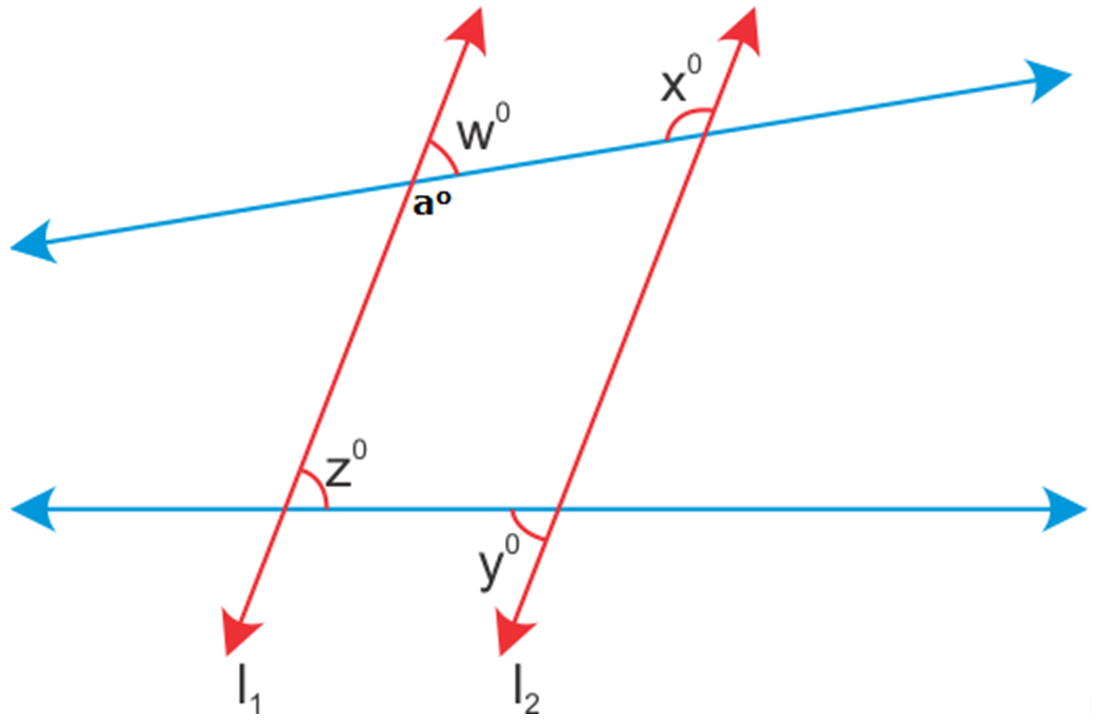
In figure, if $I_1 \| I_2$, what is $x + y$ in terms of w and $z?$
  • $180 - w + z$
  • B
    $180 + w - z$
  • C
    $180 - w - z$
  • D
    $180 + w + z$
Answer
Correct option: A.
$180 - w + z$

Let angle supplement of $w^{\circ}$ be $a^{\circ}$.
$\Rightarrow \mathrm{a}^{\circ}=180^{\circ}-\mathrm{w}^{\circ}$
Now,
$a^{\circ}=x^{\circ} \text { [Alternate opposite angles] }$
$\Rightarrow x^{\circ}=180-w^{\circ} \ldots(1)$
Now,
$y^{\circ}=z^{\circ} \ldots \text { (2) [Alternate angles] }$
Adding $(1)$ and $(2)$, we get
$x^{\circ}+y^{\circ}=180^{\circ}-w^{\circ}+z^{\circ}$
 
View full question & answer
MCQ 1691 Mark
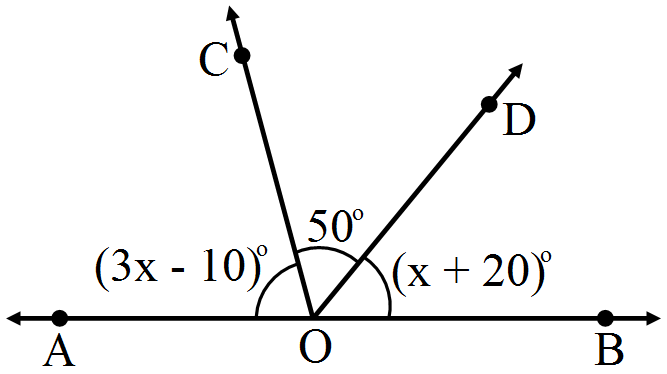
In the given figure, $AOB$ is a straight line. If $\angle\text{AOC}=(3\text{x}-10)^\circ,\angle\text{COD}=50^\circ$ and $\angle\text{BOD}=(\text{x}+20)^\circ$ then $\angle\text{AOC}=?$
  • A
    $40^\circ$
  • B
    $60^\circ$
  • $80^\circ$
  • D
    $50^\circ$
Answer
Correct option: C.
$80^\circ$
Since $AOB$ is a straight line,
$\angle\text{AOC}+\angle\text{COD}+\angle\text{BOD}=180^\circ$
$\Rightarrow(3\text{x}-10)+50+(\text{x}+20)=180^\circ$
$\Rightarrow4\text{x}+60=180$
$\Rightarrow4\text{x}=120$
$\Rightarrow\text{x}=30$
So, $\angle\text{AOC}=3\text{x}-10=3(30)-10=80^\circ$
View full question & answer
MCQ 1701 Mark
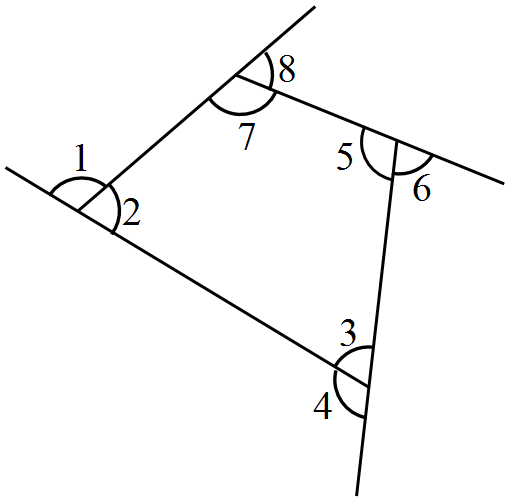
The sides of a quadrilateral are extended in order to form 4 exterior angles. The sum of these exterior angles is:
  • $360^\circ$
  • B
    $180^\circ$
  • C
    $720^\circ$
  • D
    $90^\circ$
Answer
Correct option: A.
$360^\circ$

As seen from the above figure:
$\angle1+\angle2=180^\circ$ (Linear Pair)
Similarly $\angle3+\angle4=180=\angle5+\angle6=\angle7+\angle8=180^\circ$
Adding up all of the above
$\angle1+\angle2+\angle3+\angle4+\angle5+\angle6+\angle7+\angle8=180\times4=720^\circ $
But we know that the angles of a quadrilateral add up to $360^\circ$
Therefore $\angle2+\angle3+\angle5+\angle7=360^\circ$
Substituting in the above equation we get:
$\angle1+\angle4+\angle6+\angle8+360^\circ=720^\circ$
Therefore $\angle1+\angle4+\angle6+\angle8=360^\circ$
Hence the sum of all exterior angles $= 360^\circ .$
View full question & answer
MCQ 1711 Mark
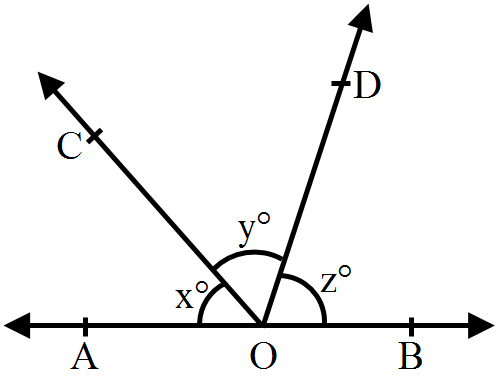
In the adjoining figure, $AOB$ is a straight line. If $x : y : z = 4 : 5 : 6$, then $y =?$
  • A
    $72^{\circ}$
  • $60^{\circ}$
  • C
    $48^{\circ}$
  • D
    $80^{\circ}$
Answer
Correct option: B.
$60^{\circ}$
Let $\angle\text{AOC}=\text{x}^\circ=(4\text{a})^\circ,\angle\text{COD}=\text{y}^\circ=(5\text{a})^\circ$ and $\angle\text{BOD}=\text{z}^\circ=(6\text{a})^\circ$
Then, we have
$\angle\text{AOC}+\angle\text{COD}+\angle\text{BOD}=180^\circ$ [Since $AOB$ is a straight line]
$\Rightarrow 4a + 5a + 6a= 180^{\circ}$
$\Rightarrow 15a = 180^{\circ}$
$\Rightarrow a = 12^{\circ}$
$\therefore y = 5 \times a = 5 \times 12^\circ = 60^{\circ}$.
View full question & answer
MCQ 1721 Mark
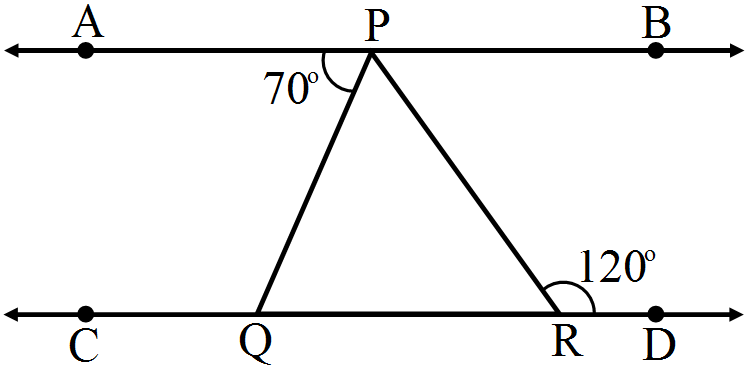
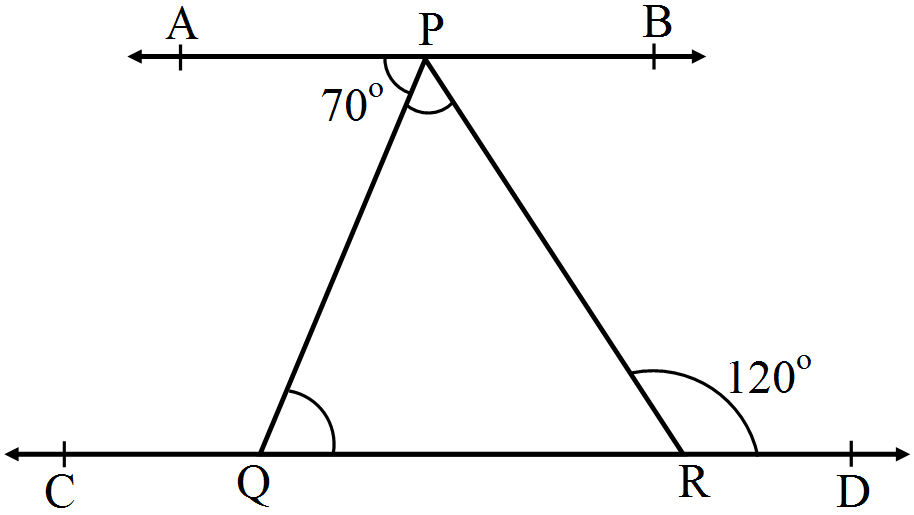
In the figure, $AB \| CD$. If $\angle\text{APQ}=70 ^\circ$ and $\angle\text{PRD}=120^\circ$ then $\angle\text{QPR}=?$
  • $55^\circ$
  • B
    $60^\circ$
  • C
    $40^\circ$
  • D
    $35^\circ$
Answer
Correct option: A.
$55^\circ$

Since $AB \| CD,$
$\angle\text{APQ}=\angle\text{PQR}=70^\circ$ (Alternate angles)
$\Rightarrow\angle\text{PRD}=\angle\text{PQR}+\angle\text{QPR}$ (Exterior angle is equal to sum of the remote interior angles)
$\Rightarrow120^\circ=70^\circ+\angle\text{QPR}$
$\Rightarrow\angle\text{QPR}=506^\circ$
View full question & answer
MCQ 1731 Mark
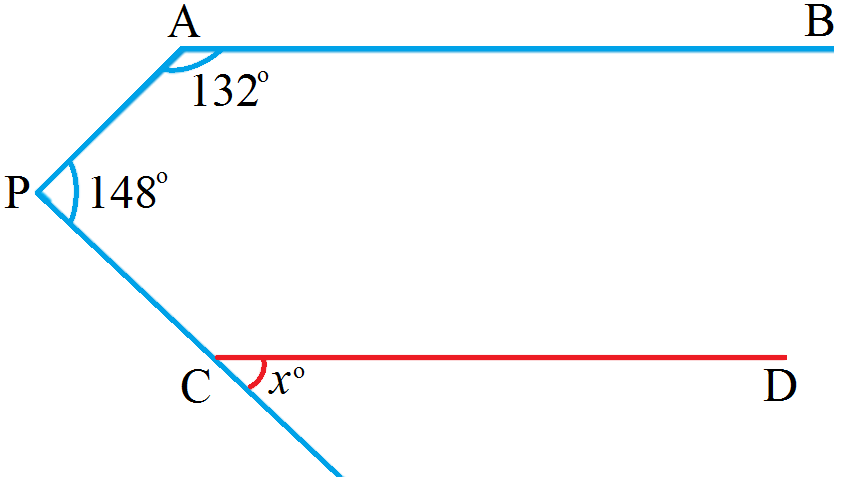
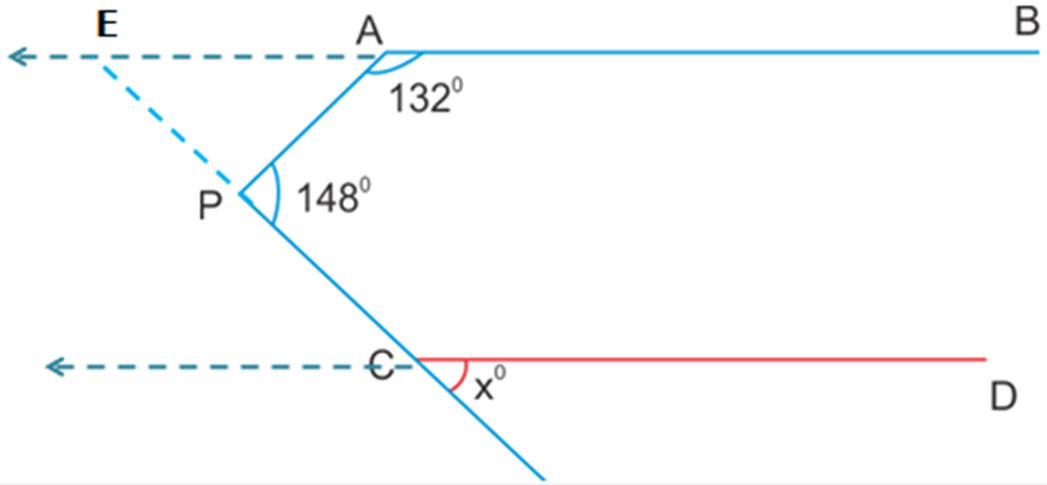
In figure, if $AB \| CD$, then $x =$
  • $100$
  • B
    $105$
  • C
    $110$
  • D
    $114$
Answer
Correct option: A.
$100$

Extending line $BA$ and $CP$ to meet at point $E.$
$\angle\text{APE}=180^\circ-148^\circ=32^\circ$
$\angle\text{EAP}=180^\circ-132^\circ=48^\circ$
$\angle\text{AEP}=\text{x}^\circ$ [(Correspondence angles) because $AB \| CD$ cut by transverse $EC]$
Now, in $\triangle\text{APE}$
$\angle\text{APE}+\angle\text{EAP}+\angle\text{AEP}=180^\circ$
$\Rightarrow\ 32^\circ+48^\circ+\text{x}^\circ=180^\circ$
$\Rightarrow\ \text{x}^\circ=100$
View full question & answer
MCQ 1741 Mark
One angle is equal to three times its supplement. The measure of the angle is:
  • A
    $130^\circ$
  • $135^\circ$
  • C
    $90^\circ$
  • D
    $120^\circ$
Answer
Correct option: B.
$135^\circ$
Let the required angle be ${\theta}.$
Then, measure of its supplement $180^\circ-\theta$
According to question, we have
$\theta=3(180-\theta)$
$\Rightarrow\ \theta=540^\circ-3\theta$
$\Rightarrow\ 4\theta=540^\circ $
$\Rightarrow\ \theta=135^\circ$
View full question & answer
MCQ 1751 Mark
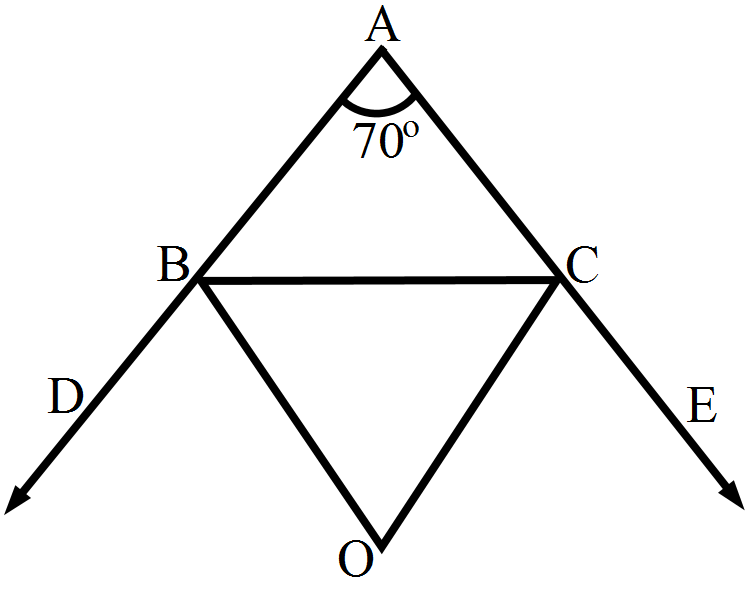
In the adjoining figure, the bisectors of $\angle\text{CBD}$ and $\angle\text{BCE}$ meet at the point O. If $\angle\text{BAC}=70^\circ$ then $\angle\text{BOC}$ is equal to:
  • A
    $11^\circ$
  • $55^\circ$
  • C
    $70^\circ$
  • D
    $35^\circ$
Answer
Correct option: B.
$55^\circ$
$\angle\text{BOC}=90^\circ-\frac{1}{2 }\angle\text{BAC}$
$\angle\text{BOC}=90^\circ-35^\circ=55^\circ$
View full question & answer
MCQ 1761 Mark
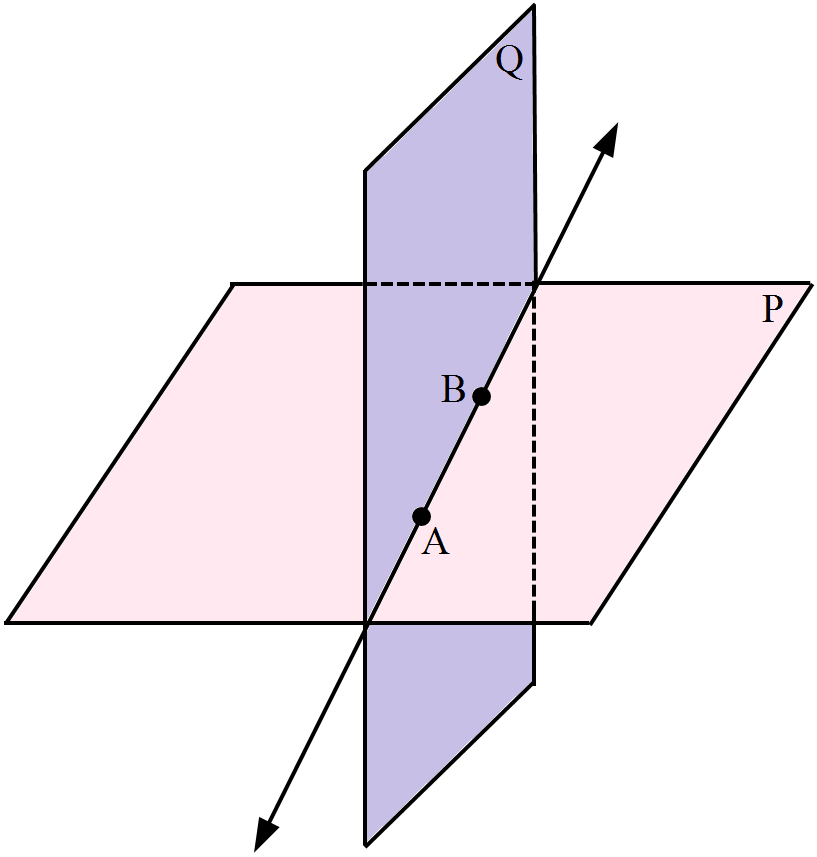
Two planes intersect each other to form a:
  • A
    Plane.
  • B
    Point.
  • C
    Angle.
  • Straight line.
Answer
Correct option: D.
Straight line.

As can be seen from the above diagram, the two planes $"P"$ and $"Q"$ are intersecting in a line, which is $AB.$
View full question & answer
MCQ 1771 Mark
In the given figure, $AB \I CD$. If $\angle\text{AOC}=30^\circ$ and $\angle\text{OAB}=100^\circ.$ then $\angle\text{OCD}=?$
  • $80^\circ$
  • B
    $100^\circ$
  • C
    $130^\circ$
  • D
    $150^\circ$
Answer
Correct option: A.
$80^\circ$
Extend line $CD$ which intersect $AO$ at $M.$
(Corresponding angle)
$\angle\text{MOC}+\angle\text{CMO}=\angle\text{DCO}$ (exterior angle is equal to the sum of two opposite interior angles)
$\angle\text{DCO}=100^\circ+30^\circ=130^\circ$
View full question & answer
MCQ 1781 Mark
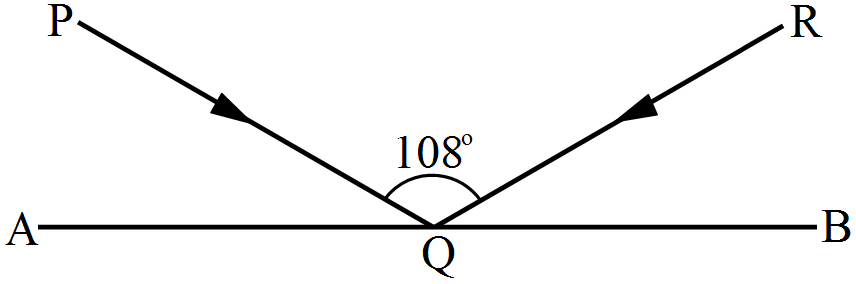
In the given figure, $AB$ is a mirror, $PQ$ is the incident ray and $QR$ is the reflected ray. If $\angle\text{PQR}=108^\circ$ then $\angle\text{AQP}=?$
  • A
    $72^\circ$
  • B
    $18^\circ$
  • $36^\circ$
  • D
    $54^\circ$
Answer
Correct option: C.
$36^\circ$
We know that, angle of incidance = angle reflection.
that is, $\angle\text{AQP}=\angle\text{BQR}$
Since $AOB$ is a straight line,
$\angle\text{AQP}+\angle\text{BQR}+\angle\text{PQR}=180^\circ$
$\Rightarrow\angle\text{AQP}+\angle\text{AQP}+\angle\text{PQR}=180^\circ$
$\Rightarrow2\angle\text{AQP}=72$
$\Rightarrow \angle\text{AQP}=36^\circ$
View full question & answer
MCQ 1791 Mark
Measurement of reflex angle is:
  • A
    Between $0^\circ $ and $90^\circ $
  • B
    $90^\circ$
  • Between $180^\circ $ and $360^\circ $
  • D
    Between $90^\circ $ and $180^\circ $
Answer
Correct option: C.
Between $180^\circ $ and $360^\circ $
Let $x$ be the angle
then its reflex angle is $360^\circ - x$
and in any triangle the angle lies between $0$ to $180^\circ $
View full question & answer
MCQ 1801 Mark
One angle is equal to three times its supplement. The measure of the angle is:
  • A
    $130^\circ$
  • B
    $120^\circ$
  • $135^\circ$
  • D
    $90^\circ$
Answer
Correct option: C.
$135^\circ$
Let the required angle be $x$
Supplement $= 180^\circ - x$
According to question,
$x = 3 (180^\circ - x)$
$x = 540^\circ - 3x$
$x = 135^\circ .$
View full question & answer
MCQ 1811 Mark
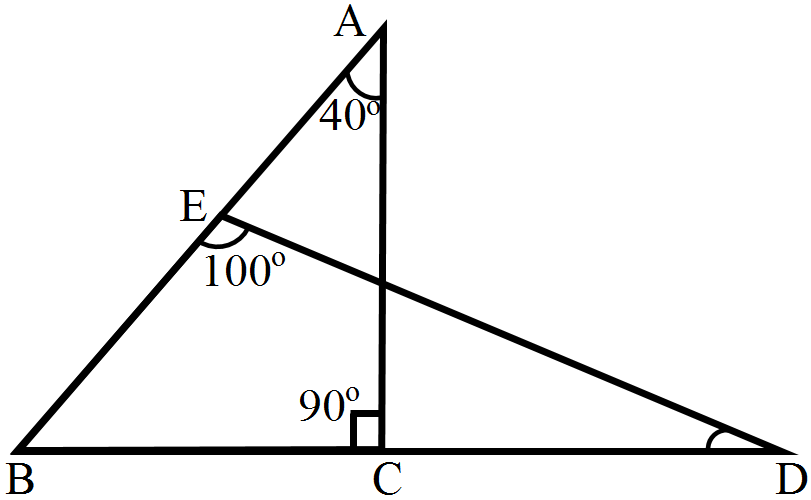
In the given figure, $\angle\text{BAC}=40^\circ,\angle\text{ACB}=90^\circ$ and $\angle\text{BED}=100^\circ$ Then $\angle\text{BDE}=?$
  • A
    $25^\circ$
  • B
    $40^\circ$
  • C
    $50^\circ$
  • $30^\circ$
Answer
Correct option: D.
$30^\circ$
In $\triangle\text{ABC}$
$\angle\text{ABC}+\angle\text{BAC}+\angle\text{ACB}=180^\circ$(Angle sum property)
$\angle\text{ABC}=180^\circ-90^\circ-40^\circ$
$\angle\text{ABC}=50^\circ$
In $\triangle\text{BED}$
$\angle\text{BED}+\angle\text{EBD}+\angle\text{BDE}=180^\circ$(Angle sum property)
$\angle\text{EBD}=180^\circ-50^\circ-100^\circ$
$\angle\text{EBD}=30^\circ$
View full question & answer
MCQ 1821 Mark
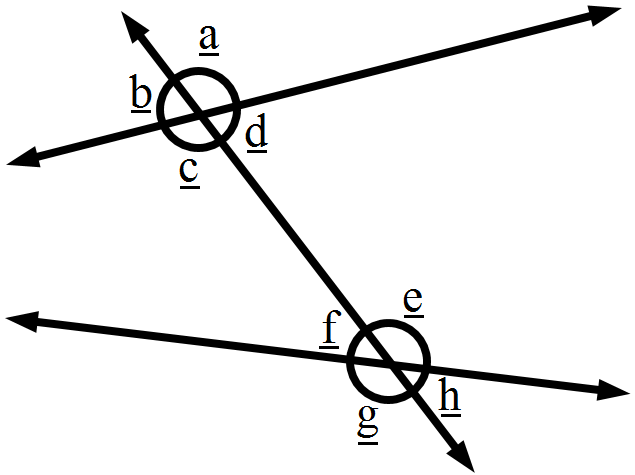
In the adjoining figure, $\angle\text{a}$ and $\angle\text{g}$ are called:
  • A
    Co-interior angles.
  • B
    Corresponding angles.
  • Alternate exterior angles.
  • D
    Alternate interior angles.
Answer
Correct option: C.
Alternate exterior angles.
$\angle\text{a}$ and $\angle\text{g}$ are on alternate side and are exterior.
View full question & answer
MCQ 1831 Mark
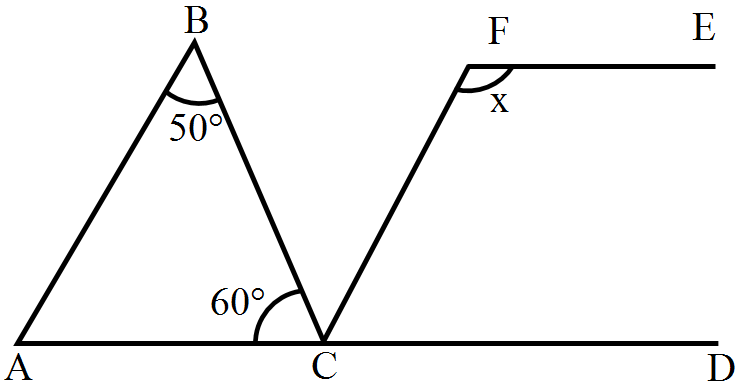
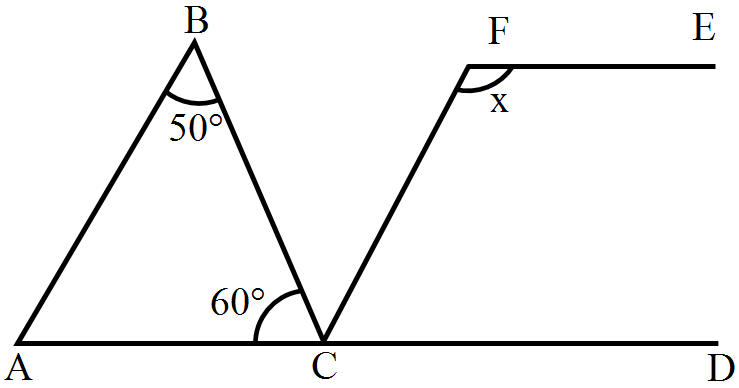
In figure, if $AB \| CF, CD \| EF$, then the value of $x$ is:
  • A
    $140^\circ$
  • B
    $120^\circ$
  • C
    $100^\circ$
  • $110^\circ$
Answer
Correct option: D.
$110^\circ$

In the above figure, $\angle\text{B}=\angle\text{BCF}$ (Alternate Interior angles)
Now $\angle\text{FCA}=\angle\text{BCA}+\angle\text{FCB}$
$= 60^\circ + 50^\circ = 110^\circ$
Now $\angle\text{FCA}=\angle\text{x} $ (Alternate interior angles)
Therefore $\angle\text{x}=110^\circ.$
View full question & answer
MCQ 1841 Mark
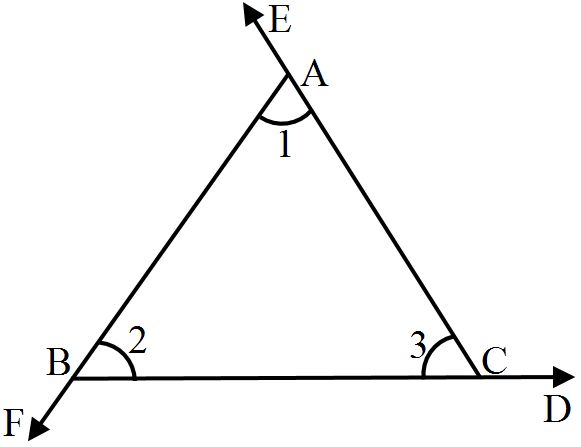
The sides $BC, CA$ and $AB$ of $\triangle\text{ABC}$ have been produced to $D, E$ and $F$ respectively as shown in the figure, forming exterior angles $\angle\text{ACD},\angle\text{BAE}$ and $\angle\text{CBF}.$ Then, $\angle\text{ACD}+\angle\text{BAE}+\angle\text{CBF}=?$
  • A
    $240^\circ$
  • $360^\circ$
  • C
    $300^\circ$
  • D
    $320^\circ$
Answer
Correct option: B.
$360^\circ$
We know that the exteior angle is sum of opposite interior angle
$\angle\text{ACD}=\angle1+\angle2\text{ (i)}$
$\angle\text{BAE}=\angle3+\angle2\text{ (ii)}$
$\angle\text{CBF}=\angle1+\angle3\text{ (iii)}$
$ADD$ Equation $(i), (ii)$ and $(iii)$
$\angle\text{ACD}+\angle\text{BAE}+\angle\text{CBF}=2\times(\angle1+\angle2+\angle3)$
$\angle1+\angle2+\angle3=180^\circ\text{(ASP)}$
$\angle\text{ACD}+\angle\text{BAE}+\angle\text{CBF}=2\times180^\circ$
$\angle\text{ACD} +$ We know that the exteior angle is sum of opposite interior angle
$\angle\text{ACD}=\angle1+\angle2\text{ (i)}$
$\angle\text{BAE}=\angle3+\angle2\text{ (ii)}$
$\angle\text{CBF}=\angle1+\angle3\text{ (iii)}$
$ADD$ Equation $(1i), (ii)$ and $(iii)$
$\angle\text{ACD}+\angle\text{BAE}+\angle\text{CBF}=2\times(\angle1+\angle2+\angle3)$
$\angle1+\angle2+\angle3=180^\circ\text{(ASP)}$
$\angle\text{ACD}+\angle\text{BAE}+\angle\text{CBF}=2\times180^\circ$
$\angle\text{ACD}+\angle\text{BAE}+\angle\text{CBF}=360^\circ.$
View full question & answer
MCQ 1851 Mark
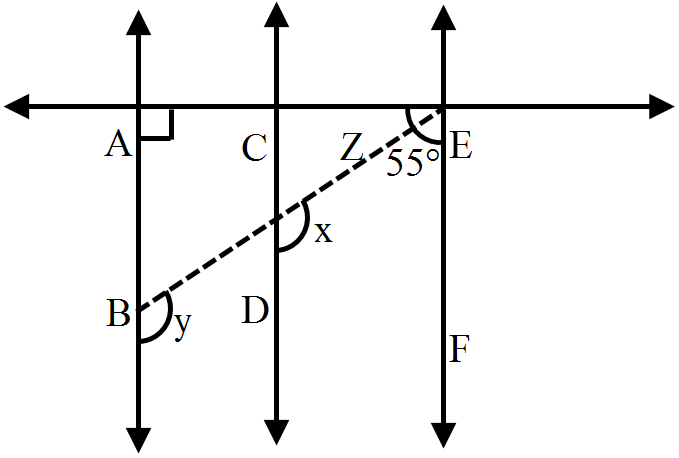
In the adjoining figure, $AB \| CD$ and $AB \| EF$. If $\text{EA}\bot\text{BA}$ and $\angle\text{BEF}=55^\circ,$ then the values of $x, y$ and $z:$
  • A
    $35^\circ , 125^\circ , 120^\circ$
  • $125^\circ , 125^\circ , 35^\circ$
  • C
    $60^\circ , 60^\circ , 60^\circ$
  • D
    $120^\circ , 130^\circ , 25^\circ$
Answer
Correct option: B.
$125^\circ , 125^\circ , 35^\circ$
$x + 55 = 180^\circ $ (Sum of supplementary angles or co-interior angles)$x = 125^\circ$
$x = y = 125^\circ $ (Corresponding angles)
$\text{z}+\angle\text{EAB}=\text{y} $ (Exterior angle property)
$z = 125^\circ - 90^\circ = 35^\circ .$
View full question & answer
MCQ 1861 Mark
The number of line segments determined by three given non$-$collinear points is:
  • A
    Four.
  • B
    Infinitely many.
  • C
    Two.
  • Three.
Answer
Correct option: D.
Three.
Three because non$-$collinear points means the point does not lies in a same line.
View full question & answer
MCQ 1871 Mark
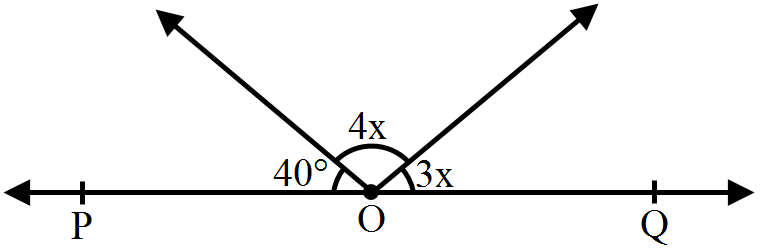
In the figure, $POQ$ is a line. The value of $x$ is:
  • A
    $30^\circ$
  • $20^\circ$
  • C
    $35^\circ$
  • D
    $25^\circ$
Answer
Correct option: B.
$20^\circ$
Since, $POQ$ is a line segment.
$\therefore\angle\text{POQ}=180^\circ$
$\Rightarrow\angle\text{POA}+\angle\text{AOB}+\angle\text{BOQ}=180^\circ$
$\Rightarrow40^\circ+4\text{x}+3\text{x}=180^\circ$
[Putting $\angle\text{POA}=40^\circ,\angle\text{AOB}=4\text{x}$ and $\angle\text{BOQ}=3\text{x}$]
$\Rightarrow7\text{x}=180^\circ-40^\circ$
$\Rightarrow7\text{x}=140^\circ$
$\text{x}=\frac{140^\circ}{7}$
$\text{x}=20^\circ.$
View full question & answer
MCQ 1881 Mark
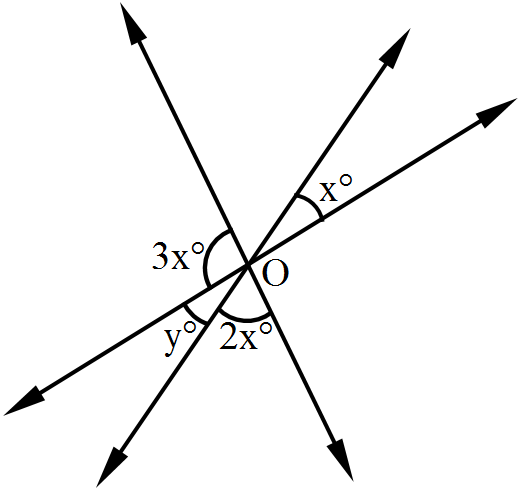
In Fig. the value of $y$ is:
  • A
    $20^{\circ}$
  • B
    $60^{\circ}$
  • $30^{\circ}$
  • D
    $45^{\circ}$
Answer
Correct option: C.
$30^{\circ}$
$3x + y + 2x = 180^{\circ}$(Linear pair)
$5x + y = 180^{\circ} (i)$
From figure,
$y = x$ (Vertically opposite angles)
Using it in $(i)$, we get
$5x + x = 180^{\circ}$
$6x = 180^{\circ}$
$x = 30^{\circ}$
Thus,
$y = x = 30^{\circ}$.
View full question & answer
MCQ 1891 Mark
An angle which measures more than $180^{\circ}$ but less than $360^{\circ}$, is called.
  • A
    An acute angle.
  • B
    An obuse angle.
  • C
    A straight angle.
  • A reflex angle.
Answer
Correct option: D.
A reflex angle.
An angle which measures more than $180^{\circ}$ but less than $360^{\circ}$is called a reflex angle.
View full question & answer
MCQ 1901 Mark
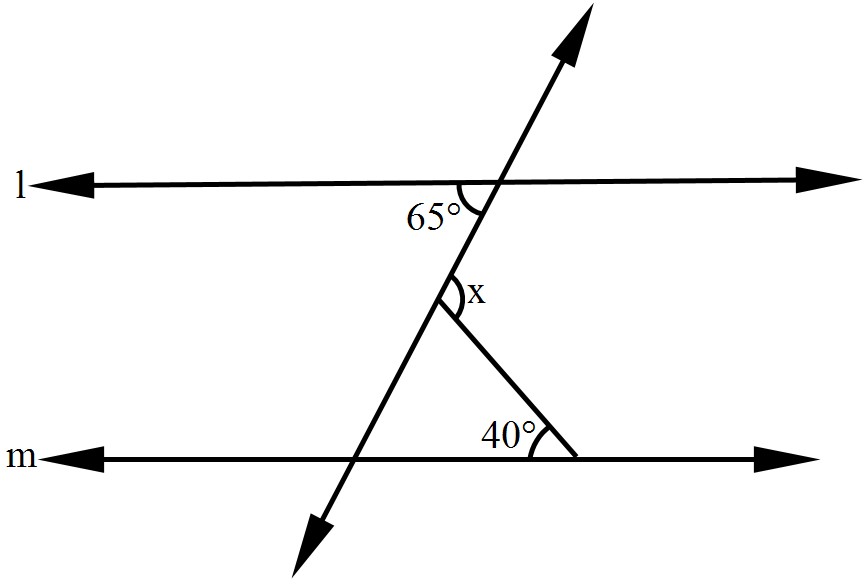
In Fig., if $l \| m,$ then $x =$
  • A
    $40^{\circ}$
  • B
    $25^{\circ}$
  • C
    $65^{\circ}$
  • $105^{\circ}$
Answer
Correct option: D.
$105^{\circ}$
Given that,
$l \| m$ and n cuts them
Let,
$​​\angle1=65^\circ$
$​​\angle2=\text{x}$
$​​\angle3=40^\circ$
$​​\angle1+​​\angle4=65^\circ$ (Alternate angle) $(i)$
$​​\angle3+​​\angle4+​​\angle5=180^\circ$(Angle sum property)
$40^\circ+165^\circ+​​\angle5=180^\circ$
$​​\angle5=75^\circ$
Now,
$​​\angle2+​​\angle5=180^\circ$ (Linear pair)
$x + 75^{\circ}$ = 180$^{\circ}$
$x = 105^{\circ}$.
View full question & answer
MCQ 1911 Mark
Angles of a triangle are in the ratio $2 : 4 : 3$. The smallest angle of the triangle is:
  • A
    $20^\circ$
  • $40^\circ$
  • C
    $60^\circ$
  • D
    $80^\circ$
Answer
Correct option: B.
$40^\circ$
Given, the ratio of angles of a triangle is $2 : 4 : 3.$
Let the angles of a triangle be $\angle\text{A},\angle\text{B}$ and $\angle\text{C}.$
$\angle\text{A}=2\text{x}, \angle\text{B}=4\text{x}$
$\angle\text{C}=3\text{x},\angle\text{A}+\angle\text{B}+\angle\text{C}=180^\circ$
[sum of all the angles of a triangle is 180º]
$2\text{x}+4\text{x}+3\text{x}=180^\circ$
$9\text{x}=180^\circ$
$\text{x}=\frac{180^\circ}{9}=20^\circ$
$\angle\text{A}=2\text{x}=2\times20^\circ=40^\circ$
$\angle\text{B}=4\text{x}=2\times20^\circ=80^\circ$
$\angle\text{C}=3\text{x}=3\times20^\circ=60^\circ$
Hence, the smallest angle of a triangle is $40^\circ .$
View full question & answer
MCQ 1921 Mark
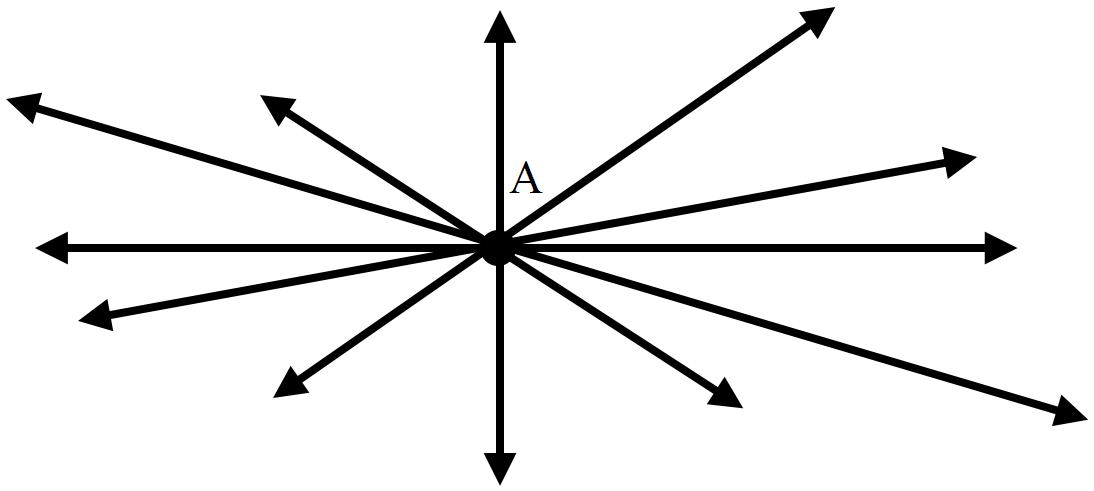
The number of lines that can pass through a given point is:
  • A
    Only one
  • B
    Two
  • C
    One
  • Infinity
Answer
Correct option: D.
Infinity

As seen from the above image, any number of lines can be drawn through a given point.
Hence, the answer may be given as $"$Infinity$"$.
View full question & answer
MCQ 1931 Mark
If two angles are complements of each other then each angle is:
  • A
    A straight angle.
  • B
    A reflex angle.
  • An acute angle.
  • D
    An obtuse angle.
Answer
Correct option: C.
An acute angle.
If two angles are complements of each other, that is, the sum of their measures is $90^\circ $, then each angle is an acute angle.
View full question & answer
MCQ 1941 Mark
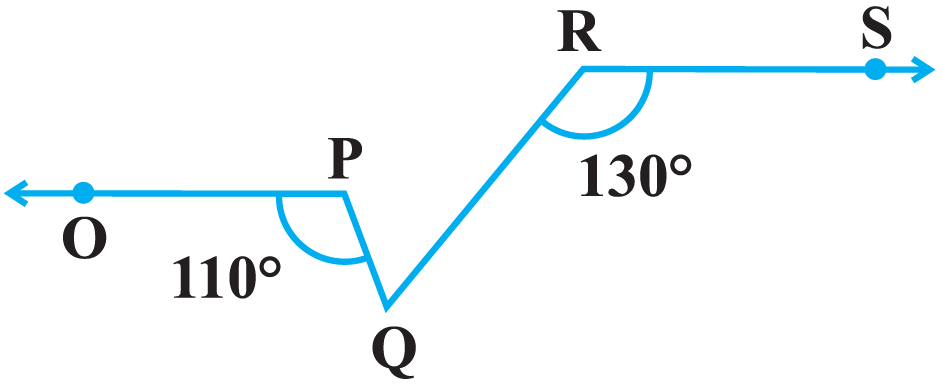
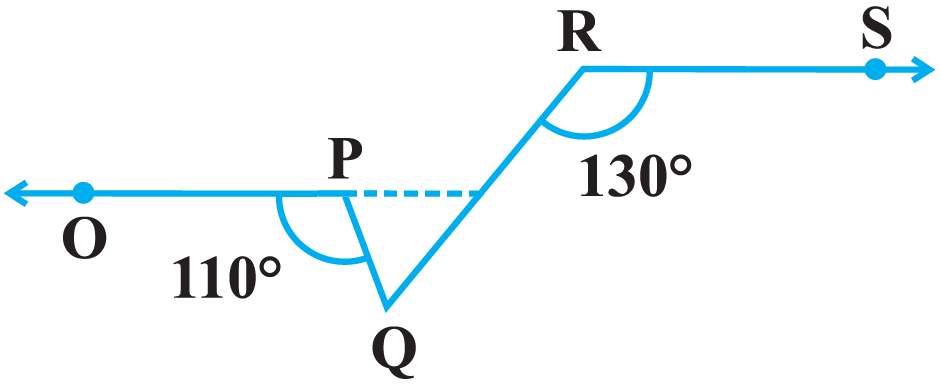
Write the correct answer in the following: In Fig. if $\text{OP}||\text{RS},$ $\angle\text{OPQ}=110^\circ$ and $\angle\text{QRS}=130^\circ,$ then $\angle\text{PQR}$ is equal to,
  • A
    $40^\circ$
  • B
    $50^\circ$
  • $60^\circ$
  • D
    $70^\circ$
Answer
Correct option: C.
$60^\circ$
In the given figure, producing $OP$, to interscet $RQ$ at $X.$
Since, $\text{OP}||\text{RS}$ and RX is a transversal.
So, $\angle\text{RXP}=\angle\text{XRS}$

$\Rightarrow\angle\text{RXP}=130^\circ$$\big[\because\angle\text{QRS}=130^\circ(\text{given})\big]....(\text{i})$
Now, $RQ$ is a line segment.
So,$\angle\text{PXQ}+\angle\text{RXP}=180^\circ$ [linear pair axiom]
$\Rightarrow\angle\text{PXQ}=180^\circ-\angle\text{RXP}=180^\circ-130^\circ$ [from eq. $(i)]$
$\Rightarrow\angle\text{PXQ}=50^\circ$
In $\Delta\text{PQX},$ $\angle\text{OPQ}$ is an exterior angle,
$\therefore\angle\text{OPQ}=\angle\text{PXQ}+\angle\text{PQX}$
[$\because\ $exterior asngle = sum of two opposite interior angles]
$110^\circ=50^\circ+\angle\text{PQX}$
$\angle\text{PQX}=110^\circ-50^\circ$
$\angle\text{PQR}=60^\circ$ $[\because\ \angle\text{PQX}=\angle\text{PQR}]$
View full question & answer
MCQ 1951 Mark
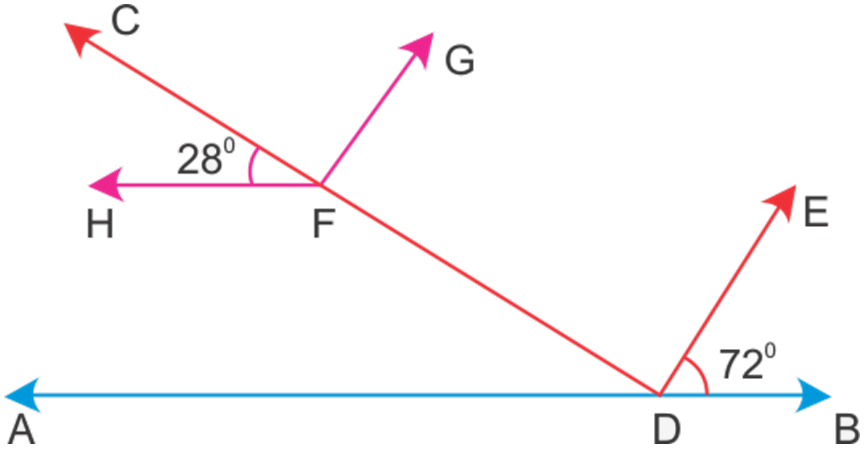
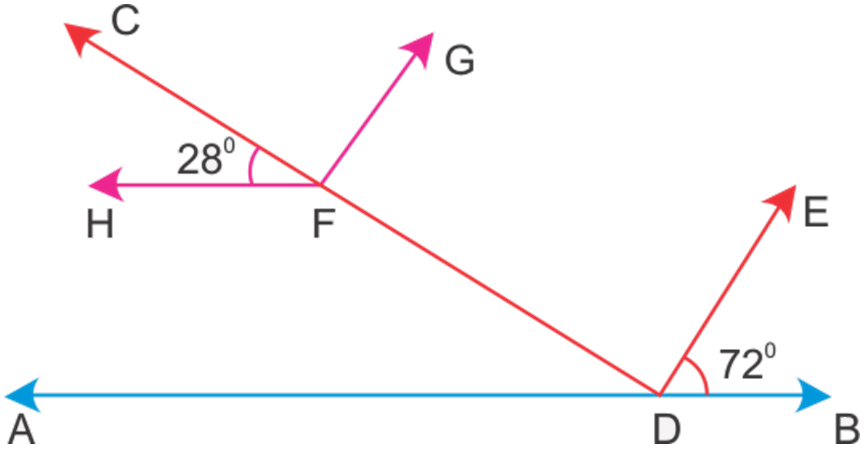
In figure, if $AB \| HF$ and $DE \| FG$, then the measure of $\angle\text{FDE}$ is:
  • A
    $108^\circ$
  • $80^\circ$
  • C
    $100^\circ$
  • D
    $90^\circ$
Answer
Correct option: B.
$80^\circ$

AB || HF and $\angle\text{CFH}=28^\circ$ [Given]
$\angle\text{CFH}=\angle\text{FDA}$ [Correspondence angels are equal]
$\angle\text{FDA}=28^\circ$
Now,
$\angle\text{FDA}+\angle\text{FDE}+\angle\text{EDB}=180^\circ$
$\Rightarrow\ 28^\circ+\angle\text{FDE}+72^\circ=180^\circ$
$\Rightarrow\ \angle\text{FDE}=80^\circ$
View full question & answer
MCQ 1961 Mark
In the given figure, straight lines $AB$ and $CD$ intersect at $O$. If $\angle\text{AOC}+\angle\text{BOD}=130^\circ$ then $\angle\text{AOD}=?$
  • $115^\circ$
  • B
    $125^\circ$
  • C
    $110^\circ$
  • D
    $65^\circ$
Answer
Correct option: A.
$115^\circ$
We have,
$\angle\text{AOC}=\angle\text{BOD}$ [Vertically-Opposite Angles]
$\therefore\angle\text{AOC}+\angle\text{BOD}=130^\circ$
$\Rightarrow\angle\text{AOC}+\angle\text{AOC}=130^\circ [\therefore\angle\text{AOC}=\angle\text{BOD}]$
$\Rightarrow2\angle\text{AOC}=130^\circ$
$\Rightarrow\angle\text{AOC}=65^\circ$
Now,
$\angle\text{AOC}+\angle\text{AOD}=180^\circ$ [$\because$ COD is a straight line]
$\Rightarrow65^\circ+\angle\text{AOD}=180^\circ$
$\Rightarrow\angle\text{AOC}=115^\circ.$
View full question & answer
MCQ 1971 Mark
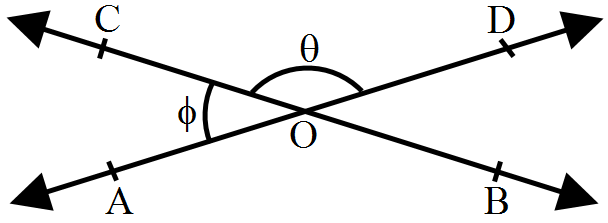
In the given figure, straight lines $AB$ and $CD$ intersect at $O$. If $\angle\text{AOC}=\phi,\angle\text{BOC}=\theta$ and $\theta=3\phi,$ then $\phi=?$
  • $45^\circ$
  • B
    $30^\circ$
  • C
    $60^\circ$
  • D
    $40^\circ$
Answer
Correct option: A.
$45^\circ$
We have.
$\theta+\phi=180^\circ$ [$\because AOD$ is a straight line]
$\Rightarrow3\phi+\phi=180^\circ [\because\theta=3\phi]$
$\Rightarrow4\theta=180^\circ$
$\Rightarrow\phi=45^\circ.$
View full question & answer
MCQ 1981 Mark
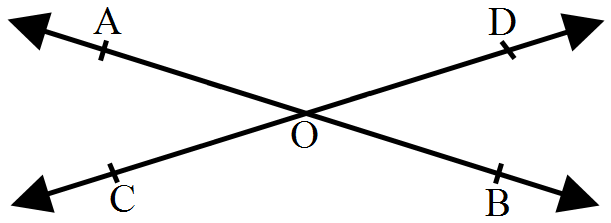
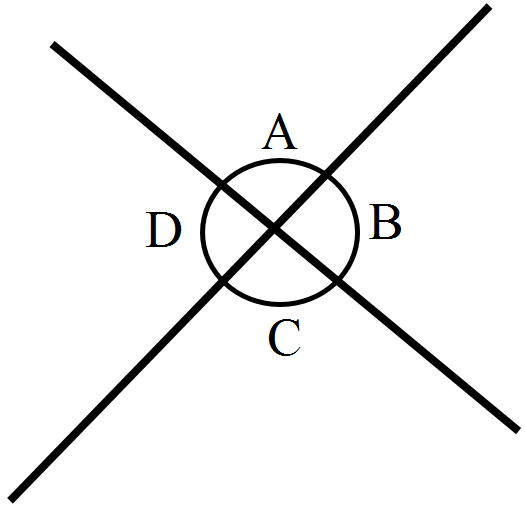
If two lines intersect each other then:
  • A
    Corresponding angles are equal.
  • B
    Alternate interior angles are equal.
  • C
    Co-interior angles are equal.
  • Vertically opposite angles are equal.
Answer
Correct option: D.
Vertically opposite angles are equal.

$\angle\text{A}+\angle\text{B}=180^\circ ($Linear Pair$)$
$\angle\text{B}+\angle\text{C}=180 ($Linear Pair$)$
On equating above equations, we get
$\angle\text{A}+\angle\text{B}=\angle\text{B}+\angle\text{C}$
$\angle\text{A}=\angle\text{C}$
Similarly, $\angle\text{B}=\angle\text{D}$
View full question & answer
MCQ 1991 Mark
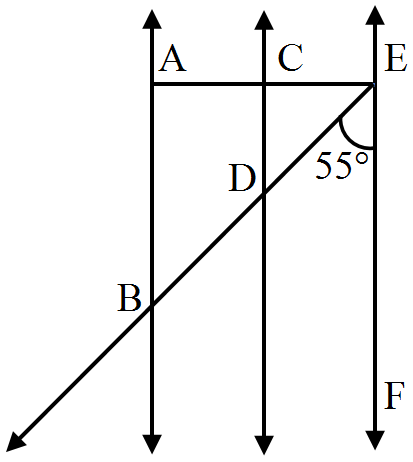
In the given figure, $AB \| CD \| EF,$ $\text{EA }\bot\text{ AB}$ and BDE is the transversal such that $\angle\text{DEF}=55^\circ,$ Then $\angle\text{AEB}=?$
  • $35^\circ$
  • B
    $55^\circ$
  • C
    $45^\circ$
  • D
    $25^\circ$
Answer
Correct option: A.
$35^\circ$
$\text{EA }\bot\text{ AB}$
$\angle\text{AEF}=90^\circ$
$\angle\text{AEF}=\angle\text{BEF}+\angle\text{AEB}$
$\angle\text{BEF}+\angle\text{AEB}=90^\circ$
$\angle\text{BEF}=55^\circ$
$55^\circ+\angle\text{AEB}=90^\circ$
$\text{AEB}=90^\circ-55^\circ$
$\angle\text{AEB}=35^\circ.$
View full question & answer
MCQ 2001 Mark
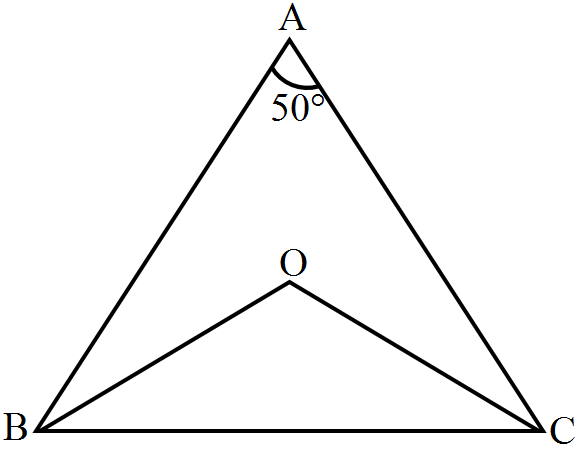
In the given figure, $BO$ and $CO$ are the bisectors of $\angle\text{B}$ and $\angle\text{C}$ respectively. If $\text{A}=50^\circ,$ then $\angle\text{BOC}=?$
  • A
    $130^\circ$
  • B
    $120^\circ$
  • C
    $100^\circ$
  • $115^\circ$
Answer
Correct option: D.
$115^\circ$
In ​​​​$\triangle\text{ABC}$
$\text{2x}+\text{2y}+\angle\text{A}=180^\circ$ (Angle sum property)
$\text{x}+\text{y}+(\frac{\angle\text{A}}{2})=90^\circ$
$\text{x}+\text{y}=90^\circ-(\frac{\text{A}}{2})$(1)
In ​​​​$\triangle\text{BOC},$ we have
$\text{x}+\text{y}+\angle\text{BOC}=180^\circ$
$90^\circ- (\frac{\angle\text{A}}{2})+\angle\text{BOC}=180^\circ$ [From (1)]
$\text{BOC}=180^\circ-90^\circ+(\frac{\text{A}}{2})$
$\angle\text{BOC}=90^\circ+(\frac{\text{A}}{2})$
$\angle\text{BOC}=90^\circ+25^\circ=115^\circ.$
View full question & answer
M.C.Q - Page 4 - Maths STD 9 Questions - Vidyadip