Questions · Page 5 of 5

M.C.Q

MCQ 2011 Mark
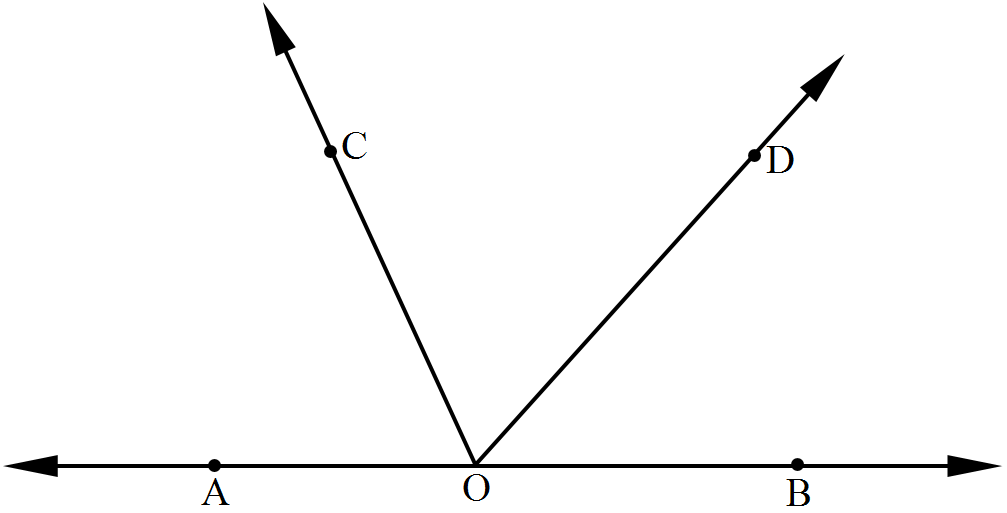
In Fig. $AOB$ is a straight line. If $\angle\text{AOC}+\angle\text{BOD}=85^\circ,$ then ​​$\angle\text{COD}=$
  • A
    $90^\circ$
  • B
    $85^\circ$
  • $95^\circ$
  • D
    $100^\circ$
Answer
Correct option: C.
$95^\circ$
Given,
$AOB =$ Straight line
​​$\angle\text{AOC}+\angle\text{BOD}=85^\circ$
$\angle​\text{AOC}+\angle\text{COD}+\angle\text{BOD}=180^\circ $(Linear pair)
$85^\circ+\angle\text{COD}=180^\circ$
$\angle​\text{COD}=95^\circ.$
View full question & answer
MCQ 2021 Mark
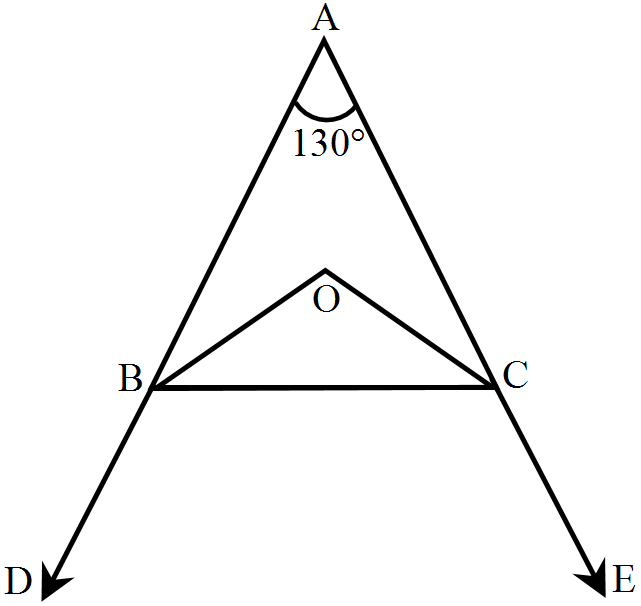
If one of the angles of a triangle is $130^{\circ}$, then the angle between the bisectors of the other two angles can be:
  • A
    $145^{\circ}$
  • B
    $155^{\circ}$
  • $50^{\circ}$
  • D
    $65^{\circ}$
Answer
Correct option: C.
$50^{\circ}$
Let angles of a triangle be $\angle\text{A},\angle\text{B}$ and $\angle\text{C}.$

In $\triangle\text{ABC},$
$\angle\text{A}+\angle\text{B}+\angle\text{C}=180^\circ $[sum of all interior angles of a triangle is $180^{\circ}$]
$\Rightarrow12\angle\text{A}+12\angle\text{B}+12\angle\text{C}=180^\circ2=90^\circ$[dividing both sides by $2]$
$\Rightarrow12\angle\text{B}+12\angle\text{C}=90^\circ−12\angle\text{A} $
$[\because\text{In}\triangle\text{OBC},\angle\text{OBC}+\angle\text{BCO}+\angle\text{COB}=180^\circ]$
⇒ Since, $\angle\text{B}2+\angle\text{C}2+\angle\text{BOC}=180^\circ$ as $BO$ and $OC$ are the angle bisectors of $\angle\text{ABC} $ and $\angle\text{BCA},$ respectively
$\Rightarrow180^\circ−\angle\text{BOC}=90^\circ−12\angle\text{A}$
$\therefore\angle\text{BOC}=180^\circ-90^\circ+12\angle\text{A}$
= $90^{\circ}+12 \times 130^{\circ}=90^{\circ}+65^{\circ}[\therefore\angle\text{A}=130^\circ(\text{given)}]$
$= 155^{\circ}$
Hence, the required angle is 155$^{\circ}$.
View full question & answer
MCQ 2031 Mark
If two angles are supplementary and the larger is $20^{\circ}$ less then three times the smaller, then the angles are:
  • A
    $72\frac{1}{2}^0,17\frac{1}{2}^0$
  • B
    $140^0,40^0$
  • $130^0,50^0$
  • D
    $62\frac{1}{2}^0,27\frac{1}{2}^0$
Answer
Correct option: C.
$130^0,50^0$
Let the two supplimentary angles be $\mathrm{x}^0$ and $180^{\circ}-\mathrm{x}^0$
Let $180^{\circ}-x$ be the larger angle
$180^{\circ}-x=3 x-20^0$
$4 x=200^{\circ}$
$x=50^{\circ}$
So the angles are $50^{\circ}$ and $130^{\circ}$
View full question & answer
MCQ 2041 Mark
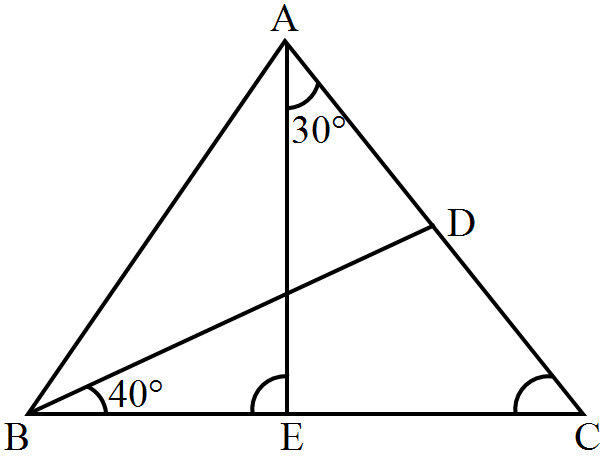
In $\triangle\text{ABC, }\text{BD}\perp\text{AC, }\angle\text{CAE} = 30^\circ$ and $\angle\text{CBD}=40^\circ.$ Then $\angle\text{AEB}=?$
  • A
    $70^\circ$
  • B
    $50^\circ$
  • C
    $60^\circ$
  • $80^\circ$
Answer
Correct option: D.
$80^\circ$
In $BDC$
$\angle\text{BDC}+\angle\text{BCD}+\angle\text{DBC}=180^\circ$
$\text{BD}\perp\text{AC}$
$\angle\text{BCD}=90^\circ,\angle\text{DBC}=40^\circ$
$90^\circ+\angle\text{BCD}+40^\circ=180^\circ$
$\angle\text{BCD}+130^\circ=180^\circ$
$\angle\text{BCD}=180^\circ-130^\circ$
$\angle\text{BCD}=50^\circ$
$\angle\text{AEB}=\angle\text{CAE}+\angle\text{C}$ (exterior angle)
$\angle\text{CAE}=30^\circ$
$\angle\text{C}=50^\circ$
$\angle\text{AEB}=30^\circ+50^\circ$
$\angle\text{AEB}=80^\circ.$
View full question & answer
MCQ 2051 Mark
Two complementary angles are such that twice the measure of the one is equal to three times the measure of the other. The larger of the two measures.
  • A
    $72^\circ$
  • B
    $36^\circ$
  • $54^\circ$
  • D
    $63^\circ$
Answer
Correct option: C.
$54^\circ$
Let the measure of the required angle be $x^\circ$
Then, the measure of its complement will be $(90 - x)^\circ$
Therefore, $2x = 3 (90 - x)$
$\Rightarrow 2x = 270 - 3x$
$\Rightarrow 5x = 270$
$\Rightarrow x = 54^\circ .$
View full question & answer
MCQ 2061 Mark
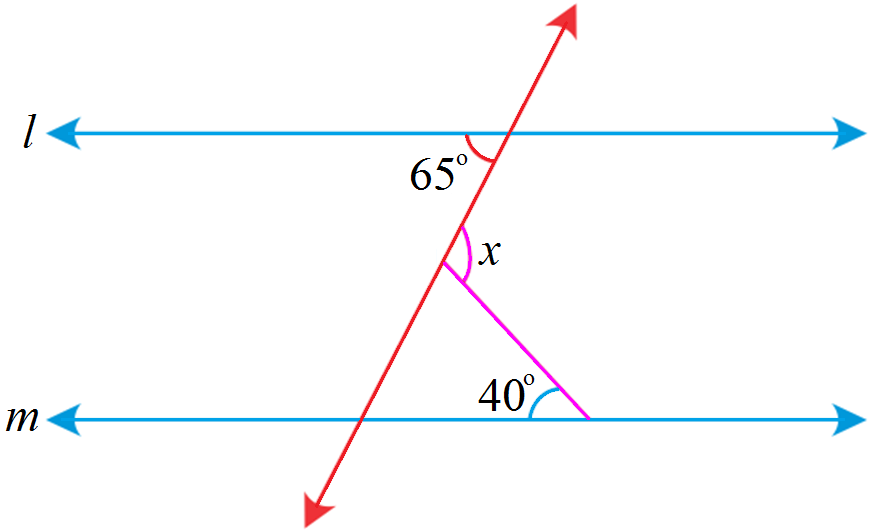
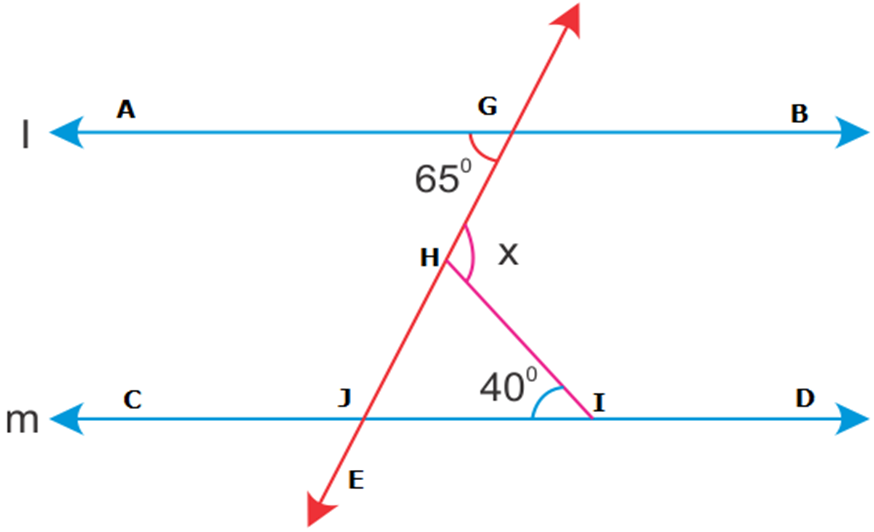
In figure, if $l \| m$, then $x =$
  • $105^\circ$
  • B
    $65^\circ$
  • C
    $40^\circ$
  • D
    $25^\circ$   
Answer
Correct option: A.
$105^\circ$

From figure,
$\angle\text{AGE}=\angle\text{FGB}$ [Opposite angles]
$\Rightarrow\ \angle\text{FGB}=65^\circ$
Also,
$\angle\text{FGB}=\angle\text{HJI}$ [Corresponding angle]
$\Rightarrow\ \angle\text{HJI}=65^\circ$
Now, in $\angle\text{HJI},$
$\angle\text{HJI}+\angle\text{JIH}+\angle\text{IHJ}=180^\circ$
$\Rightarrow\ 65^\circ+40^\circ+\angle\text{IHJ}=180^\circ$
$\Rightarrow\ \angle\text{IHJ}=180^\circ-65^\circ-40^\circ=75^\circ$
Now,
$\text{x}=180^\circ-\angle\text{IHJ}=180^\circ-75^\circ$
$=105^\circ$
View full question & answer
MCQ 2071 Mark
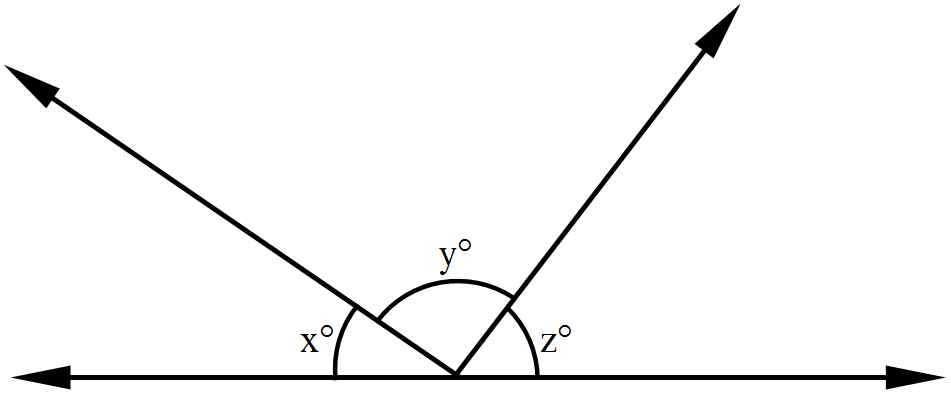
In Fig. if $\frac{\text{y}}{\text{x}}=5$ and $\frac{\text{z}}{\text{x}}=4,$ then the value of $x$ is:
  • A
    $15^\circ$
  • $18^\circ$
  • C
    $12^\circ$
  • D
    $8^\circ$
Answer
Correct option: B.
$18^\circ$
In the given figure, we have $x^\circ , y^\circ $ and $z^\circ $ forming a linear pair, therefore these must be supplementary.
That is,
$x + y + z = 180^\circ (1)$
Also,
$\frac{\text{y}}{\text{x}}=5$
$y = 5x (2)$
And
$\frac{\text{z}}{\text{x}}=4$
$z = 4x (3)$
Substituting $(ii)$ and $(iii)$ in $(i),$ we get:
$x + 5x + 4x = 180^\circ$
$10x = 180^\circ$
$\text{x}=\frac{180^\circ}{10}$
$x = 18^\circ .$
View full question & answer
MCQ 2081 Mark
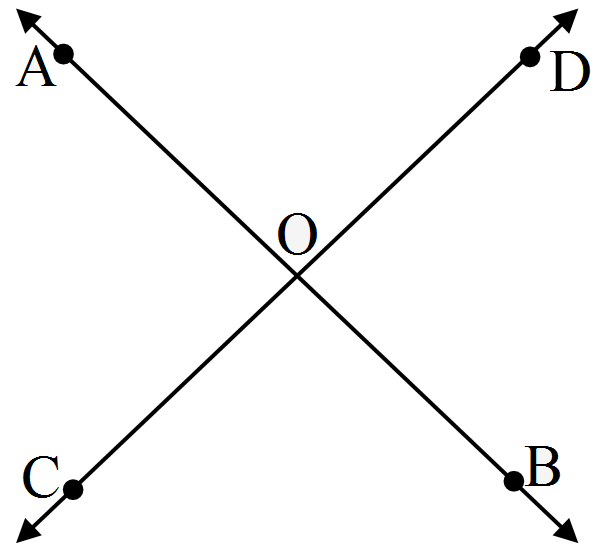
Two straight lines $AB$ and $CD$ cut each other at $O$. If ​​$\angle\text{BOD}=63^\circ,$ then​​ $\angle\text{BOC}=$
  • A
    $153^\circ$
  • B
    $17^\circ$
  • $117^\circ$
  • D
    $63^\circ$
Answer
Correct option: C.
$117^\circ$
$\angle\text{BOD}+\angle\text{BOC}=180^\circ$ (Linear pair)
$63^\circ+\angle\text{BOC}=180^\circ$
$\text{BOC}=117^\circ.$
View full question & answer
MCQ 2091 Mark
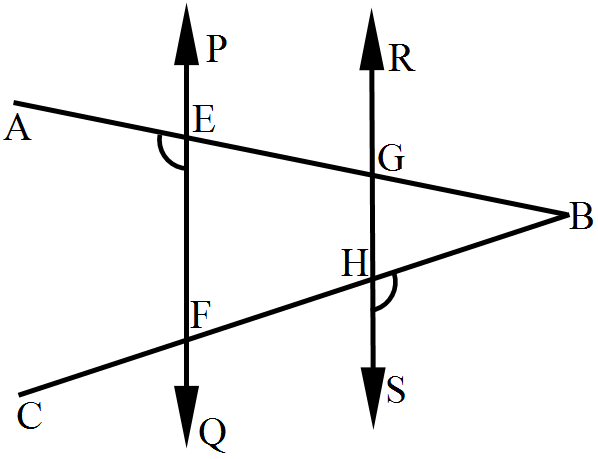
In Fig, $PQ \| RS$, $\angle\text{AEF}=95^\circ,\angle\text{BHS}=110^\circ,$ and $\angle\text{ABC}=\text{x}^\circ.$ Then the value of $x$ is:
  • A
    $70^\circ$
  • B
    $15^\circ$
  • $25^\circ$
  • D
    $35^\circ$
Answer
Correct option: C.
$25^\circ$
Given that,
$PQ \| RS$
$\angle​​\text{AEF}=95^\circ$
$​​\angle\text{BHS}=110^\circ$
$\angle​​\text{ABC}=\text{x}^\circ$
$\angle\text{AEF}=\angle\text{AGH}=95^\circ$ (Corresponding angles)
$\angle​\text{AGH}+\angle\text{HGB}=180^\circ$ (Linear pair)
$95^\circ+\angle\text{HGB}=180^\circ$
$\angle​\text{HGB}=85^\circ$
$\angle​​\text{BHS}+\angle\text{BHG}=180^\circ $(Linear pair)
$110^\circ+\angle\text{BHG}=180^\circ$
$\angle\text{BHG}=70^\circ$
In $\triangle\text{BHG},$
$\angle\text{BHG}+\angle\text{HGB}+\angle\text{GBH}=180^\circ$
$70^\circ+85^\circ+\angle\text{GBH}=180^\circ$
$\angle​\text{GBH}=25^\circ$
Thus,
$\angle\text{ABC}=\angle\text{GBH}=25^\circ.$
View full question & answer
MCQ 2101 Mark
Two lines $AB$ and $CD$ intersect at $O$. If $\angle\text{AOC}+\angle\text{COB}+\angle\text{BOD}=270^\circ,$then $\angle\text{AOC}=$
  • A
    $70^\circ$
  • B
    $80^\circ$
  • $90^\circ$
  • D
    $180^\circ$
Answer
Correct option: C.
$90^\circ$

$\angle\text{AOC}+\angle\text{COB}+\angle\text{BOD}=270^\circ$ [Given]
From figure,
$\angle\text{AOC}+\angle\text{COB}+\angle\text{BOD}+\angle\text{DOA}=360^\circ$
$\Rightarrow\ 270^\circ+\angle\text{DOA}=360^\circ$
$\Rightarrow\ \angle\text{DOA}=360^\circ-270^\circ=90^\circ$
Now,
$\angle\text{DOA}+\angle\text{AOC}=180^\circ$
$\Rightarrow\ \angle\text{AOC}=180^\circ-90^\circ=90^\circ$
View full question & answer
MCQ 2111 Mark
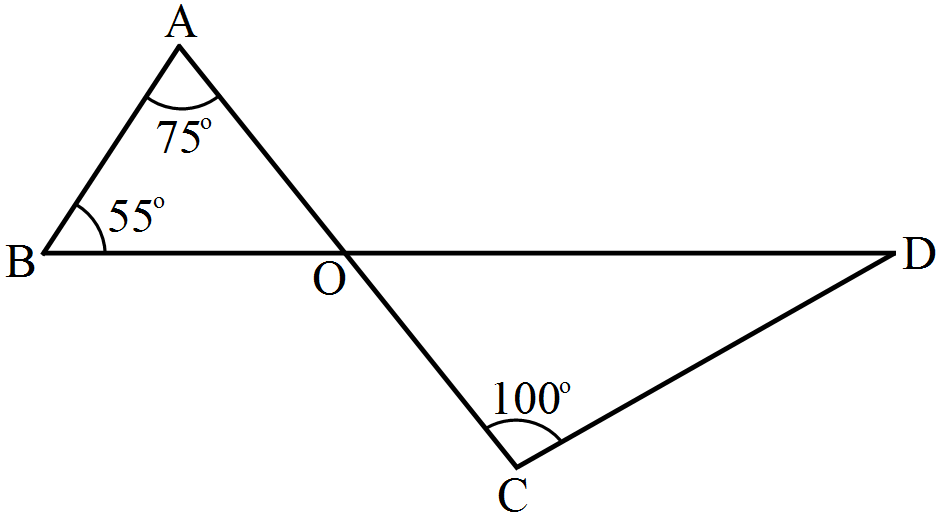
In the given figure, $\angle\text{OAB}=75^\circ, \angle\text{OBA}=55^\circ$ and $\angle\text{OCD}=100^\circ.$ then, $\angle\text{ODC}=?$
  • A
    $20^\circ$
  • B
    $25^\circ$
  • $30^\circ$
  • D
    $35^\circ$
Answer
Correct option: C.
$30^\circ$
In $\triangle\text{OAB},$ we have
$\angle\text{OAB}+\angle\text{OBA}+\angle\text{AOB}=180^\circ$ (Angle sum property)
$\Rightarrow55^\circ+75^\circ+\angle\text{AOB}=180^\circ$
$\Rightarrow\angle\text{AOB}=50^\circ$
$\Rightarrow\angle\text{COD}=\angle\text{AOB}=50^\circ$ (Vertivcally opposite angles)
In $\triangle\text{OCD},$ we have
$\angle\text{COD}+\angle\text{OCD}+\angle\text{ODC}=180^\circ$ (Angle sum property)
$\Rightarrow50^\circ+100^\circ+\text{x}=180^\circ$
$\Rightarrow\text{x}=30^\circ$
View full question & answer
MCQ 2121 Mark
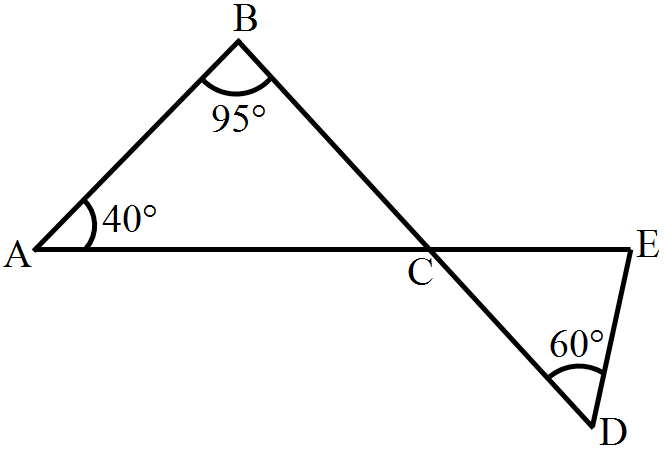
In the adjoining figure, if $A = 40^\circ , B = 95^\circ $ and $D = 60^\circ $, then $E$ is equal to:
  • $75^\circ$
  • B
    $55^\circ$
  • C
    $65^\circ$
  • D
    $85^\circ$
Answer
Correct option: A.
$75^\circ$
in $\triangle\text{ABC}$$\angle\text{ABC}+\angle\text{BCA}+\angle\text{CAB}=180^\circ$ (Angle sum property)
$\angle\text{BCA}=180^\circ-95^\circ-40^\circ=45^\circ$
$\angle\text{BCA}=\angle\text{ECD}=45^\circ$ (Vertically opposite angle)
In $\triangle\text{ECD}$
$\angle\text{ECD}+\angle\text{DEC}+\angle\text{CDE}=180^\circ$ (Angle sum property)
$\angle\text{ECD}=180^\circ-45^\circ-60^\circ=75^\circ.$
View full question & answer
MCQ 2131 Mark
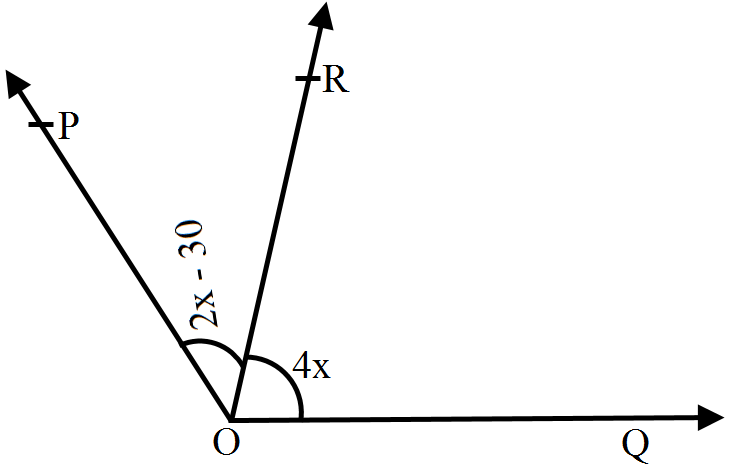
In the given figure, the value of x which makes $POQ$ a straight line is:
  • A
    $30^\circ$
  • $25^\circ$
  • C
    $35^\circ$
  • D
    $40^\circ$
Answer
Correct option: B.
$25^\circ$
We know that he measure of a straight angle is $180^\circ$
$(2x + 30^\circ ) + 4x = 180^\circ$
$2x + 30^\circ + 4x = 180^\circ$
$6x = 180^\circ - 30^\circ$
$6x = 150^\circ$
$\text{x}=\frac{150^\circ}{6}=25^\circ.$
View full question & answer
MCQ 2141 Mark
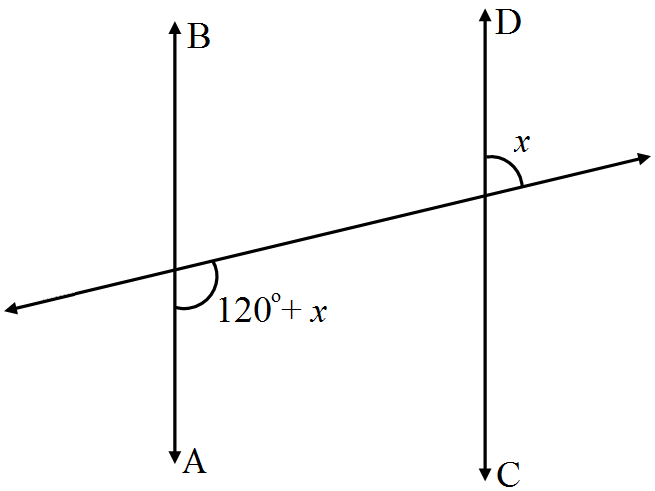
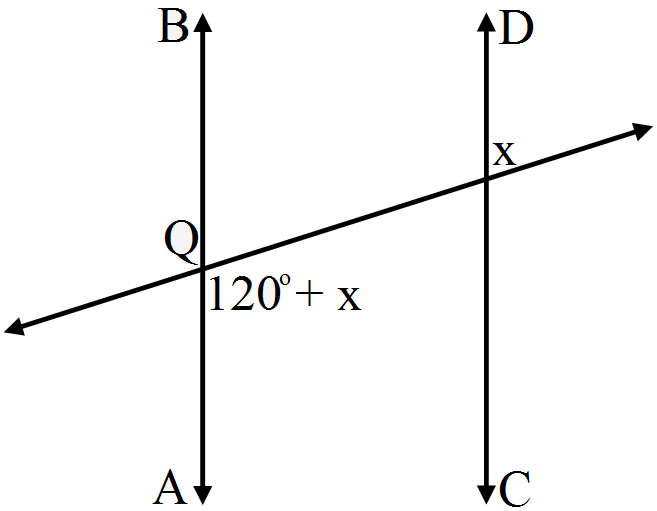
In figure, if $AB \| CD$, then the value of $x$ is:
  • A
    $20^\circ$
  • $30^\circ$
  • C
    $45^\circ$
  • D
    $60^\circ$
Answer
Correct option: B.
$30^\circ$

From figure,
$\angle\text{DPQ}+\angle\text{x}^\circ=180^\circ\dots(1)$ [linear pair]
Also,
$\angle\text{DPQ}=\angle\text{AQP}$ [Interior opposite angles]
$\Rightarrow\ \angle\text{DPQ}=120^\circ+\text{x}$
From $(1),$
$120^\circ+\text{x}+\text{x}=180^\circ$
$\Rightarrow\ 2\text{x}=60^\circ$
$\Rightarrow\text{x}=30^\circ$
View full question & answer
MCQ 2151 Mark
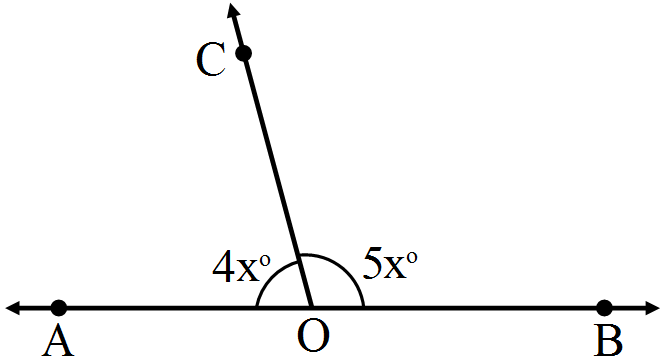
In the given figure, $AOB$ is a straight line. If $\angle\text{AOC}=4\text{x}^\circ$ and $\angle\text{BOC}=5\text{x}^\circ$ then $\angle\text{AOC}=?$
  • A
    $40^\circ$
  • B
    $60^\circ$
  • $80^\circ$
  • D
    $100^\circ$
Answer
Correct option: C.
$80^\circ$
Since $AOB$ is a straight line,
$\angle\text{AOC}+\angle\text{BOC}=180^\circ$
$\Rightarrow4\text{x}+5\text{x}=180^\circ$
$\Rightarrow9\text{x}=180^\circ$
$\Rightarrow\text{x}=206^\circ$
So, $\angle\text{AOC}=4\text{x}=4(20)=80^\circ$
View full question & answer
MCQ 2161 Mark
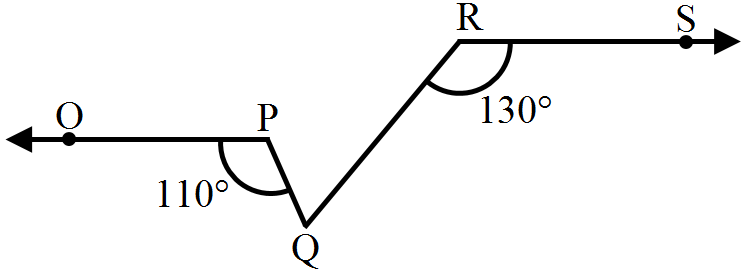
In a figure, if $OP \| RS$, $\angle\text{OPQ}=110^\circ$ and $\angle\text{QRS}=130^\circ,$ then $\angle\text{PQR}$ is equal to:
  • $60^\circ$
  • B
    $70^\circ$
  • C
    $40^\circ$
  • D
    $50^\circ$
Answer
Correct option: A.
$60^\circ$
Produce $OP$ to intersect $RQ$ at point $N.$
Now, $OP \| RS$ and transversal RN intersects them at N and R respectively.
$\therefore\angle\text{RNP}=\angle\text{SRN}$ (Alternate interior angles)
$\Rightarrow\angle\text{RNP}=130^\circ$
$\therefore\angle\text{PNQ}=180^\circ−130^\circ=50^\circ$ (Linear pair)
$\angle\text{OPQ}=\angle\text{PNQ}+\angle\text{PQN}$ (Exterior angle property)
$\Rightarrow110^\circ= 50^\circ+\angle\text{PQN}$
$\Rightarrow\angle\text{PQN}=110^\circ-50^\circ=60^\circ=\angle\text{PQR}.$
View full question & answer
MCQ 2171 Mark
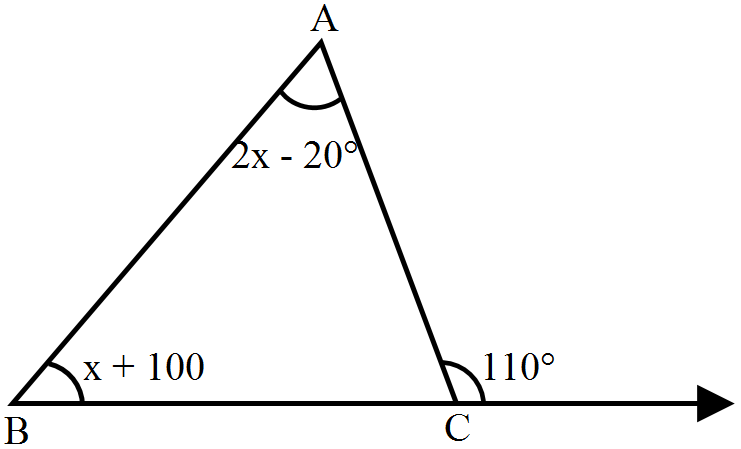
In the below figure, the value of $x$ is:
  • A
    $30^\circ$
  • $10^\circ$
  • C
    $15^\circ$
  • D
    $25^\circ$
Answer
Correct option: B.
$10^\circ$
$2x - 20^\circ + x + 100^\circ = 110^\circ $ (Exterior angle is equal to sum of its interior opposite angles)$3x = 110^\circ - 100^\circ + 20^\circ$
$x = 10^\circ .$
View full question & answer
MCQ 2181 Mark
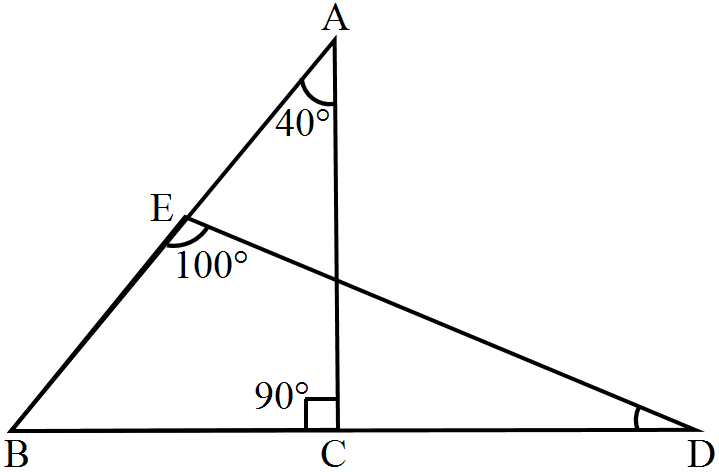
In the given figure, $\angle\text{BAC}=40^\circ,\angle\text{ACB}=90^\circ$ and $\angle\text{BED}=100^\circ,$ Then $\angle\text{BDE}=?$
  • A
    $50^\circ$
  • B
    $40^\circ$
  • C
    $25^\circ$
  • $30^\circ$
Answer
Correct option: D.
$30^\circ$
In $\triangle\text{ABC}$$\angle\text{ABC}+\angle\text{BAC}+\angle\text{ACB}=180^\circ$ (Angle sum property)
$\angle\text{ABC}=180^\circ-90^\circ-40^\circ$
$\angle\text{ABC}=50^\circ$
In $\angle\text{BED}$
$\angle\text{BED}+\angle\text{EBD}+\angle\text{BDE}=180^\circ$ (Angle sum property)
$\angle\text{BDE}=180^\circ-50^\circ-100^\circ$
$\angle\text{BDE}=30^\circ.$
View full question & answer
MCQ 2191 Mark
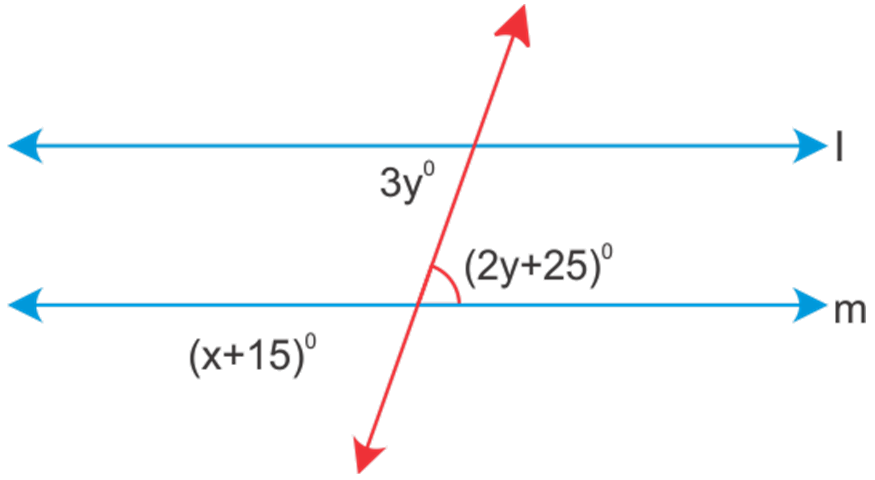
In figure, if $l \| m$, what is the value of $x?$
  • $60$
  • B
    $50$
  • C
    $45$
  • D
    $30$
Answer
Correct option: A.
$60$

$3y^\circ = 2y^\circ + 25^\circ $ [Alternate angles]
$\Rightarrow y^\circ = 25^\circ $
Now,
$x^\circ + 15^\circ = 2y^\circ + 25^\circ $ [Opposite angles]
$\Rightarrow x = 2y^\circ + 25^\circ - 15^\circ $
$\Rightarrow x = 2y^\circ + 10^\circ $
$\Rightarrow x = 2 \times 25^\circ + 10^\circ $
$\Rightarrow x = 60^\circ $
View full question & answer
MCQ 2201 Mark
Which of the following statements is false?
  • Through a given point, only one straight line can be drawn.
  • B
    Through two given points, it is possible to draw one and only one straight line.
  • C
    Two straight lines can intersect only at one point.
  • D
    A line segment can be produced to any desired length.
Answer
Correct option: A.
Through a given point, only one straight line can be drawn.
Option $(a)$ is false, since through a given point we can draw an infinite number of straight lines.
View full question & answer
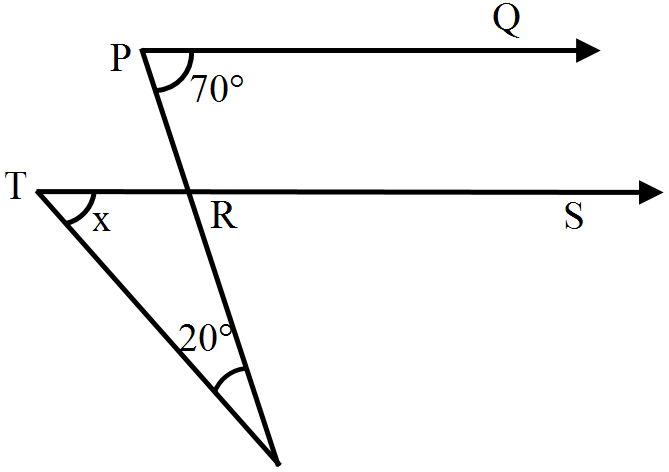
MCQ 2211 Mark
In figure, $\text{PQ }||\text{ RS},\angle\text{QPR}=70^\circ,\angle\text{ROT}=20^\circ$ find the value of $x.$
  • A
    $20^\circ$
  • $50^\circ$
  • C
    $70^\circ$
  • D
    $110^\circ$
Answer
Correct option: B.
$50^\circ$
$\text{PQ }||\text{ RS},\angle\text{QPR}=\angle\text{SRO}=70^\circ$ (Corresponding, Angle)
Now in $\triangle\text{RTO}$
$x + 20^\circ = 70^\circ $ (exterior angle)
$x = 70^\circ - 20^\circ$
$x = 50^\circ .$
View full question & answer
MCQ 2221 Mark
The complement of $(90-a)^0$ is:
  • A
    $(90+2 a)^{\circ}$
  • B
    $(90-a)^0$
  • $a^{\circ}$
  • D
    $-a^{\circ}$
Answer
Correct option: C.
$a^{\circ}$
We know that the sum of complementary angles are $90^{\circ}$
Let the complementary angle of $(90-\mathrm{a})^{\circ}$ be $x$
$x+(90-a)^{\circ}=90^{\circ}$
$x=90^{\circ}-(90-a)^{\circ}$
$x=90^{\circ}-90^{\circ}+a^{\circ}$
$x=a^{\circ}$.
 
View full question & answer
MCQ 2231 Mark
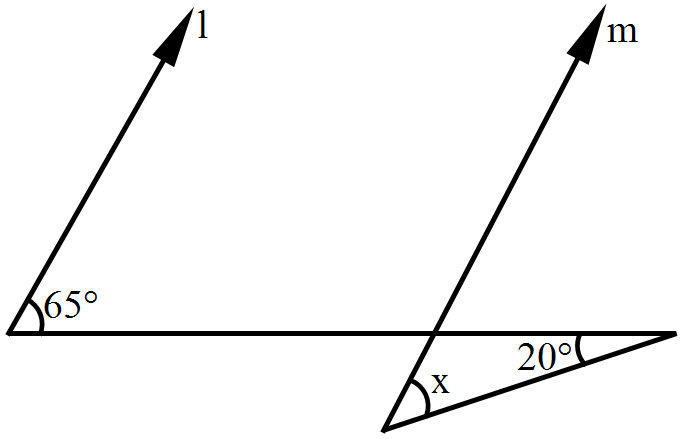
In Fig. if lines $l$ and $m$ are parallel, then $x =$
  • A
    $85^{\circ}$
  • B
    $65^{\circ}$
  • C
    $20^{\circ}$
  • $45^{\circ}$
Answer
Correct option: D.
$45^{\circ}$
$l \| m$ Let transversal be n and ​​$\angle1=65^\circ$
$​\angle2=20^\circ$
$​\angle3=\text{x}$
Since,
$l \| m$ and n cuts them so,
$​​\angle1+​​\angle4=180^\circ$ (Co. interior angle)
$65^\circ+\angle4=80^\circ$
$​\angle4=115^\circ\text{(i)}$
​​$\angle4=​​\angle5=115^\circ$ (Vertically opposite angle)
$​​\angle2+​​\angle5+​​\angle3=180^\circ$
$20^{\circ} + 115^{\circ}+ x = 180^{\circ}$
$x = 45^{\circ}$.
View full question & answer
MCQ 2241 Mark
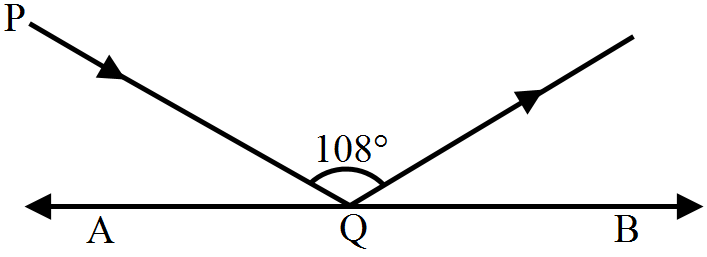
In the given figure $AB$ is a mirror, $PQ$ is the incident ray and $QR$ is the reflected ray. If $\angle\text{PQR}=108^\circ$ then $\angle\text{AQP}=?$
  • A
    $18^\circ$
  • B
    $54^\circ$
  • C
    $72^\circ$
  • $36^\circ$
Answer
Correct option: D.
$36^\circ$
According to question,
$\angle\text{AQP}=\angle\text{BQR}=\text{x}$
$\angle\text{AQP}+\angle\text{BQR}+\angle\text{PQR}=180^\circ$ (Linear Pair)
$2x + 108^\circ = 180^\circ$
$x = 36^\circ $.
View full question & answer
MCQ 2251 Mark
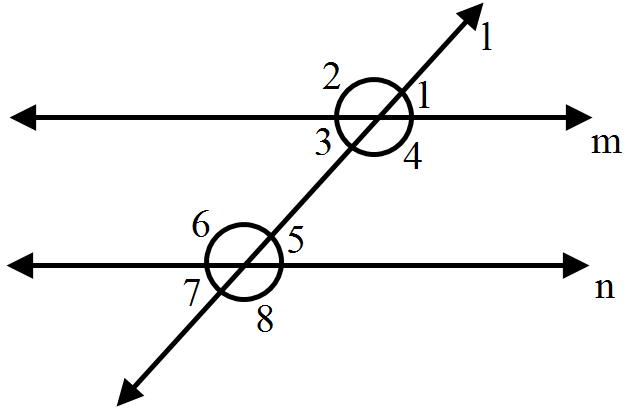
In the adjoining figure, if $m \| n$, then $\angle4+\angle7$ is equal to:
  • $180^\circ$
  • B
    $120^\circ$
  • C
    $90^\circ$
  • D
    $150^\circ$
Answer
Correct option: A.
$180^\circ$
$\angle1=\angle5$ (Corresponding angle)
$\angle7=\angle5$ (Vertically Opposite angle)
$\angle4+\angle1=180^\circ$ (Linear Pair)
$\angle4+\angle7=180^\circ$ (From above equations).
View full question & answer
MCQ 2261 Mark
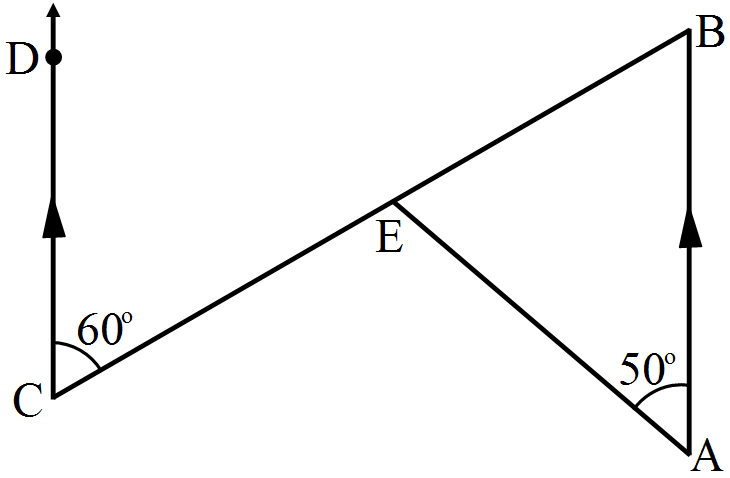
In the given figure, $AB \| CD$. If $\angle\text{EAB}=50^\circ$ and $\angle\text{ECD}=60^\circ$ then $\angle\text{AEB}=?$
  • A
    $50^\circ$
  • B
    $60^\circ$
  • $70^\circ$
  • D
    $55^\circ$
Answer
Correct option: C.
$70^\circ$
Let $\angle\text{AEB}=\text{x}^\circ$
Now, $AB \| CD$ and $BC$ is the transversal
$\therefore\angle\text{ABE}=\angle\text{BCD}=60^\circ$ (Alterante angles)
In $\triangle\text{ABE},$
$\angle\text{BAE}+\angle\text{AEB}+\angle\text{ABE}=180^\circ$ (Angle sum property)
$\Rightarrow50^\circ+\text{x}^\circ+60^\circ=180^\circ$
$\Rightarrow\text{x}=70^\circ$
$\therefore\angle\text{AEB}=70^\circ$
View full question & answer
MCQ 2271 Mark
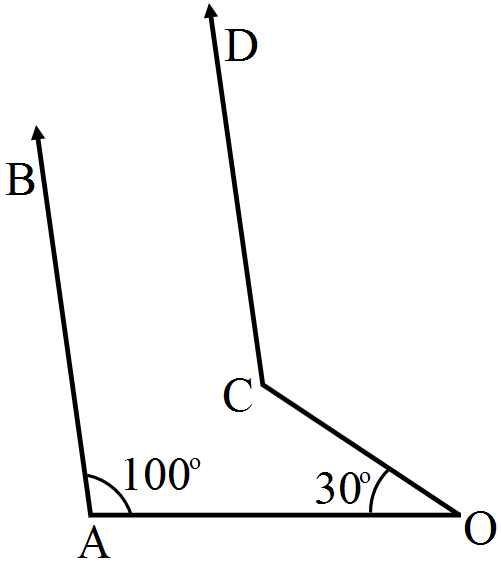
In the given figure, $AB \| CD$. If $\angle\text{AOC}=30^\circ$ and $\angle\text{OAB}=100^\circ$ then $\angle\text{OCD}=?$
  • $130^\circ$
  • B
    $150^\circ$
  • C
    $80^\circ$
  • D
    $100^\circ$
Answer
Correct option: A.
$130^\circ$
Construction: Through $O$, draw $OE \| AB \| CD$
$\Rightarrow\angle\text{BAO}+\angle\text{EOA}=180^\circ$
$\Rightarrow100^\circ+\angle\text{EOA}=180^\circ$
$\Rightarrow\angle\text{EOA}=80^\circ$
So, $\angle\text{EOC}=\angle\text{EAO}-\angle\text{COA}=80^\circ-30^\circ=50^\circ$
Since $CD \| EO$
$\angle\text{OCD}+\angle\text{EOC}=1806^\circ$
$\Rightarrow\angle\text{OCD}+50^\circ=180^\circ$
$\Rightarrow\angle\text{OCD}=130^\circ$
View full question & answer
M.C.Q - Page 5 - Maths STD 9 Questions - Vidyadip