Question 514 Marks
Solve the following systems of equations:
$3x - 7y + 10 = 0,$
$y - 2x - 3 = 0.$
AnswerThe given equations are
$3x - 7y + 10 = 0 ......(i)$
$y - 2x - 3 = 0 ......(ii)$
Multiply equation $(i)$ by $2$ and equation $(ii)$ by $(3)$, and add both equations we get.
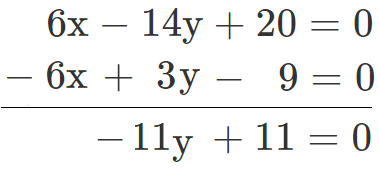
$\Rightarrow y = 1$
Put the value of y in equation $(i)$ we get,
$3x - 7 \times 1 + 10 = 0$
$\Rightarrow 3x = -3$
$\Rightarrow x = -1$
Hence the value of $x = -1$ and $y = 1.$ View full question & answer→Question 524 Marks
One says. "give me hundred, friend! I shall then become twice as rich as you" The other replies, "If you give me ten, I shall be six times as rich as you". Tell me what is the amount of their respective capital?
AnswerLet the money with first person be Rs. $x$ and the money with the recond person be Rs.$ y.$ Then
$\Rightarrow (x + 100) = 2(y - 100)$
$\Rightarrow (y + 10) = 6(x - 10)$
It is given trhat if first person given Rs. $100$ to second person then second person will become twice as rich as first person.
Then, according to the question.
$\Rightarrow (x + 100) = 2(y - 100)$
$\Rightarrow x + 100 = 2y - 200$
$\Rightarrow x - 2y + 100 + 200 = 0$
$\Rightarrow x - 2y + 300 = 0 .....(i)$
It is also given that if first person gives Rs. $100$ to second person then the second person will become twice as rich as first person.
Then according to the question, we have
$\Rightarrow (y + 10) = 6(x - 10)$
$\Rightarrow y + 10 = 6x - 60$
$\Rightarrow 6x - y - 60 - 10$
$\Rightarrow 6x - y - 70 = 0 .....(ii)$
Now, multiplying eq. $(ii)$ by $2$ and we get
$\Rightarrow 12x - 2y - 140 = 0 .....(iii)$
By subtracting eq. $(iii)$ from eq. $(i)$ and we get
$\Rightarrow x - 2y + 300 - (12x - 2y - 140)$
$\Rightarrow x - 2y + 300 - 12x + 2y + 140 = 0$
$\Rightarrow -11x + 440 = 0$
$\Rightarrow 11x = 440$
$\Rightarrow\text{x}=\frac{440}{11}$
$\Rightarrow x = 40$
Now, Putting $x = 40$ in eq. $(ii)$ and we get
$6 \times 40 - y - 70 = 0$
$\Rightarrow 240 - y - 70 = 0$
$\Rightarrow -y + 170 = 0$
$\Rightarrow -y = -170$
$\Rightarrow y = 170$
Hence, first person's capital will be Rs. $40$ recond person's capital will be Rs. $170$
View full question & answer→Question 534 Marks
A boat goes $24\ km$ upstream and $28\ km$ downstream in $6$ hrs. It goes $30\ km$ upstream and $21\ km$ downstream in $6\frac{1}{2}$ hrs. Find the speed of the boat in still water and also speed of the stream.
AnswerLet the speed of stream and boat in still water be $y \ km/ hr$ and $x \ km/ hr$ respectively.
Speed upstream $= (x - y) km/ hr$
Speed upstream $= (x + y) km/ hr$
Times taken to cover 24 km. upstream $=\frac{24}{\text{x}-\text{y}}(\text{hour})$
Times taken to cover 28 km downstream $=\frac{28}{\text{x}+\text{y}}(\text{hour})$
Total journey of 6 hours $=\frac{24}{\text{x}-\text{y}}+\frac{28}{\text{x}+\text{y}}$
$\Rightarrow6=\frac{24}{(\text{x}-\text{y})}+\frac{28}{(\text{x}+\text{y})}\ .....(\text{i})$
When total journey of $6\frac{1}{2}$ hours $=\frac{30}{(\text{x}-\text{y})}+\frac{21}{(\text{x}+\text{y})}$
$\Rightarrow\frac{13}{2}=\frac{30}{(\text{x}-\text{y})}+\frac{21}{(\text{x}+\text{y})}\ ....(\text{ii})$
Let $\frac{1}{\text{x}-\text{y}}=\text{u}$ and $\frac{1}{\text{x}+\text{y}}=\text{v}$
multiplying $(iii)$ by $5$ and $(iv)$ by $2$, we get
$\Rightarrow60\text{u}+70\text{v}=15\ ....(\text{v})$
$\Rightarrow60\text{u}+42\text{v}=13\ ....(\text{vi})$
Subtracting $(vi)$ from $(v)$ we get
$\Rightarrow28\text{v}=15-13$
$\Rightarrow28\text{v}=2$
$\Rightarrow\text{v}=\frac{1}{14}$
Putting $\text{v}=\frac{1}{14}$ in $(v)$ we get
$\Rightarrow60\text{u}+70\times\frac{1}{14}=15$
$\Rightarrow60\text{u}+5=15$
$\Rightarrow60\text{u}=10$
$\Rightarrow\text{u}=\frac{1}{6}$
$\because\frac{1}{\text{x}-\text{y}}=\text{u}$
$\Rightarrow\frac{1}{\text{x}-\text{y}}=\frac{1}{6}$
$\text{x}-\text{y}=6\ ....(\text{vii})$
and $\frac{1}{\text{x}+\text{y}}=\text{v}$
$\Rightarrow\frac{1}{\text{x}+\text{y}}=\frac{1}{14}$
$\Rightarrow\text{x}+\text{y}=14\ .....(\text{viii})$
Adding $(vii)$ and $(viii)$ we get
$\Rightarrow2\text{x}=20$
$\Rightarrow\text{x}=10$
Putting $x = 10$ in $(viii)$ we get
$\Rightarrow10+\text{y}=14$
$\Rightarrow\text{y}=4$
Thus, speed of stream $= 4\ km/ hr.$
And, speed of boat in still water $= 10\ km/ hr.$
View full question & answer→Question 544 Marks
Solve the following system of equations by the method of cross-multiplication:
$ a^2 x+b^2 y=c^2$
$ b^2 x+a^2 y=d^2$
AnswerGiven,
$ a^2 x+b^2 y=c^2$
$ b^2 x+a^2 y=d^2$
To find: The solution of the systems of equation by the method of cross-multiplication: Here we have the pair of simultaneous equation,
$a^2 x+b^2 y-c^2=0$
$ b^2 x+a^2 y-d^2=0$
By cross multiplication method we get,
$\Rightarrow\frac{\text{x}}{(-\text{d}^2\text{b}^2)-(-\text{c}^2\text{a}^2)}=\frac{-\text{y}}{(-\text{d}^2\text{a}^2)-(-\text{c}^2\text{b}^2)}\\=\frac{1}{\text{a}^4-\text{b}^4}$
$\Rightarrow\frac{\text{x}}{(\text{c}^2\text{a}^2-\text{d}^2\text{b}^2)}=\frac{\text{y}}{(\text{d}^2\text{a}^2-\text{c}^2\text{b}^2)}=\frac{1}{\text{a}^4-\text{b}^4}$
Consider the following for x
$\Rightarrow \frac{\text{x}}{(\text{c}^2\text{a}^2-\text{d}^2\text{b}^2)}=\frac{1}{\text{a}^4-\text{b}^4}$
$\Rightarrow\text{x}=\frac{\text{a}^2\text{c}^2-\text{d}^2\text{b}^2}{\text{a}^4-\text{b}^2}$
Now consider the following for y
$\Rightarrow \frac{\text{y}}{(\text{d}^2\text{a}^2-\text{c}^2\text{b}^2)}=\frac{1}{\text{a}^4-\text{b}^4}$
$\Rightarrow \text{y}=\frac{\text{a}^2\text{d}^2-\text{b}^2\text{c}^2}{\text{a}^4-\text{b}^4}$
Hence, we get the value of $ \text{x}=\frac{\text{a}^2\text{c}^2-\text{b}^2\text{d}^2}{\text{a}^4-\text{b}^4}$ and $\text{y}=\frac{\text{a}^2\text{d}^2-\text{b}^2\text{c}^2}{\text{a}^4-\text{b}^4}$
View full question & answer→Question 554 Marks
$7$ audio cassettes and $3$ video cassettes cost Rs. $1110,$ while 5 audio cassettes and $4$ video cassettes cost Rs. $1350$. Find the cost of an audio cassette and a video cassette.
AnswerLet x and y be the cost of audio and video cassettes respectively.
cost of $7$ audio and $3$ video cassette $Rs. 1110$
$7x + 3y = 1110 .....(i)$
Cost of 5 audion and 4 video cassettes $Rs. 1350$
5x + 4y = 1350 ......$(ii)$
Multiplying $(i)$ by $4$ and $(ii)$ by $3$, we get
$28x + 12y = 4440 .....(iii)$
$15x + 12y = 4050 ........(iv)$
Subtracting $(iv)$ from $(iii)$ we get
$\Rightarrow 13x = 390$
$\Rightarrow\text{x}=\frac{390}{13}=30$
Putting $x = 30$ in $(i)$ we get
$\Rightarrow 7 \times 30 + 3y = 1110$
$\Rightarrow 3y = 1110 - 210$
$\Rightarrow\text{y}=\frac{900}{3}=300$
Thus cost of cassette = $Rs. 30$ and cost of video cassette = $Rs. 300$
View full question & answer→Question 564 Marks
Solve the following systems of equations:
$23x - 29y = 98,$
$29x - 23y = 110.$
AnswerThe given equations are
$23x - 29y = 98 .......(i)$
$29x - 23y = 110 .......(ii)$
Adding $(i)$ and $(ii)$ we get
$\Rightarrow 52x - 52y = 208$
$\Rightarrow x - y = 4 .......(iii)$
Subtracting $(i)$ from $(ii)$ we get
$\Rightarrow 6x + 6y = 12$
$\Rightarrow x + y = 2 ........(iv)$
Adding $(iii)$ and $(iv)$ we get
$\Rightarrow 2x = 6$
$\Rightarrow x = 3$
Putting $x = 3$ in $(iv)$ we get
$\Rightarrow 3 + y = 2$
$\Rightarrow y = -1$
Thus, $x = 3 $and $y = -1.$
View full question & answer→Question 574 Marks
Solve the following systems of equations:
$11x + 15y + 23 = 0,$
$7x - 2y - 20 = 0.$
AnswerThe given equations are
$11x + 15y + 23 = 0 ......(i)$
$7x - 2y - 20 = 0 .......(ii)$
From $(i)$, we get
$\text{y}=\frac{-23-11\text{x}}{15}\ .....(\text{iii})$
Putting the values of y from $(iii)$ to $(ii)$, we get
$\Rightarrow\text{7}\text{x}-2\Big(\frac{-23-11\text{x}}{15}\Big)-20=0$
$\Rightarrow105\text{x}+46+22\text{x}-300=0$
$\Rightarrow127\text{x}-254=0$
$\Rightarrow\text{x}=\frac{254}{127}$
$\Rightarrow\text{x}=2$
Putting $x = 2$ in $(iii),$ we get
$\Rightarrow\text{y}=\frac{-23-11\times2}{15}$
$\Rightarrow\frac{-45}{15}$
$\Rightarrow\text{y}=-3$
Thus, $x = 2$ and $y = -3.$
View full question & answer→Question 584 Marks
Solve the following system of equations by the method of cross-multiplication:
$x + ay = b,$
$ax - by = c.$
AnswerThe given system of equations by be written as
$x + ay - b = 0$
$ax - by - c = 0$
Here $a_1=1, b_1=a, c_1=-b$
$\mathrm{a}_2=\mathrm{a}, \mathrm{b}_2=-\mathrm{b}$ and $\mathrm{c}_2=-\mathrm{c}$
$\Rightarrow\ \frac{\text{x}}{\text{a}\times(-\text{c})-(-\text{b})\times(-\text{b})}=\frac{-\text{y}}{1\times(-\text{c})-(-\text{b})\times\text{a}}\\=\frac{1}{1\times(-\text{b})-\text{a}\times\text{a}}$
$\Rightarrow\ \frac{\text{x}}{-\text{a}\text{c}-\text{b}^2}=\frac{-\text{y}}{-\text{c}+\text{ab}}=\frac{1}{-\text{b}-\text{a}^2}$
Now, $\frac{\text{x}}{-\text{ac}-\text{b}^2}=\frac{1}{-\text{b}-\text{a}^2}$
$\Rightarrow\ \text{x}=\frac{-\text{ac}-\text{b}^2}{-\text{b}-\text{a}^2}$
$\Rightarrow\ \text{x}=\frac{-(\text{b}^2+\text{ac})}{-(\text{a}^2+\text{b})}$
and $\frac{-\text{y}}{-\text{c}+\text{ab}}=\frac{1}{-\text{b}-\text{a}^2}$
$\Rightarrow\ -\text{y}\frac{\text{ab}-\text{c}}{-(\text{a}^2+\text{b})}$
$\Rightarrow\ \text{y}=\frac{\text{ab}-\text{c}}{\text{a}^2+\text{b}}$
Hence, $\text{x}=\frac{\text{ac}+\text{b}^2}{\text{a}^2+\text{b}},\text{y}=\frac{\text{ab}-\text{c}}{\text{a}^2+\text{b}}$ is the solution of the given system the equations.
View full question & answer→Question 594 Marks
The present age of a father is three years more than three times the age of the son. Three years hence father's age will be $10$ years more than twice the age of the son. Determine their present ages.
AnswerLet the present age of father be $x$ years and the present age of his son be y years.
The present age of father is three years more than three times the age of the son. Thus, we have
$x = 3y + 3$
$\Rightarrow x - 3y - 3 = 0$
After $3$ years, father's age will be $(x + 3)$ years and son’s age will be $(y + 3)$ years.
Thus using the given information, we have
$x + 3 = 2(y + 3) + 10$
$\Rightarrow x + 3 = 2y + 6 + 10$
$\Rightarrow x - 2y - 13 = 0$
Here $x$ and $y$ are unknowns. We have to solve the above equations for $x$ and $y.$
By using cross-multiplication, we have
$\Rightarrow\frac{\text{x}}{(-3)\times(-13)-(-2)\times(-3)}=\frac{-\text{y}}{1\times(-13)-1\times(-3)}$
$=\frac{1}{1\times(-2)-1\times(-3)}$
$\Rightarrow\frac{\text{x}}{39-6}=\frac{-\text{y}}{-13+3}=\frac{1}{-2+3}$
$\Rightarrow\frac{\text{x}}{33}=\frac{-\text{y}}{-10}=\frac{1}{1}$
$\Rightarrow\frac{\text{x}}{33}=\frac{\text{y}}{10}=1$
$\Rightarrow\text{x}=33,\ \text{y}=10$
Hence, the present age of father is $33$ years and the present age of son is $10$ years.
View full question & answer→Question 604 Marks
Solve the following system of equations graphically:
Shade the region between the lines and the y-axis.
$3x - 4y = 7,$
$5x + 2y = 3.$
AnswerThe given equations are,
$3x - 4y = 7 ......(i)$
$5x + 2y = 3 ........(ii)$
From $(i)$, $\text{y}=\frac{3\text{x}-7}{4}\ .....(\text{iii})$
Putting $x = -3$ in equations $(iii)$, we get $y = -4$
Putting $x = 1$ in equations $(ii)$, we get $y = -1$
|
$x$
|
$-3$
|
$1$
|
|
$y$
|
$-4$
|
$-1$
|
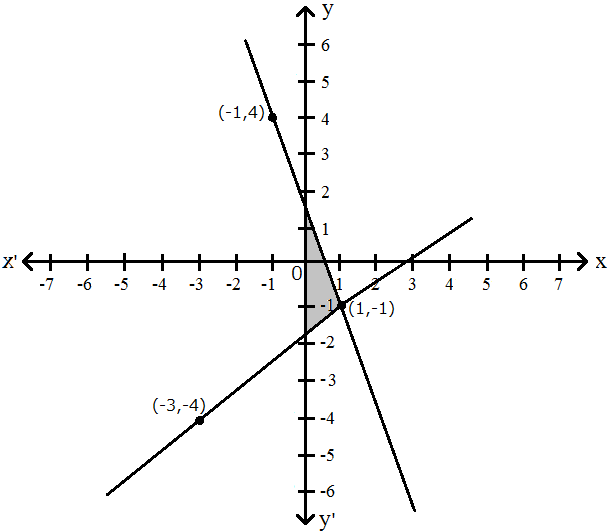
From $(ii)$, $\text{y}=\frac{3-5\text{x}}{2}\ ......(\text{iv})$
Putting $x = 1$ in equations$ (ii),$ we get $y = -1$
Putting $x = -1$ in equations$ (ii), $we get$ y = 4$
|
$x$
|
$1$
|
$-1$
|
|
$y$
|
$-1$
|
$4$
|
Clearly, from the graph that these two lines intersect each other at point $(1, -1)$ so solution of these equation $x = 1$ and $y = -1.$ View full question & answer→Question 614 Marks
Solve the following systems of equations graphically:
$2x + 3y = 4$
$x - y + 3 = 0$
AnswerThe given equations are,
$2x + 3y = 4 ......(i)$
$x - y + 3 = 0 ........(ii)$
Putting $x = 0$ in equation $(i)$, we get,
$\Rightarrow 2 \times 0 + 3y = 4$
$\Rightarrow\text{y}=\frac{4}{3}$
$\Rightarrow\text{x}=0,\ \text{y}=\frac{4}{3}$
Putting $y = 0$ in equation $(i)$, we get,
$\Rightarrow 2x + 3 \times 0 = 4$
$\Rightarrow x = 2$
$\Rightarrow x = 2, y = 0$
Use the following table to draw the graph.
|
$X$
|
$0$
|
$2$
|
|
$Y$
|
$\frac{4}{3}$
|
$0$
|
Draw the graph by plotting the two points $\text{A}\Big(0, \frac{4}{3}\Big)$ and $B(2, 0)$ from table.
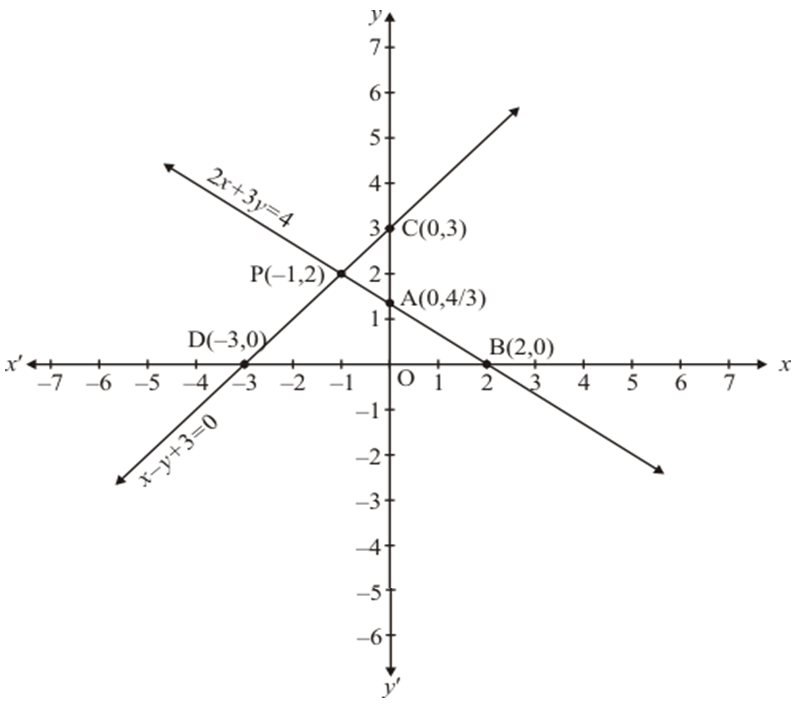
Graph of the equation,
$\Rightarrow x - y = -3 ........(ii)$
Putting $x = 0$ in equation $(ii)$, we get,
$\Rightarrow 0 - y = -3$
$\Rightarrow y = 3$
$\Rightarrow x = 0, y = 3$
Putting $y = 0$ in equation $(ii)$, we get,
$\Rightarrow x - 0 = -3$
$\Rightarrow x = -3$
$\Rightarrow x = -3, y = 0$
Use the following table to draw the graph.
Draw the graph by plotting the two points $C(0, 3)$ and $D(-3, 0)$ from table.
The two lines intersect at points $P(-1, 2).$
Hence, $x = -1$ and $y = 2$ is the solution. View full question & answer→Question 624 Marks
Solve the following systems of equations:
$\text{x}+\text{y}=2\text{xy},$
$\frac{\text{x}-\text{y}}{\text{xy}}=6,\text{x}\neq0,\text{y}\neq0.$
AnswerThe system of the given equation is
$\text{x}+\text{y}=2\text{xy}\ ......(\text{i})$
And, $\frac{\text{x}-\text{y}}{\text{xy}}=6$
$\text{x}-\text{y}=6{\text{xy}}\ ......(\text{ii})$
Adding equation $(i)$ and equation $(ii)$ we get
$2{\text{x}}=2{\text{xy}}+6{\text{xy}}$
$\Rightarrow2{\text{x}}=8{\text{xy}}$
$\Rightarrow\frac{2{\text{x}}}{8{\text{x}}}={\text{y}}$
$\Rightarrow{\text{y}}=\frac{1}{4}$
Putting ${\text{y}}=\frac{1}{4}$ in equation $(i)$ we get
${\text{x}}+\frac{1}{4}=2{\text{x}}\times\frac{1}{4}$
$\Rightarrow{\text{x}}+\frac{1}{4}=\frac{\text{x}}{2}$
$\Rightarrow{\text{x}}-\frac{\text{x}}{2}=\frac{-1}{4}$
$\Rightarrow\frac{2\text{x}-\text{x}}{2}=\frac{-1}{4}$
$\Rightarrow{\text{x}}=\frac{-2}{4}=\frac{-1}{2}$
Hence, solution of the given system of equation is ${\text{x}}=\frac{-1}{2},\text{y}=\frac{1}{4}.$
View full question & answer→Question 634 Marks
If x + 1 is a factor of $2(x)^3+a x^2+2 b x+1$, then find the values of a and b given that $2a - 3b = 4.$
AnswerGiven that $(x+1)$ is a factor of $f(x)=2(x)^3+a x^2+2 b x+1$, then $f(-1)=0$
[if $(x+\alpha)$ is a factor of $f(x)=a x^2+b x+c$, then $f(-)=0$ ]
$\Rightarrow 2(-1)^3+\mathrm{a}(-1)^2+2 \mathrm{~b}(-1)+1=0$
$\Rightarrow -2 + a - 2b + 1 =0$
$\Rightarrow a - 2b - 1 = 0 .....(i)$
Also,$2a - 3b = 4$
$\Rightarrow 3b = 2a - 4$
$\Rightarrow\text{b}=\Big(\frac{2\text{a}-4}{3}\Big)$
Now, put the value of b in eq. $(i)$ qe get
$\text{a}-2\Big(\frac{2\text{a}-4}{3}\Big)-1=0$
$\Rightarrow 3a - 2(2a - 4) - 3 = 0$
$\Rightarrow 3a - 4a + 8 - 3 = 0$
$\Rightarrow -a + 5 = 0$
$\Rightarrow a = 5$
Now put the value of a in eq $(i)$ we get
$5 - 2b - 1 = 0$
$\Rightarrow 2b = 4$
$\Rightarrow b = 2$
Hence the required value of a and b are $5$ and $2$ respectively.
View full question & answer→Question 644 Marks
The sum of two numbers is $1000$ and the difference between their squares is $256000$. Find the numbers.
AnswerLet the numbers are x and y. One of them must be greater than or equal to the other. Let us assume that x is greater than or equal to y.
The sum of the two numbers is 1000. Thus, we have $x + y = 1000$
The difference between the squares of the two numbers is $256000.$ Thus, we have
$x^2- y^2= 256000$
$\Rightarrow (x + y)(x - y) = 256000$
$\Rightarrow 1000(x - y) = 256000$
$\Rightarrow\text{x}-\text{y}=\frac{256000}{1000}$
$\Rightarrow x - y = 256$
So, we have two equations
$x + y = 1000$
$x - y = 256$
Here x and y are unknowns. We have to solve the above equations for x and y.
Adding the two equations, we have
$(x + y) + (x - y) = 1000 + 256$
$\Rightarrow x + y + x - y = 1256$
$\Rightarrow 2x = 1256$
$\Rightarrow\text{x}=\frac{1256}{2}$
$\Rightarrow x = 628$
Substituting the value of x in the first equation, we have
$628 + y = 1000$
$\Rightarrow y = 1000 - 628$
$\Rightarrow y = 372$
Hence, the numbers are $628$ and $372.$
View full question & answer→Question 654 Marks
A train covered a certain distance at a uniform speed. If the train could have been $10\ km/hr$. faster, it would have taken $2$ hours less than the scheduled time. And, if the train were slower by $10\ km/hr$. it would have taken $3$ hours more than the scheduled time. Find the distance covered by the train.
AnswerLet the actual speed of the train be $x$ km/hr. and the actual time taken by $y$ hours. Then,
Distance = Speed $\times $ Time
Distance covered $= (xy) km .....(i)$
If the speed is increased by $10km/ hr$. then time of journey is reduced by $2$ hours When speed is $(x + 10) km/hr$. time of journey is $(y - 2)$ hours
Distance coverd $= (x + 10) (y - 2)$
$xy = (x + 10) (y - 2)$
$xy = xy + 10y - 2x - 20$
$-2x + 10y - 20 = 0$
$-2x + 3y - 12 = 0 ......(ii)$
When the speed is reduced by $10\ km/hr$, then the time of journey is increased by $3$ hours when sped is $(x - 10) km/hr$. times of journey is $(y + 3)$ hours
$\therefore$ Distance covered $= (x - 10) (y + 3)$
$xy = (x - 10) (y + 3)$
$xy = xy - 10y + 3x - 30$
$0 = -10y + 3x - 30$
$3x - 10y - 30 = 0 ......(iii)$
Thus we obtain the following system of equations:
$-x + 5y - 10 = 0$
$3x - 10y - 30 = 0$
By using cross-multiplication we have
$\Rightarrow\frac{\text{x}}{5\text{x}-30-(-10)\times-10}=\frac{-\text{y}}{(-1\times-30)-(3\text{x}-10)}$
$=\frac{1}{(-1\times-10)-(3\times5)}$
$\Rightarrow\frac{\text{x}}{-150-100}=\frac{-\text{y}}{30+30}=\frac{1}{10-15}$
$\Rightarrow\frac{\text{x}}{-250}=\frac{-\text{y}}{60}=\frac{1}{-5}$
$\Rightarrow\text{x}=\frac{-250}{-5}$
$\Rightarrow\text{x}=50$
$\Rightarrow\text{y}=\frac{-60}{-5}$
$\Rightarrow\text{y}=12$
Putting the value os $x$ and $y$ in equation $(i)$ we get
Distance $= xy km$
$= 50 \times 12$
$= 600km$
Hence, the length of the journey is $600km.$
View full question & answer→Question 664 Marks
A sailor goes $8\ km$ downstream in $40$ minutes and returns in $1$ hours. Determine the speed of the sailor in still water and the speed of the current.
AnswerLet the speed of the sailor in still water be x km/hr and the spped of the current be y km/hr.
Then,
Speed downstream $= (x + y) km/hr$
Speed in return journey $= (x - y) km/hr$
Now, Time taken cover $8\ km$ downstream $=\frac{8}{\text{x}+\text{y}}\text{hrs.}$
But, Time taken to cover $8\ km$ downstream is $40$ minutes
$\Rightarrow\frac{8}{\text{x}+\text{y}}=\frac{40}{60}$
$\Rightarrow\frac{8}{\text{x}+\text{y}}=\frac{2}{3}$
$\Rightarrow\frac{8\times3}{2}=\text{x}+\text{y}$
$\Rightarrow4\times3=\text{x}+\text{y}$
$\Rightarrow\text{x}+\text{y}=12\ ....(\text{i})$
and, Times taken in return journey $=\frac{8}{\text{x}-\text{y}}\text{km/hr}$
But Time taken in return journey is $1$ hour
$=\frac{8}{\text{x}-\text{y}}=1$
$\Rightarrow\text{x}-\text{y}=8\ .....(\text{ii})$
Adding equation $(i)$ and equation $(ii)$ we get
$2\text{x} = 12 + 8$
$\Rightarrow2\text{x} = 20$
$\Rightarrow\text{x}=\frac{20}{2}=10$
Putting $x = 10$ in equation $(i)$ we get
$10+\text{y}=12$
$\Rightarrow\text{y}=12-10$
$\Rightarrow\text{y}=2$
Hence, speed of the sailor in still water $= 10km/hr$
Speed of the current $= 2km/hr.$
View full question & answer→Question 674 Marks
Determine the values of a and b so that the following system of linear equations have infinitely many solutions:
$(2a - 1)x + 3y - 5 = 0$
$3x + (b - 1)y - 2 = 0$
AnswerThe given system of equations may be written as
$(2a - 1)x + 3y - 5 = 0$
$3x + (b - 1)y - 2 = 0$
It is of the form
$ a_1 x+b_1 y+c_1=0$
$ a_2 x+b_2 y+c_2=0$
Where, $a_1=2 a-1, b_1=3, c_1=-5$
And $\mathrm{a}_2=3, \mathrm{~b}_2=\mathrm{b}-1, \mathrm{c}_2=-2$
The given system of equations will have infinite number of solutions, if
$\frac{\text{a}_1}{\text{a}_2}=\frac{\text{b}_1}{\text{b}_2}=\frac{\text{c}_1}{\text{c}_2}$
$\Rightarrow\frac{2\text{a}-1}{3}=\frac{3}{\text{b}-1}=\frac{-5}{-2}$
$\Rightarrow\frac{2\text{a}-1}{3}=\frac{-5}{-2}$ and $\frac{3}{\text{b}-1}=\frac{-5}{-2}$
$\Rightarrow2(2\text{a}-1)=5\times3$ and $3\times2=5(\text{b}-1)$
$\Rightarrow4\text{a}-2=15$ and $6 = 5\text{b}-5$
$\Rightarrow4\text{a}=15+2$ and $6+5=5\text{b}$
$\Rightarrow\text{a}=\frac{17}{4}$ and $\text{b}=\frac{11}{5}$
Hence the given system of equations will have infinitely many solutions, if $\text{a}=\frac{17}{4}$ and $\text{b}=\frac{11}{5}$
View full question & answer→Question 684 Marks
Ramesh travels $760\ km$ to his home partly by train and partly by car. He takes $8$ hours if he travels $160\ km$. by train and the rest by car. He takes $12$ minutes more if the travels $240\ km$ by train and the rest by car. Find the speed of the train and car respectively.
AnswerLet speed of train and car be $x km/ hr.$ and $y km/ hr.$
According to question
$\frac{160}{\text{x}}+\frac{600}{\text{y}}=8\ ....(\text{i})$
$\frac{240}{\text{x}}+\frac{520}{\text{y}}=8+\frac{12}{60}$
$\frac{240}{\text{x}}+\frac{520}{\text{y}}=\frac{41}{5}\ .....(\text{ii})$
Let $\frac{1}{\text{x}}=\text{u}$ and $\frac{1}{\text{y}}=\text{v}$
$\Rightarrow160\text{u}+600\text{v}=8$
$\Rightarrow20\text{u}+75\text{v}=1\ .....(\text{iii})$
$\Rightarrow240+520=\frac{41}{5}\ .....(\text{iv})$
Multiplying $(3)$ by $12$ we get
$\Rightarrow240\text{u}+900\text{v}=12\ .....(\text{v})$
subtracting $(iv)$ from $(v)$ we get
$\Rightarrow380\text{v}=\frac{19}{5}$
$\Rightarrow\text{v}=\frac{1}{100}$
Putting $\frac{1}{100}$ in $(v)$ we get
$\Rightarrow240\text{u}+900\times\frac{1}{100}=12$
$\Rightarrow240\text{u}+9=12$
$\Rightarrow240\text{u}=3$
$\Rightarrow\text{u}=\frac{3}{240}=\frac{1}{80}$
$\because\frac{1}{\text{x}}=\text{u}$
$\Rightarrow\text{x}=\frac{1}{\text{u}}=80\text{km/ hr.}$
and, $\frac{1}{\text{y}}=\text{v}$
$\Rightarrow\text{y}=\frac{1}{\text{v}}=100\text{km/ hr.}$
Thus, speed of train $= 80km/ hr.$
and, speed of car $= 100km/ hr.$
View full question & answer→Question 694 Marks
Draw the graphs of the following equations:
$2x - 3y + 6 = 0$
$2x + 3y - 18 = 0$
$y - 2 = 0$
Find the vertices of the triangle so obtained. Also, find the area of the triangle. AnswerThe given system of equations is
$2x - 3y + 6 = 0$
$2x + 3y - 18 = 0$
$y - 2 = 0$
Now, $2x - 3y + 6 = 0$
$⇒ 2x = 3y - 6$
$\Rightarrow\text{x}=\frac{3\text{y}-6}{2}$
When y = 0, we have
$\text{x}=\frac{3\times0-6}{2}=-3$
When y = 2, we have
$\text{x}=\frac{3\times2-6}{2}=0$
Thus, we have the following table
We have,
$2x + 3y - 18 = 0$
$⇒ 2x = 18 - 3y$
$\Rightarrow\text{x}=\frac{18-3\text{y}}{2}$
When $y = 2$, we have
$\Rightarrow\text{x}=\frac{18-3\times2}{2}=6$
When $y = 6,$ we have
$\text{x}=\frac{18-3\times6}{2}=0$
Thus, we have the following table.
We have,
$y - 2 = 0$
$⇒ y = -2$
Graph of the given system of equations.
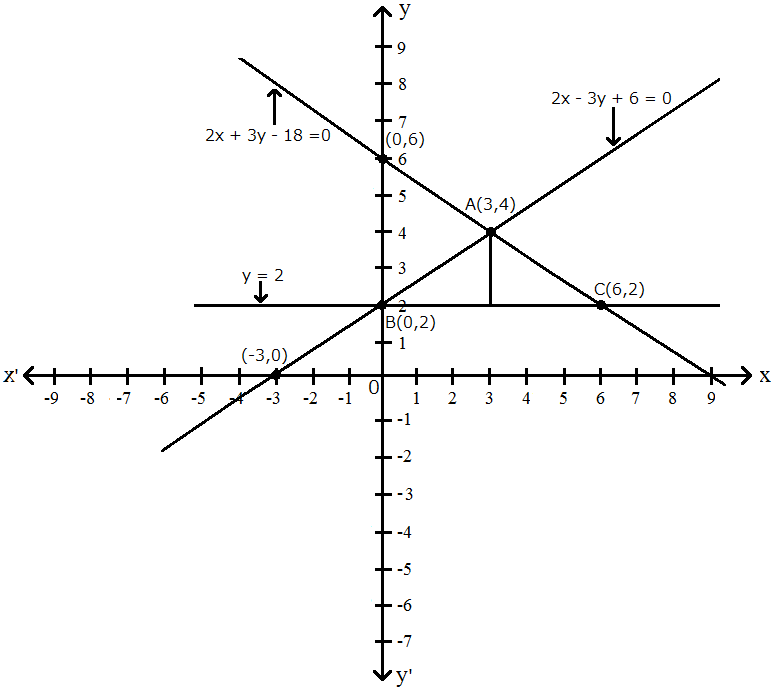
From the graph of the three equations, we find that the three lines taken in pairs intersect each other at points $A(3, 4), B(0, 2)$ and $C(6, 2).$
Hence, the vertices of the required triangle are $(3, 4), (0, 2)$ and $(6, 2).$
From graph, we have
$AD = 4 - 2 = 2$
$BC = 6 - 0 = 6$
Area of $\triangle\text{ABC}=\frac{1}{2}\text{(Base} \times \text{Height)}$
$=\frac{1}{2}\times\text{BC}\times\text{AD}$
$=\frac{1}{2}\times6\times2$
$=6\text{ sq.units.}$
$\therefore$ Area of $\triangle\text{ABC}=6\text{sq.units}.$ View full question & answer→Question 704 Marks
Solve graphically the following system of linear equation. Also find the coordinates of the points where the lines meet axis of $y.$
$2x + y - 11 = 0,$
$x - y - 1 = 0.$
AnswerThe given equations are
$2x + y - 11 = 0 ........(i)$
$x - y - 1 = 0 ...........(ii)$
From $(i), y = 11 - 2x .......(iii)$
Putting $x = 1$ in $(iii)$, we get $y = 9$
Putting $x = 2$ in $(iii)$, we get $y = 7$
Putting $x = 3$ in $(iii)$, we get $y = 5$
|
$x$
|
$1$
|
$2$
|
$3$
|
|
$y$
|
$9$
|
$7$
|
$5$
|
From $(ii), x - y - 1 = 0 .......(iv)$
$y = x - 1$
Putting $x = 1$ in $(iv)$, we get $y = 0$
Putting $x = 2$ in $(iv),$ we get $y = 1$
Putting $x = 3$ in $(iv),$ we get $y = 2$
|
$x$
|
$1$
|
$2$
|
$3$
|
|
$y$
|
$0$
|
$1$
|
$2$
|
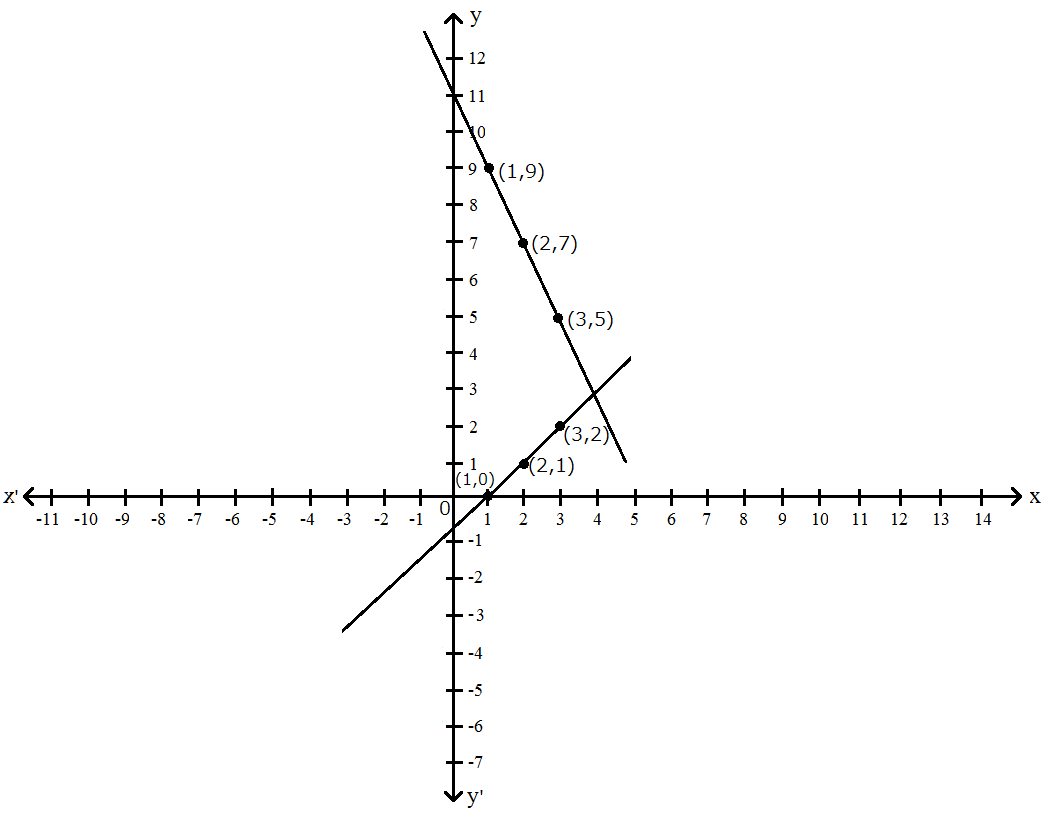
When we solv4e these equations $x = 4$ and $y = 3$, this is the point where these lines intersect each other. $(0, -1)$ abd $(0, 11)$ are the points where the lines mut axis of $y.$ View full question & answer→Question 714 Marks
$2$ women and $5$ men can together finish a piece of embroidery in $4$ days, while $3$ women and $6$ men can finish it in $3$ days. Find the time taken by $1$ woman alone to finish the embroidery, and that taken by $1$ man alone.
AnswerLet one women alone can finish the work in $x$ days and one men can finish the work in $y$ days. then,
One women one days's work $=\frac{1}{\text{x}}$
One man one day's work $=\frac{1}{\text{y}}$
$2$ women's one day's work $=\frac{2}{\text{x}}$
$5$ man's one day's work $=\frac{5}{\text{y}}$
Since, $2$ women and $5$ men can finish the work in $4$ works
$\Rightarrow 4\Big(\frac{2}{\text{x}}+\frac{5}{\text{y}}\Big)=1$
$\Rightarrow\frac{8}{\text{x}}+\frac{20}{\text{y}}=1.....(\text{i})$
$3$ women and $6$ men can finish the work in $3$ days.
$\Rightarrow 3\Big(\frac{3}{\text{x}}+\frac{6}{\text{y}}\Big)=1$
$\Rightarrow\frac{9}{\text{x}}+\frac{18}{\text{y}}=1.....(\text{iii})$
Putting $\frac{1}{\text{x}}=\text{u}$ and $\frac{1}{\text{y}}=\text{v}$ in eq. $(i)$ and eq. $(ii)$ and we get
By using cross multiplication we have
$\Rightarrow \frac{\text{u}}{20\times(-1)-(18)\times(-1)}=\frac{\text{-v}}{8\times(-1)-9\times(-1)}\\=\frac{1}{(8\times18)-(9\times20)}$
$\Rightarrow\frac{\text{u}}{-20+18}=\frac{\text{-v}}{-8+9}=\frac{1}{144-180}$
$\Rightarrow \frac{\text{u}}{-2}=\frac{\text{-v}}{1}=\frac{1}{-36}$
$\Rightarrow \frac{\text{u}}{-2}=\frac{1}{-36}$
$\Rightarrow \text{u}=\frac{-2}{-36}=\frac{1}{18}$
$\Rightarrow \frac{\text{-v}}{1}=\frac{1}{-36}$
$\Rightarrow \text{v}=\frac{1}{36}$
$\Rightarrow \frac{1}{\text{x}}=\frac{1}{18}$
$\Rightarrow\text{x}=18$
$\Rightarrow \text{v}=\frac{1}{36}$
$\Rightarrow\text{y}=36$
Hence, the time taken by $1$ women alone to finish the embroidery is $36$ days. The time taken by $1$ man alone to finish the embroidery is $18$ days.
View full question & answer→Question 724 Marks
Form the pair of linear equations in the following problems, and find their solution graphically:
$10$ students of class $X$ took part in Mathematics quiz. If the number of girls is $4$ more than the number of boys, find the number of boys and girls who took part in the quiz.
AnswerLet the number of girls and boys in the class be $x$ and $y$ respectively.
According to the given conditions, we have,
$x + y = 10$
$x - y = 4$
$x + y = 10$
$⇒ x = 10 - y$
Three solutions of this equations can be written in a table as follows,
|
$x$
|
$4$
|
$5$
|
$6$
|
|
$y$
|
$6$
|
$5$
|
$4$
|
$x - y = 4$
$⇒ x = 4 + y$
Three solutions of this equation can be written in a table as follows.
|
$x$
|
$5$
|
$4$
|
$3$
|
|
$y$
|
$1$
|
$0$
|
$-1$
|
The graphical representation is as follows.
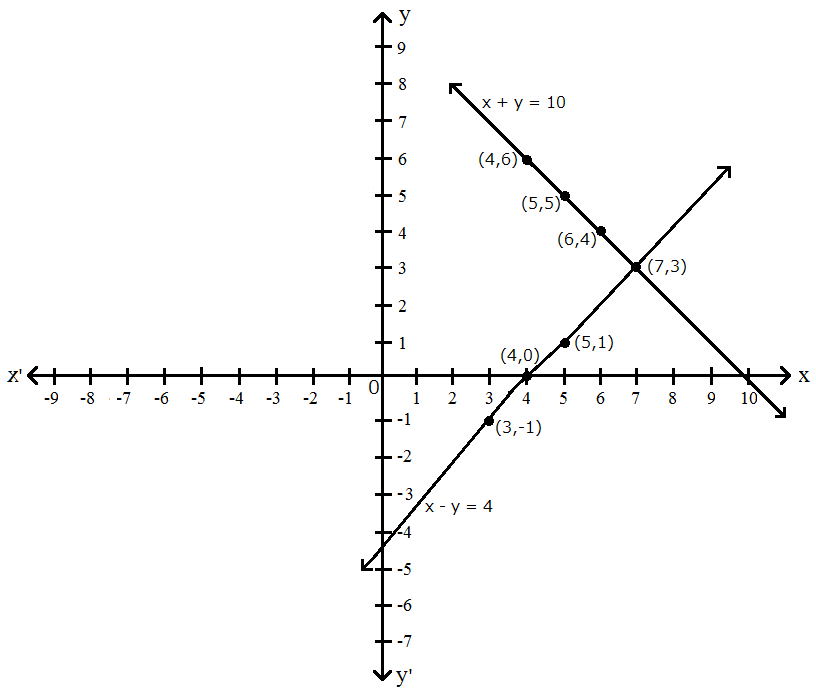
From the graph, it can be observes that the two lines intersect each other at the point $(7, 3)$. So. $x = 7$ and $y = 3.$ Thus the number of girls and boys in the class are $7$ and $3$ respectively. View full question & answer→Question 734 Marks
Solve the following systems of equations:
$\frac{6}{\text{x}+\text{y}}=\frac{7}{\text{x}-\text{y}}+3$
$\frac{1}{2(\text{x}+\text{y})}=\frac{1}{3(\text{x}-\text{y})}$ where $\text{x}+\text{y}\neq0$ and $\text{x}-\text{y}\neq0.$
AnswerLet $\frac{1}{\text{x}+\text{y}}=\text{u}$ and $\frac{1}{\text{x}-\text{y}}=\text{v}$
$6\text{u}-7\text{v}-3=0\ .....(\text{i})$
$\frac{\text{u}}{2}=\frac{\text{v}}{3}$
$3\text{u}=2\text{v}$
$3\text{u}-2\text{v}=0$
Maltiplying by $2$
$6\text{u}-4\text{v}=0\ ...(\text{iii})$
Now substracting $(iii)$ from $(i)$ we get
$-7\text{v}+4\text{v}=3$
$\text{v}=-1$
Putting $v = -1$ in equation $(iii)$
$6\text{u}+4=0$
$\text{u}=\frac{-2}{3}$
$\because\frac{1}{\text{x}+\text{y}}=\frac{-2}{3}$
$2\text{x}+2\text{y}=-3\ ...(\text{iv})$
and $\frac{1}{\text{x}-\text{y}}=-1$
$\text{x}-\text{y}=-1\ ...(\text{v})$
Multiplying $(v)$ by $2$ and adding with $(iv)$
$2\text{x}+2\text{y}=-3\\\underline{2\text{x}-2\text{y}=-2}\\4\text{x}\ \ \ \ \ \ \ \ \ =-5$
$\text{x}=\frac{-5}{4}$
and $\text{y}=\frac{-5}{4}+1$
$\text{y}=\frac{-1}{4}$
View full question & answer→Question 744 Marks
Two years ago, a father was five times as old as his son. Two year later, his age will be $8$ more than three times the age of the son. Find the present ages of father and son.
AnswerLet the present age of father be x years and the present age of his son be y years.
After 2 years, father’s age will be $(x + 2)$ years and the age of son will be $(y + 2)$ years.
Thus using the given information, we have
$x + 2 = 3(y + 2) + 8$
$\Rightarrow x + 2 = 3y + 6 + 8$
$\Rightarrow x - 3y - 12 = 0$
Before $2$ years, the age of father was $(x - 2)$ years and the age of son was $(y - 2)$ years.
Thus using the given information, we have
$(x - 2) = 5(y - 2)$
$\Rightarrow x - 2 = 5y - 10$
$\Rightarrow x - 5y + 8 = 0$
So, we have two equations
$x - 3y - 12 = 0$
$x - 5y + 8 = 0$
Here x and y are unknowns. We have to solve the above equations for $x$ and $y.$
By using cross-multiplication, we have
$\Rightarrow\frac{\text{x}}{(-3)\times8-(-5)\times(-12)}=\frac{-\text{y}}{1\times8-1\times(-12)}$
$=\frac{1}{1\times(-5)-1\times(-3)}$
$\Rightarrow\frac{\text{x}}{-24-60}=\frac{-\text{y}}{8+12}=\frac{1}{-5+3}$
$\Rightarrow\frac{\text{x}}{-84}=\frac{-\text{y}}{20}=\frac{1}{-2}$
$\Rightarrow\frac{\text{x}}{84}=\frac{\text{y}}{20}=\frac{1}{2}$
$\Rightarrow\text{x}=\frac{84}{2},\ \text{y}=\frac{20}{2}$
$\Rightarrow\text{x}=42,\ \text{y}=10$
Hence the present age of father is $42$ years and the present age of son is $10$ years.
View full question & answer→Question 754 Marks
Solve the following systems of equations:
$\frac{\text{x}}{3}+\frac{\text{y}}{4}=11,$
$\frac{5\text{x}}{6}-\frac{\text{y}}{3}=-7.$
AnswerThe given system of equation is
$\frac{\text{x}}{3}+\frac{\text{y}}{4}=11\ .......(\text{i})$
$\frac{5\text{x}}{6}-\frac{\text{y}}{3}=-7\ .......(\text{ii})$
From $(i)$, we get
$\frac{4\text{x}+3\text{y}}{12}=11$
$\Rightarrow4\text{x}+3\text{y}=132\ ......(\text{iii})$
From $(ii)$, we get
$\frac{5\text{x}-2\text{y}}{6}=-7$
$\Rightarrow5\text{x}-2\text{y}=-42\ ......(\text{iv})$
Let us eliminate $y$ from the given equations. The co-efficients of $y$ in the equations $(iii)$ and $(iv)$ are $3$ and $2$ respectively. The L.C.M of $3$ and $2$ is $6$. so, we make the co-efficient of $y$ equal to $6$ in the two equations.
Multiplying $(iii)$ by $2$ and $(iv)$ by $3$, we get
$8x + 6y = 264 .......(v)$
$15x - 6y = -126 .......(vi)$
Adding $(v)$ and $(vi)$, we get
$8x + 15x = 264 - 126$
$⇒ 23x = 138$
$\Rightarrow\text{x}=\frac{138}{23}=6$
substituting $x = 6$ in $(iii),$ we get
$4 × 6 + 3y = 132$
$⇒ 3y = 132 - 24$
$⇒ 3y = 108$
$\Rightarrow\text{y}=\frac{108}{3}=36$
Hence, the solution of the given system of equations is $x = 6, y = 36.$
View full question & answer→Question 764 Marks
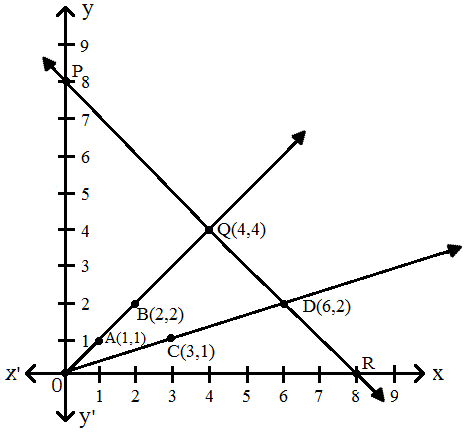
Determine, graphically, the vertices of the triangles formed by the lines $y = x, 3y = x, x + y = 8.$
AnswerGiven linear equations are $y = x ......(i)$
$3y = x .....(ii)$
and$ x + y = 8 ......(iii)$
For equation $y = x,$
If $x = 1$, then $y = 1$
If $x = 0$, then $y = 0$
If $x = 2$, then $y = 2$
Table for line $y = x,$
|
$x$
|
$0$
|
$1$
|
$2$
|
|
$y$
|
$0$
|
$1$
|
$2$
|
|
Points
|
$O$
|
$A$
|
$B$
|
For equation $x = 3y$
If $x = 0$, then $y = 0,$
if $x = 3$, then $y = 1$
and if $x = 6$, then $y = 2$
Table for line $x = 3y,$
|
$x$
|
$0$
|
$3$
|
$6$
|
|
$y$
|
$0$
|
$1$
|
$2$
|
|
Points
|
$O$
|
$C$
|
$D$
|
For equation,
If $x = 0$, then $y = 8$
if $x = 8$, then $y = 0$
and if $x = 4$, then $y = 4$
Table for line $x + y = 8$,
|
$x$
|
$0$
|
$4$
|
$8$
|
|
$y$
|
$8$
|
$4$
|
$0$
|
|
Points
|
$P$
|
$Q$
|
$R$
|
Plotting the points $A(1,1)$ and $B(2,2)$, we get the straight line $A B$. Plotting the points $C(3,1)$ and $D(6,2)$, we get the straight line $C D$. Plotting the points $P(0,8), Q(4,4)$ and $R(8,0)$, we get the straight line $P Q R$. We see that lines $A B$ and $C D$ intersecting the line $P R$ on $Q$ and $D$, respectively.
So, $\triangle O Q D$ is formed by these lines. Hence, the vertices of the $\triangle O Q D$ formed by the given lines are $O(0,0), Q(4,4)$ and $D(6,2)$.
View full question & answer→Question 774 Marks
A motor boat can travel $30\ km$ upstream and $28\ km$ downstream in $7$ hours. It can travel $21\ km$ upstream and return in $5$ hours. Find the speed of the boat in still water and the speed of the stream.
AnswerLet the speed of the motorboat in still water and the speed of the stream are u km/ h and v km/ h, respectively.
Then, a motorboat speed in downstream $= (u + v)$ km/ hr and a motorboat speed in upstream $= (u - v)$ km/ hr. Motorboat has taken time to travel $30$ km upstream,
$\text{t}_1=\frac{30}{\text{u}-\text{v}}\text{h}.$
and motorboat has taken time to travel 28km downstream,
$\text{t}_2=\frac{28}{\text{u}+\text{v}}\text{h.}$
By first condition, a motorboat can travel 30km upstream and $28km$ downstream in $7$ h.
i. e., $\text{t}_1+\text{t}_2=7\text{h.}$
$\Rightarrow\frac{30}{\text{u}-\text{v}}+\frac{28}{\text{u}+\text{v}}=7\ ....(\text{i})$
Now, motorboat has taken time to travel $21km$ upstream and return
i. e., $\text{t}_3=\frac{21}{\text{u}-\text{v}}$ [for upstream]
and $\text{t}_4=\frac{21}{\text{u}+\text{v}}$ [for downstream]
By second condition, $\text{t}_4+\text{t}_3=5\text{h.}$
$\Rightarrow\frac{21}{\text{u}+\text{v}}+\frac{21}{\text{u}-\text{v}}=5\ .....(\text{ii})$
Let $\text{x}=\frac{1}{\text{u}+\text{v}}$ and $\text{y}=\frac{1}{\text{u}-\text{v}}$
eqs. (i) and (ii) becomes
$30\text{x}+28\text{y}=7\ ....(\text{iii})$
and $21\text{x}+21\text{y}=5$
$\Rightarrow\text{x}+\text{y}=\frac{5}{21}\ .....(\text{iv})$
Now, multiplying in eq. (iv) by 28 and then subtracting from eq. $(iii)$ we get
$\ \ \ \ \ 30\text{x}+28\text{y}=\ \ \ 7\ \ \ \ \ \ \ \\\ \ \ \ \ 28\text{x}+28\text{y}=\frac{140}{21}\\\underline{ \ \ -\ \ \ \ -\ \ \ \ \ \ \ \ -\ \ \ \ \ \ \ \ \ }\\\ \ \ \ \ \ 2\text{x}\ \ \ \ \ \ \ \ \ \ \ \ =7-\frac{20}{3}$
$=\frac{21-20}{3}$
$\Rightarrow2\text{x}=\frac{1}{3}$
$\Rightarrow\text{x}=\frac{1}{6}$
On putting the value of x in eq. $(iv)$ we get
$\frac{1}{6}+\text{y}=\frac{5}{21}$
$\Rightarrow\text{y}=\frac{5}{21}-\frac{1}{6}$
$=\frac{10-7}{42}=\frac{3}{42}$
$\Rightarrow\text{y}=\frac{1}{14}$
$\therefore\text{x}=\frac{1}{\text{u}+\text{v}}=\frac{1}{6}$
$\Rightarrow\text{u}+\text{v}=6\ .....(\text{v})$
and $\text{y}=\frac{1}{\text{u}-\text{v}}=\frac{1}{14}$
$\Rightarrow\text{u}-\text{v}=14\ .....(\text{vi})$
Now, adding eqs. $(v)$ and $(vi)$ we get
$\Rightarrow 2u = 20$
$\Rightarrow u = 10$
On Putting the value of u in eq. $(v)$ we get
$10 + v = 6$
$\Rightarrow v = -4$
Hence, the speed of the motorboat in still water is $10km/ hr$. and the speed of the stream 4km/ h.
View full question & answer→Question 784 Marks
If in a rectangle, the length is increased and breadth reduced each by $2$ units, the area is reduced by $28$ square units. If, however the length is reduced by $1$ unit and the breadth increased by $2$ units, the area increases by $33$ square units. Find the area of the rectangle.
AnswerLet the length and breadth of the rectangle be $x$ and $y$ units respectively.
Then area of rectangle = xy square units
It is given that if length is increared and breadth reduced each by $2$ units. then the area is reduced by $28$ square units.
$\Rightarrow (x + 2) (y - 2) = xy - 28$
$\Rightarrow xy - 2x + 2y - 4 = xy - 28$
$\Rightarrow -2x + 2y - 4 + 28 = 0$
$\Rightarrow -2x + 2y + 24 = 0$
$\Rightarrow 2x - 2y - 24 = 0 ......(i)$
It is also given that the length is reduced by $1$ unit and breath is increcred by $2$ units then the area is increared by $33$ square units.
$\Rightarrow (x - 1) (y + 2) = xy + 33$
$\Rightarrow xy + 2x - y - 2 = xy + 33$
$\Rightarrow xy + 2x - y - 2 - xy - 33 = 0$
$\Rightarrow 2x - y - 35 = 0 ......(ii)$
Now, subtracting eq. $(ii)$ from eq. $(i)$ and we get
$\Rightarrow 2x - 2y - 24 - (2x - y - 35) = 0$
$\Rightarrow 2x - 2y - 24 - 2x + y + 35 = 0$
$\Rightarrow -y + 11 = 0$
$\Rightarrow y = 11$
Putting the value of $y$ in eq.$ (i)$
$\Rightarrow 2x - 2y - 24 = 0$
$\Rightarrow 2x - 2 \times 11 - 24 = 0$
$\Rightarrow 2x - 22 - 24 = 0$
$\Rightarrow 2x - 46 = 0$
$\Rightarrow x = 23$
Hence, the length of the rectangle is $23$ and breadth of the rectangle is $11$
Area os rectangle = length \times breadth
$= 23 \times 11$
$= 253$ square units.
View full question & answer→Question 794 Marks
Solve the following system of linear equation graphically and shade the region between the two lines and x-axis:
$3x + 2y -4 = 0$
$2x - 3y -7 = 0.$
AnswerThe system of given equations is,
$3x + 2y -4 = 0$
$2x - 3y -7 = 0$
Now, $3x + 2y -4 = 0$
$\Rightarrow 3x = 4 - 2y$
$\Rightarrow\text{x}=\frac{4-2\text{y}}{3}$
When $y = 5$, we have,
$\text{x}=\frac{4-2\times5}{3}=-2$
When y = 8, we have,
$\text{x}=\frac{4-2\times8}{3}=-4$
Thus, we have the following table,
|
$x$
|
$-2$ |
$-4$
|
|
$y$
|
$5$
|
$8$
|
We have, $2x - 3y -7 = 0$
$\Rightarrow 2x = 3y + 7$
$\Rightarrow\text{x}=\frac{3\text{y}+7}{2}$
When $y = 1$, we have,
$\text{x}=\frac{3\times1+7}{2}=5$
When $y = -1$, we have,
$\text{x}=\frac{3\times(-1)+7}{2}=2$
Thus, we have the following table,
Graph of the given system of equations.
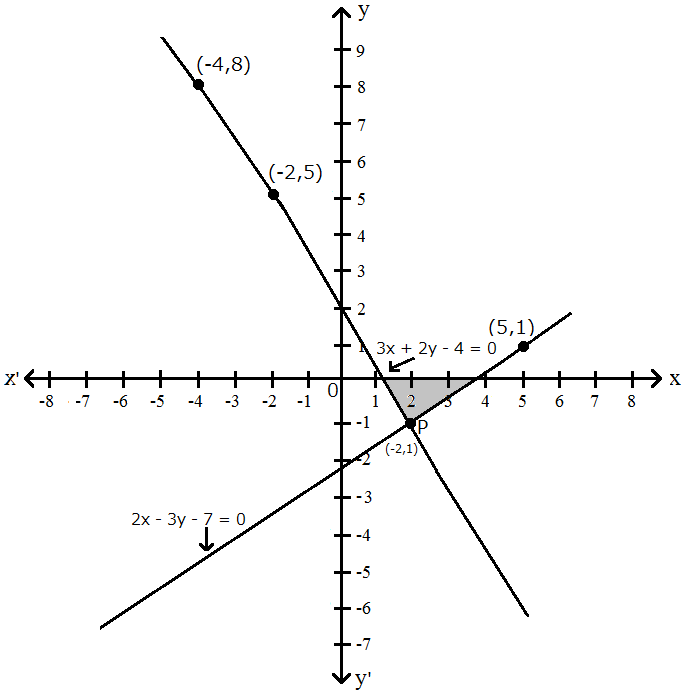
Clearly, the two lines intersect at $P(2, -1).$
Hence, $x = 2, y = -1$ is the solution of the given system of equations. View full question & answer→Question 804 Marks
Jamila spld a table and chair for ₹ $1050$, there by making a profit of $10\%$ on a table and $25\%$ on the chair. If she had taken profit of $25\%$ on the table and $10\%$ on the chair she would have got ₹ $1065$. Find the cost price of each.
AnswerLet the cost price of the table be ₹ $x$
and the cost price of the chair by ₹ $y$
The selling price of the table, when it is sold at a profit of $10\%$
$=₹\Big(\text{x}+\frac{10}{100}\text{x}\Big)$
$=₹\frac{110}{100}\text{x}$
The selling price of the chir when it is sold at a profit of $25\%$
$=₹\Big(\text{y}+\frac{25}{100}\text{y}\Big)$
$=₹\frac{125}{100}\text{y}$
So, $\frac{110}{100}\text{x}+\frac{125}{100}\text{y}=1050\ .....(\text{i})$
When the table is sold at a profit of $25\%$, its
Selling price $=₹\Big(\text{x}+\frac{25}{100}\text{x}\Big)$
$=₹\frac{125}{100}\text{x}$
When the chair is sold at a profit of $10\%$, its
Selling price $=₹\Big(\text{y}+\frac{10}{100}\text{y}\Big)$
$=₹\frac{110}{100}\text{y}$
So, $\frac{125}{100}\text{x}+\frac{110}{100}\text{y}=1065\ ....(\text{ii})$
From equations $(i)$ and $(ii)$ we get
$110x + 125y = 105000$
and $125x + 110y = 106500$
On adding and subtracting these equations, we get
$235x + 235y = 211500$
and $15x – 15y= 1500$
$i.e., x + y = 900 ......(iii)$
and $x – y = 100 ......(iv)$
Solving equation $(iii)$ and $(iv)$, we get
$2x = 1000$
$x = 500$
$500 + y = 900$
$y = 900 - 500$
$y = 400$
$x = 500, y = 400$
So, the cost price of the table is ₹ $500$ and the cost price of the chair is ₹ $400$
View full question & answer→Question 814 Marks
On selling a $T.V.$ at $5\%$ gain and a fridge at $10\%$ gain, a shopkeeper gains Rs. $2000$. But if he sells the $T.V.$ at $10\%$ gain the fridge at $5\%$ loss. He gains Rs. $1500$ on the transaction. Find the actual prices of $T.V.$ and fridge.
AnswerLet the price of a $T.V.$ be Rs. $x$ and that of a fridge be Rs. $y.$ Then we have
$\frac{5\text{x}}{100}+\frac{10\text{y}}{100}=2000$
$\Rightarrow 5x + 10y = 200000$
$\Rightarrow 5(x + 2y) = 200000$
$\Rightarrow x + 2y = 40000 ......(i)$
And, $\frac{10\text{x}}{100}-\frac{5\text{y}}{100}=1500$
$\Rightarrow 10x - 5y = 150000$
$\Rightarrow 5(2x - y) = 150000$
$\Rightarrow 2x - y = 30000 ....(ii)$
Multiplying equation $(ii)$ by $2$ we get
$4x - 2y = 60000 .....(iii)$
Adding equation $(i)$ and equation $(iii)$ we get
$x + 4x = 40000 + 60000$
$\Rightarrow 5x = 100000$
$\Rightarrow x = 20000$
Putting $x = 20000$ in equation $(i)$ we get
$20000 + 2y = 40000$
$\Rightarrow 2y = 40000 - 20000$
$\Rightarrow\text{y}=\frac{20000}{2}=10000$
Hence, the actual price of $T.V = Rs. 20,000$ and, the actual price of fridge $= Rs. 10, 000$
View full question & answer→Question 824 Marks
A wizard having powers of mystic in candations and magical medicines seeing a cock, fight going on, spoke privately to both the owners of cocks. To one he said, if your bird wins, than you give me your stake-money, but if you do not win, I shall give you two third of that'. Going to the other, he promised in the same way to give three fourths. From both of them his gain would be only $12$ gold coins. Find the the stake of money each of the cock-owners have.
AnswerLet the stake money of first and second cock-owners be Rs. $x$ and Rs. $y$ respectively. Then,
$\text{y}-\frac{2}{3}\text{x}=12$
$\Rightarrow 3y - 2x = 36 .....(i)$
And, $\text{x}-\frac{3}{4}\text{y}=12$
$\Rightarrow 4x - 3y = 48 .....(ii)$
Multiplying equation $(i)$ by $2$ we get
$6y - 4x = 72 .....(iii)$
Adding equation $(ii)$ and $(iii)$ we get
$-3y + 6y = 48 + 72$
$\Rightarrow 3y = 120$
$\Rightarrow\text{y}=\frac{120}{3}$
$\Rightarrow y = 40$
Putting $y = 40$ in equation $(ii)$ we get
$4x - 3 \times 40 = 48$
$\Rightarrow 4x - 120 = 48$
$\Rightarrow 4x = 48 + 120$
$\Rightarrow 4x = 168$
$\Rightarrow\text{x}=\frac{168}{4}$
$\Rightarrow x = 42$
Hence, the stake of money of its cock-owner $= 42$ gold and, the stake of money of II nd cock-owner $= 40$ gold coins.
View full question & answer→Question 834 Marks
Solve the following systems of equations:
$21x + 47y = 110,$
$47x + 21y = 162.$
Answer$21x + 47y = 110 ....(i)$
$47x + 21y = 162 .....(ii)$
Adding $(i) $and $(ii)$ we get
$68x + 68y = 272$
$\Rightarrow x + y = 4 ....(iii)$
Subtracting $(i)$ from $(ii),$ we get
$26x - 26y = 52$
$\Rightarrow x - y = 2 ......(iv)$
Adding $(iii)$ and $(iv)$, we get
$2x = 6$
$\Rightarrow x = 3$
Putting $x = 3$ in $(iv)$ we get
$3 - y = 2$
$\Rightarrow y = 1.$
View full question & answer→Question 844 Marks
A is elder to $B$ by $2$ years. A's father $F$ is twice as old as $A$ and $B$ is twice as old as his sister S. If the ages of the father and sister differ by $40$ years, find the age of A.
AnswerLet age of $A = x$ years
and age of $B = y$ years
According to the conditions,
$x = y + 2$
$\Rightarrow y = x – 2 ….(i)$
Age of $A’s’$ father $= 2x$
Age of $B’s$ sisters $=\frac{\text{y}}{2}$
$2\text{x}-\frac{\text{y}}{2}=40$
$4x – y = 80 ….(ii)$
$4x – (x – 2) = 80$
$\Rightarrow 4x – x + 2 = 80$
$3x = 80 – 2 = 78$
$= x = 26$
A’s age $= 26$ years
View full question & answer→Question 854 Marks
Solve the following system of equations by the method of cross-multiplication:
$2(ax - by) + a + 4b = 0$
$2(bx + ay) + b - 4b = 0$
AnswerThe given equations are,
$2(ax - by) + a + 4b = 0 .....(i)$
$2(bx + ay) + b - 4b = 0 ........(ii)$
By cross-multiplication method we get,
$\Rightarrow\frac{\text{x}}{(-2\text{b})(\text{b}-4\text{a})-(\text{a}+4\text{b})2\text{a}}=\frac{\text{y}}{(\text{a}+4\text{b})2\text{b}-2\text{a}(\text{b}-4\text{a})}\\=\frac{1}{2\text{a}\times2\text{a}-2\text{b}(-2\text{b})}$
$\Rightarrow\frac{\text{x}}{-2\text{b}^2+8\text{ab}-2\text{a}^2-8\text{ab}}=\frac{\text{y}}{2\text{ab}+8\text{b}^2-2\text{ab}+8\text{a}^2}\\=\frac{1}{4\text{a}^2+4\text{b}^2}$
$ \Rightarrow\frac{\text{x}}{-2(\text{b}^2+\text{a}^2)}=\frac{\text{y}}{8(\text{a}^2+\text{b}^2)}=\frac{1}{4(\text{a}^2+\text{b}^2)}$
$\text{x}=\frac{-2(\text{b}^2+\text{a}^2)}{4(\text{a}^2+\text{b}^2)}=-\frac{1}{2}$
$\text{y}=\frac{8(\text{a}^2+\text{b}^2)}{4(\text{a}^2+\text{b}^2)}=2$
Thus, $\text{x}=-\frac{1}{2}$ and $\text{y}=2$
View full question & answer→Question 864 Marks
Show graphically that the following system of equation is in-consistent (i.e. has no solution):
$3x - 5y = 20$
$6x - 10y = -40$
AnswerWe have,
$3x - 5y = 20$
$6x - 10y = -40$
Now, $3x - 5y = 20$
$\Rightarrow\text{x}=\frac{5\text{y}+20}{3}$
When $y = -1,$ we have,
$\text{x}=\frac{5(-1)+20}{3}=5$
When $y = -4,$ we have,
$\text{x}=\frac{5(-4)+20}{3}=0$
Thus we have the following table giving points on the line $3x - 5y = 20.$
|
$x$
|
$5$
|
$0$
|
|
$y$
|
$-1$
|
$-4$
|
Now, $6x - 10y = -40$
$\Rightarrow 6x = -40 + 10y$
$\Rightarrow\text{x}=\frac{-40+10\text{y}}{6}$
When $y = 4$, we have,
$\text{x}=\frac{-40+10\times4}{6}=0$
When $y = 1$, we have,
$\text{x}=\frac{-40+10\times1}{6}=-5$
Thus we have the following table giving points on the line $6x - 10y = -40$
Graph of the given equations:
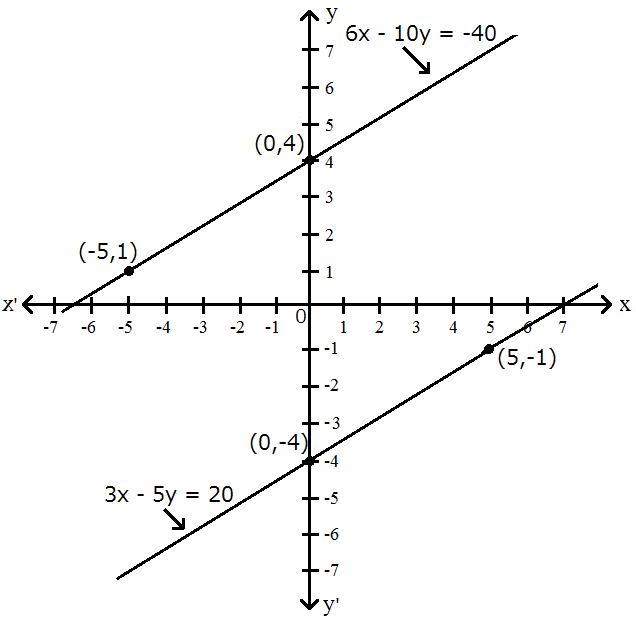
Clearly, there is no common points between these two lines.
Hence, given system of equations is in-consistent. View full question & answer→Question 874 Marks
Solve the following systems of equations:
$\frac{3}{\text{x}+\text{y}}+\frac{2}{\text{x}-\text{y}}=2,$
$\frac{9}{\text{x}+\text{y}}-\frac{4}{\text{x}-\text{y}}=1.$
AnswerThe given equations are
$\frac{3}{\text{x}+\text{y}}+\frac{2}{\text{x}-\text{y}}=2$
$\frac{9}{\text{x}+\text{y}}-\frac{4}{\text{x}-\text{y}}=1$
Let $\frac{1}{\text{x}+\text{y}}=\text{u}$ and $\frac{1}{\text{x}+\text{y}}=\text{v}$ then equations are
$3{\text{u}+2\text{v}}=2\ ......(\text{i})$
$9{\text{u}-4\text{v}}=1\ ......(\text{ii})$
Multiply equation $(i)$ by $2$ and add both equation we get
$\frac{6{\text{u}\ +\ 4\text{v}}\ \ \ =\ 4\\9{\text{u}\ -\ 4\text{v}}\ \ \ =\ 1}{15\text{u}\ \ \ \ \ \ \ \ \ =\ 5}$
$\Rightarrow\text{u}=\frac{1}{3}$
Put the value of u in equation $(i)$ we get
$3\times\frac{1}{3}+2\text{v}=2$
$\Rightarrow2\text{v}=1$
$\Rightarrow\text{v}=\frac{1}{2}$
Then $\frac{1}{\text{x}+\text{y}}=\frac{1}{3}$
$\Rightarrow\text{x}+\text{y}=3$
$$$\frac{1}{\text{x}-\text{y}}=\frac{1}{2}$
$\Rightarrow\text{x}-\text{y}=2$
Add both equations we get
$\frac{\text{x}\ +\ \text{y}\ =\ 3\\ \text{x}\ +\ \text{y}\ =\ 2}{2\text{x}\ \ \ \ \ \ \ =\ 5}$
$\Rightarrow\text{x}=\frac{5}{2}$
Put the value of x in first equation we get
$\frac{5}{2}+\text{y}=3$
$\Rightarrow\text{y}=\frac{1}{2}$
Hence the value of $\text{x}=\frac{5}{2}$ and $\text{y}=\frac{1}{2}$
View full question & answer→Question 884 Marks
Point $A$ and $B$ are $70\ km$. a part on a highway. A car starts from $A$ and another car starts from $B$ simultaneously. If they travel in the same direction, they meet in $7$ hours, but if the travel towards each other, the meet in one hour. Find the speed of the two cars.
AnswerLet $x km / hr$ and $y km / hr$ be the speed of cars $A$ and $B$ respectvely.
When they move in same direction,
Supposr they meet at $C$. Then
Distance cover by $A = AC$
Distance cover by $B=B C$
Distance $=$ Speed $\times$ time
Distance cover by $A =7 \times km$
Distance cover by $B=7 ykm$
Cleary, $A C-B C=A B$
$7 x-7 y=70$
$x-y=10 \ldots . . \text { (i) }$
When they move in opposite direction
Suppose they meet at 0
Distance cover by $A = AD$
Distance cover by $B=B D$
Distance cover by $A = xkm$
Distance cover by $B=y km$
Clearly, $x+y=70$......(ii)
Adding (i) and (ii) we get
$\Rightarrow 2 x=80$
$\Rightarrow x=\frac{80}{2}$
$\Rightarrow x=40 km / hr$
Putting $x=40$ in (ii) we get
$\Rightarrow 40+y=70$
$\Rightarrow y=30 km / hr$
Thus, speed of car A and B is $40 km / hr$ and $30 km / hr$.
View full question & answer→Question 894 Marks
A number consist of two digits whose sum is five. When the digits are reversed, the number becomes greater by nine. Find the number.
AnswerLet the digits at units and tens place of the given number be $x$ and $y$ respectively. Thus, the number is $10y + x$
The sum of the digits of the number is $5$. Thus, we have$ x + y = 5$
After interchanging the digits, the number becomes $10x + y$
The number obtained by interchanging the digits is greater by $9$ from the original number.
Thus, we have
$10x + y = 10y + x + 9$
$\Rightarrow 10x + y - 10y - x = 9$
$\Rightarrow 9x - 9y = 9$
$\Rightarrow 9(x - y) = 9$
$\Rightarrow\text{x}-\text{y}=\frac{9}{9}$
$\Rightarrow x - y = 1$
So, we have two equations
$x + y = 5$
$x - y = 1$
Here x and y are unknowns. we have to solve the above equations for $x$ and $y.$
Adding the two equations, we have
$(x + y) + (x - y) = 5 + 1$
$\Rightarrow x + y + x - y = 6$
$\Rightarrow 2x = 6$
$\Rightarrow\text{x}=\frac{6}{2}$
$\Rightarrow x = 3$
Substituting the value of x in the first equation, we have
$3 + y = 5$
$\Rightarrow y = 5 - 3$
$\Rightarrow y = 2$
Hence, the number is $10 \times 2 + 3 = 23$
View full question & answer→Question 904 Marks
Solve the following system of equations by the method of cross-multiplication:
$2x + y = 35,$
$3x + 4y = 65.$
AnswerThe given system of equations may be written as
$2x + y - 35 = 0$
$3x + 4y - 65 = 0$
Here, $a_1=2, b_1=1, c_1=-35$
$a_2=3, b_2=4$, and $c_2=-65$
By cross-multiplication, we have
$\Rightarrow\ \frac{\text{x}}{1\times(-65)-(-35)\times4}=\frac{-\text{y}}{2\times(-65)-(-35)\times3}\\=\frac{1}{2\times4-1\times3}$
$\Rightarrow\ \frac{\text{x}}{-65+140}=\frac{-\text{y}}{-130+105}=\frac{1}{8-3}$
$\Rightarrow\ \frac{\text{x}}{75}=\frac{-\text{y}}{-25}=\frac{1}{5}$
$\Rightarrow\ \frac{\text{x}}{75}=\frac{\text{y}}{25}=\frac{1}{5}$
Now, $\frac{\text{x}}{75}=\frac{1}{5}$
$\Rightarrow\ \text{x}=\frac{75}{5}=15$
and, $\frac{\text{y}}{25}=\frac{1}{5}$
$\Rightarrow\ \text{y}=\frac{25}{5}=5$
Hence,$ x = 15, y = 5 $is the solution of the given system of equations.
View full question & answer→Question 914 Marks
Solve the following system of equations by the method of cross-multiplication:
$\frac{\text{a}^2}{\text{x}}-\frac{\text{b}^2}{\text{y}}=0$
$\frac{\text{a}^2\text{b}}{\text{x}}+\frac{\text{b}^2\text{a}}{\text{y}}=\text{a}+\text{b}$ $\text{x},\text{y}\neq0$
AnswerTaking $\frac{1}{\text{x}}=\text{u}$ and $\frac{1}{\text{y}}=\text{v}.$ Then, the given system of equations become
$ a^2 u-b^2 v=0 $
$ a^2 b u+b^2 a v-(a+b)=0$
$\text { Here, }$
$ a_1=a^2, b_1=-b^2, c_1=0 $
$ a_2=a^2 b, b_2=b^2 a, \text { and } c_2=-(a+b)$
By cross multiplication we have,
$\Rightarrow\frac{\text{u}}{\text{b}^2(\text{a}+\text{b})-0\times\text{b}^2\text{a}}=\frac{-\text{v}}{-\text{a}^2(\text{a}+\text{b})-0\times\text{a}^2\text{b}}=\frac{1}{\text{a}^3\text{b}^2+\text{a}^2 \text{b}^3}$
$\Rightarrow\frac{\text{u}}{\text{b}^2(\text{a}+\text{b})}=\frac{\text{v}}{\text{a}^2(\text{a}+\text{b})}=\frac{1}{\text{a}^2\text{b}^2(\text{a}+ \text{b})}$
Now, $\frac{\text{u}}{\text{b}^2(\text{a}+\text{b})}=\frac{1}{\text{a}^2\text{b}^2(\text{a}+ \text{b})}$
$\Rightarrow\text{u}=\frac{\text{b}^2(\text{a}+\text{b})}{\text{a}^2\text{b}^2(\text{a}+ \text{b})}$
$\Rightarrow\text{u}=\frac{1}{\text{a}^2}$
And, $\frac{\text{v}}{\text{a}^2(\text{a}+\text{b})}=\frac{1}{\text{a}^2\text{b}^2(\text{a}+\text{b})}$
$ \Rightarrow{\text{v}}=\frac{\text{a}^2(\text{a}+\text{b})}{\text{a}^2\text{b}^2(\text{a}+\text{b})}$
$ \Rightarrow{\text{v}}=\frac{1}{\text{b}^2}$
Now, ${\text{x}}=\frac{1}{\text{u}}=\text{a}^2$
And, ${\text{y}}=\frac{1}{\text{v}}=\text{b}^2$
Hence, $x = a^2, y = b^2$ is the solution of the given system of equations.
View full question & answer→Question 924 Marks
Find the value of k for which each of the following system of equations have infinitely many solutions:
$2x - 3y = 7$
$(k + 2)x - (2k + 1)y = 3(2k - 1)$
AnswerThe given system of equations may be written as
$2x - 3y - 7 = 0$
$(k + 2)x - (2k + 1)y - 3(2k - 1) = 0$
The system of equations is of the form
$ a_1 x+b_1 y+c_1=0 $
$ a_2 x+b_2 y+c_2=0$
Where, $a_1=2, b_1=-3, c_1=-7$
and, $a_2=k+2, b_2=-(2 k+1), c_2=-3(2 k-1)$
For a unique solution, we must have
$\frac{\text{a}_1}{\text{a}_2}=\frac{\text{b}_1}{\text{b}_2}=\frac{\text{c}_1}{\text{c}_2}$
$\Rightarrow\frac{2}{\text{k}+2}=\frac{-3}{-(2\text{k}+1)}=\frac{-7}{-3(2\text{k}-1)}$
$\Rightarrow\frac{2}{\text{k}+2}=\frac{-3}{-(2\text{k}+1)}$ and $\frac{-3}{-(2\text{k}+1)}=\frac{-7}{-3(2\text{k}-1)}$
$⇒ 2(2k + 1) = 3(k + 2)$ and $3 × 3(2k - 1) = 7(2k + 1)$
$⇒ 4k + 2 = 3k + 6$ and $18k - 9 = 14k + 7$
$⇒ 4k - 3k = 6 - 2$ and $18k - 14k = 7 + 9$
$⇒ k = 4$ and $4k = 16 ⇒ k = 4$
$⇒ k = 4$ and $k = 4$
Hence the given system of equations will have infinitely many solutions, if $k = 4$
View full question & answer→Question 934 Marks
A man travels $600\ km$ partly by train and partly by car. If the covers $400\ km$ by train and the rest by car, it takes him $6$ hours $30$ minutes. But, if the travels $200\ km$ by train and the rest by car, he takes half an hour longer. Find the speed of the train and that of the car.
AnswerLet the speed of the train be $x \ km/ hr$ and that of the car be $y \ km/ hr$. we have following cases:
Case I: When Ramesh traveis $400\ km$ by train and the rest by car:
In this case we have
Time taken by the man to travel $400\ km$ by train $=\frac{400}{\text{x}}$
Times taken by the man to travel $(600-400) = 200km$ by car $=\frac{200}{\text{y}}$
In this case, total times of the journey is 6 hrs $30$ minutes.
$\therefore\frac{400}{\text{x}}+\frac{200}{\text{y}}=6\text{hrs. }30\text{ minutes}$
$\Rightarrow\frac{400}{\text{x}}+\frac{200}{\text{y}}=6\frac{1}{2}$
$\Rightarrow\frac{400}{\text{x}}+\frac{200}{\text{y}}=\frac{13}{2}\ .....(\text{i})$
Case II: when he travels $200km$ by train and the rest by car:
In this case we have
Times taken by the man to travel $200\ km$ by train $=\frac{200}{\text{x}}\text{hrs.}$
Times taken by the man to travel $(600 - 200) = 400 \ km$ by car $=\frac{400}{\text{y}}\text{hrs}$
In this case, total time of journey is $\Big(\frac{13}{2}+\frac{1}{2}\Big)=7\text{hrs.}$
$\therefore\frac{200}{\text{x}}+\frac{400}{\text{y}}=7\ ......(\text{ii})$
Putting $\frac{1}{\text{x}}=\text{u}$ and $\frac{1}{\text{y}}=\text{v},$ in equation $(i)$ and $(ii)$ we get
$400\text{u}+200\text{v}=\frac{13}{2}\ .....(\text{iii})$
$200\text{u}+400\text{v}=7\ .....(\text{iv})$
Multiplying equation (iii) by 2 we get
$800\text{u}+400\text{v}=13\ .....(\text{v})$
Subtracting equation $(iv)$ by equation $(v)$ we get
$$$800\text{u}-200\text{u}=13-7$
$\Rightarrow600\text{u}=6$
$\Rightarrow\text{u}=\frac{6}{600}=\frac{1}{100}$
Putting $\text{u}=\frac{1}{100}$ in equation $(iv)$ we get
$200\times\frac{1}{100}+400\text{v}=7$
$\Rightarrow2+400\text{v}=7$
$\Rightarrow400\text{v}=7-2$
$\Rightarrow400\text{v}=5$
$\text{v}=\frac{5}{400}=\frac{1}{80}$
Now, $\text{u}=\frac{1}{100}$
$\Rightarrow\frac{1}{\text{x}}=\frac{1}{100}$
$\Rightarrow\text{x}=100$
And, $\text{v}=\frac{1}{80}$
$\Rightarrow\frac{1}{\text{y}}=\frac{1}{80}$
$\Rightarrow\text{y}=80$
Hence, speed of the train $= 100\ km/ hr.$ Speed of the car $= 80 \ km/ hr.$
View full question & answer→Question 944 Marks
In a $\triangle\text{ABC},\angle\text{A}=\text{x}^\circ,\angle\text{B}=3\text{x}^\circ$ and $\angle\text{C}=\text{y}^\circ$ if $3y - 5x = 30$, , prove that the triangle is right angled.
AnswerWe have,
$\angle\text{A}=\text{x}^\circ\ ....(\text{i})$
$\angle\text{B}=3\text{x}^\circ\ .....(\text{ii})$
And, $\angle\text{C}=\text{y}^\circ\ ......(\text{iii})$
We know that, the sum of angles of a triangle is $180^\circ $
$\therefore\angle\text{A}+\angle\text{B}+\angle\text{C}=180^\circ$
$x + 3x + y = 180$ [using $(i), (ii)$ and $(iii)]$
$\Rightarrow 4x + y = 180 .....(iv)$
Now, 3$y - 5x = 30 .....(v)$ [given]
Multiplying equation $(iv)$ by $3$ we get
$12x + 3y = 540 .....(vi)$
Subtracting equation $(v)$ from equation $(vi)$ we get
$12x + 5x = 540 - 30$
$\Rightarrow 17x = 510$
$\Rightarrow\text{x}=\frac{510}{17}$
$\Rightarrow x = 30$
Putting $x = 30$ in equation $(iv)$ we get
$4 \times 30 + y = 180$
$\Rightarrow 120 + y = 180$
$\Rightarrow y = 180 - 120$
$\Rightarrow y = 60$
Now, $\angle\text{B}=3\text{x}^\circ$
$\Rightarrow\angle\text{B}=3\times30^\circ$
$\Rightarrow\angle\text{B}=90^\circ$
$\therefore\triangle\text{ABC}$ is the right angle triangle.
Hence prived.
View full question & answer→Question 954 Marks
Find the value of k for which each of the following system of equations have infinitely many solutions:
$x + (k + 1)y = 4$
$(k + 1)x + 9y = 5k + 2$
AnswerThe given system of equations may be written as
$x + (k + 1)y - 4 = 0$
$(k + 1)x + 9y - (5k + 2) = 0$
The system of equations is of the form
$ a_1 x+b_1 y+c_1=0 $
$ a_2 x+b_2 y+c_2=0$
Where, $a_1=1, b_1=k+1, c_1=-4$
and, $a_2=k+1, b_2=9$, and $c_2=-(5 k+2)$
For infinitely many solutions, we must have
$ \frac{a_1}{a_2}=\frac{b_1}{b_2}=\frac{c_1}{c_2} $
$ \Rightarrow \frac{1}{\mathbf{k}+1}=\frac{\mathbf{k}+1}{9}=\frac{-4}{-(5 k+2)} $
$ \Rightarrow \frac{1}{\mathbf{k}+1}=\frac{\mathbf{k}+1}{9} \text { and } \frac{k+1}{9}=\frac{-4}{-(5 k+2)} $
$ \Rightarrow 9=(k+1)^2 \text { and }(k+1)(5 k+2)=36 $
$ \Rightarrow 9=k^2+1+2 k \text { and } 5 k^2+2 k+5 k+2=36 $
$ \Rightarrow k^2+2 k+1-9=0 \text { and } 5 k^2+7 k+2-36=0 $
$ \Rightarrow k^2+2 k-8=0 \text { and } 5 k^2+7 k-34=0 $
$ \Rightarrow k^2+4 k-2 k-8=0 \text { and } 5 k^2+17 k-10 k-34=0 $
$ \Rightarrow k(k+4)-2(k+4)=0 \text { and } k(5 k+17)-2(5 k+7)=0 $
$ \Rightarrow(k+4)(k-2)=0 \text { and }(5 k+17)(k-2)=0 $
$ \Rightarrow(k=-4 \text { or } k=2) \text { and }\left(k=\frac{-17}{5} \text { or } k=2\right)$
$\Rightarrow k = 2$ satisfies both the conditions
Hence, the given system of equations will have infinitely many solutions, if $k = 2$
View full question & answer→Question 964 Marks
Solve graphically that the following system of equation has infinitely many solutions:
$x - 2y + 11 = 0$
$3x - 6y + 33 = 0$
AnswerThe given equations are
$x - 2y + 11 = 0 .......(i)$
$3x - 6y + 33 = 0 ..........(ii)$
Putting $x = 0 $in equation $(i),$ we get,
$\Rightarrow 0 - 2y = -11$
$\Rightarrow\text{y}=\frac{11}{2}$
$\Rightarrow\text{x}=0,\ \text{y}=\frac{11}{2}$
Putting $y = 0$ in equation $(i)$, we get,
$\Rightarrow x - 2 \times 0 = -11$
$\Rightarrow x = -11$
$\Rightarrow x = -11, y = 0$
Use the following table to draw the graph,
|
$x$
|
$0$
|
$-11$
|
|
$y$
|
$\frac{11}{2}$
|
$0$
|
Draw the graph by plotting the two points $\text{A}\Big(0,\frac{11}{2}\Big),$ B(-11, 0) from table.
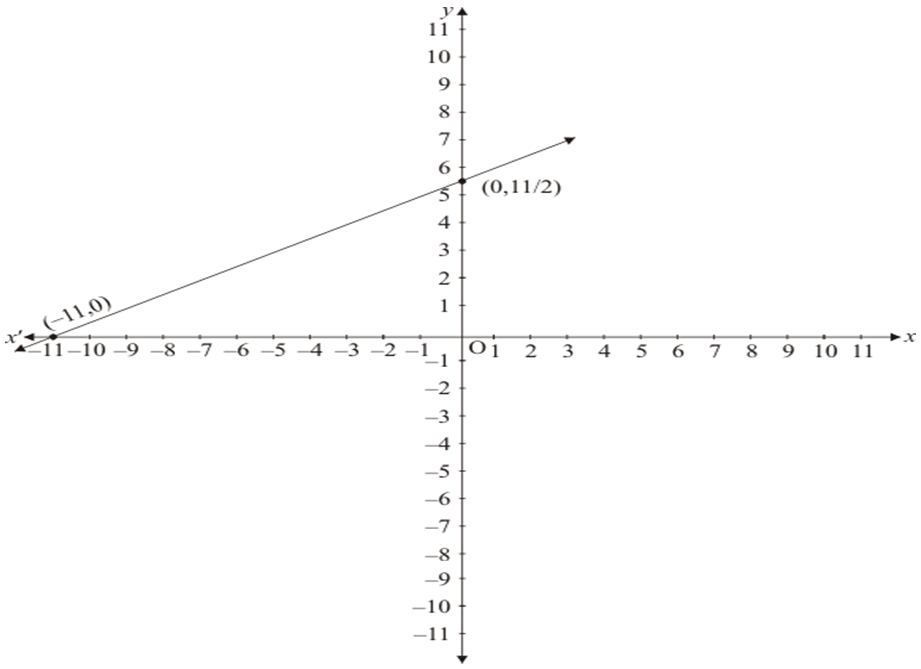
Graph of the equation,
$3x - 6y = -33 .......(ii)$
Putting $x = 0$ in equation $(ii)$, we get,
$\Rightarrow 3 \times 0 - 6y = -33$
$\Rightarrow\text{y}=\frac{11}{2}$
$\Rightarrow\text{x}=0,\text{y}=\frac{11}{2}$
Putting $y = 0$ in equation $(ii)$, we get,
$\Rightarrow 3x - 6 \times 0 = -33$
$\Rightarrow x = -11$
$\Rightarrow x = -11, y = 0$
Use the following table to draw the graph.
|
$x$
|
$0$
|
$-11$
|
|
$y$
|
$\frac{11}{2}$
|
$0$
|
Draw the graph by plotting the two points $\text{C}\Big(0,\frac{11}{2}\Big),$ (11, 0) from table. Thus the graph of the two equations are coincide Consequently, every solution of one equation is a solution of the other.
Hence the equations have infinitely many solutions. View full question & answer→Question 974 Marks
Vijay had some bananas, and he divided them into two lots $A$ and $B$. He sold first lot at the rate of $₹ 2$ for $3$ bananas and the second lot at the rate of $₹ 1$ per banana and got a total of $₹ 400$. If he had sold the first lot at the rate of $₹ 1$ per banana and the second lot at the rate of $₹ 4$ per five bananas, his total collection would have been $₹ 460$. Find the total number of bananas he had.
AnswerLet the number of bananas in lots $A$ and $B$ be $x$ and $y$, respectively.
Case I:
Cost of the first lot at the rate of ₹ $2$ for $3$ bananas + Cost of the second lot at the rate of ₹ $1$ per banana = Amount received
$\Rightarrow\frac{2}{3}\text{x}+\text{y}=400$
$\Rightarrow 2x + 3y = 1200 .....(i)$
Case II:
Cost of the first lot at the rate of ₹ $1$ per banana + Cost of the second lot at the rate of ₹ $4$ for $5$ bananas = Amount received
$\Rightarrow\text{x}+\frac{4}{5}\text{y}=460$
$\Rightarrow 5x + 4y = 2300 .....(ii)$
On multiplying in the Eq. $(i)$ by $4$ and Eq. $(ii)$ by $3$ and then subtracting them, we get,
(image)
Now, putting the value of x in Eq. $(i)$, we get
$2 x 300 + 3y = 1200$
$\Rightarrow 600 + 3y = 1200$
$\Rightarrow 3y = 1200 - 600$
$\Rightarrow 3y = 600$
$\Rightarrow y = 200$
Total number of bananas = Number of bananas in lot $A +$ Number of bananas in lot $B$
$= x + y$
$= 300 + 200$
$= 500$
Hence, he had $500$ bananas.
View full question & answer→Question 984 Marks
Solve the following systems of equations graphically:
$x - 2y = 6$
$3x - 6y = 0$
AnswerWe have
$x - 2y = 6$
$3x - 6y = 0$
Now, $x - 2y = 6$
$\Rightarrow x = 6 + 2y$
When $y = -2$, we have,
$x = 6 + 2 \times -2 = 2$
When $y = -3$, we have,
$x = 6 + 2 \times -3 = 0$
Thus, we have the following table giving points on the line$ x - 2y = 6$
|
$x$
|
$2$
|
$0$
|
|
$y$
|
$-2$
|
$-3$
|
Now, $3x - 6y = 0$
$3x = 6y$
$x = 2y$
When $y = 0$, we have,
$x = 0$
When $y = 1,$ we have,
$x = 2$
Thus, we have following table giving points on the line $3x - 6y = 0.$
Graph of the given equation are,
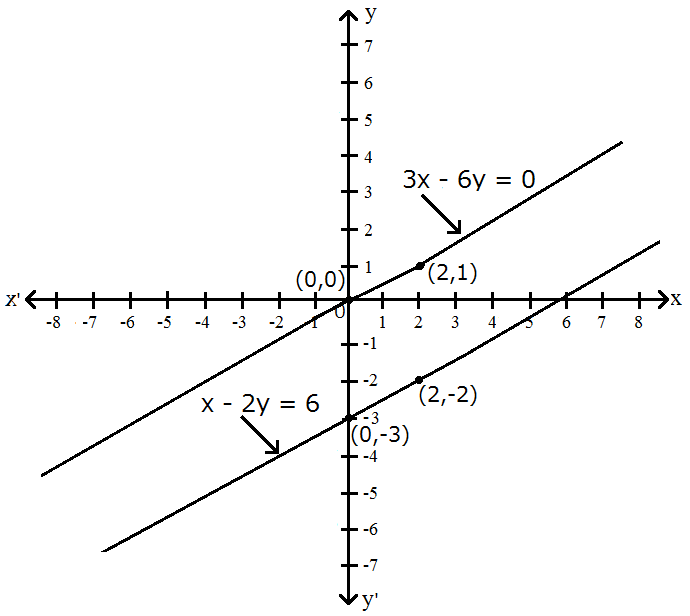
Clearly, two lines are parallel to each other. So, the two lines have no common point.
Hence, the given system of equations has no solution. View full question & answer→Question 994 Marks
Find the values of a and b for which the following system of equations has infinitely many solutions:
$(a - 1)x + 3y = 2$
$6x + (1 - 2b)y = 6$
AnswerThe given equations are
$(a - 1)x + 3y = 2 ....(i)$
$6x + (1 - 2b)y = 6......(ii)$
The given equations are of the form
$ a_1 x+b_1 y+c_1=0 $
$ a_2 x+b_2 y+c_2=0 $
$ \text { Where } a_1=(a-1), b_1=3, c_1=-2$
$ a_2=6, b_2=(1-2 b) \text {, and } c_2=-6$
For infinite many solution
$\frac{\text{a}_1}{\text{a}_2}=\frac{\text{b}_1}{\text{b}_2}=\frac{\text{c}_1}{\text{c}_2}$
$\Rightarrow\frac{(\text{a}-1)}{6}=\frac{3}{(1-2\text{b})}=\frac{-2}{-6}$
$\Rightarrow\frac{(\text{a}-1)}{6}=\frac{-2}{-6}$ and $\frac{3}{(1-2\text{b})}=\frac{-2}{-6}$
$⇒ 3(a - 1) = 6$ and $3 × 3 = 1 - 2b$
$⇒ 3a = 6 + 3$ and $9 = 1 - 2b$
$\Rightarrow\text{a}=\frac{9}{3}$ and $2b = 1 - 9$
$⇒ a = 3$ and $b = -4$
Thus, $a = 3$ and $b = -4$
View full question & answer→Question 1004 Marks
Draw the graphs of the following equations on the same graph paper.
$2x + 3y = 12,$
$x - y = 1.$
AnswerThe given equations are
$2x + 3y = 12 .......(i)$
$x - y = 1 .........(ii)$
Putting $x = 0$ in equation $(i)$, we get,
$\Rightarrow 2 \times 0 + 3y = 12$
$\Rightarrow y = 4$
$\Rightarrow x = 0, y = 4$
Putting $y = 0$ in equation $(i)$, we get,
$\Rightarrow x + 3 \times 0 = 6$
$\Rightarrow x = 6$
$\Rightarrow x = 6, y = 0$
Use the following table to draw the graph
Draw the graph by plotting the two points $A(0, 2)$ and $B(6, 0)$ from table.
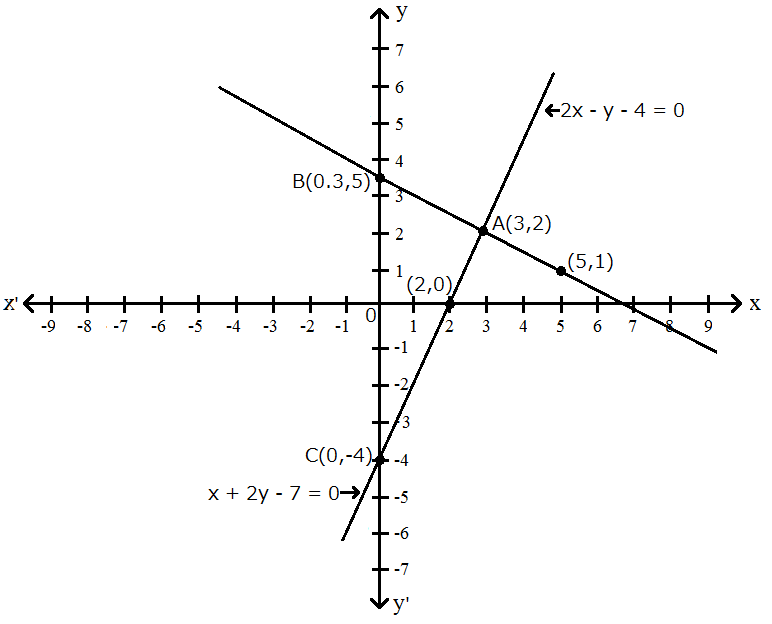
Putting $x = 0$ in equation $(ii)$ we get,
$\Rightarrow 0 - y = 1$
$\Rightarrow y = -1$
$\Rightarrow x = 0, y = -1$
Putting $y = 0$ in equation $(ii)$ we get,
$\Rightarrow x - 0 = 1$
$\Rightarrow x = 1$
$\Rightarrow x = 1, y = 0$
Use the following table to draw the graph.
Draw the graph by plotting the two points $C(0,-1), D(1,0)$ from table. Draw the graph by plotting the two points from table. The intersection point is $P(3,2)$. Three points of the triangle are $A(0,4), C(0,-1)$ and $P(3,2)$. Hence the value of $x =3$ and $y =2$. View full question & answer→