Question 1014 Marks
The students of a class are made to stand in rows. If $3$ students are extra in a row, there would be $1$ row less. If $3$ students are less in a row there would be $2$ rows more. Find the number of student in the class.
AnswerLet the number of students be x and the number of row be y. Then,
Number of students in each row $=\frac{\text{x}}{\text{y}}$
Where three students is extra in each row, there are one row less that is when each row has $\Big(\frac{\text{x}}{\text{y}}+3\Big)$
Students the number of rows is $(y - 1)$
Total number of students = no. of rows x no. of students in each row
$\text{x}=\Big(\frac{\text{x}}{\text{y}}+3\Big)(\text{y}-1)$
$\text{x}=\Big(\text{x}+3\text{y}-\frac{\text{x}}{\text{y}}-3\Big)$
$0=\frac{-\text{x}}{\text{y}}+\text{x}-\text{x}+3\text{y}-3$
$0=\frac{-\text{x}}{\text{y}}+\text{x}-\text{x}+3\text{y}-3$
$0=\frac{-\text{x}}{\text{y}}+3\text{y}-3$
If three students are less in each row then there are $2$ rows more that is when each row has
$\Big(\frac{\text{x}}{\text{y}}-3\Big)(\text{y}+2)$
Therefore, total number of students = Number of rows × Number of students in each row
$\text{x}=\Big(\frac{\text{x}}{\text{y}}-3\Big)(\text{y}+2)$
$\text{x}=\text{x}-3\text{y}+\frac{2\text{x}}{\text{y}}-6$
$0=\frac{2\text{x}}{\text{y}}+\text{x}-\text{x}-3\text{y}-6$
$0=\frac{2\text{x}}{\text{y}}-3\text{y}-6.......(\text{ii})$
Putting $\frac{\text{x}}{\text{y}}=\text{u}$ in (i) and (ii) equation we get
$\text{u}+3\text{y}-3=0\ .....(\text{iii})$
$2\text{u}-3\text{y}-6=0\ .....(\text{iv})$
Adding (iii) and (iv) equation we get
$-\text{u}\ +\ 3\text{y}\ -\ 3\ =\ 0\\2\text{u}\ -\ 3\text{y}\ -\ 6\ =\ 0\over\text{u} \ \ \ \ \ \ \ \ \ \ \ \ 9\ \ \ \ \ \ \ \ \ \ \ =\ 0$
$u = 9$
Putting $u = 9$ in equation $(iii)$ we get
$\text{u}+3\text{y}-3=0$
$-9+3\text{y}-3=0$
$3\text{y}-12=0$
$3\text{y}=12$
$\text{y}=\frac{12}{3}$
$\text{y}=4$
$\text{u}=9$
$\frac{\text{x}}{\text{y}}=9$
$\frac{\text{x}}{4}=9$
$\text{x}=9\times4$
$\text{x}=36$
Hence, the number of students in the class is $36$
View full question & answer→Question 1024 Marks
Find the values of a and b for which the following system of linear equations has infinite number of solutions:
$2x - 3y = 7$
$(a + b)x - (a + b - 3)y = 4a + b$
AnswerThe given equations are,
$2x - 3y = 7 ....(i)$
$(a + b)x - (a + b - 3)y = 4a + b ....(ii)$
The given equations are of the form
$ a_1 x+b_1 y+c_1=0 $
$a_2 x+b_2 y+c_2=0$
Where, $a_1=2, b_1=-3, c_1=-7$
And $a_2=(a+b), b_2=-(a+b-3)$, and $c_2=-(4 a+b)$
For infinitely many solutions,
$\frac{\text{a}_1}{\text{a}_2}=\frac{\text{b}_1}{\text{b}_2}=\frac{\text{c}_1}{\text{c}_2}$
$\Rightarrow\frac{2}{(\text{a}+\text{b})}=\frac{-3}{-(\text{a}+\text{b}-3)}=\frac{-7}{-(4\text{a}+\text{b})}$
$\Rightarrow\frac{2}{(\text{a}+\text{b})}=\frac{-3}{-(\text{a}+\text{b}-3)}$ and $\frac{-3}{-(\text{a}+\text{b}-3)}=\frac{-7}{-(4\text{a}+\text{b})}$
$\Rightarrow 2(a + b - 3) = 3(a + b)$ and $3(4a + b) = 7(a + b - 3)$
$\Rightarrow 2a + 2b - 6 = 3a + 3b$ and $12a + 3b = 7a + 7b - 21$
$\Rightarrow a + b + 6 = 0 .....(iii) $ and $5a - 4b = -21 ....(iv)$
Multiplying eq. $(iii)$ by $5$ ther subtract from eq. $(iv)$, we get
$-9b = 9$ and $b = -1$
Put $b = -1$ eq. (iii) we get $a = -5$
Thus $a = 5$ and $b = -1$
View full question & answer→Question 1034 Marks
A two-digit number is $3$ more than $4$ times the sum of its digits. If $8$ is added to the number, the digits are reversed. Find the number.
AnswerLet the digits at units and tens place of the given number
be x and y respectively. Thus, the number is $10y + x$
The number is 3 more than $4 $times the sum of the two digits. Thus, we have
$10y + x = 4(x + y) + 3$
$⇒ 10y + x = 4x + 4y + 3$
$⇒ 4x + 4y - 10y - x = -3$
$⇒ 3x - 6y = -3$
$\Rightarrow\text{x}-2\text{y}=-\frac{3}{3}$
$⇒ x - 2y = -1$
After interchanging the digits, the number becomes $10x + y$
If $18 $is added to the number, the digits are reversed. Thus, we have
$(10y + x) + 18 = 10x + y$
$⇒ 10x + y - 10y - x = 18$
$⇒ 9x - 9y = 18$
$⇒ 9(x - y) = 18$
$\Rightarrow\text{x}-\text{y}=\frac{18}{9}$
$⇒ x - y = 2$
So, we have the systems of equations
$x - 2y = -1$
$x - y = 2$
Here x and y are unknowns. We have to solve the above systems of equations for $x$ and $y.$
Subtracting the first equation from the second, we have
$(x - y) - (x - 2y) = 2 - (-1)$
$⇒ x - y - x + 2y = 3$
$⇒ y = 3$
Substituting the value of $y$ in the first equation, we have
$x - 2 × 3 = -1$
$⇒ x - 6 = -1$
$⇒ x = -1 + 6$
$⇒ x = 5$
Hence, the number is $10 × 3 + 5 = 35$
View full question & answer→Question 1044 Marks
Solve graphically the following system of linear equation. Also find the coordinates of the points where the lines meet axis of $y.$
$x + 2y - 7 = 0,$
$2x - y - 4 = 0.$
AnswerWe have,
$x + 2y - 7 = 0$
Now, $2x - y - 4 = 0$
$x + 2y - 7 = 0$
$x = 7 - 2y$
when, $y = 1, x = 5$
$y = 2, x = 3$
Also, $2x - y - 4 = 0$
$y = 2x - 4$
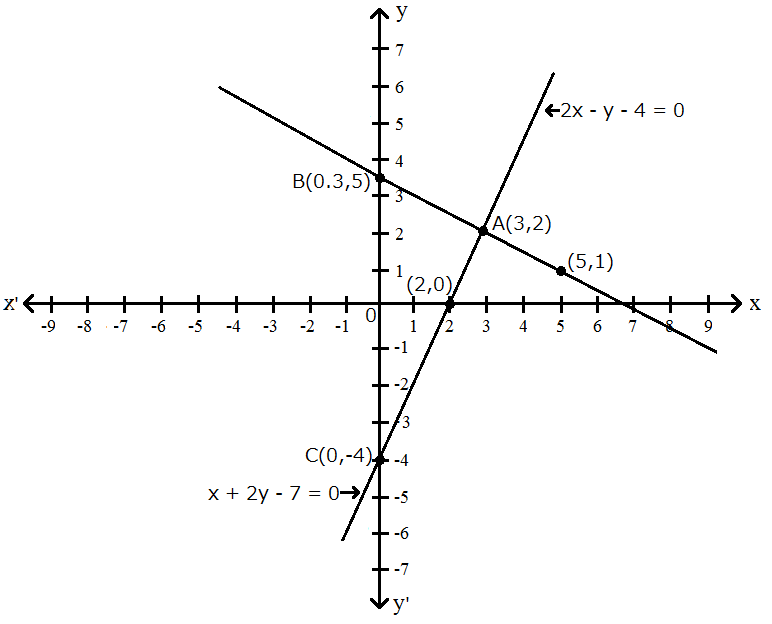
From the graph, the solution is $A(3, 2).$
Also, the coordinates of the points where the lines meet the y-axis are $B(0, 3, 5)$ and $C(0, -4).$ View full question & answer→Question 1054 Marks
Solve the following system of equations by the method of cross-multiplication:
$(a - b)x + (a + b)y = 2a^2- 2b^2$,
$(a + b)(x + y) = 4ab.$
AnswerGiven
$(a-b) x+(a+b) y=2 a^2-2 b^2 $
$(a+b)(x+y)=4 a b$
To find: The solution of the systems of equation by the method of cross-multiplication: Here we have the pair of simultaneous equation.
$(a-b) x+(a+b) y-2 a^2+2 b^2=0 $
$(a+b)(x+y)-4 a b=0$
By cross multiplication method we get,
$\Rightarrow\frac{\text{x}}{(-4\text{ab})(\text{a}+\text{b})-(\text{a}+\text{b})(-2\text{a}^2+2\text{b}^2)}=\frac{-\text{y}}{(-4\text{ab})(\text{a}-\text{b})-(\text{a}+\text{b})(-2\text{a}^2+2\text{b}^2)}\\=\frac{1}{(\text{a}+\text{b})(\text{a}-\text{b})-(\text{a}+\text{b})^2}$
$\Rightarrow\frac{\text{x}}{(\text{a}+\text{b})\big((-4\text{ab})-(-2\text{a}^2+2\text{b}^2)\big)}=\frac{-\text{y}}{(-4\text{ab})(\text{a}-\text{b})-(\text{a}+\text{b})(-2\text{a}^2+2\text{b}^2)}\\=\frac{1}{(\text{a}+\text{b})\big((\text{a}-\text{b})-(\text{a}+\text{b})\big)}$
Consider the following for x
$\Rightarrow\frac{\text{x}}{(\text{a}+\text{b})\big((-4\text{ab})-(-2\text{a}^2+2\text{b}^2)\big)}=\frac{1}{(\text{a}+\text{b})\big((\text{a}-\text{b})-(\text{a}+\text{b})\big)}$
$\Rightarrow\frac{\text{x}}{(-4\text{ab})-(-2\text{a}^2+2\text{b}^2)}=\frac{1}{(\text{a}-\text{b})-(\text{a}+\text{b})}$
$\text{x}=\frac{4\text{ab}+2\text{a}^2-2\text{b}^2}{2\text{b}}$
$\text{x}=\frac{2\text{ab}+\text{a}^2-\text{b}^2}{\text{b}}$
Now consider the following for y
$\Rightarrow\frac{-\text{y}}{(-4\text{ab})(\text{a}-\text{b})-(\text{a}+\text{b})(-2\text{a}^2+2\text{b}^2)}=\frac{1}{(\text{a}+\text{b})\big((\text{a}-\text{b})-(\text{a}+\text{b})\big)}$
$\Rightarrow\frac{\text{y}}{(4\text{ab})(\text{a}-\text{b})-(\text{a}+\text{b})(-2\text{a}^2+2\text{b}^2)}=\frac{1}{(\text{a}+\text{b})(-2\text{b})}$
$\Rightarrow\frac{\text{y}}{(4\text{ab})(\text{a}-\text{b})-(\text{a}+\text{b})(-2)(\text{a}^2-\text{b}^2)}=\frac{1}{(\text{a}+\text{b})(-2\text{b})}$
$\Rightarrow\frac{\text{y}}{(4\text{ab})(\text{a}-\text{b})-(\text{a}+\text{b})(-2)(\text{a}-\text{b})(\text{a}+\text{b})}=\frac{1}{(\text{a}+\text{b})(-2\text{b})}$
$\Rightarrow\frac{\text{y}}{(\text{a}-\text{b})(\text{a}^2-\text{b}^2)}=\frac{1}{(\text{a}+\text{b})\text{b}}$
$\text{y}=\frac{(\text{a}-\text{b})(\text{a}^2+\text{b}^2)}{(\text{a}+\text{b})\text{b}}$
Hence we get the value of $\text{x}=\frac{2\text{ab}+\text{a}^2-\text{b}^2}{\text{b}}$ and $\text{y}=\frac{(\text{a}-\text{b})(\text{a}^2+\text{b}^2)}{(\text{a}+\text{b})\text{b}}$
View full question & answer→Question 1064 Marks
Find the solution of the pair of equations $\frac{\text{x}}{10}+\frac{\text{y}}{5}-1=0$ and $\frac{\text{x}}{8}+\frac{\text{y}}{6}=15.$ Hence, find $\lambda,$ if $\text{y}=\lambda\text{x}+5.$
AnswerGiven pair of equation is
$\frac{\text{x}}{10}+\frac{\text{y}}{5}-1=0\ ......(\text{i})$
and $\frac{\text{x}}{8}+\frac{\text{y}}{6}=15\ .......(\text{ii})$
Now, multiplying both sides of eq. $(i)$ by
$L.C.M (10, 5) = 10$, we get
$x + 2y - 10 = 0$
$\Rightarrow x + 2y = 10 .....(iii)$
Again multiplying both sides of eq. $(ii)$ by
$L.C.M (8, 6) = 24$, we get
$3x + 4y = 360 ......(iv)$
On, multiplying eq. $(iii)$ by $2$ and then subtracting from eq. $(iv)$ we get
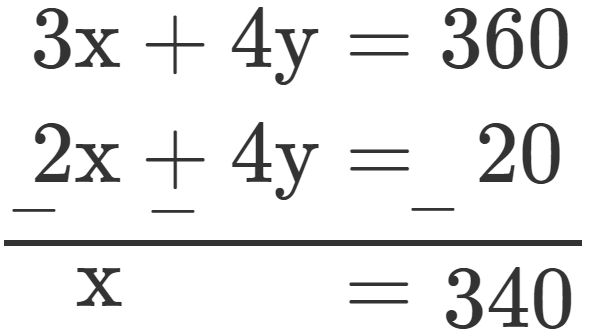
Put the value of x in eq $(iii)$ we get
$340 + 2y = 10$
$\Rightarrow y = - 165$
Given that the linear relation between $x, y$ and $\lambda$ is $\text{y}=\lambda\text{x}+5$
Now Put the value of $x$ and $y$ in above relation we get
$-165=\lambda(340)+5$
$\Rightarrow340\lambda=-170$
$\Rightarrow\lambda=\frac{-1}{2}$
Hence the solution of the pair of equations is $x = 340, y = -165$ and the requations is $x = 340, y = -165$ and the required values of $\lambda$ is $\frac{-1}{2}.$ View full question & answer→Question 1074 Marks
Solve the following systems of equations graphically:
$x + y = 3$
$2x + 5y = 12$
AnswerThe given equations are:
$x + y = 3 ......(i)$
$2x + 5y = 12 .....(ii)$
From $(i), y = 3 - x ......(iii)$
Puting $x = 0$ in $(iii),$ we get $y = 3$
Puting $x = 1$ in $(iii),$ we get $y = 2$
Puting $x = 2$ in $(iii),$ we get $y = 1$
|
$x$
|
$0$
|
$1$
|
$2$
|
|
$y$
|
$3$
|
$2$
|
$1$
|
From (ii), $\text{y}=\frac{12-2\text{x}}{5}\ .......(\text{iv})$
Puting $x = -4$ in $(iv)$, we get $y = 4$
Puting $x = 1$ in $(iv)$, we get $y = 2$
Puting $x = 64$ in $(iv)4, we get $y = 0$
|
$x$
|
$-4$
|
$1$
|
$6$
|
|
$y$
|
$4$
|
$2$
|
$0$
|
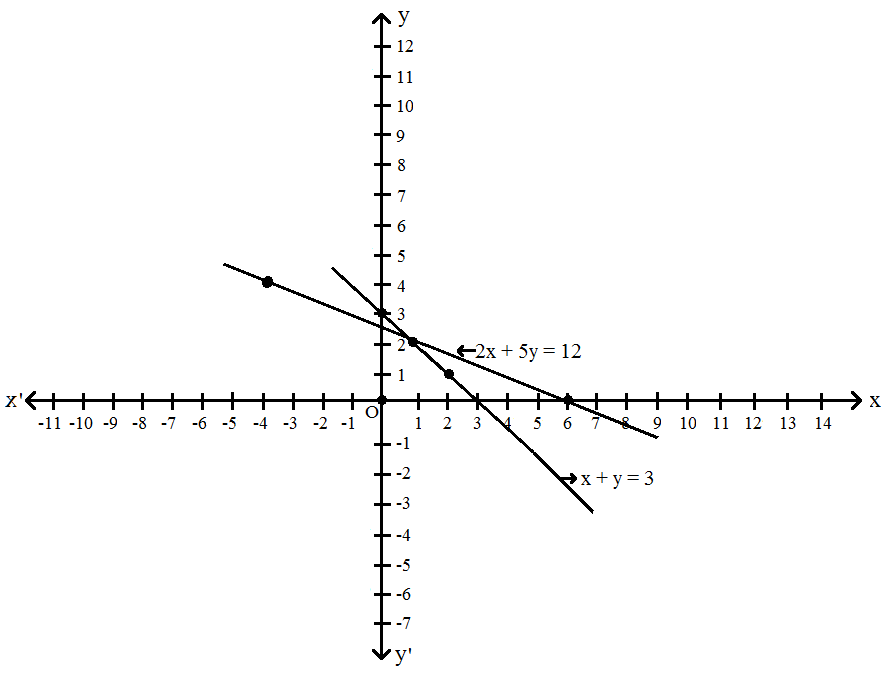
View full question & answer→Question 1084 Marks
Solve the following system of equations by the method of cross-multiplication:
$x + 2y + 1 = 0,$
$2x - 3y - 12 = 0.$
Answer The given system of equation is
$x + 2y + 1 = 0$
$2x - 3y - 12 = 0$
Here,
$ a_1=1, b_1=2, c_1=1 $
$ a_2=2, b_2=-3 \text { and } c_2=-12$
By cross-multiplication, we get
$\Rightarrow\frac{\text{x}}{2\times(-12)-1\times(-3)}=\frac{-\text{y}}{1\times(-12)-1\times2}\\=\frac{1}{1\times(-3)-2\times2 }$
$\Rightarrow\frac{\text{x}}{-24+3}=\frac{-\text{y}}{-12-2}=\frac{1}{-3-4}$
$\Rightarrow\frac{\text{x}}{-21}=\frac{-\text{y}}{-14}=\frac{1}{-7}$
Now,
$\frac{\text{x}}{-21}=\frac{1}{-7}$
$\Rightarrow\text{x}=\frac{-21}{-7}=3$
And,
$\frac{-\text{y}}{-14}=\frac{1}{-7}$
$ \Rightarrow\ \frac{\text{y}}{14}=\frac{-1}{7}$
$\Rightarrow\ \text{y}=\frac{-14}{7}=-2$
Hence, the solution of the given system of equations is $x = 3, y = -2.$
View full question & answer→Question 1094 Marks
If $2$ is added to the numerator of a fraction, it reduces to $\frac{1}{2}$ and if $1$ is subtracted from the denominator, it reduces to $\frac{1}{3}.$ Find the fraction.
AnswerLet the numerator and denominator of the fraction be x and y respectively. Then the fraction is $\frac{\text{x}}{\text{y}}$
If $2$ is added to the numerator of the fraction, it reduces to $\frac{1}{2}$
Thus we have
$\frac{\text{x}+2}{\text{y}}=\frac{1}{2}$
$\Rightarrow 2(x + 2) = y$
$\Rightarrow 2x + 4 = y$
$\Rightarrow 2x - y + 4 = 0$
If 1 is subtracted from the denominator, the fraction reduces to $\frac{1}{3}$
Thus we have
$\frac{\text{x}}{\text{y}-1}=\frac{1}{3}$
$\Rightarrow 3x = y - 1$
$\Rightarrow 3x - y + 1 = 0$
So, we have two equations
$2x - y + 4 = 0$
$3x - y + 1 = 0$
Here x and y are unknowns. We have to solve the above equations for $x$ and $y.$
By using cross-multiplication, we have
$ \Rightarrow\frac{\text{x}}{(-1)\times1-(-1)\times4}=\frac{-\text{y}}{2\times1-3\times4}$
$=\frac{1}{2\times(-1)-3\times(-1)}$
$ \Rightarrow\frac{\text{x}}{-1+4}=\frac{-\text{y}}{2-12}=\frac{1}{-2+3}$
$\Rightarrow\frac{\text{x}}{3}=\frac{-\text{y}}{-10}=1$
$\Rightarrow\frac{\text{x}}{3}=\frac{\text{y}}{10}=1$
$\Rightarrow\text{x}=3,\ \text{y}=10$
Hence, the fraction is $\frac{3}{10}$
View full question & answer→Question 1104 Marks
Solve the following system of equations by the method of cross-multiplication:
$(a + 2b)x + (2a − b)y = 2,$
$(a - 2b)x + (2a + b)y = 3.$
AnswerThe given system of equations may be written as,
$(a + 2b)x + (2a − b)y - 2 = 0$
$(a - 2b)x + (2a + b)y - 3 = 0$
Here, $a_1=a+2 b, b_1=2 a-b, c_1=-2$
$a_2=a-2 b, b_2=2 a+b$ and $c_2=-3$
By cross multiplication, we have
$\Rightarrow\frac{\text{x}}{-3(2\text{a}-\text{b})-(-2)(2\text{a}+\text{b})}=\frac{-\text{y}}{3(\text{a}+2\text{b})-(-2)(\text{a}-2\text{b})}\\=\frac{1}{(\text{a}+2\text{b})(2\text{a}+\text{b})-(2\text{a}-\text{b})(\text{a}-2\text{b})}$
$\Rightarrow\frac{\text{x}}{-6\text{a}+3\text{b}+4\text{a}+2\text{b}}=\frac{-\text{y}}{-3\text{a}-6\text{b}+2\text{a}-4\text{b}}\\=\frac{1}{2\text{a}^2+\text{a}\text{b}+4\text{a}\text{b}+2\text{b}^2-(2\text{a}^2-4\text{a}\text{b}-\text{a}\text{b}+2\text{b}^2)}$
$\Rightarrow\frac{\text{x}}{-2\text{a}+5\text{b}}=\frac{-\text{y}}{-\text{a}-10\text{b}}\\=\frac{1}{2\text{a}^2+\text{a}\text{b}+4\text{a}\text{b}+2\text{b}^2-(2\text{a}^2-4\text{a}\text{b}-\text{a}\text{b}+2\text{b}^2)}$
$\Rightarrow\frac{\text{x}}{-2\text{a}+5\text{b}}=\frac{-\text{y}}{-(\text{a}+10\text{b})}=\frac{1}{10\text{ab}}$
$\Rightarrow\frac{\text{x}}{-2\text{a}+5\text{b}}=\frac{-\text{y}}{\text{a}+10\text{b}}=\frac{1}{10\text{ab}}$
Now,
$\Rightarrow\frac{\text{x}}{-2\text{a}+5\text{b}}=\frac{1}{10\text{ab}}$
$\Rightarrow\text{y}=\frac {\text{a}+10\text{b}}{10\text{ab}}$
and,
$\Rightarrow\frac{\text{y}}{\text{a}+10\text{b}}=\frac{1}{10\text{ab}}$
$\Rightarrow\text{y}=\frac{\text{a}+10\text{b}}{10\text{ab}}$
Hence, $ \text{x}=\frac{5\text{b}-2\text{a}}{10\text{ab}},\text{y}=\frac{\text{a}+10\text{b}}{10\text{ab}}$ is the solution of the given system of equations.
View full question & answer→Question 1114 Marks
Two years ago, Salim was thrice as old as his daughter and six years later, he will be four years older than twice her age. How old are they now?
AnswerLet Salim and his daughter’s age be $x$ and $y$ year respectively.
Now, by first condition.
Two years ago, Salim was thrice as old as his daughter.
i.e., $x - 2 = 3(y - 2)$
$\Rightarrow x - 2 = 3y - 6$
$\Rightarrow x - 3y = -4 .....(i)$
and by second condition,
six years later, Salim will be four years older than twice her age,
$x + 6 = 2(y + 6) + 4$
$\Rightarrow x - 2y = 16 - 6$
$\Rightarrow x - 2y = 10 .....(ii)$
On subtracting eq. $(i)$ from eq. $(ii)$, we get
$y = 14$
Put the value of y in eq. $(ii)$, we get
$x - 2 \times 14 = 10$
$\Rightarrow x = 10 + 28$
$\Rightarrow x = 38$
Hence, Salim and his daughter’s age are $38$ years and $14$ years, respectively.
View full question & answer→Question 1124 Marks
Solve graphically the following system of linear equation. Also find the coordinates of the points where the lines meet axis of $y.$
$2x - 5y + 4 = 0,$
$2x + y - 8 = 0.$
AnswerWe have,
$2x - 5y + 4 = 0$
$2x + y - 8 = 0$
Now, $2x - 5y + 4 = 0$
$⇒ 2x = 5y - 4$
$\Rightarrow\text{x}=\frac{5\text{y}-4}{2}$
When y = 2, we have,
$\text{x}=\frac{5\times2-4}{2}=3$
When y = 4, we have,
$\text{x}=\frac{5\times4-4}{2}=8$
Thus, we have the following table giving points on the line$ 2x - 5y + 4 = 0$
Now, $2x + y - 8 = 0$
$⇒ 2x = 8 - y$
$\Rightarrow\text{x}=\frac{8-\text{y}}{2}$
When y = 4, we have,
$\text{x}=\frac{8-4}{2}=2$
When y = 2, we have,
$\text{x}=\frac{8-2}{2}=3$
Thus, we have the following table points on the line $2x + y - 8 = 0$
Graph of the given equations,
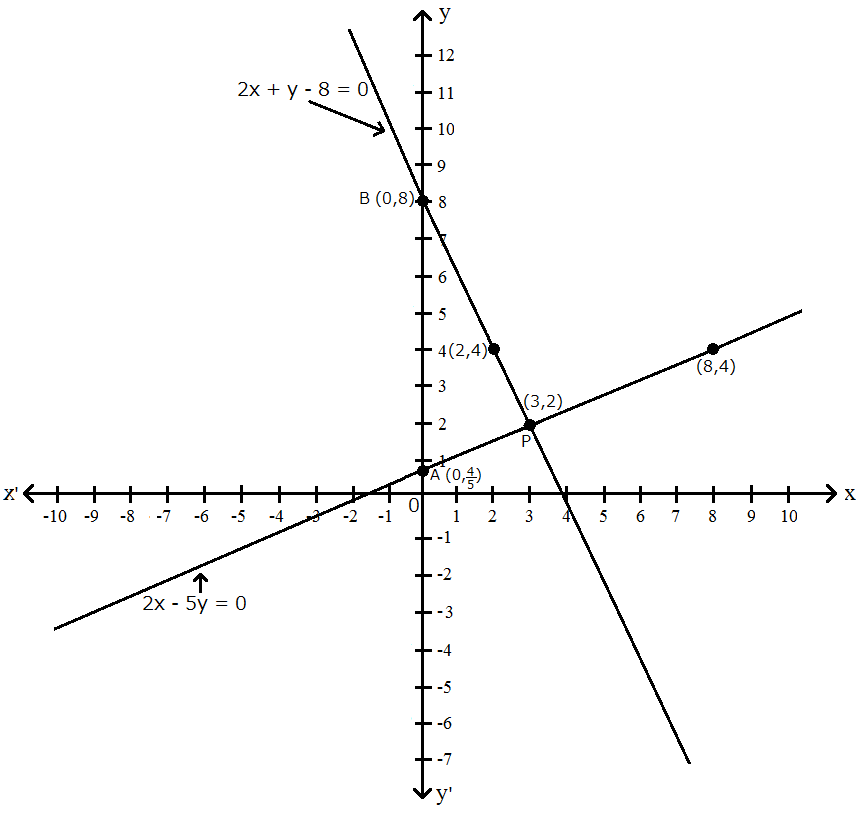
Clearly, two intersect at $P (3,2)$.
Hence, $x=3, y=2$ is the solution of the given system of equations.
We also observe that lines represented by $2 x-5 y+4$ and $2 x+y-8=0$ meet $y$-axis at $A\left(0, \frac{4}{5}\right)$ and $B(0,8)$ respectively. View full question & answer→Question 1134 Marks
Solve the following systems of equations graphically:
$2x + y + 3 = 0$
$2x - 3y - 7 = 0$
AnswerThe given equations are:
$2x + y + 3 = 0 ......(i)$
$2x - 3y - 7 = 0 .........(ii)$
From $(i), y = 3 - 2x ........(iii)$
Putting $x = 0$ in $(3)$, we get $y = 3$
Putting $x = 1$ in $(3)$, we get $y = 1$
Putting $x = 2$ in $(3)$, we get $y = -1$
|
$x$
|
$0$
|
$1$
|
$2$
|
|
$y$
|
$3$
|
$1$
|
$-1$
|
From $(ii)$, $\text{y}=\frac{2\text{x}-7}{3}\ ......(\text{iv})$
Putting $x = 2$ in $(iv)$, we get $y = -1$
Putting $x = 5$ in $(iv)$, we get $y = 1$
Putting $x = 8$ in $(iv)$, we get $y = 3$
|
$x$
|
$2$
|
$5$
|
$8$
|
|
$y$
|
$-1$
|
$1$
|
$3$
|
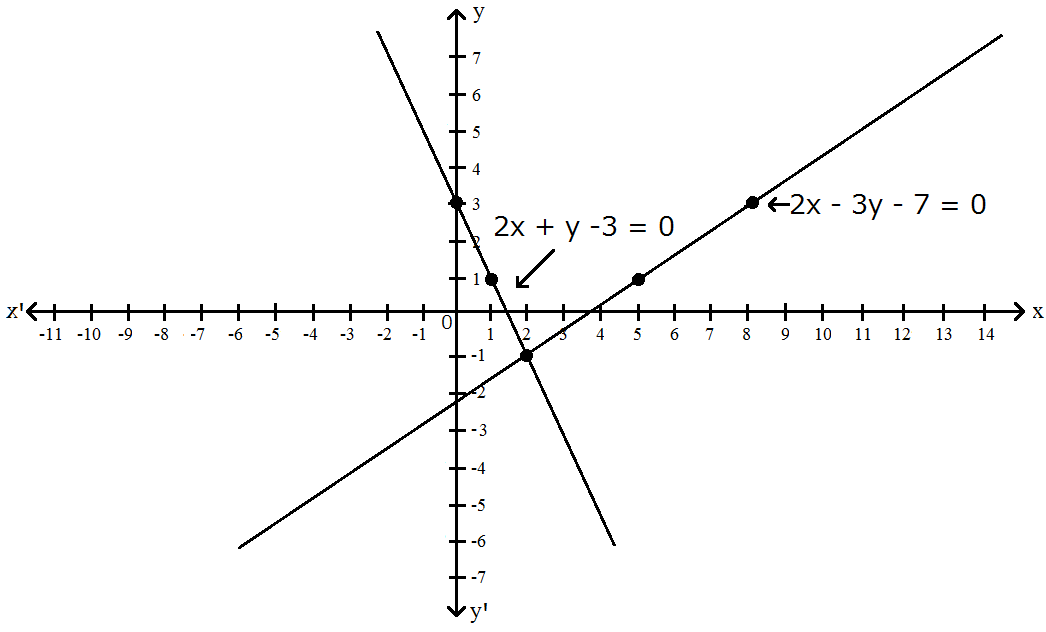
Clearly, from the above graph solution of above systam of equations is $x = 2$ and $y = -1.$ View full question & answer→Question 1144 Marks
Seven times a two-digit number is equal to four times the number obtained by reversing the digits. If the difference between the digits is $3$. Find the number.
AnswerLet the digits at units and tens place of the given number be $x$ and $y$ respectively. Thus, the number is $10y + x$
The difference between the two digits of the number is $3$. Thus, we have
After interchanging the digits, the number becomes $10x + y$
Seven times the number is equal to four times the number obtained by reversing the order of the digits.
Thus, we have
$7(10y + x) = 4(10x + y)$
$\Rightarrow 70y + 7x = 40x + 4y$
$\Rightarrow 40x + 4y - 70y - 7x = 0$
$\Rightarrow 33x - 66y = 0$
$\Rightarrow 33(x - 2y) = 0$
$\Rightarrow x - 2y = 0$
So, we have two systems of simultaneous equations
$x - y = 3$
$\Rightarrow x - 2y = 0$
$\Rightarrow x - y = -3$
$\Rightarrow x - 2y = 0$
Here x and y are unknowns. We have to solve the above systems of equations,
- First, we solve the system
$x - y = 3$
$x - 2y = 0$
Multiplying the first equation by $2$ and then subtracting from the second equation, we have
$(x - 2y) - 2(x - y) = 0 - 2 \times 3$
$\Rightarrow x - 2y - 2x + 2y = -6$
$\Rightarrow -x = -6$
$\Rightarrow x = 6$
Substituting the value of x in the first equation, we have
$6 - y = 3$
$\Rightarrow y = 6 - 3$
$\Rightarrow y = 3$
Hence, the number is $10 \times 3 + 6 = 36$
- Now, we solve the system
$x - y = -3$
$x - 2y = 0$
Multiplying the first equation by $2$ and then subtracting from the second equation, we have
$(x - 2y) - 2(x - y) = 0 - (-3 \times 2)$
$\Rightarrow x - 2y - 2x + 2y = 6$
$\Rightarrow -x = 6$
$\Rightarrow x = -6$
Substituting the value of x in the first equation, we have
$-6 - y = -3$
$\Rightarrow y = -6 + 3$
$\Rightarrow y = -3$
But, the digits of the number can’t be negative. Hence, the second case must be removed. View full question & answer→Question 1154 Marks
While covering a distance of $30\ km$. Ajeet takes $2$ hours more than Amit. If Ajeet doubles his speed, he would take $1$ hour less than Amit. Find their speeds of walking.
AnswerLet the speed of Ajeet and Amit be $x \ km/ hr$ and $y \ km/ hr$ respectively. Then,
Time taken by Ajeet to cover $30\text{km}=\frac{30}{\text{x}}\text{hrs}$
Time taken by Amit to cover $30\text{km}=\frac{30}{\text{y}}\text{hrs}$
By the given conditions, we have
$\frac{30}{\text{x}}-\frac{30}{\text{y}}=2\ ....(\text{i})$
If Ajeet doubles his speed then speed of Ajeet is 2x km/ hr
Time taken by Ajeet to cover $30\text{km}=\frac{30}{2\text{x}}\text{hrs}$
Time taken by Amit to cover $30\text{km}=\frac{30}{\text{y}}\text{hrs}$
According to the given condition we have
$\frac{-15\text{x}}{\text{x}}+\frac{30}{\text{y}}=1\ ...(\text{ii})$
Putting $\frac{1}{\text{x}}=\text{u}$ and $\frac{1}{\text{y}}=\text{v}$ in equation (i) and (ii) we get
$30\text{u}-30\text{v}=2\ ....(\text{iii})$
$-15\text{u}+30\text{v}=1\ .....(\text{iv})$
Adding equations (iii) and (iv) we get
$\ \ \ \ 30\text{u}-30\text{v}=2\\\underline{-15\text{u}+30\text{v}\ =1}\\\ \ \ 15\text{u}\ \ \ \ \ \ \ \ \ \ \ \ =3$
$\text{u}=\frac{3}{15}$
$\text{u}=\frac{1}{5}$
Putting $\text{u}=\frac{1}{5}$ in equation (iii) we get
$30\text{u}-30\text{v}=2$
$30\times\frac{1}{5}-30\text{v}=2$
$6-30\text{v}=2$
$-30\text{v}=2-6$
$-30\text{v}=-4$
$\text{v}=\frac{-4}{-30}$
$\text{v}=\frac{2}{15}$
Now, $\text{u}=\frac{1}{5}$
$\frac{1}{\text{x}}=\frac{1}{5}$
$\text{x}=5$
And $\text{v}=\frac{2}{15}$
$\frac{1}{\text{y}}=\frac{2}{15}$
$\text{y}=7.5$
Hence, the speed of Ajeet is $5\ km/ hr.$ The speed of Amit is $7.5 \ km/ hr.$
View full question & answer→Question 1164 Marks
Determine, graphically whether the system of equation $x - 2y = 2, 4x - 2y = 5$ is consistent or in-consistent.
AnswerWe have
$x - 2y = 2$
$4x - 2y = 5$
Now$ x - 2y = 2$
$⇒ x = 2 + 2y$
When $y = 0$, we have,
$x = 2 + 2 × 0 = 2$
when $y = -1$, we have,
$x = 2 + 2 × (-1) = 0$
Thus, we have the following table giving points on the line $x - 2y = 2$
Now, $4x - 2y = 5$
$⇒ 4x = 5 + 2y$
$\Rightarrow\text{x}=\frac{5+2\text{y}}{4}$
When $y = 0$, we have
$\text{x}=\frac{5+2\times0}{4}=\frac{5}{4}$
When $y = 1$, we have
$\text{x}=\frac{5+2\times1}{4}=\frac{7}{4}$
Thus, we have the following table giving points on the line $4x - 2y = 5$
| $x$ |
$\frac{5}{4}$ |
$\frac{7}{4}$ |
| $y$ |
$0$ |
$1$ |
Graph of the given equations,
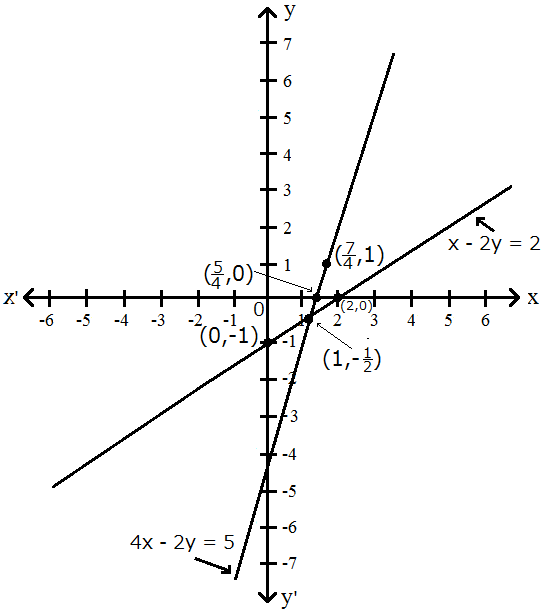
Clearly, the two lines intersect at $(i!).$
Hence, the system of equations is consistent. View full question & answer→Question 1174 Marks
Solve the following system of linear equations graphically.
$4x - 5y - 20 = 0$
$3x + 5y - 15 = 0$
AnswerThe given equations are
$4x - 5y - 20 = 0 .......(i)$
$3x + 5y - 15 = 0 ........(ii)$
From (i), $\text{y}=\frac{4\text{x}-20}{5}\ ......(\text{iii})$
Putting $x = 0$ in equations $(i)$, we get $y = -4$
Putting $x = 5$ in equations $(i)$, we get $y = 0$
From (ii), $\text{y}=\frac{15-3\text{x}}{5}\ ......(\text{iv})$
Putting $x = 0$ in equations $(i)$, we get $y = 3$
Putting $x = 5$ in equations $(i)$, we get $y = 0$
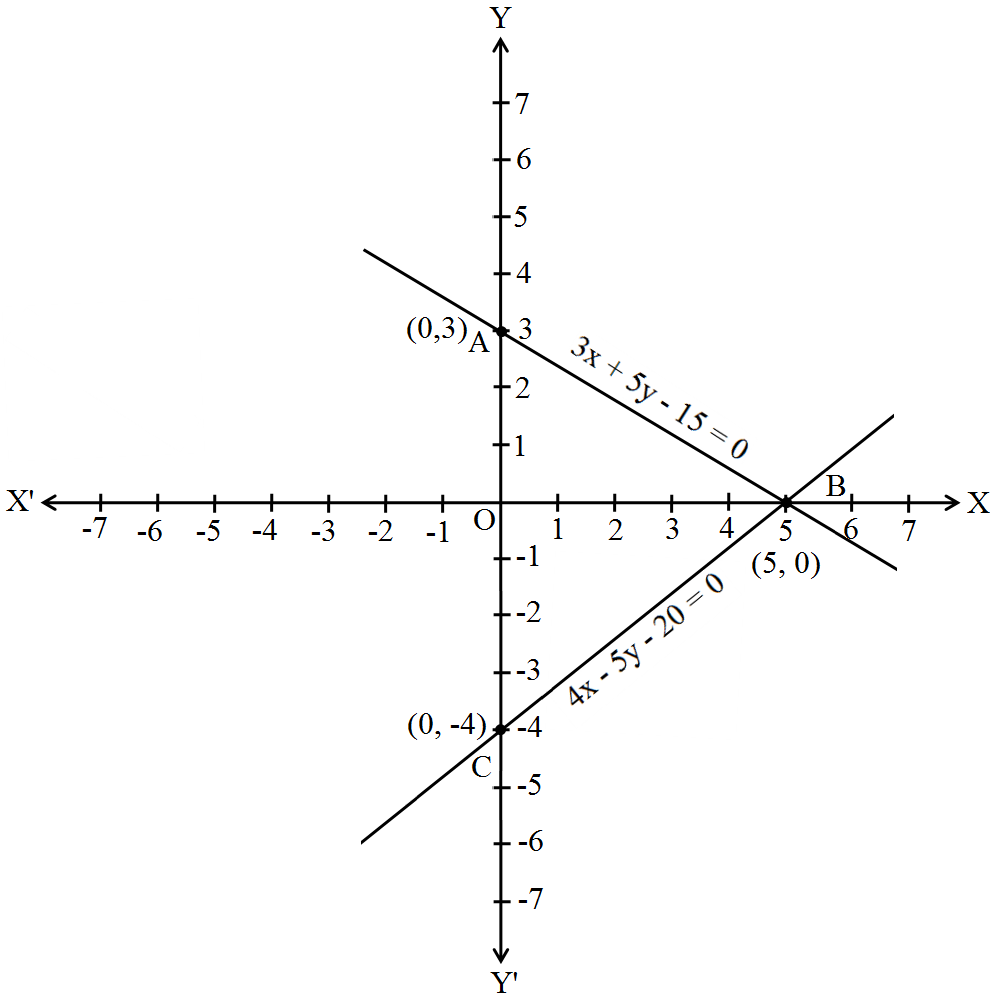
When we solve these equations we get $x = 5$ and $y = 0.$
Thus the vertices of $\triangle$ are $(0, 3), (0, -4)$ and $(5, 0).$ View full question & answer→Question 1184 Marks
Solve the following systems of equations graphically:
$2x - 3y + 13 = 0$
$3x - 2y + 12 = 0$
AnswerWe have,
$2x - 3y + 13 = 0$
$3x - 2y + 12 = 0$
Now, $2x - 3y + 13 = 0$
$\Rightarrow 2x = 3y - 13$
$\Rightarrow\text{x}=\frac{3\text{y}-13}{2}$
When $y = 1$, we have,
$\text{x}=\frac{3\times1-13}{2}=-5$
When $y = 3,$ we have,
$\text{x}=\frac{3\times3-13}{2}=-2$
Thus, we have the following table giving points on the line $2x - 3y + 13 = 0$
|
$x$
|
$-5$
|
$-2$
|
|
$y$
|
$1$
|
$3$
|
Now, $3x - 2y + 12 = 0$
$\Rightarrow 3x = 2y - 12$
$\Rightarrow\text{x}=\frac{2\text{y}-12}{3}$
When $y = 0$, we have,
$\Rightarrow\text{x}=\frac{2\times0-12}{3}=-4$
When $y = 3$, we have,
$\text{x}=\frac{2\times3-12}{3}=-2$
Thus, we have the following table giving points on the line $3y - 2y + 12 = 0$
|
$x$
|
$-4$
|
$-2$
|
|
$y$
|
$0$
|
$3$
|
Graph of the given equations are,
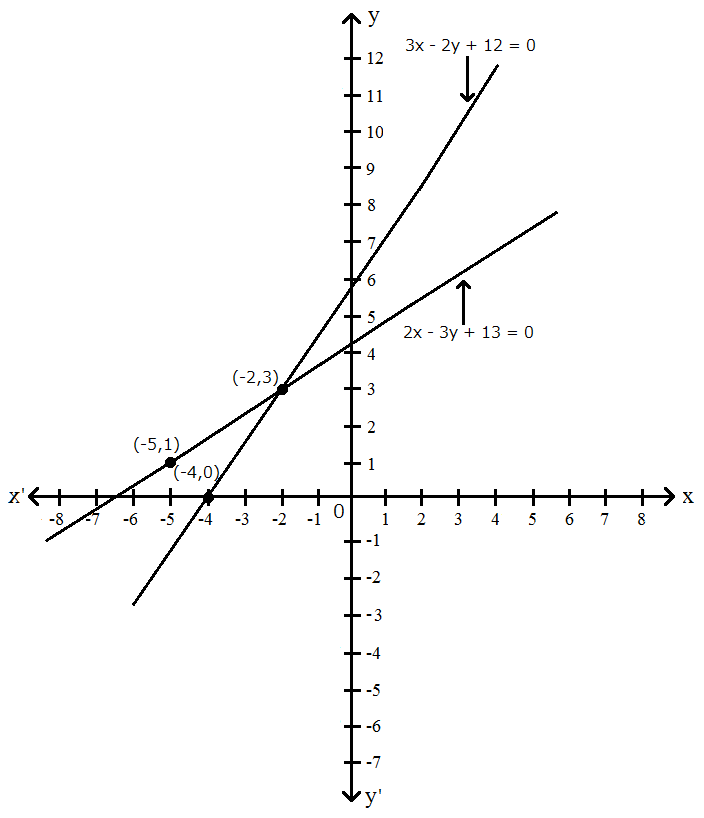
Clearly, two lines intersect at $(-2, 3)$
Hence, $x = -2, y = 3$ is the solution of the given system of equations. View full question & answer→Question 1194 Marks
Solve the following system of equations by the method of cross-multiplication:
$ax + by = a^2$,
$bx + ay = b^2$.
AnswerGiven,
$ a x+b y=a^2 $
$b x+a y=b^2$
To find: The solution of the systems of equation by the method of cross-multiplication:
Here we have the pair of simultaneous equation,
$ a x+b y-a^2=0 $
$ b x+a y-b^2=0$
By cross multiplication method we get,
$\Rightarrow\frac{\text{x}}{\text{b}\times(-\text{b}^2)-\text{a}\times(-\text{a}^2)}=\frac{-\text{y}}{\big(\text{a}\times(-\text{b}^2)-\big(\text{b}\times(-\text{a}^2)\big)}\\=\frac{1}{\big(\text{a}\times(\text{a})\big)-\big((\text{b}\times\text{b})\big)}$
$\frac{\text{x}}{(\text{a}^3-\text{b}^3)}=\frac{-\text{y}}{(-\text{ab}^2+\text{a}^2\text{b})}=\frac{1}{(\text{a}^2-\text{b}^2)}$
$\frac{\text{x}}{(\text{a}^3-\text{b}^3)}=\frac{1}{(\text{a}^2-\text{b}^2)}$
$\text{x}=\frac{(\text{a}^3-\text{b}^3)}{(\text{a}^2-\text{b}^2)}$
$\text{x}=\frac{(\text{a}-\text{b})(\text{a}^2+\text{ab}+\text{b}^2)}{(\text{a}^2-\text{b}^2)}$ $\big\{\text{since}(\text{a}^3-\text{b}^3)=(\text{a}-\text{b})(\text{a}^2+\text{ab}+\text{b}^2)\big\}$
$\text{x}=\frac{(\text{a}^2+\text{ab}+\text{b}^2)}{(\text{a}+\text{b})}$ $\{\text{since}(\text{a}^2-\text{b}^2)=(\text{a}+\text{b})(\text{a}-\text{b})\big\}$
And, $\frac{-\text{y}}{(-\text{ab}^2+\text{a}^2\text{b})}=\frac{1}{(\text{a}^2-\text{b}^2)}$
$ \text{y}=\frac{(-\text{ab}^2+\text{a}^2\text{b})}{(\text{a}^2-\text{b}^2)}$
$\text{y}=\frac{\big(-\text{ab}(\text{a}-\text{b})\big)}{(\text{a}^2-\text{b}^2)}$
$\text{y}=\frac{(-\text{ab}(\text{a}-\text{b}))}{(\text{a}-\text{b})(\text{a}+\text{b})}$ $\big\{\text{since}(\text{a}^2-\text{b}^2)=(\text{a}+\text{b})(\text{a}-\text{b})\big\}$
$\text{y}=\frac{-\text{ab}}{(\text{a}+\text{b})}$
Hence we get the value of $ \text{x}=\frac{(\text{a}^2+\text{ab}+\text{b}^2)}{(\text{a}+\text{b})}$ and $\text{y}=\frac{-\text{ab}}{(\text{a}+\text{b})}.$
View full question & answer→Question 1204 Marks
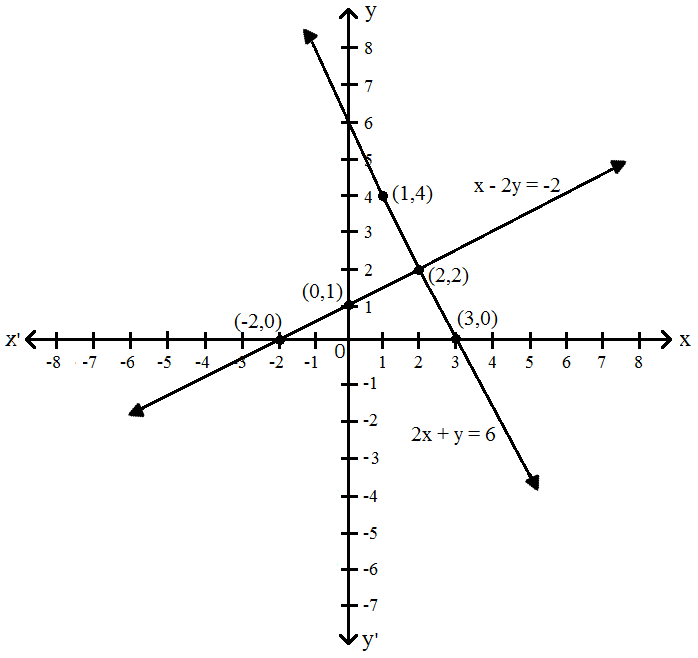
Solve graphically each of the following systems of linear equations. Also, find the coordinates of the points where the lines meet the axis of $x$ in each system.
$2x + y = 6,$
$x - 2y = -2.$
AnswerThe given system of equation is,
$2x + y = 6 .......(i)$
$x - 2y = -2 ..........(ii)$
$2x + y = 6 .......(i)$
$y = 6 - 2x$
Substituting some different values of $x$, we get their corresponding values of $y$ as shown below;
|
$x$
|
$1$
|
$2$
|
$3$
|
|
$y$
|
$4$
|
$2$
|
$0$
|
Now plot the points and join them similarly in the equation.
$x - 2y = -2$
$\Rightarrow x = 2y - 2$
|
$x$
|
$-2$
|
$0$
|
$2$
|
|
$y$
|
$0$
|
$1$
|
$2$
|
Now plot the points and join them we see that these two lines intersect each other at $(2, 2) x = 2, y = 2$. Here two lines also meet x-axis at $(3, 0)$ and $(-2, 0)$ respectively as shown in the.
View full question & answer→Question 1214 Marks
A railway half ticket costs half the full fare and the reservation charge is the same on half ticket as on full ticket. One reserved first class ticket from Mumbai to Ahmedabad costs Rs. $216$ and one full and one half reserved first class tickets cost Rs. $327$. What is the basic first class full fare and what is the reservation charge?
AnswerLet take first class full of fare is Rs. x and reservation charge is Rs. $y$ per ticket.
Then, half of the ticket as on full ticket $=\frac{\text{x}}{2}$
According to the question,
$\Rightarrow\text{x}+\text{y}=216\ ....(\text{i})$
$\Rightarrow\text{x}+\text{y}+\frac{\text{x}}{2}+\text{y}=327$
$\Rightarrow\frac{3\text{x}}{2}+2\text{y}-327=0\ ....(\text{ii})$
Now, multiplying eq. $(i)$ by $2$
$\Rightarrow2\text{x}+2\text{y}-432=0\ .....(\text{iii})$
Now, subtracting eq. $(iii)$ from eq. $(ii)$
$\Rightarrow\frac{3\text{x}}{2}+2\text{y}-327-(2\text{x}+2\text{y}-432)$
$\Rightarrow \frac{3\text{x}}{2}+2\text{y}-327-2\text{x}-2\text{y}+432$
$\Rightarrow \frac{3}{2}\text{x}-2\text{x}+105$
$\Rightarrow \frac{\text{-x}}{2}+105=0$
$\Rightarrow \frac{\text{-x}}{2}=-105$
$\Rightarrow\text{x}=2\times105$
$\Rightarrow\text{x}=210$
Now, putting the value of x in eq. $(i)$
$\Rightarrow210+\text{y}=216$
$\Rightarrow\text{y}=216-210$
$\Rightarrow\text{x}=6$
Hence, the basic first class full fare is Rs. $210,$ The reservation charqe is Rs. $6.$
View full question & answer→Question 1224 Marks
Solve the following systems of equations:
$3\text{x}-\frac{\text{y}+7}{11}+2=10,$
$3\text{y}-\frac{\text{x}+11}{7}=10.$
AnswerThe given systems of equations is,
$3\text{x}-\frac{\text{y}+7}{11}+2=10\ ......(\text{i})$
$3\text{y}-\frac{\text{x}+11}{7}=10\ ......(\text{ii})$
From (i), we get
$\frac{33\text{x}-\text{y}-7+22}{11}=10$
$\Rightarrow 33\text{x} -\text{y} + 15 = 10 × 11$
$\Rightarrow 33\text{x} + 15 - 110 = \text{y}$
$\Rightarrow \text{y} = 33\text{x} - 95$
From (ii), we get
$\frac{21\text{y}-\text{x}-11}{7}=10$
$21\text{y}-\text{x}-11=70$
$21\text{y}-\text{x}=70+11$
$\text{x}-21\text{y}=81$
$\text{x}-21\text{y}=-81\ ...(\text{iii})$
Substitution value of y in equation $(iii)$
$\text{x}-21(33\text{x}-95)=-81$
$\text{x}-693\text{x}+1995=-81$
$-692\text{x}=-81-1995$
$-692\text{x}=-2076$
$\text{x}=\frac{2076}{692}=3$
So that $\text{y}=33\times3-95$
$\text{y}=99-95$
$\text{y}=4$
Hence solution of the given system of equation $x = 3, y = 4.$
View full question & answer→Question 1234 Marks
Solve the following system of equations by the method of cross-multiplication:
$\frac{\text{x}}{\text{b}}=\frac{\text{y}}{\text{b}},$
$\text{ax}+\text{by}=\text{a}^2+\text{b}^2.$
Answer$\frac{\text{x}}{\text{a}}-\frac{\text{y}}{\text{b}}=0$
$\text{a}\text{x}+\text{b}\text{y}=\text{a}^2+\text{b}^2$
The given pair of linear equetions is
$\frac{\text{x}}{\text{a}}-\frac{\text{y}}{\text{b}}=0\dots(\text{i})$
$\text{a}\text{x}+\text{b}\text{y}=\text{a}^2+\text{b}^2\dots(\text{ii})$
From equetion $(i)$, we have
$\frac{\text{y}}{\text{b}}=\frac{\text{x}}{\text{a}}$
$\Rightarrow\text{y}=\frac{\text{b}}{\text{a}}\text{x}\dots(\text{iii})$
Substituting the value of y in equetion $(ii)$, we get
$\text{a}\text{x}+\text{b}\Big(\frac{\text{b}}{\text{a}}\text{x}\Big)=\text{a}^2+\text{b}^2$
$\Rightarrow\text{a}\text{x}+\frac{\text{b}^2}{\text{a}}\text{x}=\text{a}^2+\text{b}^2$
$\Rightarrow\text{a}^2\text{x}+\text{b}^2\text{x}=\text{a}(\text{a}^2+\text{b}^2)$
$\Rightarrow\text{x}=\frac{\text{a}(\text{a}^2+\text{b}^2)}{\text{a}^2+\text{b}^2}=\text{a}$
Substituting the value of x in equetion $(iii),$ we get
$\text{y}=\frac{\text{b}}{\text{a}}\text{x}$
$\Rightarrow\text{y}=\frac{\text{b}}{\text{a}}\times\text{a}=\text{b}$
Hence, $\text{x}=\text{a},\text{y}=\text{b}$
View full question & answer→Question 1244 Marks
Solve the following system of equations by the method of cross-multiplication:
$\frac{2}{\text{x}}+\frac{3}{\text{y}}=13,$
$\frac{5}{\text{x}}-\frac{4}{\text{y}}=-2,$ where $\text{x}\neq0$ and $\text{y}\neq0.$
AnswerThe given equations are,
$\frac{2}{\text{x}}+\frac{3}{\text{y}}=13\ ...(\text{i})$
$\frac{5}{\text{x}}-\frac{4}{\text{y}}=-2\ ...(\text{ii})$
Let $\frac{1}{\text{x}}=\text{u}$ and $\frac{1}{\text{y}}=\text{v}.$
$2\text{u}+3\text{v}-13=0\ ...(\text{iii})$
$5\text{u}-4\text{v}+2=0\ ....(\text{iv})$
By cross-multiplication we get,
$\Rightarrow\frac{\text{u}}{3\times2-(-13)(-4)}=\frac{\text{v}}{(-13)(5)-2\times2}\\=\frac{1}{2(-4)-3(5)}$
$\Rightarrow\frac{\text{u}}{6-52}=\frac{\text{v}}{-65-4}=\frac{1}{-8-15}$
$\Rightarrow\frac{\text{u}}{-46}=\frac{\text{v}}{-69}=\frac{1}{-23}$
$\text{u}=\frac{-46}{-23}=2$ and $\text{v}=\frac{-69}{-23}=3$
$\because\frac{1}{\text{x}}=\text{u}\ \Rightarrow\text{x}=\frac{1}{\text{u}}\ \Rightarrow\text{x}=\frac{1}{2}$
and $\frac{1}{\text{y}}=\text{v}\ \Rightarrow\text{y}=\frac{1}{\text{v}}\ \Rightarrow\text{y}=\frac{1}{3}$
View full question & answer→Question 1254 Marks
Solve the following systems of equations graphically:
$x + y = 6$
$x - y = 2$
AnswerThe given equations are
$x + y = 6 .......(i)$
$x - y = 2 ..........(ii)$
Putting $x = 0$ in equation $(i)$, we get,
$\Rightarrow 0 + y = 6$
$\Rightarrow y = 6$
$x = 0, y = 6$
Putting $y = 0$ in equation $(i)$, we get,
$\Rightarrow x + 0 = 6$
$\Rightarrow x = 6$
$x = 6, y= 0$
Use the following table to draw the graph.
Draw the graph by plotting the two points $A(0, 6)$ and $B(6, 0)$ from table.
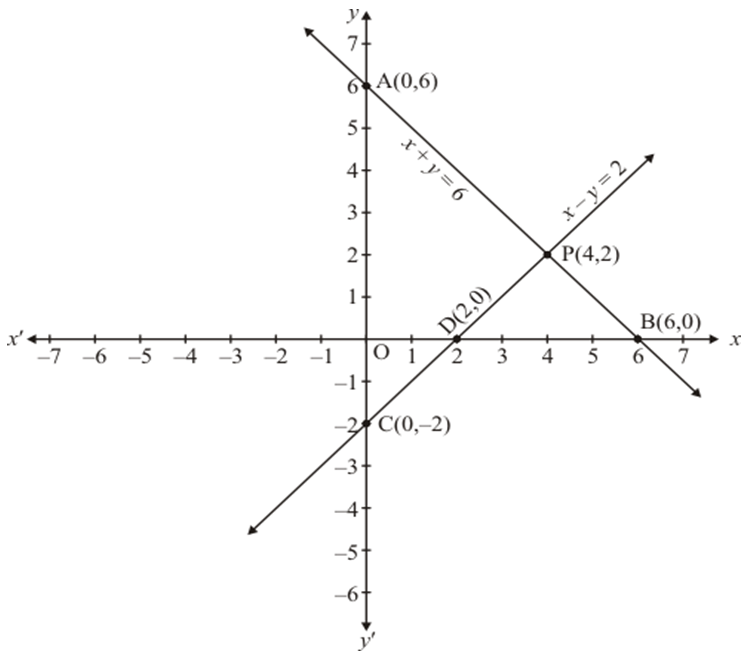
Graph of the equation,
$x - y = 2 .......(ii)$
Putting $x = 0$ in equation $(ii)$ we get,
$\Rightarrow 0 - y = 2$
$\Rightarrow y = -2$
$\Rightarrow x = 0, y = -2$
Putting $y = 0$ in equation $(ii)$, we get,
$\Rightarrow x - 0 = 2$
$\Rightarrow x = 2$
$\Rightarrow x = 2, y = 0$
Use the following table to draw the graph.
Draw the graph by plotting the two points $C(0, -2)$ and $D(2, 0)$ from table.
The two lines intersect at points$ P(4, 2).$
Hence $x = 4, y = 2$ is the solution. View full question & answer→Question 1264 Marks
A two-digit number is such that the product of its digits is $20$. If $9$ is added to the number, the digits interchange their places. Find the number.
AnswerLet the digits at units and tens place of the given number be x and y respectively. Thus, the number is $10y + x$
The product of the two digits of the number is $20$. Thus, we have $xy = 20$
After interchanging the digits, the number becomes $10x + y$
If 9 is added to the number, the digits interchange their places. Thus, we have
$(10y + x) + 9 = 10x + y$
$⇒ 10y + x + 9 = 10x + y$
$⇒ 10x + y - 10y - x = 9$
$⇒ 9x - 9y = 9$
$⇒ 9(x - y) = 9$
$\Rightarrow\text{x}-\text{y}=\frac{9}{9}$
$⇒ x - y = 1$
So, we have the systems of equations
$xy = 20$
$x - y = 1$
Here x and y are unknowns. We have to solve the above systems of equations for x and y
Substituting $x = 1 + y$ from the second equation to the first equation, we get
$(1+y) y=20$
$\Rightarrow y+y^2=20$
$\Rightarrow y+y^2-20=0$
$\Rightarrow y^2+5 y-4 y-20=0$
$\Rightarrow y(y+5)-4(y+5)=0$
$\Rightarrow(y+5)(y-4)=0$
$\Rightarrow y=-5 \text { or } y=4$
Substituting the value of y in the second equation, we have
|
$y$
|
$-5$
|
$4$
|
|
$x$
|
$-4$
|
$5$
|
Hence, the number is $10 × 4 + 5 = 45$
Note: That in the first pair of solution the values of $x$ and $y$ are both negative. But, the digits of the number can’t be negative. So, we must remove this pair. View full question & answer→Question 1274 Marks
$A$ and $B$ each have a certain number of mangoes. A says to $B,$ "if you give $30$ of your mangoes, I will have twice as many as left with you.$" B$ replies, "if you give me $10$, I will have thrice as many as left with you." How many mangoes does each have?
AnswerTo find:
Total mangoes of $A.$
Total mangoes of $B.$
Suppose $A$ has x mangoes and $B$ has y mangoes,
According to the given conditions,
$x + 30 = 2(y - 30)$
$x + 30 = 2y - 60$
$x - 2y + 30 + 60 = 0$
$x - 2y + 90 = 0 ......(i)$
$y + 10 = 3(x - 10)$
$y + 10 = 3x - 30$
$y - 3x + 10 + 30 = 0$
$y - 3x + 40 = 0 .......(ii)$
Multiplying eq. $(i)$ by $(3)$
$3x - 6y + 270 = 0 ......(iii)$
and now adding eq. $(ii)$ and eq $(iii)$
$5y = 310$
$\text{y}=\frac{310}{5}$
$y = 62$
$x - 2 \times 62 + 90 = 0$
$x - 124 + 90 = 0$
$x - 34 = 0$
$x = 34$
Hence A has $34$ mangoes and $B$ has $62$ mangoes.
View full question & answer→Question 1284 Marks
In the following system of equation determine whether the system has a unique solution, no solution or infinitely many solutions. In case there is a unique solution, find it:
$3x - 5y = 20$
$6x - 10y = 40$
Answer$3x - 5y = 20$
$6x - 10y = 40$
Compareit with
$ a_1 x+b_1 y+c_1=0 $
$a_2 x+b_2 y+c_2=0$
$\text { we get }$
$ a_1=3, b_1=-5, \text { and } c_1=-20 $
$a_2=6, b_2=-10 \text { and } c_2=-40$
$\frac{\text{a}_1}{\text{a}_2}=\frac{3}{6},\frac{\text{b}_1}{\text{b}_2}=\frac{5}{10},$ and $\frac{\text{c}_1}{\text{c}_2}=\frac{1}{2}$
Simplifyingit we get
$\frac{\text{a}_1}{\text{a}_2}=\frac{1}{2},\frac{\text{b}_1}{\text{b}_2}=\frac{1}{2},$ and $\frac{\text{c}_1}{\text{c}_2}=\frac{1}{2}$
Hence, $\frac{\text{a}_1}{\text{a}_2}=\frac{\text{b}_1}{\text{b}_2}=\frac{\text{c}_1}{\text{c}_2}$
So both lines are coincident and overlap with each other, so it will have infinite or many solutions.
View full question & answer→Question 1294 Marks
Given the linear equation $2x + 3y - 8 = 0,$ write another linear equation in two variables such that the geometrical representation of the pair so formed is:
- Intersecting lines.
- Parallel lines.
- Coincident lines.
AnswerFor the two lines $a_1x + b_1x + c_1 = 0$ and $a_2 x+b_2 x+c_2=0$, to be intersecting, we must have
$\frac{\text{a}_1}{\text{a}_2}\neq\frac{\text{b}_1}{\text{b}_2}$
So, the other linear equation can be $5x + 6y - 16 = 0$
as $\frac{\text{a}_1}{\text{a}_2}=\frac{2}{5},$
$\frac{\text{b}_1}{\text{b}_2}=\frac{3}{6}=\frac{1}{2},$
$\frac{\text{c}_1}{\text{c}_2}=\frac{-8}{-16}=\frac{1}{2}$
For the two lines $a_1x + b_1x + c_1= 0$ and $a_2 x+b_2 x+c_2=0$, to be parallel, we must have
$\frac{\text{a}_1}{\text{a}_2}=\frac{\text{b}_1}{\text{b}_2}\neq\frac{\text{c}_1}{\text{c}_2}$
So, the other linear equation can be $6x + 9y + 24 =0$
as $\frac{\text{a}_1}{\text{a}_2}=\frac{2}{6}=\frac{1}{3},$
$\frac{\text{b}_1}{\text{b}_2}=\frac{3}{9}=\frac{1}{3},$
$\frac{\text{c}_1}{\text{c}_2}=\frac{-8}{24}=\frac{-1}{3}$
For the two lines $a_1x + b_1x+ c_1= 0$ and $a_2 x+b_2 x+c_2=0$, to be coincident, we must have
$\frac{\text{a}_1}{\text{a}_2}=\frac{\text{b}_1}{\text{b}_2}=\frac{\text{c}_1}{\text{c}_2}$
So, the other linear equation can be $8x + 12y - 32 =0$
as $\frac{\text{a}_1}{\text{a}_2}=\frac{2}{8}=\frac{1}{4},$
$\frac{\text{b}_1}{\text{b}_2}=\frac{3}{12}=\frac{1}{4},$
$\frac{\text{c}_1}{\text{c}_2}=\frac{-8}{-32}=\frac{1}{4}$
View full question & answer→Question 1304 Marks
Determine, by drawing graphs, whether the following system of linear equations has a unique solution or not:
$2y = 4x - 6, 2x = y + 3.$
AnswerThe given equations are,
$2y = 4x - 6 ........(i)$
$2x = y + 3 ..........(ii)$
From (i), $\text{y}=\frac{4\text{x}-6}{2}\ .....(\text{iii})$
When $x = 0, y = -3$
$x = 1, y = -1$
$x = 2, y = 1$
P lot these points $A(0, -3), B(1, -1)$ and $C(2, 1)$ on graph paper and join then,
From $(ii), y = 2x - 3 ......(iv)$
When $x = 0, y = -3$
$x = 1, y = -1$
$x = 2, y = 1$
P lot these points $P(0, -3), Q(1, -1)$ and $R(2, 1)$ on graph paper and join then.
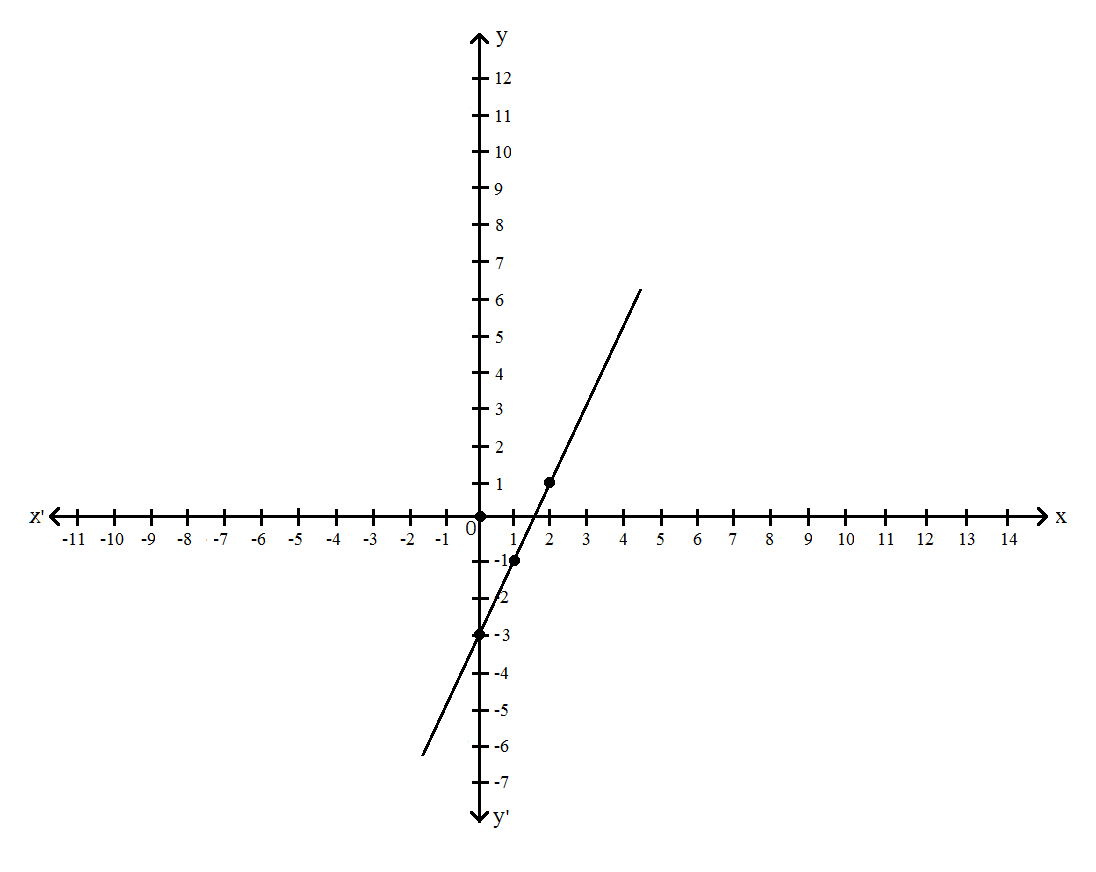
We observe that points $A, B, C$ and $P, Q, R$ on same line so the syatem of equation has infinitaly many solutions. View full question & answer→Question 1314 Marks
A two-digit number is $4$ more than $6$ times the sum of its digits. If $18$ is subtracted from the number, the digits are reversed. Find the number.
AnswerLet the digit at unit and tens place be $x$ and $y$ respectively.
Number $= 10y + x$
Sum of digits $= x + y$
According to question,
$10y + x = 6(x + y) + 4$
$\Rightarrow 10y + x = 6x + 6y + 4$
$\Rightarrow 5x - 4y + 4 = 0 ......(i)$
and,$ 10y + x - 18 = 10x + y$
$\Rightarrow 9x - 9y + 18 = 0$
$\Rightarrow x - y + 2 = 0 .....(ii)$
Multiplying $(ii)$ by $4$ we get
$\Rightarrow 4x - 4y + 8 = 0 ......(iii)$
Subtracting $(iii)$ from $(i)$ we get
$\Rightarrow x - 4 = 0$
$\Rightarrow x = 4$
Putting $x = 4$ in $(i)$ we get
$\Rightarrow 5 \times 4 - 4y + 4 = 0$
$\Rightarrow 20 - 4y + 4 = 0$
$\Rightarrow 4y = 24$
$\Rightarrow\text{y}=\frac{24}{4}$
$\Rightarrow y = 6$
Thus, the number will be $(6 \times 10 + 4) = 64$
View full question & answer→Question 1324 Marks
Solve the following systems of equations:
$\frac{1}{3\text{x}+\text{y}}+\frac{1}{3\text{x}-\text{y}}=\frac{3}{4}$
$\frac{1}{2(3\text{x}-\text{y})}+\frac{1}{2(3\text{x}-\text{y})}=\frac{-1}{8}$
Answer$\frac{1}{3\text{x}+\text{y}}+\frac{1}{3\text{x}-\text{y}}=\frac{3}{4}$
$\frac{1}{2(3\text{x}+\text{y})}+\frac{1}{2(3\text{x}-\text{y})}=\frac{-1}{8}$
Putting $\frac{1}{3\text{x}+\text{y}}=\text{p} $ and $\frac{1}{3\text{x}-\text{y}}=\text{q} $ in the given equations.
we get
$\text{p}+\text{q}=\frac{3}{4}\dots(\text{i})$
$\frac{\text{p}}{2}-\frac{\text{q}}{2}=-\frac{1}{8}$
$\text{p}-\text{q}=-\frac{1}{4}\dots(\text{ii})$
Adding $(i)$ and $(ii)$, we get
$2\text{p}=\frac{3}{4}-\frac{1}{4}$
$2\text{p}=\frac{1}{2}$
$\text{p}=\frac{1}{4}$
Putting the value in equation $(ii)$, we get
$\frac{1}{4}-\text{q}=-\frac{1}{4}$
$\text{q}=\frac{1}{4}+\frac{1}{4}=\frac{1}{2}$
$\text{p}=\frac{1}{3\text{x}+\text{y}}=\frac{1}{4}$
$3x + y = 4 ...(iii)$
$\text{q}=\frac{1}{3\text{x}-\text{y}}=\frac{1}{2}$
$3x - y = 2 ...(iv)$
Adding equations $(iii)$ and $(iv)$, we get
$6x = 6$
$x = 1 ...(v)$
Putting the value in equation $(iii)$, we get
$3(1) + y = 4$
$y = 1$
Hence, $x = 1$ and $y= 1.$
View full question & answer→Question 1334 Marks
Show graphically that the following system of equation is in-consistent (i.e. has no solution):
$2y − x = 9$
$6y − 3x = 21$
AnswerThe given equations are
$2y − x = 9 ......(i)$
$6y − 3x = 21 .......(ii)$
Putting $x = 0$ in equation $(i)$, we get,
$⇒ 2y - 0 = 9$
$\Rightarrow\text{y}=\frac{9}{2}$
$\Rightarrow\text{x}=0,\ \text{y}=\frac{9}{2}$
Putting $y = 0$ in equation $(i)$, we get,
$⇒ 2 × 0 - x = 9$
$⇒ x = -9$
$⇒ x = -9, y = 0$
Use the following table to draw the graph.
|
$x$
|
$0$
|
$-9$
|
|
$y$
|
$\frac{9}{2}$
|
$0$
|
Draw the graph by plotting the two points $\text{A}\Big(0,\frac{9}{2}\Big), B(-9, 0)$ from table.
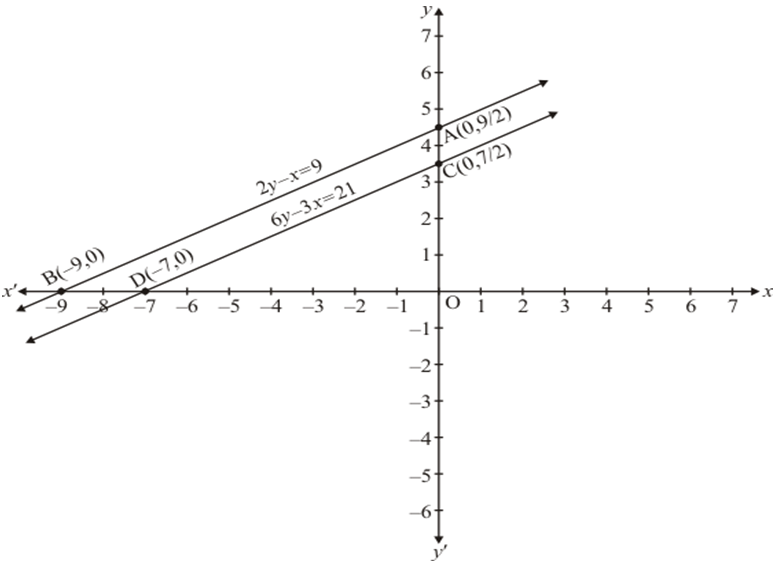
$6y - 3x = 21 ......(ii)$
Putting $x = 0$ in equation $(ii),$ we get,
$⇒ 6y - 3 × 0 = 21$
$\Rightarrow\text{y}=\frac{7}{2}$
$\Rightarrow\text{x}=0,\ \text{y}=\frac{7}{2}$
Putting $y = 0$ in equation $(ii),$ we get,
$⇒ 6 × 0 - 3x = 21$
$⇒ x = -7$
$\therefore x = -7, y = 0$
Use the following table to draw the graph.
| $x$ |
$0$ |
$-7$ |
| $y$ |
$\frac{7}{2}$ |
$0$ |
Draw the graph by plotting the two points $\text{C}\Big(0,\frac{7}{2}\Big), D(-7, 0)$ from table.
Here two lines are parallel and so don’t have common points. Hence the given system of equations has no solution. View full question & answer→Question 1344 Marks
Solve graphically each of the following systems of linear equations. Also, find the coordinates of the points where the lines meet the axis of x in each system.
$2x + 3y = 8,$
$x - 2y = -3.$
AnswerThe given equations are,
$2x + 3y = 8 ......(i)$
$x - 2y = -3 .........(ii)$
$⇒ 2x = 8 - 3y$
$\text{x}=\frac{8-3\text{y}}{2}$
Substituting some different values of y, we get their corresponding values of $x$ as shown below.
|
$x$
|
$4$
|
$1$
|
$-2$
|
|
$y$
|
$0$
|
$2$
|
$4$
|
Plot these points on the graph and join them similarly in equation
$x - 2y = -3$
$x = 2y - 3$
|
$x$
|
$-3$
|
$-1$
|
$1$
|
|
$y$
|
$0$
|
$1$
|
$2$
|
Now plot these points and join them we see that these two lines intersect each other at $(1, 2) x = 1, y = 2$ and also these lines meet x-axis at $(4, 0)$ and $(-3, 0)$ respectively as shown in the,
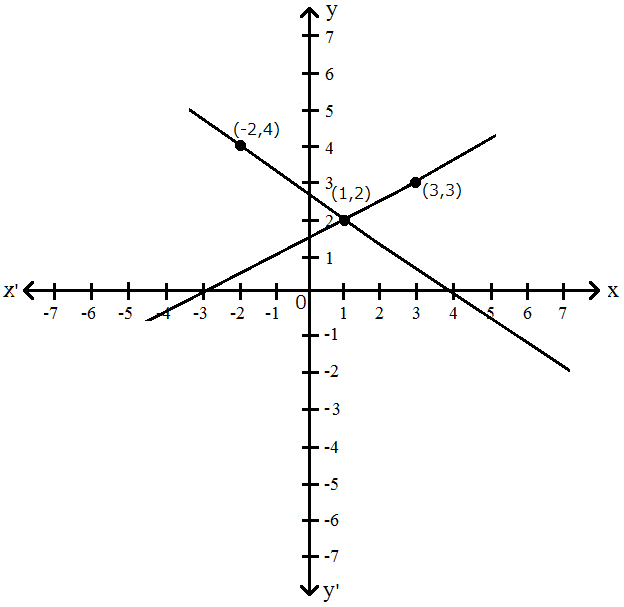
View full question & answer→Question 1354 Marks
Solve the following systems of equations:
$\frac{5}{\text{x}+\text{y}}-\frac{2}{\text{x}-\text{y}}=-1,$
$\frac{15}{\text{x}+\text{y}}+\frac{7}{\text{x}-\text{y}}=10.$
AnswerLet $\frac{1}{\text{x}+\text{y}}=\text{u}$ and $\frac{1}{\text{x}-\text{y}}=\text{v}$ so
$5u - 2v = -1 .....(i)$
$15u + 7v = 10 .....(ii)$
Multiplying $(i)$ by $3$ we get
$⇒ 15u - 6v = -3 .......(iii)$
Subtracting $(iii)$ from $(ii)$ we get
$⇒ 13v = 13$
$⇒ v = 1$
Putting $v = 1$ in $(iii)$ we get
$⇒ 15u - 6 × 1 = -3$
$⇒ 15u = 3$
$\Rightarrow\text{u}=\frac{1}{5}$
$\therefore\frac{1}{\text{x}+\text{y}}=\frac{1}{5}$
$x + y = 5 .....(iv)$
$\frac{1}{\text{x}-\text{y}}=1$
$x - y = 1 .......(v)$
Adding $(iv)$ and $(v)$ we get
$⇒ 2x = 6$
$⇒ x = 3$
Putting $x = 3$ in $(iv)$ we get
$⇒ 3 + y = 5$
$⇒ y = 2$
Thus $x = 3$ and $y = 2.$
View full question & answer→Question 1364 Marks
Solve the following system of equations by the method of cross-multiplication:
$\frac{\text{x}}{\text{a}}+\frac{\text{y}}{\text{b}}=\text{a}+\text{b},$
$\frac{\text{x}}{\text{a}^2}+\frac{\text{y}}{\text{b}^2}=2.$
AnswerThe given system of equation may be written as
$\frac{1}{\text{a}}\text{x}\times+\frac{1}{\text{b}}\times\text{y}-(\text{a}+\text{b})=0$
$\frac{1}{\text{a}^2}\text{x}\times+\frac{1}{\text{b}^2}\times\text{y}-2=0$
Here, $\text{a}_1=\frac{1}{\text{a}},\text{b}_2=\frac{1}{\text{b}},\text{c}_1=-(\text{a}+\text{b})$
$\text{a}_2=\frac{1}{\text{a}^2},\text{b}_2=\frac{1}{\text{b}^2},$ and $\text{c}_2=-2$
By cross multiplication, we get
$\Rightarrow\frac{\text{x}}{\frac{1}{\text{b}}(-2)+\frac{1}{\text{b}^2}(\text{a}+\text{b})}=\frac{-\text{y}}{\frac{1}{\text{a}}\times2+\frac{1}{\text{a}^2}(\text{a}+\text{b})}\\=\frac{1}{\frac{1}{\text{a}}\times\frac{1}{\text{b}^2}-\frac{1}{\text{a}^2}\times\frac{1}{\text{b}}}$
$ \Rightarrow\frac{\text{x}}{-\frac{2}{\text{b}}+\frac{\text{a}}{\text{b}^2}+\frac{1}{\text{b}}}=\frac{-\text{y}}{-\frac{2}{\text{a}}+\frac{1}{\text{a}}+\frac{\text{b}}{\text{a}^2}}=\frac{1}{-\frac{1}{\text{ab}^2}-\frac{1}{\text{a}^2\text{b}}}$
$\Rightarrow\frac{\text{x}}{\frac{\text{a}}{\text{b}^2}-\frac{1}{\text{b}}}=\frac{-\text{y}}{-\frac{1}{\text{a}}+\frac{\text{b}}{\text{a}^2}}=\frac{1}{\frac{1}{\text{ab}^2}-\frac{1}{\text{a}^2\text{b}}}$
$ \Rightarrow\frac{\text{x}}{\frac{\text{a}-\text{b}}{\text{b}^2}}=\frac{\text{y}}{\frac{\text{a}-\text{b}}{\text{a}^2}}=\frac{1}{\frac{\text{a}-\text{b}}{\text{a}^2\text{b}^2}}$
$\Rightarrow\text{x}=\frac{\text{a}-\text{b}}{\text{b}^2}\times\frac{1}{\frac{\text{a}-\text{b}}{\text{a}^2\text{b}^2}}=\text{a}^2$ and $\text{y}=\frac{\text{a}-\text{b}}{\text{a}^2}\times\frac{1}{\frac{\text{a}-\text{b}}{\text{a}^2\text{b}^2}}=\text{b}^2$
Hence, $\text{x}=\text{a}^2,\ \text{y}=\text{b}^2$ is the solution of the given system of the equtaions.
View full question & answer→Question 1374 Marks
The sum of the digits of a two-digit number is $9$. Also, nine times this number is twice the number obtained by reversing the order of the digits. Find the number.
AnswerLet the units digit and tens digits of the number be $x$ and $y$ respectively.
Number $= 10y + x$
Number after reversing the digits $= 10x + y$
According to the question,
$x + y = 9 ....(i)$
$9(10y + x) = 2(10x + y)$
$88y - 11x = 0 ......(ii)$
Adding equations $(i)$ and $(ii)$ we obtain,
$9y = 9$
$y = 1$
Substituting the value of $y$ in equation $(i)$ we obtain,
$x = 8$
Thus, the number is $10y + x = 10 × 1 + 8 = 18$
Concept insight: This problem talks about a two digit number. Here, remember that a two digit number $xy$ can be expanded as $10x + y$. Then, using the two given conditions, a pair of linear equations can be formed which can be solved by eliminating one of the variables.
View full question & answer→Question 1384 Marks
Solve the following system of equations by the method of cross-multiplication:
$6(ax + by) = 3a + 2b$
$6(bx - ay) = 3b - 2a$
AnswerThe given system of equations is,
$6(ax + by) = 3a + 2b ......(i)$
$6(bx - ay) = 3b - 2a ........(ii)$
From equation $(i)$ we get,
$6ax + 6by - (3a + 2b) = 0 .....(iii)$
From equation $(ii)$ we get,
$6bx - 6ay - (3b - 2a) = 0 .......(iv)$
$ \text { Here, } a_1=6 a, b_1=6 b, c_1=-(3 a+2 b) $
$a_2=6 b, b_2=-6 a \text {, and } c_2=-(3 b-2 a)$
By cross-multiplication we have,
$\Rightarrow\frac{\text{x}}{-6\text{b}(3\text{b}-2\text{a})-6\text{a}(\text{3a + 2b})}=\frac{-\text{y}}{-\text{6a}(\text{3b - 2a)}+\text{6b}(\text{3a +2b})}\\=\frac{1}{-\text{36a}^2-\text{36b}^2}$
$\Rightarrow \frac{\text{x}}{-\text{18b}^2+12\text{ab}-18\text{a}^2-12\text{ab}}=\frac{-\text{y}}{-18\text{ab}+\text{12a}^2+\text{18ab}+\text{12b}^2}\\=\frac{1}{-\text{36}(\text{a}^2+\text{b}^2)}$
$ \Rightarrow\frac{\text{x}}{-18\text{a}^2-18\text{b}^2}=\frac{-\text{y}}{12\text{a}^2+12\text{b}^2}=\frac{1}{-\text{36}(\text{a}^2+\text{b}^2)}$
$\Rightarrow\frac{\text{x}}{-18(\text{a}^2+\text{b}^2)}=\frac{-\text{y}}{12(\text{a}^2+\text{b}^2)}=\frac{-1}{\text{36}(\text{a}^2+\text{b}^2)}$
Now, $ \frac{\text{x}}{-18(\text{a}^2+\text{b}^2)}=\frac{-1}{\text{36}(\text{a}^2+\text{b}^2)}$
$\Rightarrow\text{x}=\frac{{18(\text{a}^2+\text{b}^2)}}{{\text{36}(\text{a}^2+\text{b}^2)}}$
$\Rightarrow\text{x}=\frac{1}{2}$
and, $\frac{-\text{y}}{12(\text{a}^2+\text{b}^2)}=\frac{-1}{36(\text{a}^2+\text{b}^2)}$
$\Rightarrow\text{y}=\frac{12(\text{a}^2+\text{b}^2)}{36(\text{a}^2+\text{b}^2)}$
$\Rightarrow\text{y}=\frac{1}{3}$
Hence, $\text{x}=\frac{1}{2}$ and $\text{y}=\frac{1}{3}$
View full question & answer→Question 1394 Marks
Solve the following systems of equations:
$99x + 101y = 499,$
$101x + 99y = 501.$
AnswerThe given system of equation is
$99x + 101y = 499 .......(i)$
$101x + 99y = 501 ........(ii)$
Adding equation $(i)$ and equation $(ii)$ we get
$99x + 101x + 101y + 99y = 499 + 501$
$⇒ 200x + 200y = 1000$
$⇒ 200 (x + y) = 1000$
$\Rightarrow\text{x}+\text{y}=\frac{1000}{200}=5$
$⇒ x + y = 5 ......(iii)$
Subtracting equation $(i)$ by equation $(ii)$ we get
$101x - 99x + 99y - 101y = 501 - 499$
$⇒ 2x + 2y = 2$
$⇒ 2(x - y) = 2$
$\Rightarrow\text{x}-\text{y}=\frac{2}{2} $
$\Rightarrow\text{x}-\text{y}=1 \ .....(\text{iv})$
Adding equation $(iii)$ and equation $(iv)$ we get
$2x = 5 + 1$
$\Rightarrow\text{x}=\frac{6}{2} =3$
Putting $x = 3$ in equation $(iii)$ we get
$3 + y = 5$
$⇒ y = 5 - 3 = 2$
Hence solution of the given system of equation is $x = 3, y = 2.$
View full question & answer→Question 1404 Marks
Solve the following systems of equations:
$2\text{x}-\frac{3}{\text{y}}=9,$
$\text{3}\text{x}+\frac{7}{\text{y}}=2,\text{y}\neq0.$
AnswerThe given system of equation is
$2\text{x}-\frac{3}{\text{y}}=9\ .....(\text{iv})$
$\text{3}\text{x}+\frac{7}{\text{y}}=2,\text{y}\neq0\ .....(\text{ii})$
Taking $\frac{1}{\text{y}}=\text{u},$ the given equations becomes
$2\text{x}-3\text{u}=9\ ....(\text{iii})$
$3\text{x}+7\text{u}=2\ ....(\text{iv})$
From $(iii)$, we get
$2\text{x}=9+3\text{u}$
$\Rightarrow\text{x}=\frac{9+3\text{u}}{2}$
Substituting $\text{x}=\frac{9+3\text{u}}{2}$ in (iv), we get
$3\Big(\frac{9+3\text{u}}{2}\Big)+7\text{u}=2$
$\Rightarrow\frac{27+9\text{u}+14\text{u}}{2} =2$
$\Rightarrow27+23\text{u}=2\times2$
$\Rightarrow23\text{u}=4-27$
$\Rightarrow\text{u}=\frac{-23}{23}=-1$
Hence, $\text{y}=\frac{1}{\text{u}}=\frac{1}{-1}=-1$
Putting u = -1 in $=\text{x}=\frac{9+3\text{u}}{2},$ we get
$\text{x}=\frac{9+3(-1)}{2}$
$=\frac{9-3}{2}=\frac{6}{2}=3$
$\Rightarrow\text{x}=3$
Hence, solution of the given system of equation is $x = 3, y = -1.$
View full question & answer→Question 1414 Marks
The sum of the numerator and denominator of a fraction is $3$ less than twice the denominator. If the numerator and denominator are decreased by $1$, the numerator becomes half the denominator. Determine the fraction.
AnswerLet the numerator and denominator of the fraction be $x$ and $y$ respectively. Then the fraction is $\frac{\text{x}}{\text{y}}$
The sum of the numerator and denominator of the fraction is $3$ less than twice the denominator.
Thus, we have
$x + y = 2y - 3$
$\Rightarrow x + y - 2y + 3 = 0$
$\Rightarrow x - y + 3 = 0$
If the numerator and denominator are decreased by $1$, the numerator becomes half the denominator.
Thus, we have
$\text{x}-1=\frac{1}{2}(\text{y}-1)$
$\Rightarrow\frac{\text{x}-1}{\text{y}-1}=\frac{1}{2}$
$\Rightarrow 2(x - 1) = y - 1$
$\Rightarrow 2x - 2 = y - 1$
$\Rightarrow 2x - y - 1 = 0$
So, we have two equations
$x - y + 3 = 0$
$2x - y - 1 = 0$
Here $x$ and $y$ are unknowns. We have to solve the above equations for $x$ and $y$
By using cross-multiplication, we have
$ \Rightarrow\frac{\text{x}}{(-1)\times(-1)-(-1)\times3}=\frac{-\text{y}}{1\times(-1)-2\times3}$
$=\frac{1}{1\times(-1)-2\times(-1)}$
$ \Rightarrow\frac{\text{x}}{1+3}=\frac{-\text{y}}{-1-6}=\frac{1}{-1+2}$
$\Rightarrow\frac{\text{x}}{4}=\frac{-\text{y}}{-7}=\frac{1}{1}$
$\Rightarrow\frac{\text{x}}{4}=\frac{-\text{y}}{-7}=1$
$\Rightarrow\text{x}=4,\ \text{y}=7 $
Hence, the fraction is $\frac{4}{7}$
View full question & answer→Question 1424 Marks
Solve the following systems of equations:
$152x - 378y = −74,$
$-378x + 152y = -604.$
Answer$152\text{x}-378\text{y}=-74$
$-378\text{x}+152\text{y}=-604$
The given pair of linear equations is
$152\text{x}-378\text{y}=-74\dots(\text{i})$
$-378\text{x}+152\text{y}=-604\dots(\text{ii})$
Adding equation $(i)$ and equation $(ii)$, we get
$-226\text{x}-226\text{y}=-678$
$\Rightarrow\ \text{x}+\text{y}=3\dots(\text{iii})$
[Dividing throughout by $-226]$
Subtracting equation $(ii)$ from equation $(i)$, we get
$530\text{x}-530\text{y}=530$
$\Rightarrow\ \text{x}-\text{y}=1\dots(\text{iv})$
[Dividing throughout by $530]$
Adding equation $(iii)$ and equation $(iv)$, we get
$2\text{x}=4 $
$\Rightarrow\ \text{x}=\frac{4}{2}=2$
Subtracting equation $(iv)$ from equation $(iii)$, we get
$2\text{y}=2$
$\Rightarrow\ \text{y}=\frac{2}{2}=1$
Hence, the solution of the given pair of linear equations is$ x = 2, y = 1.$
View full question & answer→Question 1434 Marks
Solve the following systems of equations graphically:
$x + y = 4$
$2x - 3y = 3$
AnswerThe given equations are,
$x + y = 4 ......(i)$
$2x - 3y = 3 ........(ii)$
From $(i), y = 4 - x .......(iii)$
Putting $x = 0$ in $(iii)$, we get $y = 4$
Putting $x = 1$ in $(iii)$, we get $y = 3$
Putting $x = 2$ in $(iii)$, we get $y = 2$
|
$x$
|
$0$
|
$1$
|
$2$
|
|
$y$
|
$4$
|
$3$
|
$2$
|
From (ii), $\text{y}=\frac{2\text{x}-3}{3}\ ......(\text{iv})$
Putting $x = 0$ in $(iv)$, we get $y = -1$
Putting $x = 3$ in $(iv)$, we get $y = 1$
Putting $x = 6$ in $(iv)$, we get $y = 3$
|
$x$
|
$0$
|
$3$
|
$6$
|
|
$y$
|
$-1$
|
$1$
|
$3$
|
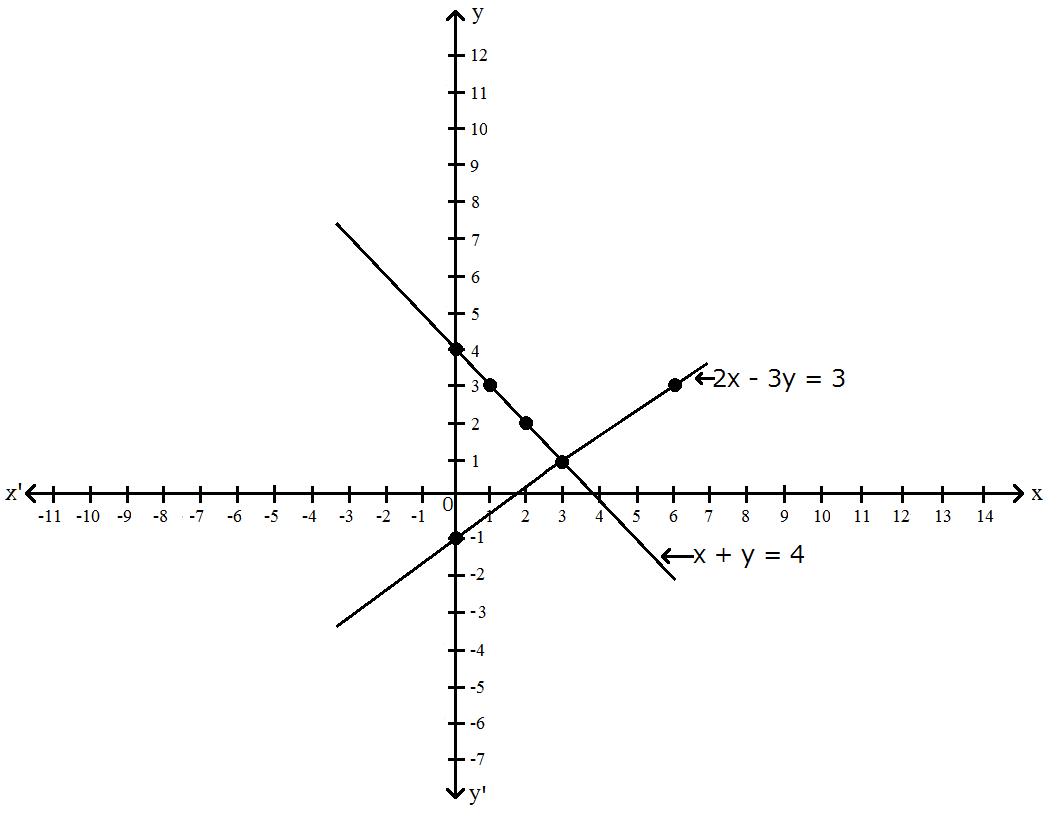
Clearly, from the above graph solution of above syatam of equations is $x = 3$ and $y = 1.$ View full question & answer→Question 1444 Marks
$2$ men and $7$ boys can do a piece of work in $4$ days. The same work is done in $3$ days by $4$ men and $4$ boys. How long would it take one man and one boy to do it?
AnswerLet one man alone can finish the work in $x$ days and one boy alone can finish it in $y$ days. Then,
One man's one day's work $=\frac{1}{\text{x}}$
One boy's alay's work $= \frac{1}{\text{y}}$
$2$ men one day work $= \frac{2}{\text{x}}$
$7$ boys one day work $= \frac{7}{\text{y}}$
Since $2$ men and $7$ days can finish the work in $4$ days.
$\Rightarrow4\Big(\frac{2}{\text{x}}+\frac{7}{\text{y}}\Big)=1$
$\Rightarrow\frac{8}{\text{x}}+\frac{28}{\text{y}}=1\ ....(\text{i})$
Again $4$ men and $4$ boys can finish the work in $3$ days.
$\Rightarrow3\Big(\frac{4}{\text{x}}+\frac{4}{\text{y}}\Big)=1$
$\Rightarrow\frac{12}{\text{x}}+\frac{12}{\text{y}}=1.....(\text{ii})$
Putting $\frac{1}{\text{x}}=\text{u}$ and $\frac{1}{\text{y}}=\text{v}$ in equation $(i)$ and eq. $(ii)$
$\Rightarrow8\text{u}+28\text{v}-1=0\ ...(\text{iii})$
$\Rightarrow12\text{u}+12\text{v}-1=0\ ....(\text{iv})$
By using cross-multiplication we have
$\Rightarrow\frac{\text{u}}{28\times(-1)-12\times(-1)}=\frac{\text{-v}}{8\times(-1)-12\times(-1)}\\=\frac{1}{8\times12-12\times28}$
$\Rightarrow\frac{\text{u}}{-28+12}=\frac{\text{-v}}{-8+12}=\frac{1}{96-336}$
$\Rightarrow\frac{\text{u}}{-16}=\frac{\text{-v}}{4}=\frac{1}{-240}$
$\Rightarrow\frac{\text{u}}{-16}=\frac{1}{-240}$
$\Rightarrow\text{u}=\frac{-16}{-240}$
$\Rightarrow\text{u}=\frac{1}{15}$
$\Rightarrow\frac{\text{-v}}{4}=\frac{1}{-240}$
$\Rightarrow\text{v}=\frac{4}{240}$
$\Rightarrow\text{v}=60$
View full question & answer→Question 1454 Marks
Solve the following systems of equations:
$\frac{1}{2(\text{x}+2\text{y})}+\frac{5}{3(3\text{x}-2\text{y})}=\frac{-3}{2}$
$\frac{5}{4(\text{x}+2\text{y})}-\frac{3}{5(3\text{x}-2\text{y})}=\frac{61}{60}$
AnswerLet $\frac{1}{\text{x}+2\text{y}}=\text{u}$ and $\frac{1}{3\text{x}-2\text{y}}=\text{v}$
Then the given system of equation become
$\frac{\text{u}}{2}+\frac{5\text{v}}{3}=\frac{-3}{2}$
$\Rightarrow\frac{3\text{u}+10\text{v}}{6}=\frac{-3}{2}$
$\Rightarrow3\text{u}+10\text{v}=-9\ .....(\text{i})$
$\frac{5\text{u}}{4}-\frac{3\text{v}}{5}=\frac{61}{60}$
And
$\Rightarrow\frac{25\text{u}-12\text{v}}{20}=\frac{61}{60}$
$\Rightarrow25\text{u}-12\text{v}=\frac{61}{3}\ ......(\text{ii})$
Multiplying equation (i) by 12, and equation (ii) by 10, we get
$36\text{u}+120\text{v}=-108\ .....(\text{iii})$
$250\text{u}-120\text{v}=\frac{610}{3}\ .....(\text{iv})$
Adding equation (iii) and equation (iv) we get
$36\text{u}+250\text{u}=\frac{610}{3}-108$
$\Rightarrow286\text{u}=\frac{610-324}{3}$
$\Rightarrow286\text{u}=\frac{286}{3}$
$\Rightarrow\text{u}=\frac{1}{3}$
Putting $\text{u}=\frac{1}{3}$ in equation $(i)$ we get
$3\times\frac{1}{3}+10\text{v}=-9$
$\Rightarrow1+10\text{v}=-9$
$\Rightarrow10\text{u}=-9-1$
$\Rightarrow\text{v}=\frac{-10}{10}=-1$
Now, $\text{u}=\frac{1}{\text{x}+2\text{y}}$
$\Rightarrow\frac{1}{\text{x}+\text{v}}=\frac{1}{3}$
$\Rightarrow\text{x}+2\text{y}=3\ ......(\text{v})$
And $\text{v}=\frac{1}{3\text{x}-2\text{y}}$
$\Rightarrow\frac{1}{3\text{x}-2\text{y}}=-1$
$\Rightarrow3\text{x}-2\text{y}=-1\ .....(\text{vi})$
Putting $\text{x}=\frac{1}{2}$ in equation $(v)$, we get
$\frac{1}{2}+2\text{y}=3$
$\Rightarrow2\text{y}=3-\frac{1}{2}$
$\Rightarrow2\text{y}=\frac{6-1}{2}$
$\Rightarrow\text{y}=\frac{5}{4}$
Hence solution of the given system is $\text{x}=\frac{1}{2}, \text{y}=\frac{5}{4}.$
View full question & answer→Question 1464 Marks
In a cyclic quadrilateral $ABCD$ $\angle\text{A}=(2\text{x}+4)^\circ,\angle\text{B}=(\text{y}+3)^\circ,$ $\angle\text{C}=(2\text{y}+10)^\circ,\angle\text{D}=(4\text{x}-5)^\circ.$ Find the four angles.
AnswerWe know that the sum of the opposite angles of cyclic quadrilateral is $180^\circ $. in the cyclic quadrilateral $ABCD$, angles $A$ and $C$ and angles $B$ and $D$ pairs of opposite angles. Therefore
$\angle\text{A}+\angle\text{C}=180^\circ$
By substituting $\angle\text{A}=(2\text{x}+4)^\circ$ and $\angle\text{C}=(2\text{y}+10)^\circ$ we get
$2x + 4 + 2y + 10 = 180$
$2x + 2y + 14 = 180^\circ $
$2x + 2y = 180^\circ - 14^\circ $
$2x + 2y = 166 .....(i)$
Taking $\angle\text{B}+\angle\text{D}=180^\circ$
By substituting $\angle\text{B}=(\text{y}+3)^\circ$ and $\angle\text{D}=(4\text{x}-5)^\circ$ we get
$y + 3 + 4x - 5 = 180^\circ $
$4x + y - 5 + 3 = 180^\circ $
$4x + y - 2 = 180^\circ $
$4x + y = 180^\circ + 2^\circ $
$4x + y = 182^\circ .....(ii)$
By multiplying equation $(ii)$ by $2$ we get $8x + 2y = 364 .....(iii)$
By subtracting equation $(iii)$ from $(i)$ we get
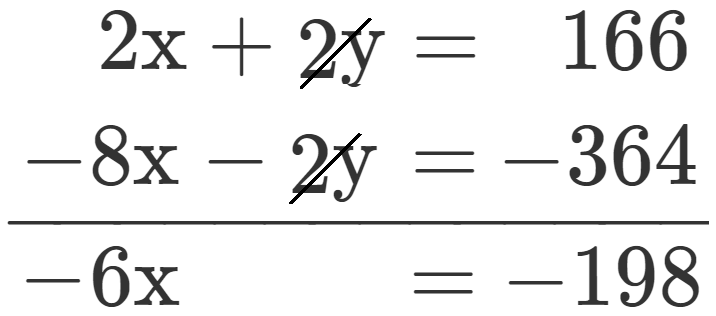
$\text{x}=\frac{-198}{-6}$
$x = 33^\circ $
By substituting $x = 33^\circ $ in equation $(ii)$ we get
$4x + y = 182$
$4 \times 33 + y = 182$
$132 + y = 182$
$y = 182 - 132$
$y = 50$
The angles of a cyclic quadrilateral are
$\angle\text{A}=2\text{x}+4$
$= 2 \times 33 + 4$
$= 66 + 4$
$= 70^\circ $
$\angle\text{B}=\text{y}+3$
$= 50 + 3$
$= 53^\circ $
$\angle\text{C}=2\text{y}+10^\circ$
$= 2 \times 50 + 10$
$= 100 + 10$
$= 110^\circ$
$\angle\text{D}=4\text{x}-5$
$= 4 \times 33 - 5$
$= 132 - 5$
$= 127^\circ $
Hence, the angles of cyclic quadrilateral $ABCD$ are $\angle\text{A}=70^\circ,\angle\text{B}=53^\circ,\angle\text{C}=110^\circ,\angle\text{D}=127^\circ$ View full question & answer→Question 1474 Marks
Solve graphically each of the following systems of linear equations. Also, find the co-ordinates of the points where the lines meet the axis of $x$ in each system.
$2x - y = 2,$
$4x - 2y = 8.$
Answer$2x - y = 2 .......(i)$
$4x - y = 8 ......(ii)$
$2x - y = 2 .....(i)$
$\Rightarrow y = 2x - 2$
Substituting some different values of $x$, we get corresponding values of $y$ as shown below.
|
$x$
|
$0$
|
$1$
|
$2$
|
|
$y$
|
$-2$
|
$0$
|
$2$
|
Now plot the points on the graph and join them similarly in equation
$4x - y = 8....(ii)$
$\Rightarrow y = 4x - 8$
|
$x$
|
$1$
|
$2$
|
$3$
|
|
$y$
|
$-4$
|
$0$
|
$4$
|
Now polt these points and join them we see that these two lines intersect each other at $(3, 4) x = 3, y = 4$. These two lines also meet x-axis at $(1, 0)$ and $(2, 0)$ respectively as shown in the,
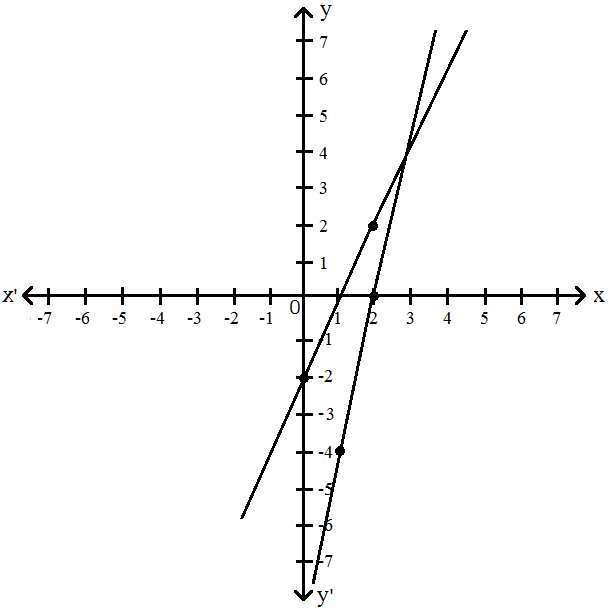
View full question & answer→Question 1484 Marks
Solve the following systems of equations:
$\frac{4}{\text{x}}+3\text{y}=14,$
$\frac{1}{3\text{x}}-4\text{y}=23.$
Answer$\frac{4}{\text{x}}+3\text{y}=14$
$\frac{3}{\text{x}}-4\text{y}=23$
Let $\frac{1}{\text{x}}=\text{p}$ in the equations changes we get
$4\text{p}+3\text{y}=14$
$\Rightarrow4\text{p}+3\text{y}-14=0\ ...(\text{i})$
$3\text{p}-4\text{y}=23$
$\Rightarrow3\text{p}-4\text{y}-23=0\ ...(\text{ii})$
By cross-multiplication. we get
$\frac{\text{p}}{-69-56}=\frac{\text{y}}{-42-(-92)}=\frac{1}{-16-9}$
$\Rightarrow-\frac{\text{p}}{125}=\frac{\text{y}}{50}=\frac{1}{-25}$
Now,
$-\frac{\text{p}}{125}=\frac{-1}{25}\ \text{and}\ \frac{\text{y}}{50}=\frac{1}{-25}$
$\Rightarrow\text{p}=5\ \text{and}\ \text{y}=-2$
Also, $\text{p}=\frac{1}{\text{x}}=5$
$\Rightarrow\text{x}=\frac{1}{5}$
So, $\text{x}=\frac{1}{5}$ and $y = -2 $ is the solution.
View full question & answer→Question 1494 Marks
Find the values of $x$ and $y$ in the following rectangle.
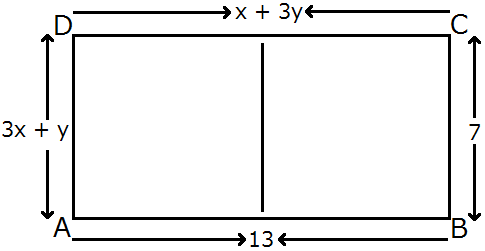
AnswerBy Property of rectangle,
Lengths are equal i.e., $CD = AB$
$\Rightarrow x + 3y = 13 .....(i)$
Breadth are equal i.e., $AD = BC$
$\Rightarrow 3x + y = 7 ......(ii)$
On multiplying eq. $(ii)$ by $3$ and then subtracting eq. $(i)$ we get
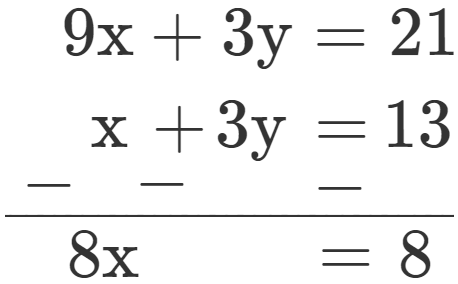
$x = 1$
On Putting $x = 1$ in eq. we get
$3y = 12 $
$\Rightarrow y = 4$
Hence the equired values of $x$ and $y$ are $1$ and $4$, respectively. View full question & answer→Question 1504 Marks
Places $A$ and $B$ are $80\ km$ apart from each other on a highway. A car starts from $A$ and other from $B$ at the same time. If they move in the same direction, they meet in $8$ hours and if they move in opposite directions, they meet in $1$ hour and $20$ minutes. Find the speeds of the cars.
AnswerLet x and y be two cars starting from points $A$ and $B$ respectively.
Let the speed of the car $X$ be $x km / hr$ and that of the car $Y$ be $y km / hr$.
Case I: When two cars move in the same directions:
Suppose two cars meet at point $Q$ then,
Distance travelled by car $X = AQ$
Distance travelled by car $Y=B Q$
It is given that two cars meet in 8 hours.
Distance travelled by car $X$ in 8 hours $=8 x km AQ =8 x$
Distance travelled by car $Y$ in 8 hours $=8 y km BQ =8 y$
Clearly $A Q-B Q=A B$
$8 x-8 y=80$
Both sides divided by $8$ , we get
$x-y=10$
Case II: When two cars move in opposite direction
Suppose two cars meet at point $P$, then,
Distance travelled by $X$ car $X=A P$
Distance travelled by $Y \operatorname{car} Y=B P$
In this case, two cars meet in $1$ hour $20$ minutes, we can write it as $1$ hour $1 \frac{1}{3}$ hours that is $\frac{4}{3}$ hours.
Therefore,
Distance travelled by car y in $\frac{4}{3}$ hours $=\frac{4}{3}\text{x}\text{ km}$
Distance travelled by car y in $\frac{4}{3}$ hours $=\frac{4}{3}\text{y}\text{ km}$
$\text{AP}+\text{BP}=\text{AB}$
$\frac{4}{3}\text{x}+\frac{4}{3}\text{y}=80$
$\frac{4}{3}(\text{x}+\text{y})=80$
$(\text{x}+\text{y})=80\times\frac{3}{4}$
$\text{x}+\text{y}=60\ ....(\text{ii})$
By solving $(i)$ and $(ii)$ we get,
$\text{x}\ -\ \text{y}\ =\ 10\\\text{x}\ +\ \text{y}\ =\ 60\over2\text{x}\ \ \ \ \ \ =\ 70$
$\text{x}=\frac{70}{2}$
$\text{x}=35$
By substituting $x = 35$ in equation $(ii)$ we get
$\text{x}-\text{y}=60$
$35+\text{y}=60$
$\text{y}=60-35$
$\text{y}=25$
Hence, Speed of car $X$ is $35\ km/hr.$ speed of car $Y$ is $25\ km/hr.$
View full question & answer→