Sample QuestionsPolynomials questions
One sample from each question group in this chapter. Select any group above to see the full set with answer keys.
If $\alpha$ and $\beta$ are zeroes of $P (x)=x^2-3 x+2 k$ and $\alpha+\beta=\alpha \cdot \beta$ then $k=$ _______
- A
$3$
- B
$-3$
- C
$1$
- ✓
$\frac{3}{2}$
Answer: D.
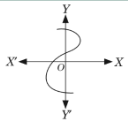
View full solution →In figure, the graph of a polynomial $p(x)$ is shown. Find the number of zeroes of $p(x)$.
Answer: B.
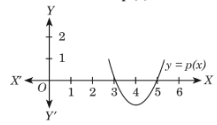
View full solution →In the figure, graph of a polynomial $p(x)$ is given. Find the zeroes of $p(x)$.
Answer: B.
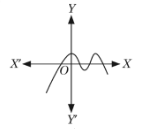
View full solution →The number of zeroes of the polynomial shown in the graph are
Answer: B.
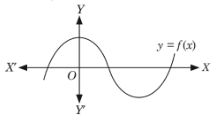
View full solution →In the given figure, the number of zeroes of the polynomial $f(x)$ are
Answer: C.
View full solution →Sum of zeroes of quadratic polynomial is $=$ _______ $\left(\frac{\text { coefficiant of } x}{\text { coefficiant of } x^2}, \frac{- \text { coefficiant of } x}{\text { coefficiant of } x^2}, \frac{\text { constant }}{\text { coefficiant of } x^2}\right)$
View full solution →One zero $-5$ is of quadratic equation $P (x)=x^2+7 x+10$ then second zero is _______ $ \cdot(-2,7,5) \quad$
View full solution →The graph of $P (x)=x^2+4 x+3$ is _______ (line, open upwards parabolas, open downwards parabolas)
View full solution →$\alpha$ and $\beta$ are zeroes of quadratic equation $a x^2+b x+$ $c=0$, where $a \neq 0$, then $\alpha \cdot \beta=$_______ $\left(\frac{-b}{a}, \frac{-c}{a}, \frac{c}{a}\right)$
View full solution →If $\alpha$ and $\beta$ are zeroes of quadratic equation $a x^2+b x+c=0$, where $a \neq 0$ then $\alpha+\beta=$_______ . $\left(\frac{-b}{a}, \frac{b}{a}, \frac{c}{a}\right)$
View full solution →Maximum zeroes get in a cubic polynomial.
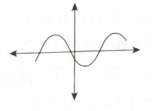
The graph of $y= P (x)$ is represented in a following figure. In this case number of zeroes of $P (x)$ is $4$.
View full solution →Zero of linear polynomial $P (x)=7 x-5$ is $\frac{-5}{7}$
View full solution →Maximum zeroes of cubical polynomial is $3$ .
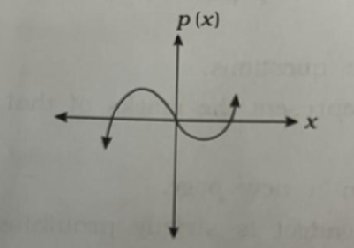
View full solution →The following figure depicts the graph of a polynomial y = p(x) In this case. the number of zeroes of p(x) is 3.
Find a quadratic polynomial, the sum and product of whose zeroes are $0,\sqrt 5 $ respectively.
View full solution →Find a quadratic polynomial of $4, 1$ as the sum and product of its zeroes respectively.
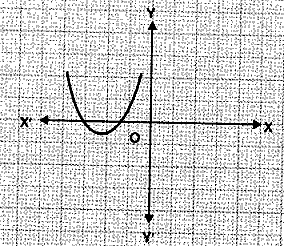
View full solution →The graph of $y = p(x)$ in a figure given below, for some polynomial $p(x)$. Find the number of zeroes of $p(x)$.
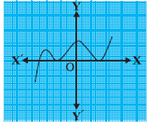
View full solution →The graph of $y = p(x)$ in a figure given below, for some polynomial $p(x)$. Find the number of zeroes of $p(x)$.
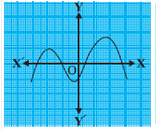
View full solution →The graph of $y = p(x)$ in a figure given below, for some polynomial $p(x)$. Find the number of zeroes of $p(x)$.
View full solution →Find a quadratic polynomial, the sum and product of whose zeroes are $\sqrt { 2 } , \frac { 1 } { 3 }$ respectively.
View full solution →Find a quadratic polynomial, the sum and product of whose zeroes are $\frac { 1 } { 4 } , - 1$ respectively.
View full solution →Find the zeroes of quadratic polynomial $t^2– 15$ and verify the relationship between the zeroes and their coefficients.
View full solution →Find the zeroes of quadratic polynomial $4u^2+ 8u$ and verify the relationship between the zeroes and their coefficients.
View full solution →Find the zeroes of quadratic polynomial $6x^2 - 3 - 7x$ and verify the relationship between the zeroes and their coefficients.
View full solution →Find a quadratic polynomial of the given numbers as the sum and product of its zeroes respectively. $- \frac { 1 } { 4 } , \frac { 1 } { 4 }$
View full solution →Find a quadratic polynomial of the given numbers as the sum and product of its zeroes respectively. $- \frac { 1 } { 4 } , \frac { 1 } { 4 }$
View full solution →Find the zeroes of quadratic polynomial $3x^2- x - 4$ and verify the relationship between the zeroes and their coefficients.
View full solution →Find the zeroes of quadratic polynomial $3x^2- x - 4$ and verify the relationship between the zeroes and their coefficients.
View full solution →Find the zeroes of quadratic polynomial $x^2- 2x - 8$ and verify the relationship between the zeroes and their coefficients.
View full solution →| A | B |
| Q.1. If $\alpha, \beta$ and $\gamma$ are zeroes of the cubic polynomial $p(x)=a x^3+b x^2+c x+d$ then $\alpha \beta+\beta \gamma+\gamma \alpha=\ldots .$. | (a) $-\frac{b}{a}$ |
| Q.2. The degree of the polynomial $(x+1)\left(x^2-x+x^4+1\right)$ | (b) $\frac{c}{a}$ |
| (c) 5 |
| A | B |
| Q.1. If $\alpha$ and $\beta$ are zeroes of a quadratic polynomial $a x^2+b x+c$, then $\frac{1}{\alpha}+\frac{1}{\beta}=\ldots \ldots \ldots .$. | (a) Only one point |
| Q.2. The graph of $p(x)=x^2-10 x+25$ intersects X-axis at ......points | (b) $\frac{-b}{c}$ |
| | (c) $\frac{c}{a}$ |
| A | B |
| Q.1. A quadratic equation has no any real zeroes. So, its graph | (a) intersects X-axis |
| Q.2. If $\alpha, \beta$ and $\gamma$ are zeroes of a polynomial $p(x)=a x^3+b x^2+c x+d$ $(a \neq 0)$ then their product $\alpha \beta \gamma=\ldots \ldots \ldots .$. | (b) does not intersect X-axis |
| | (c) $\frac{-d}{a}$ |
| A | B |
| Q.1. The degree of the polynomial $p(x)=7-5 x^3-3 x^2+8 x$ | (a) 7 |
| Q.2. Find a quadratic polynomial the sum and product of whose zeroes are 3 and 3 respectively. | (b) 3 |
| | (c) $x^2-3 x+3$ |
| A | B |
| Q.1. Write the zeroes of a quadratic polynomial $x^2+x-12$ | (a) 4, -3 |
| Q.2. If one of the zeroes of a polynomial P(x) is 3, then state one factor of it. | (b) x- 3 |
| (c) -4, 3 |