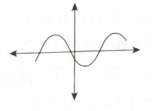
Question 21 MarkThe graph of $y= P (x)$ is represented in a following figure. In this case number of zeroes of $P (x)$ is $4$. AnswerFalseView full question & answer→
Question 31 MarkZero of linear polynomial $P (x)=7 x-5$ is $\frac{-5}{7}$AnswerFalseView full question & answer→
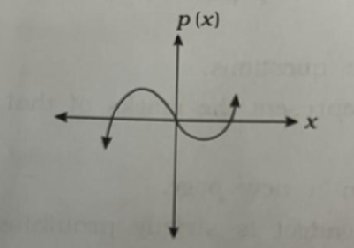
Question 51 MarkThe following figure depicts the graph of a polynomial y = p(x) In this case. the number of zeroes of p(x) is 3.AnswerTrueView full question & answer→
Question 61 MarkThe multiplication of zero of cubic polynomial $p(x)=x^3+5 x^2-2 x-24$ is -24 .AnswerfalseView full question & answer→
Question 71 MarkIf 3 is one zero of polynomial $p(x)=x^2-11 x+k$ then $k=24$AnswertrueView full question & answer→
Question 91 MarkIf the graph at polynomial intersects X-axis at only one point then polynomial can't be quadratic polynomial.AnswerfalseView full question & answer→
Question 101 MarkNumbers at zeroes at polynomial $p(x)=x^2-10 x+16$ are three.AnswerfalseView full question & answer→
Question 111 MarkZeroes at polynomial $x^2+2 \sqrt{2} x-6 \sqrt{2}, 3 \sqrt{2}$AnswerfalseView full question & answer→
Question 121 MarkSum and product at zeroes at polynomial is -4 and 3 respectively then quadratic polynomial is $x^2+4 x+3$.AnswertrueView full question & answer→
Question 131 MarkIf polynomial $3 x^3+14 x^2+9 x+m$ is divided by $3 x+5$ with zero remainder then $m=10$.AnswerfalseView full question & answer→
Question 141 MarkIf polynomial $x^6+2 x^3+x-1$ is divided by the polynomial at $x$ with degree 5 then dividend is $x^2-1$.AnswerfalseView full question & answer→