Sample QuestionsReal Numbers questions
One sample from each question group in this chapter. Select any group above to see the full set with answer keys.
Out of the following is rational number.
- A
$\sqrt{3}$
- B
$\pi$
- C
$\frac{4}{0}$
- ✓
$\frac{0}{4}$
Answer: D.
View full solution →The least perfect square number which is divisible $3,4,5,6$ and $8$ is
- A
$900$
- B
$1200$
- C
$2500$
- ✓
$3600$
Answer: D.
View full solution →$\operatorname{LCM}(a, 18)=36 \operatorname{HCF}(a, 18)=2$ then $a=\ldots \ldots \ldots$
Answer: C.
View full solution →If $\operatorname{HCF}(a, b)=18$ then $\operatorname{LCM}(a, b)=\ldots \ldots \ldots .$ is not possible.
Answer: C.
View full solution →Out of the following is a square of any natural number.
- A
$136162$
- B
$126738$
- C
$410883$
- ✓
$385641$
Answer: D.
View full solution →Out of the following is rational number.
- A
$\sqrt{3}$
- B
$\pi$
- C
$\frac{4}{0}$
- ✓
$\frac{0}{4}$
Answer: D.
View full solution →The least perfect square number which is divisible $3,4,5,6$ and $8$ is
- A
$900$
- B
$1200$
- C
$2500$
- ✓
$3600$
Answer: D.
View full solution →$\operatorname{LCM}(a, 18)=36 \operatorname{HCF}(a, 18)=2$ then $a=\ldots \ldots \ldots$.
Answer: C.
View full solution →If $\operatorname{HCF}(a, b)=18$ then $\operatorname{LCM}(a, b)=\ldots \ldots \ldots .$. is not possible.
Answer: C.
View full solution →Out of the following is a square of any natural number.
- A
$136162$
- B
$126738$
- C
$410883$
- ✓
$385641$
Answer: D.
View full solution →The heap of a stone is distributed in a fixed number but after after distributing the stones in $18,27 ,$ and $32$ heap, after that $11$ stones remains. Then, the least number of stones in the heap will be $(11, 846, 875)$
View full solution →$22=3 k+1$, then $k=$ $(1,7,14)$
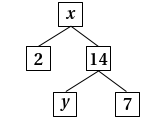
View full solution →The $x+y=$ for the following factorisation tree. $(30,32,34)$
View full solution →The $LCM$ of the least prime factorisation and composite factorisation is $(4,2,5)$
View full solution →Dividing $a^2$ by $6$ , the reminder will be $(a \in N ) \quad(0,1,3$ or $4 ; 0,1,3$, or $5 ; 5,0,1,3)$
View full solution →By dividing the integer $a$ by $3$ , we get the remainder $0$ and $1$ .
View full solution →In $\frac{1}{2^m, 5^n}, m, n \in N$ and $m>n$, so, given digit has $m$ number after decimal.
View full solution →The $H.C.F$. of $15$ and $51$ is not $1$ .
View full solution →The $H.C.F$ of $(120,504,882)$ is $6$ .
View full solution →$3.141141114 \ldots \ldots \ldots .$. is an irrational number.
View full solution →Given that $HCF (306, 657) = 9,$ find $LCM (306, 657).$
View full solution →Find the $LCM$ and $HCF$ of $12, 15$ and $21$ integers by applying the prime factorisation method.
View full solution →Find the $LCM$ and $HCF$ of $8, 9$ and $25$ integers by applying the prime factorisation method.
View full solution →Find the $LCM$ and $HCF$ of $17, 23$ and $29$ integers by applying the prime factorisation method.
View full solution →Find the $LCM$ and $HCF$ of $510$ and $92$ pairs of integers and verify that $LCM$ $\times$ $HCF =$ product of the two numbers.
View full solution →Prove that $6+\sqrt { 2 }$ is irrational.
View full solution →Prove that $7 \sqrt { 5 }$ is irrational.
View full solution →Check whether $6^n$ can end with the digit $0$ for any natural number $n$.
View full solution →Find the $LCM$ and $HCF$ of $336$ and $54$ pairs of integers and verify that $LCM$ $\times$ $HCF =$ product of the two numbers.
View full solution →Find the $HCF$ and $LCM$ of $6, 72$ and $120$, using the prime factorisation method.
View full solution →Prove that $\frac{1}{{\sqrt 2 }}$ is irrational.
View full solution →Prove that $3+2\sqrt { 5 }$ is irrational.
View full solution →Prove that $\sqrt 5 $ is irrational.
View full solution →There is a circular path around a sports field. Sonia takes $18$ minutes to drive one round of the field, while Ravi takes $12$ minutes for the same. Suppose they both start at the same point and at the same time and go in the same direction. After how many minutes will they meet again at the starting point?
View full solution →Explain why $7 \times 11 \times 13 + 13$ and $7 \times 6 \times 5 \times 4 \times 3 \times 2 \times 1 + 5$ are composite numbers.
View full solution →