Questions

2 Marks Questions

🎯

Test yourself on this topic

9 questions · timed · auto-graded

Question 12 Marks
A spherical glass vessel has a cylindrical neck $8\ cm$ long, $2\ cm$ in diameter the diameter of the spherical part is $8.5\ cm$. By measuring the amount of water it holds, a child finds its volume to be $345\ cm^3$. Check whether she is correct, taking the above as the inside measurements and $\pi $ $= 3.14$.
Answer
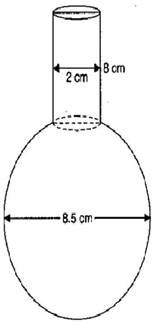
Amount of water it holds $ = \frac{4}{3}\pi {r^3} + \pi {r^2}h$
$ = \frac{4}{3}\pi {\left( {\frac{{8.5}}{2}} \right)^3} + \pi {\left( {\frac{2}{2}} \right)^2} \times 8$
$ = \frac{4}{3} \times 3.14 \times 4.25 \times 4.25 \times 4.25 + 8 \times 3.14$
$= 321.39 + 25.12$
$= 346.51\ cm^3$
Hence, she is correct. The correct volume is $346.51\ cm^3$.
View full question & answer
Question 22 Marks
A solid iron pole consists of a cylinder of height $220\ cm$ and base diameter $24\ cm$ is surmounted by another cylinder of height $60\ cm$ and radius $8\ cm$. Find the mass of the pole, given that $1\ cm^3$ of iron has approximately $8\ g$ mass.
$($Use $\pi = 3.14)$
Answer
Radius of lower cylinder $= R = 12\ cm$
Radius of upper cylinder $= r = 8\ cm$
Height of upper cylinder $ = h = 60\ cm$
Height of lower cylinder $= H = 220\ cm$
Volume of solid iron pole $= \pi R ^ { 2 } H + \pi r ^ { 2 } h$
$= 3.14 \times ( 12 ) ^ { 2 } \times 220$$+ 3.14 \times ( 8 ) ^ { 2 } \times 60$
$= 111532.8 \mathrm { cm } ^ { 3 }$
Mass of the pole $= 111532.8 \times 8 g$
$= 892.2624 \mathrm { kg }$
View full question & answer
Question 32 Marks
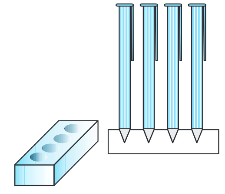
A pen stand made of wood is in the shape of a cuboid with four conical depressions to hold pens. The dimensions of the cuboid are $15\ cm$ by $10\ cm$ by $3.5\ cm$. The radius of each of the depressions is $0.5\ cm$ and the depth is $1.4\ cm$. Find the volume of wood in the entire stand.
Answer
Depth $(h)$ of each conical depression $= 1.4\ cm$
Radius $(r)$ of each conical depression $= 0.5\ cm$
Volume of wood = Volume of cuboid $- 4 \times$ Volume of cones
$= lbh – 4 \times$ $\frac{1}{3} \pi r^{2} h$
$= 15 \times$ $10$ $\times 3.5 – 4 \times$ $\frac{1}{3}$ $\times$ $\frac{22}{7}$ $\times$ $\left(\frac{1}{2}\right)^{2}$ $\times 1.4$
$= 525 – 1.47$
$= 523.53\ cm^3$
Hence, the volume of wood in the entire stand $= 523.53\ cm^3$
View full question & answer
Question 42 Marks
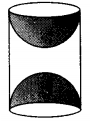
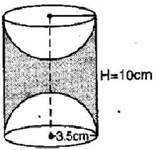
A wooden article was made by scooping out a hemisphere from each end of a solid cylinder as shown in figure. If the height of the cylinder is $10\ cm$ and its base is of radius $3.5\ cm$, Find the total surface area of the article.
Answer

$ \text { TSA of the article }=2 \pi \mathrm{rh}+2\left(2 \pi \mathrm{r}^2\right) $
$ =2 \pi(3.5)(10)+2\left[2 \pi(3.5)^2\right]$
$= 70\pi + 49\pi$
$= 119 \pi$
$= 119 \times \frac {22}7$
$= 374\ cm^2$
View full question & answer
Question 52 Marks
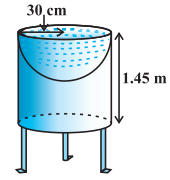
Mayank made a bird-bath for his garden in the shape of a cylinder with a hemispherical depression at one end (see Fig.). The height of the cylinder is $1.45\ m$ and its radius is $30\ cm$. Find the total surface area of the bird-bath.
(Take $\pi = \frac{22}{7}$ )
Answer
Let h be height of the cylinder, and r the common radius of the cylinder and hemisphere.
Then, the total surface area of the bird-bath = $CSA$ of cylinder + $CSA$ of hemisphere
$=2 \pi r h+2 \pi r^{2}=2 \pi r(h+r)$
$=2 \times \frac{22}{7} \times 30(145+30) \mathrm{cm}^{2}$
$=33000 \mathrm{~cm}^2=3.3 \mathrm{~m}^2$
View full question & answer
Question 62 Marks
Both radius and height of a cylinder are equal, if it's radius is 7 cm. Find the volume of the cylinder.
Answer
Radius of cylinder $=r=7 cm$ and $h=7 cm$
$
\begin{aligned}
\text { Volume of cylinder } & =\pi r^2 h \\
& =\frac{22}{7} \times 7 \times 7 \times 7 cm ^3 \\
& =22 \times 49 cm ^3 \\
& =1078 cm ^3
\end{aligned}
$
Thus, volume of cylinder is $1078 cm ^3$.
View full question & answer
Question 72 Marks
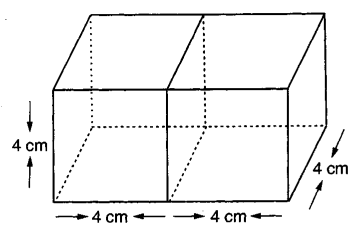
Two cubes each of volume $64 \ cm^3$ are joined end to end. Find the surface area and volume of the resulting cuboid.
Answer
Two cubes each of volume $64 \ cm^3$ are joined end to end. We have to find the surface area and volume of the resulting cuboid.
Let the length of each edge of the cube of volume $64 \ cm^3$  be $x \ cm.$ Then,
Volume $= 64 \ cm^3$
$\Rightarrow  x^3 = 64$
$\Rightarrow  x^3 = 4^3$
$\Rightarrow  x = 4 \ cm$

The dimensions of the cuboid so formed are$:$
$L =$ Length $= (4 + 4) \ cm = 8 \ cm, b =$ Breadth $= 4 \ cm$ and, $h =$ Height $= 4 \ cm$
Surface area of the cuboid $= 2 (lb + bh + Ih)$
$= 2 (18 \times 4 + 4  \times  4 + 8  \times  4) \ cm^2= 160 \ cm^2$
Volume of the cuboid $ = Ibh = 8  \times  4  \times  4 \ cm^3 = 128 \ cm^3​​​​​​​$​​​​​​​
View full question & answer
Question 82 Marks
The height and the diameter of a base of a cone are 6 cm and 5 cm respectively. Find the slant height of the cone.
Answer
To find the slant height of a cone, we can use the Pythagorean theorem since the height, radius, and slant height form a right-angled triangle.
The formula is: $l=\sqrt{r^2+h^2}$
Diameter of the base = 5 cm
Radius of the base, $r=\frac{\text { Diameter }}{2}=\frac{5}{2}=2.5 cm$
Height of the cone,$h=6 cm$
Now, substitute these values into the formula:
$\begin{array}{l}l=\sqrt{(2.5)^2+(6)^2} \\ l=\sqrt{6.25+36} \\ l=\sqrt{42.25} \\ l=6.5 cm\end{array}$
The slant height of the cone is 6.5 cm.
View full question & answer
Question 92 Marks
Find the total surface area of a cube with edge 6 cm.
Answer
Total Surface Area $=6 a^2$  where a is the length of the edge.
Given that the edge of the cube is a=6 cm.
Substitute the value of a into the formula:
$\begin{array}{l}\text { Total Surface Area }=6 \times(6 cm)^2 \\ \text { Total Surface Area }=6 \times\left(36 cm^2\right) \\ \text { Total Surface Area }=216 cm^2\end{array}$
The total surface area of the cube is $216 cm^2$.
View full question & answer
2 Marks Questions - Maths STD 10 Questions - Vidyadip