Question
Find the total surface area of a cube with edge 6 cm.

Answer

Total Surface Area $=6 a^2$  where a is the length of the edge.
Given that the edge of the cube is a=6 cm.
Substitute the value of a into the formula:
$\begin{array}{l}\text { Total Surface Area }=6 \times(6 cm)^2 \\ \text { Total Surface Area }=6 \times\left(36 cm^2\right) \\ \text { Total Surface Area }=216 cm^2\end{array}$
The total surface area of the cube is $216 cm^2$.

Need a full question paper?

Generate a complete, print-ready paper with questions like this in minutes — across 16+ boards, with answer keys.
Start Generating Free

Similar questions

If the sum of the zeros of the quadratic polynomial $f(x) = kx^2- 3x + 5$ is $1,$ write the value of $k.$
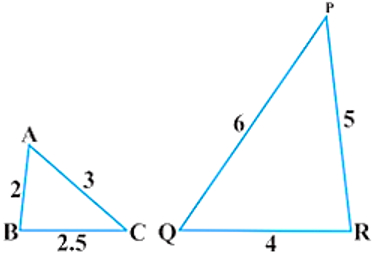
State the pair of triangles in the figure below are similar. Write the similarity criterion used by you for answering the question and also write the pair of similar triangles in the symbolic form:
A solid metal cone with radius of base $12\ cm$ and height $24\ cm$ is melted to form solid spherical balls of diameter $6\ cm$ each. Find the number of balls thus formed.
Is this $–10, –6, –2, 2, ....$ an AP? If it forms an $AP$, find the common difference $d$ and write three more terms.
If the graph of quadratic polynomial $ax^2+ bx + c$ cuts negative direction of $y-$axis, then what is the sign of $c?$
In a musical chair game, the person playing the music has been advised to stop playing the music at any time within $2$ minutes after she starts playing. What is the probability that the music will stop within the first half-minute after starting?
On comparing the ratios $\frac { a _ { 1 } } { a _ { 2 } } , \frac { b _ { 1 } } { b _ { 2 } }$ and $\frac {c_1}{c_2}$, find out whether the lines representing the pair of linear equations intersect at a point, are parallel or coincident: $9x + 3y + 12 = 0; 18x + 6y + 24 = 0$
Find the $LCM$ and $HCF$ of the following pairs of integers and verify that $LCM × HCF =$ Product of the integers:
$336$ and $54$
Find the $30^{th}$ term of an $A P\ 10,7,4,....$
A point $P$ is $26\ cm$ away from the centre $O$ of a circle and the length $PT$ of the tangent drawn from $P$ to the circle is $10\ cm.$ Find the radius of the circle.