Questions

[3 Mark Questions]

🎯

Test yourself on this topic

19 questions · timed · auto-graded

Question 13 Marks
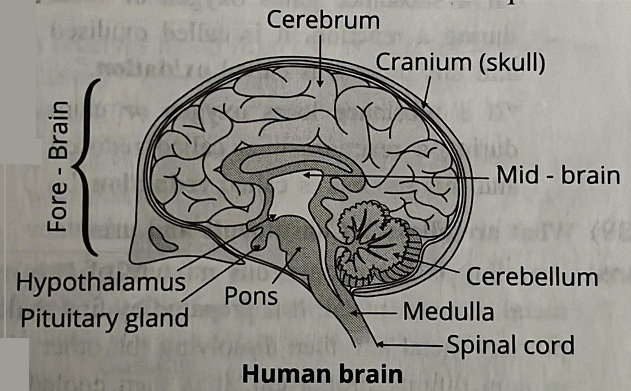
Explain with diagram the structure of human brain.
Answer
The nervous system present in the mid axis of the body is called $CNS$ (Central Nervous System). The central nervous system consists of the brain and spinal cord.
Image
→ Spinal cord is made up of nerves which supply information to think about. Brain is the main coordinating organ of the body $CNS$ receive information from all parts of the body and integrate it.
→ The spinal cord carries the sensation as impulses to the brain. The brain sends its feedback sensation to the muscles.
→ There are $12$ pairs of cranial nervous in the brain connecting head and upper body while $31$ pairs of spinal nerves connecting the rest of the body constitutes the Peripheral Nervous System $(PNS)$ which receives and coordinates instructions from all parts of the body.
→ In order to perform some voluntary actions like writing, talking, moving a chair, clapping etc brain has to send messages to the muscles. The $PNS$ helps the brain to send these messages. Thus the brain allows us to think and further act based on our thinking.
View full question & answer
Question 23 Marks
How are involuntary actions and reflex actions different from each other?
Answer
Involuntary action Reflex action
$1$. An action which is not in control of any organism is
called involuntary action.
$1$. An immediate response unplanned sequence or action and nearly instantaneous response to a stimulus is called reflex action.
$2$. It is controlled by Mid-brain and hind-brain $2$. It is immediate response to stimuli.
$3$. It is not an immediate quick response to a sensation. $3$. There is an immediate, rapid response to sensation
$4$. Involuntary action is done by involuntary organs. $4$. Reflex actions are done by voluntary organs.
$5$. External stimulus is not necessary to carry out action $5$. External stimulus is necessary to carry out action
View full question & answer
Question 33 Marks
Give examples of reflex arc.
Answer
Examples of reflex arc are :
$(1)$ Due to sudden light on eyes, pupil contracts.
$(2)$ Sudden reaction to extreme cold or extreme hot water.
$(3)$ Movement of diaphragm
$(4)$ Sudden closing of the eye when something comes near the eye.
$(5)$ Coughing
$(6)$ Moving the hand as soon as nail is hurted etc.
View full question & answer
Question 43 Marks
Explain Reflex action in detail.
Answer
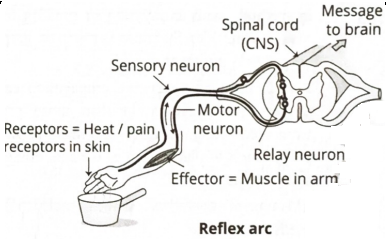
Reflex action is such a situation in which, we do not think about but express an immediate response to changes in the environment for eg : We move our hands immediately after touching the hot pan.
→ In normal conditions any sensory impulse travel through the spinal cord to the brain which is protected in the skull. The brain thinks about it In response it sends impulse to the muscle. The arm can the be moved as the muscles contract. All these actions take a lot of time. Whereas, reflex action is very fast and it is carried out for protecting our body.
→ In the above example the sensation of heat is received by the nerves. Nerves directly innervate the muscles. So this action is completed very quickly Usually this type of structure is known as Reflex arc. Reflex arc is created in spinal cord, where the motor olfactory nerve and sensory nerve meet.
Image
Animals have very little or none of the complex neuron network needed for thinking. So it is quite likely that reflex arcs have evolved as efficient ways of functioning in the absence of true thought processes. Even after complex neuron networks have come into existence, reflex arcs continue to be more efficient for quick responses.
View full question & answer
Question 53 Marks
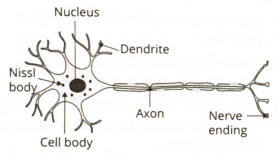
Draw the structure of a neuron and explain its function.
Answer
Image
⇒ Functions of Neurons
$(1)$ Neurons form an organised reticular structure which forms nervous tissue.
$(2)$ Neurons carry sensations or instructions from receptors.
$(3)$ From their sensations or instructions are carried as electric impulse.
$(4)$ Further this impulse is converted into chemical signal so that it can be spread further.
View full question & answer
Question 73 Marks
Write short notes : Breathing in human
Answer
  • When we breathe in, we lift our ribs and flatten our diaphragm.
  • As a result the chest cavity becomes larger.
  • Because of this, air is sucked into the lungs and fills the expanded alveoli.
  • The alveoli provide a surface for exchange of gases.
  • The blood brings carbon dioxide from the rest of body release into the alveoli and the oxygen in the alveolar air is taken up by blood in the alveolar blood vessels.
  • Now, diaphragm pulled up and ribs move down.
  • As a result, the chest cavity becomes smaller.
  • Because of this, air is expelled from lungs into the atmosphere.
  • During the breathing cycle, when air is taken in and let out, the lungs always contain a residual volume of air so that there is sufficient time for oxygen to be absorbed and for the carbon dioxide to be released.
View full question & answer
Question 83 Marks
Explain in brief: Anaerobic respiration
Answer
  • In certain bacteria, yeast and other fungi, several endoparasites and in animal muscles at the time of exercise, the process of releasing energy from glucose, takes place without using oxygen which is called anaerobic respiration.
  • During this process Ethanol and $CO_2$ are set free in plant cells while in the animal cells only lactic acid is formed.
  • In any of these mediums the glucose molecules are incompletely oxidized and hence release only a very small amount of energy takes place.
  • The equations for this process are as follows:
  • In Yeast:
  • Glucose → $2$ Pyruvic acid → Ethanol +$ 2CO_2$ + Energy
  • $(6-C)$ In cytoplasm $(3-C)$ Fermentation
($O_2$ not used) + Energy ($O_2$ absent)
  • In Animal muscles:
  • Glucose → $2$ Pyruvic acid → $2$ Lactic acid + Energy
  • $(6-C)$ In cytoplasm $(3-C)$ In absence
($O_2$ not used) + Energy of $O_2$
View full question & answer
Question 93 Marks
differences between : autotrophic nutrition and heterotrophic nutrition.
Answer
Autotrophic Nutrition Heterotrophic Nutrition
$1$. It occurs in green plants and some bacteria. $1$. It occurs in animals fungi.
$2$. In such mode of nutrition, food is synthesised from inorganic components, i.e., $CO_2$ and $H_2O.$ $2$. In such mode of nutrition food is consumed from other organisms.
$૩$. Photosynthesis is important process for autotrophic nutrition. $3$. Food digestion is important for such nutrition.
View full question & answer
Question 103 Marks
Explain in details about small intestine.
Answer
  • Small intestine is the longest part of the alimentary canal which is fitted into a compact space because of extensive coiling in human beings.
  • The length of the small intestine differs in various animals depending on the food they eat.
  • Herbivores eating grass need a longer small intestine to allow the cellulose to be digested.
  • Meat is easier to digest, hence carnivores like tigers have a shorter small intestine.
  • Digestion in small intestine:
  • Small intestine is the longest part of the alimentary canal.
  • It is the site of the complete digestion of carbohydrates, proteins and fat.
  • From the stomach, the food enters the small intestine.
  • Small intestine receives bile juice from liver and pancreatic juice from pancreas.
  • $(1)$ Action of bile juice:
  • The food coming from stomach is acidic and bile makes it alkaline for the pancreatic enzymes to act.
  • Bile salts break large fat globules present in food down into smaller globules.
  • This process is called emulsification.
  • This process increases the efficiency of enzyme action.
  • $(2)$ Action of pancreatic juice:
  • The pancreas secretes pancreatic juice which contains enzymes like trypsin for digesting proteins, pancreatic amylase for carbohydrates and lipase for breaking down emulsified fats.
  • $(3)$ Action of intestinal juice:
  • The wall of small intestine contain glands which secrete intestinal juice.
  • The enzymes present in it finally convert the proteins to amino acids, complex carbohydrates into glucose and fats into fatty acids and glycerol.
  • Absorption of digested food:
  • Digested food is taken up by the walls of the intestine.
  • The inner lining of the small intestine has numerous fingerlike projection called villi.
  • Villi increase the surface area for absorption.
  • The villi are richly supplied with blood vessels, which increase the efficiency of absorption of digested food.
View full question & answer
Question 123 Marks
How autotrophs meet their requirement of raw materials?
Answer
  • Autotrophs meet their requirement of raw materials by following:
  • $(1) CO_2$ used in photosynthesis is taken from atmosphere through stomatal pores.
  • $(2)$ Water used in photosynthesis is taken up from the soil by the roots in terrestrial plants.
  • $(3)$ Other materials like nitrogen, phosphorous, iron and magnesium are taken up from the soil.
  • Nitrogen is an essential element used in the synthesis of proteins and other nitrogenous compounds.
  • Nitrogen is taken up in the form of inorganic nitrates or nitrites.
  • If may be taken up as organic compounds which have been prepared by bacteria from atmospheric nitrogen.
View full question & answer
Question 133 Marks
Write short note on: Excretion in plants.
Answer
  • Unlike animals, the plants do not possess any special organs or system for excretion.
  • However, the plants excrete their wastes in different ways :
  • $(1) O_2$ produced during photosynthesis by the green plants is set free directly in the atmosphere.
  • $(2)$ Plants remove surplus water by the process of transpiration through the stomata.
  • $(3)$ Sometimes plants store certain wastes in the cells of their leaves which are ultimately shed off.
  • $(4)$ Certain plants store wastes in the cellular vacuoles of their cells.
  • $(5)$ Other waste products such as resin and gum are stored especially in old xylem.
  • $(6)$ Plants excrete some waste substances into the soil around them.
View full question & answer
Question 143 Marks
What is excretion ? What strategy is used by animals to do this?
Answer
  • The biological process involved in the removal of harmful nitrogenous metabolic wastes from the body is called excretion.
  • Various metabolic activities in animal body generate these nitrogenous waste materials which should be excreted out.
  • Different organisms use varied strategies for excretion.
  • Many unicellular organisms remove these wastes by simple diffusion from the body surface into surrounding water.
  • Complex multi-cellular animals use specialised excretory organs to perform the same function.
View full question & answer
Question 153 Marks
Why a proper system of transportation is essential in plants?
Answer
  • Plants are autotrophic.
  • They take in simple substances in the form of inorganic compounds from their environment.
  • $CO_2$ is taken from atmosphere by leaves for photosynthesis.
  • From soil raw materials like $N, P$ and other substances are absorbed by roots.
  • If the distances between soil contacting organs and chlorophyll containing organs are small, energy and raw materials can easily diffuse to all parts of the plant body.
  • But if these distances become large, then diffusion processes will not be sufficient.
  • So, in higher plants to provide raw materials in leaves and energy in roots, a proper transportation system is essential.
View full question & answer
Question 163 Marks
Answer the following questions regarding blood pressure:
$(1)$ What is called blood pressure?
$(2)$ What is called systolic and diastolic pressure?
$(3)$ What is the normal value of systolic and diastolic pressure?
$(4)$ Which instrument is use to measure blood pressure?
$(5)$ What is hypertension? How it is caused?
Answer
SELF
View full question & answer
Question 173 Marks
What is lymph? How it is formed and transport? State the functions of it.
Answer
  • Lymph is a colourless fluid involved in transportation.
  • It is also called tissue fluid.
  • Through the pores present in the wall of capillaries some amount of plasma, proteins and blood cells escape into intercellular spaces in the tissues to form the lymph or tissue fluid.
  • Lymph is similar to the plasma of blood but contains less protein.
  • Lymph drains into lymphatic capillaries from the intercellular spaces, which join to form large lymph vessels that finally open into larger veins.
  • Functions:
  • $(1)$ Lymph carries digested and absorbed fat from intestine.
  • $(2)$ It drains excess fluid from intercellular space back into the blood.
View full question & answer
Question 183 Marks
Write about blood and what are the features for an effective transport system.
Answer
  • Blood is a red colour fluid connective tissue.
  • It consists of a fluid medium called plasma in which cells are suspended.
  • Blood cells are red blood corpuscle (erythrocytes), white blood corpuscle (leucocytes) and platelets.
  • Plasma transports food, carbon dioxide, salts and nitrogenous wastes in dissolved form.
  • Oxygen is carried by red blood corpuscles.
  • The features for an effective transport system are as follows:
  • $(1)$ A pumping organ to push blood throughout the body.
  • $(2)$ A network of tubes to reach all the tissues.
  • $(3)$ A system in place to ensure this network can be repaired if damaged.
View full question & answer
Question 193 Marks
What is photosynthesis? Enlist the events that take place in process, giving the equation of photosynthesis.
Answer
  • A process by which carbon dioxide and water is converted into carbohydrates in presence of sunlight and chlorophyll is called photosynthesis.
  • Equation for the process of photosynthesis:
  • $6 CO _2+12 H _2 O \xrightarrow[chlorophyll]{\text { Sunlight }} C _6 H _{12} O _6+6 O _2+6 H _2 O$
Glucose
  • The following events occur in photosynthesis:
  • $(1)$ Absorption of light energy by chlorophyll.
  • $(2)$ Conversion of light energy into chemical energy, and splitting of water molecules into hydrogen and oxygen.
  • $(3)$ Reduction of carbon dioxide into carbohydrate (glucose).
View full question & answer
[3 Mark Questions] - Science STD 10 Questions - Vidyadip