MCQ
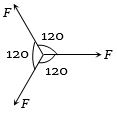
Three concurrent forces of the same magnitude are in equilibrium. What is the angle between the forces  Also name the triangle formed by the forces as sides
  • $120^°$ equilateral triangle
  • B
    $60^°$ equilateral triangle
  • C
    $120^°, 30^°, 30^° $ an isosceles triangle
  • D
    $120^°$ an obtuse angled triangle

Answer

Correct option: A.
$120^°$ equilateral triangle
a
(a) In $N$ forces of equal magnitude works on a single point and their resultant is zero then angle between any two forces is given

$\theta = \frac{{360}}{N}$$ = \frac{{360}}{3} = 120^\circ $

If these three vectors are represented by three sides of triangle then they form equilateral triangle

Need a full question paper?

Generate a complete, print-ready paper with questions like this in minutes — across 16+ boards, with answer keys.

Start Generating Free

Similar questions

Natural length of the spring is $40\ cm$ and its spring constant is $4000\ Nm^{-1}$. A mass of $20\ kg$ is hung from it.The extension produced in the spring is $(g = 9.8\ ms^{-2})$
What effect occurs on the frequency of a pendulum if it is taken from the earth surface to deep into a mine
A sphere is rolled on a rough horizontal surface. It gradually slows down and stops. The force of friction tries to:
  1. Decrease the linear velocity.
  2. Increase the angular velocity.
  3. Increase the linear momentum.
  4. Decrease the angular velocity.
A weightlifter lifts a weight off the ground and holds it up
A bomb of mass $9\,kg$ explodes into $2$ pieces of mass $3\,kg$ and $6\,kg.$ The velocity of mass $3\,kg$ is $1.6\, m/s$, the K.E. of mass $6\,kg$ is ............ $J$
The thermal radiation emitted by a body is proportional to $\text{T}^n$ where $T$ is its absolute temperature. The value of $n$ is exactly $4$ for:
What is the range of the gravitational force?
A projectile has the same range $R$ for two angles of projection. If $T_1$ and $T_2$ be the times of flight in the two cases, then $R$ is
The additional kinetic energy to be provided to a satellite of mass $m$ revolving around a planet of mass $M,$ to transfer it from a circular orbit of radius $R_1$ to another of radius $R_2\,(R_2 > R_1)$ is 
In the $s-t$ equation $\left(s=10+20 t-5 t^2\right)$, match the following columns.
Colum $I$ Colum $II$
$(A)$ Distance travelled in $3\,s$ $(p)$ $-20$ units
$(B)$ Displacement in $1\,s$ $(q)$ $15$ units
$(C)$ Initial acceleration $(r)$ $25$ units
$(D)$ Velocity at $4\,s$ $(s)$ $-10$ units