Question 15 Marks
Show that the angular momentum of a particle is the product of its linear momentum and moment arm. Also, show that the angular momentum is produced only by the angular component of linear momentum. What is the physical meaning of angular momentum?
Answer
View full question & answer→Physical meaning of angular momentum. Consider a particle P of mass m whose position vector relative to the origin O is $\vec{r}$. Suppose the momentum vector $\vec{p}$ of the particle makes angle $\theta$ with the position vector $\vec{r}$ as shown in Fig.
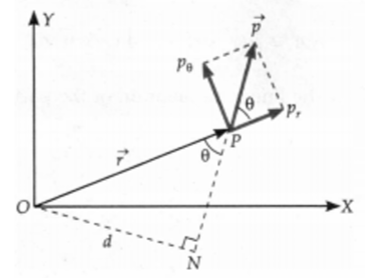
Draw ON perpendicular to the line of action of linear momentum $\vec{p}$. From right angled $\Delta ONP$, we get
$
\frac{O N}{O P}=\frac{d}{r}=\sin \theta \text { or } d=r \sin \theta
$
This is the perpendicular distance of the line of action of linear momentum from the point of rotation O and is called moment arm of the momentum.
The magnitude of the angular momentum about the point $O$ is
$
L=r p \sin \theta=p(r \sin \theta)=p d
$
Angular momentum $=$ Linear momentum $\times$ moment arm
This is the physical meaning of angular momentum. According to it, angular momentum is the moment of linear momentum and is a measure of the turning motion of the object. In contrast to it, we know that
$
\text { Torque }=\text { Force } \times \text { moment arm }
$
Thus torque is the moment of force and is a measure of the turning effect of force.
Moreover, as shown in Fig. the momentum vector $\vec{p}$ can be resolved into two rectangular components:
i. Radial component, $p _{ r }$ along the direction of the position vector $\vec{r}$.
ii. Angular or tangential component, $p_\theta$ perpendicular to $\vec{r}$
or Angular momentum = Angular component of linear momentum
Hence only the angular component and not the radial component of the linear momentum contributes towards the angular momentum.
Draw ON perpendicular to the line of action of linear momentum $\vec{p}$. From right angled $\Delta ONP$, we get
$
\frac{O N}{O P}=\frac{d}{r}=\sin \theta \text { or } d=r \sin \theta
$
This is the perpendicular distance of the line of action of linear momentum from the point of rotation O and is called moment arm of the momentum.
The magnitude of the angular momentum about the point $O$ is
$
L=r p \sin \theta=p(r \sin \theta)=p d
$
Angular momentum $=$ Linear momentum $\times$ moment arm
This is the physical meaning of angular momentum. According to it, angular momentum is the moment of linear momentum and is a measure of the turning motion of the object. In contrast to it, we know that
$
\text { Torque }=\text { Force } \times \text { moment arm }
$
Thus torque is the moment of force and is a measure of the turning effect of force.
Moreover, as shown in Fig. the momentum vector $\vec{p}$ can be resolved into two rectangular components:
i. Radial component, $p _{ r }$ along the direction of the position vector $\vec{r}$.
ii. Angular or tangential component, $p_\theta$ perpendicular to $\vec{r}$
or Angular momentum = Angular component of linear momentum
Hence only the angular component and not the radial component of the linear momentum contributes towards the angular momentum.