Questions

3 Marks Question

🎯

Test yourself on this topic

18 questions · timed · auto-graded

Question 13 Marks
Give reasons for the following:
  1. Acetylation of aniline reduces its activation effect.
  2. CH3NH2 is more basic than C6H5NH2.
  3. Although -NH2 is o/p directing group, yet aniline on nitration gives a significant amount of m-nitroaniline.
Answer
  1. Due to the resonance, the electron pair of nitrogen atom gets delocalised towards carbonyl group/resonating structures.
  2. Because of +I effect in methylamine electron density at nitrogen increases whereas in aniline resonance takes place and electron density on nitrogen decreases/resonating structures.
  3. Due to protonation of aniline/formation of anilinium ion.
View full question & answer
Question 23 Marks
Give reasons for the following :
  1. Acetylation of aniline reduces its activation effect.
  2. CH3NH2 is more basic than C6H5NH2.
  3. Although -NH2 is o/p directing group, yet aniline on nitration gives a significant amount of m-nitroaniline.
Answer
  1. Due to the resonance, the electron pair of nitrogen atom gets delocalised towards carbonyl group / resonating structures.
  2. Because of +I effect in methylamine electron density at nitrogen increases whereas in aniline resonance takes place and electron density on nitrogen decreases / resonating structures.
  3. Due to protonation of aniline / formation of anilinium ion.
View full question & answer
Question 33 Marks
Give reasons for the following:
  1. Aniline does not undergo Friedal-Crafts reaction.
  2. (CH3)2 NH is more basic than (CH3)3 N in an aqueous solution.
  3. Primary amines have higher boiling point than tertiary amines.
Answer
  1. Aniline is a Lewis base while AlCl3 is lewis acid. They combine to form a salt.
  2. Due to combined + I and solvation effects.
  3. Due to presence of H-bonding in primary amines.
View full question & answer
Question 43 Marks
Give reasons for the following:
  1. Acetylation of aniline reduces its activation effect.
  2. CH3NH2 is more basic than C6H5NH2.
  3. Although -NH2 is o/p directing group, yet aniline on nitration gives a significant amount of m-nitroaniline.
Answer
  1. Due to the resonance, the electron pair of nitrogen atom gets delocalised towards carbonyl group/resonating structures.
  2. Because of +I effect in methylamine electron density at nitrogen increases whereas in aniline resonance takes place and electron density on nitrogen decreases/resonating structures.
  3. Due to protonation of aniline/formation of anilinium ion.
View full question & answer
Question 63 Marks
Account for any two of the following:
  1. Amines are basic substances while amides are neutral.
  2. Nitro compounds have higher boiling points than the hydrocarbons having almost the same molecular mass.
  3. Aromatic amines are weaker bases than aliphatic amines.
Answer
  1. Due to the presence of lone pair of electrons on nitrogen of amines they are basic in nature whereas nitrogen of amides acquire positive charge due to resonance with carbonyl group which makes it neutral. 
  2. Because of the polar nature of nitro compounds leading to stronger interactions due to dipole-dipole interactions.
  3. Due to resonance in aromatic amines nitrogen acquires positive charge which decreases its basic character whereas there is no resonance in aliphatic amines.
View full question & answer
Question 73 Marks
Complete the following reactions :

  1. $\text{C}_6\text{H}_5-\text{COO}^-\text{NH}^+_4\xrightarrow{\text{ }\text{ }\text{ }\text{ }\text{ }\text{ }\text{ }\text{ }\triangle\text{ }\text{ }\text{ }\text{ }\text{ }\text{ }\text{ }\text{ }\text{ }}\text{A}\xrightarrow{\text{ }\text{ }\text{ }\text{ }\text{Br}_2/\text{KOH}\text{ }\text{ }\text{ }\text{ }}\text{B}\xrightarrow{\text{ }\text{ }\text{ }\text{ }\text{CH}_3\text{COC}l_3/\text{pyridine}\text{ }\text{ }\text{ }\text{ }}\text{C}$

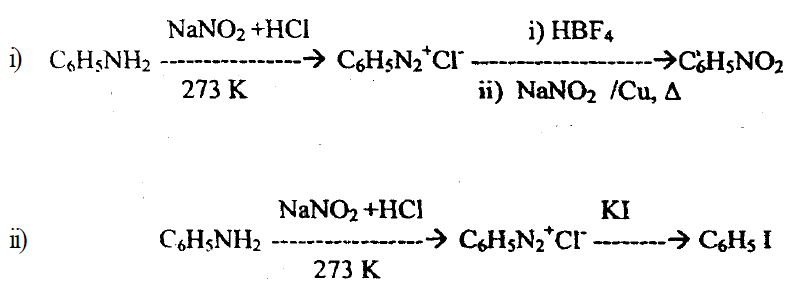
  2. $\text{C}_6\text{H}_5\text{N}^+_2\text{BF}^-_4\xrightarrow[\triangle]{\text{ }\text{ }\text{ }\text{ }\text{ }\text{ }\text{ }\text{ }\text{NaNO}_2/\text{Cu}\text{ }\text{ }\text{ }\text{ }\text{ }\text{ }\text{ }\text{ }\text{ }}\text{A}\xrightarrow{\text{ }\text{ }\text{ }\text{ }\text{Sn}/\text{HC}l\text{ }\text{ }\text{ }\text{ }}\text{B}\xrightarrow[\triangle]{\text{ }\text{ }\text{ }\text{ }\text{CHC}l_3+\text{alc. KOH}\text{ }\text{ }\text{ }\text{ }}\text{C}$

Answer
i. A: C6H5CONH2 B: C6H5NH2 C: C6H5NHCOCH3
ii. A: C6H5NO2 B: C6H5NH2 C: C6H5- NC
View full question & answer
Question 83 Marks
Complete the following reactions :

  1. $\text{C}_6\text{H}_5-\text{COO}^-\text{NH}^+_4\xrightarrow{\text{ }\text{ }\text{ }\text{ }\text{ }\text{ }\text{ }\text{ }\triangle\text{ }\text{ }\text{ }\text{ }\text{ }\text{ }\text{ }\text{ }\text{ }}\text{A}\xrightarrow{\text{ }\text{ }\text{ }\text{ }\text{Br}_2/\text{KOH}\text{ }\text{ }\text{ }\text{ }}\text{B}\xrightarrow{\text{ }\text{ }\text{ }\text{ }\text{CH}_3\text{COC}l_3/\text{pyridine}\text{ }\text{ }\text{ }\text{ }}\text{C}$

  2. $\text{C}_6\text{H}_5\text{N}^+_2\text{BF}^-_4\xrightarrow[\triangle]{\text{ }\text{ }\text{ }\text{ }\text{ }\text{ }\text{ }\text{ }\text{NaNO}_2/\text{Cu}\text{ }\text{ }\text{ }\text{ }\text{ }\text{ }\text{ }\text{ }\text{ }}\text{A}\xrightarrow{\text{ }\text{ }\text{ }\text{ }\text{Sn}/\text{HC}l\text{ }\text{ }\text{ }\text{ }}\text{B}\xrightarrow[\triangle]{\text{ }\text{ }\text{ }\text{ }\text{CHC}l_3+\text{alc. KOH}\text{ }\text{ }\text{ }\text{ }}\text{C}$

Answer
i. A: C6H5CONH2 B: C6H5NH2 C: C6H5NHCOCH3
ii. A: C6H5NO2 B: C6H5NH2 C: C6H5- NC
View full question & answer
Question 93 Marks
Give reasons:
  1. Acetylation of aniline reduces its activation effect.
  2. CH3NH2 is more basic than C6H5NH2.
  3. Although –NH2 is o/p directing group, yet aniline on nitration gives a significant amount of m-nitroaniline.
Answer
  1. Due to the resonance, the electron pair of nitrogen atom gets delocalised towards carbonyl group/resonating structures.
  2. Because of +I effect in methylamine electron density at nitrogen increases whereas in aniline resonance takes place and electron density on nitrogen decreases/resonating structures.
  3. Due to protonation of aniline/formation of anilinium ion.

View full question & answer
Question 103 Marks
Write chemical equations for the following conversions:
  1. Nitrobenzene to benzoic acid.
  2. Benzyl chloride to 2-phenylethanamine.
  3. Aniline to benzyl alcohol.
View full question & answer
Question 123 Marks
Account for the following:
  1. Electrophilic substitution in case of aromatic amines takes place more readily than benzene.
  2. CH3CONH2 is a weaker base than CH3CH2NH2.
  3. Nitro compounds have higher boiling points than hydrocarbons having almost same molecular mass.
Answer
  1. –NH2 group in aromatic amines strongly activates the aromatic ring through delocalization of the lone pair of electrons on nitrogen atom over the benzone ring. However, no such delocalization occurs in case of benzene.
  2. In CH3 CONH2, the lone pair of electrons on nitrogen is delocalized with carbonyl group as a result of which electron density on nitrogen decreases and hence basic character decreases whereas, in CH3CH2 NH2, ethyl group is electron releasing which makes the amine more basic.
  3. Because of polar nature of -NO2 group.
View full question & answer
Question 143 Marks
  1. Out of (CH3)3C–Br and (CH3)3C–I, which one is more reactive towards SN1 and why?
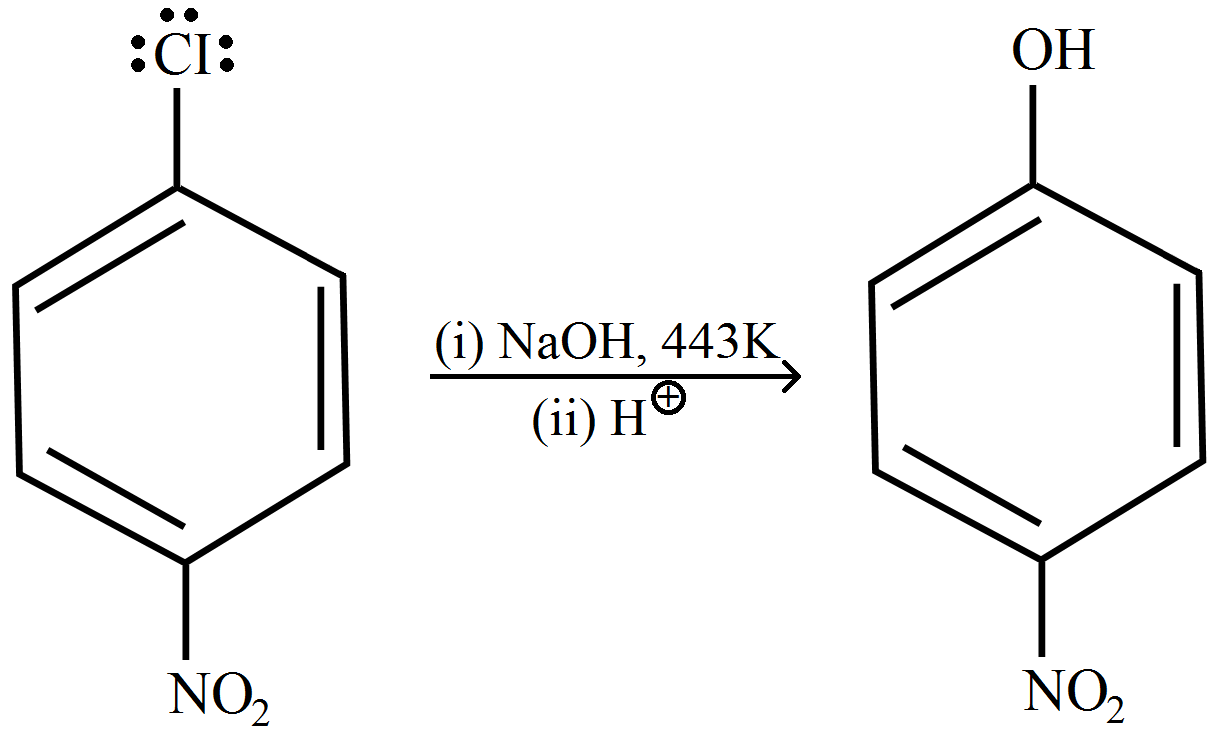
  2. Write the product formed when p-nitrochlorobenzene is heated with aqueous NaOH at 443K followed by acidification.
  3. Why dextro and laevo–rotatory isomers of Butan-2-ol are difficult to separate by fractional distillation?
View full question & answer
Question 153 Marks
An aromatic compound ‘A’ on heating with Br2 and KOH forms a compound ‘B’ of molecular formula C6H7N which on reacting with CHCl3 and alcoholic KOH produces a foul smelling compound ‘C’. Write the structures and IUPAC names of compounds A, B and C.
View full question & answer
Question 163 Marks
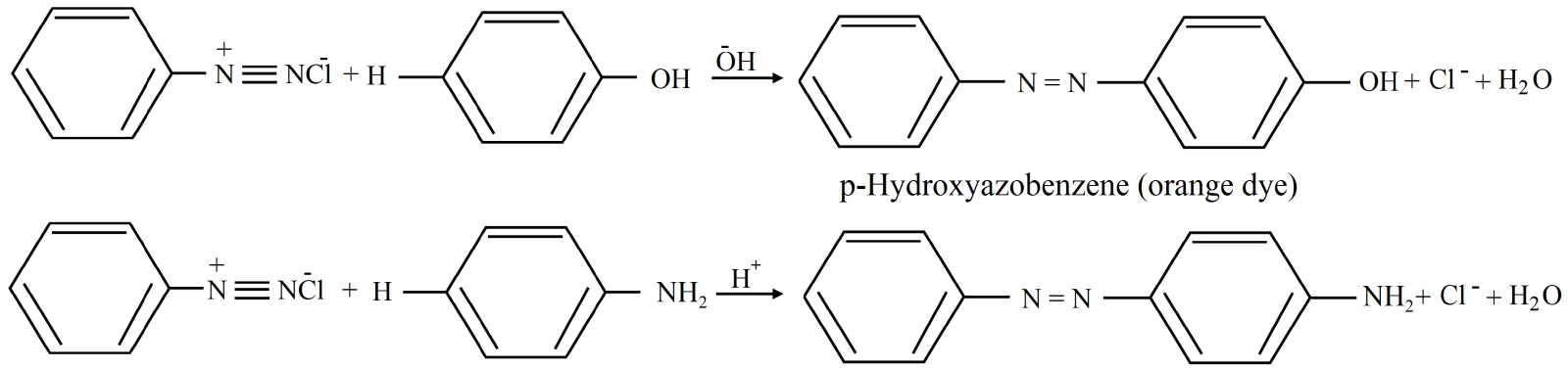
A solution contains 1g mol. each of p-toluene diazonium chloride and pnitrophenyl diazonium chloride. To this 1g mol. of alkaline solution of phenol is added. Predict the major product. Explain your answer.
View full question & answer
Question 173 Marks
Predict, giving reasons, the order of basicity of the following compounds in (i) gaseous phase and (ii) in aqueous solutions (CH3)3N, (CH3)2NH, CH3NH2, NH3.
Answer
In gaseous phase, basic character of amines increases with the increase in number of electron releasing groups, due to +I effect, so trend of basic character is,

$(\text{CH}_3)_3\text{N}>(\text{CH}_3)_2\text{NH}>\text{CH}_3\text{NH}_2>\text{NH}_3\$3^\circ)\ \ \ \ \ \ \ \ \ \ \ \ \ \ \ \ \ \ \ \ \ \ (2^\circ)\ \ \ \ \ \ \ \ \ \ \ \ \ \ (1^\circ)$

But in aqueous phase, solvation of ammonium cation occurs by water molecules, greater the size of ion, lesser will be the solvation, and lesser will be the stability of ion, so on combining +I effect and solvation effect, in aqueous phase trend changes to,

$(\text{CH}_3)_2\text{NH}>\text{CH}_3\text{NH}_2>(\text{CH}_3)_3\text{N}>\text{NH}_3\$2^\circ)\ \ \ \ \ \ \ \ \ \ \ \ \ \ \ \ \ \ \ \ \ (1^\circ)\ \ \ \ \ \ \ \ \ \ \ \ (3^\circ)$

View full question & answer
3 Marks Question - Chemistry STD 12 Science Questions - Vidyadip