Questions · Page 1 of 2

3 Marks Question

🎯

Test yourself on this topic

50 questions · timed · auto-graded

Question 23 Marks
  1. For the complex [Fe(H2O)6]3+, write the hybridization, magnetic character and spin of the complex. (At. number: Fe = 26)
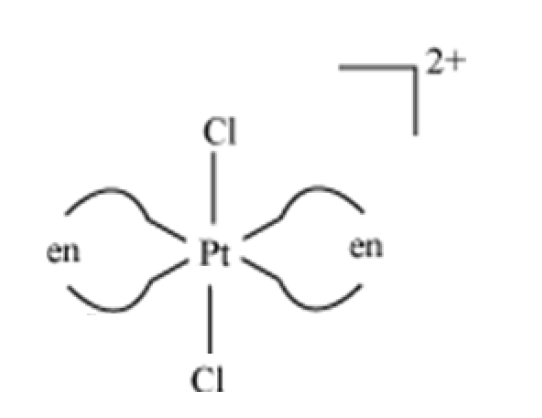
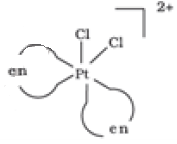
  2. Draw one of the geometrical isomers of the complex [Pt(en)2Cl2]2+ which is optically inactive.
Answer
  1. spd2, paramagnetic, high spin.
  2.  

View full question & answer
Question 33 Marks
  1.  What type of isomerism is shown by [Co(NH3)5ONO]Cl2?
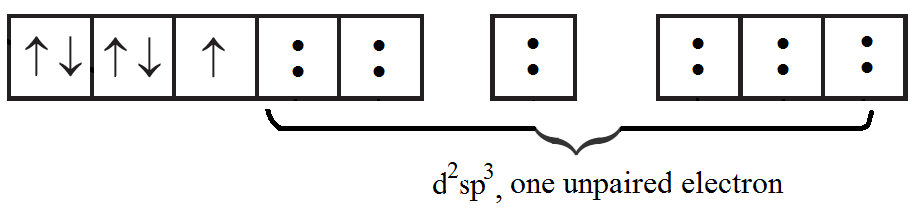
  2. On the basis of crystal field theory, write the electronic configuration for dion if $\Delta$ o< P.
  3. Write the hybridization and shape of [Fe(CN)6]3-.

(Atomic number of Fe = 26)

Answer
  1. Linkage isomerism.
  2. t2g3 eg1/Diagrammatic representation.
  3. d2sp3, Octahedral.
View full question & answer
Question 43 Marks
  1. What type of isomerism is shown by the complex [Co(NH3)5 (SCN)]2+?
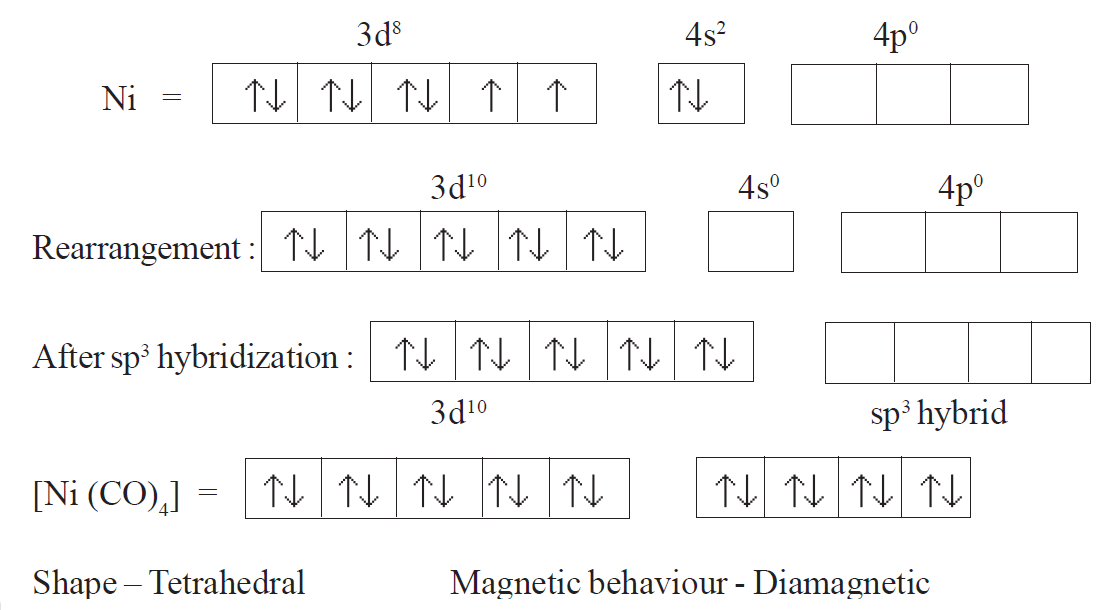
  2. Why is [NiCl4]2- paramagnetic while [Ni(CN)4]2- is diamagnetic? (Atomic number of Ni = 28)
  3. Why are low spin tetrahedral complexes rarely observed?
Answer
  1. Linkage isomerism.
  2. In [NiCl4]2-, due to the presence of Cl-, a weak field ligand no pairing occurs whereas in [Ni(CN)4]2-, CN- is a strong field ligand and pairing takes place/diagrammatic representation.
  3. Because of very low CFSE which is not able to pair up the electrons.
View full question & answer
Question 53 Marks
  1. Write the IUPAC name of the complex [Cr(NH3)4 Cl2]Cl.
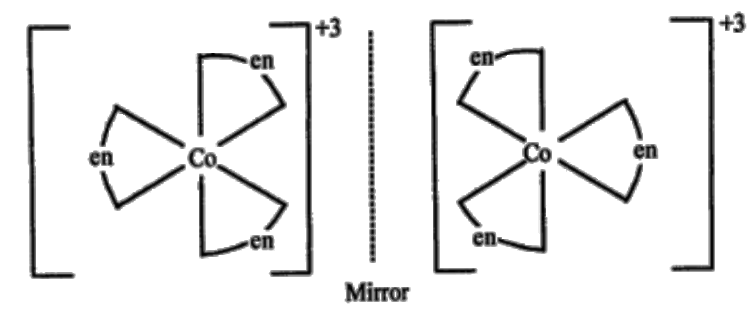
  2. What type of isomerism is exhibited by the complex [Co(en)3]3+?

(en= ethane-1,2-diamine)

  1. Why is [NiCl4]2–paramagnetic but [Ni(CO)4] is diamagnetic?

(At. nos.: Cr= 24, Co=27, Ni= 28)

Answer
  1. Tetraamminedichloridochromium (III) chloride.
  2. Optical isomerism.
  3. In [NiCl4]2; Cl–acts as weak ligand therefore, does not cause forced pairing, thus electrons will remain unpaired hence paramagnetic.

In [Ni(CO)4]; CO acts as strong ligand therefore, causes forced pairing, thus electrons will become paired hence diamagnetic.

View full question & answer
Question 63 Marks
What is meant by crystal field splitting energy? On the basis of crystal field theory, write the electronic configuration of d4 in terms of t2g and ein an octahedral field when
  1. Δ0>P
  2. Δ0<P
Answer
The energy involved in splitting the degenerate d-orbitals into two sets t2g and eg is called crystal field splitting energy.
  1. t2g4ego
  2. t2g3eg1
View full question & answer
Question 73 Marks
For the complex [NiCI4]2-, write

  1. The IUPAC name.
  2. The hybridization type.
  3. The shape of the complex.

(Atomic no. of Ni = 28)

Answer
  1. Tetrachloridonickelate(II) ion.
  2. sp3.
  3. Tetrahedral.
View full question & answer
Question 83 Marks
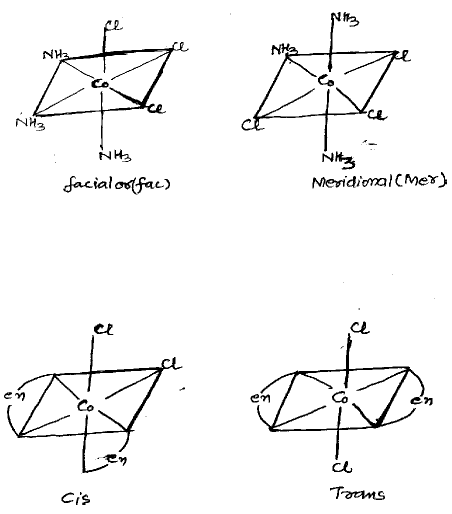
Name the following coordination entities and draw the structures of their stereoisomers:
  1. [Co(en)2Cl2]+ (en = ethan-l, 2-diamine).
  2. [Cr(C2O4)3]3–.
  3. [Co(NH3)3 Cl3].
(Atomic numbers Cr=24, Co=27).
View full question & answer
Question 93 Marks
Explain the following terms giving a suitable example in each case:
  1. Ambident ligand.
  2. Denticity of a ligand.
  3. Crystal field splitting in an octahedral field.
Answer
  1. Ambident ligand: a unidentate ligand which can co-ordinate to the central metal atom through more than one co-ordinating bond.e.g. NO2, SCN.
  2. The number of donor atoms in ligating groups is known as denticity of that ligand. e.g. in C2O42– denticity is 2.
  3. Crystal field splitting in an Octahedral field: The splitting of d-orbitals under the influence of approaching ligand is known as crystal field splitting for example for d4, configuration is t2g 3eg1/or diagrammatic representation.
View full question & answer
Question 103 Marks
Explain the following cases giving appropriate reasons: 
  1. Nickel does not form low spin octahedral complexes.
  2. The $\pi$-complexes are known for the transition metals only.
  3. Co2+ is easily oxidised to Co3+ in the presence of a strong ligand.
Answer
  1. Because two inner d-orbitals are not available in Ni.
  2. Because only d-electrons can be involved in ð-complex.
  3. Because crystal field splitting energy is more than compensated for the third ionisation enthalpy.
View full question & answer
Question 113 Marks
Compare the following complexes with respect to structural shapes of units, magnetic behaviour and hybrid orbitals involved in units:

[Co(NH3)6]3+, [Cr(NH3)6]3+, Ni(CO)4.

(At. Nos.: Co = 27, Cr = 24, Ni = 28).

Answer
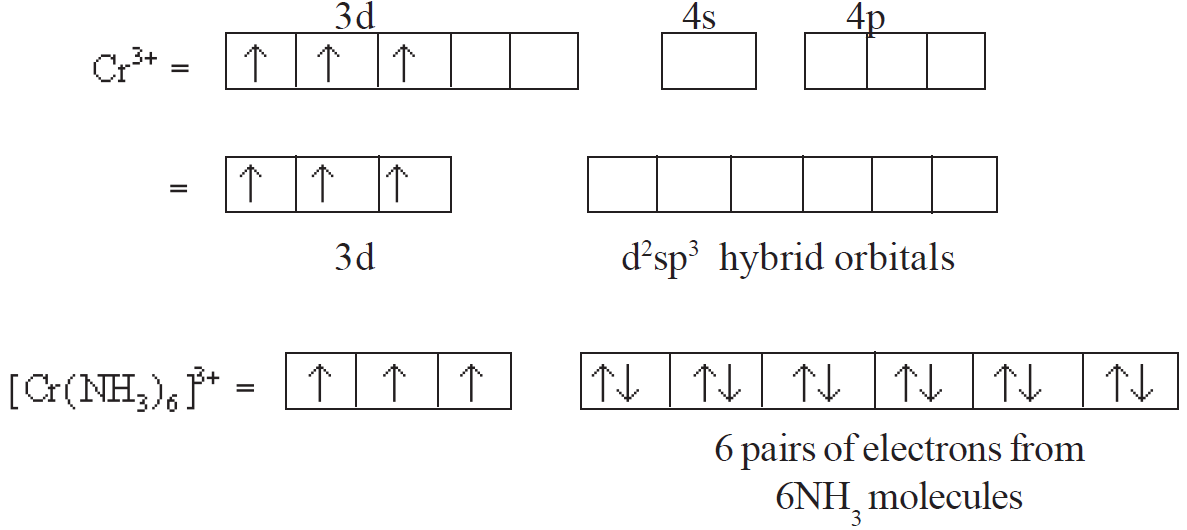
[Co(NH2)6]3+ Octahedral Diamagnetic d2sp3
[Cr(NH3)6]3+ Octahedral Paramagnetic d2sp3
[Ni(CO)4] Tetrahedral Diamagnetic sp3
View full question & answer
Question 133 Marks
Describe for any two of the following complex ions, the type of hybridization, shape and magnetic property:
  1. [Fe(H2O6)]2+
  2. [Co(NH3)6]3+
  3. [NiCl4]2-
(At. Nos. Fe = 26, Co = 27, Ni = 28).
View full question & answer
Question 143 Marks
  1. Define crystal field splitting energy. On the basis of crystal field theory, write the electronic configuration for d4 ion if $\triangle_0>\text{P}.$
  2. Write the hybridization and magnetic character of [CoF6]3–. (At. no. of Co = 27)
Answer
  1. It is the magnitude of difference in energy between the two sets of d orbital i.e. t2g and eg t42g eg0
  2. sp3d2 , paramagnetic
View full question & answer
Question 153 Marks
  1. Define crystal field splitting energy. On the basis of crystal field theory, write the electronic configuration for d4 ion if $\triangle_0>\text{P}$.
  2. [Ni(CN)4]2– is diamagnetic whereas [NiCl4]2– is paramagnetic. Give reason. (At. no. of Ni = 28)
Answer
  1. It is the magnitude of difference in energy between the two sets of d orbital i.e. t2g and eg t42g eg0
  2. In [Ni(CN)4]2-, CN- is a strong field ligand and pairing takes place whereas in [NiCl4]2-, due to the presence of Cl-, a weak field ligand no pairing occurs / diagrammatic representation.
View full question & answer
Question 163 Marks
  1. Define crystal field splitting energy. On the basis of crystal field theory, write the electronic configuration for d4 ion if $\triangle_0$< P.
  2. [Ni(CN)4]2– is colourless whereas [Ni(H2O)6]2+ is green. Why? (At. no. of Ni = 28)
Answer
  1. It is the magnitude of difference in energy between the two sets of d orbital i.e. t2g and eg t32g eg1.
  2. In [Ni(H2O)6]2+, Ni+2(3d8) has two unpaired electrons which do not pair up in the presence of weak field ligand H2O.
View full question & answer
Question 173 Marks
  1. For the complex [Fe(CO)5], write the hybridization, magnetic character and spin of the complex. (At. number : Fe = 26)
  2. Define crystal field splitting energy.
Answer
  1. dsp3, Diamagnetic, low spin.
  2. The energy used to split degenerate d-orbitals due to the presence of ligands in a definite geometry is called crystal field splitting energy.
View full question & answer
Question 183 Marks
  1. What type of isomerism is shown by the complex [Co(en)3]Cl3?
  2. Write the hybridisation and magnetic character of [Co(C2O4)3]3.

(At. no. of Co = 27)

  1. Write IUPAC name of the following Complex [Cr(NH3)3Cl3]
Answer
  1. Optical isomerism
  2. d2sp3, diamagnetic
  3. Triamminetrichloridochromium (III)
View full question & answer
Question 193 Marks
  1. For the complex [Fe(CN)6]3–, write the hybridization type, magnetic character and spin nature of the complex.

(At. number: Fe=26).

  1. Draw one of the geometrical isomers of the complex [Pt(en)2Cl2]2+ which is optically active.
View full question & answer
Question 203 Marks
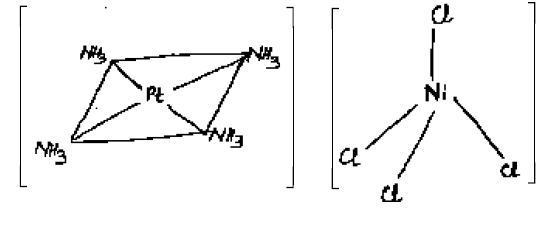
  1. What type of isomerism is shown by the complex [Co(NH3)6] [Cr(CN)6]?
  2. Why a solution of [Ni(H2O)6]2+ is green while a solution of [Ni(CN)4]2– is colourless?(At. no. of Ni = 28)
  3. Write the IUPAC name of the following complex: [Co(NH3)5(CO3)]Cl.
Answer
  1. Coordination isomerism.
  2. Unpaired electrons in [Ni(H2O)6]2+ / d-d transition.
  3. Pentaamminecarbonatocobalt (III) Chloride.
View full question & answer
Question 213 Marks
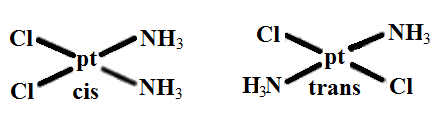
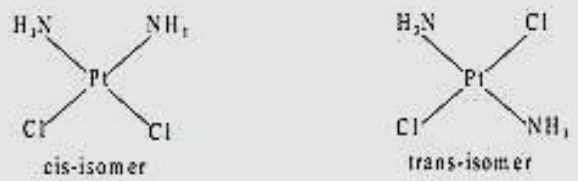
  1. Draw the geometrical isomers of complex [Pt(NH3)2Cl2].
  2. On the basis of crystal field theory, write the electronic configuration for d4 ion if $\Delta$0< P.
  3. Write the hybridization and magnetic behaviour of the complex [Ni(CO)4].

(At. no. of Ni = 28)

View full question & answer
Question 223 Marks
Write the IUPAC names of the following coordination compounds:
  1. [Cr(NH3)3cl3]
  2. K3[Fe(CN)6]
  3. [CoBr2(em)2]+, (en= ethylenediamine)
Answer
  1. Triamminetrichloridochromium(III).
  2. Potassium hexacynoferrate(III).
  3. Dibromidobis-(ethane-1,2-diamine)cobalt(III)/Dibromidobis-(ethylenediamine)cobalt(III).
View full question & answer
Question 233 Marks
Complete the following chemical equations:
  1. Cr2O72- + 6 Fe2++ 14H+
  2. 2CrO2-+ 2H+
  3. 2MnO-+ 5C2O42- + 16H+
Answer
  1. Cr2O72- + 6Fe2+ + 14H+  → 2Cr3+ + 6Fe3+ + 7H2O
  2. 2CrO42- + 2H+ → Cr2O72- + H2O
  3. 2MnO4- + 5C2O42- + 16H+ → 2Mn2+ + 10CO2 + 8H2O
View full question & answer
Question 243 Marks
Give the formula of each of the following coordination entities:

  1. Co3+ ion is bound to one Cl, one NH3 molecule and two bidentate ethylenediamine (en) molecules.
  2. Ni2+ ion is bound to two water molecules and two oxalate ions.
Write the name and magnetic behaviour of each of the above coordination entities.

(At. nos. Co = 27, Ni = 28).

Answer
  1. [Co(en)2 (NH3)Cl]2+: Amminechloridobis-(ethane-1,2-diamine) cobalt(III),

Diamagnetic.

  1. [Ni(C2O4)2(H2O)2]–2: Diaquadioxalatonickelate(II),

Paramagnetic.

View full question & answer
Question 253 Marks
Write the name, stereochemistry and magnetic behaviour of the following:
(At. nos. Mn = 25, Co = 27, Ni = 28)
  1. K4[Mn(CN)6].
  2. [Co(NH3)5Cl]Cl2.
  3. K2[Ni(CN)4].
Answer
  1. K4[Mn(CN)2]: Potassium hexacyanomanganate (II),Octahedral/paramagnetic.
  2. [Co(NH3)5Cl]Cl2: Pentaamminechloridocobalt(III) chloride, octahederal/diamagnetic.
  3. K2[Ni(CN)4): Potassium tetracyanonickelate(II), square planar/diamagnetic.
View full question & answer
Question 263 Marks
For the complex [Fe(en)2Cl2]Cl, (en = ethylene diamine), identify.
  1. The oxidation number of iron,
  2. The hybrid orbitals and the shape of the complex,
  3. The magnetic behaviour of the complex,
  4. The number of geometrical isomers,
  5. Whether there is an optical isomer also, And
  6. Name of the complex. (At. no. of Fe = 26).
Answer
  1. Oxidation number: +3.
  2. d2sp3 or octahedral.
  3. Paramagnetic.
  4. Two/Cis & trans isomers.
  5. Yes.
  6. Dichlorobis (ethylenediamine) iron (III) chloride or Dichlorobis (ethane-1,2 diamine) iron (III) chloride or Dichloridobis (ethane-1,2 diamine) iron  (III) chloride.
View full question & answer
Question 273 Marks
  1. What is a ligand? Give an example of a bidentate ligand.
  2. Explain as to how the two complexes of nickel, [Ni(CN)4]2– and Ni(CO)4, have different structures but do not differ in their magnetic behaviour. (Ni = 28).
Answer
  1. Ligand: The ions or molecules bound to the central atom/ ion in the coordination entity are called ligands.

ex. of bidentate ligand- ethane-1,2-diamine or oxalate ion.

  1. [Ni(CN)4]2-, dsp2 hybridization-
  • Structure square planar.
  • Diamagnetic in nature as its 3d-orbitals contain paired electrons.

Ni(CO)4, sp3 hybridization-

  • Structure tetrahedral.
  • Diamagnetic in nature as its 3d-orbitals contain paired electrons.
View full question & answer
Question 303 Marks
  1. Write the formula of the following coordination compound:

Iron(III) hexacyanoferrate(II)

  1. What type of isomerism is exhibited by the complex [Co(NH3)5Cl]SO4?
  2. Write the hybridisation and number of unpaired electrons in the complex [CoF6]3-. (Atomic No. of Co = 27)
Answer
  1. Fe4[Fe(CN)6]3
  2. Ionisation isomerism [Co(NH3)5Cl]SO4
  3. [CoF6]3-:

Hybridisation: sp3d2

No. of unpaired electrons: 4.

View full question & answer
Question 313 Marks
Answer
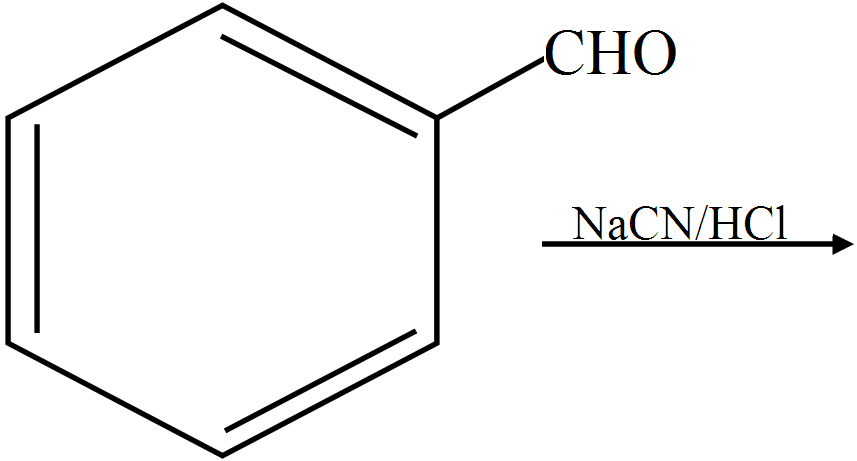
  1. Reaction of benzaldehyde with NaCN/ HCl gives cyanohydrin.

  1. Treatment of acyl chlorides with dialkylcadmium gives a ketone.

$2\text{CH}_3-\text{CO}-\text{Cl}+(\text{C}_6\text{H}_5-\text{CH})\xrightarrow{\ \ \ \ \ \ \ \ \ \ \ }2\text{CH}_3-\text{CO}-\text{CH}_2-\text{C}_6\text{H}_5+\text{CdCl}_2\\\ \ \ \ \ \ \ \ \ \ \ \ \ \ \ \ \ \ \ \ \ \ \ \ \ \ \ \ \ \ \ \ \ \ \ \ \ \ \ \ \ \ \ \ \ \ \ \ \ \ \ \ \ \ \ \ \ \ \ \ \ \ \ \ \ \ \ \ \ ^{ \text{1}-\text{Phenylpropan}-2-\text{One}}$

  1. Carboxylic acid having α-hydrogen are halogenated at α-position on treatment with Br2 in presence of red phosphorous to give α -halocarboxylic acids. This is Hell Volhard-Zelinsky reaction.

$\ \ \ \ \ \ \ \ \ \ \ \ \text{CH}_3\ \ \ \ \ \ \ \ \ \ \ \ \ \ \ \ \ \ \ \ \ \ \ \ \ \ \ \ \ \ \ \ \ \ \ \ \ \ \ \ \ \ \ \ \ \ \ \ \ \ \ \ \ \ \ \ \ \ \text{CH}_3\ \ \\ \ \ \ \ \ \ \ \ \ \ \ \ \ \ \ \ |\ \ \ \ \ \ \ \ \ \ \ \ \ \ \ \ \ \ \ \ \ \ \ \ \ \ \ \ \ \ \ \ \ \ \ \ \ \ \ \ \ \ \ \ \ \ \ \ \ \ \ \ \ \ \ \ \ \ \ \ \ \ \ |\\\text{CH}_3-\text{CH}-\text{COOH}\xrightarrow[(\text{ii})\ \text{H}_2\text{O}]{\ \ \ \ \ \ {(\text{i})\ \text{Br}_2/ \text{ Red P}_4} \ \ \ \ \ \ \ }\text{CH}_3-\text{C}-\text{COOH}\\ \ \ \ \ \ \ \ \ \ \ \ \ \ \ \ \ \ \ \ \ \ \ \ \ \ \ \ \ \ \ \ \ \ \ \ \ \ \ \ \ \ \ \ \ \ \ \ \ \ \ \ \ \ \ \ \ \ \ \ \ \ \ \ \ \ \ \ \ \ \ \ \ \ \ \ \ \ \ \ \ \ |\\ \ \ \ \ \ \ \ \ \ \ \ \ \ \ \ \ \ \ \ \ \ \ \ \ \ \ \ \ \ \ \ \ \ \ \ \ \ \ \ \ \ \ \ \ \ \ \ \ \ \ \ \ \ \ \ \ \ \ \ \ \ \ \ \ \ \ \ \ \ \ \ \ \ \ \ \ \ \ \ \text{Br}$

View full question & answer
Question 323 Marks
Write chemical equations for the following reactions:
  1. Propanone is treated with dilute Ba(OH)2.
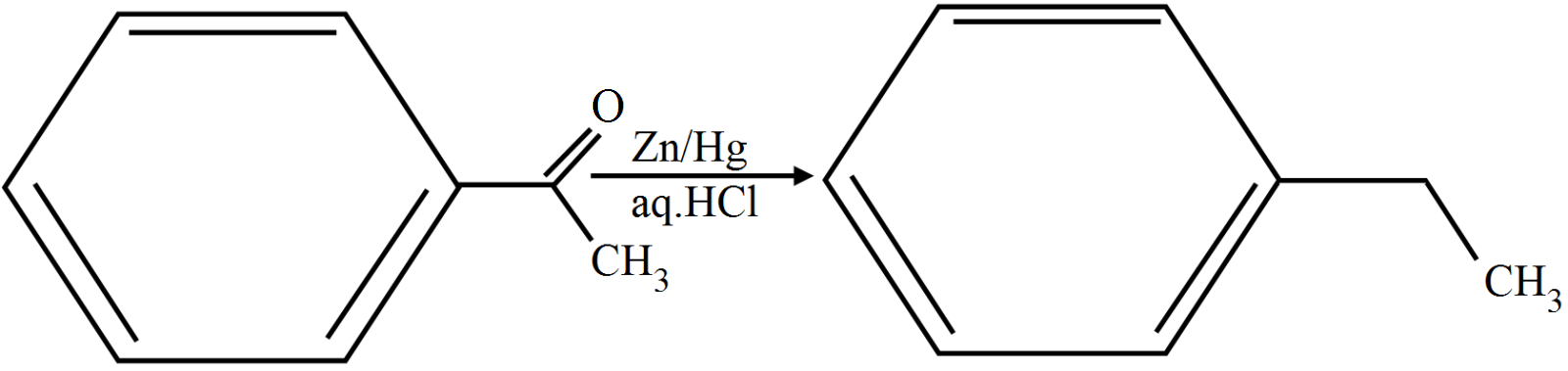
  2. Acetophenone is treated with Zn(Hg)/ Conc. HCl
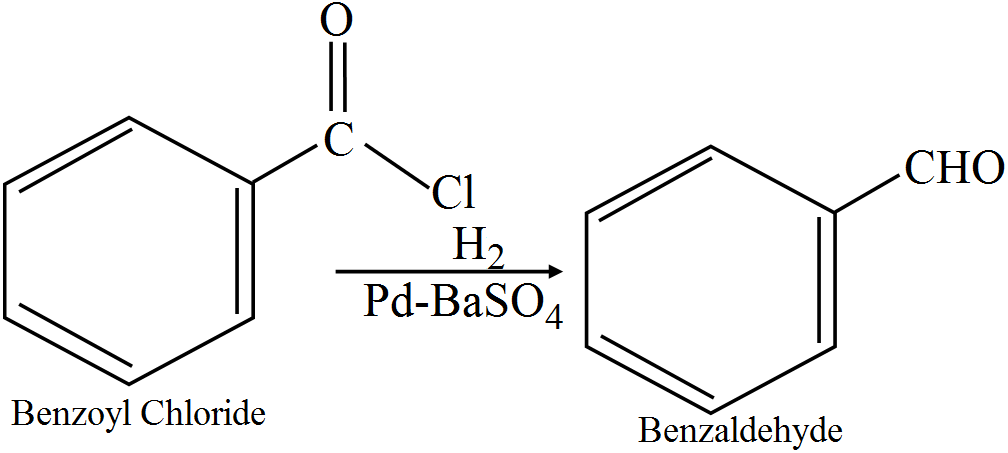
  3. Benzoyl chloride is hydrogenated in presence of Pd/ BaSO4.
View full question & answer
Question 333 Marks
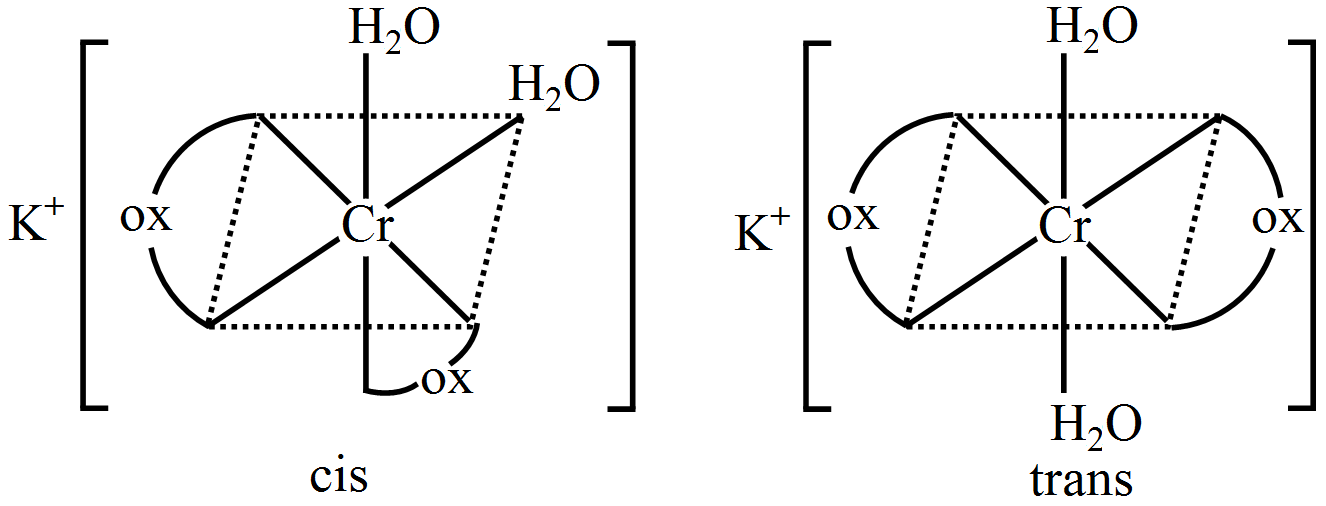
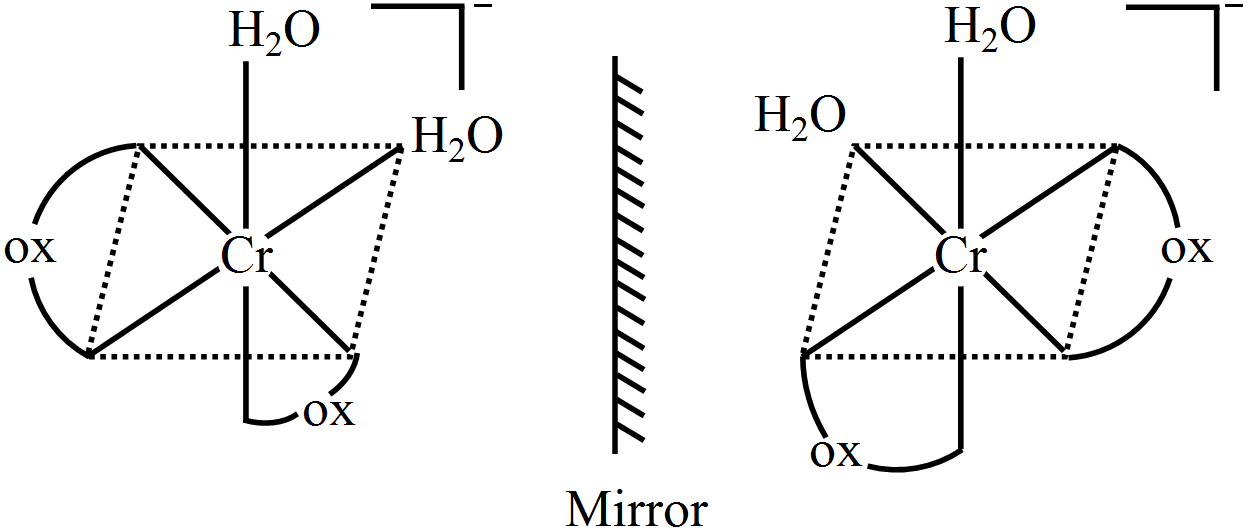
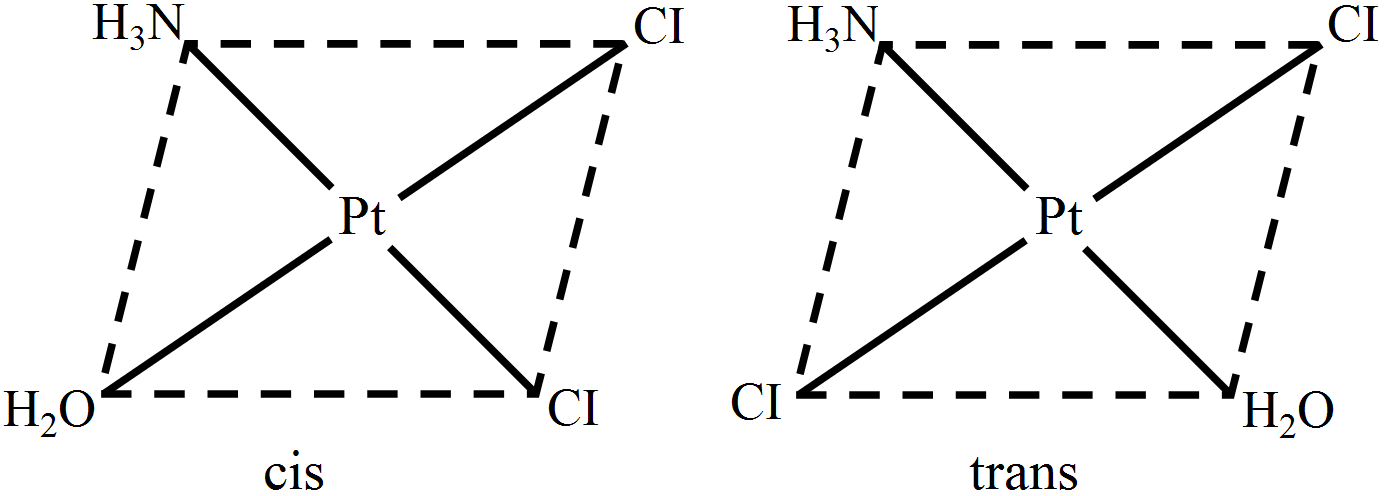
Indicate the types of isomerism exhibited by the following complexes and draw the structures for these isomers:
  1. [Pt(NH3)(H2O)Cl2].
  2. K[Cr(H2O)2(C2O4)2].
Answer
  1. Geometrical isomers can exist.
  2. Both geometrical (cis–trans) and optical isomers for cis can exist.
  1. Geometrical isomers of K[Cr(H2O)2(C2O4)2]

  1. Optical isomers (d- and l-) of cis-K[Cr(H2O)2(C2O4)2]
View full question & answer
Question 343 Marks
List various types of isomerism possible for coordination compounds, giving an example of each.
Answer
Coordination compounds exhibit stereo isomerism and structural isomerism. Two types of stereoisomerism and their examples are as follows.
  1. Geometrical isomerism.

  1. Optical isomerism.

Four types of structural isomerism are as follows:

  1. Linkage isomerism [Co(NH3)5NO2]Cl2 and [Co(NH3)5 ONO] Cl2
  2. Coordination isomerism [Co(NH3)6][Cr(CN)6] and [Cr(NH3)6][Co(CN)6]
  3. Ionisation isomerism [Co(NH3)5SO4]Br and [Co(NH3)5Br]SO4
  4. Solvate or hydrate isomerism [Cr(H2O)6] Cl2 and [Cr(H2O)5Cl]Cl.H2O
View full question & answer
Question 363 Marks
Write IUPAC names of the following coordination compounds:
  1. K3[Fe(C2O4)3]
  2. K2[PdCl4]
Answer
  1. Potassium trioxalatoferrate(III). 

  2. Potassium tetrachloridopalladate(II).

View full question & answer
Question 383 Marks
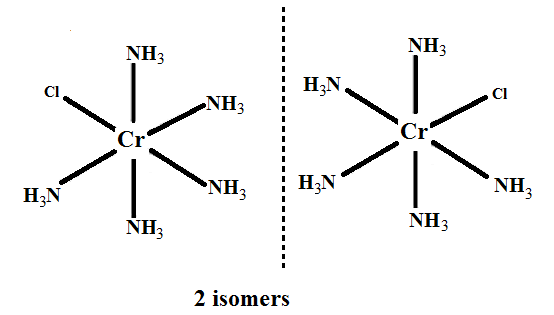
Write down the IUPAC name for the following complex and indicate the oxidation state, electronic configuration and coordination number. Also give stereochemistry and magnetic moment of the complex:
K4[Mn(CN)6]
Answer
K4[Mn(CN)6]

IUPAC name: Potassium hexacyanomanganate(II).

Oxidation state of manganate = +2

Electronic configuration of d5+ : t2g5

Coordination number = 6

Shape: : octahedral.

Stereochemistry: optically inactive

Magnetic moment:

µ$=\sqrt{\text{n}(\text{n}+2)}$

$=\sqrt{1(1+2)}$

$=\sqrt{3}$

$=1.732$
View full question & answer
Question 393 Marks
Why do compounds having similar geometry have different magnetic moment?
Answer
The compounds having similar geometry may have different number of unpaired electrons due to the presence of weak and strong field ligands in complexes. If CFSE is high, the complex will show low value of magnetic moment and if CFSE is low, the complex will show high value of magnetic moment. For example, the [CoF6]3 is paramagnetic moment. For example, the [COF6]3 is paramagnetic but [Co(NH3)6]3+ is diamagnetic.
View full question & answer
Question 403 Marks
Write down the IUPAC name for the following complex and indicate the oxidation state, electronic configuration and coordination number. Also give stereochemistry and magnetic moment of the complex:
Cs[FeCl4]
Answer
Cs[FeCl4]
IUPAC name: Caesium tetrachloroferrate (III).
Oxidation state of Fe = +3
Electronic configuration of d6 = egt2g3
Coordination number = 4
Shape: : tetrahedral.
Stereochemistry: optically inactive
Magnetic moment:
µ$=\sqrt{\text{n}(\text{n}+2)}$
$=\sqrt{5(5+2)}$
$=\sqrt{35}\text{~}6\text{BM}$
View full question & answer
Question 413 Marks
Write down the IUPAC name for the following complex and indicate the oxidation state, electronic configuration and coordination number. Also give stereochemistry and magnetic moment of the complex:
[Co(NH3)5Cl-]Cl2
Answer
[Co(NH3)5Cl]Cl2

IUPAC name: Pentaamminechloridocobalt(III) chloride

Oxidation state of Co = +3

Coordination number = 6

Shape: octahedral.

Electronic configuration: d6 : t2g6.

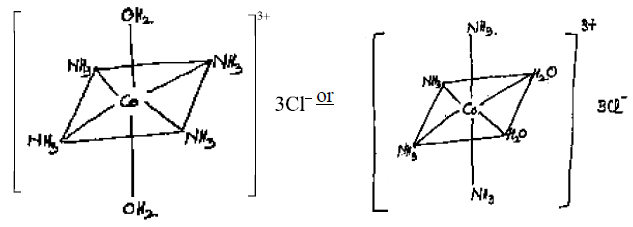
Stereochemistry:

Magnetic Moment = 0

View full question & answer
Question 423 Marks
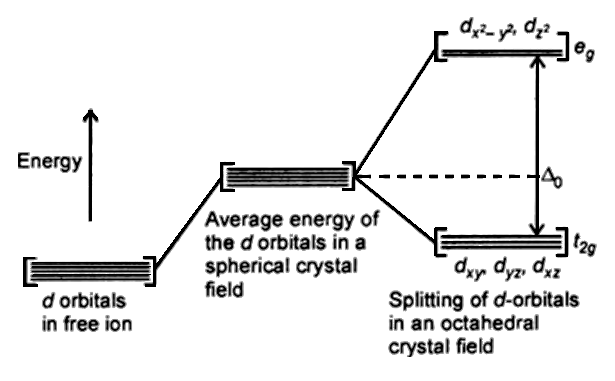
Draw figure to show the splitting of d orbitals in an octahedral crystal field.
View full question & answer
Question 433 Marks
What is meant by chelate effect?
Answer
When a bidentate or polydentate ligand is bonded through two or more donor sites to a metal ion and forms a ring structure then it is said to be chelating ligand. Chelating ligands form more stable complexes than monodentate analogs. This is called chelating effect.
View full question & answer
Question 443 Marks
Explain with two examples each of the following: coordination entity, ligand, coordination number, coordination polyhedron, homoleptic and heteroleptic.
Answer
Coordination entity: It constitutes of a central atom/ion bonded to fixed number of ions or molecules by coordinate bonds e.g. [COCl3(NH3)3], [Ni (C0)4] etc.
Ligand: The ions/molecules bound to central atom/ion in coordination entity are called ligands. Ligands in above examples are CL, NH3, CO
Coordination number: This is the number of bond formed by central atom/ion with ligands.
Coordination polyhedron: Spatial arrangement of ligands defining the shape of complex. In above cases Co and Ni polyhedron are octahedral and tetrahedral in [CoCl3 (NH3)3] and [Ni(C0)4] respectively.
Homoleptic: Metal is bound to only one kind of ligands eg Ni in [Ni(C0)4]
Heteroletric: Metal is bound to more than one kind of ligandseg Coin [CoCl3(NH3)3]
View full question & answer
Question 453 Marks
Square complexes of MX2A2 type with coordination number of 4 exhibit geometrical isomerism whereas tetrahedral complexes with similar composition do not. Why?
Answer
Square planar complexes of MA2X2 type with coordination number 4 exhibit geometrical isomerism because any of the two ligand may be arranged adjacent to each other in a cis form or opposite to each other in a trans- form. Tetrahedral complexes of this type do not show geometrical isomerism because the relative positions of the monodentate ligands attached to the central metal atom are same with respect to each other.
View full question & answer
Question 463 Marks
An octahedral complex is prepared by mixing CoCl3 and NH3 in the molar ratio 1 : 4, 0.1m solution of this complex was found to freeze at 0.372°C. What is the formula of the complex? Given that molal depression constant (Kf) for water = 1.86°C/m.
Answer
Theoretical value of
$\triangle\text{T}_\text{f}=\text{K}_\text{f}\times\text{m}=1.86^\circ\text{C/m}=0.1\text{m}=0.186^\circ\text{C}$
Observed value of $\triangle\text{T} _\text{f }=0.372^\circ\text{C}$.
As observed $\triangle\text{T}_\text{f}$ is twice the theoretical value, this shows that each molecule of the complex dissociate to form two ions. This can be possible only if the formula of the complex is [Co(NH3)4Cl2]Cl.
View full question & answer
Question 473 Marks
The $\pi$-complexes are known for transition metals only. Why?
Answer
Transition metals have vacant d-orbitals in their atoms or ions into which the electron pairs can be donated by ligands containing $\pi$-electrons, e.g., C6H6, CH2=CH2, etc. Thus, $\text{d}$$\pi$ – $\text{p}\pi$ bonding is possible.
View full question & answer
Question 483 Marks
What is spectrochemical series? Explain the difference between a weak field ligand and a strong field ligand.
Answer
Spectro-chemical series is a series in which the ligands have been arranged in order of increasing magnitude of splitting they produce. The order is,
I– < Br < SCN < Cl– < S2– < F  < OH < C2O42– < H2O < NCS– < edta4– < NH3 < en < CN < CO
The ligand present on the R.H.S of the series are strong field ligand while L.H.S are weak field ligand. Also, strong field ligand cause higher splitting in the d- orbitals than weak field ligand.
  Weak field ligand Strong field ligand
1. They are formed when the crystal field stabilisation energy (Δ0) in octahedral complexes is less than the energy required for an electron pairing in a single orbital (p). They are formed when the crystal field stabilisation energy (Δ0) is greater than the p.
2. They are also called high spin complexes. They are called low spin complexes.
3. They are mostly paramagnetic in nature complex. They are mostly diamagnetic or less paramagnetic than weak field.
View full question & answer
Question 493 Marks
Write the IUPAC name of the ionisation isomer of the coordination compound [Co(NH3)5Br]SO4. Give one chemical test to distinguish between the two compounds.
Answer
Ionisation isomer is [Co(NH3)5SO4]Br.The IUPAC name is Pentaamminesulphatocobalt(III)bromide. The isomer [Co(NH3)5Br]SO4 will give SO2−4 ions in the solution which gives white precipitate with BaCl2solution. The isomer [Co(NH3)5SO4]Br will give Br– ions in the solution which gives yellow precipitate with AgNO3 solution.
View full question & answer
Question 503 Marks
Write down the IUPAC name for the following complex and indicate the oxidation state, electronic configuration and coordination number. Also give stereochemistry and magnetic moment of the complex:
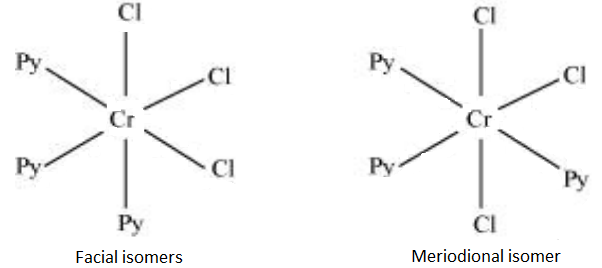
CrCl3(py)3
Answer
CrCl3(py)3
IUPAC name: Trichloridotripyridinechromium (III).
Oxidation state of chromium = +3
Electronic configuration for d3 = t2g3
Coordination number = 6
Shape: octahedral.
Stereochemistry:

Both isomers are optically active. Therefore, a total of 4 isomers exist.
Magnetic moment, µ$=\sqrt{\text{n}(\text{n}+2)}$
$=\sqrt{3(3+2)}$
$=\sqrt{15}$
$=∼4\text{BM}$
View full question & answer
3 Marks Question - Chemistry STD 12 Science Questions - Vidyadip