At absolute zero, an exothermic reaction is always spontaneous but at temperatures above absolute zero, we have to consider both enthalpy and entropy before we can predict spontaneity. Why?
Question types
Solutions question types
396 questions across 7 question groups — pick any mix to generate a Chemistry paper with step-by-step answer keys.
396
Questions
7
Question groups
5
Question types
01
2 Marks Questions
61 Q→023 Marks Question
63 Q→031 Marks Question
51 Q→04Case study (4 Marks)
11 Q→05M.C.Q (1 Marks)
150 Q→06Assertion (A) & Reason (B) MCQ
24 Q→075 Marks Questions
36 Q→Sample Questions
Solutions questions
One sample from each question group in this chapter. Select any group above to see the full set with answer keys.
View full solution →
- Gas (A) is more soluble in water than Gas (B) at the same temperature. Which one of the two gases will have the higher value of KH (Henry's constant) and why?
- In non-ideal solution, what type of deviation shows the formation of maximum boiling azeotropes?
- Why are aquatic species more comfortable in cold water than in warm water?
- What happens when we place the blood cell in saline water solution (hypertonic solution)? Give reason.
State the following:
- Raoult's law in its general form in reference to solutions.
- Henry's law about partial pressure of a gas in a mixture.
Define the terms, ‘osmosis’ and ‘osmotic pressure’. What is the advantage of using osmotic pressure as compared to other colligative properties for the determination of molar masses of solutes in solutions?
- Urea forms an ideal solution in water. Determine the vapour pressure of anaqueous solution containing 10% by mass of urea at 40°C. (Vapour pressure of water at 40°C = 55.3 mm of Hg)
- Why is freezing point depression of 0.1 M sodium chloride solution nearly twice that of 0.1 M glucose solution?
Calculate the boiling point of solution when 4 g of MgSO4 (M = 120 g mol-1) was dissolved in 100 g of water, assuming MgSO4 undergoes complete ionization.
(Kb for water=0.52 K kg mol-1).
(Kb for water=0.52 K kg mol-1).
Vapour pressure of water at 20oC is 17.5 mm Hg. Calculate the vapour pressure of water at 20 oC when 15 g of glucose (Molar mass =180 g mol-1) is dissolved in 150 g of water.
A solution prepared by dissolving 8.95mg of a gene fragment in 35.0mL. of water has an osmotic pressure of 0.335 torr at 25°C. Assuming that the gene fragment is a non-electrolyte, calculate its molar mass.
What mass of NaCl (molar mass = 58.5 g mol–1) must be dissolved in 65 g of water to lower the freezing point by 7.50oC? The freezing point depression constant, Kf, for water is 1.86 K kg mol–1. Assume van’t Hoff factor for NaCl is 1.87.
Define ‘mole fraction’ of a substance in a solution.
State the condition resulting in reverse osmosis.
What type of intermolecular attractive interaction exists in the pair of methanol and acetone?
State Henry's law. What is the effect of temperature on the solubility of a gas in a liquid?
Some liquids on mixing form 'azeotropes'. What are 'azeotropes'?
Read the passage given below and answer the following questions
Few colligative properties are:
The following questions are multiple choice questions. Choose the most appropriate answer:
Few colligative properties are:
- Relative lowering of vapour pressure: depends only on molar concentration of solute (mole fraction) and independent of its nature.
- Depression in freezing point: it is proportional to the molal concentration of solution.
- Elevation of boiling point: it is proportional to the molal concentration of solute.
- Osmotic pressure: it is proportional to the molar concentration of solute
The following questions are multiple choice questions. Choose the most appropriate answer:
- Molality of the given solution is.
- 0.0052m
- 0.0036m
- 0.0006m
- 1.29m
- Boiling point for the solution will be.
- 373.05K
- 373.15K
- 373.02K
- 373.02K
- The depression in freezing point of solution will be.
- 0.0187K
- 0.035K
- 0.082K
- 0.067K
- Mole fraction of glucose in the given solution is.
- 6.28 × 10⁻⁵
- 6.28 × 10⁻⁴
- 0.00625
- 0.00028
- If same amount of sucrose (C12 H22 O11) is taken instead of glucose, then.
- Elevation in boiling point will be higher.
- Depression in freezing point will be higher.
- Depression in freezing point will be lower.
- Both (a) and (b).
Read the passage given below and answer the following questions:
The concentration of a solute is very important in studying chemical reactions because it determines how often molecules collide in solution and thus indirectly determine the rate of reactions and the conditions at equilibrium. There are several ways to express the amount of solute present in a solution. The concentration of a solution is a measure of the amount of solute that has been dissolved in a given amount of solvent or solution. Concentration can be expressed in terms of molarity, molality, parts per million, mass percentage, volume percentage, etc.
The following questions are multiple choice questions. Choose the most appropriate answer:
View full solution →The concentration of a solute is very important in studying chemical reactions because it determines how often molecules collide in solution and thus indirectly determine the rate of reactions and the conditions at equilibrium. There are several ways to express the amount of solute present in a solution. The concentration of a solution is a measure of the amount of solute that has been dissolved in a given amount of solvent or solution. Concentration can be expressed in terms of molarity, molality, parts per million, mass percentage, volume percentage, etc.
The following questions are multiple choice questions. Choose the most appropriate answer:
- A solution is prepared using aqueous Kl which is turned out to be 20% w/w Density of Kl is 1.202 g/mL the molality of the given solution and mole fraction of solute are respectively.
- 1.95m, 0.120
- 1.5m, 0.0263
- 2.5m, 0.0569
- 3.0m, 0.0352
- The molarity (in mol L-1) of the given solution will be.
- 1.56
- 1.89
- 0.263
- 1.44
- Which of the following is correct relationship between mole fraction and molality?
- $\text{x}_2=\frac{\text{mM}_1}{1+\text{mM}_1}$
- $\text{x}_2=\frac{\text{mM}_1}{1-\text{mM}_1}$
- $\text{x}_2=\frac{1+\text{mM}_1}{\text{mM}_1}$
- $\text{x}_2=\frac{1-\text{mM}_1}{\text{mM}_1}$
- Which of the following is temperature dependent?
- Molarity
- Molality
- Mole fraction
- Mass percentage
- Which of the following is true for an aqueous solution of the solute in terms of concentration?
- 1M = 1m
- 1M > 1m
- 1M < 1m
- Cannot be predicted
Read the passage given below and answer the following questions: An ideal solution may be defined as the solution which obeys Raoult's law exactly over the entire range of concentration. The solutions for which vapour pressure is either higher or lower than that predicted by Raoult's law are called non-ideal solutions.Non-ideal solutions can show either positive or negative deviations from Raoult's law depending on whether the A-B interactions in solution are stronger or weaker than A - A and B - B interactions. The following questions are multiple choice questions. Choose the most appropriate answer:
View full solution →- Which of the following solutions is/are ideal solution(s)?
- Bromoethane and iodoethane.
- Acetone and chloroform
- Benzene and acetone
- n-heptane and n-hexane
- Only I
- I and II
- II and III
- I and Iv
- For which of the following solutions $\Delta\text{H}_{\text{mix}}$ and $\Delta\text{V}_{\text{mix}}$ is negative?
- Acetone and aniline
- Ethyl alcohol and cyclohexane
- Acetone and CS2
- Benzene and toluene
- Which of the following is not true for positive deviations?
- The A-B interactions in solution are weaker than the A - A and B - B interactions.
- $\text{P}_\text{A}<\text{P}\mathring{\text{A}}\ \text{x}_\text{A}$ and $\text{P}_\text{B}<\text{P}\mathring{\text{B}}\ \text{x}_\text{B}$
- Carbon tetrachloride and chloroform mixture is an example of positive deviations.
- All of these.
- For water and nitric acid mixture, which of the given graph is correct?
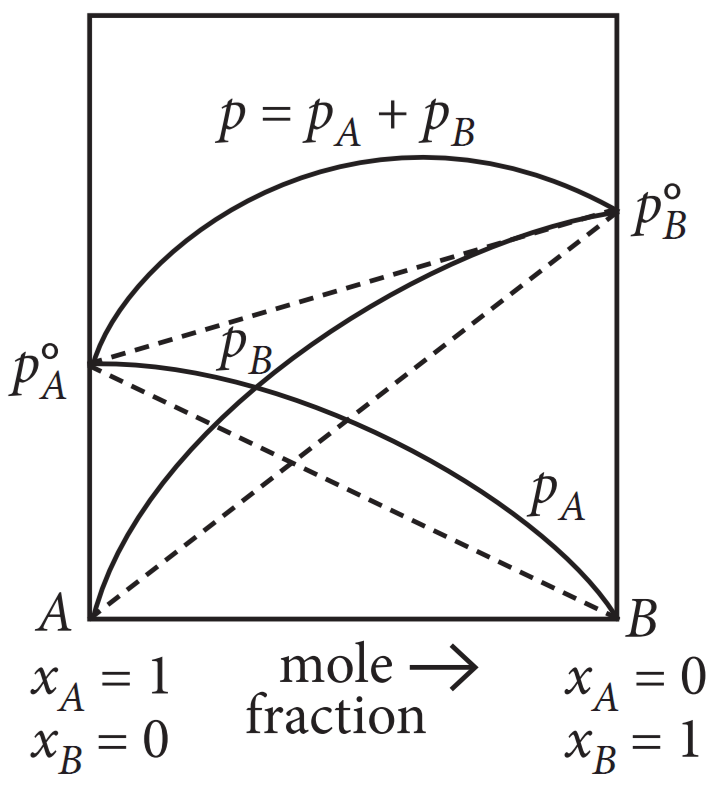
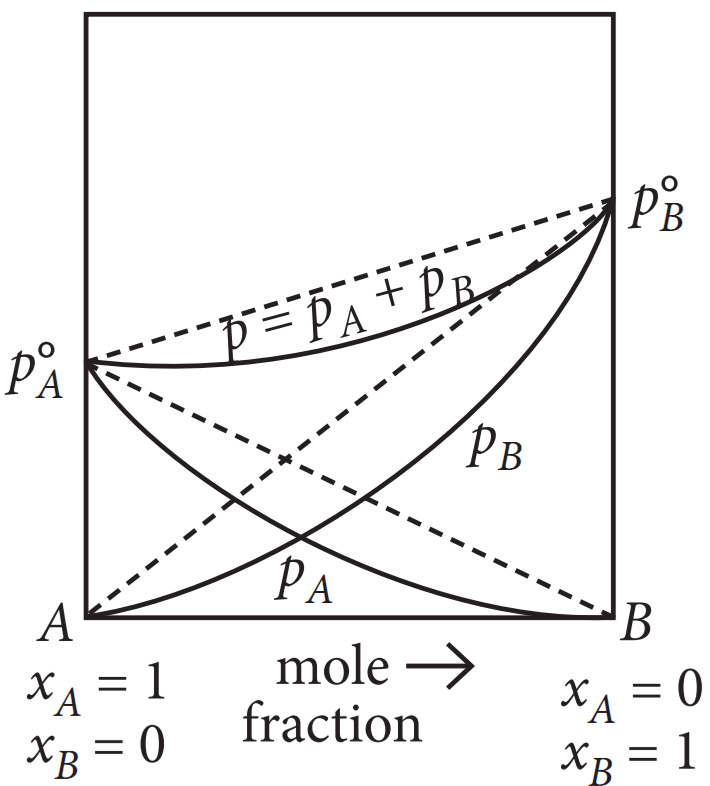
- Both of these
- None of these
- Water-HCI mixture.
- Shows positive deviations.
- Forms minimum boiling azeotrope.
- Shows negative deviations.
- Forms maximum boiling azeotrope.
- I and II
- I and III
- I and IV
- III and IV
Read the passage given below and answer the following questions: According to Raoult's law, the partial pressure of two components of the solution maybe given as: $\text{P}_\text{A}=\stackrel{{0}}{\hbox{PA }}\text{x}_\text{A}$ and $\text{P}_\text{B}=\stackrel{{0}}{\hbox{PB }}\text{x}_\text{B}$ For an ideal solution (obeys Raoult's law always) $\Delta\text{H}_\text{mix}=0,\Delta\text{mix}=0$ All solutions do not obey Raoults law over entire range of concentration. These are known as non-ideal solutions. For non-ideal solutions, $\text{P}_\text{A}\not=\stackrel{{0}}{\hbox{PA }}\text{x}_\text{A}$ or $\text{P}_\text{B}\not=\stackrel{{0}}{\hbox{PB }}\text{x}_\text{B}$ Positive deviation $\Rightarrow\text{P}_\text{A}>\stackrel{{0}}{\hbox{PA }}\text{x}_\text{A}$ and $\text{P}_\text{B}>\stackrel{{0}}{\hbox{PB }}\text{x}_\text{B}$ Negative deviation $\text{P}_\text{A}<\stackrel{{0}}{\hbox{PA }}\text{x}_\text{A}$ and $\text{P}_\text{B}\stackrel{{0}}{\hbox{PB }}\text{x}_\text{B}$ A statement of assertion followed by a statement ofreason is given. Choose the correct answer out of the following choices.
View full solution →- Assertion and reason both are correct statements and reason is correct explanation for assertion.
- Assertion and reason both are correct statements but reason is not correct explanation for assertion.
- Assertion is correct statement but reason is wrong statement.
- Assertion is wrong statement but reason is correct statement.
- Assertion: An ideal solution obeys Raoult's law.
Reason: In an ideal solution, solute-solute as well as solvent-solvent interactions are similar to solute-solvent interactions.
- Assertion: Acetone and aniline show negative deviations.
Reason: H-bonding between acetone and aniline is stronger than that between acetone-acetone and aniline-aniline.
- Assertion: Azeotropic mixtures are formed only by non-ideal solutions and they may have boiling points either greater than both the components or lesser than both the components.
Reason: The composition of the vapour phase is same as that of the liquid phase of an azeotropic mixture.
- Assertion: The solutions which show negative deviations from Raoult's law are called maximum boiling azeotropes.
Reason: 68% nitric acid and 32% water by mass fonn maximum boiling azeotrope.
- Assertion: $\Delta\text{H}_{\text{mix}}$ mix and $\Delta\text{V}_{\text{mix}}$ are positive for an ideal solution.
Reason: The interactions between the particles of the components of an ideal solution are almost identical as between particles in the liquids.
Read the passage given below and answer the following questions: Boiling point or freezing point of liquid solution would be affected by the dissolved solids in the liquid phase. A soluble solid in solution has the effect of raising its boiling point and depressing its freezing point. The addition of non-volatile substances to a solvent decreases the vapor pressure and the added solute particles affect the formation of pure solvent crystals. According to many researches the decrease in freezing point directly correlated to the concentration of solutes dissolved in the solvent. This phenomenon is expressed as freezing point depression and it is useful for several applications such as freeze concentration of liquid food and to find the molar mass of an unknown solute in the solution. Freeze concentration is a high quality liquid food concentration method where water is removed by forming ice crystals. This is done by cooling the liquid food below the freezing point of the solution. The freezing point depression is referred as a colligative property and it is proportional to the molar concentration of the solution (m), along with vapor pressure lowering, boiling point elevation, and osmotic pressure. These are physical characteristics of solutions that depend only on the identity of the solvent and the concentration of the solute. The characters are not depending on the solute’s identity.
- When a non volatile solid is added to pure water it will:
- boil above 100°C and freeze above 0°C
- boil below 100°C and freeze above 0°C
- boil above 100°C and freeze below 0°C
- boil below 100°C and freeze below 0°C
- Colligative properties are:
- dependent only on the concentration of the solute and independent of the solvent’s and solute’s identity.
- dependent only on the identity of the solute and the concentration of the solute and independent of the solvent's identity.
- dependent on the identity of the solvent and solute and thus on the concentration of the solute.
- dependent only on the identity of the solvent and the concentration of the solute and independent of the solute’s identity.
- Assume three samples of juices A, B and C have glucose as the only sugar present in them. The concentration of sample A, B and C are 0.1M, 5M and 0.2 M respectively. Freezing point will be highest for the fruit juice:
- A
- B
- C
- All have same freezing point
- Identify which of the following is a colligative property:
- freezing point
- boiling point
- osmotic pressure
- all of the above
Partial pressure of a solution component is directly proportional to its mole fraction. This is known as:
- AHenry’s law
- BRaoult’s law
- CDistribution law
- DOstawald’s dilution law
Which of the following statements is false?
- ATwo different solutions of sucrose of same molality prepared in different solvents will have the same depression in freezing point.
- BThe osmotic pressure of a solution is given by the equation $\pi=\text{CRT}$ (where C is the molarity of the solution).
- CDecreasing order of osmotic pressure for 0.01M aqueous solutions of barium chloride, potassium chloride, acetic acid and sucrose is BaCl2 > KCl > CH3COOH > sucrose.
- DAccording to Raoult's law, the vapour pressure exerted by a volatile component of a solution is directly proportional to its mole fraction in the solution.
The correct statement among the following is:
- ASmoke is carbon dispersed in air.
- BButter is water dispersed in fat.
- CGreater is the valency of ion more will be its coagulating power.
- DMore is the gold number of a lyophobic sot, more is protecting power.
Two beakers of capacity 500mL were taken. One of these beakers, labelled as “A”, was filled with 400mL water whereas the beaker labelled “B” was filled with 400mL of 2M solution of NaCl. At the same temperature both the beakers were placed in closed containers of same material and same capacity as shown in. At a given temperature, which of the following statement is correct about the vapour pressure of pure water and that of NaCl solution.
- Avapour pressure in container (A) is more than that in container (B).
- Bvapour pressure in container (A) is less than that in container (B).
- Cvapour pressure is equal in both the containers.
- Dvapour pressure in container (B) is twice the vapour pressure in container (A).
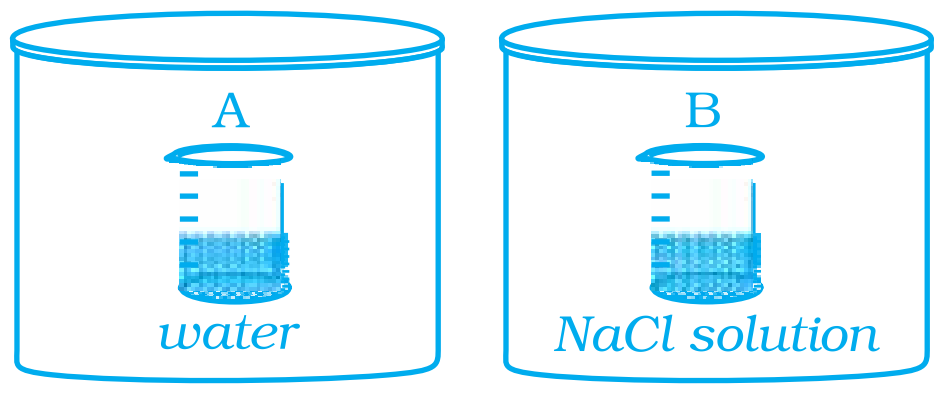
The rate of vapourisation of water depends upon:
- ATemperature
- BSurface area of container
- Ckinetic energy of liquid molecules
- DAll of the above
In these questions, a statement of assertion followed by a statement of reason is given. Choose the correct answer out of the following choices.
Reason: Solution containing one mole of solute in 1000g solvent is called one molal solution.
- Assertion and reason both are correct statements and reason is correct explanation for assertion.
- Assertion and reason both are correct statements but reason is not correct explanation for assertion.
- Assertion is correct statement but reason is wrong statement.
- Assertion is wrong statement but reason is correct statement.
Reason: Solution containing one mole of solute in 1000g solvent is called one molal solution.
In these questions, a statement of assertion followed by a statement of reason is given. Choose the correct answer out of the following choices.
Reason: The volume of a solution changes with change in temperature.
- Assertion and reason both are correct statements but the reason is the correct explanation for assertion.
- Assertion and reason both are correct statements but the reason is not a correct explanation for assertion.
- Assertion is a correct statement but the reason is a wrong statement.
- Assertion is a wrong statement but the reason is correct
Reason: The volume of a solution changes with change in temperature.
In these questions, a statement of assertion followed by a statement of reason is given. Choose the correct answer out of the following choices.
Reason: Sodium chloride depresses the freezing point of water.
- Assertion and reason both are correct statements and reason is correct explanation for assertion.
- Assertion and reason both are correct statements but reason is not correct explanation for assertion.
- Assertion is correct statement but reason is wrong statement.
- Assertion is wrong statement but reason is correct statement.
Reason: Sodium chloride depresses the freezing point of water.
In these questions, a statement of assertion followed by a statement of reason is given. Choose the correct answer out of the following choices.
Reason: Elevation of boiling point is directly proportional to the number of species present in the solution.
- Assertion and reason both are correct statements and reason is correct explanation for assertion.
- Assertion and reason both are correct statements but reason is not correct explanation for assertion.
- Assertion is correct statement but reason is wrong statement.
- Assertion is wrong statement but reason is correct statement.
Reason: Elevation of boiling point is directly proportional to the number of species present in the solution.
In these questions, a statement of assertion followed by a statement of reason is given. Choose the correct answer out of the following choices.
Reason: Due to osmosis, the movement of water molecules into the cell, dilutes the salt content.
- Assertion and reason both are correct statements and reason is correct explanation for assertion.
- Assertion and reason both are correct statements but reason is not correct explanation for assertion.
- Assertion is correct statement but reason is wrong statement.
- Assertion is wrong statement but reason is correct statement.
Reason: Due to osmosis, the movement of water molecules into the cell, dilutes the salt content.
- What type of deviation is shown by a mixture of ethanol and acetone? Give reason.
- A solution of glucose (molar mass = 180 g mol–1) in water is labelled as 10% (by mass). What would be the molality and molarity of the solution?
(Density of solution = 1.2 g mL–1).
- A 10% solution (by mass) of sucrose in water has a freezing point of 269.15 K. Calculate the freezing point of 10% glucose in water if the freezing point of pure water is 273.15 K. Given:
(Molar mass of sucrose = 342 g mol-1)
(Molar mass of glucose = 180 g mol-1)
- Define the following terms:
- Molality (m)
- Abnormal molar mass
- 30 g of urea (M = 60 g mol-1) is dissolved in 846 g of water. Calculate the vapour pressure of water for this solution if vapour pressure of pure water at 298 K is 23.8 mm Hg.
- Write two differences between ideal solutions and non-ideal solutions.
- Define the following terms:
- Molarity.
- Molal elevation constant(Kb).
- A solution containing 15 g urea (molar mass = 60 g mol–1) per litre of solution in water has the same osmotic pressure (isotonic) as a solution of glucose (molar mass = 180 g mol–1) in water. Calculate the mass of glucose present in one litre of its solution.
- State Raoult’s law for a solution containing volatile components.
How does Raoult’s law become a special case of Henry’s law?
- 1.00 g of a non-electrolyte solute dissolved in 50 g of benzene lowered the freezing point of benzene by 0.40 K. Find the molar mass of the solute. (Kf for benzene= 5.12 kg mol-1).
Generate a Solutions paper free
Pick question groups from the list above, set marks and difficulty, and export a branded PDF with step-by-step answer keys. First 3 chapters free — no signup.