Questions

5 Marks Questions

🎯

Test yourself on this topic

36 questions · timed · auto-graded

Question 15 Marks
  1. What type of deviation is shown by a mixture of ethanol and acetone? Give reason.
  2. A solution of glucose (molar mass = 180 g mol–1) in water is labelled as 10% (by mass). What would be the molality and molarity of the solution?

(Density of solution = 1.2 g mL–1).

Answer
  1. It shows positive deviation.

It is due to weaker interaction between acetone and ethanol than ethanol-ethanol interactions.

  1. Given: WB = 10g WS = 100g, WA = 90g MB = 180g/mol & d = 1.2g/m L

$\text{M}=\frac{\text{Wt}\text{ %}\times\text{density}\times\text{10}}{\text{Mol.wt}}$

$\text{M}=\frac{\text{10}\times{1.2}\times{10}}{{180}}=0.66\text{M }\text{ or }\text{ 0.66 mol/L}$

$\text{m}=\frac{\text{W}_{B}\times{1000}}{\text{M}_{B}\times{W}_{A}\text{(in g)}}$

$\text{m}=\frac{\text{10}\times{1000}}{\text{180}\times\text{90}}$

= 0.61m or 0.61mol/kg.

View full question & answer
Question 25 Marks
  1. A 10% solution (by mass) of sucrose in water has a freezing point of 269.15 K. Calculate the freezing point of 10% glucose in water if the freezing point of pure water is 273.15 K. Given:

(Molar mass of sucrose = 342 g mol-1)

(Molar mass of glucose = 180 g mol-1)

  1. Define the following terms:
  1. Molality (m)
  2. Abnormal molar mass
Answer
  1. $\triangle\text{T}_{\text{f}}=\text{K}_{\text{f}}\text{m}$

$\text{Here}, \ \text{m}=\frac{\text{w}_2\times1000}{\text{M}_2\times\text{M}_1}$

$273.15-269.15=\frac{\text{K}_{\text{f}}\times10\times1000}{342\times90}$

$\text{K}_{\text{f}}=12.3\text{ }\text{K}\text{ }\text{kg}/\text{mol}$

$\triangle\text{T}_{\text{f}}=\text{K}_{\text{f}}\text{m}$

$=\frac{12.3\times10\times1000}{180\times90}$

$=7.6\text{ }\text{K}$

$\text{T}_{\text{f}}=273.15-7.6=265.55\text{ }\text{K}$

  1.  
  1. Number of moles of solute dissolved in per kilo gram of the solvent.
  2. Abnormal molar mass: If the molar mass calculated by using any of the colligative properties to be different than theoretically expected molar mass.
View full question & answer
Question 35 Marks
  1. 30 g of urea (M = 60 g mol-1) is dissolved in 846 g of water. Calculate the vapour pressure of water for this solution if vapour pressure of pure water at 298 K is 23.8 mm Hg.
  2. Write two differences between ideal solutions and non-ideal solutions.
Answer
  1. $\frac{(\text{P}_{\text{A}}^0-\text{P}_{\text{A}})}{\text{P}_\text{A}^0}=\frac{(\text{w}_{\text{B}}\times\text{M}_{\text{A}})}{(\text{M}_{\text{B}}\times\text{w}_{\text{A}})}$

$\frac{23.8-\text{P}_{\text{A}}}{23.8}=30\times\frac{18}{60}\times846$

$23.8-\text{P}_{\text{A}}=23.8\times[30\times\frac{18}{60}\times846]$

$23.8-\text{P}_{\text{A}}=0.2532$

$\text{P}_{\text{A}}=23.55\text{ }mm\text{ }\text{H}g$

  1. Ideal solution
    Non ideal solution

    (i) It obeys Raoult’s law over the entire range of concentration.

    (ii) Δ𝑚𝑖𝑥 𝐻 = 0

    (iii) Δ𝑚𝑖𝑥 𝑉 = 0

    (i) Does not obey Raoult’s law over the entirerange of concentration.

    (ii) Δ𝑚𝑖𝑥 𝐻 is not equal to 0.

    (iii) Δ𝑚𝑖𝑥 𝑉 is not equal to 0.

View full question & answer
Question 45 Marks
  1. Define the following terms:
  1. Molarity.
  2. Molal elevation constant(Kb).
  1. A solution containing 15 g urea (molar mass = 60 g mol–1) per litre of solution in water has the same osmotic pressure (isotonic) as a solution of glucose (molar mass = 180 g mol–1) in water. Calculate the mass of glucose present in one litre of its solution.
Answer
  1.  
  1. Molarity is defined as number of moles of solute dissolved in one litre of solution.
  2. It is equal to elevation in boiling point of 1 molal solution.
  1. For isotonic solutions: $\pi$ urea = $\pi$ glucose

$\frac{\text{W}_\text{urea}}{\text{M}_\text{urea}\times\text{V}_{s}}=\frac{\text{W}_{Glucose}}{\text{M}_{Glucose}\times\text{V}_{s}}$ (As volume of solution is same)

$ \frac{\text{W}_{urea}}{\text{M}_{urea}}=\frac{\text{W}_{Glucose}}{\text{M}_{Glucose}}$ or $ \frac{\text{15g}}{\text{60g mol}^{-1}}=\frac{\text{W}_{Glucose}}{\text{180g mol}^{-1}}$

$\text{W}_{Glucose}=\frac{\text{15g}\times\text{180g mol}^{-1}}{\text{60g mol}^{-1}}=\text{45g}$

View full question & answer
Question 55 Marks
  1. State Raoult’s law for a solution containing volatile components.

 How does Raoult’s law become a special case of Henry’s law?

  1. 1.00 g of a non-electrolyte solute dissolved in 50 g of benzene lowered the freezing point of benzene by 0.40 K. Find the molar mass of the solute. (Kf for benzene= 5.12 kg mol-1).
Answer
  1. Partial vapour pressure of a liquid component is directly proportional to its mole fraction in its solution.

The partial pressure of the volatile component or gas is directly proportional to its mole fraction in solution. Only the proportionality constant KH differs from PoA. Thus, Raoult’s law becomes a special case of Henry’s law in which KH becomes equal to PoA.

  1. Given WB = 1∙00g;
WA = 50g; Kf = 5∙12K kg/ mol- 1;   ΔTf = 0∙40K

 $\Delta\text{T}_{f}=\text{K}_{f}\frac{\text{W}_{B}\times{1000}}{\text{M}_{B}\times\text{W}_{A}\text{(in grams)}}$

$\text{M}_{B}=\text{K}_{f}\frac{\text{W}_{B}\times{1000}}{\Delta\text{T}_{f}\times\text{W}_{A}}$

$\text{M}_{B}=\frac{\text{5.12}\times{1}\times{1000}}{\text{0.40}\times\text{50}}$

= 256g mol-1

View full question & answer
Question 65 Marks
  1. Define the following terms:
  1. Ideal solution.
  2. Azeotrope.
  3. Osmotic pressure.
  1. A solution of glucose (C6H12O6) in water is labelled as 10% by weight. What would be the molality of solution?

(Molar mass of glucose = 180 g mol-1).

Answer
  1.  
  1. Ideal Solution: Those solutions which follows Raoult’s law under all conditions of temperature and pressure.
  2. Azeotrope: A liquid mixture which distills at constant temperature without under going any change in composition is called Azeotrope.
  3. Osmotic Pressure: The minimum excess pressure that has to be applied on the solution side to prevent the entry of the solvent in to the solution through the semi - permeable membrane is called osmotic pressure.
  1. Given Molecular mass of Glucose = 180, % by wt = 10

$\text{M}=\frac{\text{1000}\times\text{wt%}}{\text{(100-wt%)}\times\text{mol. wt. of solute}}$ OR $\text{M}=\frac{\text{w}\times\text{1000}}{\text{M}\times\text{W}}$

$\text{M}=\frac{\text{1000}\times\text{10}}{\text{(100-10)}\times\text{180}}$

$\text{M}=\frac{\text{10000}}{\text{90}\times\text{180}}$

m = 0∙617m.

View full question & answer
Question 75 Marks
  1. Define the following terms:
  1. Mole fraction.
  2. Ideal solution.
  1. 15.0 g of an unknown molecular material is dissolved in 450 g of water. The resulting solution freezes at - 0.34°C. What is the molar mass of the material?

(Kf for water = 1.86 K kg mol–1).

Answer
  1.  
  1. The Ratio of number ofmoles of one component to the total number of moles of solution./ormathematical expression.
  2. The Solution which follows Raoult’s law over the entire range of concentrations.
  1.  WB = 15 g    WA = 450 g
    $\Delta$Tf = 0.34 oC    Kf = 1.86 Kkg/mol    MB = ?

$\text{M}_{B}=\frac{1000\times\text{K}_{f}\times\text{W}_{B}}{\Delta\text{T}_{f}\times\text{W}_{A}}$

$\text{M}_{B}=\frac{1000\times\text{1.86 k mol}^{-1}\times\text{15g}}{0.34\text{K}\times\text{450g}}$

= 182.35 g/mol.

View full question & answer
Question 85 Marks
  1. Explain the following:
  1. Henry's law about dissolution of a gas in a liquid.
  2. Boiling point elevation constant for a solvent.
  1. A solution of glycerol (C3H8O3) in water was prepared by dissolving some glycerol in 500 g of water. This solution has a boiling point of 100.42°C. What mass of glycerol was dissolved to make this solution? (Kb for water = 0.512 K kg mol–1).
Answer
  1.  
  1. The Partial pressure of the gas above the liquid is directly proportional to the mole fraction of the gas dissolved in the liquid.
  2. Boiling PointElevation Constant. It is equal to elevation in boiling point of 1 molal solution, i.e., 1 mole of solute is dissolved in 1 kg of solvent.
  1. WB = ?    WA = 500 g    $\Delta$Tb = 100.42 oC – 100 oC = 0.42 oC or 0.42K
    Kb = 0.512 K kg/mol      MB = 92g/mol

$\Delta\text{T}_{b}=\text{K}_{b}\frac{\text{W}_{B}\times1000}{\text{M}_{B}\times\text{W}_{A{\text{(in gram)}}}}$

$\text{W}_{B}=\frac{\Delta\text{T}_{b}\times\text{W}_{\text{A(in grams)}}}{\text{1000}\times\text{K}_{b}}$

$=\frac{\text{042K}\times\text{92 g mol}^{-1}\times\text{500kg}}{\text{1000}\times\text{0.512K kg mol}^{-1}}$

WB = 37.73 g

View full question & answer
Question 95 Marks
  1. Define the following terms:
  1. Mole fraction.
  2. Van’t Hoff factor.
  1. 100 mg of a protein is dissolved in enough water to make 10.0 mL of a solution. If this solution has an osmotic pressure of 13.3 mm Hg at 25° C, what is the molar mass of protein?

(R = 0.0821 L atm mol–1 K–1 and 760 mm Hg = 1 atm.)

Answer
  1.  
  1. Mole fraction is the ratio of number of moles of one component to the total number of moles in a mixture.
  2. Van't Hoff factor is expressed as:

$\text{i}=\frac{\text{norml molar mass (m}_{1})}{\text{abnormal molar mass (m'}_{1})\text{(due to dissociation or association )}}$

  1. $\pi$ = CRT

$\text{M}_{2}=\frac{\text{w2RT}}{\pi\text{ V}}$

$\text{M}_{2}=\frac{100\times10^{-3}\text{g}\times0.0821\text{ L atm mol}^{-1}\text{K}^{-1}\times\text{298 K}\times760\times1000}{\text{13.3 atm}\times\text{10L}}$

M2 = 13980g mol–1 or 1.4 x 10⁴g mol–1.

View full question & answer
Question 105 Marks
  1. What is meant by:
  1. Colligative properties.
  2. Molality of a solution.
  1. What concentration of nitrogen should be present in a glass of water at room temperature? Assume a temperature of 25°C, a total pressure of 1 atmosphere and mole fraction of nitrogen in air of 0.78. [KH for nitrogen = 8.42 x 10⁻⁷ M/mm Hg].
Answer
  1.  
  1. Properties, whose values depend only on the concentration (number) of solute particles in solution and not on the nature of the solute, are called colligative properties.
  2. Molality (m) is the Number of moles of solute dissolved in one kg of the solvent.
  1. Given p(gas) = 0.78 atm = 0.78 x 760 mm = 592.8 mm Hg

KH = 8.42 x 10⁻⁷ M/mm Hg.

Xgas = ?

X gas = KH$\times$P

X gas = 8.42 x 10–7 x 592.8

= 4991.376 x 10–7 = 0.4991 x 10⁻³

$\text{X}_{N2}=\frac{\text{n}_{N_2}}{\text{n}_{N_2}+\text{n H}_{2}\text{O}}$

0.4991x10⁻³ $\frac{\text{n}_{N_2}}{\text{n H}_{2}\text{O}}$

0.4991x10⁻³$\frac{\text{n}_{N_2}}{\text{55.55}}$

$\text{n}_{\text{N}_{2}}$ = 0.4991 X 10–3 X 55.55 = 2.772 x 10⁻³ M.

View full question & answer
Question 115 Marks
  1. When 2.56 g of sulphur was dissolved in 100 g of CS2, the freezing point lowered by 0.383 K. Calculate the formula of sulphur (Sx).

(Kf for CS2 = 3.83 K kg mol–1, Atomic mass of Sulphur = 32 g mol–1]

  1. Blood cells are isotonic with 0.9% sodium chloride solution. What happens if we place blood cells in a solution containing.
  1. 1.2% sodium chloride solution?
  2. 0.4% sodium chloride solution?
Answer
  1. $ \Delta\text{T}_\text{f}=\frac{\text{K}_\text{f}{W}_\text{b}\times{1000}}{\text{M}_\text{b}\times{W}_\text{a}}$

0.383 =( 3.83×2.56/M×100) ×1000
M=256
S × x = 256
32× x= 256
x=8.

  1.  
  1. Shrinks.
  2. Swells.
View full question & answer
Question 125 Marks
  1. Calculate the freezing point of solution when 1.9 g of MgCl2(M = 95 g mol–1) was dissolved in 50 g of water, assuming MgClundergoes complete ionization. (Kf for water= 1.86 K kg mol–1)
  2.  
  1. Out of 1 M glucose and 2 M glucose, which one has a higher boiling point and why?
  2. What happens when the external pressure applied becomes more than the osmotic pressure of solution?
Answer
  1. $ \Delta\text{T}_\text{f}=\text{i}\frac{\text{K}_\text{f}{W}_\text{b}\times{1000}}{\text{M}_\text{b}\times{W}_\text{a}}$

$\Delta$Tf = 3×(1.86×1.9/95×50) ×1000
= 2.23K
Tf -$\Delta$Tf’ = 273.15 - 2.23/273 - 2.23
Tf’ = 270.92 K or 270.77K.

  1.  
  1. 2M glucose; More number of particles/less vapour pressure.
  2. Reverse Osmosis.
View full question & answer
Question 135 Marks
  1. Define the terms osmosis and osmotic pressure. Is the osmotic pressure of a solution a colligative property? Explain.
  2. Calculate the boiling point of a solution prepared by adding 15.00 g of NaCl to 250.0 g of water. (Kb for water = 0.512 K kg mol–1, Molar mass of NaCl = 58.44 g)
Answer
  1. The flow of solvent molecules from solution of low concentration to higher concentration through semipermeable membrane is called osmosis. 

The hydrostatic pressure that has to be applied on the solution to prevent the entry of the solvent into the solution through the semipermeable membrane is called the Osmotic Pressure.

Yes osmotic pressure is a colligative property as it depends upon the number of particles of the solute in a solution.

  1. $\text{T}_{b}=\text{iK}_{b}\text{ m}$

$\text{T}_{b}-\text{T}_{b}^{0}=2\times 0.512\text{K kg mol}^{-1}\times\frac{15 g}{\text{58.44 gmol}^{-1}}\times\frac{1000}{250kg}$

Tb-373 K = 1.05 K
Tb = 374.05K or 101.05oC.

View full question & answer
Question 145 Marks
  1. Differentiate between molarity and molality for a solution. How does a change in temperature influence their values?
  2. Calculate the freezing point of an aqueous solution containing10.50g of MgBr2 in 200 g of water. (Molar mass of MgBr2 = 184 g)

(Kf for water = 1.86 K kg mol–1)

Answer
  1. Molality (m) is the number of moles of the solute per kilogram (kg) of the solvent whereas Molarity is the number of moles of solute present in one litre (or one cubic decimeter) of solution at a particular temperature. 

Molality is independent of temperature whereas Molarity is function. of temperature because volume depends on temperature and the mass does not or Molarity decreases with increase of temperature.

  1. $\Delta\text{T}_{f}=7.5^{o}C$

$\Delta\text{T}_{f}=\text{iK}_{f}\text{m}$

$\text{T}_{f}^{0}-\text{T}_{f}=3\times1.86^0\text{C kg mol}^{-1}\times\frac{10.50g}{\text{184 gmol}^{-1}}\times\frac{\text{1000}}{\text{200 kg}}$

0oC-Tf = 1.59oC
Tf = –1.59oC or 271.41 K.

View full question & answer
Question 155 Marks
Explain the following phenomena with the help of Henry’s law.
  1. Painful condition known as bends.
  2. Feeling of weakness and discomfort in breathing at high altitude.
Answer
  1. According to Henry’s law pressure of a gas is directly proportional to solubility. Scuba divers when come towards surface the air pressure gradually decreases. This reduced pressure releases the dissolved gases present in blood and leads to the formation of bubbles of nitrogen in the blood. This blocks capillaries and creates a medical condition known as bends, which is painful and dangerous to life.
  2. At high altitude, partial pressure of oxygen is less than that of ground level. This leads to low concentrations of oxygen in blood and tissues of people living at high altitudes. Low blood oxygen causes weakness and discomfort.
View full question & answer
Question 165 Marks
Explain why on addition of 1mol of NaCl to 1 litre of water, the boiling point of water increases, while addition of 1mol of methyl alcohol to one litre of water decreases its boiling point.
Answer
  • Boiling point of a liquid depends on the vapur pressure of the liquid as compared to amspheric pressure. Lesser the vapour pressure higher would be the boilling point of a liquid or vice-versa, at a fixed atmospheric pressure.
  • NaCl is a nonvolatile solute, therefore, addition of NaCl to water lowers the vapour pressure of water. As a result, boiling point of water increases. Methyl alcohol on the other hand is more volatile than water, therefore its addition increases, the total vapour pressure over the solution and a decrease in boiling point of water results.
View full question & answer
Question 175 Marks
Match the terms given in Column I with expressions given in Column II.
  Column I
  Column II
i. Mass percentage
a. $\frac{\text{Number of moles of the solute component}}{\text{Volume of solution in litres}}$
ii. Volume percentage
b. $\frac{\text{Number of moles of a component}}{\text{Total number of moles of all the components}}$
iii. Mole fraction
c. $\frac{\text{Volume of the solute component in solution}}{\text{Total volume of solution}}\times100$
iv. Molality
d. $\frac{\text{Mass of the solute component in solution}}{\text{Total mass of the solution}}\times100$
v. Molarity
e. $\frac{\text{Number of moles of the solute components}}{\text{Mass of solvent in kilograms}}$
Answer


Column I


Column II

i.

Mass percentage

d.

$\frac{\text{Mass of the solute component in solution}}{\text{Total mass of the solution}}\times100$

ii.

Volume percentage

c.

$\frac{\text{Volume of the solute component in solution}}{\text{Total volume of solution}}\times100$

iii.

Mole fraction

b.

$\frac{\text{Number of moles of a component}}{\text{Total number of moles of all the components}}$

iv.

Molality

e.

$\frac{\text{Number of moles of the solute components}}{\text{Mass of solvent in kilograms}}$

v.

Molarity

a.

$\frac{\text{Number of moles of the solute component}}{\text{Volume of solution in litres}}$

View full question & answer
Question 185 Marks
Answer the following question:
Calculate the molality of a sulphuric acid solution in which the mole fraction of water is 0.85.
Answer
$\frac{\text{n}_\text{A}}{\text{n}_\text{A}+\text{n}_\text{B}}=0.85\ \dots(\text{i})$

$\therefore\ \frac{\text{n}_\text{B}}{\text{n}_\text{A}+\text{n}_\text{B}}=1-0.85=0.15\ \dots(\text{ii})$

Dividing (ii) by (i), we get

$\frac{\text{n}_\text{B}}{\text{n}_\text{A}}=\frac{0.15}{0.85}$

or $\frac{\text{n}_\text{B}}{1000/18}=\frac{0.15}{0.85}$

or $\text{n}_\text{B}=\frac{0.15}{0.85}\times\frac{1000}{18}=9.8\text{ mol}$

Hence, molality = 9.8m

View full question & answer
Question 195 Marks
Match the laws given in Column I with expresions given in Column II.
  Column I
  Column II
i. Raoult’s law
a. $\Delta\text{T}_\text{f}=\text{K}_\text{f}\text{m}$
ii. Henry’s law
b. $\pi=\text{CRT}$
iii. Elevation of boiling point
c. $\text{p}=\text{x}_1\text{p}^0_1+\text{x}_2\text{p}^0_2$
iv. Depression in freezing point
d. $\Delta\text{T}_\text{b}=\text{K}_\text{b}\text{m}$
v. Osmotic pressure
e. $\text{p}=\text{K}_\text{H}\cdot\text{x}$
Answer
 

Column I


Column II

i.

Raoult’s law

c.

$\text{p}=\text{x}_1\text{p}^0_1+\text{x}_2\text{p}^0_2$

ii.

Henry’s law

e.

$\text{p}=\text{K}_\text{H}\cdot\text{x}$

iii.

Elevation of boiling point

d.

$\Delta\text{T}_\text{b}=\text{K}_\text{b}\text{m}$

iv.

Depression in freezing point

a.

$\Delta\text{T}_\text{f}=\text{K}_\text{f}\text{m}$

v.

Osmotic pressure

b.

$\pi=\text{CRT}$

Explanation:

  1. Raoult's law: Mathematical respresentation of Raoult's law $\text{p}=\text{x}_1\text{p}^0_1+\text{x}_2\text{p}^0_2$

  2. Henry's law: $\text{p}=\text{K}_\text{H}\cdot\text{x}$

  3. Elevation of boiling point: Mathematical representation, $\Delta\text{T}_\text{b}=\text{K}_\text{b}\text{m}$

  4. Depression in freezing point: Mathematical representation, $\Delta\text{T}_\text{f}=\text{K}_\text{f}\text{m}$

  5. Osmotic pressure: Mathematical representation, $\pi=\text{CRT}$

View full question & answer
Question 205 Marks
Answer the following question:
The graphical representation of vapour pressures of two component system as a function of composition is given alongside. By graphic inspection, answer the following questions:
  1. Are the A-B interactions weaker, stronger or of the same magnitude as A-A and B-B?
  2. Name the type of deviation shown by this system from Raoult’s law.
  3. Predict the sign of $\Delta_\text{mix}\text{H}$ for this system.
  4. Predict the sign of $\Delta_\text{mix}\text{H}$ for this system.
  5. Give an example of such a system.
  6. What type of azeotrope will this system form, if possible?

Answer
  1. Stronger.
  2. Negative deviation.
  3. -ve.
  4. -ve.
  5. A liquid mixture consisting of 20% acetone and 80% chloroform by mass.
  6. Maximum boiling azeotrope.
View full question & answer
Question 215 Marks
Match the items given in Column I and Column II.
 
Column I
 
Column II
i.
Saturated solution
a.
Solution having same osmotic pressure at a given temperature as that of given solution.
ii.
Binary solution
b.
A solution whose osmotic pressure is less than that of another.
iii.
Isotonic solution
c.
Solution with two components.
iv.
Hypotonic solution
d.
A solution which contains maximum amount of solute that can be dissolved in a given amount of solvent at a given temperature.
v.
Solid solution
e.
A solution whose osmotic pressure is more than that of another.
vi
Hypertonic solution
f.
A solution in solid phase.
View full question & answer
Question 225 Marks
Define the following modes of expressing the concentration of a solution. Which of these modes are independent of temperature and why?
  1. w/w (mass percentage)
  2. V/V (volume percentage)
  3. w/V (mass by volume percentage)
  4. ppm. (parts per million)
  5. x (mole fraction)
  6. M (Molarity)
  7. m (Molality)
Answer
  1. w/w (mass percentage) $=\frac{\text{Mass of component in the solution}}{\text{Total mass of the solution}}\times100$

  2. V/V (volume percentage) $=\frac{\text{Volume of the component}}{\text{Total volume of the solution}}\times100$

  3. w/V (mass by volume percentage) $=\frac{\text{Mass of solute}}{100\text{ml of solution}}$

  4. ppm. (parts per million) $=\frac{\text{Number of parts of component}}{\text{Total number of parts of all components of the solution}}\times10^{6}$

  5. x (mole fraction) $=\frac{\text{Number of moles of component}}{\text{Total number of moles all the components}}$

  6. M (Molarity) $=\text{M}=\frac{\text{Moles of solute}}{\text{Volume of solution in litre}}$

  7. m (Molality) $=\frac{\text{Moles of solute}}{\text{Mass of solvent in kg}}$

  8. Mass percentage, ppm, mole fraction and molality are independent of temperature since mass does not change with temperature.
View full question & answer
Question 235 Marks
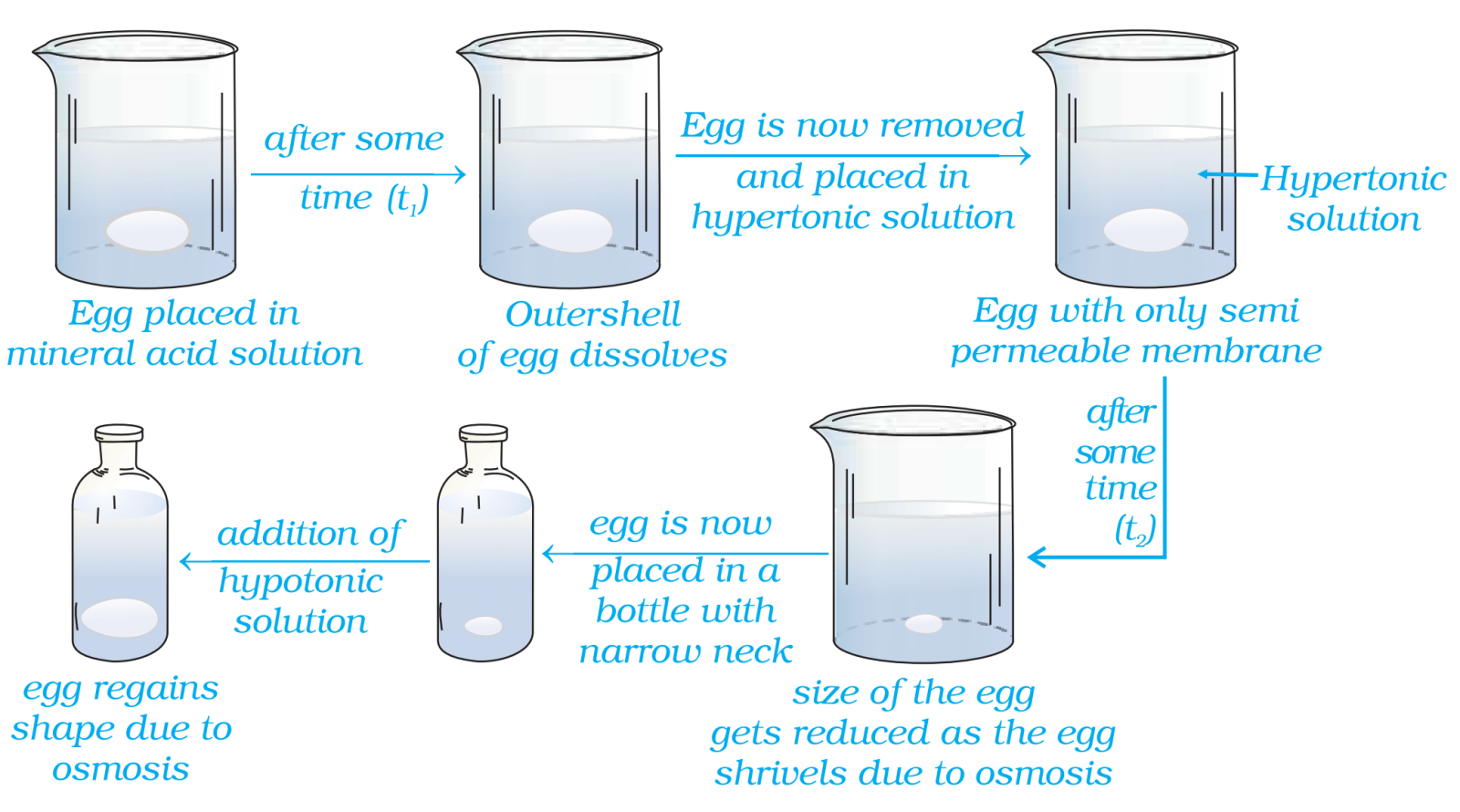
How can you remove the hard calcium carbonate layer of the egg without damaging its semiprermiable membrane? Can this egg be inserted into a bottle with a narrow neck without distorting its shape? Explain the process involved.
View full question & answer
Question 245 Marks
Match the items given in Column I with the type of solutions given in Column II.
 
Column I
 
Column II
i.
Soda water
a.
A solution of gas in solid.
ii.
Sugar solution
b.
A solution of gas in gas.
iii.
German silver
c.
A solution of solid in liquid.
iv.
Air
d.
A solution of solid in solid.
v.
Hydrogen gas in palladium
e.
A solution of gas in liquid.
 
 
f.
A solution of liquid in solid.
Answer
 
Column I
 
Column II
i.
Soda water
e.
A solution of gas in liquid.
ii.
Sugar solution
c.
A solution of solid in liquid.
iii.
German silver
d.
A solution of solid in solid.
iv.
Air
b.
A solution of gas in gas.
v.
Hydrogen gas in palladium
a.
A solution of gas in solid.
 
 
f.
A solution of liquid in solid.
View full question & answer
Question 255 Marks
Answer the following question:
g of benzoic acid (C6H5COOH) dissolved in 25g of benzene shows a depression in freezing point equal to 1.62K. Molal depression constant for benzene is 4.9K kg mol-1. What is the percentage association of acid if it forms dimer in solution?
Answer
The given quantities are,

WB = 2g, WA = 25g,

$\Delta\text{T}_\text{f}=1.62\text{ K}, \text{ K}_\text{f}=4.9\text{ K kg mol}^{-1}$

Substituting these values in equation $\text{M}_\text{B}=\frac{\text{K}_\text{f}\times\text{W}_\text{B}\times1000}{\Delta\text{T}_\text{f}\times\text{W}_\text{A}},$ We get

$\text{M}_\text{B}=\frac{4.9\text{ K kg mol}^{-1}\times2\text{ g}\times1000\text{ g kg}^{-1}}{1.62\text{K}\times25\text{ g}}=241.98\text{ g mol}^{-1}$

Thus, observed molecular mass of benzoic acid in benzene = 241.98g mol-1

Normal molecular mass of C6H5COOH = 122g mol-1

$\therefore \ \text{i}=\frac{\text{Normal molecular mass}}{\text{Observed molecualr mass}}=\frac{122\text{ g mol}^{-1}}{241.98\text{ g mol}^{-1}}=0.504$

$\text{i}=0.504\ \dots(\text{i})$

If $\alpha$ represents the degree of association of solute then we would have $(1-\alpha)$ mole of benzoic acid left in unassociated form and corresponding $\frac{\alpha}{2}$ as associated moles of benzoic acid at equilibrium.

Now, consider the following equilibrium for the acid:

$2(\text{C}_6\text{H}_5-\text{COOH})\rightleftharpoons(\text{C}_6\text{H}_5-\text{COOH})_2\\\ \ \ \ 1\text{ mol}\ \ \ \ \ \ \ \ \ \ \ \ \ \ \ \ \ \ \ \ \ \ \ \ \ \ \ \ \ \ \ \ \ \ \ \ \ \ \ \ \ \ \ \ 0\$1-\alpha)\text{ mol}\ \ \ \ \ \ \ \ \ \ \ \ \ \ \ \ \ \ \ \ \ \ \ \ \ \ \ \frac{\alpha}{2}\text{ mol}$

Thus, total number of moles of particles at equilibrium.

$=1-\alpha+\frac{\alpha}{2}=1-\frac{\alpha}{2}$

$\text{i}=\frac{\text{Total number of mole so f particles after association}}{\text{Number of mole so f particles be fore association}}$

$\text{i}=\frac{1-\frac{\alpha}{2}}{1}=1-\frac{\alpha}{2}\ \dots(\text{ii})$

From (i) and (ii), we have

$0.504=1-\frac{\alpha}{2}$

$\frac{\alpha}{2}=1-0.504=0.496$

Or $=0.496\times2=0.992$

Therefore, degree of association of benzoic acid in benzene is 99.2%.

View full question & answer
Question 265 Marks
The air is a mixture of a number of gases. The major components are oxygen and nitrogen with approximate proportion of 20% is to 79% by volume at 298 K. The water is in equilibrium with air at a pressure of 10 atm. At 298 K if the Henry’s law constants for oxygen and nitrogen at 298 K are 3.30 × 107 mm and 6.51 × 107 mm respectively, calculate the composition of these gases in water.
Answer
Percentage of oxygen (O2) in air = 20%

Percentage of nitrogen (N2) in air = 79%

Also, it is given that water is in equilibrium with air at a total pressure of 10 atm, that is, (10 × 760) mm Hg = 7600 mm Hg

Therefore,

Partial pressure of oxygen, $\text{P}_{\text{O}_2}=\frac{20}{100}\times7600\text{ mm Hg}$

= 1520 mm Hg

Partial pressure of nitrogen, $\text{P}_{\text{N}_2}=\frac{79}{100}\times7600\text{ mm Hg}$

= 6004 mm Hg

Now, according to Henry's law:

p = KH.x For oxygen:

$\text{P}_{\text{O}_2}=\text{K}_\text{H}.\text{x}_{\text{O}_2}$

$\text{x}_{\text{O}_2}=\frac{\text{P}_{\text{O}_2}}{\text{K}_\text{H}}$

$=\frac{1520\text{ mm Hg}}{3.30\times10^7\text{ mm Hg}(\text{Given K}_\text{H}=3.30\times10^7\text{mm Hg})}$

= 4.61 × 10-5

For nitrogen:

$\text{P}_{\text{N}_2}=\text{K}_\text{H}.\text{x}_{\text{N}_2}$

$\text{x}_{\text{N}_2}=\frac{\text{P}_{\text{N}_2}}{\text{K}_\text{H}}$

$=\frac{6004\text{ mm Hg}}{6.51\times10^7\text{ mm Hg}}$

= 9.22 × 10-5

Hence, the mole fractions of oxygen and nitrogen in water are 4.61 × 10-5 and 9.22 × 10⁻⁵ respectively.

View full question & answer
Question 275 Marks
Calculate the depression in the freezing point of water when 10 g of CH3CH2CHClCOOH is added to 250 g of water. Ka = 1.4 × 10⁻³, Kf = 1.86 K kg mol–1.
Answer
Molar mass of CH3CH2CHClCOOH = 15 + 14 + 13 + 35.5 + 12 + 16 + 16 + 1

= 122.5g mol−1

Therefore, No. of moles present in 10 g of CH3CH2CHClCOOH $=\frac{10\text{ g}}{122.5\text{ g mol}^{-1}}$

= 0.0816 mol

It is given that 10 g of CH3CH2CHClCOOH is added to 250 g of water.

Therefore, Molality of the solution, $=\frac{0.0186}{250}\times1000$

= 0.3264 mol kg-1

Let a be the degree of dissociation of CH3CH2CHClCOOH

CH3CH2CHClCOOH undergoes dissociation according to the following equation:

$\text{Initial conc. At equilibrium}=\text{CH}_3\text{CH}_2\text{CHClCOOH}\leftrightarrow\text{CH}_3\text{CH}_2\text{CHClCOOH}^-+\text{H}^+\\ \ \ \ \ \ \ \ \ \ \ \ \ \ \ \ \ \ \ \ \ \ \ \ \ \ \ \ \ \ \ \ \ \ \ \ \ \ \ \ \ \ \ \ \ \ \ \ \ \ \ \ \ \ \ \ \ \ \ \ \ \ \text{C mol L}^{-1}\ \ \ \ \ \ \ \ \ \ \ \ \ \ \ \ \ \ \ \ \ \ \ \ \ \ \ \ \ \ \ \ \ \ \ 0\ \ \ \ \ \ \ \ \ \ \ \ \ \ \ \ \ \ \ \ \ \ \ \ \ 0\\ \ \ \ \ \ \ \ \ \ \ \ \ \ \ \ \ \ \ \ \ \ \ \ \ \ \ \ \ \ \ \ \ \ \ \ \ \ \ \ \ \ \ \ \ \ \ \ \ \ \ \ \ \ \ \ \ \ \ \ \ \text{C}(1-\alpha)\ \ \ \ \ \ \ \ \ \ \ \ \ \ \ \ \ \ \ \ \ \ \ \ \ \ \ \ \ \ \ \ \ \ \ \ \ \text{C}\alpha\ \ \ \ \ \ \ \ \ \ \ \ \ \ \ \ \ \ \ \ \ \text{C}\alpha$

$\text{K}_\text{a}=\frac{\text{C}\alpha.\text{C}\alpha}{\text{C}(1-\alpha)}$

$=\frac{\text{C}\alpha^2}{1-\alpha}$

Since α is very small with respect to 1, 1 - $\alpha\ ââ€^{o}ˆ1$

$\text{K}_\text{a}=\frac{\text{C}\alpha^2}{1}$

$\text{Now,}\text{ K}_\text{a}=\text{C}\alpha^2$

$\alpha=\sqrt{\frac{\text{K}_\text{a}}{\text{C}}}$

$=\sqrt{\frac{1.4\times10^{-3}}{0.3264}}(\because\ \text{K}_\text{a}=1.4\times10^{-3})$

= 0.0655

Again,

$\text{Initial moles at equilibrium}=\text{CH}_3\text{CH}_2\text{CH}\text{ClCOOH}\leftrightarrow\text{CH}_3\text{CH}_2\text{CH}\text{ClCOOH}^-+\text{H}^+\\ \ \ \ \ \ \ \ \ \ \ \ \ \ \ \ \ \ \ \ \ \ \ \ \ \ \ \ \ \ \ \ \ \ \ \ \ \ \ \ \ \ \ \ \ \ \ \ \ \ \ \ \ \ \ \ \ \ \ \ \ \ \ \ \ \ \ \ \ \ \ \ 1\ \ \ \ \ \ \ \ \ \ \ \ \ \ \ \ \ \ \ \ \ \ \ \ \ \ \ \ \ \ \ \ \ \ \ \ \ \ \ \ \ 0\ \ \ \ \ \ \ \ \ \ \ \ \ \ \ \ \ \ \ \ \ \ \ \ \ 0\\ \ \ \ \ \ \ \ \ \ \ \ \ \ \ \ \ \ \ \ \ \ \ \ \ \ \ \ \ \ \ \ \ \ \ \ \ \ \ \ \ \ \ \ \ \ \ \ \ \ \ \ \ \ \ \ \ \ \ \ \ \ \ \ \ \ \ 1-\alpha\ \ \ \ \ \ \ \ \ \ \ \ \ \ \ \ \ \ \ \ \ \ \ \ \ \ \ \ \ \ \ \ \ \ \ \ \ \ \alpha\ \ \ \ \ \ \ \ \ \ \ \ \ \ \ \ \ \ \ \ \ \ \ \ \ \alpha$

$\text{Total moles of equilibrium = 1− α + α + α}$

$=1+\alpha$

$\text{Therefore,}\text{ i}=\frac{1+\alpha}{1}$

$=1+\alpha$

= 1 + 0.0655

= 1.0655

Hence, the depression in the freezing point of water is given as:

$\Delta\text{T}_\text{f}=\text{i}.\text{K}_\text{f}\text{m}$

= 1.0655 × 1.86 K kg mol-1 × 0.3264 mol kg-1

= 0.65 K

View full question & answer
Question 285 Marks
Concentration terms such as mass percentage, ppm, mole fraction and molality are independent of temperature, however molarity is a function of temperature. Explain.
Answer
Molarity of a solution is a weight by volume relationship to represent its strength and defined as 'The number of moles of solute dissolved in one litre of solution'. Since volume depends on temperature and undergoes a change with change in temperature, the molarity will also change with change in temperature. On the other hand, the other concentration terms such as mass percentage, ppm, mole fraction and molality are based upon mass by mass relationship of solute and solvent present in a binary solution. Mass does not change with change in temperature, as a result these concentration terms remain unchanged wth variation of temperature. According to the definition of all these terms, mass of the solvent used for making the solution is related to the mass of solute.
View full question & answer
Question 295 Marks
Answer the following question:
What is the freezing point of 0.4 molal solution of acetic acid in benzene in which it dimerises to the extent of 85%? Freezing point of benzene is 278.4K and its molar heat of fusion is 10.042kJ mol-1.
Answer
Given, $\text{M}=78\text{ g mol}^{-1},\ \text{T}^{0}_{\text{f}}=278.4\text{ K},$

$\Delta_\text{fus}\text{H}=10.042\text{ kJ mol}^{-1}$

$\text{K}_\text{f}=\frac{\text{R}(\text{T}^0_\text{f})^2\text{M}}{1000\times\Delta_\text{fus}\text{H}}$

$\text{K}_\text{f}=\frac{8.314\times10^{-3}\times(278.4)^2\times78}{1000\times10.042}=5.0\text{ K kg mol}^{-1}$

$2\text{CH}_3\text{COOH}\rightarrow(\text{CH}_{3}\text{COOH})_2\\\ \ \ \ \ \ \ \ \ \ \ \ \ \ \ \ \ \ \ \ \ \ \ \ \ \ \ \ \ \ \ \ \ \ \text{Dimer}$

$\alpha=\frac{\text{i}-1}{\frac{1}{\text{n}}-1}\ \Rightarrow0.85=\frac{\text{i}-1}{\frac{1}{2}-1}$

Or $\text{i}=1-0.425=0.575$

$\Delta\text{T}_\text{f}=\text{iK}_\text{f}\text{m}$

$=0.575\times5\times0.4=1.15\text{K}$

$\text{T}_{\text{f}}=\text{T}^0_\text{f}-\Delta\text{T}_\text{f}$

$=278.4\text{ K}-1.15\text{ K}=277.25\text{ K}$

View full question & answer
Question 305 Marks
Explain the terms ideal and non-ideal solutions in the light of forces of interactions operating between molecules in liquid solutions.
Answer
Ideal solutions: The solutions which obey Raoult’s law over the entire range of concentration are known as ideal solution. For an ideal solution,
$\Delta_{\text{mix}}\text{H}=0,\Delta_{\text{mix}}\text{V}=0$
A-B interactions $\approx$ A-A interactions and B-B interactions.
None-ideal solutions: When a solution does not obey Raoult's law over the entire range of consentration, it is called non-ideal solution.
Positive deviations: Vapour pressure of such solution shows higher value than the predicted value.
$\Delta_{\text{mix}}\text{H}=+\text{ve}$
$\Delta_{\text{mix}}\text{V}=+\text{ve}$
A-B interactions < A-A and B-B interactions.
Negative deviation: Vapour pressure of such solutions shows lower value than expected.
$\Delta_{\text{mix}}\text{H}=-\text{ve}$
$\Delta_{\text{mix}}\text{V}=-\text{ve}$
A-B interactions < A-A and B-B interactions.
View full question & answer
Question 315 Marks
Answer the following question:
0.6mL of acetic acid (CH3COOH), having density 1.06g mL-1, is dissolved in 1 litre of water. The depression in freezing point observed for this strength of acid was 0.0205°C. Calculate the van’t Hoff factor and the dissociation constant of acid.
Answer
Mass = Density × Volume

$\therefore$ Mass of acetic acid = 1.06g mL-1 × 0.6mL = 0.636g

Number of moles of acetic acid $=\frac{\text{Masso facetic acid}}{\text{Molar mass}}$

$=\frac{0.636\text{ g}}{60\text{ g mol}^{-1}}=0.0106\text{ mol}$

Mass of water = 1g mL-1 × 1000mL = 100g

$\text{Molality}=\frac{\text{Number of moleso facetic acid}}{\text{Mass of water in grams}}\times1000$

$=\frac{0.0106}{1000}\times1000=0.0106\text{ mol kg}^{-1}$

$\Delta\text{T}_{\text{f}}=\text{K}_\text{f}.\text{m}$

= 1.86K kg mol-1 × 0.0106 mol kg-1

= 0.0197K

Van't Hoff Factor $(\text{i})=\frac{\text{Observed freezing point}}{\text{Calculated freezing point}}=\frac{0.0205\text{ K}}{0.0197\text{ K}}$

i = 1.041 ...(i)

If $\alpha$ is the degree of dissociation of acetic acid, then we would have $\text{n}(1-\alpha)$ moles of undissociated acid, $\text{n}\alpha$ moles of CH3-COO- and $\text{n}\alpha$ moles of H+ ions at equilibrium.

$\text{CH}^3-\text{COOH}\rightleftharpoons\text{H}^++\text{CH}^3-\text{COO}^-\\\text{n mol}\ \ \ \ \ \ \ \ \ \ \ \ \ \ \ \ \ \ \ \ \ \ 0\ \ \ \ \ \ \ \ \ \ \ \ \ \ \ \ \ \ \ \ \ \ \ \ 0\\\text{n}(1-\alpha)\ \ \ \ \ \text{n}\alpha\text{ mol}\ \ \ \ \ \ \ \ \ \ \ \ \ \ \ \ \ \ \ \ \text{n}\alpha\text{ mol}$

Thus total moles of particles $=\text{n}-\text{n}\alpha+\text{n}\alpha+\text{n}\alpha=\text{n}(1+\alpha)$

$\text{i}=\frac{\text{Total number of moles of particles after dissociation}}{\text{Number of moles of particles before dissociation}}$

$\text{i}=\frac{\text{n}(1+\alpha)}{\text{n}}=1+\alpha\dots(\text{ii})$

From (i) and (ii), we have

$1.041=1+\alpha\Rightarrow\ \alpha=1.041-1=0.041$

$\text{K}_\text{a}=\frac{[\text{CH}_3-\text{COO}][\text{H}^+]}{[\text{CH}_3-\text{COOH}]}$

$[\text{CH}_3-\text{COOH}]=\text{n}(1-\alpha)=0.0106(1-0.041)$

$=0.0106\times0.959$

$[\text{H}^+]=\text{n}\alpha=0.106\times0.041;$

$[\text{CH}_3-\text{COO}^-]=\text{n}\alpha=0.0106\times0.041$

$\therefore\ \text{K}_\text{a}=\frac{0.0106\times0.041\times0.0106\times0.041}{0.0106\times0.959}$

$=1.86\times10^{-5}$

View full question & answer
Question 325 Marks
Why is the mass determined by measuring a colligative property in case of some solutes abnormal? Discuss it with the help of Van’t Hoff factor.
Answer
The compounds which dissociate or associate in the solvent show abnormal molecular masses.

  1. Association: Compounds like benzoic acid or ethanoic acid dimerise in benzene due to hydrogen bonding as a result of which the number of particles in the solution decreases. Since colligative properties depend upon number of particles, such solutes show lower colligative property.

  2. Dissociation: Electrolytes like NaCl, KCl, etc. dissociate into ions which result in increased number of particles, hence higher value of colligative property.

To account for association or dissociation van’t Hoff introduced a factor T known as van’t Hoff factor. It is defined as Expected molar mass Abnormal molar mass Observed colligative property Calculated colligative property. Total number of moles of particles after association/ dissociation Total number of moles of particles before association/ dissociation.

$\text{i}=\frac{\text{Expected molar mass}}{\text{Abnormal molar mass}}$

$\text{i}=\frac{\text{Observed colligative property}}{\text{Calculated colligative property}}$

$\text{i}=\frac{\text{Total number of moles of particles}\\\text{after association/ dissociation}}{\text{Total number of moles of particles}\\\text{before association/ dissociation}}$

View full question & answer
Question 335 Marks
19.5 g of CH2FCOOH is dissolved in 500 g of water. The depression in the freezing point of water observed is 1.00 C. Calculate the van’t Hoff factor and dissociation constant of fluoroacetic acid.
Answer
It is given that:

w1 = 500g

w2 = 19.5g

Kf = 1.86 K kg mol-1

$\Delta\ \text{T}_\text{f}=1\text{K}$

$\text{We know that:}\ \text{ M}_2=\frac{\text{K}_\text{f}\times\text{w}_2\times1000}{\Delta\text{T}_\text{f}\times\text{w}_1}$

$=\frac{1.86\text{ K kg mol}^{-1}\times19.5\text{ g}\times1000\text{ g Kg}^{-1}}{500\text{ g}\times1\text{ K}}$

72.54g mol−1

Therefore, observed molar mass of $\text{CH}_2\text{FCOOH},(\text{M}_2)_\text{obs}=72.54\text{ g mol}$

The calculated molar mass of $\text{CH}_2\text{FCOOH}$ is:

$(\text{M}_2)_{\text{cal}}=14+19+12+16+16+1$

= 76 g mol-1

Therefore, van't Hoff factor, $\text{i}=\frac{(\text{M}_2)_\text{cal}}{(\text{M}_2)_\text{obs}}$

$\frac{78\text{ g mol}^{-1}}{72.54\text{ g mol}^{-1}}$

= 1.0753

Let αbe the degree of dissociation of $\text{CH}_2\text{FCOOH}$

$\text{Initial conc. At equilibrium}=\text{CH}_2\text{FCOOH}\leftrightarrow\text{CH}_2\text{FCOO}^-+\text{H}^+\text{Total}=\text{C}(1+\alpha)\\ \ \ \ \ \ \ \ \ \ \ \ \ \ \ \ \ \ \ \ \ \ \ \ \ \ \ \ \ \ \ \ \ \ \ \ \ \ \ \ \ \ \ \ \ \ \ \ \ \ \ \ \ \ \ \ \ \ \ \text{C mol L }^{-1}\ \ \ \ \ \ \ \ \ \ \ \ 0\ \ \ \ \ \ \ \ \ \ \ \ \ \ \ \ \ 0\\ \ \ \ \ \ \ \ \ \ \ \ \ \ \ \ \ \ \ \ \ \ \ \ \ \ \ \ \ \ \ \ \ \ \ \ \ \ \ \ \ \ \ \ \ \ \ \ \ \ \ \ \ \ \ \ \ \text{C}(1-\alpha)\ \ \ \ \ \ \ \ \ \ \ \ \ \ \ \text{C}\alpha\ \ \ \ \ \ \ \ \ \ \ \ \ \ \text{C}\alpha$

$\text{i}=\frac{\text{C}(1+\alpha)}{\text{C}}$

$\text{i}=1+\alpha$

$\alpha=\text{i}-1$

= 1.0753 – 1

= 0.0753

Now, the value of Ka is given as:

$\text{K}_\text{a}=\frac{\big[\text{CH}_2\text{FCOO}^-\big]\big[\text{H}^+\big]}{\big[\text{CH}_2\text{FCOOH}\big]}$

$=\frac{\text{C}\alpha.\text{C}\alpha}{\text{C}(1-\alpha)}$

$\frac{\text{C}\alpha^2}{1-\alpha}$

Taking the volume of the solution as 500 mL, we have the concentration:

$\text{C}=\frac{\frac{19.5}{78}}{500}\times1000\text{M}$

= 0.5 M

Therefore, $\text{K}_\text{a}=\frac{\text{C}\alpha^2}{1-\alpha}$

$=\frac{0.5\times(0.0753)^2}{1-0.0753}$

$\frac{0.5\times0.00567}{0.9247}$

= 0.00307 (approximately)

= 3.07 × 10-3

View full question & answer
Question 345 Marks
Discuss biological and industrial importance of osmosis.
Answer
The process of osmosis is of immense biological and industrial importance as is evident from the following examples:
  1. Biological Importance: 
  • Movement of water from soil into plant roots and subsequently into upper portion of the plant is partly due to osmosis.
  • Preservation of meat against bacterial action by adding salt (i.e. salting).
  • Preservation of fruits against bacterial action by adding sugar. Bacterium in canned fruit loses water through the process of osmosis, shrivels and dies.
  • When placed in water containing less than 0.9% (mass by volume) salt blood cells collapse due to loss of water by osmosis. People taking lot of salt or salty food experience water retention in their tissue cells and in their intercellular spaces because of osmosis. This resulting puffiness or swelling has been identified as a disease called edema.
  • Revival of wilted flowers when placed in fresh water.
  1. Industrial importance:
  • Reverse osmosis is used for desalination of sea water- when a pressure more than osmotic pressure is applied over sea water, pure water is squeezed out of the sea water through a semipermeable membrane. A variety of semipermeable membranes are available for this purpose.
View full question & answer
Question 355 Marks
Why is it not possible to obtain pure ethanol by fractional distillation? What general name is given to binary mixtures which show deviation from Raoult’s law and whose components cannot be separated by fractional distillation. How many types of such mixtures are there?
Answer
The general name given to binary mixtures which show deviation from Rault's law and whose components cannot be separated by fractional distillation is "aziotropes".

It is not possible to obtain pure ethanol by fractional distillation because of following reasons, Azeotropes are binary solutions (liquid mixtures) having the same composition in liquid and vapour phase and it is not possible to separate the components of an azeotrope by fractional distillation. Ethanol-water mixture (obtained by fermentation of sugars) on fractional distillation gives a solution of approx. 95% ethanol by volume of ethanol. This has the same composition in liquid and vapour phase and hence it is not possible to separate them.

There are two types of such binary mixtures termed as:

  1. Minimum boiling azeotrope: The non-ideal solutions showing large positive deviation from minimum boiling azeotrope at a specific composition.

For example, 95% ethanol and 5% water (by volume). The boiling points of pure ethanol, water and its azeotrope is given below, Ethanol = 351.3K, Water = 373K, Azeotrope = 351.1K.

  1. Maximum boiling azeotrope: The non-ideal solutions showing large negative deviation from Rault's lawform maximum boiling azeotrope at a specific composition, viz. Nitric acid and water with approximate composition, 68% nitric acid and 32% water by mass. Boiling point of such HNO3 - H2O Azeotropic mixture is 393.5K.

View full question & answer
Question 365 Marks
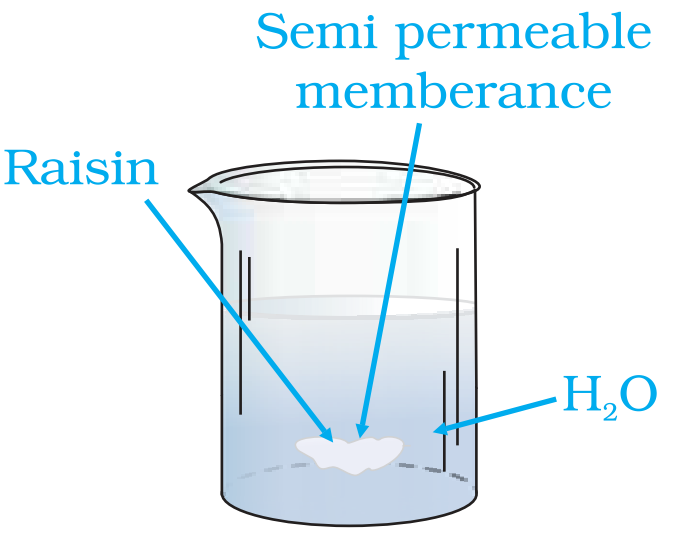
When kept in water, raisin swells in size. Name and explain the phenomenon involved with the help of a diagram. Give three applications of the phenomenon.
Answer
Raisins swell in size on keeping in water. This happens due to the phenomenon of osmosis. The outer skin of raisin acts as a semipermeable membrane. Water moves from a place of lower concentration to a place of higher concentration through the semipermeable membrane. Thus, water enters inside the raisins and make them swell.

Applications of the phenomenon:
  1. Movement of water from soil into plant roots and subsequently into upper portion of the plant is partly due to osmosis.
  2. Preservation of meat against bacterial action by adding salt.
  3. Preservation of fruits against bacterial action by adding sugar. Bacterium in canned fruit loses water through the process of osmosis, shrivels and dies.
  4. Reverse osmosis is used for desalination of water.
View full question & answer
5 Marks Questions - Chemistry STD 12 Science Questions - Vidyadip