MCQ 11 Mark
For the $LP$ problem
"Maximize $z=x+4 y$
subject to $3 x+6 y \leq 6,4 x+8 y \geq 16$ and $x \geq 0, y \geq 0$."
- A
$4$
- B
$8$
- C
feasible region is unbounded
- ✓
View full question & answer→MCQ 21 Mark
For the $LP$ problem
Maximize $z=2 x+3 y$ the coordinates of the corner points of the bounded feasible region are $A\,(3,3), B\,(20,3),$ $\mathrm{C}\,(20,10), \mathrm{D}\,(18,12)$ and $\mathrm{E}\,(12,12) .$ The maximum value of $z$ is $\ldots \ldots$
View full question & answer→MCQ 31 Mark
For the $LP$ problem
Minimize $z=2 x+3 y$ the coordinates of the corner points of the bounded feasible region are $A\,(3,3), B\,(20,3),$ $\mathrm{C}\,(20,10), \mathrm{D}\,(18,12)$ and $\mathrm{E}\,(12,12) .$ The minimum value of $z$ is $\ldots \ldots$
View full question & answer→MCQ 41 Mark
Solution of the following $LP$ problem
Maximize $z=2 x+6 y$ subject to $-x+y \leq 1,2 x+y \leq 2$ and $x \geq 0, y \geq 0 "$ is $.......$
- A
$\frac{4}{3}$
- B
$\frac{1}{3}$
- ✓
$\frac{26}{3}$
- D
AnswerCorrect option: C. $\frac{26}{3}$
View full question & answer→MCQ 51 Mark
Solution of the following $LP$ problem
Minimize $z=-3 x+2 y$
subject to $0 \leq x \leq 4,1 \leq y \leq 6, x+y \leq 5$ is $.....$
View full question & answer→MCQ 61 Mark
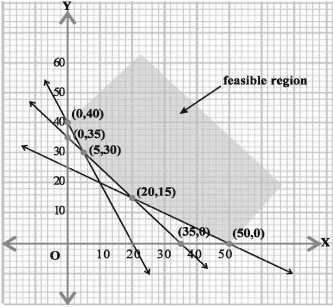
The following graph represents a feasible region. Minimum value of $z=5 x+4 y$ is $\ldots \ldots$
View full question & answer→MCQ 71 Mark
The region formed by the inequalities $x, y \geq 0, y \leq 6, x+y \leq 3$ is $.....$
- A
unbounded in first quadrant
- B
unbounded in first and second quadrants
- ✓
bounded in first quadrant
- D
AnswerCorrect option: C. bounded in first quadrant
c
Converting the given inequations into equations, we obtain
$y=6, x+y=3, x=0$ and $y=0 y=6$ is the line passing through $(0,6)$ and parallel to the $X$ axis. The region below the line $y=6$ will satisfy the given inequation.
The line $x+y=3$ meets the coordinate axis at $A(3,0)$ and $B(0,3)$. Join these points to obtain the line $x+y=3$.
Clearly, $(0,0)$ satisfies the inequation $x+y \leq 3$. So, the region in $x y$-plane that contains the origin represents the solution set of the given equation.
Region represented by $x \geq 0$ and $y \geq 0$ :
Since, every point in the first quadrant satisfies these inequations. So, the first quadrant is the region represented by the inequations.
View full question & answer→MCQ 81 Mark
The corner points of the feasible region are $(0,0),(16,0),(8,12),(0,20) .$ The maximum and minimum values of $\mathrm{Z}=22 x+18 y$ are $m$ and $n$ respectively then $m+n=\ldots$
View full question & answer→MCQ 91 Mark
For linear programming $x+2 y \geq 10,3 x+4 y \leq 24$ and $x \geq 0, y \geq 0 \ldots \ldots \ldots .$ is not the corner point of feasible region.
- A
$(0,6)$
- B
$(4,3)$
- C
$(3,4)$
- D
$(0,5)$
View full question & answer→MCQ 101 Mark
The corner points of the feasible region are $A(3,3), B(20,3), C(20,10), D(18,12)$ and $E(12, 12)$. The maximum value of $Z=2 x+3 y$ is $.......$
Answera
Corner point Corresponding value of $Z =2 x+3 y$
| $\mathrm{A}(3,3)$ |
$\mathrm{Z}=15$ |
| $\mathrm{B}(20,3)$ |
$\mathrm{Z}=49$ |
| $\mathrm{C}(20,10)$ |
$\mathrm{Z}=70$ |
| $\mathrm{D}(18,12)$ |
$\mathrm{Z}=72$ |
| $\mathrm{E}(12,12)$ |
$\mathrm{Z}=60$ |
The maximum value of $\mathrm{Z}$ is $72 .$
View full question & answer→MCQ 111 Mark
Cake$-A$ requires $200\, \mathrm{g}$ of flour and $25\, \mathrm{g}$ of fat. Cake$-B$ requires $100\, \mathrm{g}$ of flour and $50\, \mathrm{g}$ of fat. Find the maximum number of cakes which can be made from $5\, \mathrm{kg}$ of flour and $1\, \mathrm{kg}$ of fat. The mathematical form of this $LPP$ is $.....$
- ✓
$\mathrm{Z}=x+y, 2 x+y \leq 50, x+2 y \leq 40, x \geq 0, y \geq 0$
- B
$\mathrm{Z}=x+y, 2 x+y \leq 5, x+2 y \leq 1, x \geq 0, y \geq 0$
- C
$\mathrm{Z}=x+y, 200 x+100 y \leq 5,25 x+50 y \leq 1, x \geq 0, y \geq 0$
- D
$\mathrm{Z}=x+y, 200 x+100 y \geq 5,25 x+50 y \geq 1, x \geq 0, y \geq 0$
AnswerCorrect option: A. $\mathrm{Z}=x+y, 2 x+y \leq 50, x+2 y \leq 40, x \geq 0, y \geq 0$
a
$\mathrm{Z}=x+y, 2 x+y \leq 50, x+2 y \leq 40, x \geq 0, y \geq 0$
Let the number of cake $A=x$
The number of cake $B=y$
| |
$A$ |
$B$ |
Given
ingredients |
| Flour |
$200 \,g$ |
$100\, g$ |
$5 \,kg$ |
| Fat |
$25\, g$ |
$50 \,g$ |
$1 \,kg$ |
$200 x+100 y \leq 5000$
$\therefore 2 x+y \leq 50$
$25 x+50 y \leq 1000$
$\therefore \quad x+2 y \leq 40$
$x \geq 0, y \geq 0$
$\mathrm{Z}=x+y$
View full question & answer→MCQ 121 Mark
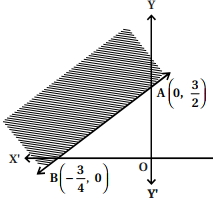
The shaded region in the given figure is a graph of $.....$
- A
$4 x-2 y \leq 3$
- ✓
$4 x-2 y \leq-3$
- C
$2 x-4 y \geq 3$
- D
$2 x-4 y \leq-3$
AnswerCorrect option: B. $4 x-2 y \leq-3$
b
The given line intersects $\mathrm{X}$ - axis at $\left(-\frac{3}{4}, 0\right)$ and $\mathrm{Y}$ - axis at $\left(0, \frac{3}{2}\right)$
$\therefore$ Equation of the line $\frac{x}{-\frac{3}{4}}+\frac{y}{\frac{3}{2}}=1$
$\therefore-4 x+2 y=3$
$\therefore 4 x-2 y=-3$
Taking $x=y=0 \Rightarrow 0-0 \leq-3$ which is not true.
$\therefore 4 x-2 y \leq-3$ is a half plane not containing $(0,0).$
View full question & answer→MCQ 131 Mark
The point at which the maximum value of $Z=3 x+2 y$ subject to the constraints $x+2 y \leq 2, x \geq 0, y \geq 0$ is $.....$
- A
$(0,0)$
- B
$(1.5,-1.5)$
- ✓
$(2,0)$
- D
$(0,2)$
AnswerCorrect option: C. $(2,0)$
c
$(2,0)$ Given points Corresponding
$(0,0)$
value of $\mathrm{Z}=3 x+2 y$
$\mathrm{Z}=1$
$(1.5,-1.5)$
$Z=1.5$
$(2,0)$
$Z=6$
$(0,2)$
$\mathrm{Z}=4$
$\therefore \mathrm{Z}=3 x+2 y$ has maximum at $\mathrm{C}(2,0)$
View full question & answer→MCQ 141 Mark
The maximum value of $\mathrm{Z}=x+3 y$ subject to the constraints $2 x+y \leq 20, x+2 y \leq 20$ $x \geq 0, y \geq 0$ is $....$
Answerd
At $\mathrm{A}(10,0), \mathrm{Z}=x+3 y=10$
At $\mathrm{B}\left(\frac{20}{3}, \frac{20}{3}\right), \mathrm{Z}=x+3 y=\frac{80}{3}$
At $\mathrm{C}(0,10), \mathrm{Z}=x+3 y=30$
$\therefore$ The maximum value of $Z=x+3 y$ is $30.$
View full question & answer→MCQ 151 Mark
The solution set of the constraints $x+2 y \geq 11,3 x+4 y \leq 30,2 x+5 y \leq 30, x \geq 0, y \geq 0$ includes the point.
- A
$(2,3)$
- B
$(3,2)$
- ✓
$(3,4)$
- D
$(4,3)$
AnswerCorrect option: C. $(3,4)$
c
For $(2,3), x+2 y=8 \geq 11$ is false.
For $(3,2), x+2 y=7 \geq 11$ is false.
For $(3,4), x+2 y=11 \geq 11$ is true.
$3 x+4 y=25 \leq 30$ is true.
$2 x+5 y=26 \leq 36$ is true.
View full question & answer→MCQ 161 Mark
$z=30 x-30 y+1800$ is a objective function. The corner points of the feasible region are $(15,0),(15,15),(10,20),(0,20)$ and $(0,15) $. $z$ has the minimum value at $\ldots \ldots \ldots .$ point.
- ✓
$(0,20)$
- B
$(0,15)$
- C
$(15,0)$
- D
$(10,20)$
AnswerCorrect option: A. $(0,20)$
a
|
Corner
point
|
Corresponding value of
$z=30 x-30 y+1800$
|
| $(15,0)$ |
$2250$ |
| $(15,15)$ |
$1800$ |
| $(10,20)$ |
$1500$ |
| $(0,20)$ |
$1200=$ Minimum |
| $(0,15)$ |
$1350$ |
View full question & answer→MCQ 171 Mark
A wholesale dealer wants to starts the business with $Rs.\, 2,40,000$. The cost price of a quintal wheat is $Rs.\, 2000$ and the cost price of a quintal rice is $Rs.\, 3000$. He has the space capacity for $200$ quintals grain. The profit from the sale of one quintal wheat is $Rs.\, 125$ and that from one quintal rice is $Rs.\, 200$. If he has $x$ quintal rice and $y$ quintal wheat then the objective function for the maximum profit is $....$
AnswerCorrect option: B. $200 x+125 y$
b
For maximum profit.
| Item |
quintal |
profit |
| Rice |
$x$ |
$200 \,x$ |
| Wheat |
$y$ |
$125 \,y$ |
$\therefore$ The objective function is $z=200 x+125 y$.
View full question & answer→MCQ 181 Mark
The production of item $A$ is $x$ and the production of item $B$ is $y .$ If the corner points of the bounded feasible region are $(1,0),(2,0),(0,2)$ and $(0,1)$ then the maximum profit $z=2000 x+5000 y$ is $\ldots \ldots$
- A
$20000$
- B
$5000$
- C
$4000$
- ✓
$10000$
AnswerCorrect option: D. $10000$
d
| Corner point |
Corresponding value of $z=2000 x+5000 y$ |
| $(1,0)$ |
$z=2000(1)+5000(0)=2000$ |
| $(2,0)$ |
$z=2000(2)+5000(0)=4000$ |
| $(0,2)$ |
$z=2000(0)+5000(2)=10,000$ (Maximum value)
|
| $(0,1)$ |
$z=2000(0)+5000(1)=5000$ |
$\therefore$ The maximum profit is $10,000.$
View full question & answer→MCQ 191 Mark
The minimum value of $z=2 x+4 y$ subject to constraints $x+2 y \geq 10,3 x+y \geq 10, x \geq 0,$ $y \geq 0$ is $....$
Answera
$x \leq 0$
When $x$ is greater than zero it mean tangent of that mean the feasible region is on or to the right of the line where equation is zero $( x =0)$ which is the line which is $y$ axis
$y \leq 0$
Where $y$ is greater that it means above that mean feasible region is on or above the line where equation is $y =0$ which is the line which is $x$-axis
Those two mean that the feasible region is in the upper right hand part of the xy co ordinate system.
See image $1$
When $x$ is greater that it mean right of
$y \leq 1-x$
That mean feasible region os on or above the line where equation is $x+y=1$
See image $2$
$3 x +2 y \leq 6$
If we solve
$x \leq \frac{6-2 y}{3}$
$y \leq \frac{6-3 x}{2}$
$x$ intercept $(2,0) \quad y \quad$ intercept $(0,3)$
Corner point value of $2=2 x +4 y$
$(1,0)$
$2=2(1)+4(10)=2+0=2$
$(2,0)$
$2=2(2)+4(0)=4+0=4$
$(0,3)$
$2=2(0)+4(3)=0+12=12$
$(0,1)$
$2=2(0)+4(1)=0+4=4$
Maximum value when $x=0 \quad y=3$
View full question & answer→MCQ 201 Mark
The corner points of the feasible region determined by the system of linear constraints are $(0,0),(0,40),(20,40),(60,20),(60,0) .$ The objective function is $z=4 x+3 y$ Compare the quantity in Column $A$ and Column $B$
| Column |
Maximum of $z$ |
| $A$ |
$300$ |
| $B$ |
$325$ |
AnswerCorrect option: B. The quantity in column $(B)$ is greater
b
The quantity in column $(B)$ is greater
| Corner point |
Corrsponding value of
$z=4 x+3y$
|
| $(0,0)$ |
$z=4(0)+3(0)=0$ |
| $(0,40)$ |
$z=4(0)+3(40)=120$ |
| $(20,40)$ |
$z=4(20)+3(40)=200$ |
| $(60,20)$ |
$z=4(60)+3(20)=300$ (maximum value) |
| $(60,0)$ |
$z=4(60)+0=240$ |
$\therefore$ Maximum value of the objective function $300\,<\,325$
$\therefore$ Value of column $(B)$ is maximum.
View full question & answer→MCQ 211 Mark
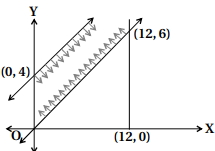
The feasible region for an $LPP$ is shown in the Figure. Let $z=3 x-4 y$ be the objective function. Maximum value of $z$ is $....$
Answerc
Corner points of the feasible region are $(0,0), (12,0)$ and $(0,4)$
| Corner point |
Objective function
$z=3 x-4 y$
|
| $(0,0)$ |
$z=3(0)-4(0)=0$ |
| $(12,6)$ |
$z=3(12)-4(6)=36-24=12$ (maximum value)
|
| $(0,4)$ |
$z=3(0)-4(4)=-16$ |
Maximum value of the objective function $z$ is $12.$
View full question & answer→MCQ 221 Mark
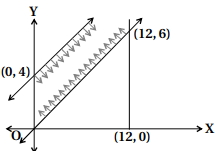
The feasible region for an $LPP$ is shown in the Figure. Let $z=3 x-4 y$ be the objective function.Minimum value of $Z$ is $....$
View full question & answer→MCQ 231 Mark
Corner points of the feasible region for an $\operatorname{LPP}$ are $(0,2),(3,0),(6,0),(6,8)$ and $(0,5)$
Let $F=4 x+6 y$ be the objective function. Maximum of $F-$ Minimum of $F=.....$
View full question & answer→MCQ 241 Mark
Corner points of the feasible region determined by the system of linear constraints are $(0,3), (1,1)$ and $(3,0) .$ Let $Z=p x+q y,$ where $p, q\,>\,0 .$ Condition on $p$ and $q,$ so that the maximum of $Z$ occurs at $(3,0)$ and $(1,1)$ is $.....$
- A
$p=2 q$
- ✓
$p=\frac{q}{2}$
- C
$p=3 q$
- D
$p=q$
AnswerCorrect option: B. $p=\frac{q}{2}$
b
Function $z$ is maximum of $(3,0)$ and $(1,1)$
$\therefore$ Maximum value of $z$ of $(3,0)=$ Maximum value of $z=(1,1)$
$\therefore p(3)+q(0)=p(1)+q(1)$
$\therefore p(3)+0=p+q$
$\therefore 3 p=p+q$
$\therefore 2 p=q$
$\therefore p=\frac{q}{2}$
View full question & answer→MCQ 251 Mark
The corner points of the feasible region determined by the following system of linear inequalities:
$2 x+y \leq 10, x+3 y \leq 15, x, y \geq 0$ are $(0,0),(5,0),(3,4)$ and $(0,5) .$ Let $Z =p x+q y,$ where $p, q\,>\,0 .$ Condition on $p$ and $q$ so that the maximum of $Z$ occurs at both $(3,4)$ and $(0,5)$ is $....$
- A
$p= q$
- ✓
$q=3 p$
- C
$p=3 q$
- D
$p=2 q$
AnswerCorrect option: B. $q=3 p$
b
The maximum value of $Z$ is unique.
It is given that the maximum value of $Z$ occurs at two points, $(3,4)$ and $(0,5).$
$\therefore$ Value of $Z$ at $(3,4)=$ Value of $Z$ at $(0,5)$
$\Rightarrow p (3)+ q (4)= p (0)+ q (5)$
$\Rightarrow 3 p+4 q=5 q$
$\Rightarrow q=3 p$
Hence, the correct answer is $B$.
View full question & answer→MCQ 261 Mark
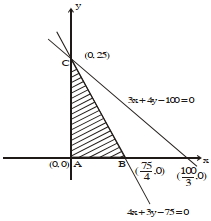
The maximum value of $z$ in the following equation $z=6 x y+y^{2},$ where $3 x+4 y \leq 100$ and $4 x+3 y \leq 75$ for $x \geq 0$ and $y \geq 0$ is $......$
Answera
$z=6 x y+y^{2}=y(6 x+y)$
$3 x+4 y \leq 100$ $....(i)$
$4 x+3 y \leq 75$ $......(ii)$
$x \geq 0$
$y \geq 0$
$z \leq \frac{75-3 y}{4}$
$Z=y(6 x+y)$
$Z \leq y\left(6 \cdot\left(\frac{75-3 y}{4}\right)+y\right)$
$z \leq \frac{1}{2}\left(225 y-7 y^{2}\right) \leq \frac{(225)^{2}}{2 \times 4 \times 7}$
$=\frac{50625}{56}$
$\approx 904.0178$
$\approx 904.02$
It will be attained at $y =\frac{225}{14}$
View full question & answer→MCQ 271 Mark
Objective function of an LP problems is
- A
- ✓
a function to be optimized
- C
- D
AnswerCorrect option: B. a function to be optimized
b
The objective of Linear Programming Problems $(LPP)$ is to minimize or maximize the function.
View full question & answer→MCQ 281 Mark
Let $x$ and $y$ be optimal solution of an $LP$ problem, then $......$
- A
$z=\lambda x+(1-\lambda) y, \lambda \in \mathrm{R}$ is also an optimal solution
- ✓
$z=\lambda x+(1-\lambda) y, 0 \leq \lambda \leq 1$ gives an optimal solution.
- C
$z=\lambda x+(1+\lambda) y, 0 \leq \lambda \leq 1$ gives an optimal solution.
- D
$z=\lambda x+(1+\lambda) y, \lambda \in \mathrm{R}$ gives an optimal solution.
AnswerCorrect option: B. $z=\lambda x+(1-\lambda) y, 0 \leq \lambda \leq 1$ gives an optimal solution.
b
for $L P$
If $x, y$ are optind solutions
So a multiple of $z=\lambda x+(1-\lambda) y, \lambda \in R$ is abo an optimal sivhin
View full question & answer→MCQ 291 Mark
The optimal value of the objective function is attained at the points
AnswerCorrect option: C. given by corner points of the feasible region
c
The optimal value of the objective function is attained at the point is given by corner points of the feasible region.
View full question & answer→MCQ 301 Mark
The corner points of the feasible region determined by the system of linear constraints are $(0,10),(5,5),(15,15),(0,20) .$ Let $z=p x+q y,$ where $p, q\,>\,0 .$ Condition on $p$ and $q$ so that the maximum of $z$ occurs at both the pooints $(15,15)$ and $(0,20)$ is $\ldots \ldots$
- A
$p=q$
- B
$p=2 q$
- C
$q=2 p$
- ✓
$q=3 p$
AnswerCorrect option: D. $q=3 p$
d
Let $z_0$ be the maximum value of $z$ in the feasible region.
Since maximum occurs at both $(15,15)$ and $(0,20)$ s, the value $z_0$ is attained at both $(15,15)$ and $(0,20)$
$\Rightarrow z _0= p (15)+ q (15) \text { and } z _0= p (0)+ q (20)$
$\Rightarrow p (15)+ q (15)= p (0)+ q (20)$
$\Rightarrow 15 p =5 q$
$\Rightarrow 3 p = q$
View full question & answer→MCQ 311 Mark
Which of the following statements is correct?
- A
Every $LP$ problem has at least one optimal solution.
- B
Every $LP$ problem has a unique optimal solution.
- ✓
If an $LP$ problem has two optimal solutions, then it has infinitely many solutions.
- D
If a feasible region is unbounded then $LP$ problem has no solution.
AnswerCorrect option: C. If an $LP$ problem has two optimal solutions, then it has infinitely many solutions.
View full question & answer→MCQ 321 Mark
In solving the $LP$ problem :
"Minimize $z=6 x+10 y$ subject to $x \geq 6, y \geq 2,2 x+y \geq 10, x \geq 0, y \geq 0$." redundant constraints are $....$
AnswerCorrect option: B. $2 x+y \geq 10, x \geq 0, y \geq 0$
View full question & answer→MCQ 331 Mark
Solution set of the inequality $2x + y\, >\, 5$ is $.......$
AnswerCorrect option: B. The open half plane not containing origin
b
The open half plane not containing origin In the solution set of $2 x+y\,>\,5$
No points on the line $2 x+y=5$ are included.
For $\mathrm{O}\,(0,0), 0+0\,>\,5 \mathrm{which}$ is not true.
$\therefore$ The open half plane not containing origin in the solution set of $2 x+y\,>\,5$
View full question & answer→MCQ 341 Mark
The region represented by the inequation $x-y \leq-1, x-y \geq 0, x \geq 0, y \geq 0$ is $.....$
Answerc
do not exist
The inequalities $x-y \leq-1$ and $x-y \geq 0$, do not hold together.
$\therefore$ No region exist for the given condition.
View full question & answer→MCQ 351 Mark
Consider a $LPP$ given by minimise $\mathrm{Z}=6 x+10 \mathrm{y}$. Subject to $x \geq 6, y \geq 2,2 x+y \geq 10, x \geq 0$ $y \geq 0 .$ Redundant constraints in this LPP are $....$
AnswerCorrect option: B. $2 x+y \geq 10, x \geq 0, y \geq 0$
b
$2 x+y \geq 10, x \geq 0, y \geq 0$
Here $x \geq 6 \Rightarrow x \geq 0$
$\therefore x \geq 0$ is not necessary.
$y \geq 2 \Rightarrow y \geq 0 \Rightarrow y \geq 0$ is not necessary.
$2 x+y=2(6)+2=14 \geq 10$
$\therefore 2 x+y \geq 10$ is not necessary.
View full question & answer→MCQ 361 Mark
The feasible region of the inequality $x+y \leq 1$ and $x-y \leq 1$ lies in $\ldots \ldots \ldots$ quadrants.
- A
Only $I$ and $II$
- B
Only $I$ and $III$
- C
Only $II$ and $III$
- ✓
Answerd
It is clear that the feasible region of the inequality $x+y \leq 1$ and $x-y \leq 1$ lie in all the four quadrants.
View full question & answer→MCQ 371 Mark
The following five inequalities form the feasible region. $2 x-y \leq 8, x+y \leq 20,-x+y \geq-10$ $x \geq 0, y \geq 0 .$ Redundant constraints is $\ldots . . .$
- A
$x \geq 0$
- B
$2 x-y \leq 8$
- ✓
$-x+y \geq-10$
- D
$x+y \leq 20$
AnswerCorrect option: C. $-x+y \geq-10$
c
$-x+y \geq-10$
From the given inequalities, Redundant constraint is $-x+y \geq-10$.
View full question & answer→MCQ 381 Mark
The position of the points $\mathrm{O}(0,0)$ and $\mathrm{P}(2,-1)$ is $\ldots \ldots . .,$ in the region of the inequality $2 y-3 x\,<\,5$
- A
$O$ is inside the region and $\mathrm{P}$ is outside the region
- ✓
$O$ and $P$ both are inside the region
- C
$\mathrm{O}$ and $\mathrm{P}$ both are outside the region
- D
$O$ is outside the region and $\mathrm{P}$ is inside the region
AnswerCorrect option: B. $O$ and $P$ both are inside the region
View full question & answer→MCQ 391 Mark
The constraints $x+y \leq 4,3 x+3 y \geq 18, x \geq 0, y \geq 0$ defines on
- A
- B
unbounded feasible region
- C
feasible region in first and second quadrants
- ✓
View full question & answer→MCQ 401 Mark
Out of the following points, how many points are satisfied the inequality $2 x-3 y>-5 ?$
$(1,1)(-1,1),(1,-1),(-1,-1),(-2,1)(2,-1),(-1,2)$ and $(-2,-1)$
Answerb
The points $(1,1),(1,-1),(2,-1),(-2,-1)$ and $(-1,-1)$ satisfy the inequality $2 x-3 y\,>\,-5$
$\therefore$ There are $5$ points.
View full question & answer→MCQ 411 Mark
How many points having integer co-ordinates are there in the feasible region of the inequality $3 x+4 y \leq 12, x \geq 0$ and $y \geq 1$ ?
Answerc
The points having integer co-ordinates in the region of $3 x+4 \leq 12, x \geq 0$ and $y \geq 1$ are $\mathrm{A}\,(0,1), \mathrm{B}\,(1,1), \mathrm{C}\,(2,1), \mathrm{D}\,(0,2)$ and $\mathrm{E}\,(0,3) .$
There are $5$ required points.
View full question & answer→MCQ 421 Mark
The constraints $-x+y \leq 1,-x+3 y \leq 9, x \geq 0, y \geq 0$ defines on $.....$
- A
- ✓
- C
Does not get feasible space
- D
Feasible space is a square
View full question & answer→MCQ 431 Mark
The solution set of the constraints $2 x+3 y \leq 6,5 x+3 y \leq 15$ and $x \geq 0, y \geq 0$ does not include $..........$ point.
- A
$(0,2)$
- B
$(0,0)$
- C
$(3,0)$
- ✓
$(0,5)$
AnswerCorrect option: D. $(0,5)$
View full question & answer→MCQ 441 Mark
The solution set of the constraints $2 x+3 y \leq 6, x+4 y \leq 4$ and $x \geq 0, y \geq 0$ includes the point $\ldots \ldots \ldots . .$ as corner point.
- A
$(1,0)$
- B
$(1,1)$
- ✓
$\left(\frac{12}{5}, \frac{2}{5}\right)$
- D
$\left(\frac{2}{5}, \frac{12}{5}\right)$
AnswerCorrect option: C. $\left(\frac{12}{5}, \frac{2}{5}\right)$
View full question & answer→MCQ 451 Mark
The region formed by the inequalities $2 x+3 y-5 \leq 0,4 x-3 y+2 \leq 0$ and $x \geq 0 \ldots \ldots \ldots$
- A
does not lie in first quadrant
- B
lies in first quadrant and bounded
- C
lies in first quadrant and unbounded
- ✓
lies in first and second quadrant
AnswerCorrect option: D. lies in first and second quadrant
d
lies in first and second quadrant
View full question & answer→MCQ 461 Mark
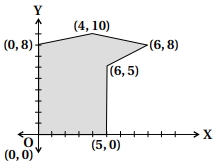
The feasible solution for a $LPP$ is shown in Figure Let $z=3 x-4 y$ be the objective function. Minimum of $Z$ occurs at $....$
- A
$(0,0)$
- ✓
$(0,8)$
- C
$(5,0)$
- D
$(4,10)$
AnswerCorrect option: B. $(0,8)$
b
$(B) \,\,(0,8)$
| Corner point |
Objective function
$z=3 x-4 y$
|
| $(0,0)$ |
$z=3(0)-4(0)=0$ |
| $(5,0)$ |
$z=3(5)-4(0)=15$ (Maximum value) |
| $(6,5)$ |
$z=3(6)-4(5)=18-20=-2$ |
| $(6,8)$ |
$z=3(6)-4(8)=-14$ |
| $(4,10)$ |
$z=3(4)-4(10)=-28$ |
| $(0,8)$ |
$z=3(0)-4(8)=-32($ minimum value ) |
Minimum value of the objective function is $-32$
$\therefore$ Minimum value exists at point $(0,8).$
View full question & answer→MCQ 471 Mark
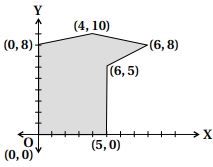
The feasible solution for a $LPP$ is shown in Figure Let $z=3 x-4 y$ be the objective function. Maximum of $Z$ occurs at $......$
- ✓
$(5,0)$
- B
$(6,5)$
- C
$(6,8)$
- D
$(4,10)$
AnswerCorrect option: A. $(5,0)$
a
| Corner point |
Objective function
$z=3 x-4 y$
|
| $(0,0)$ |
$z=3(0)-4(0)=0$ |
| $(5,0)$ |
$z=3(5)-4(0)=15$ (Maximum value) |
| $(6,5)$ |
$z=3(6)-4(5)=18-20=-2$ |
| $(6,8)$ |
$z=3(6)-4(8)=-14$ |
| $(4,10)$ |
$z=3(4)-4(10)=-28$ |
| $(0,8)$ |
$z=3(0)-4(8)=-32($ minimum value ) |
maximum value of objective function $z=3 x-4 y$ is $15$ which exists at point $(5,0).$
View full question & answer→MCQ 481 Mark
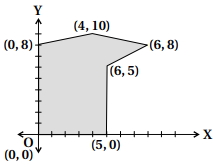
The feasible solution for a LPP is shown in Figure Let $z=3 x-4 y$ be the objective function. (Maximum value of $z+$ Minimum value of $z$ ) is equal to $....$
Answerd
| Corner point |
Objective function
$z=3 x-4 y$
|
| $(0,0)$ |
$z=3(0)-4(0)=0$ |
| $(5,0)$ |
$z=3(5)-4(0)=15$ (Maximum value) |
| $(6,5)$ |
$z=3(6)-4(5)=18-20=-2$ |
| $(6,8)$ |
$z=3(6)-4(8)=-14$ |
| $(4,10)$ |
$z=3(4)-4(10)=-28$ |
| $(0,8)$ |
$z=3(0)-4(8)=-32($ minimum value ) |
we have (Maximum value of $z$ ) $+$ (Minimum value of $z$ ) $=15-32=-17$.
View full question & answer→MCQ 491 Mark
Corner points of the bounded feasible region for an $LP$ problem are $(0,4),(6,0),(12,0),(12,16)$ and $(0,10) .$
Let $z=8 x+12 y$ be the objective function. Match the following :
$(i)$ Minimum value of $z$ occurs at $\ldots$
$(ii)$ Maximum value of $z$ occurs at $\ldots$
$(iii)$ Maximum of $z$ is $\ldots$
$(iv)$ Minimum of $z$ is $\ldots \ldots$
- A
$(i) (6,0)$ $(ii) (12,0)$ $(iii) 288$ $(iv) 48$
- ✓
$(i) (0,4)$ $(ii) (12,16)$ $(iii) 288$ $(iv) 48$
- C
$(i) (0,4)$ $(ii) (12,16)$ $(iii) 288$ $(iv) 96$
- D
$(i) (6,0)$ $(ii) (12,0)$ $(iii) 288$ $(iv) 96$
AnswerCorrect option: B. $(i) (0,4)$ $(ii) (12,16)$ $(iii) 288$ $(iv) 48$
View full question & answer→MCQ 501 Mark
The solution of linear programming problem, maximize $\mathrm{Z}=3 x_{1}+5 x_{2}$ subject to $3 x_{1}+$ $2 x_{2} \leq 18, x_{1} \leq 4, x_{2} \leq 6, x_{1} \geq 0, x_{2} \geq 0$ is $.....$
- A
$x_{1}=2, x_{2}=0, z=6$
- ✓
$x_{1}=2, x_{2}=6, z=36$
- C
$x_{1}=4, x_{2}=3, z=27$
- D
$x_{1}=4, x_{2}=6, z=42$
AnswerCorrect option: B. $x_{1}=2, x_{2}=6, z=36$
b
$x_{1}=2, x_{2}=6, z=36$
If we take the maximum value of $\mathrm{Z}$ as $42, x_{1}=4, x_{2}=6$
$\therefore 3 x_{1}+2 x_{2}=24 \leq 18$ which is not true.
$x_{1}=2, x_{2}=6,3 x_{1}+2 x_{2}=18 \leq 18$
Also $x_{1} \leq 4, x_{2} \leq 6$
$\therefore$ All conditions are satisfied.
$\therefore$ Maximum value of $\mathrm{Z}$ is $36 .$
View full question & answer→