MCQ 11 Mark
If $y=5 \cos x-3 \sin x$, then $\frac{d^2 y}{d x^2}$ is equal to
Answer$\begin{array}{l}\text {We have, } y=5 \cos x-3 \sin x \\ \Rightarrow \frac{d y}{d x}=-5 \sin x-3 \cos x \\ \Rightarrow \frac{d^2 y}{d x^2}=-5 \cos x+3 \sin x=-y\end{array}$
View full question & answer→MCQ 21 Mark
If $y=\log \left(\cos e^x\right)$, then $\frac{d y}{d x}$ is
- A
$\cos e^{x-1}$
- B
$e^{-x} \cos e^x$
- C
$e^x \sin e^x$
- D
$-e^x \tan e^x$
AnswerWe have, $y=\log \left(\cos e^x\right)$
Differentiating both sides w.r.t. $x$, we get
$
\begin{array}{l}
\frac{d y}{d x}=\frac{1}{\cos e^x} \cdot\left(-\sin e^x\right) \cdot e^x \\
\Rightarrow \frac{d y}{d x}=-e^x \tan e^x
\end{array}
$
View full question & answer→MCQ 31 Mark
If $y=\sin \left(2 \sin ^{-1} x\right)$, then $\left(1-x^2\right) y_2$ is equal to
- A
$-x y_1+4 y$
- B
$-x y_1-4 y$
- C
$x y_1-4 y$
- D
$x y_1+4 y$
Answer$
\begin{array}{l}
\text { We have, } y=\sin \left(2 \sin ^{-1} x\right) \\
\Rightarrow \quad y=\sin \left[\sin ^{-1}\left(2 x \sqrt{1-x^2}\right)\right] \\
\Rightarrow \quad y=2 x \sqrt{1-x^2}.........(i) \\
\Rightarrow \quad y_1=2 x \times \frac{-2 x}{2 \sqrt{1-x^2}}+2 \sqrt{1-x^2}=\frac{-4 x^2+2}{\sqrt{1-x^2}}.......(ii) \\
\therefore \quad y_2=\frac{\sqrt{1-x^2}(-8 x)-\left(-4 x^2+2\right) \times \frac{-2 x}{2 \sqrt{1-x^2}}}{1-x^2} \\
\quad=\frac{4 x^3-6 x}{\left(1-x^2\right) \sqrt{1-x^2}} \Rightarrow\left(1-x^2\right) y_2=\frac{4 x^3-6 x}{\sqrt{1-x^2}}
\end{array}
$Now, consider $x y_1-4 y$
$\begin{array}{l}
=\frac{-4 x^3+2 x}{\sqrt{1-x^2}}-8 x \sqrt{1-x^2} \\
=\frac{4 x^3-6 x}{\sqrt{1-x^2}}
\end{array}$[Using (i) and (ii)]
Thus, $\left(1-x^2\right) y_2=x y_1-4 y$
View full question & answer→MCQ 41 Mark
The value of $k(k<0)$ for which the function $f$ defined as $f(x)=\left\{\begin{array}{cc}\frac{1-\cos k x}{x \sin x} & , x \neq 0 \\ \frac{1}{2} & , x=0\end{array}\right.$ is continuous at $x=0$ is
- A
$\pm 1$
- B
- C
$\pm \frac{1}{2}$
- D
$\frac{1}{2}$
AnswerWe have, $f(x)=\left\{\begin{array}{cc}\frac{1-\cos k x}{x \sin x}, & x \neq 0 \\ \frac{1}{2}, & x=0\end{array}\right.$
$\because f(x)$ is continuous at $x=0$.
\[\begin{array}{l}
\therefore \lim _{x \rightarrow 0} \frac{1-\cos k x}{x \sin x}=\frac{1}{2} \Rightarrow \lim _{x \rightarrow 0} \frac{2 \sin ^2 \frac{k x}{2}}{x^2 \frac{\sin x}{x}}=\frac{1}{2} \\
\Rightarrow \lim _{x \rightarrow 0} 2 \cdot \frac{k^2}{4}\left\{\frac{\sin \left(\frac{k x}{2}\right)}{\frac{k x}{2}}\right\}^2 \frac{1}{\frac{(\sin x)}{x}}=\frac{1}{2} \\
\Rightarrow \frac{k^2}{2}=\frac{1}{2} \Rightarrow k= \pm 1 \\
\text { But } k<0 \therefore k=-1
\end{array}\]
View full question & answer→MCQ 51 Mark
The derivative of $\sin ^{-1}\left(2 x \sqrt{1-x^2}\right)$ w.r.t. $\sin ^{-1} x$ $\frac{1}{\sqrt{2}}$ < x <1,is
- A
- B
$\frac{\pi}{2}-2$
- C
$\frac{\pi}{2}$
- D
AnswerLet $u=\sin ^{-1}\left(2 x \sqrt{1-x^2}\right)$
and $v=\sin ^{-1} x, \frac{1}{\sqrt{2}}<x<1$
$\Rightarrow \sin v=x$
From (i) and (ii), we get
$
\Rightarrow \quad \begin{array}{l}
u=\sin ^{-1}(2 \sin v \cos v)=\sin ^{-1}(\sin 2 v) \\
\quad u=2 v
\end{array}
$
Differentiating with respect to $v$ both sides, we get
$\frac{d u}{d v}=2
$
View full question & answer→MCQ 61 Mark
If the function $f(x)=\left\{\begin{array}{cc}3 x-8, & \text { if } x \leq 5 \\ 2 k, & \text { if } x>5\end{array}\right.$ is continuous, then the value of $k$ is
- A
$2 / 7$
- B
$7 / 2$
- C
$3 / 7$
- D
$4 / 7$
Answer$\begin{array}{l}\text { : Since } f(x) \text { is continuous at } x=5 \text {, } \\ \Rightarrow \lim _{x \rightarrow 5} f(x)=\lim _{x \rightarrow 5^{+}} f(x)=f(5) \\ \Rightarrow \quad 3(5)-8=2 k \Rightarrow 7=2 k \Rightarrow k=\frac{7}{2}\end{array}$
View full question & answer→MCQ 71 Mark
If $y=e^{-x}$, then $\frac{d^2 y}{d x^2}$ is equal to
AnswerGiven, $y=e^{-x}$
$\Rightarrow \quad \frac{d y}{d x}=-e^{-x} \Rightarrow \frac{d^2 y}{d x^2}=e^{-x}=y$
View full question & answer→MCQ 81 Mark
If $y=\tan ^{-1}\left(e^{2 x}\right)$, then $\frac{d y}{d x}$ is equal to
- A
$\frac{2 e^{2 x}}{1+e^{4 x}}$
- B
$\frac{1}{1+e^{4 x}}$
- C
$\frac{2}{e^{2 x}+e^{-2 x}}$
- D
$\frac{1}{e^{2 x}-e^{-2 x}}$
AnswerGiven, $y=\tan ^{-1}\left(e^{2 x}\right)$
\[\therefore \frac{d y}{d x}=\frac{1}{1+e^{4 x}} \times 2 e^{2 x}=\frac{2 e^{2 x}}{1+e^{4 x}}\]
View full question & answer→MCQ 91 Mark
If $e^x+e^y=e^{x+y}$, then $\frac{d y}{d x}$ is
- A
$e^{y-x}$
- B
$e^{y+x}$
- C
$-e^{y-x}$
- D
$2 e^{x-y}$
AnswerWe have, $e^x+e^y=e^{x+y}$
$
\Rightarrow e^{-y}+e^{-x}=1
$
Differentiating w.r.t. $x$, we get
$
-e^{-y} \frac{d y}{d x}-e^{-x}=0 \Rightarrow \frac{d y}{d x}=-e^{y-x}
$
View full question & answer→MCQ 101 Mark
If $x=a \sec \theta, y=b \tan \theta$, then $\frac{d^2 y}{d x^2}$ at $\theta=\frac{\pi}{6}$ is
- A
$\frac{-3 \sqrt{3} b}{a^2}$
- B
$\frac{-2 \sqrt{3} b}{a}$
- C
$\frac{-3 \sqrt{3} b}{a}$
- D
$\frac{-b}{3 \sqrt{3} a^2}$
AnswerWe have, $x=a \sec \theta$
$
\begin{array}{l}
\Rightarrow \frac{d x}{d \theta}=a \tan \theta \sec \theta \text { and } y=b \tan \theta \Rightarrow \frac{d y}{d \theta}=b \sec ^2 \theta \\
\therefore \frac{d y}{d x}=\frac{b \sec ^2 \theta}{a \tan \theta \sec \theta}=\frac{b}{a} \operatorname{cosec} \theta
\end{array}
$
$\begin{array}{l}\Rightarrow \frac{d^2 y}{d x^2}=\frac{-b}{a} \operatorname{cosec} \theta \cot \theta \frac{d \theta}{d x} \\ =\frac{-b}{a} \operatorname{cosec} \theta \cot \theta \frac{1}{a \tan \theta \sec \theta}=\frac{-b}{a^2} \cot ^3 \theta \\ \therefore\left[\frac{d^2 y}{d x^2}\right]_{\theta=\frac{\pi}{6}}=\frac{-3 \sqrt{3} b}{a^2}\end{array}$
View full question & answer→MCQ 111 Mark
If $y^2(2-x)=x^3$, then $\left(\frac{d y}{d x}\right)_{(1,1)}$ is equal to
Answer$\begin{array}{l}\text {Given, } y^2(2-x)=x^3 \\ \Rightarrow y^2=\frac{x^3}{2-x} \Rightarrow 2 y \cdot \frac{d y}{d x}=\frac{(2-x) \times 3 x^2-x^3(-1)}{(2-x)^2} \\ \Rightarrow \frac{d y}{d x}=\frac{6 x^2-2 x^3}{2 y(2-x)^2} \Rightarrow\left(\frac{d y}{d x}\right)_{(1,1)}=\frac{6-2}{2 \times 1}=2\end{array}$
View full question & answer→MCQ 121 Mark
The point(s), at which the function $f$ given by $f(x)=\left\{\begin{array}{l}\frac{x}{|x|}, x<0 \\ -1, x \geq 0\end{array}\right.$ is continuous, is/are
- A
$x \in R$
- B
$x=0$
- C
$x \in R-\{0\}$
- D
$x=-1$ and 1
AnswerWe have, $f(x)=\left\{\begin{array}{ll}\frac{x}{|x|}, & x<0 \\ -1, & x \geq 0\end{array}\right.$
\[\begin{array}{l}
\Rightarrow f(x)=\left\{\begin{array}{cc}
\frac{x}{-x}=-1, & x<0 \\
-1, & x \geq 0
\end{array}\right. \\
\Rightarrow f(x)=-1 \forall x \in R
\end{array}\]
$\Rightarrow f(x)$ is continuous $\forall x \in R$ as it is a constant function.
View full question & answer→MCQ 131 Mark
The function $f(x)=\left\{\begin{array}{cc}x^2 & \text { for } x<1 \\ 2-x & \text { for } x \geq 1\end{array}\right.$ is
AnswerAt $x=1 \lim _{x \rightarrow 1^{-}} f(x)=\lim _{x \rightarrow 1} x^2=1$
And $\lim _{x \rightarrow 1^{+}} f(x)=\lim _{x \rightarrow 1} 2-x=1$
Also, $f(1)=2-1=1 \because \lim _{x \rightarrow 1^{-}} f(x)=\lim _{x \rightarrow 1^{+}} f(x)=f(x)$
$\therefore f(x)$ is continuous at $x=1$
Now, L.H.D. $=\lim _{x \rightarrow 1^{-}} \frac{f(x)-f(1)}{x-1}=\lim _{x \rightarrow 1} \frac{x^2-1}{x-1}=\lim _{x \rightarrow 1}(x+1)=2$
R.H.D. $=\lim _{x \rightarrow 1^{+}} \frac{f(x)-f(1)}{x-1}=\lim _{x \rightarrow 1} \frac{(2-x)-1}{x-1}=-1$
$\because \quad$ L.H.D. $\neq$ R.H.D. $\therefore f(x)$ is not differentiable at $x=1$.
View full question & answer→MCQ 141 Mark
If $x=t^2+1, y=2 a t$, then $\frac{d^2 y}{d x^2}$ at $t=a$ is
- A
$-\frac{1}{a}$
- B
$-\frac{1}{2 a^2}$
- C
$\frac{1}{2 \sigma^2}$
- D
$0$
AnswerGiven, $x=t^2+1$ and $y=2 a t$
\[
\begin{array}{l}
\Rightarrow \frac{d x}{d t}=2 t \Rightarrow \frac{d y}{d t}=2 a \therefore \frac{d y}{d x}=\frac{a}{t} \\
\Rightarrow \frac{d^2 y}{d x^2}=\frac{-a}{t^2} \cdot \frac{d t}{d x}=\frac{-a}{2 t^3} \therefore\left(\frac{d^2 y}{d x^2}\right)_{a t t=a}=\frac{-a}{2 a^3}=\frac{-1}{2 a^2}
\end{array}
\]
View full question & answer→MCQ 151 Mark
For what value of $k$, the function given below is continuous at $x=0$ ?
$f(x)=\left\{\begin{array}{cc}\frac{\sqrt{4+x}-2}{x} & , x \neq 0 \\ k & , x=0\end{array}\right.$
Answer$\begin{array}{l}\text {As, } f(x)=\left\{\begin{array}{cc}\frac{\sqrt{4+x-2}}{x}, & x \neq 0 \\ k, & x=0\end{array} \text { is continuous at } x=0\right. \\ \Rightarrow \quad L H L=R H L=f(0) \text { or } \lim _{x \rightarrow 0} f(x)=f(0) \\ \Rightarrow \quad \lim _{x \rightarrow 0} \frac{\sqrt{4+x}-2}{x} \times \frac{\sqrt{4+x}+2}{\sqrt{4+x}+2}=k \\ \Rightarrow \quad \lim _{x \rightarrow 0} \frac{4+x-4}{x(\sqrt{4+x}+2)}=k \Rightarrow k=\lim _{x \rightarrow 0} \frac{1}{(\sqrt{4+x}+2)} \\ \therefore \quad k=\frac{1}{4}\end{array}$
View full question & answer→MCQ 161 Mark
Derivative of $e^{2 x}$ with respect to $e^x$, is
- A
$e^x$
- B
$2 e^x$
- C
$2 e^{2 x}$
- D
$2 e^{3 x}$
AnswerLet $u=e^{2 x}$ and $v=e^x$
$
\Rightarrow \quad \frac{d u}{d x}=2 e^{2 x}, \frac{d v}{d x}=e^x \therefore \quad \frac{d u}{d v}=\frac{d u / d x}{d v / d x}=\frac{2 e^{2 x}}{e^x}=2 e^x
$
View full question & answer→MCQ 171 Mark
If $y=\cos ^{-1}\left(e^x\right)$, then $\frac{d y}{d x}$ is :
- A
$\frac{1}{\sqrt{e^{-2 x}+1}}$
- B
$-\frac{1}{\sqrt{e^{-2 x}+1}}$
- C
$-\frac{1}{\sqrt{e^{-2 x}-1}}$
- D
$-\frac{1}{\sqrt{e^{-2 x}-1}}$
AnswerWe have, $y=\cos ^{-1}\left(e^x\right)$
\[\Rightarrow \frac{d y}{d x}=\frac{-1}{\sqrt{1-\left(e^x\right)^2}} e^x=\frac{-e^x}{\sqrt{1-e^{2 x}}}=\frac{-e^x}{e^x \sqrt{e^{-2 x}-1}}=\frac{-1}{\sqrt{e^{-2 x}-1}}\]
View full question & answer→MCQ 181 Mark
Derivative of $e^{\sin ^2 x}$ with respect to $\cos x$ is
AnswerLet $P=e^{\sin ^2 x}$ and $Q=\cos x$
Differentiating both sides w.r.t. $x$, we get $\frac{d P}{d x}=e^{\sin ^2 x} \cdot 2 \sin x \cdot \cos x$ and $\frac{d Q}{d x}=-\sin x$
Now, $\frac{d p}{d Q}=\frac{\frac{d P}{d x}}{\frac{d Q}{d x}}=\frac{2 e^{\sin ^2 x} \sin x \cos x}{-\sin x}=-2 e^{\sin ^2 x} \cos x$
View full question & answer→MCQ 191 Mark
The number of points of discontinuity of
$f(x)=\left\{\begin{array}{ll}|x|+3, & \text { if } x \leq-3 \\ -2 x, & \text { if }-3<x<3 is\\ 6 x+2, & \text { if } x \geq 3\end{array}\right.$
Answerwe have
$f(x)=\left\{\begin{array}{ll}|x|+3, & \text { if } x \leq-3 \\ -2 x, & \text { if }-3<x<3 is\\ 6 x+2, & \text { if } x \geq 3\end{array}\right.$
Now, $\lim _{x \rightarrow-3^{-}} f(x)=-(-3)+3=6$ and $\lim _{x \rightarrow-3^{+}} f(x)=-2(-3)=6$
Also, $f(-3)=-(-3)+3=3+3=6$
As $\lim _{x \rightarrow-3^{-}} f(x)=\lim _{x \rightarrow-3^{+}} f(x)=f(-3)$
$\therefore f(x)$ is discontinuous at $x=-3$
Again $\lim _{x \rightarrow 3^{-}} f(x)=-2(3)=-6$ and $\lim _{x \rightarrow 3^{+}} f(x)=6(3)+2=20 \neq-6$
$\therefore f(x)$ is discontinuous at $x=3$.
So, only one point of discontinuity.
View full question & answer→MCQ 201 Mark
The derivative of $\tan ^{-1}\left(x^2\right)$ w.r.t. $x$ is :
- A
$\frac{x}{1+x^4}$
- B
$\frac{2 x}{1+x^4}$
- C
$-\frac{2 x}{1+x^4}$
- D
$\frac{1}{1+ x ^4}$
AnswerLet $y=\tan ^{-1}\left(x^2\right)$
\[\Rightarrow \frac{d y}{d x}=\frac{d}{d x}\left(\tan ^{-1}\left(x^2\right)\right)=\frac{1}{1+\left(x^2\right)^2} \times 2 x=\frac{2 x}{1+x^4}\]
View full question & answer→MCQ 211 Mark
The function $f(x)=[x]$, where $[x]$ denotes the greatest integer less than or equal to $x$, is continuous at
- A
$x=1$
- B
$x=1.5$
- C
$x=-2$
- D
$x=4$
AnswerLet $x=1.5$
$\therefore$ L.H.L. $=\operatorname{Lt}_{x \rightarrow 1.5^{-}} f(x)=\underset{h \rightarrow 0}{\operatorname{Lt}}[1.5-h]=1$
and R.H.L. $=\operatorname{Lt}_{x \rightarrow 1.5^{+}} f(x)=\underset{h \rightarrow 0}{\operatorname{Lt}}[1.5+h]=1$
$\because \quad$ L.H.L. = R.H.L.
$\therefore f(x)$ is continuous at $x=1.5$
Also, greatest integer function is discontinuous at all integral values of $x$.
View full question & answer→MCQ 221 Mark
A function $f: R \rightarrow R$ is defined by:
$f(x)=\left\{\begin{array}{cc}e^{-2 x}, & x<\ln \frac{1}{2} \\ 4, & \ln \frac{1}{2} \leq x \leq 0 \\ e^{-2 x}, & x>0\end{array}\right.$
Which of the following statements is true about the function at the point $x=\ln \frac{1}{2}$ ?
- A
$f(x)$ is not continuous but differentiable.
- ✓
$f(x)$ is continuous but not differentiable.
- C
$f(x)$ is neither continuous nor differentiable.
- D
$f(x)$ is both continuous as well as differentiable.
AnswerCorrect option: B. $f(x)$ is continuous but not differentiable.
$f(x)$ is continuous but not differentiable.
View full question & answer→MCQ 231 Mark
If $f(x)=\left\{\begin{array}{l}\frac{k x}{|x|} \text {, if } x<0 \\ 3, \text { if } x \geq 0\end{array}\right.$ is continuous at $x=0$, then the value of $k$ is
Answer$\begin{array}{l}\text {} f(x)=\left\{\begin{array}{l}\frac{k x}{|x|}, \text { if } x<0 \\ 3, \text { if } x \geq 0\end{array}\right. \\ \text { Since, } f \text { is continuous at } x=0, \\ \Rightarrow \quad \text { L.H.L }=\text { R.H.L. }=f(0) \\ \Rightarrow \quad \lim _{x \rightarrow 0^{-}} f(x)=\lim _{x \rightarrow 0^{+}} f(x)=f(0) \\ \Rightarrow \quad \lim _{x \rightarrow 0^{-}} \frac{-k x}{x}=\lim _{x \rightarrow 0^{+}} 3=3 \Rightarrow k=-3 .\end{array}$
View full question & answer→MCQ 241 Mark
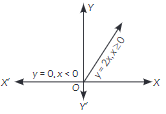
The set of all points where the function $f(x)=x+|x|$ is differentiable, is
View full question & answer→MCQ 251 Mark
If $f(x)=\cos ^{-1} \sqrt{x}$, 0 < x < 1, which of the following is aqual to $f^{\prime}(x) ?$
AnswerCorrect option: D. $\frac{-1}{2 \sqrt{x(1-x)}}$
$\frac{-1}{2 \sqrt{x(1-x)}}$
View full question & answer→MCQ 261 Mark
If $y=\log \left(\sin e^x\right)$, then $\frac{d y}{d x}$ is
Answer$y=\log \left(\sin e^x\right)$
Differentiating w.r.t. $x$, we get
$\begin{aligned}
\frac{d y}{d x}= & \frac{1}{\sin e^x} \cdot \frac{d}{d x}\left(\sin e^x\right)=\frac{1}{\sin e^x} \cos e^x \cdot \frac{d}{d x} e^x=\frac{1}{\sin e^x} \cos e^x \cdot e^x \\
& =e^x \cot e^x
\end{aligned}
$
View full question & answer→MCQ 271 Mark
The value of $k$ for which $f(x)=\left\{\begin{array}{cc}3 x+5, & x \geq 2 \\ k x^2, & x<2\end{array}\right.$ is a continuous functions, is:
- A
$-\frac{11}{4}$
- B
$\frac{4}{11}$
- C
- D
$\frac{11}{4}$
AnswerGiven Function is
$f(x)=\left\{\begin{array}{cc}
3 x+5, & x \geq 2 \\
k x^2, & x<2
\end{array}\right.
$
For a function $f(x)$ to be continuous at $x=a$,
L.H.L of $f(x)$ at $a=$ R.H.L. of $f(x)$ at $a$
i.e., $\lim _{x \rightarrow a^{-}} f(x)=\lim _{x \rightarrow a^{+}} f(x)$
$\Rightarrow \quad \lim _{h \rightarrow 0} k(2-h)^2=\lim _{h \rightarrow 0} 3(2+h)+5 \Rightarrow 4 \times k=11 \Rightarrow k=\frac{11}{4}
$
View full question & answer→MCQ 281 Mark
If $(\cos x)^y=(\cos y)^x$, then $\frac{d y}{d x}$ is equal to:
- A
$\frac{y \tan x+\log (\cos y)}{x \tan y-\log (\cos x)}$
- B
$\frac{x \tan y+\log (\cos x)}{y \tan x+\log (\cos y)}$
- C
$\frac{y \tan x-\log (\cos y)}{x \tan y-\log (\cos x)}$
- D
$\frac{y \tan x+\log (\cos y)}{x \tan y+\log (\cos x)}$
AnswerGiven, $(\cos x)^y=(\cos y)^x$
Taking log on both sides, we get
$\log \left[(\cos x)^y\right]=\log \left[(\cos y)^x\right] \Rightarrow y \log (\cos x)=x \log (\cos y)$
Differentiate w.r.t. $x$, we get
$\begin{array}{l}
\frac{d y}{d x} \log (\cos x)+\frac{y}{\cos x}(-\sin x)=\log (\cos y)+\frac{x}{\cos y}(-\sin y) \cdot \frac{d y}{d x} \\
\Rightarrow \frac{d y}{d x}(\log (\cos x)+x \tan y)=\log (\cos y)+y \tan x \\
\Rightarrow \frac{d y}{d x}=\frac{y \tan x+\log (\cos y)}{x \tan y+\log (\cos x)}
\end{array}
$
View full question & answer→MCQ 291 Mark
If $x=A \cos 4 t+B \sin 4 t$, then $\frac{d^2 x}{d t^2}$ is equal to
AnswerWe have, $x=A \cos 4 t+B \sin 4 t$
Differentiating both sides w.r.t. t, we get
$
\frac{d x}{d t}=A \cdot(-\sin 4 t) \cdot 4+B \cos 4 t \cdot 4
$
Again differentiating both sides of (i) w.r.t. t, we get
$
\begin{array}{l}
\frac{d^2 x}{d t^2}=-4 A(\cos 4 t) \cdot 4+4 B(-\sin 4 t) \cdot 4 \\
=-16 A \cos 4 t-16 B \sin 4 t=-16(A \cos 4 t+B \sin 4 t)=-16 x
\end{array}
$
View full question & answer→MCQ 301 Mark
The derivative of $x^{2 x}$ w.r.t. $x$ is
- A
$x^{2 x-1}$
- B
$2 x^{2 x} \log x$
- C
$2 x^{2 x}(1+\log x)$
- D
$2 x^{2 x}(1-\log x)$
AnswerLet $y=x^{2 x}$
Taking log on both sides, we get
$
\log y=2 x \log x
$
Differentiating both sides w.r.t. $x$, we get
$
\begin{aligned}
& \frac{1}{y} \frac{d y}{d x}=2\left\{x \cdot \frac{1}{x}+\log x \cdot 1\right\} \\
\Rightarrow & \frac{d y}{d x}=2 y\{1+\log x\}=2 x^{2 x}(1+\log x)
\end{aligned}
$
View full question & answer→MCQ 311 Mark
If $x=a \cos \theta+b \sin \theta, y=a \sin \theta-b \cos \theta$, then which one of the following is true?
- A
$y^2 \frac{d^2 y}{d x^2}-x \frac{d y}{d x}+y=0$
- B
$y^2 \frac{d^2 y}{d x^2}+x \frac{d y}{d x}+y=0$
- C
$y^2 \frac{d^2 y}{d x^2}+x \frac{d y}{d x}-y=0$
- D
$y^2 \frac{d^2 y}{d x^2}-x \frac{d y}{d x}-y=0$
AnswerGiven, $x=a \cos \theta+b \sin \theta$ and $y=a \sin \theta-b \cos \theta$ Differentiate w.r.t $\theta$, we get
$
\frac{d x}{d \theta}=-a \sin \theta+b \cos \theta \text { and } \frac{d y}{d \theta}=a \cos \theta+b \sin \theta
$
Now, $\frac{d y}{d x}=\frac{d y}{d \theta} \times \frac{d \theta}{d x}=\frac{a \cos \theta+b \sin \theta}{-(a \sin \theta-b \cos \theta)}=\frac{x}{-y}$
$
\Rightarrow \frac{d y}{d x}=\frac{-x}{y}
$
Differentiate (i) w.r.t. $x$, we get
$
\begin{aligned}
& \frac{d^2 y}{d x^2}=\frac{y(-1)+x(d y / d x)}{y^2} \\
\Rightarrow & y^2 \frac{d^2 y}{d x^2}=-y+\frac{x d y}{d x} \Rightarrow y^2 \frac{d^2 y}{d x^2}-\frac{x d y}{d x}+y=0
\end{aligned}
$
View full question & answer→MCQ 321 Mark
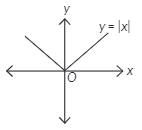
The function $f(x)=|x|$ is
View full question & answer→MCQ 331 Mark
The value of ' $k$ ' for which the function $f(x)=\left\{\begin{array}{cll}\frac{1-\cos 4 x}{8 x^2}, & \text { if } & x \neq 0 \\ k, & \text { if } & x=0\end{array}\right.$ is continuous at $x=0$ is
AnswerGiven, the function $f$ is continuous at $x=0$.
$\therefore \quad \lim _{x \rightarrow 0} f(x)=f(0)$.
Now, $\lim _{x \rightarrow 0} f(x)$
$
\begin{array}{l}
=\lim _{x \rightarrow 0} \frac{1-\cos 4 x}{8 x^2}=\lim _{x \rightarrow 0} \frac{2 \sin ^2 2 x}{8 x^2}=\lim _{x \rightarrow 0} \frac{\sin ^2 2 x}{4 x^2} \\
=\lim _{x \rightarrow 0}\left(\frac{\sin 2 x}{2 x}\right)^2=1
\end{array}
$Also, $f(0)=k$
Hence $k=1$
View full question & answer→MCQ 341 Mark
If $y=\log _e\left(\frac{x^2}{e^2}\right)$, then $\frac{d^2 y}{d x^2}$ equals
- A
$-\frac{1}{x}$
- B
$-\frac{1}{x^2}$
- C
$\frac{2}{x^2}$
- D
$-\frac{2}{x^2}$
Answer$\begin{array}{l}\text { 84. (d) : We have, } y=\log _e\left(\frac{x^2}{e^2}\right) \\ \therefore \quad \frac{d y}{d x}=\frac{e^2}{x^2} \cdot \frac{1}{e^2} \cdot 2 x=\frac{2}{x} \Rightarrow \frac{d^2 y}{d x^2}=-\frac{2}{x^2}\end{array}$
View full question & answer→MCQ 351 Mark
If $\sec ^{-1}\left(\frac{1+x}{1-y}\right)=a$, then $\frac{d y}{d x}$ is equal to
- A
$\frac{x-1}{y-1}$
- B
$\frac{x-1}{y+1}$
- C
$\frac{y-1}{x+1}$
- D
$\frac{y+1}{x-1}$
AnswerGiven, $\sec ^{-1}\left(\frac{1+x}{1-y}\right)=a \Rightarrow \sec a=\frac{1+x}{1-y}$
On differentiating, we get
$\frac{(1-y)+(1+x) \frac{d y}{d x}}{(1-y)^2}=0 \Rightarrow(1+x) \frac{d y}{d x}=y-1 \Rightarrow \frac{d y}{d x}=\frac{y-1}{1+x}
$
View full question & answer→MCQ 361 Mark
If $x=f(t)$ and $y=g(t)$ are differentiable functions of $t$, then $\frac{d^2 y}{d x^2}$ is
- ✓
$\frac{f^{\prime}(t) \cdot g^{\prime \prime}(t)-g^{\prime}(t) \cdot f^{\prime \prime}(t)}{\left[f^{\prime}(t)\right]^3}$
- B
$\frac{f^{\prime}(t) \cdot g^{\prime \prime}(t)-g^{\prime}(t) \cdot f^{\prime \prime}(t)}{\left[f^{\prime}(t)\right]^2}$
- C
$\frac{g^{\prime}(t) \cdot f^{\prime \prime}(t)-f^{\prime}(t) \cdot g^{\prime \prime}(t)}{\left[f^{\prime}(t)\right]^3}$
- D
$\frac{g^{\prime}(t) \cdot f^{\prime \prime}(t)+f^{\prime}(t) \cdot g^{\prime \prime}(t)}{\left[f^{\prime}(t)\right]^3}$
AnswerCorrect option: A. $\frac{f^{\prime}(t) \cdot g^{\prime \prime}(t)-g^{\prime}(t) \cdot f^{\prime \prime}(t)}{\left[f^{\prime}(t)\right]^3}$
(a) : We have, $x=f(t), y=g(t)$
$
\Rightarrow \quad \frac{d x}{d t}=f^{\prime}(t) \text { and } \frac{d y}{d t}=g^{\prime}(t)
$
Now, $\frac{d y}{d x}=\frac{\frac{d y}{d t}}{\frac{d x}{d t}}=\frac{g^{\prime}(t)}{f^{\prime}(t)}$
$
\begin{aligned}
\Rightarrow \quad \frac{d^2 y}{d x^2} & =\frac{f^{\prime}(t) \cdot g^{\prime \prime}(t)-g^{\prime}(t) \cdot f^{\prime \prime}(t)}{\left(f^{\prime}(t)\right)^2} \cdot \frac{d t}{d x} \\
& =\frac{f^{\prime}(t) \cdot g^{\prime \prime}(t)-g^{\prime}(t) \cdot f^{\prime \prime}(t)}{\left(f^{\prime}(t)\right)^2} \cdot \frac{1}{f^{\prime}(t)} \\
& =\frac{f^{\prime}(t) \cdot g^{\prime \prime}(t)-g^{\prime}(t) f^{\prime \prime}(t)}{\left(f^{\prime}(t)\right)^3}
\end{aligned}
$
View full question & answer→MCQ 371 Mark
If $y=\tan ^{-1}(\sqrt{x})-\tan ^{-1}(x)$, then $y^{\prime}(1)$ is equal to
- A
- B
$\frac{1}{2}$
- C
- ✓
$-\frac{1}{4}$
AnswerCorrect option: D. $-\frac{1}{4}$
(d) : $y=\tan ^{-1}(\sqrt{x})-\tan ^{-1}(x)$
Differentiating w.r.t. $x$, we get
$
y^{\prime}(x)=\frac{1}{1+x} \cdot \frac{1}{2 \sqrt{x}}-\frac{1}{1+x^2} \Rightarrow y^{\prime}(1)=\frac{1}{2} \cdot \frac{1}{2}-\frac{1}{2}=-\frac{1}{4}
$
View full question & answer→MCQ 381 Mark
Determine the value of $k$ for which the function $f(x)$ is continuous at $x=4$.
$
f(x)=\left\{\begin{array}{ll}
\frac{x^2-16}{x-4}, & x \neq 4 \\
k, & x=4
\end{array}\right.
$
Answer(d): Since $f(x)$ is continuous at $x=4$. Therefore,
$
\begin{array}{l}
\lim _{x \rightarrow 4} f(x)=f(4) \\
\Rightarrow \lim _{x \rightarrow 4} f(x)=k \quad[\because f(4)=k] \\
\Rightarrow \lim _{x \rightarrow 4} \frac{x^2-16}{x-4}=k \quad \Rightarrow \lim _{x \rightarrow 4} \frac{(x-4)(x+4)}{x-4}=k \\
\Rightarrow \lim _{x \rightarrow 4}(x+4)=k \Rightarrow k=8
\end{array}
$
View full question & answer→MCQ 391 Mark
Let $y=t^{10}+1$ and $x=t^8+1$, then $\frac{d^2 y}{d x^2}$ is equal to
Answer(b) : We have, $y=t^{10}+1, x=t^8+1$
$
\begin{array}{l}
\Rightarrow \frac{d y}{d t}=10 t^9, \frac{d x}{d t}=8 t^7 \therefore \frac{d y}{d x}=\frac{d y / d t}{d x / d t}=\frac{10 t^9}{8 t^7}=\frac{5}{4} t^2 \\
\Rightarrow \frac{d^2 y}{d x^2}=\frac{5}{4}(2 t) \frac{d t}{d x}=\frac{5}{4} \times 2 t \times \frac{1}{8 t^7}=\frac{5}{16 t^6}
\end{array}
$
View full question & answer→MCQ 401 Mark
If the function $f(x)=\left\{\begin{array}{cc}\frac{\sin x^2}{x} ; & x \neq 0 \\ 0 ; & x=0\end{array}\right.$, is differentiable at $x=0$, then right hand derivative of $f(x)$ at $x=0$ is
- A
$\frac{1}{2}$
- B
$-\frac{1}{2}$
- ✓
- D
Answer(c) : At $x=0$, right hand derivative
$
\begin{aligned}
f^{\prime}(0) & =\lim _{h \rightarrow 0} \frac{f(0+h)-f(0)}{h} \\
& =\lim _{h \rightarrow 0} \frac{f(h)-f(0)}{h}=\lim _{h \rightarrow 0} \frac{\frac{\sin h^2}{h}-0}{h}=\lim _{h \rightarrow 0} \frac{\sin h^2}{h^2}=1
\end{aligned}
$
View full question & answer→MCQ 411 Mark
The function $f(x)=\cot x$ is discontinuous on the set
- ✓
$\{x=n \pi ; n \in Z\}$
- B
$\{x=2 n \pi ; n \in Z\}$
- C
$\left\{x=(2 n+1) \frac{\pi}{2} ; n \in Z \right\}$
- D
$\left\{x=\frac{n \pi}{2} ; n \in Z \right\}$
AnswerCorrect option: A. $\{x=n \pi ; n \in Z\}$
(a) : $f(x)=\cot x$ is discontinuous if $\cot x \rightarrow \infty$
$\Rightarrow \cot x=\cot 0 \Rightarrow x=n \pi \forall n \in Z$.
View full question & answer→MCQ 421 Mark
If $y=\log _a x+\log _x a+\log _x x+\log _a a$, then $\frac{d y}{d x}$ is equal to
- A
$\frac{1}{x}+x \log a$
- B
$\frac{\log a}{x}+\frac{x}{\log a}$
- C
$\frac{1}{x \log a}+x \log a$
- D
$\frac{1}{x \log a}-\frac{\log a}{x(\log x)^2}$
Answer$\begin{array}{l}\text { (d): } \because y=\log _a x+\frac{\log a}{\log x}+1+1 \quad\left\{\because \log _x x=1\right\} \\ \Rightarrow \frac{d y}{d x}=\frac{1}{x} \log _a e-\log a\left(\frac{1}{\log x}\right)^2 \frac{1}{x}=\frac{1}{x \log a}-\frac{\log a}{x(\log x)^2}\end{array}$
View full question & answer→MCQ 431 Mark
The derivative of $e^{x^3}$ with respect to $\log x$ is
- A
$e^{x^3}$
- B
$3 x^2 2 e^{x^3}$
- ✓
$3 x^3 e^{x^3}$
- D
$3 x^2 e^{x^3}+3 x^2$
AnswerCorrect option: C. $3 x^3 e^{x^3}$
(c) : Let $y=e^{x^3}, z=\log x$
Differentiating w.r.t. $x$, we get
$
\begin{array}{l}
\frac{d y}{d x}=e^{x^3}\left(3 x^2\right)=3 x^2 e^{x^3} \text { and } \frac{d z}{d x}=\frac{1}{x} \\
\therefore \quad \frac{d y}{d z}=\frac{\frac{d y}{d x}}{\frac{d z}{d x}}=\frac{3 x^2 e^{x^3}}{\left(\frac{1}{x}\right)}=3 x^3 e^{x^3}
\end{array}
$
View full question & answer→MCQ 441 Mark
If the function $f(x)=\left\{\begin{array}{l}\frac{\left(e^{k x}-1\right) \tan k x}{4 x^2}, x \neq 0 \\ 16, x=0\end{array}\right.$ is continuous at $x=0$, then $k=$
- A
$\pm \frac{1}{8}$
- B
$\pm 4$
- C
$\pm 2$
- ✓
$\pm 8$
AnswerCorrect option: D. $\pm 8$
(d) : Since, $f(x)$ is continuous at $x=0$.
$
\begin{array}{l}
\therefore \quad \lim _{x \rightarrow 0} f(x)=f(0) \Rightarrow \lim _{x \rightarrow 0} \frac{\left(e^{k x}-1\right) \tan k x}{4 x^2}=16 \\
\Rightarrow \frac{1}{4} \lim _{x \rightarrow 0} \frac{\left(e^{k x}-1\right)}{k x} \times \frac{\tan k x}{k x} \times k^2=16 \Rightarrow \frac{k^2}{4} \times 1 \times 1=16 \\
\Rightarrow k^2=64 \Rightarrow k= \pm 8
\end{array}
$
View full question & answer→MCQ 451 Mark
If $x^y=e^{x-y}$, then $\frac{d y}{d x}$ is
AnswerCorrect option: C. $\frac{\log x}{(1+\log x)^2}$
(c) : We have, $x^y=e^{x-y}$
Taking $\log$ on both sides, we get
$
y \log x=(x-y) \log e \Rightarrow y=\frac{x}{1+\log x}
$
Differentiating w.r.t. $x$, we get
$
\frac{d y}{d x}=\frac{(1+\log x)-x \cdot \frac{1}{x}}{(1+\log x)^2}=\frac{\log x}{(1+\log x)^2}
$
View full question & answer→MCQ 461 Mark
If $y=\cos ^2\left(\frac{3 x}{2}\right)-\sin ^2\left(\frac{3 x}{2}\right)$, then $\frac{d^2 y}{d x^2}$ is equal to
- A
- B
- C
$-9 y$
- D
$3 \sqrt{1-y^2}$
Answer$
\begin{array}{l}
\text { (c) : Given, } y=\cos ^2\left(\frac{3 x}{2}\right)-\sin ^2\left(\frac{3 x}{2}\right) \\
\Rightarrow y=\cos 3 x \Rightarrow \frac{d y}{d x}=-3 \sin 3 x \\
\Rightarrow \quad \frac{d^2 y}{d x^2}=-3 \times 3 \cos 3 x=-9 \cos 3 x=-9 y
\end{array}
$
View full question & answer→MCQ 471 Mark
If $f(x)=x^2 g(x)$ and $g(x)$ is twice differentiable, then $f^{\prime \prime}(x)$ is equal to
AnswerCorrect option: C. $x^2 g^{\prime \prime}(x)+4 x g^{\prime}(x)+2 g(x)$
(c) : $f^{\prime}(x)=\frac{d}{d x}\left(x^2 g(x)\right)=x^2 g^{\prime}(x)+2 x g(x)$
Now, $f^{\prime \prime}(x)=\frac{d}{d x}\left(x^2 g^{\prime}(x)+2 x g(x)\right)$
$
\begin{array}{l}
=x^2 g^{\prime \prime}(x)+g^{\prime}(x) 2 x+2\left\{x g^{\prime}(x)+g(x) \cdot 1\right\} \\
=x^2 g^{\prime \prime}(x)+4 x g^{\prime}(x)+2 g(x)
\end{array}
$
View full question & answer→MCQ 481 Mark
If $y=5 \cos x-3 \sin x$, then $\frac{d^2 y}{d x^2}$ is equal to
Answer$\begin{array}{l}\text { (a) : We have, } y=5 \cos x-3 \sin x \\ \Rightarrow \frac{d y}{d x}=-5 \sin x-3 \cos x \\ \Rightarrow \frac{d^2 y}{d x^2}=-5 \cos x+3 \sin x=-y\end{array}$
View full question & answer→MCQ 491 Mark
If $y=\frac{\ln x}{x}$, then the value of $y^{\prime \prime}(e)$ is
- A
- B
$-\frac{1}{e}$
- C
$-\frac{1}{e^2}$
- ✓
$-\frac{1}{e^3}$
AnswerCorrect option: D. $-\frac{1}{e^3}$
(d) : Given, $y=\frac{\ln x}{x}$
Differentiating w.r.t. $x$, we get
$
\begin{array}{l}
y^{\prime}=\frac{(1-\ln x)}{x^2} \Rightarrow y^{\prime \prime}=\frac{x^2\left(-\frac{1}{x}\right)-(1-\ln x) 2 x}{x^4} \\
\therefore \quad y^{\prime \prime}(e)=\frac{-e-0}{e^4}=-\frac{1}{e^3}
\end{array}
$
View full question & answer→MCQ 501 Mark
If $f(x)=-\sqrt{25-x^2}$, then $\lim _{x \rightarrow 1} \frac{f(x)-f(1)}{x-1}$ is equal to
- A
$\frac{1}{24}$
- B
$\frac{1}{5}$
- C
$-\sqrt{24}$
- ✓
$\frac{1}{\sqrt{24}}$
AnswerCorrect option: D. $\frac{1}{\sqrt{24}}$
(d) : $\lim _{x \rightarrow 1} \frac{f(x)-f(1)}{x-1}=f^{\prime}(1)$
Now, $f^{\prime}(x)=-\frac{1}{2} \cdot \frac{-2 x}{\sqrt{25-x^2}}=\frac{x}{\sqrt{25-x^2}}$
$
\therefore \quad f^{\prime}(1)=\frac{1}{\sqrt{25-1^2}}=\frac{1}{\sqrt{24}}
$
View full question & answer→