Questions · Page 1 of 2

2 Marks

🎯

Test yourself on this topic

50 questions · timed · auto-graded

Question 12 Marks
If A = {1, 2, 3, 4} and B = {a, b, c, d} define any four bijections from A to B. Also give their inverse functions.
Answer
f1 = {(1, a), (2, b), (3, c), (4, d)} $\Rightarrow\ \text{f}_1^{-1}=\{(\text{a},1), (\text{b},2), (\text{c},3),(\text{d},4)\}$

f2 = {(1, b), (2, a), (3, c), (4, d)} $\Rightarrow\ \text{f}_2^{-1}=\{(\text{b},1), (\text{a},2), (\text{c},3),(\text{d},4)\}$

f3 = {(1, a), (2, b), (4, c), (3, d)} $\Rightarrow\ \text{f}_3^{-1}=\{(\text{a},1), (\text{b},2), (\text{c},4),(\text{d},3)\}$

f4 = {(1, b), (2, a), (4, c), (3, d)} $\Rightarrow\ \text{f}_3^{-1}=\{(\text{b},1), (\text{a},2), (\text{c},4),(\text{d},3)\}$

Clearly, all these are bijections because they are one-one and onto.
View full question & answer
Question 22 Marks
If f : R → R is defined by f(x) = x2, write f-1(25).
Answer
Let f-1(25) = x ....(1)
⇒ f(x) = 25
⇒ x2 = 25
⇒ x2 - 25 = 0
⇒ (x - 5)(x + 5) = 0
$\Rightarrow\ \text{x}=\pm5$
⇒ f-1(25) = {-5, 5} [from (1)]
View full question & answer
Question 32 Marks
If f : R → R is given by f(x) = x3, write f-1(1).
Answer
Let f-1(1) = x .....(1)
⇒ f(x) = 1
⇒ x3 = 1
⇒ x3 - 1 = 0
⇒ (x - 1)(x2 + x + 1) = 0 [Using the identity: a3 - b3 = (a - b)(a2 + ab + b2)]
⇒ x = 1 $(\text{as x}\in\text{R})$
⇒ f-1(1) = {1} [from (1)]
View full question & answer
Question 42 Marks
Let $\text{f}:\text{R}-\Big\{-\frac{3}{5}\Big\}\rightarrow\ \text{R}$ be a function defined as $\text{f(x)}=\frac{2\text{x}}{5\text{x}+3}.$ Write f-1: Range of $\text{f}\rightarrow\ \text{R}-\Big\{-\frac{3}{5}\Big\}.$
Answer
Let f-1(x) = y ......(1)

⇒ f(y) = x

$\Rightarrow\ \frac{2\text{y}}{5\text{y}+3}=3\text{x}$

⇒ 2y = 5xy + 3x

⇒ 2y - 5xy = 3x

⇒ y(2 - 5x) = 3x

$\Rightarrow\ \text{y}=\frac{3\text{x}}{2-5\text{x}}$

$\Rightarrow\ \text{f}^{-1}(\text{x})=\frac{3\text{x}}{2-5\text{x}}$ [from 1]

View full question & answer
Question 52 Marks
Let A = {1, 2, 3}, B = {4, 5, 6, 7} and let f = {(1, 4), (2, 5), (3, 6)} be a function from A to B. State whether f is one-one or not.
Answer
f = {(1, 4), (2, 5), (3, 6)}
Here, different elements of the domain have different images in the co-domain.
So, f is one-one.
View full question & answer
Question 62 Marks
Show that the function f : R → {3} → R - {2} given by $\text{f(x)}=\frac{\text{x}-2}{\text{x}-3}$ is a bijection.
Answer
We have, f : R+ → R+ given by
f(x) = x2
g : R+ → R+ given by
$\text{g(x)}=\sqrt{\text{x}}$
$\therefore$ fog(x) = f(g(x))
$=\text{f}(\sqrt{\text{x}})=(\sqrt{\text{x}})^2=\text{x}$
Also, gof(x) = g(f(x))
$=\text{g}(\text{x}^2)=\sqrt{\text{x}^2}=\text{x}$
Thus,
fog(x) = gof(x)
View full question & answer
Question 72 Marks
If f : R → R is defined by f(x) = 10x - 7, then write f-1(x).
Answer
Let f-1(x) = y ......(1)
⇒ f(y) = x
⇒ 10y - 7 = x
⇒ 10y = x + 7
$\Rightarrow\ \text{y}=\frac{\text{x}+7}{10}$
$\Rightarrow\ \text{f}^{-1}(\text{x})=\frac{\text{x}+7}{10}$ [from (1)]
View full question & answer
Question 82 Marks
Let f : R - {-1} → R - {1} be given by $\text{f(x)}=\frac{\text{x}}{\text{x}+1}.$ Write f-1(x).
Answer
f : R - [-1] → R - [1] given by $\text{f(x)}=\frac{\text{x}}{\text{x}+1}$
$\Rightarrow\ \text{f}^{-1}\Big(\frac{\text{x}}{\text{x}+1}\Big)=\text{x}$
$\Rightarrow\ \text{f}^{-1}(\text{x})=\frac{\text{x}}{1-\text{x}}$
$\because$ Let $\frac{\text{x}}{\text{x}+1}=\text{y}$
$\Rightarrow\ \text{x}=\text{xy}+\text{y}$
$\Rightarrow\ \text{x}(1-\text{y})=\text{y}$
$\Rightarrow\ \text{x}=\frac{\text{y}}{1-\text{y}}$
$\Rightarrow\ \text{f}^{-1}(\text{x})=\frac{\text{x}+7}{10}$
View full question & answer
Question 92 Marks
Let f : R → R+ be defined by f(x) = ax, a > 0 and $\text{a}\neq1.$ Write f-1(x).
Answer
Let f-1(x) = y .......(1)
⇒ f(y) = x
⇒ ay = x
$\Rightarrow\ \text{y}=\log_\text{a}\text{x}$
$\Rightarrow\ \text{f}^{-1}(\text{x})=\log_\text{a}\text{x}$ [from (1)]
View full question & answer
Question 102 Marks
If f(x) = 4 - (x - 7)3, then write f-1(x).
Answer
We have,

f(x) = 4 - (x - 7)3

Let y = 4 - (x - 7)3

$\Rightarrow\ (\text{x} - 7)^3 = 4 - \text{y}$

$\Rightarrow\ \text{x}-7=\sqrt[3]{4-\text{y}}$

$\Rightarrow\ \text{x}=7+\sqrt[3]{4-\text{y}}$

$\Rightarrow\ \text{f}^{-1}(\text{y})=7+\sqrt[3]{4-\text{y}}$

$\therefore\ \text{f}^{-1}(\text{x})=7+\sqrt[3]{4-\text{x}}$

View full question & answer
Question 112 Marks
Let $\text{f(x)=}\begin{cases}1+\text{x,}&0\leq\text{x}\leq2\\3-\text{x,}&2<\text{x}\leq3\end{cases}.$ Find fof.
Answer
$\text{f(x)=}\begin{cases}1+\text{x,}&0\leq\text{x}\leq2\\3-\text{x,}&2<\text{x}\leq3\end{cases}$
$\therefore$ Range of $\text{f}=[0,3]\subseteq$ Domain of f.
$\therefore$ fof(x) = f(f(x))
$=\text{f}\begin{cases}1+\text{x,}&0\leq\text{x}\leq2\\3-\text{x,}&2<\text{x}\leq3\end{cases}$
$\text{fof(x)}=\begin{cases}2+\text{x},&0\leq\text{x}\leq1\\2-\text{x},&1<\text{x}\leq2\\4-\text{x},&2<\text{x}\leq3\end{cases}$
View full question & answer
Question 122 Marks
If f(x) = 2x + 5 and g(x) = x2 + 1 be two real functions, then describe the following functions:
fog
Also, show that fof ≠ f2
Answer
f(x) and g(x) are polynomials.
⇒ f : R → R and g : R → R.
So, fog : R → R and gof : R → R.
(fog)(x) = f(g(x))
= f(x2 + 1)
= 2(x2 + 1) + 5
= 2x2 + 2 + 5
= 2x2 + 7
View full question & answer
Question 132 Marks
Let f : R → R, g : R → R be two functions defined by f(x) = x2 + x + 1 and g(x) = 1 - x2. Write fog (-2).
Answer
(fog)(-2) = f(g(-2))
= f(1 - (-2)2)
= f(-3)
= (-3)2 + (-3) + 1
= 9 - 3 + 1
= 7
View full question & answer
Question 142 Marks
If f : R → R is defined by f(x) = 3x + 2, find f(f(x)).
Answer
f(f(x)) = f(3x + 2)
= 3(3x + 2) + 2
= 9x + 6 + 2
= 9x + 8
View full question & answer
Question 152 Marks
If f : R → R, g : R → R are given by f(x) = (x + 1)2 and g(x) = x2 + 1, then write the value of fog(-3).
Answer
(fog)(-3) = f(g(-3))
= f((-3)2 + 1)
= f(10)
= (10 + 1)2
= 121
View full question & answer
Question 162 Marks
Let A and B be two sets, each with a finite number of elements. Assume that there is an injective map from A to B and that there is an injective map from B to A. Prove that there is a bijection from A to B.
Answer
A and B are two non empty sets.
Let f be a function from A to B. It is given that there is injective map from A to B. That means f is one-one function. It is also given that there is injective map from B to A. That means every element of set B has its image in set A.
f is onto function or surjective.
$\therefore$ f is bijective.
If a function is both injective and surjective, then the function is bijective.
View full question & answer
Question 172 Marks
Write the domain of the real function $\text{f(x)}=\sqrt{[\text{x}]-\text{x}}.$
Answer
[x] is the greatest integral function.
Therefore, $0\leq\text{x}-[\text{x}]<1$
$\Rightarrow\ \sqrt{\text{x}-[\text{x}]}$ exists for every $\text{x}\in\text{R}$
⇒ Domain = R
View full question & answer
Question 182 Marks
Let f be a real function given by $\text{f(x)}=\sqrt{\text{x}-2}.$ Find the following:
f2
Also, show that fof ≠ f2.
Answer
We have, $\text{fof}=\sqrt{\sqrt{\text{x}-2}-2}$
⇒ f2(x) = f(x) × f(x)
$=\sqrt{\text{x}-2}\times\sqrt{\text{x}-2}=\text{x}-2$
So, $\text{fof}\neq\text{f}^2$
View full question & answer
Question 192 Marks
Are the following set of ordered pairs functions? If so, examine whether the mapping is injective or surjective:
{(a, b): a is a person, b is an ancestor of a}
Answer
g = {(a, b): a is a person, h is an ancestor of a}
Since,the ordered map (a, b) does not map 'a' - a person to a living person.
Therefore, g is not a function.
View full question & answer
Question 202 Marks
Classify the following functions as injection, surjection or bijection:
f : N → N given by f(x) = x2
Answer
f : N → N given by f(x) = x2

Let x1 = x2 for $\text{x}_1,\text{ x}_2\in\text{N}$

$\text{x}_1^2=\text{x}_2^2\Rightarrow\ \text{f}(\text{x}_1)=\text{f}(\text{x}_2)$

$\therefore$ f is one-one.

Surjectivity: Since f takes only square value like 1, 4, 9, 16 .....

So, non-perfect square values in N $(\infty-\text{domain})$ do not have pre image in domain N.

Thus, f is not onto.

View full question & answer
Question 212 Marks
Write the domain of the real function $\text{f(x)}=\sqrt{\text{x}-[\text{x}]}.$
Answer
We have, $\text{f(x)}=\sqrt{\text{x}-[\text{x}]}$
The domain of will be real only if
$\text{x}-[\text{x}]\geq0$
⇒ Domain of f = x for all $\text{x}\in\text{R}$
$\therefore$ Domain of f = R
$[\because\ \text{f(x)}=\text{x}-[\text{x}]=\text{x}\ \forall\ \text{x}\in\text{R}]$
View full question & answer
Question 222 Marks
If f(x) = x + 7 and g(x) = x - 7, x ∈ R, write fog (7).
Answer
(fog)(7) = f(g(7))
= f(7 - 7)
= f(0)
= 0 + 7
= 7
View full question & answer
Question 232 Marks
If f(x) = 2x + 5 and g(x) = x2 + 1 be two real functions, then describe the following functions:
fof
Also, show that fof ≠ f2
Answer
f(x) and g(x) are polynomials.
⇒ f : R → R and g : R → R.
So, fog : R → R and gof : R → R.
(fof)(x) = f(f(x))
= f(2x + 5)
= 2(2x + 5) + 5
= 4x + 10 + 5
= 4x + 15
View full question & answer
Question 242 Marks
Find the number of all onto functions from the set A = {1, 2, 3, ..., n} to itself.
Answer
We know that every onto function from A to itself is one-one.
Therefore, the number of one-one functions = number of bijections =n!
View full question & answer
Question 252 Marks
If f : R → R be defined by $\text{f(x)} = (3 - \text{x}^3)^\frac{1}{3},$ then find fof(x).
Answer
f : R → R defined by $\text{f(x)}=(3-\text{x}^3)^\frac{1}{3}$
$\therefore$ fof(x) = f(f(x))
$=\text{f}(3-\text{x}^3)^\frac{1}{3}$
$=\bigg\{3-\Big[(3-\text{x}^3)^\frac{1}{3}\Big]^3\bigg\}^\frac{1}{3}$
$=\{3-3+\text{x}^3\}^\frac{1}{3}$
$\therefore$ fof(x) = x
View full question & answer
Question 262 Marks
If f(x) = 2x + 5 and g(x) = x2 + 1 be two real functions, then describe the following functions:

f2

Also, show that fof ≠ f2

Answer
f(x) and g(x) are polynomials.
⇒ f : R → R and g : R → R.
So, fog : R → R and gof : R → R.
f2(x) = f(x) × f(x)
= (2x + 5)(2x + 5)
= (2x + 5)2
= 4x2 + 20x + 25
View full question & answer
Question 272 Marks
Let f : R → R and g : R → R be defined by f(x) = x2 and g(x) = x + 1. Show that fog ≠ gof.
Answer
Given,  f : R → R and g : R → R.
So, the domains of f and g are the same.
(fog)(x) = f(g(x)) = f(x + 1) = (x + 1)2 = x2 + 1 + 2x
(gof)(x) = g(f(x)) = g(x2) = x2 + 1
So, fog ≠ gof.
View full question & answer
Question 282 Marks
If f : C → C is defined by f(x) = (x - 2)3, write f-1(-1).
Answer
Let f-1(1) = x ......(1)
⇒ f(x) = -1
⇒ (x - 2)3 = -1
$\Rightarrow\ \text{x}-2=-1\ \text{or }-\omega\text{ or }-\omega^2$
as the roots of $(-1)^\frac{1}{3}$ are $-1,-\omega\text{ and }-\omega^2,$ where $\omega=\frac{1\pm\text{i}\sqrt{3}}{2}$
$\Rightarrow\ \text{x}=-1+2\text{ or }2-\omega\text{ or }2-\omega^2=1,2-\omega,2-\omega$
$\Rightarrow\ \text{f}^{-1}(-1)=1,2-\omega,2-\omega^2$ [from 1]
View full question & answer
Question 292 Marks
If A = {a, b, c} and B = {-2, -1, 0, 1, 2}, write the total number of one-one functions from A to B.
Answer
A = {a, b, c}, B = {-2, -1, 0, 1, 2}
The total number of one-one function is
$^{\text{n}}\text{C}_\text{m}\times\text{m}!$ (where n = number of elements of B = 5, m = number of elements of A = 3.)
$=\ ^5\text{C}_3\times3!$
$=10\times6=60$
View full question & answer
Question 302 Marks
Let C denote the set of all complex numbers. A function f : C → C is defined by f(x) = x3. Write f-1(1).
Answer
f : R → R defined by f(x) = x3
$\therefore$ f-1(x3) = x
$\Rightarrow\ \text{f}^{-1}(1)=\{1,\omega,\omega^2\}$ $[\because\ \sqrt[3]{1}=\{1,\omega,\omega^2\}]$
View full question & answer
Question 312 Marks
Find gof and fog when f : R → R and g : R → R are defined by:
f(x) = 2x + x2 and g(x) = x3
Answer
Given: f : R → R and g : R → R
Therefore, gof : R → R and fog : R → R
f(x) = 2x + x2 and g(x) = x3
gof(x) = g(f(x)) = g(2x + x2)
gof(x) = g(2x + x2)3
fog(x) = f(g(x)) = f(x3)
$\therefore$ fog(x) = 2x3 + x6
View full question & answer
Question 322 Marks
Which of the following functions from A to B are one-one and onto?
f2 = {(2, a), (3, b), (4, c)}; A = {2, 3, 4}, B = {a, b, c}
Answer
f2 = {(2, a), (3, b), (4, c)}

A = {2, 3, 4}, B = {a, b, c}

It in not clear that different elements of A have different images in B.

$\therefore$ f2 in not one-one.

Again, each element of B is the image of some element of A.

$\therefore$ f2 in not on to.

View full question & answer
Question 332 Marks
If f : C → C is defined by f(x) = x4, write f-1(1).
Answer
Let f-1(1) = x ......(1)
⇒ f(x) = 1
⇒ x4 = 1
⇒ x4 - 1 = 0
⇒ (x2 - 1)(x2 + 1) = 0 [Using identity: a2 - b2 = (a - b)(a + b)]
⇒ (x - 1)(x + 1)(x - i)(x + i) = 0 where $\text{i}=\sqrt{-1}$ [Using identity: a2 - b2 = (a - b)(a + b)]
$\Rightarrow\ \text{x}=\pm1,\pm\text{i}$
⇒ f-1(1) = {-1, 1, i, -i} [from (1)]
View full question & answer
Question 342 Marks
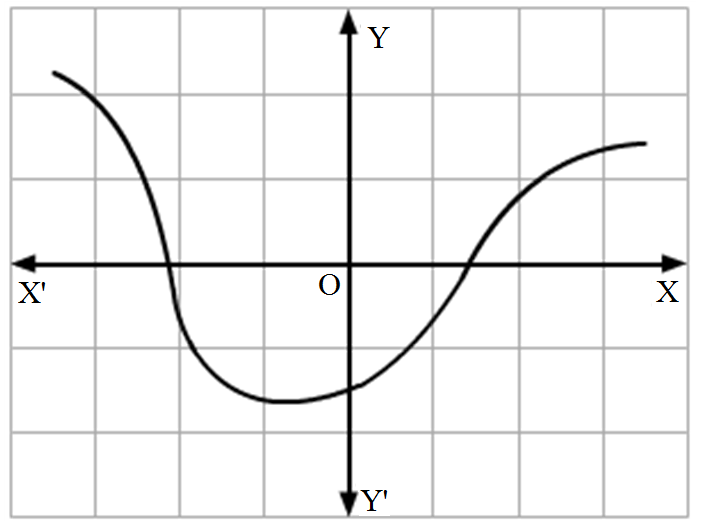
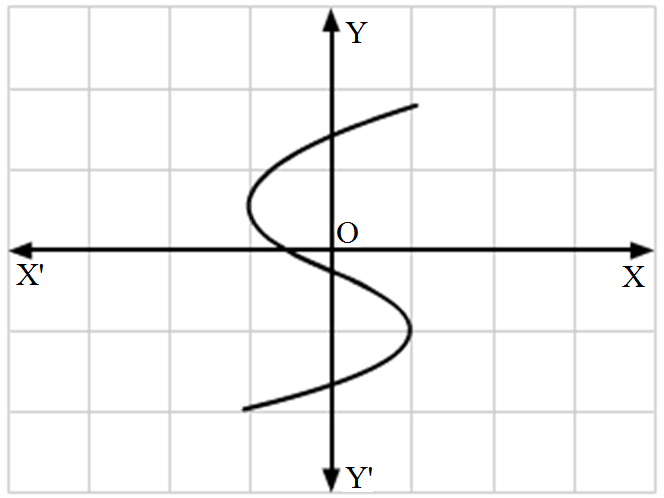
Which one of the following graphs represents a function?

  1.  

  1.  

Answer
Figure (a) represents a function f : R → R
Whereas fig (b) does not represent a function.
View full question & answer
Question 352 Marks
If f : A → A, g : A → A are two bijections, then prove that:
fog is an injection.
Answer
Given: A → A, g : A → A are two bijections.
Then, fog : A → A
Injectivity of fog: Let x and y be two elements of the domain (A), such that
(fog)(x) = (fog)(y)
⇒ f(g(x)) = f(g(y))
⇒ g(x) = g(y) (As, f is one-one)
⇒ x = y (As, g is one-one)
So, fog is an injection.
View full question & answer
Question 362 Marks
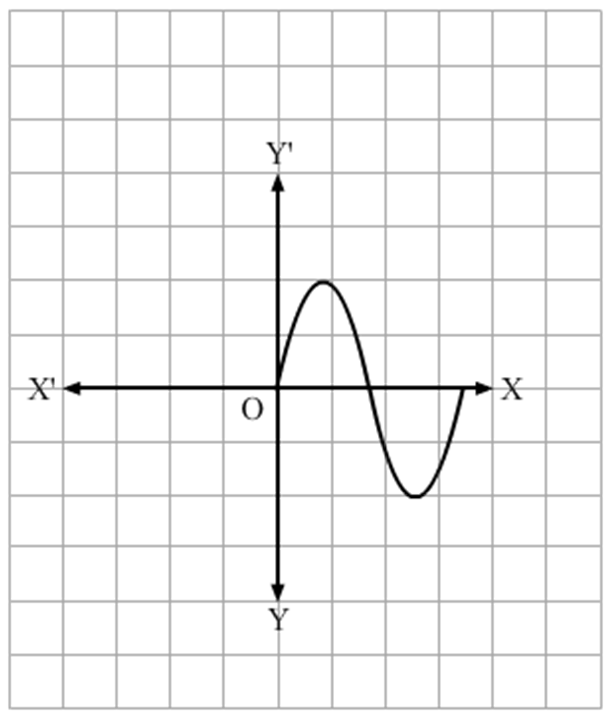
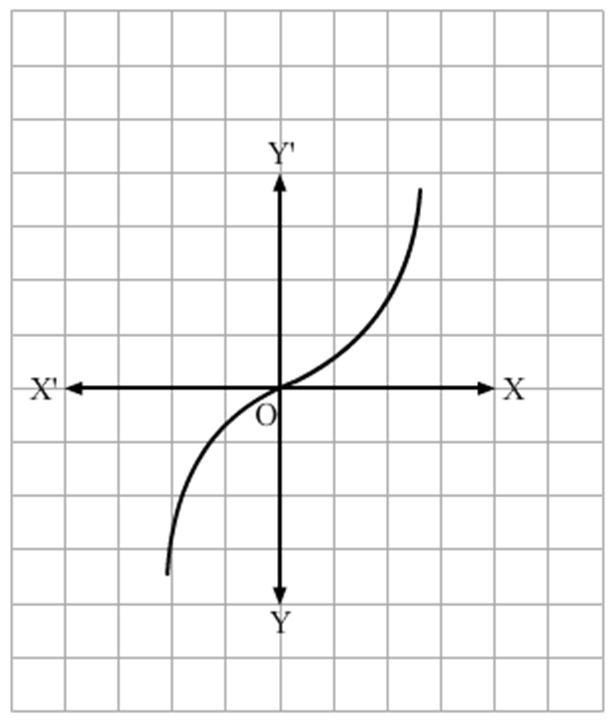
Which of the following graphs represents a one-one function?

  1.  

  1.  

Answer
In the graph of (b), different elements on the x-axis have different images on the y-axis. But in (a), the graph cuts the x-axis at 3 points, which means that 3 points on the x-axis have the same image as O and hence, it is not one-one.
View full question & answer
Question 372 Marks
If f : R → R be defined by f(x) = x4, write f-1(1).
Answer
Let f-1(1) = x ......(1)
⇒ f(x) = 1
⇒ x4 = 1
⇒ x4 - 1 = 0
⇒ (x2 - 1)(x2 + 1) = 0 [Using identity: a2 - b2 = (a - b)(a + b)]
⇒ (x - 1)(x + 1)(x2 + 1) = 0 [Using identity: a2 - b2 = (a - b)(a + b)]
$\Rightarrow\ \text{x}=\pm1\ [\text{as x}\in\text{R}]$
⇒ f-1(1) = {-1, 1} [from (1)]
View full question & answer
Question 382 Marks
If f : A → B is an injection, such that range of f = {a}, determine the number of elements in A.
Answer
Range of f = {a}
Therefore, the number of images of f = 1
Since, is an injection, there will be exactly one image for each element of f.
Therefore, number of element in A = 1.
View full question & answer
Question 392 Marks
Write the domain of the real function $\text{f(x)}=\frac{1}{\sqrt{|\text{x}|-\text{x}}}.$
Answer
Case-1: When x > 0
|x| = x
$\Rightarrow\ \frac{1}{\sqrt{|\text{x}|-\text{x}}}=\frac{1}{\sqrt{\text{x}-\text{x}}}=\frac{1}{0}=\infty$
Case-2: When x < 0
|x| = -x
$\Rightarrow\ \frac{1}{\sqrt{|\text{x}|-\text{x}}}=\frac{1}{\sqrt{-\text{x}-\text{x}}}=\frac{1}{\sqrt{-2\text{x}}}$ (exists because when x < 0, -2x > 0)
⇒ f(x) is defined when x < 0
So, domain $=(-\infty,0)$
View full question & answer
Question 402 Marks
Write the total number of one-one functions from set A = {1, 2, 3, 4} to set B = {a, b, c}.
Answer
A has 4 elements and B has 3 elements.
Also, one-one function is only possible from A to B if nA ≤ nB.
But, here nA > nB
So, the number of one-one functions from A to B is 0.
View full question & answer
Question 412 Marks
Let A = {1, 2, 3, 4} and B = {a, b} be two sets. Write the total number of onto functions from A to B.
Answer
When two sets A and B have m and n elements respectively, then the number of onto functions from A to B is,

$\begin{cases}\sum_{\text{r}=1}^\text{n}(-1)^\text{r}\text{ nC}_\text{r}\text{r}^\text{m},&\text{if m}\geq\text{n}\\0,&\text{if m}<\text{n}\end{cases}$

Here, number of elements in A = 4 = m

Number of elements in B = 2 = n

So, m > n

Number of onto functions

$=\sum_{\text{r}=1}^2(-1)^\text{r}2\text{C}_\text{r}\text{r}^4$

$= (-1)^12\text{C}_11^4 + (-1)^22\text{C}_22^4$

$= -2 + 16$

$= 14$

View full question & answer
Question 422 Marks
If A = {1, 2, 3} and B = {a, b}, write the total number of functions from A to B.
Answer
If set A has m elements and set B has n elements, then the number of functions from A to B is nm.
Given: A = {1, 2, 3} and B = {a, b}
⇒ n(A) = 3 and n(B) = 2
$\therefore$ Number of functions from A to B = 23 = 8
View full question & answer
Question 432 Marks
If f(x) = 2x + 5 and g(x) = x2 + 1 be two real functions, then describe the following functions:
gof
Also, show that fof ≠ f2
Answer
f(x) and g(x) are polynomials.
⇒ f : R → R and g : R → R.
So, fog : R → R and gof : R → R.
(gof)(x) = g(f(x))
= g(2x + 5)
= (2x + 5)2 + 1
= 4x2 + 20x + 26
View full question & answer
Question 442 Marks
If f : C → C is defined by f(x) = x2, write f-1(-4). Here, C denotes the set of all complex numbers.
Answer
f : C → C defined by f(x) = x2

⇒ f-1(x2) = x

⇒ f-1(-4) = f-1[(2i, -2i)2] = (2i, -2i)

$\therefore$ f-1(-4) = (2i, -2i)

View full question & answer
Question 452 Marks
Write whether f : R → R, given by $\text{f(x)}=\text{x}+\sqrt{\text{x}^2},$ is one-one, many-one, onto or into.
Answer
f : R → R given by $\text{f(x)}=\text{x}+\sqrt{\text{x}^2}$
$\because\ \text{f(x)=}\begin{cases}2\text{x};&\text{for x}>0\\0;&\text{for x}<0\end{cases}$
$\therefore$ f is many-one function.
View full question & answer
Question 462 Marks
Which one the following relations on A = {1, 2, 3} is a function?
f = {(1, 3), (2, 3), (3, 2)}, g = {(1, 2), (1, 3), (3, 1)}
Answer
As, each element of the domain set has unique image in the relation f = {(1, 3), (2, 3), (3, 2)}
So, f is a function.
Also, the element 1 of the domain set has two images 2 and 3 of the range set in the relation g = {(1, 2), (1, 3), (3, 1)}
So, g is not a function.
View full question & answer
Question 472 Marks
Let f be a function from C (set of all complex numbers) to itself given by f(x) = x3. Write f-1(-1).
Answer
Let f-1(-1) = x .....(1)
⇒ f(x) = -1
⇒ x3 = -1
⇒ x3 + 1 = 0
⇒ (x + 1)(x2 - x + 1) = 0
[Using the identity: a3 + b3 = (a + b)(a2 - ab + b2)]
$\Rightarrow\ (\text{x}+1)(\text{x}+\omega)(\text{x}+\omega^2)=0,$ where $\omega=\frac{1\pm\text{i}\sqrt{3}}{2}$
$\Rightarrow\ \text{x}=-1,-\omega,-\omega^2$ $(\text{as x}\in\text{C})$
$\Rightarrow\ \text{f}^{-1}(-1)=\{-1,-\omega,-\omega^2\}$ [from 1]
View full question & answer
Question 482 Marks
Which of the following functions from A to B are one-one and onto?
f3 = {(a, x), (b, x), (c, z), (d, z)}; A = {a, b, c, d,}, B = {x, y, z}
Answer
f3 = {(a, x), (b, x), (c, z), (d, z)}
A = {a, b, c, d,}, B = {x, y, z}
Since, f3(a) = x = f3(b) and f3(c) = z = f3(d)
$\therefore$ f3 in not one-one.
Again, $\text{y}\in\text{B}$ in not the image of any of the element of A.
$\therefore$ f3 in not on to.
View full question & answer
Question 492 Marks
Let A = {x ∈ R : -4 ≤ x ≤ 4 and x ≠ 0} and f : A → R be defined by $\text{f(x)}=\frac{|\text{x}|}{\text{x}}.$ Write the range of f.
Answer
We have, $\text{A}=\{\text{x}\in\text{R}:-4\leq\text{x}\leq4\text{ and x }\neq0\}$
f : A → R defined by $\text{f(x)}=\frac{|\text{x}|}{\text{x}}$
Clearly, $\text{f(x)}=\begin{cases}1;&\text{x}>0\\-1;&\text{x}<0\end{cases}$
$\therefore$ Range of f = {-1, 1}
View full question & answer
Question 502 Marks
Let f, g : R → R be defined by f(x) = 2x + 1 and g(x) = x2 - 2 for all x ∈ R, respectively. Then, find gof.
Answer
We have,
f, g : R → R are defined by f(x) = 2x + 1 and g(x) = x2 - 2 for all x ∈ R, respectively
Now,
gof(x) = g(f(x))
= g(2x + 1)
= (2x + 1)2 - 2
= 4x2 + 4x + 1 - 2
= 4x2 + 4x - 1
View full question & answer
2 Marks - Maths STD 12 Science Questions - Vidyadip