Questions · Page 3 of 5

M.C.Q (1 Marks)

MCQ 1011 Mark
The corner point of the feasible region determined by the system of linear constraints are (0, 0), (0, 40), (20, 40), (60, 20), (60, 0). The objective function is Z = 4x + 3y. Compare the quantity in Column A and Column B.
Column A
Column B
Maximum of Z
325
  • A
    The quantity in column A is greater.
  • B
    The quantity in column B is greater.
  • C
    The two quantities are equal.
  • D
    The relationship cannot be determined On the basis of the information supplied.
Answer
  1. The quantity in column B is greater.
View full question & answer
MCQ 1021 Mark
Objective function of a LPP is:
  • A
    a constraint
  • B
    a function to be optimized
  • C
    a relation between the variables
  • D
    none of these
Answer
  1. a function to be optimized

Solution:

The objective function of a linear programming problem is either to be maximized or minimized i.e. objective function is to be optimized.

View full question & answer
MCQ 1031 Mark
The given table shows the number of cars manufactured in four different colours on a particular day. Study it carefully and answer the question.
 
Number of cars manufactured
Colour
Vento
Creta
Wagonr
Red
65
88
93
White
54
42
80
Black
66
52
88
Sliver
37
49
74
Which car was twice the number of silver Vento?
  • A
    Silver WagonR
  • B
    Red WagonR
  • C
    Red Vento
  • D
    White Creta
Answer
  1. Silver WagonR

Solution:

The number of silver Vento car = 37 (from the table)

Twice the number of silver Vento cars = 2 × 37 = 74

Now from table we can see that silver WagonR is only car type having 74 cars

View full question & answer
MCQ 1041 Mark
The solution set of the inequation 2x + y > 5 is:
  • A
    half plane that contains the origin
  • B
    open half plane not containing the origin
  • C
    whole xy-plane except the points lying on the line 2x + y = 5
  • D
    none of these
Answer
  1. open half plane not containing the origin

Solution:

On putting x = 0, y = 0 in the given inequality, we get 0 > 5, which is absurd.

Therefore, the solution set of the given inequality does not include the origin.

Thus, the solution set of the given inequality consists of the open half plane not containing the origin.

View full question & answer
MCQ 1051 Mark
The first step in formulating an LP problem is:
  • A
    Graph the problem.
  • B
    Perform a sensitivity analysis.
  • C
    Define the decision variables.
  • D
    Understand the managerial problem being faced.
Answer
  1. Understand the managerial problem being faced.

Solution:

The first step in formulating an linear programming problem is to understand the managerial problem being faced i.e., determine the quantities that are needed to solve the problem.

View full question & answer
MCQ 1061 Mark
Linear programming model which involves funds allocation of limited investment is classified as:
  • A
    Ordination budgeting model
  • B
    Capital budgeting models
  • C
    Funds investment models
  • D
    Funds origin models
Answer
  1. Capital budgeting models

Solution:

In linear programming, Capital budgeting models to minimize the total capital cost. 

The solutions from the model are used to decide the best combination of capital resources and best times to start and finish projects and to determine the net capital cost.

View full question & answer
MCQ 1071 Mark
Which of the following statements about an LP problem and its dual is false?
  • A
    If the primal and the dual both have optimal solutions, the objective function values for both problems are equal at the optimum.
  • B
    If one of the variables in the primal has unrestricted sign, the corresponding constraint in the dual is satisfied with equality.
  • C
    If the primal has an optimal solution, so has the dual.
  • D
    The dual problem might have an optimal solution, even though the primal has no (bounded) optimum.
Answer
  1. The dual problem might have an optimal solution, even though the primal has no (bounded) optimum.

Solution:

If one of the problems (primal, dual) is infeasible then the other problem is infeasible.

View full question & answer
MCQ 1081 Mark
Objective of LPP is:
  • A
    A constraint
  • B
    A function to be optimized
  • C
    A relation between the variables
  • D
    None of the above
Answer
  1. A function to be optimized

Solution:

The objective of Linear Programming Problems (LPP) is to minimize or maximize the function.

View full question & answer
MCQ 1091 Mark
What is the solution of $\text{x}\leq4,\text{y}\geq0$ and $\text{x}\leq-4,\text{y}\geq0$?
  • A
    $\text{x}\geq-4,\text{y}\leq0$
  • B
    $\text{x}\leq4,\text{y}\geq0$
  • C
    $\text{x}\leq-4,\text{y}=0$
  • D
    $\text{x}\geq-4,\text{y}=0$
Answer
  1. $\text{x}\leq-4,\text{y}=0$

Solution:

$\text{x}\leq4$ and $\text{x}\leq-4$

 $\Rightarrow\text{x}\leq-4$

Also, $\text{y}\geq0$ and $\text{y}\leq0$

$\Rightarrow\text{y}=0$

Hence the solutione is $\text{x}\leq-4,\text{y}=0.$

View full question & answer
MCQ 1101 Mark
The problem associated with LPP is:
  • A
    Single objective function
  • B
    Double objective function
  • C
    No any objective function
  • D
    None
Answer
  1. Single objective function

Solution:

The problem associated with LLP is single objective.

View full question & answer
MCQ 1111 Mark
In linear programming, oil companies used to implement resources available is classified as:
  • A
    Implementation modeling
  • B
    Transportation models
  • C
    Oil model
  • D
    Resources modeling
Answer
  1. Transportation models

Solution:

In linear programming, transportation model are applied to problems related to the study of efficient transportation routes.

For oil companies, how effectively the available resources are transported to different destinations with minimum cost.

View full question & answer
MCQ 1121 Mark
The solution set of the inequation 3x + 2y > 3 is:
  • A
    Half plane not containing the origin
  • B
    Half plane containing the origin
  • C
    The point being on the line 3x + 2y = 3
  • D
    None of these
Answer
  1. Half plane not containing the origin
View full question & answer
MCQ 1131 Mark
Which of the following statements is correct?
  • A
    Every LPP admits an optimal solution
  • B
    A LPP admits unique optimal solution
  • C
    If a LPP admits two optimal solution it has an infinite number of optimal solutions
  • D
    The set of all feasible solutions of a LPP is not a converse set
Answer
  1. If a LPP admits two optimal solution it has an infinite number of optimal solutions

Solution:

Optimal solution of LPP has three types.

  1. Unique
  2. Infinite
  3. Does not exist.

Hence, it has infinite solution if it admits two optimal solution.

View full question & answer
MCQ 1141 Mark
The optimal value of the objective function is attained at the points
  • A
    given by intersection of inequations with the axes only
  • B
    given by intersection of inequations with x-axis only
  • C
    given by corner points of the feasible region
  • D
    none of these
Answer
  1. given by corner points of the feasible region

Solution:

It is known that the optimal value of the objective function is attained at any of the corner point.

Thus, the potimal value of the objective function is attined at the points given by corner points of the feasible region.

View full question & answer
MCQ 1151 Mark
Choose the correct answer from the given four options.
Corner points of the feasible region for an LPP are (0, 2), (3, 0), (6, 0), (6, 8) and (0, 5).
Let F = 4x + 6y be the objective function.
The Minimum value of F occurs at.
  • A
    (0, 2) only.
  • B
    (3, 0) only.
  • C
    The mid point of the line sgment joining the points (0, 2) and (3, 0) only.
  • D
    Any point on the line segment joining the points (0, 2) and (3, 0).
Answer
  1. Any point on the line segment joining the points (0, 2) and (3, 0).

Solution:

Corner points
Corresponding value of F = 4x + 6y
(0, 2)
12 (Minimum)
(3, 0)
12 (Minimum)
(6, 0)
24
(6, 8)
72 (Maxmimum)
(0, 5)
30
 
View full question & answer
MCQ 1161 Mark
While plotting constraints on a graph paper, terminal points on both the axes are connected by a straight line because:
  • A
    The resources are limited in supply.
  • B
    The objective function as a linear function.
  • C
    The constraints are linear equations or inequalities.
  • D
    All of the above.
Answer
  1. The constraints are linear equations or inequalities.

Solution:

The graph of the linear equation is a straight line.

If the terminal points are connected by a straight line then the given constraints are linear equations which may include inequalities.

View full question & answer
MCQ 1171 Mark
Choose the most correct of the following statements relating to primal - dual linear programming problems:
  • A
    Shadow prices of resources in the primal are optimal values of the dual variables.
  • B
    The optimal values of the objective functions of primal and dual are the same.
  • C
    If the primal problem has unbounded solution, the dual problem would have infeasibility.
  • D
    All of the above.
Answer
  1. All of the above.

Solution:

From the primal - dual relationship, The shadow prices of resources in the primal are optimal values of the dual variables.

If one of the problems has an optimal feasible solution then the other problem also has an optimal feasible solution.

The optimal objective function value is same for both primal and dual problems.

If one problem has an unbounded solution then the other problem is infeasible.

View full question & answer
MCQ 1181 Mark
Linear programming used to optimize mathematical procedure and is:
  • A
    Subset of mathematical programming
  • B
    Dimension of mathematical programming
  • C
    Linear mathematical programming
  • D
    All of above
Answer
  1. Subset of mathematical programming

Solution:

Linear programming is an extremely powerful tool for addressing a wide range of applied optimization problems.

A short list of application areas is resource allocation, production scheduling, warehousing, layout, transportation scheduling, facility location, flight crew scheduling, portfolio optimization, parameter estimation.

So, linear programming is used to subset mathematical programming.

View full question & answer
MCQ 1191 Mark
The objective function Z = 4x + 3y can be maximised subjected to the constraints $ 3\text{x}+4\text{y}\leq24,$ $8\text{x}+6\text{y}\leq48,$ $\text{x}\leq5,\text{y}\leq6;\text{x},\text{y}\leq0.$
  • A
    At only one point
  • B
    At two points only.
  • C
    At an infinite number of points.
  • D
    None of these
Answer
  1. At an infinite number of points.
View full question & answer
MCQ 1201 Mark
Choose the correct answer from the given four options.
The corner points of the feasible region determined by the system of linear constraints are (0, 0), (0, 40), (20, 40), (60, 20), (60, 0). The objective function is Z = 4x + 3y.
Compare the quantity in Column A and Column B.
Column A
Column B
Maximum of Z
325
  • A
    The quantity in column A is greater .
  • B
    The quantity in column B is greater.
  • C
    The two quantities are equal.
  • D
    The relationship can not be determined on the basis of the information supplied.
Answer
  1. The quantity in column B is greater.

Solution:

Corner points
Corresponding value of Z = 4x + 3y
(0, 0)
0
(0, 40)
120
(20, 40)
200
(60, 20)
300 (Maximum)
(60, 0)
240

Hence, maxmimum value of Z = 300 < 325

So, the quantity in column B is greater.

View full question & answer
MCQ 1211 Mark
Solving an integer programming problem by rounding off answers obtained by solving it as a linear programming problem (using simplex), we find that.
  • A
    The values of decision variables obtained by rounding off are always very close to the optimal values.
  • B
    The value of the objective function for a maximization problem will likely be less than that for the simplex solution.
  • C
    The value of the objective function for a minimization problem will likely be less than that for the simplex solution.
  • D
    All constraints are satisfied exactly.
Answer
  1. The value of the objective function for a maximization problem will likely be less than that for the simplex solution.

Solution:

Solving an integer programming problem by rounding off answers obtained by solving it as a linear programming problem, we find that the value of the objective function for a maximization problem will likely be less than that for the simplex solution.

View full question & answer
MCQ 1221 Mark
The optimal value of the objective function is attained at the points:
  • A
    On X - axis
  • B
    On Y - axis
  • C
    Corner points of the feasible region
  • D
    None of these
Answer
  1. Corner points of the feasible region

Solution:

Any point in the feasible region that gives the optimal value (maximum or minimum) of the objective function is called an optimal solution.

View full question & answer
MCQ 1231 Mark
Mark the wrong statement:
  • A
    The primal and dual have equal number of variables.
  • B
    The shadow price indicates the change in the value of the objective function, per unit increase in the value of the RHS.
  • C
    The shadow price of a non - binding constraint is always equal to zero.
  • D
    The information about shadow price of a constraint is important since it may be possible to purchase or, otherwise, acquire additional units of the concerned resource.
Answer
  1. The primal and dual have equal number of variables.

Solution:

The number of variables in dual is equal to the number of constraints in the primal and the number of variables in primal is equal to the number of constraints in the dual.

Therefore, the primal and dual doesnt have equal number of variables.

View full question & answer
MCQ 1241 Mark
The feasible solution of a LPP belongs to:
  • A
    First and second quadrants
  • B
    First and third quadrants.
  • C
    Second quadrant
  • D
    Only firstquadrant.
Answer
  1. Only firstquadrant.
View full question & answer
MCQ 1251 Mark
In linear programming context, sensitivity analysis is a technique to:
  • A
    Allocate resources optimally.
  • B
    Minimize cost of operations.
  • C
    Spell out relation between primal and dual.
  • D
    Determine how optimal solution to LPP changes in response to problem inputs.
Answer
  1. Determine how optimal solution to LPP changes in response to problem inputs.

Solution:

A sensitivity analysis is performed to determine the sensitivity of the solution to changes in parameters.

View full question & answer
MCQ 1261 Mark
Which of the following is not a convex set?
  • A
    {(x, y) ; 2x + 5y ≤ 7}
  • B
    {(x, y) : x2 + y2 ≤ 4}
  • C
    {x : |x| = 5}
  • D
    {(x, y) : 3x2 + 2y2 ≤ 6}
Answer
  1. {x : |x| = 5}

Solution:

|x| = 5 is not a convex set as any two points from negative and positive x-axis if are joined will not lie in set.

View full question & answer
MCQ 1271 Mark
If the constraints in a linear programming problem are changed:
  • A
    Solution is not defined.
  • B
    The objective function has to be modified.
  • C
    The problems is to be re - evaluated.
  • D
    None of these.
Answer
  1. The problems is to be re - evaluated.
View full question & answer
MCQ 1281 Mark
The region represented by the inequation system x, y ≥ 0, y ≤ 6, x + y ≤ 3 is:
  • A
    unbounded in first quadrant
  • B
    unbounded in first and second quadrants
  • C
    bounded in first quadrant
  • D
    none of these
Answer
  1. bounded in first quadrant

Solution:

Converting the given inequations into equations, we obtain

y = 6, x + y = 3, x = 0 and y = 0

y = 6 is the line passing through (0, 6) and parallel to the X axis.

The region below the line y = 6 will satisfy the given inequation.

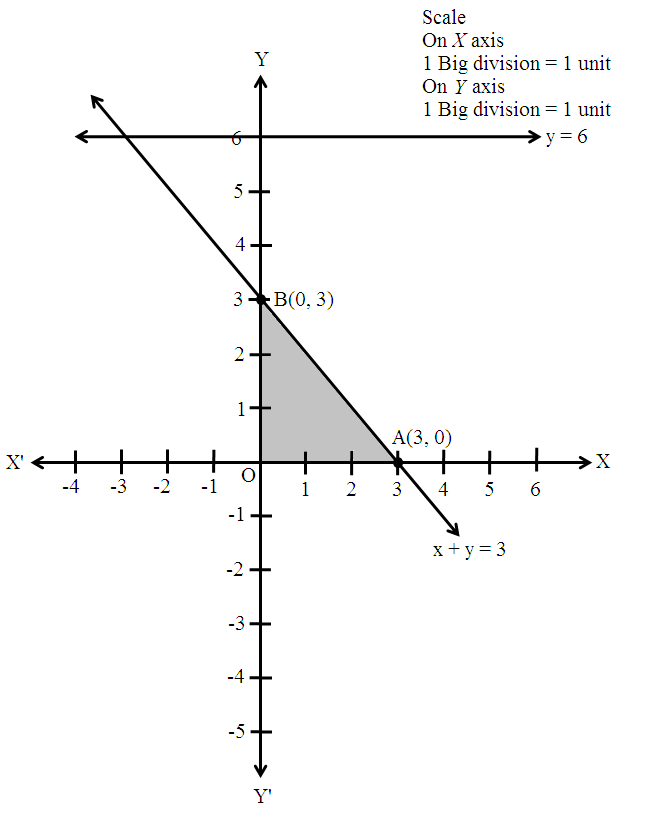
The line x + y = 3 meets the coordinate axis at A(3, 0) and B(0, 3).

Join these points to obtain the line x + y = 3

Clearly, (0, 0) satisfies the inequation x + y ≤ 3.

So, the region in xy-plane that contains the origin represents the solution set of the given equation.

Region represented by x ≥ 0 and y ≥ 0:

Since, every point in the first quadrant satisfies these inequations.

So, the first quadrant is the region represented by the inequations.

These lines are drawn using a suitable scale.

The shaded region represents the feasible region of the given LPP, which is bounded in the first quadrant.

View full question & answer
MCQ 1291 Mark
The objective function of LPP defined over the convex set attains its optimum value at.
  • A
    Atleast two of the corner points.
  • B
    All the corner points.
  • C
    Atleast one of the corner points.
  • D
    None of the corner points.
Answer
  1. Atleast one of the corner points.

Solution:

Let Z = ax + by be the objective function

When Z has optimum value(maximum or minimum), where the variables

x and y are subject to constraints described by linear inequalities, this optimum value must occur at a corner points of the feasible region.

Thus, the function attains its optimum value at one of the corner points.

View full question & answer
MCQ 1301 Mark
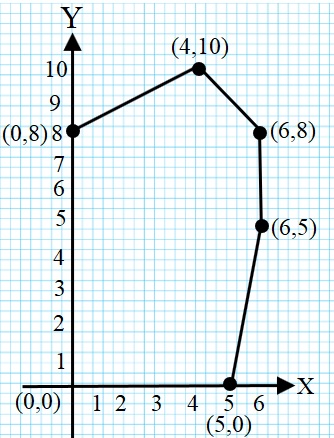
The feasible region for an LPP is shown below:

Let Z = 3x - 4y be the objective function. Minimum of Z occurs at

  • A
    (0, 0)
  • B
    (0, 8)
  • C
    (5, 0)
  • D
    (4, 10)
Answer
  1. (0, 8)
View full question & answer
MCQ 1311 Mark
Minimize Z = 20x1 + 9x2, subject to $\text{x}_{1}\geq0,\text{x}_{2}\geq0,2\text{x}_{1}+2\text{x}_{2}\geq36,6\text{x}_{1}+\text{x}_{2}\geq60.$
  • A
    360 at (18, 0)
  • B
    336 at (6, 4)
  • C
    540 at (0, 60)
  • D
    0 at (0, 0)
Answer
  1. 336 at (6, 4)
View full question & answer
MCQ 1321 Mark
The corner points of the feasible region determined by the system of linear constraints are (0, 10), (5, 5), (15, 15), (0, 20). Let Z = px + qy, where p, q > 0. Condition on p and q so that the maximum of Z occurs at both the points (15, 15) and (0, 20) is:
  • A
    p = q
  • B
    p = 2q
  • C
    q = 2p
  • D
    q = 3p
Answer
  1. q = 3p
View full question & answer
MCQ 1331 Mark
Maximize Z = 11 x + 8y subject to $\text{x}\leq4,\text{y}\leq6,\text{x}+\text{y}\leq6,\text{x}\geq0,\text{y}\geq0.$
  • A
    44 at (4, 2)
  • B
    60 at (4, 2)
  • C
    62 at (4, 0)
  • D
    48 at (4, 2)
Answer
  1. 60 at (4, 2)
View full question & answer
MCQ 1341 Mark
The maximum value of the object function Z = 5x + 10y subject to the constraints $\text{x}+2\text{y}\leq120,\text{x}+\text{y}\geq60,\text{x}-2\text{y}\geq0,\text{x}\geq0,\text{y}\geq0$ is:
  • A
    300
  • B
    600
  • C
    400
  • D
    800
Answer
  1. 600
View full question & answer
MCQ 1351 Mark
Unboundedness is usually a sign that the LP problem.
  • A
    Has finite multiple solutions.
  • B
    Is degenerate.
  • C
    Contains too many redundant constraints.
  • D
    Has been formulated improperly.
Answer
  1. Has been formulated improperly.

Solution:

A linear programming problem is said to have unbounded solution if it has infinite number of solutions.

I.e., the problem has been formulated improperly.

View full question & answer
MCQ 1361 Mark
If an iso-profit line yielding the optimal solution coincides with a constaint line, then:
  • A
    The solution is unbounded
  • B
    The solution is infeasible
  • C
    The constraint which coincides is redundant
  • D
    None of the above
Answer
  1. None of the above

Solution:

If an iso profit line which is yielding the optimal solution coincide with a constant line; then

→ the solution will b bounded, i.e there will be a definite bounded area where the solution would be optional.

→ Since the area is bounded,the solution is feasible

→ And the constant which coincides is not a redundant

Hence None of above is the answer.

View full question & answer
MCQ 1371 Mark
If the feasible region for a solution of linear inequations is bounded, it is called as:
  • A
    Concave Polygon
  • B
    Finite Region
  • C
    Convex Polygon
  • D
    None of the above
Answer
  1. Convex Polygon

Solution:

A bounded feasible region will have both a maximum value and a minimum value for the objective function. It is bounded if it can be enclosed in any shape.

A convex polygon is a simple not self-intersecting closed shape in which no line segment between two points on the boundary ever goes outside the polygon.

Hence, the answer is convex polygon.

View full question & answer
MCQ 1381 Mark
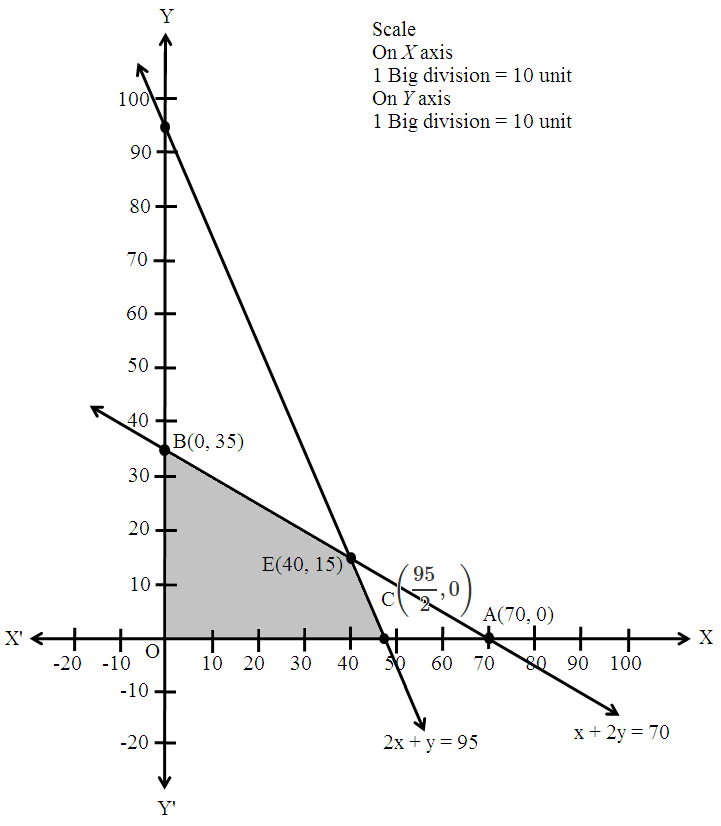
The point at which the maximum value of x + y, subject to the constraints x + 2y ≤ 70, 2x + y ≤ 95, x, y ≥ 0 isobtained, is:
    • A
      (30, 25)
    • B
      (20, 35)
    • C
      (35, 20)
    • D
      (40, 15)
    Answer
    1. (40, 15)

    Solution:

    We need to maximize the function

    Z = x + y

    Converting the given inequations into equations, we obtain x + 2y = 70, 2x + y = 95, x = 0 and y = 0

    Region represented by x + 2y ≤ 70:

    The line x + 2y = 70 meets the coordinate axes at A(70, 0) and B(0, 35) respectively.

    By joining these points we obtain the line x + 2y = 70.

    Clearly (0, 0) satisfies the inequation x + 2y ≤ 70.

    So, the region containing the origin represents the solution set of the inequation x + 2y ≤ 70.

    Region represented by 2x + y ≤ 95:

    The line 2x + y = 95 meets the coordinate axes at $\text{C}\Big(\frac{95}{2},0\Big)$ and D(0, 95) respectively.

    By joining these points we obtain the line 2x + y = 95.

    Clearly (0, 0) satisfies the inequation 2x + y ≤ 95.

    So, the region containing the origin represents the solution set of the inequation 2x + y ≤  95.

    Region represented by x ≥ 0 and y ≥ 0:

    Since, every point in the first quadrant satisfies these inequations.

    So, the first quadrant is the region represented by the inequations x ≥ 0, and y ≥ 0.

    The feasible region determined by the system of constraints x + 2y ≤ 70, 2x + y ≤ 95, x ≥ 0, and y ≥ 0, are as follows.

    The corner points of the feasible region are O(0, 0), $\text{C}\Big(\frac{95}{2},0\Big)$, E(40, 15) and B(0, 35).

    The values of Z at these corner points are as follows.

    $\text{Corner point}$

    $\text{Z} = \text{x} + \text{y}$

    $\text{O}(0, 0)$

    $0 + 0 = 0$

    $\text{C}\Big(\frac{95}{2},0\Big)$

    $\frac{95}{2}+0,2=\frac{95}{2}$

    $\text{E}(40, 1)$

    $40 + 15 = 55$

    $\text{B}(0, 35)$

    $0 + 35 = 35$

    We see that the maximum value of the objective function Z is 55 which is at (40, 15).

    View full question & answer
    MCQ 1391 Mark
    The number of constraints allowed in a linear program is which of the following?
    • A
      Less than 5
    • B
      Less than 72
    • C
      Less than 1,024
    • D
      Unlimited
    Answer
    1. Unlimited

    Solution:

    There is no limit on constraints allowed in linear programming.

    so the number of constraints is unlimited.

    View full question & answer
    MCQ 1401 Mark
    By graphical method, the solution of linear programming problem
    Maximize Z = 3x1 + 5x2
    Subject to
    3x1 + 2x2 ≤ 18
    x1 ≤ 4
    x2 ≤ 6
    x1 ≥ 0, x2 ≥ 0, is:
      • A
        x1 = 2, x2 = 0, Z = 6
      • B
        x1 = 2, x2 = 6, Z = 36
      • C
        x1 = 4, x2 = 3, Z = 27
      • D
        x1 = 4, x2 = 6, Z = 42
      Answer
      1. x1 = 2, x2 = 6, Z = 36

      Solution:

      We need to maximize the function Z = 3x4 + 5x2

      First, we will convert the given inequations into equations, we obtain the following equations:

      3x1 + 2x2 = 18, x1 = 4, x2 = 6, x1 = 0 and x2 = 0

      Region represented by 3x1 + 2x2 ≤ 18:

      The line 3x1 + 2x2 = 18 meets the coordinate axes at A(6, 0) and B(0, 9) respectively.

      By joining these points we obtain the line 3X1 + 2x2 = 18.

      Clearly (0, 0) satisfies the inequation 3x1 + 2x2 = 18.

      So the region in the plane which contain the origin represents the solution set of the inequation 3x1 + 2x2 ≤ 18.

      Region represented by x1 ≤ 4:

      The line x1 = 4 is the line that passes through C(4, 0) and is parallel to the Y axis.

      The region to the left of the line x1 = 4 will satisfy the inequation x1 ≤ 4.

      Region represented by x2 ≤ 6:

      The line x2 = 6 is the line that passes through D(0, 6) and is parallel to the X axis.

      The region below the line x2 = 6 will satisfy the inequation X2 ≤ 6.

      Region represented by x1 ≥ 0 and x2 ≥ 0:

      Since, every point in the first quadrant satisfies these inequations.

      So, the first quadrant is the region represented by the inequations x1 ≥ 0 and x2 ≥ 0.

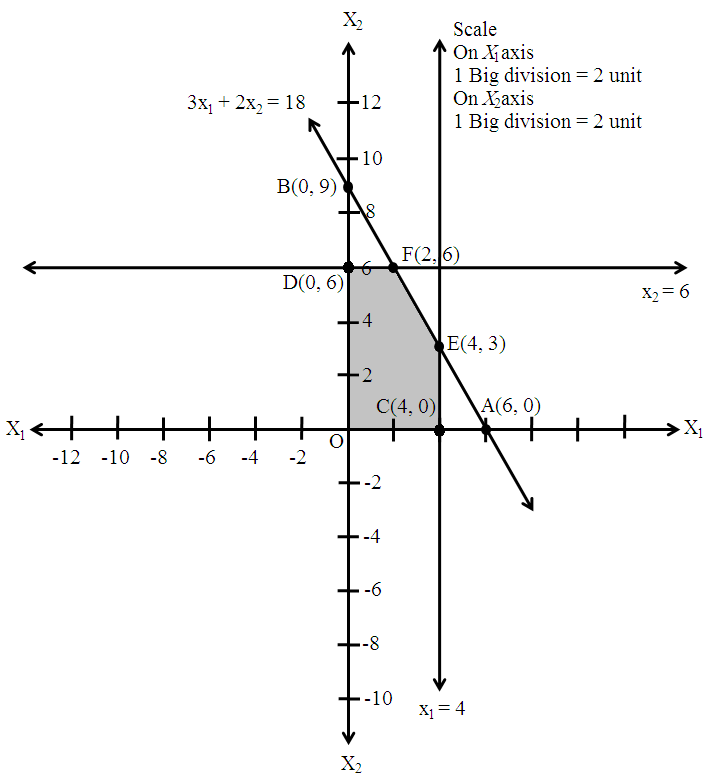
      The feasible region determined by the system of constraints, 3x1 + 2x2 ≤ 18, x1 ≤ 4, x2 ≤ 6, x1 ≥ 0 and x2 ≥ 0 are as follows

      Corner points are O(0, 0), D(0, 6), F(2, 6), E(4, 3) and C(4, 0).

      The values of the objective function at these points are given in the following table.

      Points
      Value of Z
      O(0, 0)
      3(0) + 5(0) = 0
      D(0, 6)
      3(0) + 5(6) = 30
      F(2, 6)
      3(2) + 5(6) = 36
      E(4, 3)
      3(4) + 5(3) = 27
      C(4, 0)
      3(4) + 5(0) = 12

      We see that the maximum value of the objective function Z is 36 which is at F(2, 6).

      View full question & answer
      MCQ 1411 Mark
      For a linear programming equations, convex set of equations is included in region of:
      • A
        Feasible solutions
      • B
        Disposed solutions
      • C
        Profit solutions
      • D
        Loss solutions
      Answer
      1. Feasible solutions

      Solution:

      In order for a linear programming problem to have a unique solution, the solution must exist at the intersection of two or more constraints.

      Then the problem becomes convex and has a single optimum(maximum or minimum) solution.

      Therefore the convex set of equations is included in the feasible region.

      View full question & answer
      MCQ 1421 Mark
      The Convex Polygon Theorem states that the optimum (maximum or minimum) solution of a LPP is attained at atleastone of the ______ of the convex set over which the solution is feasible.
      • A
        Origin
      • B
        Corner points
      • C
        Centre
      • D
        Edge
      Answer
      1. Corner points

      Solution:

      The fundamental theorem of programming (i.e., Convex Polygon Theorem) states that the optimum value(maximum or minimum) of a linear programming problem over a convex region occur at the corner points.

      View full question & answer
      MCQ 1431 Mark
      Apply linear programming to this problem. A firm wants to determine how many units of each of two products (products D and E) they should produce to make the most money. The profit in the manufacture of a unit of product D is 100 and the profit in the manufacture of a unit of product E is100 and the profit in the manufacture of aunit of product E is 87. The firm is limited by its total available labor hours and total available machine hours. The total labor hours per week are 4,000. Product D takes 5 hours per unit of labor and product E takes 7 hours per unit. The total machine hours are 5,000 per week. Product D takes 9 hours per unit of machine time and product E takes 3 hours per unit. Which of the following is one of the constraints for this linear program?
      • A
        $5\text{D}+7\text{E}\leq5,000$
      • B
        $9\text{D}+3\text{E}\geq4,000$
      • C
        $5\text{D}+9\text{E}\leq5,000$
      • D
        $9\text{D}+3\text{E}\leq5,000$
      Answer
      1. $9\text{D}+3\text{E}\leq5,000$

      Solution:

      Given, product D takes 5 hours per unit of labour, and product E takes 7 hours per unit of labour.

      Therefore, to produce D units of product D takes 5D hours andto produce E units of product E takes 7E hours Given, total labour hours per week are 4000 hours.

      Hence, $5\text{D}+7\text{E}\leq4,000$

      Given, product D takes 9 hours per unit of machine time, andproduct E takes 3 hours per unit of machine time.

      Therefore, to produce D units of product D takes 9D hours andto produce E units of product E takes 3E hours Given, total machine hours per week are 5000 hours.

      Hence, $9\text{D}+3\text{E}\leq5,000$

      View full question & answer
      MCQ 1441 Mark
      Choose the correct answer from the given four options.
      Let F = 3x - 4y be the objective function.
      Minimum value of F is:
      • A
        0.
      • B
        -16.
      • C
        12.
      • D
        Does not exist.
      Answer
      1. -16

      Solution:

      the feasible region as show in the figure, has objective function F= 3x - 4y

      Corner points
      Corresponding value of z = 3x - 4y
      (0, 0)
      0
      (12, 6)
      12 (masimum)
      (0, 4)
      -16 (miminum)

      We have minimum value of F is -16at (0, 4).

      View full question & answer
      MCQ 1451 Mark
      In linear programming, lack of points for a solution set is said to:
      • A
        Have no feasible solution
      • B
        Have a feasible solution
      • C
        Have single point method
      • D
        Have infinte point method
      Answer
      1. Have no feasible solution

      Solution:

      If there is no point in the feasible set, there is no feasible solution of the linear programming model.

      In linear programming, lack of points for a solution set is said to have no feasible solution.

      View full question & answer
      MCQ 1461 Mark

      The corner points of the feasible region determined by the following system of linear inequalities:

      2x + y ≤ 10, x + 3y ≤ 15, x, y ≥ 0 are (0, 0), (5, 0), (3, 4) and (0, 5).

      Let Z = px + qy, where p.q > 0.

      Condition on p and q so that the maximum of Z occurs at both (3, 4) and (0, 5) is:

        • A
          P = q
        • B
          p = 2q
        • C
          p = 3q
        • D
          q = 3q
        Answer
        1. q = 3p

        Solution:

        The maximum value of Z is unique.

        It is given that the maximum value of Z occurs at two points (3, 4) and (0,5).

        Value of Z at (3, 4) = Value of Z at (0,5)

        = p(3) + q(4) = p(0) + 7(5)

        = 3p + 4q = 5q

        = q = 3p

        View full question & answer
        MCQ 1471 Mark

        The objective function Z = 4x + 3y can be maximised subjected to the constraints 3x + 4y ≤ 24, 8x + 6y ≤ 48, x ≤ 5, y ≤ 6, x, y ≥ 0

          • A
            at only one point
          • B
            at two points only
          • C
            at an infinite number of points
          • D
            none of these
          Answer
          1. at an infinite number of points

          Solution:

          We need to maximize Z = 4x + 3y

          First, we will convert the given inequations into equations, we obtain the following equations: 3x + 4y = 24, 8x + 6y = 48, x = 5, y = 6, x = 0 and y = 0.

          The line 3x + 4y = 24 meets the coordinate axis at A(8, 0) and B(0, 6).

          Join these points to obtain the line 3x + 4y = 24.

          Clearly, (0, 0) satisfies the inequation 3x + 4y ≤ 24.

          So, the region in xy-plane that contains the origin represents the solution set of the given equation.

          The line 8x + 6y = 48 meets the coordinate axis at C(6, 0) and D(0, 8).

          Join these points to obtain the line 8x + 6y = 48.

          Clearly, (0, 0) satisfies the inequation 8x + 6y ≤ 48.

          So, the region in xy plane that contains the origin represents the solution set of the given equation.

          x = 5 is the line passing through x = 5 parallel to the Y axis.

          y = 6 is the line passing through y = 6 parallel to the X axis.

          Region represented by x ≥ 0 and y ≥ 0:

          Since, every point in the first quadrant satisfies these inequations.

          So, the first quadrant is the region represented by the inequations.

          These lines are drawn using a suitable scale.

          and B (0,6).

          The corner points of the feasible region are O(0, 0), G(5, 0), $\text{F}\Big(5,\frac{4}{3}\Big),\text{E}\Big(\frac{24}{7},\frac{24}{7}\Big)$and B(0, 6).

          The values of Z at these corner points are as follows.

          $\text{Corner point}$ $\text{Z} = 4\text{x} + 3\text{y}$
          $\text{O}(0, 0)$ $4 \times 0 + 3 \times 0= 0$
          $\text{G}(5, 0)$ $4 \times 5 + 3 \times 0 = 20$
          $\text{F}\Big(5,\frac{4}{3}\Big)$ $4\times5+3\times\frac{4}{3}=24$
          $\text{E}\Big(\frac{24}{7},\frac{24}{7}\Big)$ $4\times\frac{24}{7}+3\times\frac{24}{7}=\frac{196}{7}=24$
          $\text{B}(0, 6)$ $4\times0+3\times6=18$

          We see that the maximum value of the objective function Z is 24 which is at F(5, 4) and $\text{E}\Big(\frac{24}{7},\frac{24}{7}\Big).$

          Thus, the optimal value of Z is 24.

          As, we know that if a LPP has two optimal solution, then there are an infinite number of optimal solutions.

          Therefore, the given objective function can be subjected at an infinite number of points.
          View full question & answer
          MCQ 1481 Mark

          The value of objective function is maximum under linear constraints

            • A
              at the centre of feasible region
            • B
              at (0, 0)
            • C
              at any vertex of feasible region
            • D
              the vertex which is maximum distance from (0, 0)
            Answer
            1. at any vertex of feasible region

            Solution:

            In linear programming problem we substitute the coordinates of vertices of feasible region in the objective function and then we obtain the maximum or minimum value.

            Therefore, the value of objective function is maximum under linear constraints at any vertex of feasible region.

            View full question & answer
            MCQ 1491 Mark
            Maximize Z = 6x + 4y, subject to $\text{x}\leq2,\text{x}+\text{y}\leq3,-2\text{x}+\text{y}\leq1,\text{x}\geq0,\text{y}\geq0.$
            • A
              12 at (2, 0)
            • B
              16 at (2, 1)
            • C
              $\frac{140}{3}$ at $\Big(\frac{2}{3},\frac{1}{3}\Big)$
            • D
              4 at (0, 1)
            Answer
            1. $\frac{140}{3}$ at $\Big(\frac{2}{3},\frac{1}{3}\Big)$
            View full question & answer
            MCQ 1501 Mark
            Which of the following is not true about feasibility?
            • A
              It cannot be determined in a graphical solution of an LPP.
            • B
              It is independent of the objective function.
            • C
              It implies that there must be a convex region satisfying all the constraints.
            • D
              Extreme points of the convex region gives the optimum solution.
            Answer
            1. It cannot be determined in a graphical solution of an LPP. 

            Solution:

            There are various methods to solve the linear programming problems namely simplex method, ellipsoid method, graphical method, interior points method, etc.

            Therefore a linear programming problem can be solved using the graphical method.

            Hence, the feasibility of the linear programming problem can be determined by the graphical method.

            View full question & answer