Question 512 Marks
If $\begin{bmatrix}\text{x}+\text{y}\\\text{x}-\text{y} \end{bmatrix}=\begin{bmatrix}2&1\\4&3 \end{bmatrix}\begin{bmatrix}1\\-2\end{bmatrix},$ then write the value of (x, y).
AnswerAfter doing the matrix multiplication we get,
$\begin{bmatrix}\text{x}+\text{y}\\\text{x}-\text{y} \end{bmatrix}=\begin{bmatrix}0\\-2\end{bmatrix}$
As corresponding entries of two equal matrices are equal so,
x + y = 0,
x - y = -2
Solving simultanecus linear equation gives the value of x = -1 and y = 1
or (x, y) = (-1, 1).
View full question & answer→Question 522 Marks
For a 2×2 matrix A = [aij] whose elements are given by $\text{a}_{\text{ij}}=\frac{\text{i}}{\text{j}}$ , write the value of a12.
AnswerGiven that a 2×2 matrix A = [aij] whose elements are given by $\text{a}_{\text{ij}}=\frac{\text{i}}{\text{j}}.$
We need to find the value of a12.
Thus, $\text{a}_{12}=\frac{1}{2}.$
View full question & answer→Question 532 Marks
The cooperative stores of a particular school has 10 dozen physics books, 8 dozen chemistry books and 5 dozen mathematics books. Their selling prices are Rs. 8.30, Rs. 3.45 and Rs. 4.50 each respectively. Find the total amount the store will receive from selling all the items.
AnswerMatrix representation of stock of various types of book in the store is given by, $\text{X}=\begin{bmatrix}\text{Physics}&\text{Chemistry}&\text{Mathematics}\\120&96&60\end{bmatrix}$ Matrix representation of selling price (Rs.) of each book is given by, $\text{Y}=\begin{bmatrix}8.30&\text{Physics}\\3.45&\text{Chemistry}\\4.50&\text{Mathematics}\end{bmatrix}$ So, total amount recieved by the store from selling all the items is given by, $\text{XY}=\begin{bmatrix}120&96&60\end{bmatrix}\begin{bmatrix}8.30\\3.45\\4.50\end{bmatrix}$ $\big[(120)(8.30)+(96)(3.45)+(60)(4.50)\big]$ $=\big[996+331.20+270\big]$ $=\big[1597.20\big]$ Required amount = Rs. 1597.20
View full question & answer→Question 542 Marks
If $\text{A}=\begin{bmatrix}1&-3&2\\2&0&2\end{bmatrix}$ and $\text{B}=\begin{bmatrix}2&-1&-1\\1&0&-1\end{bmatrix},$ find the matrix C such that A + B + C is zeor matrix.
AnswerGiven,
$\text{A}=\begin{bmatrix}1&-3&2\\2&0&2\end{bmatrix},\text{B}=\begin{bmatrix}2&-1&-1\\1&0&-1\end{bmatrix},$
And
$\text{A}+\text{B}+\text{C}=0$
$\Rightarrow\text{C}=-\text{A}-\text{B}+0$
$\Rightarrow\text{C}=-\text{A}-\text{B}$
$\Rightarrow\text{C}=-\begin{bmatrix}1&-3&2\\2&0&2\end{bmatrix}-\begin{bmatrix}2&-1&-1\\1&0&-1\end{bmatrix}$
$\Rightarrow\text{C}=\begin{bmatrix}-1&3&-2\\-2&0&-2\end{bmatrix}-\begin{bmatrix}2&-1&-1\\1&0&-1\end{bmatrix}$
$\Rightarrow\text{C}=\begin{bmatrix}-1-2&3+1&-2+1\\-2-1&0-0&-2+1\end{bmatrix}$
$\Rightarrow\text{C}=\begin{bmatrix}-3&4&-1\\-3&0&-1\end{bmatrix}$
Hence,
$\text{C}=\begin{bmatrix}-3&4&-1\\-3&0&-1\end{bmatrix}$
View full question & answer→Question 552 Marks
If $\text{A}=\begin{bmatrix}-3&0\\0&-3\end{bmatrix}$, find A4.
AnswerHere,
$\text{A}^2 = \text{AA}$
$\Rightarrow\text{A}^2=\begin{bmatrix}-3&0\\0&-3\end{bmatrix}\begin{bmatrix}-3&0\\0&-3\end{bmatrix}$
$\Rightarrow\text{A}^2=\begin{bmatrix}9+0&0+0\\0+0&0+9\end{bmatrix}$
$\Rightarrow\text{A}^2=\begin{bmatrix}9&0\\0&9\end{bmatrix}$
Now,
$\text{A}^4 = \text{A}^2\cdot\text{A}^2$
$\Rightarrow\text{A}^4=\begin{bmatrix}9&0\\0&9\end{bmatrix}\begin{bmatrix}9&0\\0&9\end{bmatrix}$
$\Rightarrow\text{A}^4=\begin{bmatrix}81+0&0+0\\0+0&0+81\end{bmatrix}$
$\Rightarrow\text{A}^4=\begin{bmatrix}81&0\\0&81\end{bmatrix}$
View full question & answer→Question 562 Marks
What is the total number of 2×2 matrices with each entry 0 or 1?
AnswerIn a 2×2 matrix
Total number of elements are 4 and each entry can be writte in 2 ways.
So, Number of ways in which 4 entries can be written
= 42
= 16
So,
Total number of 2 × 2 matrices with each entry 0 or 1 = 16
View full question & answer→Question 572 Marks
If matrix A = [1 2 3], write AAT.
AnswerGiven: A = [1 2 3]
$\text{A}^{\text{T}}=\begin{bmatrix}1\\2\\3 \end{bmatrix}$
$\text{AA}^{\text{T}}=\begin{bmatrix}1&2&3 \end{bmatrix}\begin{bmatrix}1\\2\\3 \end{bmatrix}$
⇒ AAT = 1 + 4 + 9
⇒ AAT = 14
View full question & answer→Question 582 Marks
Simplify: $$$\cos\theta\begin{bmatrix}\cos\theta&\sin\theta\\-\sin\theta&\cos\theta\end{bmatrix} + \sin\theta\begin{bmatrix}\sin\theta&-\cos\theta\\ \cos\theta&\sin\theta\end{bmatrix}$
AnswerGiven: $\cos\theta\begin{bmatrix}\cos\theta&\sin\theta\\-\sin\theta&\cos\theta\end{bmatrix} + \sin\theta\begin{bmatrix}\sin\theta&-\cos\theta \\ \cos\theta&\ \sin\theta\end{bmatrix}$
$=\begin{bmatrix}\cos^2\theta&\cos\theta\sin\theta\\-\sin\theta\cos\theta&\cos^2\theta\end{bmatrix} + \begin{bmatrix}\sin^2\theta&-\cos\theta\sin\theta\\ \cos\theta\sin\theta&\ \sin^2\theta\end{bmatrix} = \begin{bmatrix}1&0\\0&1\end{bmatrix}$
View full question & answer→Question 592 Marks
If $\text{A}=\begin{bmatrix}2&3\\5&7\end{bmatrix},$ find A + AT.
AnswerGiven: $\text{A}=\begin{bmatrix}2&3\\5&7\end{bmatrix}$
$\text{A}^\text{T}=\begin{bmatrix}2&5\\3&7\end{bmatrix}$
Now,
$\text{A}+\text{A}^{\text{T}}=\begin{bmatrix}2&3\\5 &7\end{bmatrix}+\begin{bmatrix}2&5\\3&7\end{bmatrix}$
$\Rightarrow\text{A}+\text{A}^\text{T}=\begin{bmatrix}2+2&3+5\\5+3&7+7\end{bmatrix}$
$\Rightarrow\text{A}+\text{A}^\text{T}=\begin{bmatrix}4&8\\8&14\end{bmatrix}$
View full question & answer→Question 602 Marks
If A = [aij] is a skew-symmetric matrix, then write the value of $\sum\limits_\text{i}\sum\limits_\text{j}\text{a}_\text{ij}.$
AnswerGiven: A = [aij] is a skew-symmetric matrix.
⇒ aij = -aij [For all values of i, j]
⇒ aij = -aij [For all values of i]
⇒ aij = 0
Now,
$\sum\limits_{\text{i}}\sum\limits_{\text{j}} \text{a}_{\text{ij}} = \text{a}_{11} +\text{a}_{12} +\text{a}_{13 } + ... + \text{a}_{21} +\text{a}_{22} +\text{a}_{23} + ... + \text{a}_{31} +\text{a}_{32} +\text{a}_{33} +...$
$= 0 + \text{a}_{12} +\text{a}_{13} + ... -\text{a}_{12} + 0 + \text{a}_{23} +...-\text{a}_{13} - \text{a}_{23} +0 + ...$
$=0$
Thus,
$\sum\limits_{\text{i}}\sum\limits_{\text{j}} \text{a}_{\text{ij}} =0$
View full question & answer→Question 612 Marks
If $\begin{bmatrix}2&1&3 \end{bmatrix}$ $\begin{pmatrix}-1&0&-1\\-1&1&0\\0&1&1 \end{pmatrix}\begin{pmatrix}1\\0\\-1 \end{pmatrix}=\text{A},$ then write the order of matrix A.
AnswerConsider, $\begin{pmatrix}2&1&3 \end{pmatrix}\begin{pmatrix}-1&0&-1\\-1&1&0\\0&1&1 \end{pmatrix}\begin{pmatrix}1\\0\\-1 \end{pmatrix}=\text{A}$
Order of matrix $\begin{pmatrix}2&1&3 \end{pmatrix}$ is 1 × 3.
Order of matrix $\begin{pmatrix}-1&0&-1\\-1&1&0\\0&1&1 \end{pmatrix}$ is 3 × 3
Order of matrix $\begin{pmatrix}1\\0\\-1 \end{pmatrix}$ is 3 × 1
Therefore, order of $\begin{pmatrix}2&1&3 \end{pmatrix}\begin{pmatrix}-1&0&-1\\-1&1&0\\0&1&1 \end{pmatrix}\begin{pmatrix}1\\0\\-1 \end{pmatrix}$ is 1 × 1.
View full question & answer→Question 622 Marks
Construct a 3 × 4 matrix A = [aij] whose element aij are given by:
$\text{a}_\text{ij}=\frac{1}{2}|-3\text{i}+\text{j}|$
AnswerHere, $\text{A}=(\text{a}_\text{ij})_{3\times4}=\begin{bmatrix}\text{a}_{11}&\text{a}_{12}&\text{a}_{13}&\text{a}_{14}\\\text{a}_{21}&\text{a}_{22}&\text{a}_{23}&\text{a}_{24}\\\text{a}_{31}&\text{a}_{32}&\text{a}_{33}&\text{a}_{34}\end{bmatrix}\ \dots(1)$
$\text{a}_{11}|-3(1)+1|=\frac{1}{2}|-2|=1,$ $\text{a}_{12}=\frac{1}{2}|-3(1)+2|=\frac{1}{2}|-1|=\frac{1}{2},$
$\text{a}_{13}=\frac{1}{2}|-3(1)+3|=\frac{1}{2}|0|=\frac{0}{2}=0,$ $\text{a}_{14}=\frac{1}{2}|-3(1)+4|=\frac{1}{4}|1|=\frac{1}{2}$
$\text{a}_{21}=\frac{1}{2}|-3(2)+1|=\frac{1}{2}|-5|=\frac{5}{2},$ $\text{a}_{22}=\frac{1}{2}|-3(2)+2|=\frac{1}{2}|-4|=2,$
$\text{a}_{23}=\frac{1}{2}|-3(2)+3|=\frac{1}{2}|-3|=\frac{3}{2},$ $\text{a}_{24}=\frac{1}{2}|-3(2)+4|=\frac{1}{2}|-2|=1$
$\text{a}_{31}=\frac{1}{2}|-3(3)+1|=\frac{1}{2}|-8|=4,$ $\text{a}_{32}=\frac{1}{2}|-3(3)+2|=\frac{1}{2}|-7|=\frac{7}{2},$
$\text{a}_{33}=\frac{1}{2}|-3(3)+3|=\frac{1}{2}|-6|=3$ and $\text{a}_{34}=\frac{1}{2}|-3(3)+4|=\frac{1}{2}|-5|=\frac{5}{2}$
So, the required matrix is $\begin{bmatrix}1&\frac{1}{2}&0&\frac{1}{2}\\\frac{5}{2}&2&\frac{3}{2}&1\\4&\frac{7}{2}&3&\frac{5}{2}\end{bmatrix}.$
View full question & answer→Question 632 Marks
Construct a 2 × 2 matrix A = [aij] whose elements aij are given by:
$\text{a}_\text{ij}=\text{e}^{2\text{ix}}\sin(\text{xj})$
AnswerHere,
$\text{a}_{11}=\text{e}^{2\times1\times\text{x}}\sin(\text{x}\times1)=\text{e}^{2\text{x}}\sin(\text{x}),$ $\text{a}_{12}=\text{e}^{2\times1\times\text{x}}\sin(\text{x}\times2)=\text{e}^{2\text{x}}\sin(2\text{x})$
$\text{a}_{21}=\text{e}^{2\times2\times\text{x}}\sin(\text{x}\times1)=\text{e}^{4\text{x}}\sin(\text{x}),$ $\text{a}_{22}=\text{e}^{2\times2\times\text{x}}\sin(\text{x}\times2)=\text{e}^{4\text{x}}\sin(2\text{x})$
So, the required matrix is $\begin{bmatrix}\text{e}^{2\text{x}}\sin(\text{x})&\text{e}^{2\text{x}}\sin(2\text{x})\\\text{e}^{4\text{x}}\sin(\text{x})&\text{e}^{4\text{x}}\sin(2\text{x})\end{bmatrix}.$
View full question & answer→Question 642 Marks
Let $\text{A}=\begin{bmatrix}1&1&1\\3&3&3\end{bmatrix},\ \text{B}=\begin{bmatrix}3&1\\5&2\\-2&4\end{bmatrix}$ and $\text{C}=\begin{bmatrix}4&2\\-3&5\\5&0\end{bmatrix}.$ Verify that AB = AC though B ≠ C, A ≠ O.
AnswerHere,
$\text{A}=\begin{bmatrix}1&1&1\\3&3&3\end{bmatrix},\ \text{B}=\begin{bmatrix}3&1\\5&2\\-2&4\end{bmatrix}$ and $\text{C}=\begin{bmatrix}4&2\\-3&5\\5&0\end{bmatrix}$
Now,
$\text{A}\text{B}=\begin{bmatrix}1&1&1\\3&3&3\end{bmatrix}\begin{bmatrix}3&1\\5&2\\-2&4\end{bmatrix}$
$\Rightarrow\text{A}\text{B}=\begin{bmatrix}3+5-2&1+2+4\\9+15-6&3+6+12\end{bmatrix}$
$\Rightarrow\text{A}\text{B}=\begin{bmatrix}6&7\\18&21\end{bmatrix}$
$\text{AC}=\begin{bmatrix}1&1&1\\3&3&3\end{bmatrix}\begin{bmatrix}4&2\\-3&5\\5&0\end{bmatrix}$
$\Rightarrow\text{AC}=\begin{bmatrix}4-3+5&2+5+0\\12-9+15&6+15+0\end{bmatrix}$
$\Rightarrow\text{AC}=\begin{bmatrix}6&7\\18&21\end{bmatrix}$
So, AB = AC though B ≠ C, A ≠ O.
View full question & answer→Question 652 Marks
For what valuse of x and y are the following matrices equal?
$\text{A}=\begin{bmatrix}2\text{x}+1&2\text{y}\\0&\text{y}^2-5\text{y}\end{bmatrix}\text{B}=\begin{bmatrix}\text{x}+3&\text{y}^2+2\\0&-6\end{bmatrix}$
AnswerGiven,
$\text{A}=\begin{bmatrix}2\text{x}+1&2\text{y}\\0&\text{y}^2-5\text{y}\end{bmatrix}\text{B}=\begin{bmatrix}\text{x}+3&\text{y}^2+2\\0&-6\end{bmatrix}$
Since equal matrics has all corresponding elements equal,
So,
2x + 1 = x + 3 ...(i)
2y = y2 + 2 ...(ii)
y2 - 5y = -6 ...(iii)
Solving equation (i),
2x + 1 = x + 3
2x - x = 3 - 1
x = 2
Solving equation (ii),
2y = y2 + 2
y2 - 2y + 2 = 0
D = b2 - 4ac
= (-2)2 - 4
= 4 - 8
= -2
So, There is no real value of y from equation (ii),
Solving equation (iii),
y2 - 5y = -6
y2 - 5y + 6 = 0
y2 - 3y - 2y + 6 = 0
y(y - 3) - 2(y - 3) = 0
(y - 3)(y - 2) = 0
y = 3 or y = 2
From solution of equation (i), (ii) and (iii), we can say that A and B can not be equal for any value of y.
View full question & answer→Question 662 Marks
If A and B are square matrices of the same order such that AB = BA, then show that (A + B)2 = A2 + 2AB + B2.
AnswerGiven,
A and B two square matrices of same order such that AB = BA
To prove: (A + B)2 = A2 + 2AB + B2
Now, solving LHS gives,
(A + B)2 = (A + B)(A + B)
= A(A + B) + B(A + B) [by dist, of matrix multiplication over addition]
= A2 + AB + BA + B2 [by dist, of matrix multiplication over addition]
= A2 + 2AB + B2 [As, AB = BA]
= RHS
Hence proved.
View full question & answer→Question 672 Marks
If matrix $\text{A}=\begin{bmatrix}2&-2\\-2&2 \end{bmatrix}$ and A2 = pA, then write the value of p.
AnswerGiven: $\text{A}=\begin{bmatrix}2&-2\\-2&2 \end{bmatrix}$
$\text{A}^{2}=\begin{bmatrix}2&-2\\-2&2 \end{bmatrix}\begin{bmatrix}2&-2\\-2&2 \end{bmatrix}$
$=\begin{bmatrix}4+4&-4-4\\-4-4&4+4 \end{bmatrix}$
$=\begin{bmatrix}8&-8\\-8&8 \end{bmatrix}$
$=4\begin{bmatrix}2&-2\\-2&2 \end{bmatrix}$
$=4\text{A}$
Hence, p = 4.
View full question & answer→Question 682 Marks
The sales figure of two car dealers during January 2013 showed that dealer A sold 5 deluxe, 3 premium and 4 standard cars, while dealer B sold 7 deluxe, 2 premium and 3 standard cars. Total sales over the 2 month period of January-February revealed that dealer A sold 8 deluxe 7 premium and 6 standard cars. In the same 2 month period, dealer B sold 10 deluxe, 5 premium and 7 standard cars. Write 2 × 3 matrices summarizing sales data for January and 2-month period for each dealer.
AnswerAccording to the data, dealer A sold 5 deluxe cars, 3 premium cars and 4 standard cars in January.
Also, dealer B sold 7 deluxe cars, 2 premium cars and 3 standard cars in January.
The above information can be given by,
Deluxe Premium Standard $\begin{matrix}\text{Dealer A} \\\text{Dealer B} \end{matrix}\begin{bmatrix}5&3&4\\7&2&3\end{bmatrix}$
Total sales over the period of January-February reveal that dealer A sold 8 deluxe cars,7 premium cars and 6 standard cars, while dealer B sold 10 deluxe cars, 5 premium cars and 7 standard cars.
This information can be given by,
Deluxe Premium Standard $\begin{matrix}\text{Dealer A} \\\text{Dealer B} \end{matrix}\begin{bmatrix}8&7&6\\10&5&7\end{bmatrix}$
View full question & answer→Question 692 Marks
If A and B are square matrices of the same order, explain, why in general:
(A − B)2 ≠ A2 − 2AB + B2
Answer(A - B)2 - (A - B)(A - B)
= A(A - B) - B(A - B) {using distributive property}
= A × A - AB - BA + B × B
= A2 - AB - BA + B2
≠ A2 - 2AB + B2
Since, in general matrix multiplication is not commutative (AB ≠ BA),
So, (A - B)2 ≠ A2 - 2AB + B2
View full question & answer→Question 702 Marks
Compute the products AB and BA whichever exists the following cases:
$\text{A}=\begin{bmatrix}1&-2\\2&3\end{bmatrix}$ and $\text{B}=\begin{bmatrix}1&2&3\\2&3&1\end{bmatrix}$
Answer$\text{AB}=\begin{bmatrix}1&-2\\2&3\end{bmatrix}\begin{bmatrix}1&2&3\\2&3&1\end{bmatrix}$
$\Rightarrow\text{AB}=\begin{bmatrix}1-4&2-6&3-2\\2+6&4+9&6+3\end{bmatrix}$
$\Rightarrow\text{AB}=\begin{bmatrix}-3&-4&1\\8&13&9\end{bmatrix}$
Since the number of columns in B is greater then the number of rows in A, BA does not exists.
View full question & answer→Question 712 Marks
If $\begin{bmatrix}1&-1\\-1&1\end{bmatrix},$ satisfies the matrix equation A2 = kA, write the value of k.
AnswerGiven,
$\text{A}=\begin{bmatrix}1&-1\\-1&1\end{bmatrix}$
and
$\text{A}^2=\text{kA}$
$\Rightarrow\begin{bmatrix}1&-1\\-1&1\end{bmatrix}\begin{bmatrix}1&-1\\-1&1\end{bmatrix}=\text{k}\begin{bmatrix}1&-1\\-1&1\end{bmatrix}$
$\Rightarrow\begin{bmatrix}1+1&-1-1\\-1-1&1+1\end{bmatrix}=\begin{bmatrix}\text{k}&-\text{k}\\-1&1\end{bmatrix}$
$\Rightarrow\begin{bmatrix}2&-2\\-2&2\end{bmatrix}=\begin{bmatrix}\text{k}&-\text{k}\\-\text{k}&\text{k}\end{bmatrix}$
Since, corresponding entries of equal matrices are equal, so
k = 2
View full question & answer→Question 722 Marks
If A is an m × n matrix and B is n × p matrix does AB exist? If yes, write its order.
AnswerGiven: Order of A = m × n
Order of B = n × p
Since the number of columns in A are equal to the number of rows in B, i.e. n, AB exists.
Order of AB = Number of rows in A × Number of columns in B = m × p
View full question & answer→Question 732 Marks
If A and B are symmetric matrices of the same order, write whether AB − BA is symmetric or skew-symmetric or neither of the two.
AnswerSince A and B are symmetric matrices, AT = A and BT = B.
Here,
(AB - BA)T = (AB)T - (BA)T
⇒ (AB - BA)T = BTAT - ATBT [$\because$ (AB)T = BTAT]
⇒ (AB - BA)T = BA - AB [$\because$ BT = B and AT = A]
⇒ (AB - BA)T = -(AB - BA)
Therefore, AB - BA is skew - symmetric.
View full question & answer→Question 742 Marks
If A is a square matrix such that A2 = A, then write the value of 7A − (I + A)3, where I is the identity matrix.
AnswerA2 = A
A3 = A2 = A
7A - (I + A)3
= 7A - (I3 + A3 + 3A2I + 3AI2)
= 7A - (I + A + 3A + 3A)
= 7A - (I + 7A)
= -I
View full question & answer→Question 752 Marks
Write a 2×2 matrix which is both symmetric and skew-symmetric.
AnswerA matrix which is both symmetric and skew-symmetric is a null matrix.
Hence, the required matrix is $\begin{bmatrix}0&0\\0&0 \end{bmatrix}$.
View full question & answer→Question 762 Marks
If $\begin{bmatrix}1&2\\3&4 \end{bmatrix}\begin{bmatrix}3&1\\2&5 \end{bmatrix}=\begin{bmatrix}7&11\\\text{k}&23 \end{bmatrix},$ then write the value of k.
AnswerGiven: $\begin{bmatrix}1&2\\3&4 \end{bmatrix}\begin{bmatrix}3&1\\2&5 \end{bmatrix}=\begin{bmatrix}7&11\\\text{k}&23 \end{bmatrix}$
$\Rightarrow\begin{bmatrix}3+4&1+10\\9+8&3+20 \end{bmatrix}=\begin{bmatrix}7&11\\\text{k}&23 \end{bmatrix}$
$\Rightarrow\begin{bmatrix}7&11\\17&23 \end{bmatrix}=\begin{bmatrix}7&11\\\text{k}&23 \end{bmatrix}$
The corresponding elements of two equal matrices are equal.
$\therefore$ k = 17
View full question & answer→Question 772 Marks
Write a square matrix which is both symmetric as well as skew-symmetric.
AnswerLet $\text{A}=\begin{bmatrix}0&0\\0&0 \end{bmatrix}$
$\text{A}^{\text{T}{}}=\begin{bmatrix}0&0\\0&0 \end{bmatrix}$
Since AT = A, A is a symmetric matrix.
Now,
$-\text{A}=-\begin{bmatrix}0&0\\0&0 \end{bmatrix}$
$\Rightarrow-\text{A}=\begin{bmatrix}0&0\\0&0 \end{bmatrix}$
Since AT = -A, A is a skew-symmetric matrix.
Thus, $\text{A}=\begin{bmatrix}0&0\\0&0 \end{bmatrix}$is an exampal of a matrix that is both symmetric and skew-symmetric.
View full question & answer→Question 782 Marks
If $\text{A}=\begin{bmatrix}-1&0&0\\0&-1&0\\0&0&-1\end{bmatrix},$ find A3.
AnswerGiven,
$\text{A}=\begin{bmatrix}-1&0&0\\0&-1&0\\0&0&-1\end{bmatrix}$
$\text{A}^2=\begin{bmatrix}-1&0&0\\0&-1&0\\0&0&-1\end{bmatrix}\begin{bmatrix}-1&0&0\\0&-1&0\\0&0&-1\end{bmatrix}$
$=\begin{bmatrix}1+0+0&0+0+0&0+0+0\\0+0+0&0+1+0&0+0+0\\0+0+0&0+0+0&0+1+0\end{bmatrix}$
$=\begin{bmatrix}1&0&0\\0&1&0\\0&0&1\end{bmatrix}$
$\text{A}^3=\text{A}^2\times\text{A}$
$=\begin{bmatrix}1&0&0\\1&0&0\\0&0&1\end{bmatrix}\begin{bmatrix}-1&0&0\\0&-1&0\\0&0&-1\end{bmatrix}$
$=\begin{bmatrix}-1+0+0&0+0+0&0+0+0\\0+0+0&0-1+0&0+0+0\\0+0+0&0+0+0&0+0-1\end{bmatrix}$
$=\begin{bmatrix}-1&0&0\\0&-1&0\\0&0&-1\end{bmatrix}$
$\text{A}^3=\text{A}$
Hence,
$\text{A}^3=\text{A}$
View full question & answer→Question 792 Marks
Find the value of $\lambda,$ non-zero scalar, if $\lambda\begin{bmatrix}1&0&2\\3&4&5\end{bmatrix}+2\begin{bmatrix}1&2&3\\-1&-3&2\end{bmatrix}=\begin{bmatrix}4&4&10\\4&2&14\end{bmatrix}$
AnswerGiven: $\lambda\begin{bmatrix}1&0&2\\3&4&5\end{bmatrix}+2\begin{bmatrix}1&2&3\\-1&-3&2\end{bmatrix}=\begin{bmatrix}4&4&10\\4&2&14\end{bmatrix}$
$\Rightarrow\begin{bmatrix}\lambda&0&2\lambda\\3\lambda&4\lambda&5\lambda\end{bmatrix}+\begin{bmatrix}2&4&6\\-2&-6&4\end{bmatrix}=\begin{bmatrix}4&4&10\\4&2&14\end{bmatrix}$
$\Rightarrow\begin{bmatrix}\lambda+2&0+4&2\lambda+6\\3\lambda-2&4\lambda-6&5\lambda+4\end{bmatrix}=\begin{bmatrix}4&4&10\\4&2&14\end{bmatrix}$
$\Rightarrow\lambda+2=4$
$\Rightarrow\lambda=4-2$
$\therefore\ \lambda=2$
View full question & answer→Question 802 Marks
construct a 3 × 4 matrix, whose elements are given by:
$\text a_{\text {ij}}=2{\text{i}}-{\text{j}} $
Answer$\text{Let A}=\left[\text a_{\text{ij}}\right]\text {be required}\ 3\times4\ \text{matrix where}\ {\text a_{\text {ij}}} =2{\text{i - j}}$ $\therefore\ \text a_{11}=2-1=1,\ \text a_{12}=2-2=0,$ $ \text a_{13}=2-3=-1,\ \text a_{14}=2-4=-2 $ $\text a_{21}=4-1=3,\ \text{a}_{22}=4-2=2,$ $ \text{a}_{23}=4-3=1,\ \ \text{a}_{24}=4-4=0 $ $\text a_{31}=6-1=5,\ \ \text a_{32}=6-2=4,$ $\text a_{33}=6-3=3,\ \ \text a_{34}=6-4=2 $ $\therefore\ \text A = \begin{bmatrix}1 & 0 &-1 & -2 \\3 & 2&1&0\\\ 5&4&3&2 \end{bmatrix} $
View full question & answer→Question 812 Marks
Find a matrix X such that 2A + B + X = 0, where.
If $\text{A}=\begin{bmatrix}8&0\\4&-2\\3&6\end{bmatrix}$ and $\text{B}=\begin{bmatrix}2&-2\\4&2\\-5&1\end{bmatrix},$ then find the matrix X of order 3 × 2 such that 2A + 3X = 5B.
Answer$2\text{A}+3\text{X}=5\text{B}$
$\Rightarrow2\begin{bmatrix}8&0\\4&-2\\3&6\end{bmatrix}+3\text{X}=5\begin{bmatrix}2&-2\\4&2\\-5&1\end{bmatrix}$
$\Rightarrow\begin{bmatrix}16&0\\8&-4\\6&12\end{bmatrix}+3\text{X}=\begin{bmatrix}10&-10\\20&10\\-25&5\end{bmatrix}$
$\Rightarrow3\text{X}=\begin{bmatrix}10&-10\\20&10\\-25&5\end{bmatrix}-\begin{bmatrix}16&0\\8&-4\\6&12\end{bmatrix}$
$\Rightarrow3\text{X}=\begin{bmatrix}10-16&-10-0\\20-8&10+4\\-25-6&5-12\end{bmatrix}$
$\Rightarrow3\text{X}=\begin{bmatrix}-6&-10\\12&14\\-31&-7\end{bmatrix}$
$\Rightarrow\text{X}=\frac{1}{3}\begin{bmatrix}-6&-10\\12&14\\-31&-7\end{bmatrix}$
$\therefore\ \text{X}=\begin{bmatrix}-2&\frac{-10}{3}\\4&\frac{14}{3}\\\frac{-31}{3}&\frac{-7}{3}\end{bmatrix}$
View full question & answer→Question 822 Marks
Construct a 2 × 2 matrix A = [aij] whose elements aij are given by:
$\text{a}_\text{ij}=\frac{(2\text{i}-\text{j})^2}{2}$
AnswerHere,
$\text{a}_{11}=\frac{[2(1)+1]^2}{2}=\frac{(2+1)^2}{2}=\frac{(3)^2}{2}=\frac{9}{2},$ $\text{a}_{12}=\frac{[2(1)+2]^2}{2}=\frac{(4)^2}{2}=\frac{16}{2}=8$
$\text{a}_{21}=\frac{[2(2)+1]^2}{2}=\frac{(4+1)^2}{2}=\frac{(5)^2}{2}=\frac{25}{2},$ $\text{a}_{22}=\frac{[2(2)+2]^2}{2}=\frac{(4+2)^2}{2}=\frac{(6)^2}{2}=\frac{36}{2}=18$
So, the required matrix is $\begin{bmatrix}\frac{9}{2}&8\\\frac{25}{2}&18\end{bmatrix}.$
View full question & answer→Question 832 Marks
Given an example of two non-zero 2×2 matrices A and B such that AB = 0.
AnswerLet,
$\text{A}=\begin{bmatrix}1&0\\0&0\end{bmatrix}\neq0$
$\text{B}=\begin{bmatrix}0&0\\0&1\end{bmatrix}\neq0$
$\text{AB}=\begin{bmatrix}1&0\\0&0\end{bmatrix}\begin{bmatrix}0&0\\0&1\end{bmatrix}$
$=\begin{bmatrix}0&0\\0&0\end{bmatrix}$
$=0$
So,
$\text{A}=\begin{bmatrix}1&0\\0&0\end{bmatrix}$
$\text{B}=\begin{bmatrix}0&0\\0&1\end{bmatrix}$
View full question & answer→Question 842 Marks
A matrix X has a + b rows and a + 2 columns while the matrix Y has b + 1 rows and a + 3 columns. Both matrices XY and YX exist. Find a and b. Can you say XY and YX are of the same type? Are they equal.
AnswerHere, [X]
(a+b) × (a+2) [Y]
(b+1) × (a+3) Since XY exists, the number of columns in X is equal to the number of rows in Y. ⇒ a + 2 = b + 1 ...(1) Similarly, since YX exists, the number of columns in Y is equal to the number of rows in X. ⇒ a + b = a + 3 ⇒ b = 3 Putting the value of b in (1), we get a + 2 ≈ 3 + 1 ⇒ a = 2
Since the order of the matrices XY and YX is not same, XY and YX are not of the same type and they are unequal.
View full question & answer→Question 852 Marks
Find x, y and z so that A = B, where.
$\text{A}=\begin{bmatrix}\text{x}-2&3&2\text{z}\\18\text{z}&\text{y}+2&6\text{z}\end{bmatrix},\text{B}=\begin{bmatrix}\text{y}&\text{z}&6\\6\text{y}&\text{x}&2\text{y}\end{bmatrix}$
AnswerSince all the corresponding elements of a matrix are equal,
$\text{A}=\begin{bmatrix}\text{x}-2&3&2\text{z}\\18\text{z}&\text{y}+2&6\text{z}\end{bmatrix},\text{B}=\begin{bmatrix}\text{y}&\text{z}&6\\6\text{y}&\text{x}&2\text{y}\end{bmatrix}$
Here,
x - 2 = y ...(1)
z = 3 ...(2)
18z = 6y ...(3)
Putting the value of z in eq. (3), we get
18(3) = 6y
⇒ 54 = 6y
$\Rightarrow\text{y}=\frac{54}{6}=9$
Putting the value of y in eq. (1), we get
x - 2 = 9
⇒ x = 9 + 2
⇒ x = 11
$\therefore$ x = 11, y = 9 and z = 3
View full question & answer→Question 862 Marks
Find the values of x, y and z from the following equations:
$\begin{bmatrix}\text{x+y} & 2 \\5+\text{z} & \text {xy} \end{bmatrix}=\begin{bmatrix}6 & 2 \\5& 8 \end{bmatrix}$
AnswerWe are given that
$\begin{bmatrix}\text{x+y} & 2 \\5+\text{z} & \text {xy} \end{bmatrix}=\begin{bmatrix}6 & 2 \\5& 8 \end{bmatrix}$
By defination of equality of matrices,
x + y = 6 ...(1)
5 + z = 5 ...(2)
xy = 8 ...(3)
Form (2), z = 0
Form y = 6 - x ...(4)
Putting y = 6 - x in (3), we get.
x(6 - x) = or 6 x - x2 - 8 = 0
$\therefore$ x2 - 6x + 8 = 0 ? (x - 2) (x - 4) = 0;
? x = 2.4
$\therefore$ from (4), y = 6 - 2, 6 - 4 = 4, 2
$\therefore$ we have
x =2, y = 4, z = 0; x = 4, y = 2, z = 0
View full question & answer→Question 872 Marks
If $2\begin{bmatrix}3&4\\5&\text{x} \end{bmatrix}+\begin{bmatrix}1&\text{y}\\0&1 \end{bmatrix}=\begin{bmatrix}7&0\\10&5 \end{bmatrix},$ find x - y.
Answer$2\begin{bmatrix}3&4\\5&\text{x} \end{bmatrix}+\begin{bmatrix}1&\text{y}\\0&1 \end{bmatrix}=\begin{bmatrix}7&0\\10&5 \end{bmatrix}$
$\Rightarrow\begin{bmatrix}6+1&8+\text{y}\\10+0&2\text{x}+1 \end{bmatrix}=\begin{bmatrix}7&0\\10&5 \end{bmatrix}$
$\Rightarrow\begin{bmatrix}7&8+\text{y}\\10&2\text{x}+1 \end{bmatrix}=\begin{bmatrix}7&0\\10&5 \end{bmatrix}$
⇒ 8 + y = 0 and 2x + 1 = 5
⇒ y = - 8 and 2x = 4
⇒ y = - 8 and x = 2
Hence, x - y = 2 - (- 8) = 10.
View full question & answer→Question 882 Marks
Let A and B be square matrices of the same order. Does (A + B)2 = A2 + 2AB + B2 hold? If not, why?
AnswerLHS = (A + B)2
= (A + B)(A + B)
= A(A + B) + B(A + B)
= A2 + AB + BA + B2
We know that a matrix does not have commutative property. So,
AB ≠ BA
Thus,
(A + B)2 ≠ A2 + 2AB + B2
View full question & answer→Question 892 Marks
If $\begin{bmatrix}\text{xy}&4\\\text{z}+6&\text{x}+\text{y} \end{bmatrix}=\begin{bmatrix}8&\text{w}\\0&6 \end{bmatrix},$ write the value of (x + y + z).
Answer$\begin{bmatrix}\text{xy}&4\\\text{z}+6&\text{x}+\text{y} \end{bmatrix}=\begin{bmatrix}8&\text{w}\\0&6 \end{bmatrix}$
Corresponding elements of equal matrices are equal.
$\therefore$ z + 6 = 0 and x + y = 6
⇒ z = -6 and x + y = 6
Therefore, x + y + z = 6 - 6 = 0.
View full question & answer→Question 902 Marks
Give example of matrices:
A and B such that AB = 0 but BA ≠ 0
AnswerLet $\text{A}=\begin{bmatrix}0&1\\0&0\end{bmatrix}$ and $\text{B}=\begin{bmatrix}1&0\\0&0\end{bmatrix}$
$ \therefore\ \text{AB}=0$
and $\text{BA}=\begin{bmatrix}1&0\\0&0\end{bmatrix}\begin{bmatrix}0&1\\0&0\end{bmatrix}$
$\Rightarrow\text{BA}=\begin{bmatrix}0+0&1+0\\0+0&0+0\end{bmatrix}$
$\Rightarrow\text{BA}=\begin{bmatrix}0&1\\0&0\end{bmatrix}$
Thus, AB = 0 but BA ≠ 0
View full question & answer→Question 912 Marks
The monthly incomes of Aryan and Babban are in the ratio 3 : 4 and their monthly expenditures are in the ratio 5 : 7. If each saves Rs. 15,000 per month, find their monthly incomes using matrix method. This problem reflects which value?
AnswerLet the monthly incomes of Aryan and Babban be 3x and 4x, respectively.
Suppose their monthly expenditures are 5y and 7y, respectively
Since each saves Rs. 15,000 per month,
Monthly saving of Aryan: 3x - 5y = 15,000
Monthly saving of Babban: 4x - 7y = 15,000
The above system of equations can be written in the matrix form as follows:
$\begin{bmatrix}3&-5\\4&-7\end{bmatrix}\begin{bmatrix}\text{x}\\\text{y} \end{bmatrix}=\begin{bmatrix}15000\\15000 \end{bmatrix}$
Or,
AX = B, where $\text{A}=\begin{bmatrix}3&-5\\4&-7\end{bmatrix},\text{X}=\begin{bmatrix}\text{x}\\\text{y} \end{bmatrix}$ and $\text{B}=\begin{bmatrix}15000\\15000 \end{bmatrix}$
Now,
$|\text{A}|=\begin{vmatrix}3&-5\\4&-7\end{vmatrix}=-21-(-20)=-1$
$\text{Adj A}=\begin{bmatrix}-7&-4\\5&3\end{bmatrix}^\text{T}=\begin{bmatrix}-7&5\\-4&3\end{bmatrix}$
So, $\text{A}^{-1}=\frac{1}{|\text{A}|}\text{ adj A}=-1=\begin{bmatrix}-7&5\\-4&3\end{bmatrix}=\begin{bmatrix}7&-5\\4&-3\end{bmatrix}$
$\therefore\ \text{X}=\text{A}^{-1}\text{B}$
$\Rightarrow\begin{bmatrix}\text{x}\\\text{y}\end{bmatrix}=\begin{bmatrix}7&-5\\4&-3\end{bmatrix}\begin{bmatrix}15000\\15000 \end{bmatrix}$
$\Rightarrow\begin{bmatrix}\text{x}\\\text{y}\end{bmatrix}=\begin{bmatrix}105000-75000\\60000-45000 \end{bmatrix}$
$\Rightarrow\begin{bmatrix}\text{x}\\\text{y} \end{bmatrix}=\begin{bmatrix}30000\\15000\end{bmatrix}$
$\Rightarrow\text{x}=30,000$ and $\text{y}=15,000$
Therefore,
Monthly income of Aryan = 3 × Rs. 30,000 = Rs. 90,000
Monthly income of Babban = 4 × Rs. 30,000 = Rs. 1,20,000
From this problem, we are encouraged to understand the power of savings.
We should save certain part of our monthly income for the future.
View full question & answer→Question 922 Marks
If B is a skew-symmetric matrix, write whether the matrix AB AT is symmetric or skew-symmetric.
AnswerIf B is a skew-symmetric matrix, then BT = -B.
$(\text{ABA}^\text{T})^\text{T}=(\text{A}^\text{T})^\text{T}\text{B}^\text{T}\text{A}^\text{T}$ $\big[\because\ (\text{ABC})^\text{T}=\text{C}^\text{T}\text{B}^\text{T}\text{A}^\text{T}\big]$
$\Rightarrow(\text{ABA}^\text{T})^\text{T}=\text{AB}^\text{T}\text{A}^\text{T}$ $\big[\because\ (\text{A}^\text{T})^\text{T}=\text{A}\big]$
$\Rightarrow(\text{ABA}^\text{T})^\text{T}=\text{A}(-\text{B})\text{A}^\text{T}$ $\big[\because\ \text{B}^\text{T}=-\text{B}\big]$
$\Rightarrow(\text{ABA}^\text{T})^\text{T}=-\text{ABA}^\text{T}$
$\therefore$ ABAT is a skew-symmetric matrix.
View full question & answer→Question 932 Marks
If $\begin{bmatrix}2\text{x}+1&5\text{x}\\0&\text{y}^2+1\end{bmatrix}=\begin{bmatrix}\text{x}+3&10\\0&26\end{bmatrix},$ find the value of (x + y).
AnswerAs the given matrices are equal, therefore, their corresponding elements must be equal.
Comparing the corresponding elements, we get
$\begin{bmatrix}2\text{x} + 1 = \text{x} + 3&5\text{x}=10\\0=0&\text{y}^2+1=26\end{bmatrix}$
On simplifying, we get
x = 2 and $\text{y}=\pm5$
Therefore, x + y = 2 + 5 = 7
or x + y = 2 - 5 = -3
Hence, the value of (x + y) is 7, -3.
View full question & answer→Question 942 Marks
If $\text{A}=\begin{bmatrix}-1&0&0\\0&-1&0\\0&0&-1\end{bmatrix},$ find A2.
AnswerHere,
$\text{A}^2=\text{AA}$
$\Rightarrow\text{A}^2=\begin{bmatrix}-1&0&0\\0&-1&0\\0&0&-1\end{bmatrix}\begin{bmatrix}-1&0&0\\0&-1&0\\0&0&-1\end{bmatrix}$
$\Rightarrow\text{A}^2=\begin{bmatrix}1+0+0&0+0+0&0+0+0\\0+0+0&0+1+0&0+0+0\\0+0+0&0+0+0&0+0+1\end{bmatrix}$
$\Rightarrow\text{A}^2=\begin{bmatrix}1&0&0\\0&1&0\\0&0&1\end{bmatrix}$
View full question & answer→Question 952 Marks
Find the value of a, b, c and d from the following equations:
$\begin{bmatrix}2\text{a}+\text{b}&\text{a}-2\text{b}\\5\text{c}-\text{d}&4\text{c}+3\text{d}\end{bmatrix}=\begin{bmatrix}4&-3\\11&24\end{bmatrix}$
AnswerAs the given m atrices are equal, therefore their corresponding elements must be equal.
Comparing the corresponding elements, we get
2a + b = 4 ...(i)
a - 2b = -3 ...(ii)
5c - d = 11 ...(iii)
4c + 3d = 24 ...(iv)
Multiplying (i) by 2 and adding to (ii)
5a = 5 ⇒ a = 1
(i) ⇒ b = 4 - 2 × 1 = 2
Multiplying (iii) by 3 and adding to (iv)
19c = 57 ⇒ c = 3
(iii) ⇒ d = 5 × 3 - 11 = 4
Hence, a = 1, b = 2, c = 3, d = 4
View full question & answer→Question 962 Marks
If $\text{A}=\begin{bmatrix}1\\2\\3\end{bmatrix},$ write AAT.
AnswerIf $\text{A}=\begin{bmatrix}1\\2\\3\end{bmatrix}$
$\text{A}^\text{T}=\begin{bmatrix}1&2&3\end{bmatrix}$
Now,
$\text{AA}^\text{T}=\begin{bmatrix}1\\2\\3\end{bmatrix}\begin{bmatrix}1&2&3\end{bmatrix}$
$\Rightarrow\ \text{AA}^\text{T}=\begin{bmatrix}1&2&3\\2&4&6\ \\3&6&9\end{bmatrix}$
View full question & answer→Question 972 Marks
The monthly incomes of Aryan and Babban are in the ratio 3 : 4 and their monthly expenditures are in the ratio 5 : 7. If each saves ₹ 15,000 per month, find their monthly incomes using matrix method. This problem reflects which value?
AnswerLet the monthly incomes of Aryan and Babban be 3x and 4x, respectively.
Suppose their monthly expenditures are 5y and 7y, respectively.
Since each saves Rs. 15,000 per month,
Monthly saving of Aryan: 3x - 5y = 15,000
Monthly saving of Babban: 4x - 7y = 15,000
The above system of equations can be written in the matrix form as follows:
$\begin{bmatrix}3&-5\\4&-7\end{bmatrix}\begin{bmatrix}\text{x}\\\text{y}\end{bmatrix}=\begin{bmatrix}15000\\15000\end{bmatrix}$
or,
AX = B, where $\text{A}=\begin{bmatrix}3&-5\\4&-7\end{bmatrix},\ \text{X}=\begin{bmatrix}\text{x}\\\text{y}\end{bmatrix}$ and $\text{B}=\begin{bmatrix}15000\\15000\end{bmatrix}$
Now,
$\big|\text{A}\big|=\begin{vmatrix}3&-5\\4&-7\end{vmatrix}=-21-(-20)=-1$
$\text{Adj}\ \text{A}=\begin{bmatrix}-7&-4\\5&3\end{bmatrix}^\text{T}=\begin{bmatrix}-7&5\\-4&3\end{bmatrix}$
So, $\text{A}^{-1}=\frac{1}{\big|\text{A}\big|}\text{ adj }\text{A}=-1\begin{bmatrix}-7&5\\-4&3\end{bmatrix}=\begin{bmatrix}7&-5\\4&-3\end{bmatrix}$
$\therefore\ \text{X}=\text{A}^{-1}\text{B}$
$ \Rightarrow\begin{bmatrix}\text{x}\\\text{y}\end{bmatrix}=\begin{bmatrix}7&-5\\4&-3\end{bmatrix}\begin{bmatrix}15000\\15000\end{bmatrix}$
$ \Rightarrow\begin{bmatrix}\text{x}\\\text{y}\end{bmatrix}=\begin{bmatrix}105000-75000\\60000-45000\end{bmatrix}$
$\Rightarrow\begin{bmatrix}\text{x}\\\text{y}\end{bmatrix}=\begin{bmatrix}30000\\15000\end{bmatrix}$
$\Rightarrow\text{x}=30,000$ and $\text{y}=15,000$
Therefore,
Monthly income of Aryan = 3 × Rs. 30,000 = Rs. 90,000
Monthly income of Babban = 4 × Rs. 30,000 = Rs. 1,20,000
From this problem, we are encouraged to understand the power of savings. We should save certain part of our monthly income for the future.
View full question & answer→Question 982 Marks
If $\begin{bmatrix}\text{x}-\text{y}&\text{z}\\2\text{x}-\text{y}&\text{w}\end{bmatrix}=\begin{bmatrix}-1&4\\0&5\end{bmatrix},$ find x, y, z, w.
AnswerGiven, $\begin{bmatrix}\text{x}-\text{y}&\text{z}\\2\text{x}-\text{y}&\text{w}\end{bmatrix}=\begin{bmatrix}-1&4\\0&5\end{bmatrix}$ Since corresponding entries of equal matrices are equal, So x - y = -1 ...(i) z = 4 ...(ii) 2x - y = 0 ...(iii) w = 5 ...(iv) Solving equation (i) and (iii) 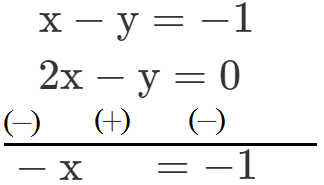
x = 1 Put x = 1 in equation (i), x - y = -1 1 - y = -1 -y = -1 - 1 -y = -2 y = 2 Equation (ii) and (iv) given the values of z and w respectively, So z = 4, w = 5 Hence, x = 1, y = 2, z = 4, w = 5 View full question & answer→Question 992 Marks
If $\begin{bmatrix}2\text{x+y}&3\text{y}\\0&4 \end{bmatrix}=\begin{bmatrix}6&0\\6&4\end{bmatrix}$, then find x.
AnswerGiven,
$\begin{bmatrix}2\text{x+y}&3\text{y}\\0&4 \end{bmatrix}=\begin{bmatrix}6&0\\6&4\end{bmatrix}$
Since, corresponding entries of equal matrices are equal, so
3y = 0
⇒ y = 0
And 2x + y = 6
⇒ 2x + 0 = 6
⇒ 2x = 6
⇒ x = 3
So,
x = 3, y = 0
View full question & answer→Question 1002 Marks
Show that:
$\begin{bmatrix}5&-1\\6&7\end{bmatrix}\begin{bmatrix}2&1\\3&4\end{bmatrix}\neq\begin{bmatrix}2&1\\3&4\end{bmatrix}\begin{bmatrix}5&-1\\6&7\end{bmatrix}$
Answer$\text{L.H.S}=\begin{bmatrix}5&-1\\6&7\end{bmatrix}\begin{bmatrix}2&1\\3&4\end{bmatrix}$$=\begin{bmatrix}5(2) + (-1)3&5(1) + (-1)4\\6(2) + 7(3)&6(1) + 7(4)\end{bmatrix}$$ = \begin{bmatrix}7&1\\33&34\end{bmatrix} $
$\text{R.H.S} = \begin{bmatrix}2&1\\3&4\end{bmatrix}\begin{bmatrix}5&-1\\6&7\end{bmatrix} $$= \begin{bmatrix}2(5) + 1(6)&2(-1) + 1(7)\\3(5) + 4(6)&3(-1) + 4(7)\end{bmatrix} $$= \begin{bmatrix}16&5\\39&25\end{bmatrix} $
$\therefore \text{L.H.S.} \neq \text{R.H.S.}$
View full question & answer→