MCQ 11 Mark
Let $A=\{1,2,3\}, B=\{4,5,6,7\}$ and let $f=\{(1,4),(2,5)$, $(3,6)\}$ be a function from $A$ to $B$. Based on the given information, $f$ is best defined as
AnswerAs every pre-image $x \in A$, has a unique image $y \in B$.
$\Rightarrow \quad f$ is injective function.
View full question & answer→MCQ 21 Mark
A relation $R$ in set $A=\{1,2,3\}$ is defined as $R=\{(1,1),(1,2),(2,2),(3,3)\}$. Which of the following ordered pair in $R$ shall be removed to make it an equivalence relation in $A$ ?
- A
$(1,1)$
- B
$(1,2)$
- C
$(2,2)$
- D
$(3,3)$
AnswerWe have, $(1,2) \in R$ but $(2,1) \notin R$
So, $(1,2)$ should be removed from $R$ to make it an equivalence relation.
View full question & answer→MCQ 31 Mark
The function $f: N \rightarrow N$ is defined by $f(n)=\left\{\begin{array}{ll}\frac{n+1}{2}, & \text { if } n \text { is odd } \\ \frac{n}{2}, & \text { if } n \text { is even }\end{array}\right.$
The function $f$ is
AnswerGiven, $f(x)=\left\{\begin{array}{cl}\frac{n+1}{2}, & \text { if } n \text { is odd } \\ \frac{n}{2}, & \text { if } n \text { is even }\end{array}\right.$
Now, $f(1)=\frac{1+1}{2}=1, f(2)=\frac{2}{2}=1$
$\Rightarrow f(1)=f(2)$ but $1 \neq 2 \therefore f$ is not one-one.
But $f$ is onto $(\because$ range of $f$ is $N$.)
View full question & answer→MCQ 41 Mark
The number of equivalence relations in the set $\{1,2,3\}$ containing the elements $(1,2)$ and $(2,1)$ is
Answer5. (c) : Equivalence relations in the set $\{1,2,3\}$ containing the elements $(1,2)$ and $(2,1)$ are
$R_1=\{(1,2),(2,1),(1,1),(2,2),(3,3)\}$
$R_2=\{(1,2),(2,1),(1,3),(3,1)(2,3),(3,2),(1,1),(2,2),(3,3)\}$
$\therefore \quad$ Number of equivalence relations is 2 .
View full question & answer→MCQ 51 Mark
The function $f: R \rightarrow R$ defined by $f(x)=4+3 \cos x$ is
AnswerWe have, $f(x)=4+3 \cos x, \forall x \in R$
At $x=\frac{\pi}{2}, f\left(\frac{\pi}{2}\right)=4+3 \cos \frac{\pi}{2}=4 \Rightarrow f\left(-\frac{\pi}{2}\right)=4+3 \cos \left(-\frac{\pi}{2}\right)=4$
Since, $f\left(\frac{\pi}{2}\right)=f\left(-\frac{\pi}{2}\right)$, But $\frac{\pi}{2} \neq-\frac{\pi}{2}$
Therefore, $f$ is not one-one.
As $-1 \leq \cos x \leq 1, \forall x \in R \Rightarrow 1 \leq 4+3 \cos x \leq 7, \forall x \in R$
$\Rightarrow f(x) \in[1,7]$, where $[1,7]$ is subset of $R . \therefore f$ is not onto.
View full question & answer→MCQ 61 Mark
The function $f: R \rightarrow R$ defined as $f(x)=x^3$ is
AnswerLet $x_1, x_2 \in R$ be such that $f\left(x_1\right)=f\left(x_2\right)$
$\Rightarrow x_1^3=x_2^3 \Rightarrow x_1=x_2 \Rightarrow f$ is one-one.
Let $f(x)=x^3=y$ for some arbitrary element $y \in R \Rightarrow x=y^{1 / 3}$
$\Rightarrow f\left(y^{1 / 3}\right)=y$
Every image $y \in R$ has a unique pre-image in $R$.
$\Rightarrow f$ is onto
$\therefore \quad f$ is one-one and onto.
View full question & answer→MCQ 71 Mark
The number of functions defined from $\{1,2,3,4,5\} \rightarrow\{a, b\}$ which are one-one is
Answer$\because f: X \rightarrow Y$ is one-one, if different element of $X$ have different image in $Y$ under $f$. But here, no such situation is possible.
View full question & answer→MCQ 81 Mark
Let $f: R \rightarrow R$ be defined by $f(x)=1 / x$, for all $x \in R$, Then, $f$ is
AnswerGiven $f(x)=\frac{1}{x}$, for all $x \in R$ At $x=0 \in R, f(x)$ is not defined.
View full question & answer→MCQ 91 Mark
Let the relation $R$ in the set $A=\{x \in Z: 0 \leq x \leq 12\}$, given by $R=\{(a, b):|a-b|$ is a multiple of 4. $\}$ Then [1], the equivalence class containing 1 , is
- A
$\{1,5,9\}$
- B
$\{0,1,2,5\}$
- C
$\phi$
- D
$A$
AnswerWe have, $R=\{(a, b):|a-b|$ is a multiple of 4$\}$
$\therefore \quad$ The set of elements related to 1 is $\{1,5,9\}$.
So, equivalence class for $[1]$ is $\{1,5,9\}$
View full question & answer→MCQ 101 Mark
A relation $R$ is defined on $N$. Which of the following is the reflexive relation?
- A
$R=\{(x, y): x>y, x, y \in N\}$
- B
$R=\{(x, y): x+y=10, x, y \in N\}$
- C
$R=\{(x, y): x y$ is the square number, $x, y \in N\}$
- D
$R=\{(x, y): x+4 y=10, x, y \in N\}$
AnswerConsider, $R=\{(x, y)$ : xy is the square number, $x, y \in N\}$
As, $x x=x^2$, which is the square of natural number $x$.
$\Rightarrow \quad(x, x) \in R$. So, $R$ is reflexive.
View full question & answer→MCQ 111 Mark
A relation $R$ is defined on $Z$ as $a R b$ if and only if $a^2-7 a b+6 b^2=0$. Then, $R$ is
- A
- B
symmetric but not reflexive
- C
transitive but not reflexive
- D
reflexive but not symmetric
AnswerGiven, $a R b, a, b \in Z$
Reflexive: For $a \in Z$, we have
\[a^2-7 a \cdot a+6 a^2=a^2-7 a^2+6 a^2=0 \Rightarrow(a, a) \in R\]
$\therefore \quad$ Relation is reflexive.
Symmetric: Since, $(6,1) \in R$
As, $6^2-7 \times 6 \times 1+6 \times 1^2=36-42+6=0$
But $(1,6) \notin R . \therefore$ Relation is not symmetric.
View full question & answer→MCQ 121 Mark
Let $f: R_{+} \rightarrow[-5, \infty)$ be defined as $f(x)=9 x^2+6 x-5$, where $R_{+}$is the set of all non-negative real numbers. Then, $f$ is :
Answer\[\begin{array}{l}\text {Let } f\left(x_1\right)=f\left(x_2\right) \\
\Rightarrow \quad 9 x_1^2+6 x_1-5=9 x_2^2+6 x_2-5 \\
\Rightarrow \quad 9\left(x_1^2-x_2^2\right)+6\left(x_1-x_2\right)=0 \\
\Rightarrow \quad\left(x_1-x_2\right)\left[9\left(x_1+x_2\right)+6\right]=0 \\
\Rightarrow \quad x_1-x_2=0 \text { as } 9\left(x_1+x_2\right)+6>0 \\
\Rightarrow \quad x_1=x_2 \quad\left(\because x_1, x_2 \text { are non-negative real numbers }\right)\end{array}\]Thus, $f$ is one-one.
Let $y \in[-5, \infty)$ be such that $f(x)=y$
Now, $f(x)=9 x^2+6 x-5=9 x^2+6 x+1-6=(3 x+1)^2-6$
\[
\begin{array}{l}
\Rightarrow y+6=(3 x+1)^2 \\
\Rightarrow \quad 3 x+1=\sqrt{y+6} \Rightarrow x=\frac{-1+\sqrt{y+6}}{3} \\
\therefore f\left(\frac{-1+\sqrt{y+6}}{3}\right)=y
\end{array}
\]
$\therefore f(x)$ is onto.
So, the given function is bijective.
View full question & answer→MCQ 131 Mark
A function $f: R \rightarrow R$ defined as $f(x)=x^2-4 x+5$ is:
- A
injective but not surjective
- B
surjective but not injective
- C
both injective and surjective
- D
neither injective nor surjective
AnswerGiven, $f(x)=x^2-4 x+5$Here $f(0)=f(4)=5$
Hence, $f(x)$ is not one-one.
To check whether the function is onto or not, we have to find range of function.
\[
\begin{array}{l}
\text { Let } y=x^2-4 x+5 \Rightarrow x^2-4 x+5-y=0 \\
\therefore \quad D=(4)^2-4(1)(5-y) \geq 0 \forall x \in R \\
\Rightarrow \quad 16-20+4 y \geq 0 \Rightarrow 4 y-4 \geq 0 \\
\Rightarrow \quad 4(y-1) \geq 0 \Rightarrow y \geq 1
\end{array}
\]
Hence, range $=(1, \infty)$
Here, Co-domain $\neq$ Range
So, $f(x)$ is not onto.
View full question & answer→MCQ 141 Mark
Let $R$ be a relation in the set $N$ given by $R=\{(a, b): a=b-2, b>6\}$. Then
- A
$(8,7) \in R$
- B
$(6,8) \in R$
- C
$(3,8) \in R$
- D
$(2,4) \in R$
AnswerGiven, $R=\{(a, b): a=b-2, b>6\}$
Since, $b>6$, so $(2,4) \notin R$
Also, $(3,8) \notin R$ as $3 \neq 8-2$
and $(8,7) \notin R$ as $8 \neq 7-2$
Now, for $(6,8)$, we have
$8>6$ and $6=8-2$, which is true
$\therefore \quad(6,8) \in R$
View full question & answer→MCQ 151 Mark
Let $A=\{3,5\}$. Then number of reflexive relations on $A$ is
AnswerTotal number of reflexive relations on a set having $n$ number of elements $=2^{n^2-n}$
Here, $n=2$
$\therefore \quad$ Required number of reflexive relations $=2^{2^2-2}$ $=2^{4-2}=2^2=4$
View full question & answer→MCQ 161 Mark
Let $A=\{1,3,5\}$. Then the number of equivalence relations in $A$ containing $(1,3)$ is
AnswerEquivalence relations in the set containing the element $(1,3)$ are
\[\begin{array}{l}R_1=\{(1,1),(3,3),(1,3),(3,1),(5,5)\} \\
R_2=\{(1,1),(3,3),(5,5),(1,5),(5,1),(3,5),(5,3),(1,3),(3,1)\}\end{array}\]
$\therefore \quad$ There are 2 possible equivalence relations.
View full question & answer→MCQ 171 Mark
The relation $R$ in the set $\{1,2,3\}$ given by $R=\{(1,2)$, $(2,1),(1,1)\}$ is
- A
symmetric and transitive, but not reflexive
- B
reflexive and symmetric, but not transitive
- C
symmetric, but neither reflexive nor transitive
- D
AnswerGiven, $R=\{(1,2),(2,1),(1,1)\}$ is a relation on set $\{1,2,3\}$
Reflexive : Clearly $(2,2),(3,3) \notin R$
$\therefore \quad R$ is not a reflexive relation.
Symmetric: Now, $(1,2) \in R$ and $(2,1) \in R \therefore R$ is symmetric.
Transitive: Now, $(2,1) \in R$ and $(1,2) \in R$ but $(2,2) \notin R$
$\therefore \quad R$ is not transitive relation.
$R$ is symmetric, but neither reflexive nor transitive.
View full question & answer→MCQ 181 Mark
The function $f: R \rightarrow R$ defined by $f(x)=6^x+6^{|x|}$ is
View full question & answer→MCQ 191 Mark
Let $A=\{1,2,3\}$ and $B=\{1,2,4\}$, then $f=\{(1,1),(1,2),(2,1),(3,4)\}$ is a
- A
one-one function from $A$ to $B$
- B
bijection from $A$ to $B$
- C
surjection from $A$ to $B$
- ✓
Answer(d) : Here, $f$ is not a function from $A$ to $B$ as $f(1)$ is not unique.
View full question & answer→MCQ 201 Mark
Let $A=\{1,2,3\}$ and consider the relation $R=\{(1,1),(2,2),(3,3),(1,2),(2,3),(1,3)\}$. Then $R$ is
- ✓
reflexive but not symmetric
- B
reflexive but not transitive
- C
- D
neither symmetric nor transitive
AnswerCorrect option: A. reflexive but not symmetric
(a) : $(1,1),(2,2),(3,3) \in R$
$\therefore \quad R$ is reflexive but it is not symmetric.
Also, $R$ is transitive.
View full question & answer→MCQ 211 Mark
Consider the non-empty set consisting of children in a family and a relation $R$ defined as $a R b$ if $a$ is brother of $b$. Then $R$ is
- A
symmetric but not transitive
- ✓
transitive but not symmetric
- C
neither symmetric nor transitive
- D
both symmetric and transitive
AnswerCorrect option: B. transitive but not symmetric
(b) : Given $a R b \Rightarrow a$ is brother of $b$.
But $b \not R a \quad[\because b$ may or may not be brother of $a]$
$\therefore \quad R$ is not symmetric.
Let $a R b$ and $b R c$
$\Rightarrow \quad a$ is brother of $b$ and $b$ is brother of $c$.
$\therefore \quad a$ is brother of $c \Rightarrow(a, c) \in R . \therefore R$ is transitive.
View full question & answer→MCQ 221 Mark
Let $A=\{1,2,3, \ldots, n\}$ and $B=\{a, b\}$. Then the number of surjections from $A$ into $B$ is
- A
${ }^n P_2$
- ✓
$2^n-2$
- C
$2^n-1$
- D
AnswerCorrect option: B. $2^n-2$
(b) : If $f: A \rightarrow B$ is a function, then $f(1)$ can be chosen in two ways, $f(2)$ can be chosen in two ways, ..., $f(n)$ can be chosen in two ways.
Hence, $f$ can be chosen in $2 \times 2 \times \ldots \times 2=2^n$ ways
In total there are $2^n$ functions possible. Out of these two functions $f_1$ and $f_2$, defined as $f_1(i)=a \forall i=1,2, \ldots, n$ and $f_2(i)=b \forall i=1,2, \ldots, n$ are not surjective as range of $f_1$ is $\{a\} \neq B$ and $f_2$ is $\{b\} \neq B$.
Hence, the number of surjections from $A$ to $B$ is $2^n-2$.
View full question & answer→MCQ 231 Mark
Let $f: R \rightarrow R$ be defined by $f(x)=\frac{1}{x}$ $\forall x \in R$. Then $f$ is
AnswerCorrect option: D. $f$ is not defined
(d) : Since, $\frac{1}{x}$ is not defined for $x=0$
$\therefore \quad f: R \rightarrow R$ can not be defined.
View full question & answer→MCQ 241 Mark
Let $R$ be the relation defined on $N \times N$ by the rule $(a, b) R(c, d) \Leftrightarrow a+d=b+c$, then $R$ is
Answer(d): Here, $(a, b) R(a, b)$ for all $(a, b) \in N \times N$
$\Rightarrow \quad R$ is reflexive.
$
(\because a+b=b+a)
$
Let $(a, b) R(c, d)$
$
\begin{array}{l}
\Rightarrow \quad a+d=b+c \quad \Rightarrow \quad d+a=c+b \\
\Rightarrow \quad c+b=d+a \quad \Rightarrow \quad(c, d) R(a, b)
\end{array}
$
$\therefore \quad R$ is symmetric.
Let $(a, b) R(c, d)$ and $(c, d) R(e, f)$
$
\begin{array}{l}
\Rightarrow \quad a+d=b+c \text { and } c+f=d+e \\
\Rightarrow \quad(a+d)+(c+f)=(b+c)+(d+e) \\
\Rightarrow \quad a+f=b+e \Rightarrow(a, b) R(e, f)
\end{array}
$
$\therefore \quad R$ is transitive
View full question & answer→MCQ 251 Mark
Let $X=\{0,1,2,3\}$ and $Y=\{-1,0,1,4,9\}$ and a function $f: X \rightarrow Y$ defined by $y=x^2$, is
Answer(b) : $y(0)=0, y(1)=1, y(2)=4, y(3)=9$. No two different values of $x$ (where $x \in X$ ) gives same image. Also -1 is element of set $Y$, which does not have its pre-image in set $X$. So, function is one-one into.
View full question & answer→MCQ 261 Mark
Let $X=\{-1,0,1\}, Y=\{0,2\}$ and afunction $f: X \rightarrow Y$ defined by $y=2 x^4$, is
Answer(b): We have, $y=2 x^4$
$
\therefore \quad y(-1)=y(1)=2, y(0)=0
$
Here, we see that for two different values of $x$, we will get a same image so, function is not one-one and no element of $y$ is left, which do not have pre-image. So, function is onto.
View full question & answer→MCQ 271 Mark
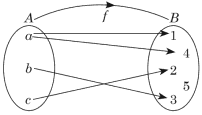
The diagram given below shows that
- A
$f$ is a function from $A$ to $B$
- B
$f$ is a one-one function from $A$ to $B$
- C
$f$ is an onto function from $A$ to $B$
- ✓
$f$ is not a function
AnswerCorrect option: D. $f$ is not a function
(d) : As $f(a)$ is not unique, thus $f$ is not a function.
View full question & answer→MCQ 281 Mark
The number of bijective functions from set $A$ to itself when $A$ contains 106 elements is
Answer(c) : The total number of bijections from a set containing $n$ elements to itself is $n$ ! Hence, required number $=(106) !$
View full question & answer→MCQ 291 Mark
Which of the following functions is not one-one?
- A
$\frac{3-x}{3+x}$
- B
$\sqrt{x}$
- ✓
$x^2+1$
- D
AnswerCorrect option: C. $x^2+1$
(c) : Since $f(x)=f(-x)=x^2+1$ for all $x \in R$, therefore, $f$ is not one-one.
View full question & answer→MCQ 301 Mark
How many reflexive relations are possible in a set $A$ whose $n(A)=3$ ?
Answer(a) : Number of reflexive relations on a set having $n$ elements $=2^{n(n-1)}$
So, required number of reflexive relations $=2^{3(3-1)}=2^6$
View full question & answer→MCQ 311 Mark
The mapping $f: N \rightarrow N$ given by $f(n)=1+n^2$, $n \in N$ where $N$ is the set of natural numbers, is
Answer(c) : Since, $f(n)=1+n^2$
For one-one, $1+n_1^2=1+n_2^2, n_1, n_2 \in N$
$
\Rightarrow n_1^2-n_2^2=0 \Rightarrow n_1=n_2 \quad\left(\because n_1+n_2 \neq 0\right)
$
$\therefore f(n)$ is one-one.
Clearly, $f(n)$ is not onto.
View full question & answer→MCQ 321 Mark
Consider the following statements on a set $A=\{1,2,3\}$ :
(i) $\quad R=\{(1,1),(2,2)\}$ is a reflexive relation on $A$.
(ii) $R=\{(3,3)\}$ is symmetric and transitive but not a reflexive relation on $A$.
Which of the statements given above is/are correct?
Answer(b) : (i) is not correct as $(3,3) \notin R$ and hence $R$ is not reflexive.
(ii) is correct as the relation $R=\{(3,3)\}$ is symmetric and transitive but not reflexive as $(1,1) \notin R,(2,2) \notin R$.
View full question & answer→MCQ 331 Mark
Let $S$ be the set of all real numbers and let $R$ be a relation on $S$ defined by $a R b \Leftrightarrow a^2+b^2=1$. Then, $R$ is
- ✓
symmetric but neither reflexive nor transitive
- B
reflexive but neither symmetric nor transitive
- C
transitive but neither reflexive nor symmetric
- D
AnswerCorrect option: A. symmetric but neither reflexive nor transitive
(a) : $\left(1^2+1^2\right) \neq 1$. So, $R$ is not reflexive.
Now, $a R b a^2+b^2=1 \Rightarrow b^2+a^2=1 \Rightarrow b R a$.
Hence, $R$ is symmetric.
Also, 1 R 0 and $0 R 1$. But, 1 is not related to 1 .
Hence, $R$ is not transitive.
View full question & answer→MCQ 341 Mark
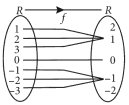
The signum function, $f: R \rightarrow R$ is given by $f(x)=\left\{\begin{array}{ll}1, & x>0 \\ 0, & x=0 \\ -1, & x<0\end{array}\right.$ is
Answer(d): We have, $f(1)=f(2)$ $=f(3)=1$
$
\begin{array}{l}
f(0)=0 \\
f(-1)=f(-2)=f(-3)=-1
\end{array}
$
Hence, function $f$ is not one-one.
View full question & answer→MCQ 351 Mark
Let $f: R \rightarrow R$ be defined by the smallest integer function $f(x)=[x]$, then $f$ is
Answer(d) : Let $f: A \rightarrow B$ such that $f(x)=[x]$.
We have, $[1.4]=[1.6]=2$
Here, two elements in $A, 1.4$ and 1.6 have the same image i.e., 2 in $B$.
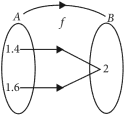
Thus, $f(x)=[x]$ is a not one-one function.
Here, codomain is not equal to range of function, so, function is not onto. View full question & answer→MCQ 361 Mark
Let $f: R \rightarrow R$ be defined by $f(x)=x+|x|$. Then $f(x)$ is
Answer(d) : Given, $f(x)=x+|x|$
Now, $f(-2)=-2+|-2|=-2+2=0$
and $f(-3)=-3+|-3|=-3+3=0$
Hence, $f$ is not one-one
Also, $f(x)=\left\{\begin{array}{ll}x+x & \text { if } x \geq 0 \\ x-x & \text { if } x<0\end{array} \Rightarrow f(x)=\left\{\begin{array}{ll}2 x, & x \geq 0 \\ 0, & x<0\end{array}\right.\right.$
Thus, $f(x)=2 x \geq 0$ for all $x \geq 0$ and $f(x)=0$ for $x<0$. This means that $f(x)$ cannot be negative for any $x \in R$. So, $f$ is not onto. Note that $R_f=[0, \infty)$, which is a proper subset of $R$.
View full question & answer→MCQ 371 Mark
Let $R$ be a relation on the set $N$ be defined by $\{(x, y): x, y \in N, 2 x+y=41\}$. Then, $R$ is
Answer(d) $: R=\{(x, y): x, y \in N, 2 x+y=41\}$
Reflexive : $(1,1) \notin R$ as $2 \cdot 1+1=3 \neq 41$. So, $R$ is not reflexive.
Symmetric : $(1,39) \in R$ but $(39,1) \notin R$. So $R$ is not symmetric.
Transitive : $(20,1) \in R$ and $(1,39) \in R$. But $(20,39) \notin R$, so $R$ is not transitive.
View full question & answer→MCQ 381 Mark
If $A$ and $B$ are finite sets containing respectively $m$ and $n$ elements, then find the number of relation that can be defined from $A$ to $B$.
- A
$m n$
- ✓
$2^{m n}$
- C
$m+n$
- D
$3^{m n}$
AnswerCorrect option: B. $2^{m n}$
(b) : Let $R$ be a relation from $A$ to $B$, then $R \subset A \times B$. This means that the number of relations from $A$ to $B$ is equal to the number of subsets of $A \times B$.
Now, $O(A)=m$ and $O(B)=n$
$\Rightarrow O(A \times B)=m n$
$\therefore \quad$ Number of subsets of $A \times B=2^{m n}$
$\left(\because O(\right.$ Power set of $\left.A)=2^{O(A)}\right)$
$\therefore \quad$ Number of relations from $A$ to $B=2^{m n}$
View full question & answer→MCQ 391 Mark
Let $A=\{a, b, c\}$ and let $R=\{(a, a),(a, b)$, $(b, a)\}$. Then, $R$ is
- A
reflexive and symmetric but not transitive
- B
reflexive and transitive but not symmetric
- ✓
symmetric and transitive but not reflexive
- D
AnswerCorrect option: C. symmetric and transitive but not reflexive
(c) : $R$ is symmetric and transitive but not reflexive.
View full question & answer→MCQ 401 Mark
If a relation $R$ on the set $\{1,2,3\}$ be defined by $R=\{(1,2)\}$, then $R$ is
View full question & answer→MCQ 411 Mark
Let $R$ be an equivalence relation on a finite set $A$ having $n$ elements. Then, the number of ordered pairs in $R$ is
AnswerCorrect option: B. Greater than or equal to $n$
(b) : As $R$ is an equivalence relation on set $A$.
Hence, $R$ has atleast $n$ ordered pairs.
View full question & answer→MCQ 421 Mark
Which one of the following relations on $R$ is an equivalence relation?
- ✓
$a R_1 b \Leftrightarrow|a|=|b|$
- B
$a R_2 b \Leftrightarrow a \geq b$
- C
$a R_3 b \Leftrightarrow a$ divides $b$
- D
$a R_4 b \Leftrightarrow a
AnswerCorrect option: A. $a R_1 b \Leftrightarrow|a|=|b|$
(a) : (i) Reflexive : $a \in R, a R_1 a \Rightarrow|a|=|a|$
(ii) Symmetric : $a, b \in R$
$
a R_1 b \Rightarrow|a|=|b| \Rightarrow|b|=|a| \Rightarrow b R_1 a
$
(iii) Transitive $: a, b, c \in R$
$
a R_1 b \Rightarrow|a|=|b|, b R_1 c \Rightarrow|b|=|c| \text {. So, }|a|=|c| \Rightarrow a R_1 c
$
$\Rightarrow R_1$ is an equivalence relation on $R$.
View full question & answer→MCQ 431 Mark
Let $R$ be the relation on the set of all real numbers defined by $a R b$ iff $|a-b| \leq 1$. Then, $R$ is
Answer(a) : Reflexive : $|a-a|=0<1 \quad \therefore a R a \forall a \in R$
$\therefore \quad R$ is reflexive.
Symmetric : $a R b \Rightarrow|a-b| \leq 1 \Rightarrow|b-a| \leq 1 \Rightarrow b R a$
$\therefore \quad R$ is symmetric.
Transitive : $1 R 2$ and $2 R 3$ but $1 \not R 3[\because|1-3|=2>1]$
$\therefore \quad R$ is not transitive.
View full question & answer→MCQ 441 Mark
Let $R$ be a relation in the set $N$ given by $R=\{(a, b): a=b-2, b>6\}$. Then
- A
$(8,7) \in R$
- ✓
$(6,8) \in R$
- C
$(3,8) \in R$
- D
$(2,4) \in R$
AnswerCorrect option: B. $(6,8) \in R$
(b) : Given, $R=\{(a, b): a=b-2, b>6\}$
Since, $b>6$, so $(2,4) \notin R$
Also, $(3,8) \notin R$ as $3 \neq 8-2$
and $(8,7) \notin R$ as $8 \neq 7-2$
Now, for $(6,8)$, we have
$8>6$ and $6=8-2$, which is true
$\therefore \quad(6,8) \in R$
View full question & answer→MCQ 451 Mark
If the set $A$ contains 5 elements and the set $B$ contains 6 elements, then the number of one-one and onto mappings from $A$ to $B$ is
Answer(c) : As $A$ contains 5 elements.
$\therefore \quad$ For any one-one onto mapping $f: A \rightarrow B, f(A)$ also contains 5 elements but $B$ contains 6 elements.
$\therefore f(A) \neq B$.
So, no one-one mapping from $A$ to $B$ can be onto.
View full question & answer→MCQ 461 Mark
Let us define a relation $R$ in $R$ as $a R b$ if $a \geq b$. Then $R$ is
- A
- ✓
reflexive, transitive but not symmetric
- C
symmetric, transitive but not reflexive
- D
neither transitive nor reflexive but symmetric
AnswerCorrect option: B. reflexive, transitive but not symmetric
(b) : Given $a R b, a \geq b$
(i) Now $a \geq a$ is true for all real number
$\therefore \quad R$ is reflexive.
(ii) Let $(a, b) \in R, a \geq b$
Now, $a \geq b$ but does not imply $b \geq a$.
$\therefore \quad(b, a) \notin R \therefore R$ is not symmetric.
(iii) Let $(a, b) \in R$ and $(b, c) \in R \Rightarrow a \geq b$ and $b \geq c$
$\therefore a \geq c \Rightarrow(a, c) \in R \therefore R$ is transitive.
View full question & answer→MCQ 471 Mark
If $R$ and $R^{\prime}$ are symmetric relations (not disjoint) on a set $A$, then the relation $R \cap R^{\prime}$ is
Answer(b) : Given $R$ and $R^{\prime}$ are not disjoint, so there is atleast one ordered pair, say, $(a, b) \in R \cap R^{\prime}$.
$
\Rightarrow \quad(a, b) \in R \text { and }(a, b) \in R^{\prime}
$
As $R$ and $R^{\prime}$ are symmetric relations, we get $(b, a) \in R$ and $(b, a) \in R^{\prime} \Rightarrow(b, a) \in R \cap R^{\prime}$
Hence, $R \cap R^{\prime}$ is symmetric.
View full question & answer→MCQ 481 Mark
Set $A$ has three elements and set $B$ has four elements. The number of injections that can be defined from $A$ to $B$ is
Answer(c) : Since $3<4$, injective functions from $A$ to $B$ are defined and the total number of such functions is
$
{ }^4 P_3=\frac{4 !}{(4-3) !}=4 \times 3 \times 2 \times 1=24 .
$
View full question & answer→MCQ 491 Mark
Which of the following statements is false?
- A
$f: A \rightarrow B$ is one-one iff $x_1 \neq x_2$ in $A$ $\Rightarrow f\left(x_1\right) \neq f\left(x_2\right)$ in $B$
- B
$f: A \rightarrow B$ is onto iff for each $y$ in $B$, there is some $x$ in $A$ s.t. $f(x)=y$
- C
$f: A \rightarrow B$ is invertible iff $f$ is both one-one and onto.
- ✓
A real valued function $f$ (of a real variable) is invertible iff $f$ is only one-one.
AnswerCorrect option: D. A real valued function $f$ (of a real variable) is invertible iff $f$ is only one-one.
View full question & answer→MCQ 501 Mark
Let $f: N \rightarrow N$, where $f(x)=x-(-1)^x$, then $f$ is
Answer(c) : $f(x)=\left\{\begin{array}{ll}x-1, & x \text { is even } \\ x+1, & x \text { is odd }\end{array}\right.$, which is clearly one-one and onto.
View full question & answer→