MCQ
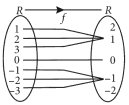
The signum function, $f: R \rightarrow R$ is given by $f(x)=\left\{\begin{array}{ll}1, & x>0 \\ 0, & x=0 \\ -1, & x<0\end{array}\right.$ is
  • A
    One-one
  • B
    Onto
  • C
    Bijective
  • None of these

Answer

Correct option: D.
None of these
(d): We have, $f(1)=f(2)$ $=f(3)=1$
$
\begin{array}{l}
f(0)=0 \\
f(-1)=f(-2)=f(-3)=-1
\end{array}
$
Hence, function $f$ is not one-one.
Image

Need a full question paper?

Generate a complete, print-ready paper with questions like this in minutes — across 16+ boards, with answer keys.
Start Generating Free

Similar questions

If $\int\text{x}\sin\text{x dx}=-\text{x}\cos\text{x}+\text{a},$ then a is equal to:
  1. $\sin\text{x}+\text{C}$
  2. $\cos\text{x}+\text{C}$
  3. $\text{C}$
  4. none of these.
The area bounded by the curve $y = \log x$ between the $x$-axis and ordinate $x = e$ is
Let $[x]$ denote the largest integer not exceeding $x$ and $\{x\}=x-[x]$. Then, $\int \limits_0^{2012} \frac{e^{\cos (\pi\{x\})}}{e^{\cos (\pi\{x\})}+e^{-\cos (\pi\{x\})}} d x$ is equal to
Let a vector $\vec{a}$ be coplanar with vectors $\vec{b}=2 \hat{i}+\hat{j}+\hat{k}$ and $\vec{c}=\hat{i}-\hat{j}+\hat{k} .$ If $\vec{a}$ is perpendicular to $\vec{d}=3 \vec{i}+2 \hat{j}+6 \hat{k}$, and $|\vec{a}|=\sqrt{10} .$ Then a possible value of $[\overrightarrow{\mathrm{a}} \overrightarrow{\mathrm{b}} \overrightarrow{\mathrm{c}}]+[\overrightarrow{\mathrm{a}} \overrightarrow{\mathrm{b}} \vec{d}]+[\overrightarrow{\mathrm{a}} \vec{c} \vec{d}]$ is equal to:
If $A = \left\{ {1,2,3,......m} \right\},$ then total number of reflexive relations that can be defined from $A \to A$ is 
If $A$ and $B$ are two independent events with $P(A)=\frac{1}{3}$ and $P(B)=\frac{1}{4}$, then $P\left(B^{\prime} \mid A\right)$ is equal to
If $\text{f}(\text{x})=\frac{1}{4\text{x}^{2}+2\text{x}+1}$, then its maximum value is :
  1. $\frac{4}{3}$
  2. $\frac{2}{3}$
  3. $1$
  4. $\frac{3}{4}$ 
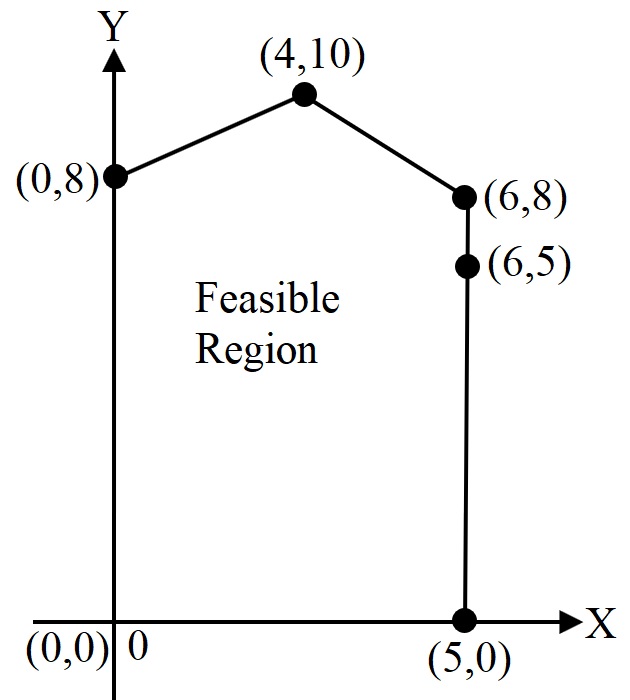
The feasible region for a LPP is shown shaded in the figure. Let Z = 3x - 4y be the objective function. Minimum of Z occurs at.

  1. (0, 0)
  2. (0, 8)
  3. (5, 0)
  4. (4, 10)
If $a = 2i + k,\,\,b = i + j + k$ and $c = 4i - 3j + 7k.$ If $d \times b = c \times b$ and $d\,.\,a = 0,$ then $d$ will be
For function $f(x)={\left( {1 + \frac{1}{x}} \right)^x}$  Which one of the following limits tends to unity'