Questions · Page 2 of 5

M.C.Q (1 Marks)

Question 511 Mark
On the power set P of a non-empty set A, we define an operation $\triangle \text{ by }\text{X}\triangle\text{Y}=(\text{X}\cap\text{Y})∪(\text{X}∩\text{Y})\text{X}\triangle\text{Y}=\text{X}∩\text{Y}∪\text{X}∩\text{Y}$
Then which are of the following statements is true about $\triangle$
  1. Commutative and associative without an identity.
  2. Commutative but not associative with an identity.
  3. Associative but not commutative without an identity.
  4. Associative and commutative with an identity.
Answer
  1. Associative and commutative with an identity.

Solution:

Commutativity:

$\text{X}\triangle\text{Y}=(\overline{\text{X}}\cap\text{Y})\cup(\text{X}\cap\overline{\text{Y}})$

$=(\overline{\text{Y}}\cap\text{X})\cup(\text{Y}\cap\overline{\text{X}})$

$=\text{Y}\triangle\text{X}$

Thus,

$\text{X}\triangle\text{Y}=\text{Y}\triangle\text{X}$

Hence, $\triangle$ is commutative on A.

Let $\phi$ be the identity element for $\triangle$ on P.

$\text{A}\triangle\phi=\big(\overline{\text{A}}\cap\phi\big)\cup\big(\text{A}\cap\overline{\phi}\big)$

$=\phi\cup\text{A}$

$=\text{A}$

and,

$\phi\triangle\text{A}=\big(\overline{\phi}\cap\text{A}\big)\cup\big(\phi\cap\overline{\text{A}}\big)$

$=\text{A}\cup\phi$

$=\text{A}$
View full question & answer
Question 521 Mark
The relation S defined on the set R of all real number by the rule aSb iff a ≥ b is:
  1. An equivalence relation.
  2. Reflexive, transitive but not symmetric.
  3. Symmetric, transitive but not reflexive.
  4. Neither transitive nor reflexive but symmetric.
Answer
  1. Reflexive, transitive but not symmetric.

Solution:

The relation S is reflexive, since for any $(\text{a, a})\in\text{S}$ the condition a2b holds,

The relation S is not symmetric since, for any ​​​​​​​$(\text{a, b}]\in\text{S}$ but $(\text{b, a})\notin\text{S}$

The relation S is transitive since, for any $(\text{a, b}]\in\text{S}$ and $(\text{b, c})\in\text{S}$

Therefore, $(\text{a, c})\notin\text{S}$

View full question & answer
Question 531 Mark
Let $\text{A}=\{\text{x}\in\text{R}:-1\leq\text{x}\leq1\}=\text{B}.$ Then, the mapping f : A → B given by f(x) = x|x| is:
  1. Injective but not surjective.
  2. Surjective but not injective.
  3. Bijective.
  4. None of these.
Answer
  1. Bijective.

Solution:

Given function is $\text{A}=\{\text{x}:-1\leq\text{x}\leq1\}$ and f : A → A such that f(x) = x|x|

For the mod function we have to check three cases as x < 0, x = 0, x > 0.

For example, x < 0

f(x) = x|x| < 0

|x| = -x

y = -x2

$\text{x}=-\sqrt{-\text{y}}$ which is not possible for x > 0

Hence, f is onto.

⇒ f is bijection.

View full question & answer
Question 541 Mark
Let L denote the set of all straight lines in a plane. Let a relation R be defined by lRm if l is perpendicular to m for all l, m ∈ L. Then, R is:
  1. Reflexive.
  2. Symmetric.
  3. Transitive.
  4. None of these.
Answer
  1. Symmetric.

​​​​​​​Solution:

Given that L denote the set of all straight lines in a plane.

A relation R be defined by lRm if is perpendicular to m for all l, m ∈ L.

R is not reflexive. R is symmetric as we can say $\text{l}\bot\text{m}$ or $\text{m}\bot\text{l}.$

View full question & answer
Question 551 Mark
In the set Z of all integers, which of the following relation R is not an equivalence relation?
  1. xRy : if $\text{x}\leq\text{y}$
  2. xRy : if x = y
  3. xRy : if x - y is an even integer
  4. xRy : if $\text{x}\equiv\text{y}\ (\text{mod 3})$
Answer
  1. xRy : if $\text{x}\leq\text{y}$

​​​​​​​Solution:

In the set of Z of all integers xRy : if $\text{x}\leq\text{y}$ is not an equivalence relation.

For the relation $\text{x}\leq\text{y}(\text{x, y})\in\text{R}$ but (y, x) not belongs to y as $\text{y}\geq\text{x}$ given.

Hence, it is not an equivalence relation.

View full question & answer
Question 561 Mark
If f : R → R is given by f(x) = x3 + 3, then f-1(x) is equal to:
  1. $\text{x}^\frac{1}{3}-3$
  2. $\text{x}^\frac{1}{3}+3$
  3. $(\text{x}-3)^\frac{1}{3}$
  4. $\text{x}+3^\frac{1}{3}$
Answer
  1. $(\text{x}-3)^\frac{1}{3}$

Solution:

Let f-1(x) = y

f(y) = x

⇒ y3 + 3 = x

⇒ y3 = x - 3

⇒ y = (x - 3)3

$\Rightarrow\ \text{y}=(\text{x}-3)^\frac{1}{3}$

View full question & answer
Question 571 Mark
Let $\text{f(x)}=\frac{1}{1-\text{x}}.$ Then, {fo(fof)}(x):
  1. x for all $\text{x}\in\text{R}$
  2. x for all $\text{x}\in\text{R}-\{1\}$
  3. x for all $\text{x}\in\text{R}-\{0,1\}$
  4. None of these.
Answer
  1. x for all $\text{x}\in\text{R}-\{0,1\}$

Solution:

Domain of f: $1-\text{x}\neq0$

$\Rightarrow\ \text{x}\neq1$

Domain of f = R - {1}

Range of f: $\text{y}=\frac{1}{1-\text{x}}$

$\Rightarrow\ 1-\text{x}=\frac{1}{\text{y}}$

$\Rightarrow\ \text{x}=1-\frac{1}{\text{y}}$

$\Rightarrow\ \text{y}\neq0$

Range of f = R - {0}

So, f : R - {1} → R - {0} and f : R - {1} → R - {0}

Range of f is not a subset of the domain of f.

Domain (fof) = {x : $\text{x}\in$ domain of f and $\text{f(x)}\in$ domain of f}

Domain (fof) $=\big\{\text{x}:\text{x}\in\text{R}-\{1\}\text{ and }\frac{1}{1-\text{x}}\in\text{R}-\{1\}\big\}$

Domain (fof) $=\big\{\text{x}:\text{x}\neq1\text{ and }\frac{1}{1-\text{x}}\neq1\big\}$

Domain (fof) $=\{\text{x}:\text{x}\neq1\text{ and }1-\text{x}\neq1\}$

Domain (fof) $=\{\text{x}:\text{x}\neq1\text{ and }\text{x}\neq0\}$

Domain (fof) = R - {0, 1}

(fof)(x) = f(f(x))

$=\text{f}\Big(\frac{1}{1-\text{x}}\Big)=\frac{1}{1-\frac{1}{1-\text{x}}}=\frac{1-\text{x}}{1-\text{x}-1}$

$=\frac{1-\text{x}}{-\text{x}}=\frac{\text{x}-1}{\text{x}}$

For range of fof, $\text{x}\neq0$

Now, fof : R → {0, 1} → R - {0} and f : R - {1} → R - {0}

Range of fof is not a subset of domain of f.

Domain (fo(fof)) $=\{\text{x}:\text{x}\in$ domain of fof and (fof)(x) $\in$ domain of f$\}$

Domain (fo(fof)) $=\Big\{\text{x}:\text{x}\in\text{R}-\{0,1\}\text{ and }\frac{\text{x}-1}{\text{x}}\in\text{R}-\{1\}\Big\}$

Domain (fo(fof)) $=\Big\{\text{x}:\text{x}\neq0,1\text{ and }\frac{\text{x}-1}{\text{x}}\neq1\Big\}$

Domain (fo(fof)) $=\{\text{x}:\text{x}\neq0,1\text{ and }\text{x}-1\neq\text{x}\}$

Domain (fo(fof)) $=\{\text{x}:\text{x}\neq0,1\text{ and }\text{x}\in\text{R}\}$

Domain (fo(fof)) = R - {0, 1}

​​​​​​​Domain (fo(fof)) = f((fof)(x))

$=\text{f}\Big(\frac{\text{x}-1}{\text{x}}\Big)$

$=\frac{1}{1-\frac{\text{x}-1}{\text{x}}}$

$=\frac{\text{x}}{\text{x}-\text{x}+1}$

$=\text{x}$

So, (fo(fof))(x) = x, where $\text{x}\neq0,1$

View full question & answer
Question 581 Mark
Let A = N × N and × be the binary operation on A defined by (a, b) × (c, d) = (a + c, b + d). Then × is:
  1. Commutative.
  2. Associative.
  3. Both (a) and (b).
  4. None of these.l
Answer
  1. Both (a) and (b).
View full question & answer
Question 591 Mark
The relation R is defined on the set of natural numbers as {(a, b) : a = 2b}. Then, R-1 is given by:
  1. {(2, 1), (4, 2), (6, 3), ….}
  2. {(1, 2), (2, 4), (3, 6), ……..}
  3. R-1 is not defiend.
  4. None of these.
Answer
  1. {(1, 2), (2, 4), (3, 6), ……..}
View full question & answer
Question 601 Mark
The distinct linear functions that map [-1, 1] onto [0, 2] are:
  1. f(x) = x + 1, g(x) = -x + 1
  2. f(x) = x - 1, g(x) = x + 1
  3. f(x) = -x - 1, g(x) = x - 1
  4. None of these.
Answer
  1. f(x) = -x - 1, g(x) = x - 1

Solution:

​​​​​​​Since f is invertible, range of f = co-domain of f = x

So, we need to find the range of f to find X.

For finding the range, let f(x) = y

⇒ 4x - x2 = y

⇒ x2 - 4x = -y

⇒ x2 - 4x + 4 = 4 - y

⇒ (x - 2)2 = 4 - y

$\Rightarrow\ \text{x}-2=\pm4-\text{y}$

$\Rightarrow\ \text{x}=2\pm4-\text{y}$

This is defined only when $4-\text{y}\geq0$

$\Rightarrow\ \text{y}\leq4,$

X = Range of f $=(-\infty,4]$

View full question & answer
Question 611 Mark
Choose the correct answer from the given four options.
Let A = {1, 2, 3, ...n} and B = {a, b}. Then the number of surjections from A into B is:
  1. nP2
  2. 2n – 2
  3. 2n – 1
  4. None of these.
Answer
  1. 2n – 2

Solution:

Given that, A = {1, 2, 3, ..... n} and B = {a, b}

If function is subjective then its range must be set B = {a, b}

Now number of onto functions = Number of ways 'n' distinct objects can be distributed in two boxes 'a' and 'b' in such a way that no box remains empty.

Now for each object there are two options, either it is put in box 'a' or in box 'b'

So total number of ways of 'n' different objects = 2 × 2 × 2 .... n times = 2n

But in one case all the objects are put box 'a' and in one case all the objects are put in box 'b'

So, number of subjective functions = 2n - 2

View full question & answer
Question 621 Mark
For the multiplication of matrices as a binary operation on the set of all matrices of the form $\begin{bmatrix}\text{a}&\text{b}\\-\text{b}&\text{a}\end{bmatrix},\text{a, b}\in\text{R}$ the inverse of $\begin{bmatrix}2&3\\-3&2\end{bmatrix}$ is:
  1. $\begin{bmatrix}-2&3\\-3&-2\end{bmatrix}$
  2. $\begin{bmatrix}2&3\\-3&2\end{bmatrix}$
  3. $\begin{bmatrix}\frac{2}{13}&\frac{-3}{13}\\\frac{3}{13}&\frac{2}{13}\end{bmatrix}$
  4. $\begin{bmatrix}1&0\\0&1\end{bmatrix}$
Answer
  1. $\begin{bmatrix}\frac{2}{13}&\frac{-3}{13}\\\frac{3}{13}&\frac{2}{13}\end{bmatrix}$

Solution:

Let the identity of $\begin{bmatrix}2&3\\-3&2\end{bmatrix}$ be $\begin{bmatrix}\text{e}&\text{f}\\-\text{f}&\text{e}\end{bmatrix}$, then

$\begin{bmatrix}2&3\\-3&2\end{bmatrix}*\begin{bmatrix}\text{e}&\text{f}\\-\text{f}&\text{e}\end{bmatrix}=\begin{bmatrix}2&3\\-3&3\end{bmatrix}$

⇒ 2e - 3f = 2 →(1)

2f + 3e = 3 →(2)

Solving (1) and (2) we get e = 1 and f = 0

So, the identity is $\begin{bmatrix}1&0\\0&1\end{bmatrix}$.

Let the inverse be $\begin{bmatrix}\text{a}&\text{b}\\-\text{b}&\text{a}\end{bmatrix}$, then

$\begin{bmatrix}2&3\\-3&2\end{bmatrix}*\begin{bmatrix}\text{a}&\text{b}\\-\text{b}&\text{a}\end{bmatrix}=\begin{bmatrix}1&0\\0&1\end{bmatrix}$

⇒ 2a - 3b = 1 →(1)

2b + 3a = 0 →(2)

Solving (1) and (2), we get $\text{a}=\frac{2}{13}$ and $\text{b}=\frac{-3}{13}$

So, the inverse of $\begin{bmatrix}2&3\\-3&2\end{bmatrix}$ is $\begin{bmatrix}\frac{2}{13}&\frac{-3}{13}\\\frac{3}{13}&\frac{2}{13}\end{bmatrix}$

View full question & answer
Question 631 Mark
The function f : R → R defined by f(x) = (x - 1)(x - 2)(x - 3) is:
  1. One-one but not onto.
  2. Onto but not one-one.
  3. Both one and onto.
  4. Neither one-one nor onto.
Answer
  1. Onto but not one-one.

Solution:

Given function is f(x) = (x - 1)(x - 2)(x - 3)

If f(x) = f(y) then

(x - 1)(x - 2)(x - 3) = (y - 1)(y - 2)(y - 3)

⇒ f(1) = f(2) = f(3) = 0

It is not one-one.

y = f(x)

$\text{x}\in\text{R}$ also $\text{y}\in\text{R}$ hence f is onto.

View full question & answer
Question 641 Mark
Which one of the following function is not invertible?
  1. $\text{f} : \text{R} \rightarrow \text{R}, \text{f(x)} = 3\text{x} + 1$
  2. $\text{f} : \text{R} \rightarrow [0,\infty), \text{f(x)} = \text{x}^2$
  3. $\text{f} : \text{R}^+\rightarrow\text{R}^+, \text{f(x)} =\frac{1}{\text{x}^3}$
  4. None of these.
Answer
  1. None of these.
View full question & answer
Question 651 Mark
Let us define a relation R in R as aRb if a ≥ b. Then R is:
  1. An equivalence relation.
  2. Reflexive, transitive but not symmetric.
  3. Symmetric, transitive but not reflexive.
  4. Neither transitive nor reflexive but symmetric.
Answer
  1. Reflexive, transitive but not symmetric.
View full question & answer
Question 661 Mark
If the function f : R → R be such that f(x) = x - [x], where [x] denotes the greatest integer less than or equal to x, then f-1(x) is:
  1. $\frac{1}{\text{x}-[\text{x}]}$
  2. [x] - x
  3. Not defined
  4. None of these.
Answer
  1. Not defined

​​​​​​​Solution:

Given function is f(x) = x - [x]

[x] is a greatest integer function.

Hence, we will have same values of the function for the different values of x.

As we are considering integer only not fraction part.

Hence, it is not defined.

View full question & answer
Question 671 Mark
If the set A contains 5 elements and the set B contains 6 elements, then the number of one-one and onto mappings from A to B is:
  1. 720
  2. 120
  3. 0
  4. None of these.
Answer
  1. 0

Solution:

As, the number of bijection from A into B can only be possible when provided $\frac{7}{(\text{A})}>\frac{7}{(\text{B})}$

But here n(A) < n(B)

So, the number of bijection.

i.e. one-one and onto mapping from A to B.

View full question & answer
Question 681 Mark
Let g(x) = 1 + x - [x] and $\text{f(x)}=\begin{cases}-1,&\text{x}<0\\0,&\text{x}=0\\1,&\text{x}>0\end{cases}$ where [x] denotes the greatest integer less than or equal to x. Then for all x, f(g(x)) is equal to:
  1. x
  2. 1
  3. f(x)
  4. g(x)
Answer
  1. 1

Solution:

When, -1 < x < 0

Then, g(x) = 1 + x - [x]

= 1 + x - (-1) = 2 + x

$\therefore$ f(g(x)) = 1

When, x = 0

Then, g(x) = 1 + x - [x]

= 1 + x - 0 = 1 + x

$\therefore$ f(g(x)) = 1

When, x > 1

Then, g(x) = 1 + x - [x]

= 1 + x - 1 = x

$\therefore$ f(g(x)) = 1

Therefore, for each interval f(g(x)) = 1

View full question & answer
Question 691 Mark
If G is the set of all matrices of the form $\begin{bmatrix}\text{x}&\text{x}\\\text{x}&\text{x}\end{bmatrix}$, where $\text{x}\in\text{R}-\{0\}$, then the identity element with respect to the multiplication of matrices as binary operation, is:
  1. $\begin{bmatrix}1&1\\1&1\end{bmatrix}$
  2. $\begin{bmatrix}-\frac{1}2&-\frac{1}2\\-\frac{1}2&-\frac{1}2\end{bmatrix}$
  3. $\begin{bmatrix}\frac{1}2&\frac{1}2\\\frac{1}2&\frac{1}2\end{bmatrix}$
  4. $\begin{bmatrix}-1&-1\\-1&-1\end{bmatrix}$
Answer
  1. $\begin{bmatrix}\frac{1}2&\frac{1}2\\\frac{1}2&\frac{1}2\end{bmatrix}$

Solution:

Let $\begin{bmatrix}\text{x}&\text{x}\\\text{x}&\text{x}\end{bmatrix}\in\text{G}$ and $\begin{bmatrix}\text{e}&\text{e}\\\text{e}&\text{e}\end{bmatrix}\in\text{G}$ such that

$\begin{bmatrix}\text{x}&\text{x}\\\text{x}&\text{x}\end{bmatrix}\begin{bmatrix}\text{e}&\text{e}\\\text{e}&\text{e}\end{bmatrix}=\begin{bmatrix}\text{x}&\text{x}\\\text{x}&\text{x}\end{bmatrix}$

$\begin{bmatrix}\text{x}&\text{x}\\\text{x}&\text{x}\end{bmatrix}\begin{bmatrix}\text{e}&\text{e}\\\text{e}&\text{e}\end{bmatrix}=\begin{bmatrix}\text{x}&\text{x}\\\text{x}&\text{x}\end{bmatrix}$

$\begin{bmatrix}2\text{ex}&2\text{ex}\\2\text{ex}&2\text{ex}\end{bmatrix}=\begin{bmatrix}\text{x}&\text{x}\\\text{x}&\text{x}\end{bmatrix}$

$2\text{ex}=\text{x}$

$\text{e}=\frac{1}2\in\text{R}-\{0\}$

Thus, $\begin{bmatrix}\frac{1}2&\frac{1}2\\\frac{1}2&\frac{1}2\end{bmatrix}\in\text{G}$, is the identity element in G.

View full question & answer
Question 701 Mark
If f(x) $=1-\frac{1}{\text{x}},$ then $\text{f}(\text{f}(\frac{1}{\text{x}}))$
  1. $\frac{1}{\text{x}}$
  2. $\frac{1}{1+\text{x}}$
  3. $\frac{\text{x}}{\text{x}-1}$
  4. $\frac{1}{\text{x}-1}$
Answer
  1. $\frac{\text{x}}{\text{x}-1}$

View full question & answer
Question 711 Mark
For the binary operation * defined on R − {1} by the rule a * b = a + b + ab for all a, b ∈ R − {1}, the inverse of a is:
  1. $-\text{a}$
  2. $-\frac{\text{a}}{\text{a}-1}$
  3. $\frac{1}{\text{a}}$
  4. $\text{a}^2$
Answer
  1. $-\frac{\text{a}}{\text{a}-1}$

Solution:

Let e be the identity element in R - {1} with respect to * such that

a * e = a = e * a, $\forall\text{ a}\in\text{R}-\{1\}$

a * e = a and e * a = a, $\forall\text{ a}\in\text{R}-\{1\}$

Then,

a + e + ae = a and e + a + ea = a, $\forall\text{ a}\in\text{R}-\{1\}$

e(1 + a) = 0, $\forall\text{ a}\in\text{R}-\{1\}$

$\text{e}=0\in\text{R}-\{1\}$

Thus, 0 is the identity element in R - {1} with respect to *.

Let $\text{a}\in\text{R}-\{1\}$ and $\text{b}\in\text{R}-\{1\}$ be the inverse of a. Then,

a * b = e = b * a

a * b = e and b * a = e

⇒ a + b + ab = 0 and b + a + ba = 0

$\Rightarrow\text{b}(1+\text{a})=-\text{a}\in\text{R}-\{1\}$

$\Rightarrow\text{b}=\frac{-\text{a}}{\text{a}-1}\in\text{R}-\{1\}$

Thus, $\frac{-\text{a}}{\text{a}-1}$ is the inverse of $\text{a}\in\text{R}-\{1\}$.

View full question & answer
Question 721 Mark
Let A = {1, 2, ......., n} and B = {a, b}. Then the number of subjections from A into B is:
  1. $^{\text{n}}\text{P}_2$
  2. $2^\text{n}-2$
  3. $2^\text{n}-1$
  4. $^{\text{n}}\text{C}_2$
Answer
  1. $2^\text{n}-2$

Solution:

The number of functions from a set with n number of elements into a set with 2 number of elements = 2n

But two functions can be many-one into function.

View full question & answer
Question 731 Mark
The function f : R → R defined by f(x) = 6x + 6|x| is:
  1. One-one and onto.
  2. Many one and onto.
  3. One-one and into.
  4. Many one and into.
Answer
  1. Many one and into.

Solution:

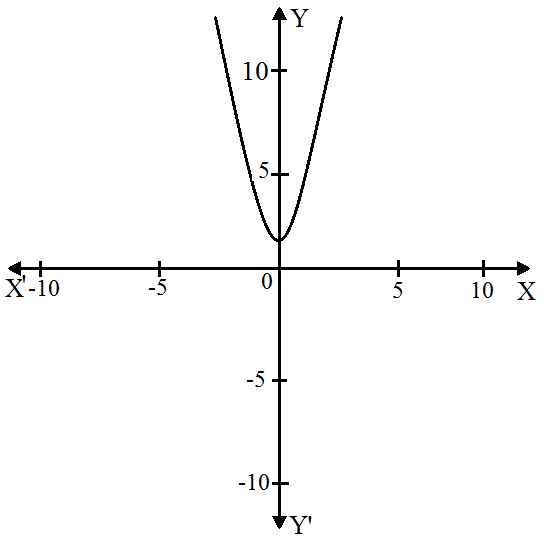
Graph of the given function is as follows:

A line parallel to X-axis is cutting the graph at two different values.

Therefore, for two different values of x we are getting the same value of y.

That means it is many one function.

From the given graph we can see that the range is $[2,\infty)$ and R is the co-domain of the given function.

Hence, Co-dornain = Range

Therefore, the given function is into.

View full question & answer
Question 741 Mark
Choose the correct answer from the given four options.
Let us define a relation R in R as aRb if a ≥ b. Then R is:
  1. An equivalence relation.
  2. Reflexive, transitive but not symmetric.
  3. Symmetric, transitive but not reflexive.
  4. Neither transitive nor reflexive but symmetric.
Answer
  1. Reflexive, transitive but not symmetric.

Solution:

We are given that, aRb if a ≥ b

⇒ aRa ⇒ a ≥ a which is true.

For relation aRb to be symmetric, we must have a ≥ b and b ≥ a which can’t be possible.

Hence, R is not symmetric.

For relation aRb to be transitive, we must have aRb and bRc.

⇒ a ≥ b and b ≥ c

⇒ a ≥ c

Hence, R is transitive.

View full question & answer
Question 751 Mark
Subtraction of integers is:
  1. Commutative but no associative.
  2. Commutative and associative.
  3. Associative but not commutative.
  4. Neither commutative nor associative.
Answer
  1. Neither commutative nor associative.

Solution:

Let $\text{a, b}\in\text{Z}$, then

a * b = a - b

b * a = b - a

⇒ a * b $\neq$ b * a

Substraction is not commutative.

(a * b) * c

= (a - b) * c

= a - b - c

a * (b * c)

= a * (b - c)

= a - b + c

⇒ (a * b) * c $\neq$ a * (b * c)

Substraction is not associative.

View full question & answer
Question 761 Mark
Let the function f : R - {-b} → R - {1} be defined by $\text{f(x)}=\frac{\text{x}+\text{a}}{\text{x}+\text{b}},\ \text{a}\neq\text{b}.$ Then,
  1. f is one-one but not onto.
  2. f is onto but not one-one.
  3. f is both one-one and onto.
  4. None of these.
Answer
  1. f is both one-one and onto.

Solution:

Injectivity: Let x and y be two elements in the domain R - {-b}, such that

f(x) = f(y) ⇒ x + ax + b = y + ay + b

⇒ x + ay + b = x + by + a

⇒ xy + bx + ay + ab = xy + ax + by + ab

⇒ bx + ay = ax + by

⇒ a - bx = a - by

⇒ x = y

So, f is one-one.

Surjectivity: Let y be an element in the co-domain of f,

i.e., R - {1}, such that f(x) = y

⇒ x + ax + b = y

⇒ x + a ⇒ x = -a

So, f is onto.

View full question & answer
Question 771 Mark
Let f : N → R : $\text{f}(\text{x})=\frac{(2\text{x}-1)}{2}$ and g : Q → R : g(x) = x + 2 be two functions. Then, (gof) $(\frac{3}{2})$ is:
  1. 3
  2. 1
  3. $\frac{7}{2}$
  4. None of these.
Answer
  1. 3
View full question & answer
Question 781 Mark
Let f : R → R be a function defined by f(x) = x3 + 4, then f is:
  1. Injective.
  2. Surjective.
  3. Bijective.
  4. None of these.
Answer
  1. Bijective.
View full question & answer
Question 791 Mark
The relation R defined on the set A = {1, 2, 3, 4, 5} by R = {(a, b): |a2 - b2| < 16} is given by:
  1. {(1, 1), (2, 1), (3, 1), (4, 1), (2, 3)}
  2. {(2, 2), (3, 2), (4, 2), (2, 4)}
  3. {(3, 3), (4, 3), (5, 4), (3, 4)}
  4. None of these.
Answer
  1. None of these.

Solution:

R is given by {(1, 2), (2, 1), (2, 3), (3, 2), (3, 4), (4, 3), (4, 5), (5, 4),(1, 3), (3, 1), (1, 4), (4, 1), (2, 4), (4, 2)} which is not mentioned in (a), (b) or (c).

View full question & answer
Question 801 Mark
If f : [1, $\infty$) → [2, $\infty$) is given by $\text{f(x)}=\text{x}+\frac{1}{\text{x}},$ then f-1 equals to:
  1. $\frac{\text{x}+\sqrt{\text{x}^2-4}}{2}$
  2. $\frac{\text{x}}{1+\text{x}^2}$
  3. $\frac{\text{x}-\sqrt{\text{x}^2-4}}{2}$
  4. $1+\sqrt{\text{x}^2-4}$
Answer
  1. $\frac{\text{x}+\sqrt{\text{x}^2-4}}{2}$

View full question & answer
Question 811 Mark
On Z an operation * is defined by a * b = a2 + b2 for all a, b ∈ Z. The operation * on Z is:
  1. Commutative and associative.
  2. Associative but not commutative.
  3. Not associative.
  4. Not a binary operation.
Answer
  1. Not associative.

Solution:

a * b = a2 + b2

b * a = b2 + a2

⇒ a * b = b * a

So * is commutative.

Now

(a * b) * c

= (a2 + b2) * c

= (a2 + b2)2 + c2

a * (b * c)

= a * (b2 + c2)

= a2 + (b2 +c2)2

⇒ (a * b) * c $\neq$ a * (b * c)

So * is not associative.

View full question & answer
Question 821 Mark
Which of the following functions from Z into Z are bijective?
  1. f(x) = x3
  2. f(x) = x + 2
  3. f(x) = 2x + 1
  4. f(x) = x2 + 1
Answer
  1. f(x) = x + 2
View full question & answer
Question 831 Mark
Let T be the set of all triangles in the Euclidean plane, and let a relation R on T be defined as aRb if a is congruent to b ∀ a, b ∈ T. Then R is:
  1. Reflexive but not transitive.
  2. Transitive but not symmetric.
  3. Equivalence.
  4. None of these.
Answer
  1. Equivalence.
View full question & answer
Question 841 Mark
Number of binary operations on the set {a, b} are:
  1. 8
  2. 20
  3. 10
  4. 16
Answer
  1. 16

Solution:

Let the given set be A = {a, b}

n(A) = 2

Total number of binary operations = 2(2 × Number of elements in the set)

= 2(2 × 2)

= 24

= 16

Therefore, the number of binary operations on the set {a, b} are 16.

View full question & answer
Question 851 Mark
If set A contains 5 elements and the set B contains 6 elements, then the number of one-one and onto mappings from A to B is:
  1. 0
  2. 120
  3. 720
  4. None of these.
Answer
  1. 0

Solution:

Given,

n(A) = 5

n(B) = 6

Each element in set B is assigned to only one element in set A for the one-one function.

Here, only ‘5’ elements of set B are assigned to ‘5’ elements of set ‘A’ and one element will be left in set B.

The range of the function must be equal to B.

However, for the given sets, it is not possible.

Thus, the range of functions does not contain all ‘6’ elements of set ‘ B’.

Therefore, if the function is one-one it cannot be onto.

Hence, the number of one-one and onto mappings from A to B is 0.

View full question & answer
Question 861 Mark
Let X = {-1, 0, 1}, Y = {0, 2} and a function f : X → Y defiend by y = 2x4, is:
  1. One-one onto.
  2. One-one into.
  3. Many-one onto.
  4. Many-one into.
Answer
  1. Many-one onto.
View full question & answer
Question 871 Mark
If the function f : R → A given by $\text{f(x)}=\frac{\text{x}^2}{\text{x}^2+1}$ is a surjection, then A =
  1. R
  2. [0, 1]
  3. [0, 1)
  4. [0, 1)
Answer
  1. [0, 1)

Solution:

As f is surjective, range of f = co-domain of f

⇒ A = range of f

$=\frac{\text{x}^2}{\text{x}^2+1},$

$\text{y}=\frac{\text{x}^2}{\text{x}^2+1}$

$\Rightarrow\ \text{y}(\text{x}^2+1)$

$\Rightarrow\ \text{x}^2=\frac{-\text{y}}{(\text{y}-1)}$

$\Rightarrow\ \text{x}=\sqrt{\frac{\text{y}}{(1-\text{y})}}$

$\Rightarrow\ \frac{\text{y}}{(1-\text{y})}\geq0$

$\Rightarrow\ \text{y}\in[0,1)$

⇒ Range of f = [0, 1)

⇒ A = [0, 1)

View full question & answer
Question 881 Mark
A relation R is defined from {2, 3, 4, 5} to {3, 6, 7, 10} by : xRy ⇔ x is relatively prime to y. Then, domain of R is:
  1. {2, 3, 5}
  2. {3, 5}
  3. {2, 3, 4}
  4. {2, 3, 4, 5}
Answer
  1. {2, 3, 4, 5}

Solution:

Given that relation R is defined from {2, 3, 4, 5} to {3, 6, 7, 10} by : xRy ⇔ x is relatively prime to y. R can be written as,

{(2, 3), (2, 7), (3, 7), (3, 10), (4, 3), (4, 7), (5, 3), (5, 6), (5, 7)}

Here we can see that domain means x element which is $2\leq\text{x}\leq5.$

Hence, {2, 3, 4, 5}

View full question & answer
Question 891 Mark
Let f(x) = x2 and g(x) = 2x. Then, the solution set of the equation fog(x) = gof(x) is:
  1. R
  2. {0}
  3. {0, 2}
  4. None of these.
Answer
  1. {0, 2}

Solution:

Since (fog)(x) = (gof)(x),

f(g(x)) = g(f(x))

$\Rightarrow\ \text{f}(2^\text{x})=\text{g}(\text{x}^2)$

$\Rightarrow\ \big(2^{\text{x}}\big)^{2}=2^{\text{x}^2}$

$\Rightarrow\ 2^{2\text{x}}=2^{\text{x}^2}$

$\Rightarrow\ \text{x}^2=2\text{x}$

$\Rightarrow\ \text{x}^2-2\text{x}=0$

$\Rightarrow\ \text{x}(\text{x}-2)=0$

$\Rightarrow\ \text{x}=0, 2$

$\Rightarrow\ \text{x}\in\{0,2\}$

View full question & answer
Question 901 Mark
Let × be a binary operation on set Q - {1} defind by a × b = a + b - ab : a, b ∈ Q - {1}. Then × is:
  1. Commutative.
  2. Associative.
  3. Both (a) and (b).
  4. None of these.
Answer
  1. Both (a) and (b).
View full question & answer
Question 911 Mark
Let f : R → R be given by $\text{f(x)}=\tan\text{x}.$ Then, f-1(1) is:
  1. $\frac{\pi}{4}$
  2. $\big\{\text{n}\pi+\frac{\pi}{4}:\text{n}\in\text{Z}\big\}$
  3. Does not exist.
  4. None of these.
Answer
  1. $\big\{\text{n}\pi+\frac{\pi}{4}:\text{n}\in\text{Z}\big\}$

Solution:

We have, f : R → R is given by

$\text{f(x)}=\tan\text{x}$

$\Rightarrow\ \text{f}^{-1}(\text{x})=\tan^{-1}\text{x}$

$\therefore\ \text{f}^{-1}(1)=\tan^{-1}1=\big\{\text{n}\pi+\frac{\pi}{4}:\text{n}\in\text{Z}\big\}$

View full question & answer
Question 921 Mark
The maximum number of equivalence relations on the set A = {1, 2, 3} is:
  1. 1
  2. 2
  3. 3
  4. 5
Answer
  1. 5

Solution:

The maximum number of equivalence relations on the set A = {1, 2, 3} is,

R1 = {(1, 1)}

R2 = {(2, 2)}

R3 = {(3, 3)}

R4 = {(1, 1), (2, 2), (3, 3), (1, 2), (2, 1)}

R5 = {(1, 1), (2, 2), (3, 3), (1, 2), (2, 1), (1, 3), (3, 1), (2, 3), (3, 2)}

The maximum number of equivalence relations on the set A = {1, 2, 3} is 5.

View full question & answer
Question 931 Mark
Let R be the relation over the set of all straight lines in a plane such that  $\text{l}_1\text{Rl}_2\Leftrightarrow\text{l}_1\bot\text{l}_2.$ Then, R is:
  1. Symmetric.
  2. Reflexive.
  3. Transitive.
  4. An equivalence relation.
Answer
  1. Symmetric.

Solution:

Given R is the relation over the set of all straight lines in a plane such that $\text{l}_1\text{Rl}_2\Leftrightarrow\text{l}_1\bot\text{l}_2.$

It is symmetric relation as we can say either or $\text{l}_2\bot\text{l}_1.$

View full question & answer
Question 941 Mark
If the binary operation * on Z is defined by a * b = a2 − b2 + ab + 4, then value of (2 * 3) * 4 is:
  1. 233
  2. 33
  3. 55
  4. −55
Answer
  1. 33

Solution:

Given that a * b = a2 - b2 + ab + 4

So,

2 * 3

= 22 - 32 + 2.3 + 4

= 4 - 9 + 6 + 4

= 5

Now,

(2 * 3) * 4

= 5 * 4

= 52 - 42 + 5.4 + 4

= 25- 16 + 20 + 4

= 33

View full question & answer
Question 951 Mark
An operation * is defined on the set Z of non-zero integers by a * b = ab for all a, b ∈ Z. Then the property satisfied is:
  1. Closure.
  2. Commutative.
  3. Associative.
  4. None of these.
Answer
  1. None of these.

Solution:

* is not clouser because when a = 1 and b = 2,

$\text{a}*\text{b}=\frac{\text{a}}{\text{b}}=\frac{1}{2}\in\text{Z}$

* is not commutative because when a = 1, b = 2 and c = 3,

$1*(2*3)=1*\Big(\frac{2}3\Big)$

$=\frac{1}{\big(\frac{2}{3}\big)}$

$=\frac{3}2$

$(1*2)*3=\frac{1}2*3$

$=\frac{\big(\frac{1}2\big)}{3}$

$=\frac{1}6$

Thus,

$1*(2*3)\neq(1*2)*3$

View full question & answer
Question 961 Mark
Let f(x) = x3 be a function with domain {0, 1, 2, 3}. Then domain of f-1 is:
  1. {3, 2, 1, 0}
  2. {0, -1, -2, -3}
  3. {0, 1, 8, 27}
  4. {0, -1, -8, -27}
Answer
  1. {0, 1, 8, 27}

Solution:

Given function is f(x) = x3 be a function with domain {0, 1, 2, 3}.

Range = {0, 13, 23, 33} = {0, 1, 8, 27}

f can be written as

{(0, 0), (1, 1), (2, 8), (3, 27)}

Hence, f-1 can be written as

{(0, 0), (1, 1), (8, 2), (27, 3)}

Domain of f-1 is {0, 1, 8, 27}

View full question & answer
Question 971 Mark
The smallest integer function f(x) = [x] is:
  1. One-one.
  2. Many-one.
  3. Both (a) and (b).
  4. None of these.
Answer
  1. Many-one.
View full question & answer
Question 991 Mark
Let R be the relation on the set A = {1, 2, 3, 4} given by R = {(1, 2), (2, 2), (1, 1), (4, 4), (1, 3), (3, 3), (3, 2)}. Then,
  1. R is reflexive and symmetric but not transitive.
  2. R is reflexive and transitive but not symmetric.
  3. R is symmetric and transitive but not reflexive.
  4. R is an equivalence relation.
Answer
  1. R is reflexive and transitive but not symmetric.

Solution:

Reflexivity: Clearly, ​​​​​​​$(\text{a, a})\in\text{R}\ \forall\ \text{a}\in\text{A}$

So, R is reflexive on A.

Symmetry: Since, $1,2\in\text{R},$ but $2,1\notin\text{R,}$ R is not symmetric on A.

Transitivity: Since, $1,3,3,2\in\text{R}$ and $1,2\in\text{R},$ R is transitive on A.

View full question & answer
Question 1001 Mark
Let R be a relation on the set N given by R = {(a, b): a = b - 2, b > 6}. Then,
  1. (2, 4) ∈ R
  2. (3, 8) ∈ R
  3. (6, 8) ∈ R
  4. (8, 7) ∈ R
Answer
  1. (6, 8) ∈ R

Solution:

a = b - 2 ⇒ 6 = 8 - 2 and b = 8 > 6

Hence, (6, 8) ∈ R

View full question & answer
M.C.Q (1 Marks) - Page 2 - Maths STD 12 Science Questions - Vidyadip