Questions · Page 1 of 5

M.C.Q (1 Marks)

🎯

Test yourself on this topic

50 questions · timed · auto-graded

Question 11 Mark
R is a relation on the set Z of integers and it is given by (x, y) ∈ R ⇔ | x - y | ≤ 1. Then, R is:
  1. Reflexive and transitive.
  2. Reflexive and symmetric.
  3. Symmetric and transitive.
  4. An equivalence relation.
Answer
  1. Reflexive and symmetric.

Solution:

Reflexivity: Let $\text{x}\in\text{R.}$ Then,

$\text{x}-\text{x}=0<1$

$\Rightarrow\ |\text{x}-\text{x}|\leq1$

$\Rightarrow\ (\text{x, x})\in\text{R}$ for all $\text{x}\in\text{Z}$

So, R is reflexive on Z.

Symmetry: Let $\text{x, y}\in\text{R.}$ Then,

$|\text{x}-\text{y}|\leq0$

$\Rightarrow\ |-(\text{y}-\text{x})|\leq1$

$\Rightarrow\ |(\text{y}-\text{x})|\leq1$ [Since |x - y| = |y - x|]

$\Rightarrow\ (\text{y, x})\in\text{R}$ for all $\text{x, y}\in\text{Z}$

So, R is symmetric on Z.

Transitivity: Let $(\text{x, y})\in\text{R}$ and $(\text{y, z})\in\text{R}.$ Then,

$|\text{x}-\text{y}|\leq1$ and $|\text{y}-\text{z}|\leq1$

⇒ It is not always true that $|\text{x}-\text{y}|\leq1.$

$\Rightarrow\ (\text{x, z})\notin\text{R}$

So, R is not transitive on Z.
View full question & answer
Question 21 Mark
The number of binary operation that can be defined on a set of 2 elements is:
  1. 8
  2. 4
  3. 16
  4. 64
Answer
  1. 16

Solution:

Total number of binary operations on a set containing n elements is

$\text{(n)}^{\text{n}^2}$ so for n = 2 we have $(2)^{2^2}=2^4=16$

View full question & answer
Question 41 Mark
Let R be the relation in the set {1, 2, 3, 4} given by R = {(1, 2), (2, 2), (1, 1), (4,4), (1, 3), (3, 3), (3, 2)}. Choose the correct answer.
  1. R is reflexive and symmetric but not transitive.
  2. R is reflexive and transitive but not symmetric.
  3. R is symmetric and transitive but not reflexive.
  4. R is an equivalence relation.
Answer
Let R be the relation in the set {1, 2, 3, 4} is given by
R = {(1, 2), (2, 2), (1, 1), (4, 4), (1, 3), (3, 3), (3, 2)}
(a) $(1,1),(2,2),(3,3),(4,4)\in\text{R}$ $\therefore$ R is reflexive
(b) $(1,2)\in\text{R}\ \text{but}\ (2,1)\notin\text{R}$ $\therefore$ R is not symmetric
(c) $\text{If }(1,3)\in\text{R}\ \text{and}\ (3,2)\in\text{R}\ \text{then}\ (1,2)\in\text{R}$ $\therefore$ R is transitive
Therefore, option (B) is correct.
  1. R is reflexive and transitive but not symmetric.
View full question & answer
Question 51 Mark
Let R be the relation in the set N given by R = {(a, b) : a = b – 2, b > 6}. Choose
the correct answer.
  1. $(2,4)\in\text{R}$
  2. $(3,8)\in\text{R}$
  3. $(6,8)\in\text{R}$
  4. $(8,7)\in\text{R}.$
Answer
Given: a = b − 2, b >  6
(A) a = 2, b = 4 , Here b > 6 is not true, therefore, this option is incorrect
(B) a = 3, b = 8 and a = b - 2 ⇒ 3 = 8-2 3 = 6, which is false.
  Therefore, this option is incorrect    
(C) a = 6, b = 8 and b = b - 2 ⇒ 6 = 8 - 2 6 = 6, which is true.
  Therefore, this option is correct    
(D) a = 8, b = 7 and a = b - 2 ⇒ 8 = 7 - 2 8 = 5, which is false.
  1. $(6,8)\in\text{R}.$
View full question & answer
Question 61 Mark
Let f: R → R be defined as f(x) = x4. Choose the correct answer.
  1. f is one-one onto
  2. f is many-one onto
  3. f is one-one but not onto
  4. f is neither one-one nor onto.
Answer
f: R → R is defined as f(x) = x4.
Let $\text{x},\text{y}\in\text{R}$ such that f(x) = f(y).
⇒ x4 = y4
$\Rightarrow\text{x}=\pm\text{y}$
$\therefore$ f(x1) = f(x2) does not imply that x1 = x2
For instance,
f(1) = f(-1) = 1
$\therefore$ f is not one-one.
Consider an element 2 in co-domain R. It is clear that there does not exist any x in domain R such that f(x) = 2.
$\therefore$ f is not onto.
Hence, function f is neither one-one nor onto.
The correct answer is D.
  1. f is neither one-one nor onto.
View full question & answer
Question 71 Mark
Let $\text{f}:\text{R}-\Big\{-\frac{4}{3}\Big\}\rightarrow\text{R}$ be a function defined as $f(\text{x})=\frac{4\text{x}}{3\text{x}+4}.$ The inverse of f is the map g: Range $\text{f}:\text{R}-\Big\{-\frac{4}{3}\Big\}\rightarrow\text{R}$ given by:
  1. $\text{g}(\text{y})=\frac{3\text{y}}{3-4\text{y}}$
  2. $\text{g}(\text{y})=\frac{4\text{y}}{4-3\text{y}}$
  3. $\text{g}(\text{y})=\frac{4\text{y}}{3-4\text{y}}$
  4. $\text{g}(\text{y})=\frac{3\text{y}}{4-3\text{y}}.$ 
Answer
Given: $\text{f}:\text{R}-\Big\{-\frac{4}{3}\Big\}\rightarrow\text{R}\ \text{and}\ f(\text{x})=\frac{4\text{x}}{3\text{x}+4}$
Now, Range of $\text{f}\rightarrow\text{R}-\Big\{-\frac{4}{3}\Big\}$
Let $\text{y}=f(\text{x})\ \ \ \therefore\ \text{y}=\frac{4\text{x}}{3\text{x}+4}\ \ \Rightarrow\ 3\text{xy}+4\text{y}=4\text{x}$
$\Rightarrow\ \ \ \text{x}(4-3\text{y})=4\text{y}\ \ \Rightarrow\ \text{x}=\frac{4\text{y}}{4-3\text{y}}$
$\therefore\ \ f^{-1}(\text{y})=\text{g(y)}=\frac{4\text{y}}{3-4\text{y}}$
Therefore, option (B) is correct.
  1. $\text{g}(\text{y})=\frac{4\text{y}}{4-3\text{y}}.$
View full question & answer
Question 81 Mark
Let f: R → R be defined as f(x) = 3x. Choose the correct answer.
  1. f is one-one onto
  2. f is many-one onto
  3. f is one-one but not onto
  4. f is neither one-one nor onto.
Answer
f: R → R is defined as f(x) = 3x.

Let $\text{x},\text{y}\in\text{R}$ such that f(x) = f(y).

⇒ 3x = 3y

⇒ x = y

$\therefore$ f is one-one.

Also, for any real number (y) in co-domain R, there exists $\frac{\text{y}}{3}$ in R such that $f\Big(\frac{\text{y}}{3}\Big)=3\Big(\frac{\text{y}}{3}\Big)=\text{y}$

$\therefore$ f is onto.

Hence, function f is one-one and onto.

The correct answer is A.

  1. f is one-one onto.
View full question & answer
Question 91 Mark
Number of binary operations on the set {a, b} are:
  1. 10
  2. 16
  3. 20
  4. 8.
Answer
A binary operation * on {a, b} is a function from {a, b} × {a, b} → {a, b} i.e., * is a function from {(a, a), (a, b), (b, a), (b, b)}.
Hence, the total number of binary operations on the set {a, b} is 24 i.e., 16.
The correct answer is B.
  1. 16.
View full question & answer
Question 101 Mark
Let A = {1, 2, 3}. Then number of equivalence relations containing (1, 2) is:
  1. 1
  2. 2
  3. 3
  4. 4.
Answer
The given set is A = {1, 2, 3}.
The smallest equivalence relation containing (1, 2) is given by,
R1 = {(1, 1), (2, 2), (3, 3), (1, 2), (2, 1)}
Now, we are left with only four pairs i.e., (2, 3), (3, 2), (1, 3), and (3, 1).
If we add any one pair [say (2, 3)] to R1, then for symmetry we must add (3, 2). Also, for transitivity we required to add (1, 3) and (3, 1).
Hence, the only equivalence relation (bigger than R1) is the universal relation.
This shows that the total number of equivalence relations containing (1, 2) is two.
  1. 2.
View full question & answer
Question 111 Mark
Find which of the binary operations are commutative and which are associative.
Consider a binary operation * on N defined as a * b = a3 + b3. Choose the
correct answer.
  1. Is * both associative and commutative?
  2. Is * commutative but not associative?
  3. Is * commutative but not associative?
  4. Is * neither commutative nor associative?
Answer
a * b = a3 + b3 = b3 + a3 = b * a
$\therefore$ The operation is commutative.
Again, (a * b) * c = a * (a3 + b3) = a3(a3 + b3)3
And (a * b) * c= (a3 + b3) * c = (a3 + b3)3 + c3 $\neq\text{a}*(\text{b}*\text{c})$
$\therefore$ The operation * is not associative.
 Therefore, option (B) is correct.
  1. Is * commutative but not associative?
View full question & answer
Question 121 Mark
The inverse of the function $\text{f}:\text{R}\rightarrow\{\text{x}\in\text{R}:\text{x}<1\}$ given by $\text{f(x)}=\frac{\text{e}^{\text{x}}-\text{e}^{-\text{x}}}{\text{e}^\text{x}+\text{e}^{-\text{x}}}$ is:

  1. $\frac{1}{2}\log\frac{1+\text{x}}{1-\text{x}}$

  2. $\frac{1}{2}\log\frac{2+\text{x}}{2-\text{x}}$

  3. $\frac{1}{2}\log\frac{1-\text{x}}{1+\text{x}}$

  4. $\text{None of these}$

Answer
  1. $\frac{1}{2}\log\frac{1+\text{x}}{1-\text{x}}$

Solution:

Let f-1(x) = y .....(1)

$\Rightarrow\ \text{f(y)}=\text{x}$

$\Rightarrow\ \frac{\text{e}^{\text{y}}-\text{e}^{-\text{y}}}{\text{e}^{\text{y}}+\text{e}^{-\text{y}}}=\text{x}$

$\Rightarrow\ \frac{\text{e}^{-\text{y}}(\text{e}^{2\text{y}}-1)}{\text{e}^{-\text{y}}(\text{e}^{2\text{y}}+1)}=\text{x}$

$\Rightarrow\ (\text{e}^{2\text{y}}-1)=\text{x}(\text{e}^{2\text{y}}+1)$

$\Rightarrow\ \text{e}^{2\text{y}}-1=\text{xe}^{2\text{y}}+\text{x}$

$\Rightarrow\ \text{e}^{2\text{y}}=\frac{1+\text{x}}{1-\text{x}}$

$\Rightarrow\ 2\text{y}=\log_\text{e}\Big(\frac{1+\text{x}}{1-\text{x}}\Big)$

$\Rightarrow\ \text{y}=\frac{1}{2}\log_\text{e}\Big(\frac{1+\text{x}}{1-\text{x}}\Big)$

$\Rightarrow\ \text{f}^{-1}(\text{x})=\frac{1}{2}\log_\text{e}\Big(\frac{1+\text{x}}{1-\text{x}}\Big)$ [From (1)]

View full question & answer
Question 131 Mark
The number of bijective functions from set A to itself when A contains 106 elements is:
  1. 106
  2. (106)2
  3. 106!
  4. 2106
Answer
  1. 106!
View full question & answer
Question 141 Mark
Let R be a relation on the set N of natural numbers denoted by nRm ⇔ n is a factor of m (i.e. n | m). Then, R is:
  1. Reflexive and symmetric.
  2. Transitive and symmetric.
  3. Equivalence.
  4. Reflexive, transitive but not symmetric.
Answer
  1. Reflexive, transitive but not symmetric.
View full question & answer
Question 151 Mark
Let R be the relation “is congruent to” on the set of all triangles in a plane is:
  1. Reflexive.
  2. Symmetric.
  3. Symmetric and reflexive.
  4. Equivalence.
Answer
  1. Equivalence.
View full question & answer
Question 161 Mark
The function $\text{f}:\Big[\frac{-1}{2},\frac{1}{2},\frac{1}{2}\Big]\rightarrow\ \Big[\frac{-\pi}{2},\frac{\pi}{2}\Big],$ defined by $\text{f(x)}=\sin^{-1}(3\text{x}-4\text{x}^3),$ is:
  1. Bijection.
  2. Injection but not a surjection.
  3. Surjection but not an injection.
  4. Neither an injection nor a surjection.
Answer
  1. Bijection.

Solution:

$\text{f(x)}=\sin^{-1}(3\text{x}-4\text{x}^3)$

$\Rightarrow\ \text{f(x)}=3\sin^{-1}\text{x}$

Injectivity: Let x and y be two elements in the domain $\Big[\frac{-1}{2},\frac{1}{2}\Big],$ such that

f(x) = f(y)

$\Rightarrow\ 3\sin^{-1}\text{x}=3\sin^{-1}\text{y}$

$\Rightarrow\ \sin^{-1}\text{x}=\sin^{-1}\text{y}$

$\Rightarrow\ \text{x}=\text{y}$

So, f is one-one.

Surjectivity: Let y be any element in the co-domain, such that

f(x) = y

$\Rightarrow\ 3\sin^{-1}\text{x}=\text{y}$

$\Rightarrow\ \sin^{-1}\text{x}=\frac{\text{y}}{3}$

$\Rightarrow\ \text{x}=\sin\frac{\text{y}}{3}\in\Big[\frac{-1}{2},\frac{1}{2}\Big]$

⇒ f is onto.

⇒ f is a bijection.

View full question & answer
Question 171 Mark
The mapping f : N → N is given by f(n) = 1 + n2, n ∈ N when N is the set of natural numbers is:
  1. One-one and onto.
  2. Onto but not one-one.
  3. One-one but not onto.
  4. Neither one-one nor onto.
Answer
  1. One-one but not onto.
View full question & answer
Question 181 Mark
If N be the set of all-natural numbers, consider f : N → N such that f(x) = 2x, ∀ x ∈ N, then f is:
  1. One-one onto.
  2. One-one into.
  3. Many-one onto.
  4. None of these.
Answer
  1. One-one into.
View full question & answer
Question 191 Mark
If × is a binary operation on set of integers I defined by a × b = 3a + 4b - 2, then find the value of 4 × 5.
  1. 35
  2. 30
  3. 25
  4. 29
Answer
  1. 30
View full question & answer
Question 201 Mark
The binary operation * is defined by a * b = a2 + b2 + ab + 1, then (2 * 3) * 2 is equal to:
  1. 20
  2. 40
  3. 400
  4. 445
Answer
  1. 445

Solution:

Given: a * b = a2 + b2 + ab + 1

2 * 3 = 22 + 32 + 2 × 3 + 1

= 4 + 9 + 6 + 1

= 20

(2 * 3) * 2 = 20 * 2

= 202 + 22 + 20 × 2 + 1

= 400 + 4 + 40 + 1

= 445

View full question & answer
Question 211 Mark
Let T be the set of all triangles in the Euclidean plane, and let a relation R on T be defined as aRb if a is congruent to b for all a, b ∈ T. Then, R is:
  1. Reflexive but not symmetric.
  2. Transitive but not symmetric.
  3. Equivalence.
  4. None of these.
Answer
  1. Equivalence.

Solution:

Given that R is T be the set of all triangle in the Euclidean plane, and a relation R on T be defined as aRb if a is congruent to b for all a, b ∈ T.

Here, congruency of triangles follows reflexive, symmetric and transitive property.

Hence, it is an equivalence relation.

View full question & answer
Question 221 Mark
Choose the correct answer from the given four options.
Let f : R → R be defined by $\text{f}(\text{x})=\begin{cases}2\text{x}:\text{x}>3\\\text{x}^2:1<\text{x}\leq3\\3\text{x}:\text{x}\leq1\end{cases}$ Then f(-1) + f(2) + f(4) is:
  1. 9
  2. 14
  3. 5
  4. none of these.
Answer
  1. 9

Solution:

We are given that, $\text{f}(\text{x})=\begin{cases}2\text{x}:\text{x}>3\\\text{x}^2:1<\text{x}\leq3\\3\text{x}:\text{x}\leq1\end{cases}$

Now, f(-1) + f(2) + f(4) = 3(-1) + (2)2 + 2 × 4

= -3 + 4 + 8

= 9

View full question & answer
Question 231 Mark
A function f from the set of natural numbers to integers defined by $\text{f(n)}=\begin{cases}\frac{\text{n}-1}{2},&\text{when n is odd}\\-\frac{\text{n}}{2},&\text{when n is even}\end{cases}$
  1. Neither one-one nor onto.
  2. One-one but not onto.
  3. Onto but not one-one.
  4. One-one and onto both.
Answer
  1. One-one and onto both.

Solution:

Injectivity: Let x and y be any two elements in the domain (N).

Case-1: Both x and y are even.

Let f(x) = f(y)

$\Rightarrow\ \frac{-\text{x}}{2}=\frac{-\text{y}}{2}$

$\Rightarrow-\text{x}=-\text{y}$

$\Rightarrow\ \text{x}=\text{y}$

Case-2: Both x and y are odd.

Let f(x) = f(y)

$\Rightarrow\ \frac{\text{x}-1}{2}=\frac{\text{y}-1}{2}$

$\Rightarrow\ \text{x}-1=\text{y}-1$

$\Rightarrow\ \text{x}=\text{y}$

Case-3: Let x be even and y be odd.

Then, $\text{f(x)}=\frac{-\text{x}}{2}$ and $\text{f(y)}=\frac{\text{y}-1}{2}$

Then, clearly

$\text{x}\neq\text{y}$

$\Rightarrow\ \text{f(x)}\neq\text{f(y)}$

From all the cases, f is one-one.

Surjectivity: Co-domain of f = Z = {......, -3, -2, -1, 0, 1, 2, 3, ......}

Range of $\text{f}=\Big\{....,\ \frac{-3-1}{2},\ \frac{-(-2)}{2},\ \frac{-1-1}{2},\ \frac{0}{2},\ \frac{1-1}{2},\ \frac{-2}{2},\ \frac{3-1}{2},\ ....\Big\}$

⇒ Range of f = {....., -2, 1, -1, 0, 0, -1, 1, .....}

⇒ Range of f = {....., -2, -1, 0, 1, 2, ......}

⇒ Co-domain of f = Range of f

⇒ f is onto.

View full question & answer
Question 241 Mark
Let × be a binary operation on Q, defined by $\text{a}\times\text{b}=\frac{3\text{ab}}{5}$ is:
  1. Commutative.
  2. Associative.
  3. Both (a) and (b).
  4. None of these.
Answer
  1. Both (a) and (b).
View full question & answer
Question 251 Mark
Which of the following is true?
  1. * defined by $\text{a}*\text{b}=\frac{\text{a + b}}2$ is a binary operation on Z.
  2. * defined by $\text{a}*\text{b}=\frac{\text{a + b}}2$ is a binary operation on Q.
  3. All binary commutative operations are associative.
  4. Subtraction is a binary operation on N.
Answer
  1. * defined by $\text{a}*\text{b}=\frac{\text{a + b}}2$ is a binary operation on Q.

Solution:

For option a, if we take 3 and 2 then

$3*2=\frac{5}2\in\text{Z}$. So, option a is not true.

For option b, if we take any two numbers a and b

then $\frac{\text{a + b}}2$ belongs to Q for $\text{a, b}\in\text{Q}$.

So, option b is correct.

For option d, if we take 2, 3 then $2-3=-1\in\text{N}$.

So, option d is not true.

Option c is not true.

View full question & answer
Question 261 Mark
If f : R → R is given by f(x) = 3x - 5, then f-1(x)
  1. is given by $\frac{1}{3\text{x}-5}$
  2. is given by $\frac{\text{x}+5}{3}$
  3. does not exist because f is not one-one.
  4. does not exist because f is not onto.
Answer
  1. is given by $\frac{\text{x}+5}{3}$

Solution:

Given function is f : R → R is given by f(x) = 3x - 5

To find f-1(x)

y = f(x)

⇒ y = 3x - 5

⇒ y + 5 = 3x

$\Rightarrow\ \text{y}=\frac{\text{y}+5}{3}$

Hence, $\text{f}^{-1}(\text{x})=\frac{\text{x}+5}{3}$

View full question & answer
Question 271 Mark
Choose the correct answer from the given four options.
Let f : [0, 1] → [0, 1] be defined by $\text{f}(\text{x})=\begin{cases}\text{x, if x is rational}\\1-\text{x, if x is irrational}\end{cases}$ Then (fof)x is:
  1. constant
  2. 1 + x
  3. x
  4. none of these.
Answer
  1. x

Solution:

We are given that, f : [0, 1] → [0, 1] be defined by $\text{f}(\text{x})=\begin{cases}\text{x, if x is rational}\\1-\text{x, if x is irrational}\end{cases}$

Now, $(\text{fof})\text{x} = \text{f}(\text{f(x)})$

$=\text{x}$

View full question & answer
Question 281 Mark
Let A = {1, 2, 3}. Then, the number of relations containing (1, 2) and (1, 3) which are reflexive and symmetric but not transitive is:
  1. 1
  2. 2
  3. 3
  4. 4
Answer
  1. 1

Solution:

Given that A = {1, 2, 3}

To find the number of relations containing (1, 2) and (1, 3) then R can be written as {(1, 2), (1, 3), (1, 1), (2, 2), (3, 3), (2, 1), (3, 1)}

Here, we can see that

(3, 1) and (1, 2) ⇒ (3, 2) which is not belongs to R.

The number of relations containing (1, 2) and (1, 3)

Which are reflexive and symmetric but not transitive is 1.

View full question & answer
Question 291 Mark
Choose the correct answer from the given four options.
Let f : R → R be defined by $\text{f}(\text{x})=\frac{1}{\text{x}}\ \forall\ \text{x}\in\text{R}.$ Then f is:
  1. one-one.
  2. onto.
  3. bijective.
  4. f is not defined.
Answer
  1. f is not defined.

Solution:

Given that, $\text{f}(\text{x})=\frac{1}{\text{x}}\ \forall\ \text{x}\in\text{R}.$

For x = 0, f(x) is not defined.

Hence, f(x) is a not defined function.

View full question & answer
Question 301 Mark
Let f : R → R be a function defined by $\text{f(x)}=\frac{\text{e}^{|\text{x}|}-\text{e}^{-\text{x}}}{\text{e}^\text{x}+\text{e}^{-\text{x}}}$ then f(x) is:
  1. One-one onto.
  2. One-one but not onto.
  3. Onto but not one-one.
  4. None of these.
Answer
  1. None of these.
View full question & answer
Question 311 Mark
Let * be a binary operation defined on Q+ by the rule $\text{a}*\text{b}=\frac{\text{ab}}3\forall\text{ a, b}\in \text{Q}^+$. The inverse of 4 * 6 is:

  1. $\frac{9}{8}$

  2. $\frac{2}3$

  3. $\frac{3}2$

  4. None of these.

Answer
  1. $\frac{9}8$

Solution:

Let e be the identity element in Q+ with respect to * such that

a * e = a = e * a, $\forall\text{ a}\in\text{Q}^+$

a * e = a and e * a = a, $\forall\text{ a}\in\text{Q}^+$

Then,

$\frac{\text{ae}}{3}=\text{a}\text{ and }\frac{\text{ea}}{3}=\text{a},\forall\text{ a}\in\text{Q}^+$

e = 3, $\forall\text{ a}\in\text{Q}^+$

Thus, 3 is the identity element in Q+ with respect to *.

Let $\text{a}\in\text{Q}^+$ and $\text{b}\in\text{Q}^+$ be the inverse of a. Then,

a * b = e = b * a

a * b = e and b * a = e

$\therefore\ \frac{\text{ab}}3=3\text{ and }\frac{\text{ba}}3=3$

$\text{b}=\frac{9}{\text{a}}\in\text{Q}^+$

Thus, $\frac{9}{\text{a}}$ is the inverse of $\text{a}\in\text{Q}^+$.

Given: $\text{a}*\text{b}=\frac{\text{ab}}3$

$4*6=\frac{4\times6}3=8$

Now,

$\text{a}^{-1}=\frac{9}{\text{a}}$

$(4*6)^{-1}=8^{-1}$

$=\frac{9}8$

View full question & answer
Question 321 Mark
Choose the correct answer out of the given four options.

Let * be binary operation defined on R by a * b = 1 + ab ∀ a, b ∈ R. Then the operation * is:

  1. Commutative but not associative.
  2. Associative but not commutative.
  3. Neither commutative nor associative.
  4. Both commutative and associative.
Answer
  1. Commutative but not associative.

Solution:

We are given that, a * b = 1 + ab ∀ a, b ∈ R

Consider, a * b = ab + 1

= ba + 1

= b * a

Hence, * is a communicative binary operation.

Also, a * (b * c) = a * (bc + 1) $[\because$ b * c = bc + 1$]$

= a(bc + 1) + 1

= a + abc + 1

Now, (a * b) * c = (ab + 1) * c $[\because$ a * b = ab + 1$]$

= (1 + ab)c + 1

= c + abc +1

Now, $\text{a}+\text{abc}+1\neq\text{c}+\text{abc}+1$

$\Rightarrow\ \text{a}\ ^*\ (\text{b}\ ^* \ \text{c})\neq(\text{a}\ ^* \ \text{b})\ ^* \ \text{c}$

Therefore, * is not associative.

Hence, * is communicative but not associative.

View full question & answer
Question 331 Mark
The domain of the function $\text{f(x)}=\frac{1}{\sqrt{\{\sin\text{x}\}+\{\sin(\pi+\text{x})}\}}$ where {.} denotes fractional part, is:
  1. $[0,\pi]$
  2. $(2\text{n}+1)\frac{\pi}{2},\text{n }\in\text{ z}$
  3. $(0,\pi)$
  4. None of these.
Answer
  1. None of these.
View full question & answer
Question 341 Mark
Choose the correct answer from the given four options.
If a relation R on the set {1, 2, 3} be defined by R = {(1, 2)}, then R is:
  1. Reflexive.
  2. Transitive.
  3. Symmetric.
  4. None of these.
Answer
  1. Transitive.

Solution:

R on the set {1, 2, 3} be defined by R = {(1, 2)}

It is clear that R is transitive.

View full question & answer
Question 351 Mark
The inverse of the function $\text{y}=\frac{10^\text{x}-10^{-\text{x}}}{10^\text{x}+10^{-\text{x}}}$ is:
  1. $\log_{10}(2-\text{x})$
  2. $\frac{1}{2}\log_{10}\Big(\frac{1+\text{x}}{1-\text{x}}\Big)$
  3. $\frac{1}{2}\log_{10}(2\text{x}-1)$
  4. $\frac{1}{4}\log\big(\frac{2\text{x}}{2-\text{x}}\Big)$
Answer
  1. $\frac{1}{2}\log_{10}\Big(\frac{1+\text{x}}{1-\text{x}}\Big)$
View full question & answer
Question 361 Mark
If f : A → B is surjective then:
  1. no two elements of A have the same image in B
  2. every element of A has an image in B
  3. every element of B has at least one pre-image in A
  4. A and B are finite non empty sets
Answer
  1.  every element of B has at least one pre-image in A

Solution:


Surjective means onto function.
co domain = Range
So every element of B has at least one pre-image in A. 

View full question & answer
Question 371 Mark
Choose the correct answer from the given four options.
Let f : [2, ∞) → R be the function defined by f(x) = x2 – 4x + 5, then the range of f is:
  1. $\text{R}$
  2. $[1,\infty)$
  3. $[4,\infty)$
  4. $[5,\infty)$
Answer
  1. $[1,\infty)$

Solution:

Given that, $\text{f}(\text{x})=\text{x}^2-4\text{x}+5,$

Let $\text{y}=\text{x}^2-4\text{x}+5$

$\Rightarrow\ \text{y}=\text{x}^2-4\text{x}+4+1$

$=(\text{x}-2)^2+1$

$\Rightarrow\ (\text{x}-2)^2=\text{y}-1$

$\Rightarrow\ \text{x}-2=\sqrt{\text{y}-1}$

$\Rightarrow\ \text{x}=2+\sqrt{\text{y}-1}$

$\therefore\ \text{y}-1\geq0,\ \text{y}\geq1$

Range $=[1,\infty)$

View full question & answer
Question 381 Mark
If a * b = a2 + b2, then the value of (4 * 5) * 3 is:
  1. (42 + 52) + 32
  2. (4 + 5)2 + 32
  3. 412 + 32
  4. (4 + 5 + 3)2
Answer
  1. 412 + 32

Solution:

Given a * b = a2 + b2

So, 4 * 5 = 42 + 52

Now,

(4 * 5) * 3 = (4 * 5)2 + 32

= (42 + 52)2 + 32

= 412 + 32

View full question & answer
Question 391 Mark
If a relation R is defined on the set Z of integers as follows: (a, b) ∈ R ⇔ a2 + b2 = 25. Then, domain (R) is:
  1. {3, 4, 5}
  2. {0, 3, 4, 5}
  3. $\{0,\pm3,\pm4,\pm5\}$
  4. None of these.
Answer
  1. $\{0,\pm3,\pm4,\pm5\}$

Solution:

As aRb ⇔ a < b

does not satisfy reflexive and symmetric relation.

View full question & answer
Question 401 Mark
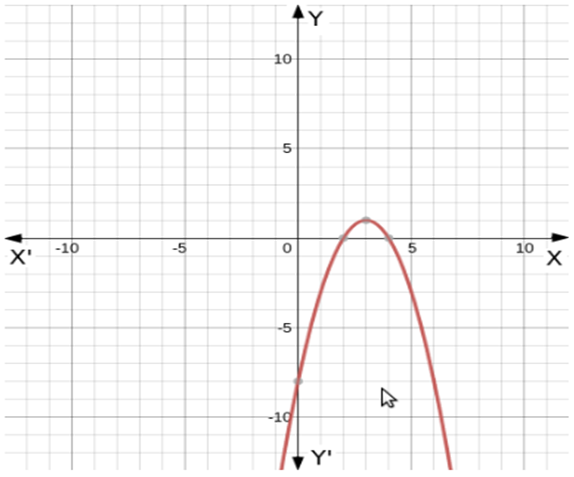
The function f : A → B defined by f(x) = -x2 + 6x- 8 is a bijection if,
  1. $\text{A}=(-\infty,3]$ and $\text{B}=(-\infty,1]$
  2. $\text{A}=[-3,\infty)$ and $\text{B}=(-\infty,1]$
  3. $\text{A}=(-\infty,3]$ and $\text{B}=[1,\infty)$
  4. $\text{A}=[3,\infty)$ and $\text{B}=[1,\infty)$
Answer
  1. $\text{A}=(-\infty,3]$ and $\text{B}=(-\infty,1]$

Solution:

f(x) = -x2 + 6x - 8, is a polynomial function and the domain of polynomial function is real number.

$\therefore\ \text{x}\in\text{R}$

f(x) = -x2 + 6x - 8

= -(x2 - 6x + 8)

= -(x2 - 6x + 9 - 1)

= -(x - 3)2 + 1

Maximum value of -(x - 3)2 woud be 0

$\therefore$ Maximum value of -(x - 3)2 + 1 woud be 1

$\therefore\ \text{f(x)}\in(-\infty,1]$

We can see from the given graph that function is symmetrical about x = 3 and the given function is bijective.

So, x would be either $(-\infty,3]\text{ or }[3,\infty)$

The correct option which satisfy A and B both is:

$\text{A}=(-\infty,3]$ and $\text{B}=(-\infty,1]$

View full question & answer
Question 411 Mark
If A = {1, 2, 3}, B = {1, 4, 6, 9} and R is a relation from A to B defined by 'x is greater than y'. The range of R is:
  1. {1, 4, 6, 9}
  2. {4, 6, 9}
  3. {1}
  4. None of these.
Answer
  1. {1}

Solution:

Here, $\text{R}=\text{x, y}:\text{x}\in\text{A}$ and $\text{y}\in\text{B}:\text{x}>\text{y}$ ⇒ R = 2, 1, 3, 1

Thus, Range of R = {1}

View full question & answer
Question 421 Mark
Let f : Z → Z be given by $\text{f(x)}=\begin{cases}\frac{\text{x}}{2},&\text{if x is even}\\0,&\text{if x is odd}\end{cases}.$ Then, f is:
  1. Onto but not one-one.
  2. One-one but not onto.
  3. One-one and onto.
  4. Neither one-one nor onto.
Answer
  1. Onto but not one-one.

Solution:

Given function is

$\text{f(x)}=\frac{\text{x}}{2}$ if x is even

= 0 if x is odd

For f(3) = 0 and f(4) = 0

⇒ f(3) = f(4)

But, $3\neq4$

Hence, it is not one-one.

$\text{x}\in\text{R}\Rightarrow\ \text{y}\in\text{R}$

Here, Domain = range of f

Hence, it is onto.

View full question & answer
Question 431 Mark
The function f : R → R, f(x) = x2 is:
  1. Injective but not surjective.
  2. Surjective but not injective.
  3. Injective as well as surjective.
  4. Neither injective nor surjective.
Answer
  1. Neither injective nor surjective.

Solution:

Given function is f : R → R, f(x) = x2

If f(x) = f(y) then

x2 = y2

$\Rightarrow\ \text{x}\pm\text{y}$

Hence, it is not one-one or injective.

f(x) = y

y = x2

$\text{x}=\pm\sqrt{\text{y}}$

But co-domain is R.

Hence, it is not onto or surjective.

View full question & answer
Question 441 Mark
Let A = {1, 2, 3, …. n} and B = {a, b}. Then the number of surjections from A into B is:
  1. $^\text{n}\text{P}_2$
  2. 2n - 2
  3. 2n - 1
  4. None of these.
Answer
  1. 2n - 2
View full question & answer
Question 451 Mark
A binary operation * on Z defined by a * b = 3a + b for all a, b ∈ Z, is:
  1. Commutative.
  2. Associative.
  3. Not commutative.
  4. Commutative and associative.
Answer
  1. Not commutative.

Solution:

Let $\text{a, b}\in\text{Z}$

a * b = 3a + b

b * a = 3b + a

Thus, a * b $\neq$ b * a

If a = 1 and b = 2,

1 * 2 = 3(1) + 2

= 5

2 * 1 = 3(2) + 1

= 7

1 * 2 $\neq$ 2 * 1

Thus, * is not commutative on Z.

View full question & answer
Question 461 Mark
Which of the following functions from $\text{A}=\{\text{x}:-1\leq\text{x}\leq1\}$ to itself are bijections?
  1. $\text{f(x)}=\frac{\text{x}}{2}$
  2. $\text{g(x)}=\sin\big(\frac{\pi\text{x}}{2}\big)$
  3. $\text{h(x)}=|\text{x}|$
  4. $\text{k(x)}=\text{x}^2$
Answer
  1. $\text{g(x)}=\sin\big(\frac{\pi\text{x}}{2}\big)$

Solution:

  1. Range of $\text{f}=\Big[\frac{-1}{2},\frac{1}{2}\Big]\neq\text{A}$

So, f is not a bijection.

  1. Range $=\Big[\sin\Big(\frac{-\pi}{2}\Big),\ \sin\Big(\frac{\pi}{2}\Big)\Big]=[-1,1]=\text{A}$

So, g is a bijection.

  1. h(-1) = |-1| = 1

And h(1) = |1| = 1

⇒ -1 and 1 have the same images.

So, h is not a bijection.

  1. k(-1) = (-1)2 = 1

And k(1) = (1)2 = 1

⇒ -1 and 1 have the same images.

So, k is not a bijection.

View full question & answer
Question 471 Mark
Let A = {1, 2, 3} and B = {(1, 2), (2, 3), (1, 3)} be a relation on A. Then, R is:
  1. Neither reflexive nor transitive.
  2. Neither symmetric nor transitive.
  3. Transitive.
  4. None of these.
Answer
  1. Transitive.

Solution:

Reflexivity: Since $(1, 1)\notin\text{B,}$ B is not reflexive on A.

Symmetry: Since $1,2\in\text{B}$ but $2,1\notin\text{B,}$ B is not symmetric on A.

Transitivity: Since $1,2\in\text{B},\ 2,3\in\text{B}$ and $1,3\in\text{B,}$ B is transitive on A.

View full question & answer
Question 481 Mark
Consider a binary operation ∗ on N defined as a ∗ b = a3 + b3.
  1. ∗ is both associative and commutative.
  2. ∗ is commutative but not associative.
  3. ∗ is neither commutative nor associative.
  4. ∗ is associative but not commutative.
Answer
  1. ∗ is commutative but not associative.

Solution:

Given that the binary operation ∗ on N is defined as a∗b = a3 + b3.

Apply the given binary operation on b∗a.

b∗a = b3 + a3 = a3 + b3

It shows that the value of a∗b is equal to that of b∗a.

So, the operation is commutative.

Consider different values of the variable as a = 1, b = 2 and c = 3.

Apply the given binary operation on (a∗b)∗c.

(a∗b)∗c = (1∗2)∗3 = (13 + 23)∗3 = 93 + 33 = 729 + 27 = 756

Apply the given binary operation on a∗(b∗c).

(a∗b)∗c = 1∗(2∗3) = 1∗(23 + 33) = 13 + 353 = 42876

(a∗b)∗c ≠ a∗(b∗c)

So the operation is not associative.

Therefore, the given operation is commutative but not associative.

View full question & answer
Question 491 Mark
If $\text{F}:[1,\infty)\rightarrow[2,\infty)$ is given by $\text{f(x)}=\text{x}+\frac{1}{\text{x}},$ then f-1(x) equals:

  1. $\frac{\text{x}+\sqrt{\text{x}^2-4}}{2}$

  2. $\frac{\text{x}}{1+\text{x}^2}$

  3. $\frac{\text{x}-\sqrt{\text{x}^2-4}}{2}$

  4. $1+\sqrt{\text{x}^2-4}$

Answer
  1. $\frac{\text{x}+\sqrt{\text{x}^2-4}}{2}$

​​​​​​​Solution:

Let f-1(x) = y

​​​​​​​$\Rightarrow\ \text{f(y)} = \text{x}$

$\Rightarrow\ \text{y}+\frac{1}{\text{y}}=\text{x}$

$\Rightarrow\ \text{y}^2 + 1 = \text{xy}$

$\Rightarrow\ \text{y}^2 - \text{xy} + 1 = 0$

$\Rightarrow\ \text{y}^2-2\times\text{y}\times\frac{\text{x}}{2}+\big(\frac{\text{x}}{2}\big)^2-\big(\frac{\text{x}}{2}\big)^2+1=0$

$\Rightarrow\ \text{y}^2-2\times\text{y}\times\frac{\text{x}}{2}+\big(\frac{\text{x}}{2}\big)^2=\frac{\text{x}^2-1}{4}$

$\Rightarrow\ \Big(\text{y}-\frac{\text{x}}{2}\Big)^2=\frac{\text{x}^2-1}{4}$

$\Rightarrow\ \text{y}-\frac{\text{x}}{2}=\frac{\sqrt{\text{x}^2-4}}{2}$

$\Rightarrow\ \text{y}=\frac{\text{x}}{2}+\frac{\sqrt{\text{x}^2-4}}{2}$

$\Rightarrow\ \text{y}=\frac{\text{x}+\sqrt{\text{x}^2-4}}{2}$

$\Rightarrow\ \text{f}^{-1}(\text{x})=\frac{\text{x}+\sqrt{\text{x}^2-4}}{2}$

View full question & answer
Question 501 Mark
Choose the correct answer from the given four options.
If the set A contains 5 elements and the set B contains 6 elements, then the number of one-one and onto mappings from A to B is:
  1. 720
  2. 120
  3. 0
  4. none of these.
Answer
  1. 0

Solution:

Since, the number of elements in B is more than A.

Hence, there cannot be any one-one and onto mapping from A to B.

View full question & answer
M.C.Q (1 Marks) - Maths STD 12 Science Questions - Vidyadip