Boron has two stable isotopes, ${ }_5^{10} B$ and ${ }_5^{11} B$. Their respective masses are $10.01294 u$ and $11.00931 u$ , and the atomic mass of boron is $10.811 u$ . Find the abundances of ${ }_3^{10} B$ and ${ }_3^{11} B$.
View full solution →Question types
Model Paper 1 question types
77 questions across 4 question groups — pick any mix to generate a Physics paper with step-by-step answer keys.
77
Questions
4
Question groups
5
Question types
Sample Questions
Model Paper 1 questions
One sample from each question group in this chapter. Select any group above to see the full set with answer keys.
Work function of Zn is 3.74 eV . If the sphere of Zn is illuminated by the X rays of wavelength 12 Å, the maximum potential produced on the sphere is ..... $\left(h=6.625 \times 10^{-34} J s \right)$
View full solution →Explain self induction and obtain equation of self induced emf in a coil.
Explain polarisation of polar molecule in uniform electric field.
Explain recombination coeflicient of intrinsic semiconductor and obtain the relation $n_t^2=n_{ c } n_{ h }$.
View full solution →A plane polarized light is incident normally on the tourmaline plate. Its $\vec{E}$ vectors make an angle $60^{\circ}$ with the optic axis of the plate. Find the $\%$ difference between initial and final maximum values of vectors.
View full solution →A Cassegrain telescope uses two mirrors as shown in figure. Such a telescop is built with the mirrors 20 mm apart. If the radius of curvature of the large mirr is 220 mm and the small mirror is 140 mm , where will the final image of object at infinity be ?
Explain the difficulties occurred by using galvanometer directly as ammeter.
The number of silicon atoms per $m^3$ is $5 \times 10^{28}$. This is doped simultaneous with $5 \times 10^{22}$ atoms per $m ^3$ of Arsenic and $5 \times 10^{20}$ per $m ^3$ atoms of Indiun Calculate the number of electrons and holes. Given that $n_i=1.5 \times 10^{16} m^{-3}$. the material $n$-type or $p$-type?
View full solution →In a Geiger-Marsden experiment, what is the distance of closest approach to the nucleus of a $7.7 MeV \alpha$-particle before it comes momentarily to rest and reverse its direction?
View full solution →An electron in hydrogen atom revolving in a radius of $5.29 \times 10^{11} m$ around the nucleus. According to the condition of Bohr's allowed electron orbits, find the principle quantum number corresponds to this orbit.
$\begin{array}{l}
h=6.625 \times 10^{-34} Js, e=1.6 \times 10^{-19} C \\
\varepsilon_0=8.85 \times 10^{-12} MKS, m=9.1 \times 10^{-31} kg \text { Find out conclusion from your answe }
\end{array}$
View full solution →$\begin{array}{l}
h=6.625 \times 10^{-34} Js, e=1.6 \times 10^{-19} C \\
\varepsilon_0=8.85 \times 10^{-12} MKS, m=9.1 \times 10^{-31} kg \text { Find out conclusion from your answe }
\end{array}$
(a) Determine the electrostatic potential energy of a system consisting of two charges $7 \mu C$ and $-2 \mu C$ (and with no external field) placed at ( -9 cm $0,0)$ and ( $9 cm, 0,0$ ) respectively.
(b) How much work is required to separate the two charges infinitely away from each other?
(c) Suppose that the same system of charge is now placed in an external electric field $E=A\left(\frac{1}{r^2}\right) ; A=9 \times 10^5 NC ^{-1} m^2$. What would the electrostatic energy, of the configuration be?
View full solution →(b) How much work is required to separate the two charges infinitely away from each other?
(c) Suppose that the same system of charge is now placed in an external electric field $E=A\left(\frac{1}{r^2}\right) ; A=9 \times 10^5 NC ^{-1} m^2$. What would the electrostatic energy, of the configuration be?
The Q value of a nuclear reaction $A + b \rightarrow C +d$ is defined by $Q =\left[m_{ A }+\right.$ $\left.m_{ b }-m_{ C }-m_{ d }\right] c^2$ where the masses refer to the respective nuclei. Determine from the given data the Q -value of the following reactions and state whether the reactions are exothermic or endothermic.
(i) ${ }_1^1 H +{ }_1^3 H \rightarrow{ }_1^2 H +{ }_1^2 H$
(ii) ${ }_6^{12} C +{ }_6^{12} C \rightarrow{ }_{10}^{20} Ne +{ }_2^4 He$
Atomic masses are given to be :
$m \left({ }_1^2 H \right)=2.014102 u, m\left({ }_1^3 H \right)=3.016049 u$,$m \left({ }_6^{12} 12 C \right)=12.000000 u$ $m \left({ }_{10}^{20} Ne \right)=19.992439 u$
View full solution →(i) ${ }_1^1 H +{ }_1^3 H \rightarrow{ }_1^2 H +{ }_1^2 H$
(ii) ${ }_6^{12} C +{ }_6^{12} C \rightarrow{ }_{10}^{20} Ne +{ }_2^4 He$
Atomic masses are given to be :
$m \left({ }_1^2 H \right)=2.014102 u, m\left({ }_1^3 H \right)=3.016049 u$,$m \left({ }_6^{12} 12 C \right)=12.000000 u$ $m \left({ }_{10}^{20} Ne \right)=19.992439 u$
Suppose while sitting in a parked car, you notice a jogger approaching towards you in the side view mirror of $R =2 m$. If the jogger is running at a speed of $5 ms^1$, how fast the image of the jogger appear to move when the jogger is (a) 39 m , (b) 29 m, (c) 19 m , and(d) 9 m away.
View full solution →Figure shows a series LCR circuit connected to a variable frequency 230 V source.
$\begin{array}{r}
L=5.0 H \cdot C=80 \mu F, R=40 \Omega \\
R=40 \Omega
\end{array}$
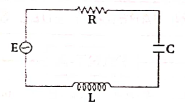
(a) Determine the source frequency which drives the circuit in resonance.
(b) Obtain the impedance of the circuit and the amplitude of current at the resonating frequency.
(c) Determine the rms potential drops across the three elements of the circuit. Show that the potential drop across the LC combination is zero at the resonating frequency.
View full solution →$\begin{array}{r}
L=5.0 H \cdot C=80 \mu F, R=40 \Omega \\
R=40 \Omega
\end{array}$
(a) Determine the source frequency which drives the circuit in resonance.
(b) Obtain the impedance of the circuit and the amplitude of current at the resonating frequency.
(c) Determine the rms potential drops across the three elements of the circuit. Show that the potential drop across the LC combination is zero at the resonating frequency.
We get __________ current through rectifier without simple filter.
- ✓changing direct
- Bconstant direct
- Calternating current
- DA.C.
Answer: A.
View full solution →On increasing the temperature, width of forbidden gap __________ .
- Abecomes zero
- ✓decreases
- Cincreases
- Dnot changing
Answer: B.
View full solution →If the phase difference between two waves is $6 \pi$ radian, then corresponding path difference is __________ .
- ✓$\lambda$
- B$2 \lambda$
- C$6 \lambda$
- D$3 \lambda$
Answer: A.
View full solution →Obtain the binding energy (in MeV ) of a nitrogen nucleus $\left({ }_7^{14} N\right)$, given $m(N)=\left({ }_7^{14} N\right)=14.00307 u$.
- ✓$104.7$
- B$10.47$
- C$0.11236$
- D$931.5$
Answer: A.
View full solution →Which of the following is true for the value of $\frac{N}{Z}$ for the nuclei of heavy element which are found stable ?
- A$<1$
- B$=1$
- ✓$>1$ but $<2$
- D$>2$
Answer: C.
View full solution →Generate a Model Paper 1 paper free
Pick question groups from the list above, set marks and difficulty, and export a branded PDF with step-by-step answer keys. First 3 chapters free — no signup.