Questions

3 Marks Question

🎯

Test yourself on this topic

9 questions · timed · auto-graded

Question 13 Marks
A plane polarized light is incident normally on the tourmaline plate. Its $\vec{E}$ vectors make an angle $60^{\circ}$ with the optic axis of the plate. Find the $\%$ difference between initial and final maximum values of vectors.
Answer
Self
View full question & answer
Question 23 Marks
A Cassegrain telescope uses two mirrors as shown in figure. Such a telescop is built with the mirrors 20 mm apart. If the radius of curvature of the large mirr is 220 mm and the small mirror is 140 mm , where will the final image of object at infinity be ?
Answer
Self
View full question & answer
Question 43 Marks
The number of silicon atoms per $m^3$ is $5 \times 10^{28}$. This is doped simultaneous with $5 \times 10^{22}$ atoms per $m ^3$ of Arsenic and $5 \times 10^{20}$ per $m ^3$ atoms of Indiun Calculate the number of electrons and holes. Given that $n_i=1.5 \times 10^{16} m^{-3}$. the material $n$-type or $p$-type?
Answer
Self
View full question & answer
Question 53 Marks
In a Geiger-Marsden experiment, what is the distance of closest approach to the nucleus of a $7.7 MeV \alpha$-particle before it comes momentarily to rest and reverse its direction?
Answer
Self
View full question & answer
Question 63 Marks
What is the de-Broglie wavelength associated with (a) an electron moving with a speed of $5.4 \times 10^6 m / s$, and (b) a ball of mass 150 g travelling at $ 30 . m / s$ ?
Answer
Self
View full question & answer
Question 73 Marks
A square loop of side 10 cm and resistance $0.5 \Omega$ is placed vertically in the east west plane. A uniform magnetic field of 0.10 T is set up across the plane in the north-east direction. The magnetic field is decreased to zero in 0.70 s at a steady rate. Determine the magnitudes of induced emf and current during this time interval.
Answer
Self
View full question & answer
Question 83 Marks
(a) Calculate the potential at a point P due to a charge of $4 \times 10^{-7} C$ located 9 cm away.
(b) Hence obtain the work done in bringing a charge of $2 \times 10^{-9} C$ from infinity to the point $P$. Does the answer depend on the path along which the charges is brought?
Answer
Self
View full question & answer
Question 93 Marks
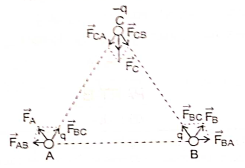
Consider the changes $q, q$ and $-q$ placed at the vertices of an equilateral triangle as shown in figure. What is the foree on each charge ?
Image
Answer
Self
View full question & answer