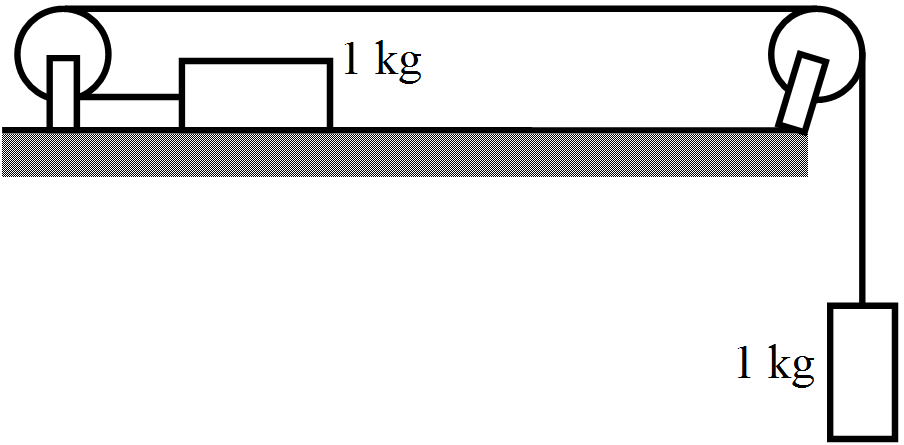
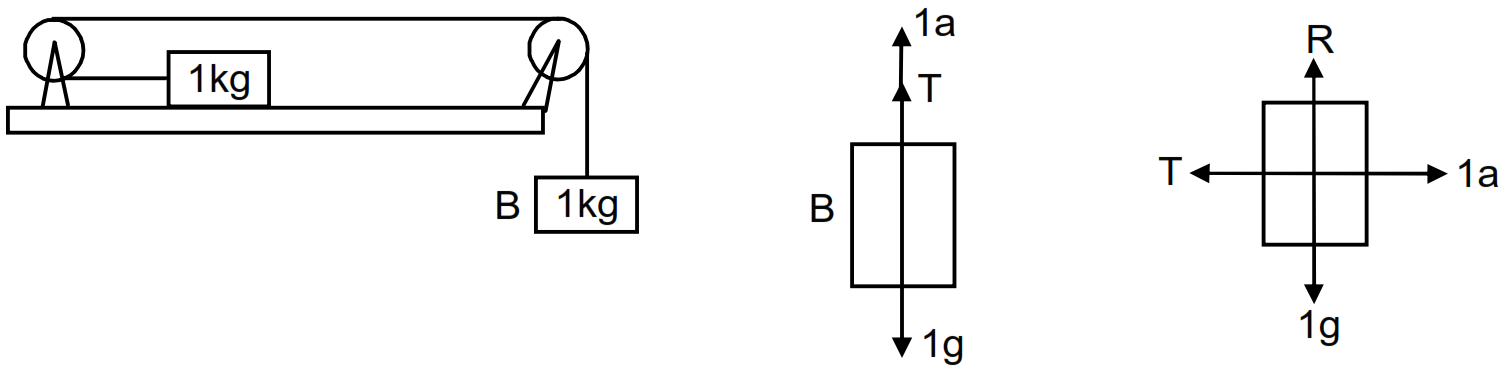
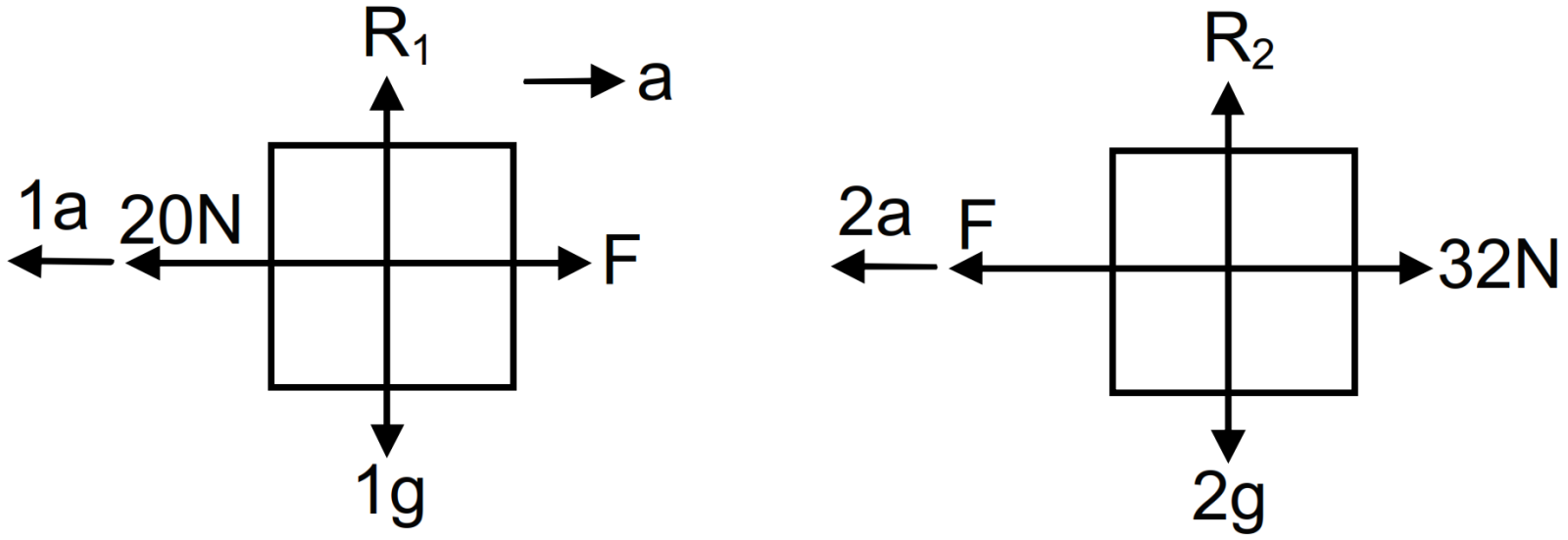
T + 1a = 1g ...(i)
T - 1a = 0 ⇒ T = 1a ...(ii)
From eqn (i) and (ii), we get
1a + 1a = 1g ⇒ 2a = g $\Rightarrow\text{a}=\frac{\text{g}}{2}=\frac{10}{2}=5\text{m/s}^2$
From (ii) T = 1a = 5N.
12 questions · timed · auto-graded

T + 1a = 1g ...(i)
T - 1a = 0 ⇒ T = 1a ...(ii)
From eqn (i) and (ii), we get
1a + 1a = 1g ⇒ 2a = g $\Rightarrow\text{a}=\frac{\text{g}}{2}=\frac{10}{2}=5\text{m/s}^2$
From (ii) T = 1a = 5N.

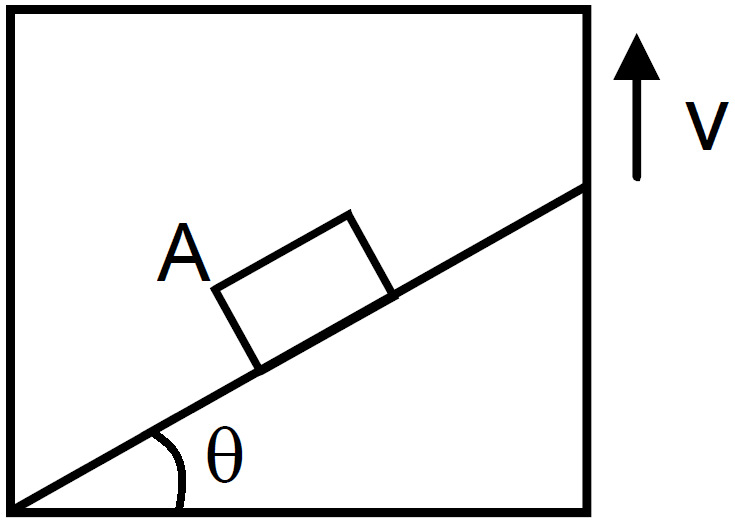
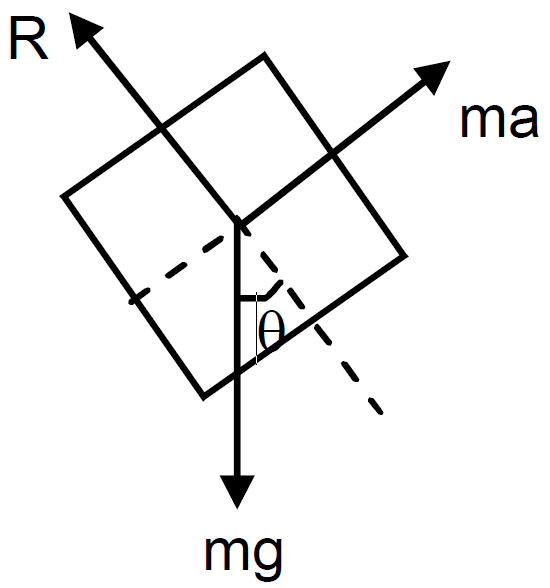
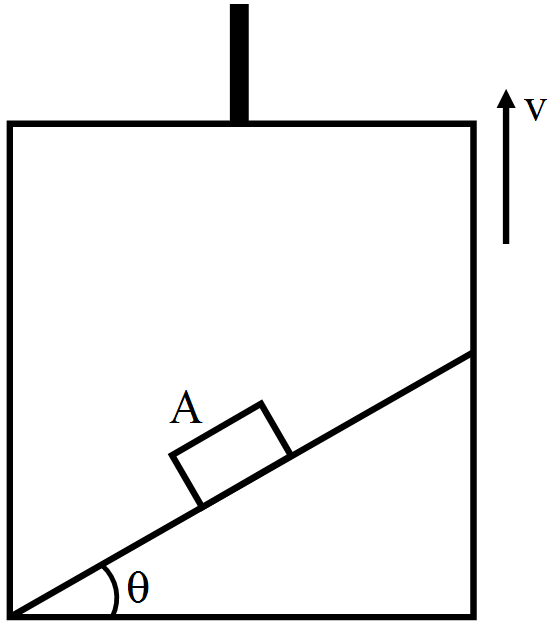
The driving force on the block which n the body to move sown the plane is $\text{F = mg}\sin\theta,$
So, acceleration $=\text{g}\sin\theta$
Initial velocity of block u = 0.
$\text{s}=\ell,\text{a = g}\sin\theta$
Now, $\text{S = ut}+\frac{1}{2}\text{at}^2$
$\Rightarrow\ell=0+\frac{1}{2}(\text{g}\sin\theta)\text{t}^2$
$\Rightarrow\text{g}^2=\frac{2\ell}{\text{g}\sin\theta}$
$\Rightarrow\text{t}=\sqrt{\frac{2\ell}{\text{g}\sin\theta}}$
Time taken is $\sqrt{\frac{2\ell}{\text{g}\sin\theta}}$

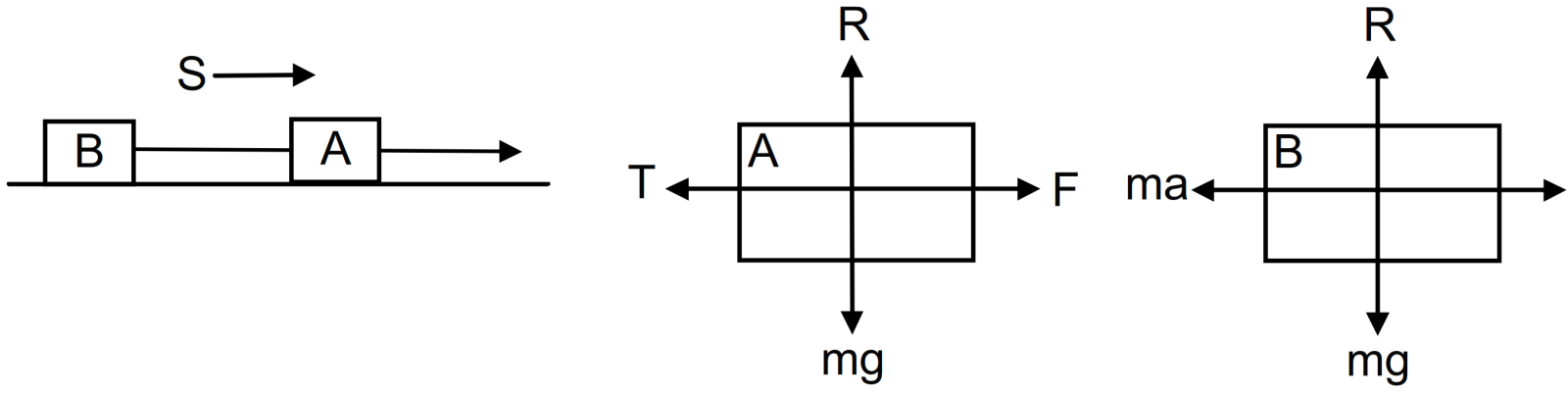
T + ma - F = 0
T - ma = 0
⇒ T = ma …(i)
⇒ F = T + ma
⇒ F = T + T from (i)
⇒ 2T = F
$\Rightarrow\text{T}=\frac{\text{F}}{2}$

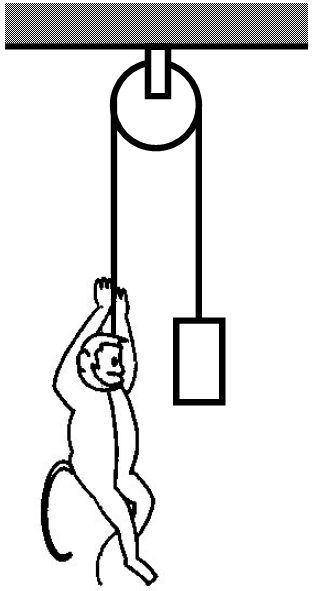
Suppose the monkey accelerates upward with acceleration ’a’ & the block, accelerate downward with acceleration a1. Let Force exerted by monkey is equal to ‘T’
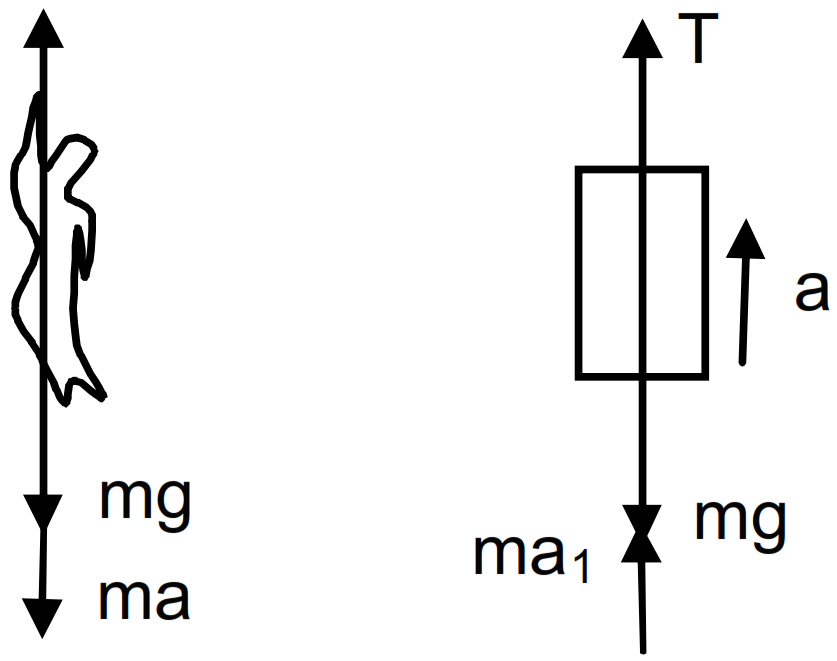
From the free body diagram of monkey
$\therefore$ T - mg - ma = 0 ...(i)
⇒ T = mg + ma.
Again, from the FBD of the block,
T = ma1 - mg = 0.
⇒ mg + ma + ma1 - mg = 0 [From (i)]
⇒ ma = -ma1
⇒ a = a1.
Acceleration ‘-a’ downward i.e. ‘a’ upward.
$\therefore$ The block & the monkey move in the same direction with equal acceleration.
If initially they are rest (no force is exertied by monkey) no motion of monkey of block occurs as they have same weight (same mass). Their separation will not change as time passes.
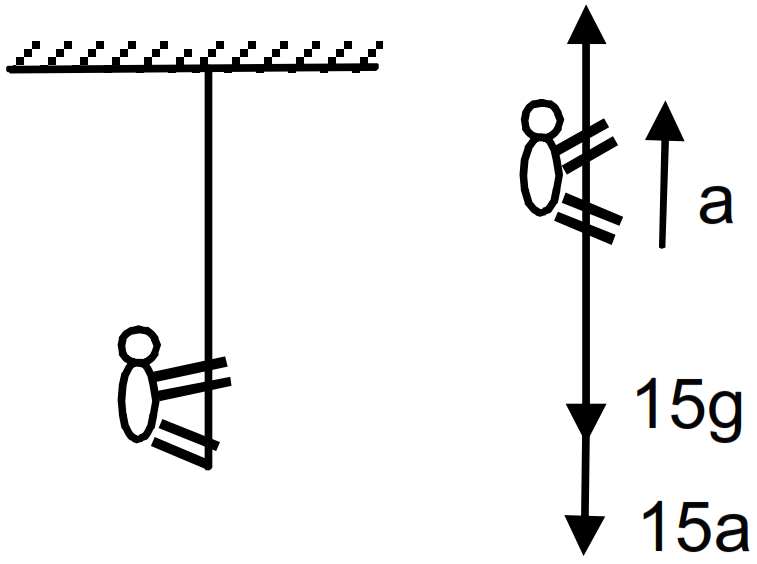
m = 15kg of monkey.
a = 1m/s2.
From the free body diagram
$\therefore$ T - [15g + 15(1)] = 0
⇒ T = 15(10 + 1)
⇒ T = 15 × 11
⇒ T = 165N.
The monkey should apply 165N force to the rope.
Initial velocity u = 0 ; acceleration a = 1m/s2; s = 5m.
$\therefore\text{s = ut}+\frac{1}{2}\text{at}^2$
$5=0+\Big(\frac{1}{2}\Big)1\text{t}^2$
$\Rightarrow\text{t}^2=5\times2$
$\Rightarrow\text{t}=\sqrt{10}\sec.$
Time required is $\sqrt{10}\text{sec}.$
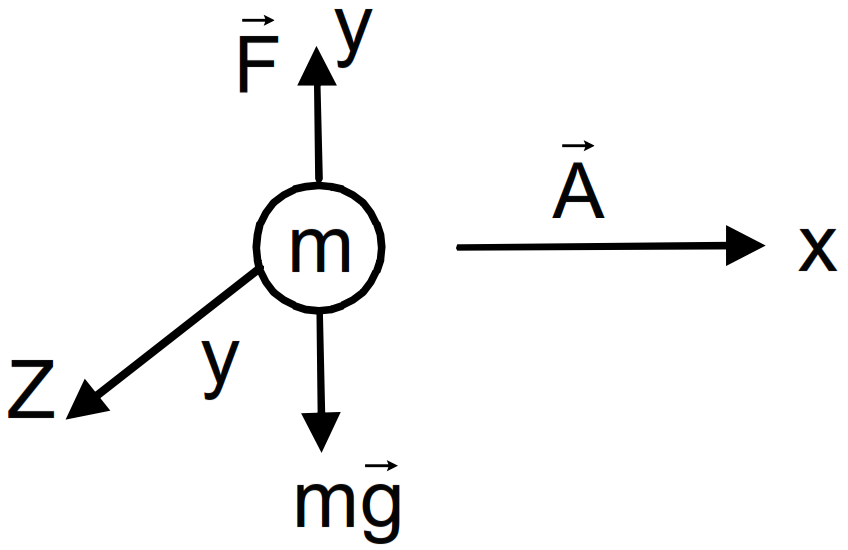
For the particle to move undeflected with constant velocity, net force should be zero. $\therefore\big(\overrightarrow{\text{u}}\times\overrightarrow{\text{A}}\big)+\overrightarrow{\text{mg}}=0$
$\therefore\big(\overrightarrow{\text{u}}\times\overrightarrow{\text{A}}\big)-\overrightarrow{\text{mg}}=0$
Because, $\big(\overrightarrow{\text{u}}\times\overrightarrow{\text{A}}\big)$ is perpendicular to the plane containing $\overrightarrow{\text{u}}$ and $\overrightarrow{\text{A}},\overrightarrow{\text{u}}$ should be in the xz-plane. Again, $\text{u A}\sin\theta=\text{mg}$$\therefore\text{u}=\frac{\text{mg}}{\text{A}\sin\theta}$
u will be minimum, when $\sin\theta=1\Rightarrow\theta=90^{\circ}$$\therefore\text{u}_{\text{min}}=\frac{\text{mg}}{\text{A}}$ along Z-axis.
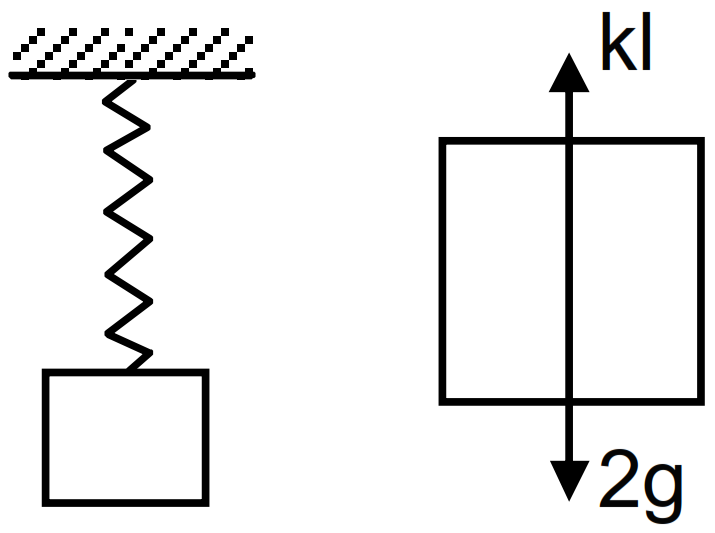
$\Rightarrow\text{I}=\frac{2\text{g}}{\text{k}}=\frac{2\times9.8}{100}=\frac{19.6}{100}=0.196=0.2\text{m}$
Suppose further elongation when 1kg block is added be x, Then k(1 + x) = 3g$\Rightarrow\text{kx}=3\text{g}-2\text{g}=\text{g}=9.8\text{N}$
$\Rightarrow\text{x}=\frac{9.8}{100}=0.098=0.1\text{m}$

Now, the block has acceleration = g = 10m/s2 u = 0 t = 0.2sec So, the distance travelled by the block is given by. $\therefore\text{s = ut}+\frac{1}{2}\text{at}^2$
$=0+\Big(\frac{1}{2}\Big)10(0.2)^2=5\times0.04=0.2\text{m}=20\text{cm.}$
The displacement of body is 20cm during first 0.2sec.
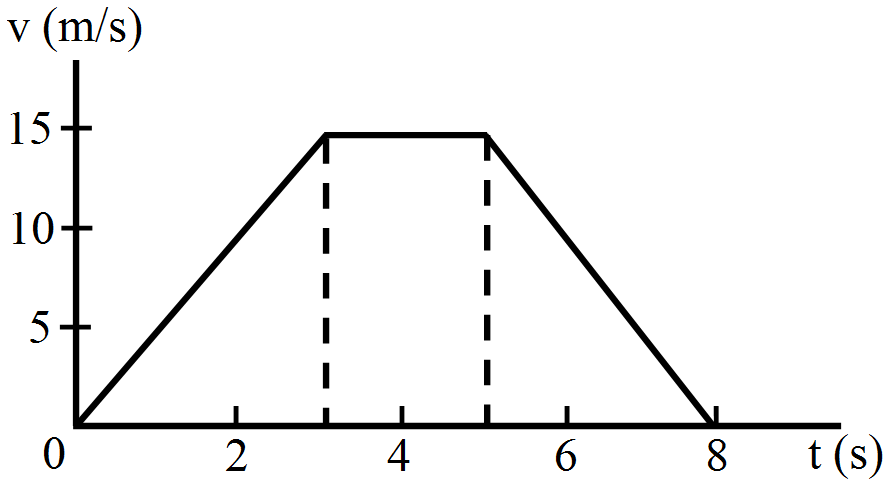
$\therefore$ Force = 0
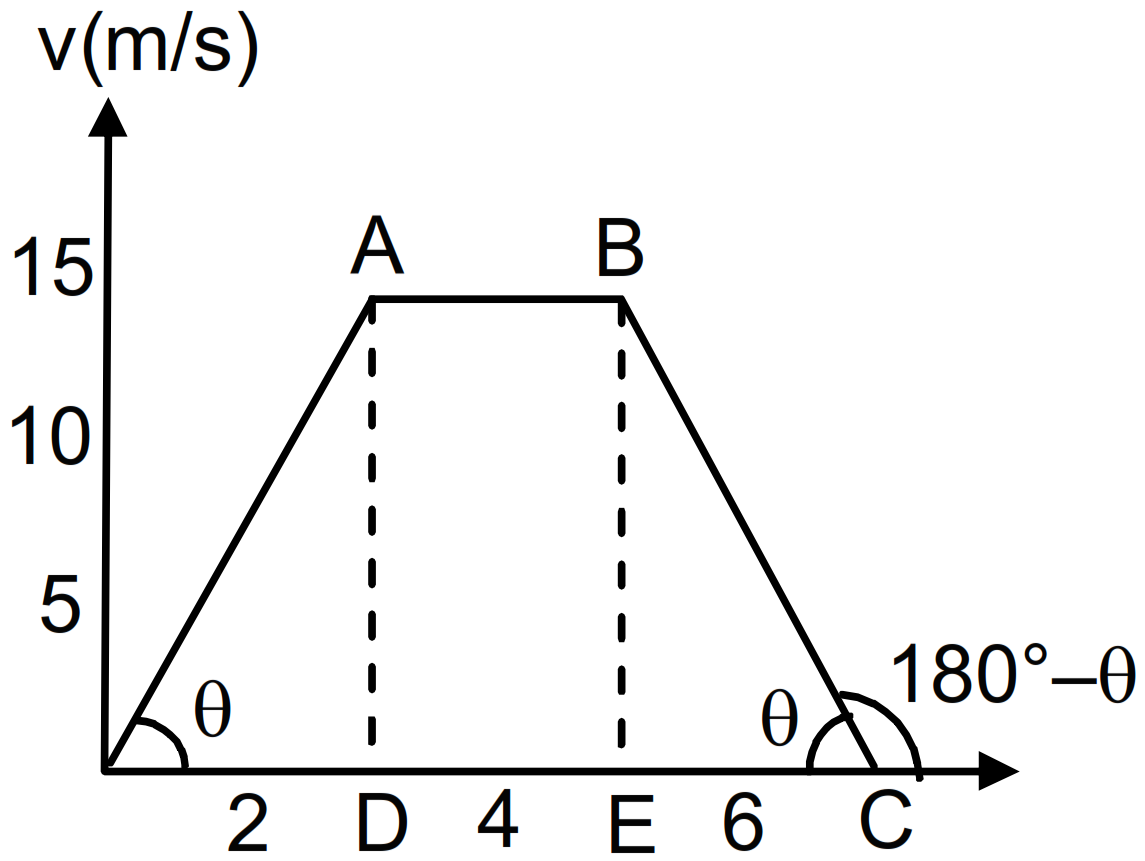
At t = 6sec, acceleration = slope of BC. In $\triangle\text{BEC}=\tan\theta=\frac{\text{BE}}{\text{EC}}=\frac{15}{3}=5.$ Slope of $\text{BC}=\tan(180^{\circ}-\theta)=-\tan\theta=-5\text{m/s}^2\text{(deceleration)}$ Force = ma = 5 × 5 × 10–2 = 0.25N. Opposite to the motion.


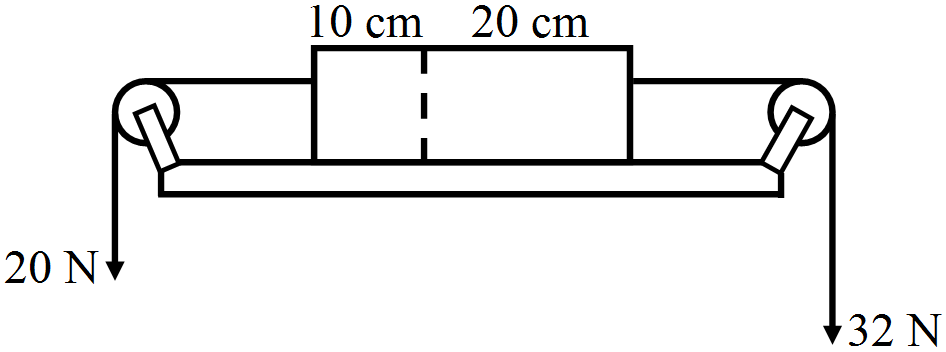
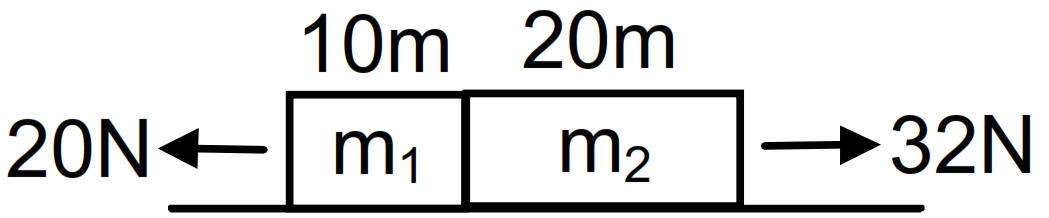
From the free body diagram F - 20 - 10 = 0 …(i) And, 32 - F - 2a = 0 …(ii) From eqa (i) and (ii) $3\text{a}-12=0\Rightarrow\text{a}=\frac{12}{3}=4\text{m/s}^2$
Contact force F = 20 + 1a = 20 + 1 × 4 = 24N.