Question
According to Newton's third law each team pulls the opposite team with equal force in a tug of war. Why then one team wins and the other loses?

Answer

The forces on the rope must be equal and opposite, according to Newton’s third law. But not all the forces acting on each team are equal. The friction between one team and the ground does not depend on the other team and can be larger on one side than on the other. In addition, the grips on the rope need not be equal and opposite. Thus, the net force acting on each team from all sources need not be equal.

Need a full question paper?

Generate a complete, print-ready paper with questions like this in minutes — across 16+ boards, with answer keys.
Start Generating Free

Similar questions

Write nuclear reaction equations for
  1. $\alpha\text{-decay of }\ ^{226}_{88}\text{Ra}$
  2. $\alpha-\text{decay of }\ ^{226}_{94}\text{Pu}$
  3. $\beta\text{-decay of }\ ^{32}_{15}\text{P}$
  4. $\beta\text{-decay of }\ ^{210}_{83}\text{Bi}$
  5. $\beta\text{-decay of }\ ^{11}_{6}\text{C}$
  6. $\beta^+\text{-decay of }\ ^{97}_{43}\text{Tc}$
  7. $\text{Electron capture of }\ ^{120}_{54}\text{Xe}$
Explain the assumption related to quantization of angular momentum in Bohr's theory.###Explain quantum condition for orbital motion of electron in hydrogen atom.###Explain Bohr's second postulate of quantisation by de Broglie hypothesis.
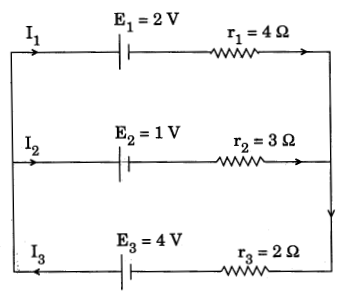
State Kirchhoff’s rules. Use these rules to write the expressions for the currents I1, I2 and I3 in the circuit diagram shown.

A water particle of mass 10.0mg and having a charge of 1.50 × 10-6C stays suspended in a room. What is the magnitude of electric field in the room? What is its direction?
With the help of a suitable diagram, explain the formation of depletion region in a p-n junction. How does its width change when the junction is (i) forward biased, and (ii) reverse biased?
Using Biot-Savart law, deduce the expression for the magnetic field at a point (x) on the axis of a circular current carrying loop of radius R. How is the direction of the magnetic field determined at this point?
Obtain the relationship between object distance (u), image distance $(v)$ and focal length (f) for a concave mirror.###Obtain $\frac{1}{f}=\frac{1}{v}+\frac{1}{u}$ formula for a concave mirror.
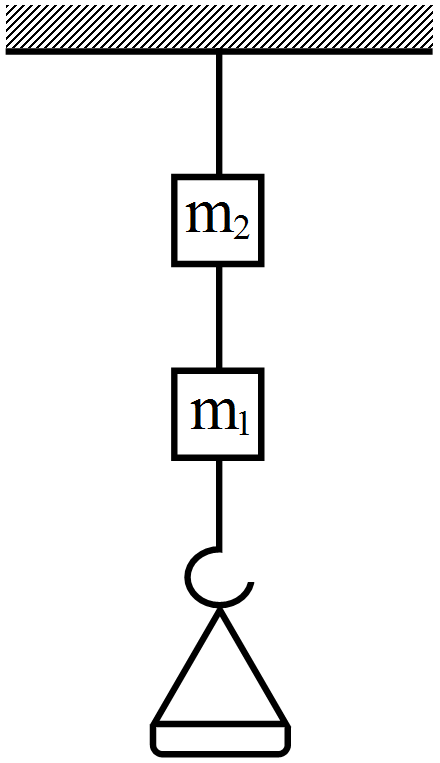
The two wires shown in are made of the,

same material which has a breaking stress of 8 × 10⁸N/m2. The area of cross-section of the upper wire is 0.006cm2 and that of the lower wire is 0.003cm2. The mass m1 = 10kg, m2 = 20kg and the hanger is light:
  1. Find the maximum load that can be put on the hanger without breaking a wire. Which wire will break first if the load is increased?
  2. Repeat the above part if m1 = 10kg and m2 = 36kg.
The current in a solenoid of 240 turns, having a length of 12cm and a radius of 2cm, changes at a rate of 0.8A/s. Find the emf induced in it.
A small telescope has an objective lens of focal length 144 cm and an eyepiece of focal length 6.0 cm. What is the magnifying power of the telescope? What is the separation between the objective and the eyepiece?