Questions

3 Marks Question

🎯

Test yourself on this topic

14 questions · timed · auto-graded

Question 13 Marks
Arrange the two pieces to form a figure with a perimeter of 22 cm.
Answer
Arranging the two pieces in such a way that they form a new shape with the desired perimeter:
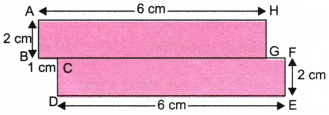
Image
Total length of boundary = AB + BC + CD + DE + EF + FG + GH + HA
= 2 + 1 + 2 + 6 + 2 + 1 + 2 + 6
= 22 cm

View full question & answer
Question 23 Marks
Can you make other shaped figures for each of the above three perimeters, or is there only one shape with that perimeter? What is your reasoning?
Answer
Smallest Perimeter (12 units): Only the 3 × 3 square achieves this.
Largest Perimeter (20 units): Only the straight line achieves this or any pattern made by folding two straight lines.
Image
Perimeter of 18 units: Multiple shapes can achieve this. For example, a T-shaped figure or other L-shaped configurations.
Image
The reasoning is based on the arrangement of the unit squares and the number of exposed edges. The more compact the shape, the smaller the perimeter; the more elongated, the larger the perimeter. For intermediate perimeters like 18 units, various configurations can be created by adjusting the arrangement of the squares.
View full question & answer
Question 33 Marks
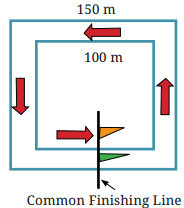
In races, usually, there is a common finish line for all the runners. Here are two square running tracks with an inner track of 100 m on each side and an outer track of 150 m on each side. The common finishing line for both runners is shown by the flags in the figure which are in the center of one of the sides of the tracks. If the total race is 350 m, then we have to find out where the starting positions of the two runners should be on these two tracks so that they both have a common finishing line after they run for 350 m. Mark the starting points of the runner on the inner track as ‘A ’ and the runner on the outer track as ‘B’.
Image
Answer
Inner Track (100 m per side)
Perimeter Calculation: The perimeter of the inner track is (4 times 100 = 400) meters.
Distance to Run: The runner on the inner track needs to run 350 meters.
Starting Position (A): Since the perimeter is 400 meters, the runner will start 50 meters before the common finish line (400 – 350 = 50 meters).
Outer Track (150 m per side)
Perimeter Calculation: The perimeter of the outer track is (4 times 150 = 600) meters.
Distance to Run: The runner on the outer track also needs to run 350 meters.
Starting Position (B): Since the perimeter is 600 meters, the runner will start 250 meters before the common finish line (600 – 350 = 250 meters).
View full question & answer
Question 43 Marks
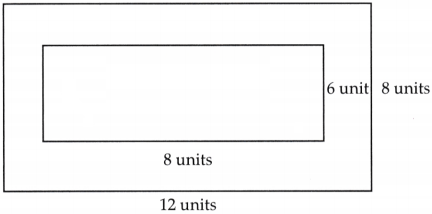
Draw a rectangle of size 12 units × 8 units. Draw another rectangle inside it, without touching the outer rectangle that occupies exactly half the area.
Answer
As given, the Area of the rectangle of size 12 units × 8 units = 96 sq units
And the area of an inner rectangle that occupies exactly half the area = 48 sq units
Image
View full question & answer
Question 53 Marks
Shape A has an area of 18 square units and Shape B has an area of 20 square units. Shape A has a longer perimeter than Shape B. Draw two such shapes satisfying the given conditions.
Answer
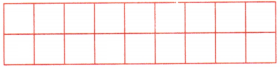
For shape A, can be arrange it as 9 units by 2 units, giving a perimeter of 22 units.
Image
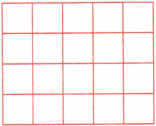
For shape B, can be arrange it as 5 units by 4 units, giving a perimeter of 18 units.
Image
View full question & answer
Question 63 Marks
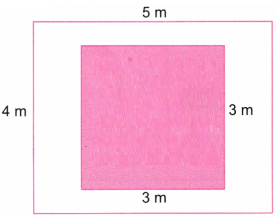
The floor of a room is 5 m long and 4 m wide. A square carpet whose sides are 3 m in length is laid on the floor. Find the area that is not carpeted.
Answer
We have a floor with dimensions 4 m width and 5 m length.
Image
A square carpet of side 3 m.
Area of the floor = length × breath
Area of the floor $=5 \times 4=20 m^2$
Area of the square carpet $=3 \times 3=9 m^2$
Now, we will subtract the square carpet area from the floor’s area to get the area of the floor that is not carpeted.
Hence, the area of the floor that is not carpeted $=20-9=11 m^2$
Thus, the area of the floor that is not carpeted is $11 m^2$.
View full question & answer
Question 73 Marks
Give the dimensions of a rectangle whose area is the sum of the areas of these two rectangles having measurements: 5 m × 10m and 2m × 7m.
Answer
Dimensions of rectangle 1: 5 m × 10m
Dimensions of rectangle 2:2m × 7m
Area of rectangle 1 = 50 sq m
Area of rectangle 2 = 14 sq m
Now, area of rectangle = sum of areas of rectangle 1 and 2 = 50 sq m + 14 sq m = 64 sq m
So possible dimensions of a rectangle with area 64 sq m are 1 m × 64 m; 2 m × 32 m; 4 m × 16 m; 8 m × 8 m, etc.
View full question & answer
Question 83 Marks
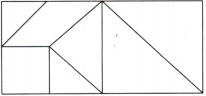
Arrange these 7 pieces to form a rectangle. What will be the area of this rectangle in terms of the area of Shape C now? Give reasons for your answer.
Answer
When arranging the 7 pieces to form a rectangle, the area of the rectangle will be the same as that of area of square.
Image
Area of rectangle = 16 × area of shape C.
View full question & answer
Question 93 Marks
Can you now figure out the area of the big square formed with all seven pieces in terms of the area of Shape C?
Answer
Let’s say the area of C = x
Area of D = Area of 2C = 2x
Area of E = Area of C = x
Area of F = Area of 2C = 2x
Area of G = Area of 2C = 2x
Area of A = Area of 2F = 2 × 2x = 4x
Area of B = Area of A = 4x
Hence total area of big shape = Area of A + B + C + D + E + F + G
= 4x + 4x + x + 2x + x + 2x + 2x
= 16x
= 16C
That means the area of a big square is 16 times the area of shape C.
View full question & answer
Question 103 Marks
How many times bigger is Shape D as compared to Shape C? What is the relationship between Shapes C, D and E?
Answer
Shape D is twice as big as shape C. This means that if you place two shape C pieces together. Then, they exactly cover shape D.
The relationship between these shapes
Shape D can be completely filled by combining shape C and shape E. So, area of shape D is equal to the sum of the area of shape C and E.
Each of shapes C and E has half the area of shape D.
View full question & answer
Question 113 Marks
What is the cost of tiling a rectangular plot of land 500 m long and 200 m wide at the rate of ₹ 8 per hundred sq m?
Answer
Length of rectangular plot $=500 m$
Breadth of rectangular plot $=200 m$
Area of rectangular plot $=500 m \times 200 m=1,00,000 sq m$
The cost of tiling the plot is given ₹ 8 per hundred sq m .
So, we will convert area into per hundred sq m $\frac{ 1 , 0 0 , 0 0 0 }{ 1 0 0 }=1,000$ (in hundred sq m )
The cost of tiling per hundred $sq m =$ ₹ 8
∴ The cost of tiling rectangular plot $=1,000 \times ₹ 8=₹ 8,000$
View full question & answer
Question 123 Marks
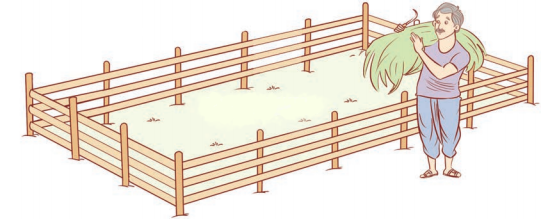
A farmer has a rectangular field having length 230 m and breadth 160 m. He wants to fence it with 3 rounds of rope as shown. What is the total length of rope needed?
Image
Answer
Perimeter of a rectangular field = 2 (length + breadth)
= 2 (230 m + 160 m)
= 780 m
The farmer wants 3 rounds of rope to fence.
Total length of rope needed = 780 m × 3
= 2340 m
View full question & answer
Question 133 Marks
A piece of string is 36 cm long. What will be the length of each side, if it is used to form:
(a) A square,
(b) A triangle with all sides of equal length, and
(c) A hexagon (a six sided closed figure) with sides of equal length?
Answer
Length of piece of string $=36 cm$
(a) Length of side of a square $=\frac{ 3 6 }{ 4 } ~ c m =9 ~ c m$
(b) Length of side of a triangle when all sides are equal $=\frac{36}{3} cm=12 cm$
(c) Length of a side of a hexagon when all sides are equal $=\frac{36}{6} cm=6 cm$
View full question & answer
Question 143 Marks
A rectangle having side lengths 5 cm and 3 cm is made using a piece of wire. If the wire is straightened and then bent to form a square, what will be the length of a side of the square?
Answer
Given, length of rectangle $=5 cm$ and breadth $=3 cm$
We know that perimeter of rectangle $=2 \times$ (length × breadth)
$
=2 \times(5+3)=16 cm
$
Now, if we bend the wire to form a square, the total length of the wire $(16 cm)$ will be divided equally among the four sides of the square.
$
\begin{array}{l}
\text { So, each side of the square }=\frac{\text { Perimeter }}{4} \\
=\frac{16}{4}=4 cm
\end{array}
$
View full question & answer
3 Marks Question - MATHS STD 6 Questions - Vidyadip