Questions

2 Marks Questions

🎯

Test yourself on this topic

44 questions · timed · auto-graded

Question 12 Marks
How can natural indicators be prepared? Explain by giving an example.
Answer
Natural indicators can be made using plant materials with pigments that change colour with acid or base. For example, to make red rose extract :
1. Wash and crush rose petals.
2. Place them in a glass tumbler and add hot water.
3. Let it sit for 5-10 minutes, then filter the mixture.
The resulting liquid is a natural indicator that turns red in acids and green in bases.
View full question & answer
Question 22 Marks
Keerthi wrote a secret message to her grandmother on her birthday using orange juice. Can you assist her grandmother in revealing the message? Which indicator would you use to make it visible?
Answer
Keerthi’s grandmother can reveal the secret message by using acid-base indicators, as orange juice is acidic in nature. She can use rose extract or beetroot juice (which will turn red) or Indian blackberry extract (which will turn pink) to make the message visible.
View full question & answer
Question 32 Marks
Grape juice was mixed with red rose extract; the mixture got a tint of red colour. What will happen if baking soda is added to this mixture? Justify your answer.
Answer
When baking soda (a base) is added to the mixture of grape juice and red rose extract, the basicity increases. In basic conditions, red rose extract turns green. So, after adding baking soda, the mixture will turn green.
View full question & answer
Question 42 Marks
Manya is blindfolded. She is given two unknown solutions to test and determine whether they are acidic or basic. Which indicator should Manya use to test the solutions and why?
Answer
Manya should use an olfactory indicator to test the solutions. Olfactory indicators change their smell in acidic or basic solutions. For example, substances like onion produce a strong smell in a basic solution and a mild smell in an acidic solution.
View full question & answer
Question 52 Marks
The extract of red rose turns the liquid X to green. What will the nature of liquid X be? What will happen when excess of amla juice is added to liquid X?
Answer
If the extract of red rose turns the liquid X to green, it indicates that liquid X is basic. Red rose extract acts as an indicator, turning red in acidic solutions and green in basic solutions. When excess amla juice (which is acidic) is added to liquid X, it will neutralise the base. The green colour of the liquid will turn to red as the solution becomes more acidic due to the addition of the acidic amla juice.
View full question & answer
Question 62 Marks
Three liquids are given to you. One is vinegar, another is a baking soda solution, and the third is a sugar solution. Can you identify them only using turmeric paper? Explain.
Answer
Using turmeric paper, we can identify a basic solution but not an acidic or neutral solution. When baking soda solution (basic) is tested, the turmeric paper will turn red. However, both vinegar (acidic) and sugar solution (neutral) will leave the paper yellow, as turmeric paper does not change colour in acidic or neutral solutions. Therefore, turmeric paper can only identify a basic solution.
View full question & answer
Question 72 Marks
A solution turns the red litmus paper to blue. Excess addition of which of the following solution would reverse the change?
(i) Lime water
(ii) Baking soda
(iii) Vinegar
(iv) Common salt solution
Answer
(iii) The solution turns from red to blue, it means it is basic. To reverse this, an acid is needed. Lime water and baking soda are basic, and the common salt solution is neutral, so they will not reverse the change. Vinegar is acidic, so it will change the colour back to red.
View full question & answer
Question 82 Marks
What are acids and bases? Explain their properties with examples.
Answer
Acids and bases are two types of substances with different properties. Acids are substances that taste sour and turn blue litmus paper red. They can be strong or weak. Some common acids are lemon juice (contains citric acid), vinegar (contains acetic acid), curd (contains lactic acid), and tamarind (contains tartaric acid). Bases are substances that taste bitter and feel soapy to touch. They turn red litmus paper blue. Bases can also be strong or weak. Some common bases are soap, baking soda, and lime water.
View full question & answer
Question 92 Marks
Blue litmus paper is dipped in a solution. It remains blue. What is the nature of the solution? Explain.
Answer
(i) It can be identified on the basis of the following observations: Bases change the colour of Red litmus paper to blue. As the colour of blue litmus paper is not affected, the solution must be basic.
(ii) If the solution is neutral, even then the colour of litmus will not change. Hence, the solution may be basic or neutral.
View full question & answer
Question 102 Marks
What are indicators? Classify them and give one example of each.
Answer
The substances which are used to test whether a substance is acidic or basic are called indicators.
There are two types of indicators:
(i) Natural indicators : Litmus paper, turmeric, etc.
(ii) Synthetic indicators : Phenolphthalein
View full question & answer
Question 112 Marks
What are these red and blue litmus paper strips made of? Why do they change colour when drops of some samples are put on them?
Answer
Red and blue litmus paper strips are made from paper soaked in an extract of lichens. They change colour when they come in contact with acidic or basic substances. Acidic substances turn blue litmus to red, and basic substances turn red litmus to blue.
View full question & answer
Question 122 Marks
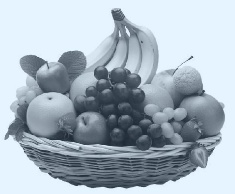
Look at the given image of a fruit basket. Identify the common acids present in the fruits given in the basket.
Image
Answer
The common acids present in the fruits in the basket are:
Citric acid – found in oranges, lemons, and other citrus fruits
Tartaric acid – found in grapes
Malic acid – found in apples
View full question & answer
Question 132 Marks
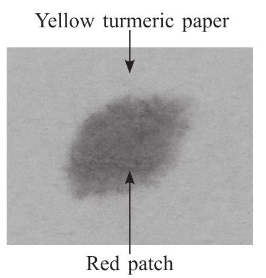
The image shows a turmeric indicator paper with a red patch formed on it. The paper is yellow in colour, and the patch indicates a reaction with a substance.
(a) Identify the sample used that caused the red discoloration of the turmeric paper. Explain why this reaction occurs with turmeric paper.
(b) What is the nature of the substance that caused the red discoloration? How can you confirm this using other indicators like litmus or red rose extract?
Image
Answer
(a) The substance used is a base (alkaline substance)
Explanation: Turmeric paper is yellow in neutral or acidic solutions, but it turns red in the presence of a base. This red discoloration shows that the substance is basic in nature.
(b) The substance is basic (alkaline).
This can be confirmed using other indicators:
Litmus paper: turns blue in a base.
Red rose extract: changes colour in a basic solution.
View full question & answer
Question 142 Marks
A message written with soap appears red when turmeric is sprayed. Why?
Answer
Turmeric acts as an indicator, changing color in response to acids or bases. Soap is basic, so when turmeric is sprayed on a soap message, the turmeric turns red due to the basic nature of the soap, revealing the message.
View full question & answer
Question 152 Marks
Why should factory waste be treated before release?
Answer
Factory waste can be acidic and harm the environment, especially aquatic life. Treating the waste neutralizes it, making it safer to release into the environment.
View full question & answer
Question 162 Marks
Suggest three eco-friendly natural indicators and their preparation.
Answer
(1) Red Cabbage:Chop red cabbage and boil in water.
(2) Turmeric:Mix turmeric powder with a little water to make a paste.
(3) Red Rose Petals:Collect red rose petals and soak them in hot water.
View full question & answer
Question 172 Marks
A gardener wants to grow blue hydrangea flowers. What kind of soil should they use?
Answer
 The gardener should use acidic soil.
View full question & answer
Question 182 Marks
How can you identify the nature of an unknown solution using turmeric, litmus, and red rose extract?
Answer
Use litmus paper: Red indicates acid, blue indicates base.
Turmeric turns red in bases.
Red rose extract turns red in acids and green in bases.
View full question & answer
Question 192 Marks
What products are formed when and acid reacts with a base in a neutralisation reaction?
Answer
When an acid reacts with a base in a neutralization reaction, the primary products formed are salt and water.
The reaction also releases heat, indicating an energy change as the acid and base combine to form new substances with different properties.
View full question & answer
Question 202 Marks
If you do not have litmus paper, how will you test the nature of a substance using kitchen materials?
Answer
When we don't have litmus paper, we can use turmeric or red rose petals from our kitchen to test if something is an acid or a base.
Example: we can make turmeric paper by mixing turmeric powder with water and applying it to paper. If we put a drop of a substance on the paper and it turns red, the substance is basic.
These kitchen materials act as natural indicators to identify acids and bases.
View full question & answer
Question 212 Marks
A bitter-tasting fruit is not necessarily a base. Explain why.
Answer
The presence of a bitter taste doesn't automatically classify a substance as a base.Bitterness can arise from various chemical compounds that are not necessarily alkaline or basic in nature.
Example:bitter gourd (karela) has a distinctly bitter taste due to compounds present in it, but it is not basic.
View full question & answer
Question 222 Marks
Differentiate between acidic and basic substances based on litmus test.
Answer
(1) Acidic substances: Turn blue litmus paper red.
(2) Basic substances: Turn red litmus paper blue.
View full question & answer
Question 232 Marks
Name two substances that do not change the colour of red or blue litmus paper.
Answer
 (1) Sugar solution
(2) Salt solution
View full question & answer
Question 242 Marks
How does baking soda help in relieving ant sting?
Answer
When an ant bites, it injects an acidic liquid called formic acid into the skin, which causes pain and irritation. Baking soda is a base, and when it is applied to the affected area, it neutralizes the formic acid. This neutralisation reaction reduces the pain and provides relief.
View full question & answer
Question 252 Marks
What precautions should be taken while testing substances with indicators?
Answer
Do not taste anything unless you are specifically instructed to do so. Many chemicals can be harmful if swallowed. Always perform experiments under the supervision of an adult, especially when using heat or sharp objects.
View full question & answer
Question 262 Marks
How does red rose extract act as an indicator?
Answer
In acidic solutions, red rose extract gives a red colour. In basic solutions, red rose extract gives a green colour.
View full question & answer
Question 272 Marks
Why does turmeric not work as an acid indicator?
Answer
Turmeric changes colour only in basic solutions, turning from yellow to red.In acidic and neutral solutions, turmeric does not change colour; it remains yellow.
View full question & answer
Question 282 Marks
Name three natural indicators and how they work.
Answer
(1) Litmus:It is obtained from lichens.
(2) Red Rose:Extract gives red colour in acidic solutions.
(3) Turmeric:The yellow colour of turmeric turns red in basic solutions.
View full question & answer
Question 292 Marks
What is a neutralisation reaction? Give an example.
Answer
It is a reaction where an acid and a base mix to form salt and water.The resulting solution is neither acidic nor basic.
Example: When an ant bites, it injects an acidic liquid (formic acid) into the skin.Rubbing moist baking soda (a base) neutralises the effect of the acid, relieving the pain.
View full question & answer
Question 302 Marks
Why is neutralisation useful in everyday life?
Answer
Neutralisation helps in treating ant bites, balancing soil for farming, treating factory waste and even controlling acidity problems in the stomach with antacids. It protects both living beings and the environment​.
View full question & answer
Question 312 Marks
Why did bubbles form when Aman spilled vinegar on eggshells?
Answer
Vinegar is acidic and reacts with the calcium carbonate in eggshells, producing carbon dioxide gas. This causes the bubbles. Soap solution is basic and does not react​.
View full question & answer
Question 322 Marks
How can you identify vinegar, baking soda solution, and sugar solution using turmeric paper?
Answer
Baking soda turns turmeric paper red (basic). Vinegar and sugar solution do not change turmeric paper colour. Among them, vinegar will taste sour (acidic) and sugar solution will taste sweet (neutral)​.
View full question & answer
Question 332 Marks
How can a gardener change the colour of hydrangea flowers?
Answer
By changing the soil’s pH. Making the soil more acidic by adding organic matter makes flowers blue; making it basic by adding lime turns flowers pink or red​.
View full question & answer
Question 342 Marks
How could Ashwin’s “secret greeting card” trick work?
Answer
Ashwin coated paper with turmeric paste and used a soap solution to write the message. When sprayed with water or acid, the letters appeared in a different colour​.
View full question & answer
Question 352 Marks
Why should we not taste unknown substances during experiments?
Answer
Unknown substances might be harmful or poisonous. To stay safe, students must avoid tasting anything unless clearly instructed by the teacher during science experiments.
View full question & answer
Question 362 Marks
What does the hydrangea flower’s colour tell about soil?
Answer
Hydrangea flowers turn blue in acidic soil and pink or red in basic soil. Gardeners can adjust soil acidity or basicity to change the colour of the flowers​.
View full question & answer
Question 372 Marks
Why can’t turmeric be used to test acidic substances?
Answer
Turmeric changes colour only in the presence of a base (turning red). It doesn’t show any change with acidic or neutral substances. Therefore, turmeric can only detect basicity, not acidity​.
View full question & answer
Question 382 Marks
How does neutralisation help in industrial waste treatment?
Answer
Factories sometimes release acidic waste into lakes, harming aquatic life. Before releasing, the waste can be treated with basic substances to neutralise it. This protects fish and other organisms living in the water​.
View full question & answer
Question 392 Marks
Explain how soil treatment helps plants grow better.
Answer
If soil becomes too acidic, lime (a base) is added to neutralise it. If soil is too basic, organic matter like compost is added. Maintaining soil’s pH balance is important for healthy plant growth and good nutrient availability​.
View full question & answer
Question 402 Marks
Why did moist baking soda help Ashwin after an ant bite?
Answer
The ant injects formic acid during a bite. Baking soda, being a base, neutralises the acid and relieves the stinging pain.
View full question & answer
Question 412 Marks
What happens in a neutralisation reaction?
Answer
When an acid reacts with a base, they neutralise each other to form salt and water, along with the release of heat​.
View full question & answer
Question 422 Marks
How is turmeric used as an indicator?
Answer
Turmeric is made into a paste and applied on paper strips. In basic substances, turmeric paper changes from yellow to red, but it stays yellow with acidic and neutral substances​.
View full question & answer
Question 432 Marks
How does red rose extract work as an indicator?
Answer
Red rose extract gives a red shade in acidic solutions and a green shade in basic solutions. It remains unchanged with neutral substances, making it a natural acid-base indicator​.
View full question & answer
Question 442 Marks
What do we learn by grouping samples into Group A, B, and C in the litmus test?
Answer
Group A substances turn blue litmus red (acidic), Group B substances turn red litmus blue (basic) and Group C substances do not affect either (neutral). This helps classify substances easily​.
View full question & answer
2 Marks Questions - Science STD 7 Questions - Vidyadip