Question types

Exploring Substances: Acidic, Basic, and Neutral question types

183 questions across 9 question groups — pick any mix to generate a Science paper with step-by-step answer keys.

183
Questions
9
Question groups
5
Question types
Sample Questions

Exploring Substances: Acidic, Basic, and Neutral questions

One sample from each question group in this chapter. Select any group above to see the full set with answer keys.

Q 5MCQ (1 Marks)1 Mark
Turmeric is a natural indicator. On adding its paste to acid and base separately, which colours would be observed?
  • A
    Yellow in both acid and base
  • Yellow in acid and red in base
  • C
    Pink in acid and yellow in base
  • D
    Red in acid and blue in base.

Answer: B.

View full solution
Assertion (A): Turmeric is a natural indicator.
Reason (R): Turmeric acquires an orange colour in basic solution.
  • A
    Both A and R are true and R is the correct explanation of A.
  • B
    Both A and R are true but R is not the correct explanation of A.
  • A is true but R is false.
  • D
    A is false but R is true.

Answer: C.

View full solution
Assertion (A): Sugar is a neutral substance.
Reason (R): A sugar solution turns red litmus blue.
  • A
    Both A and R are true and R is the correct explanation of A.
  • B
    Both A and R are true but R is not the correct explanation of A.
  • A is true but R is false.
  • D
    A is false but R is true.

Answer: C.

View full solution
Assertion (A): Neutralisation reaction is accompanied by the absorption of heat.
Reason (R): Neutralisation reaction is a reaction between an acid and a base to form salt and water.
  • A
    Both A and R are true and R is the correct explanation of A.
  • B
    Both A and R are true but R is not the correct explanation of A.
  • C
    A is true but R is false.
  • A is false but R is true.

Answer: D.

View full solution
Assertion (A): Adding lime to acidic soil helps plants grow.
Reason (R): Lime neutralises excess acid in the soil.
  • Both Assertion (A) and Reason (R) are true, and (R) is the correct explanation of (A).
  • B
    Both Assertion (A) and Reason (R) are true, but (R) is not the correct explanation of (A).
  • C
    (A) is true, but (R) is false.
  • D
    (A) is false, but (R) is true.

Answer: A.

View full solution
Assertion (A): Soap solution feels slippery.
Reason (R): It is acidic in nature.
  • A
    Both Assertion (A) and Reason (R) are true, and (R) is the correct explanation of (A).
  • B
    Both Assertion (A) and Reason (R) are true, but (R) is not the correct explanation of (A).
  • (A) is true, but (R) is false.
  • D
    (A) is false, but (R) is true.

Answer: C.

View full solution
A liquid sample from the laboratory was tested using various indicators :
IndicatorRed litmusBlue litmusTurmeric
ChangeNo changeTurned redNo change in colour
View full solution
Keerthi wrote a secret message to her grandmother on her birthday using orange juice. Can you assist her grandmother in revealing the message? Which indicator would you use to make it visible?
View full solution
Grape juice was mixed with red rose extract; the mixture got a tint of red colour. What will happen if baking soda is added to this mixture? Justify your answer.
View full solution
Manya is blindfolded. She is given two unknown solutions to test and determine whether they are acidic or basic. Which indicator should Manya use to test the solutions and why?
View full solution
The extract of red rose turns the liquid X to green. What will the nature of liquid X be? What will happen when excess of amla juice is added to liquid X?
View full solution
Q 323 Marks Question3 Marks
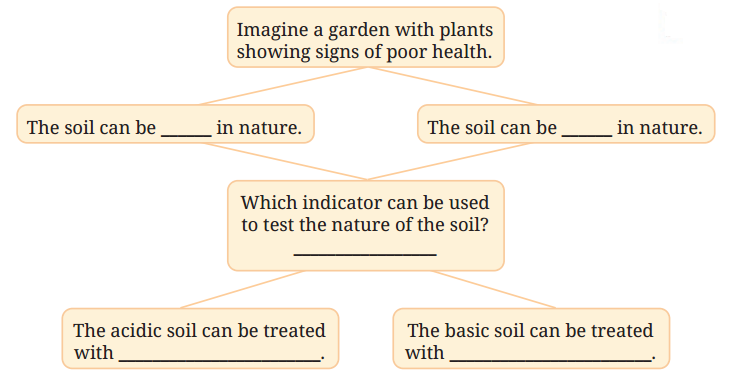
Observe and analyse the information given in the following flowchart. Complete the missing information.
(Flowchart shows poor plant health due to soil condition)
View full solution
Q 343 Marks Question3 Marks
DIY Natural Indicator from Red Cabbage} Prepare a red cabbage extract and test the following substances: lemon juice, soap solution, toothpaste, vinegar and black tea.
(a) What colour does the red cabbage extract change to in each case?
(b) Based on your observations, how can you classify the substances as acidic or basic?
substanceColour Change in Red CabbageNature of the Substance
1. Lemon Juice  
2. Soap Solution  
3. Toothpaste  
4. Vinegar  
5. Black tea  
View full solution
Q 353 Marks Question3 Marks
Read the passage and answer the questions :
Keerthi tested various substances with red rose extract.
Q.1. Red rose extract turns green with:
(a) Vinegar$\quad$(b) Baking soda
(c) Lemon juice$\quad$(d) Sugar
Q.2. Which of the following would turn it red?
(a) Lime water$\quad$(b) Soap
(c) Amla juice$\quad$(d) Baking soda
Q.3. A solution that does not affect colour is:
(a) Vinegar$\quad$(b) Lime water
(c) Baking soda$\quad$(d) Soap
View full solution
Column AColumn B
Q.1. TurmericA. Changes colour
Q.2. Acid + Base red roseB. Natural indicator from
Q.3. Hydrangea flower substancesC. Becomes red in basic
Q.4. Red rose extractD. Salt + Water + Heat
View full solution
Column AColumn B
Q.1. LitmusA. Bitter and slippery to touch
Q.2. VinegarB. Natural indicator from lichens
Q.3. BascC. Used to treat acidic soil
Q.4. Quick limeD. Olfactory indicator
 E. Acetic acid
 
View full solution
Could you suggest various materials which can be used for writing the message on the white sheet of paper (given at the beginning of the chapter) and what could be in the spray bottle? Make a table of various possible combinations and the colour of the writing obtained.
View full solution
Table : Testing the nature of samples with blue and red litmus papers
Name of the SampleColour of blue litmus paper after putting a drop of sampleColour of red litmus paper after putting a drop of sample
Lemon juiceRedRed
Soap solutionBlueBlue
Amla juiceRedRed
Tamarind waterRedRed
VinegarRedRed
Baking soda solutionBlueBlue
Lime waterBlueBlue
Tap waterBlueRed
Washing powder solutionBlueBlue
Sugar solutionBlueRed
Salt solutionBlueRed
Orange juiceRedRed
View full solution

Generate a Exploring Substances: Acidic, Basic, and Neutral paper free

Pick question groups from the list above, set marks and difficulty, and export a branded PDF with step-by-step answer keys. First 3 chapters free — no signup.
Download App