Questions

5 Marks Questions

🎯

Test yourself on this topic

11 questions · timed · auto-graded

Question 15 Marks
Could you suggest various materials which can be used for writing the message on the white sheet of paper (given at the beginning of the chapter) and what could be in the spray bottle? Make a table of various possible combinations and the colour of the writing obtained.
Answer
The colour of the writing will depend on the nature of the writing material (acidic or basic) and the solution in the spray bottle (acidic or basic). Below is the table of possible combinations.
Writing MaterialSubstance in Spray BottleColour of Writing
(on paper)
Lemon juiceBlue litmus solutionRed
Baking soda solutionRed litmus solutionBlue
Baking soda solutionRose extractGreen
VinegarRose extractRed
Soap solutionTurmeric solutionRed
Amla juiceIndian blackberry juicePink
Lime waterIndian blackberry juicePurple
Grapes juiceBeetroot extractRed
Washing powder solutionBeetroot extractBlue
Tamarind waterRed hibiscus extractPink
Soap solutionRed hibiscus extractGreen
View full question & answer
Question 25 Marks
Table : Testing the nature of samples with blue and red litmus papers
Name of the SampleColour of blue litmus paper after putting a drop of sampleColour of red litmus paper after putting a drop of sample
Lemon juiceRedRed
Soap solutionBlueBlue
Amla juiceRedRed
Tamarind waterRedRed
VinegarRedRed
Baking soda solutionBlueBlue
Lime waterBlueBlue
Tap waterBlueRed
Washing powder solutionBlueBlue
Sugar solutionBlueRed
Salt solutionBlueRed
Orange juiceRedRed
Answer
Table : Grouping of samples tested in Table
Group AGroup BGroup C
Lemon juice, Amla juice, Tamarind water, Vinegar, Orange juiceSoap solution, Baking soda solution, Lime water, Washing powder solutionTap water, Sugar solution, Salt solution
Observation and conclusion: Substances in Group A, like lemon juice and vinegar, are acidic as they turn blue litmus paper red. Group B substances, like soap and baking soda, are basic as they turn red litmus paper blue. Group C substances, like tap water and sugar solution, are neutral because they do not change the litmus paper colour.
View full question & answer
Question 35 Marks
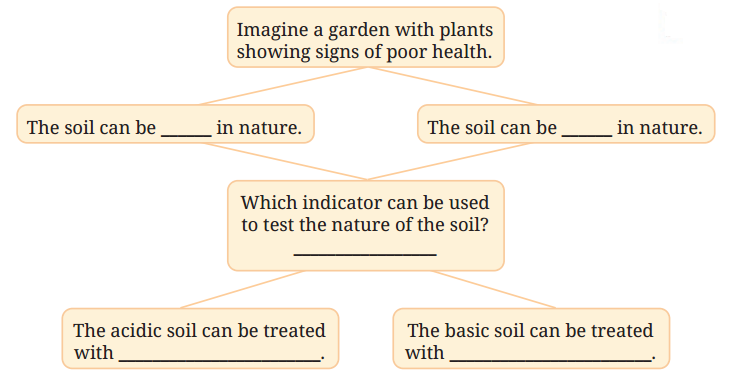
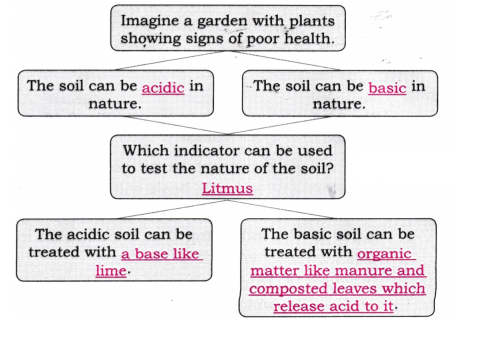
Observe and analyse the information given in the following flowchart. Complete the missing information.
Image
Answer
The complete flowchart is as follows :
Image
View full question & answer
Question 45 Marks
Explain the neutralisation reaction using lemon juice and lime water.
Answer
→ Neutralization is a chemical reaction between an acid and a base, resulting in the formation of salt and water.
 → Lemon juice contains citric acid (an acid), and lime water contains calcium hydroxide (a base). When these two are mixed in the right proportions, they neutralize each other. Initially, the lemon juice is acidic.
→ If we add an indicator like litmus, it will turn red. As lime water is gradually added, the acidic properties of the lemon juice are countered by the basic properties of the lime water.
→ At the point of neutralization, the solution is neither acidic nor basic; it becomes neutral, and the litmus paper will show a neutral color (for litmus, it would be purplish).
 → This reaction produces a salt (calcium citrate) and water, along with heat, illustrating how an acid and a base can cancel out each other's effects to form a neutral substance.
View full question & answer
Question 55 Marks
How can you use onions as an olfactory indicator?
Answer
→ To use onions as olfactory indicators, you first need to prepare onion-infused strips by finely chopping onions and storing them overnight in a closed container with strips of clean cloth or filter paper.
 → The strips absorb the onion's distinct odor. When testing for acidity or basicity, place a few drops of an acidic solution, like lemon juice, on one strip and a basic solution, like baking soda, on another.
→ Observe the changes in odor. In acidic conditions, the onion smell might intensify or remain unchanged, while in basic conditions, the onion smell typically diminishes or alters, indicating the presence of a base.
 → This change in smell helps identify whether a substance is acidic or basic, making onions a simple olfactory indicator.
View full question & answer
Question 65 Marks
What are synthetic indicators? Name two and describe their use.
Answer
Synthetic indicators are substances made in laboratories that show different colors in acidic or basic solutions. Unlike natural indicators, these are not extracted from plants or other natural sources.
synthetic indicators:
(1) Methyl Orange: This indicator is red in acidic solutions and yellow in basic solutions. It's often used in titrations to determine the endpoint of a reaction.
(2) Phenolphthalein: This is colorless in acidic solutions but turns pink in basic solutions. It's also commonly used in titrations and other experiments to observe changes in acidity or basicity.
These indicators provide clear and distinct color changes, making it easier to identify whether a solution is acidic, basic, or neutral.
View full question & answer
Question 75 Marks
Discuss the properties of acidic, basic, and neutral substances with 3 examples each.
Answer
(1) Acidic Substances:
→ Property: Acidic substances have a sour taste.They turn blue litmus paper red.They have a pH value less than 7.
Examples:
→ Lemon Juice: Contains citric acid.
→ Vinegar: Contains acetic acid.
→ Hydrochloric Acid: A strong acid found in gastric juice in the stomach.
(2) Basic (Alkaline) Substances:
→ Property: Basic substances often have a bitter taste.They turn red litmus paper blue.They have a soapy or slippery feel.
Examples:
→ Soap Solution: Used for cleaning, it contains bases that help remove dirt.
→ Baking Soda Solution: Used in baking and has alkaline properties.
→ Lime Water: A solution of calcium hydroxide.
(3) Neutral Substances:
→ Property: Neutral substances do not have a distinct taste.They do not change the color of either red or blue litmus paper.They have a pH value of 7. 
Examples:
→ Pure Water: Essential for life and has a neutral pH.
→ Sugar Solution: A solution of sugar in water, without acidic or basic properties.
→ Common Salt Solution: A solution of sodium chloride in water.
View full question & answer
Question 85 Marks
Explain how turmeric paper is made and used as an indicator.
Answer
→ Turmeric paper, a simple and natural indicator, is crafted by mixing turmeric powder with water to form a paste.
→ which is then evenly spread on filter paper or paper towels and left to dry completely.
→ Once dried, the turmeric-coated paper is cut into strips, ready for use as an indicator. To test a substance, a turmeric paper strip is dipped into the solution, and any color change is observed.
→ In acidic solutions, the paper remains yellow or turns slightly lighter, while in basic solutions, it turns a distinct reddish-brown.
→ This makes turmeric paper particularly useful for identifying basic substances due to its noticeable color change, though it is less effective for identifying acids, where the change is minimal.
View full question & answer
Question 95 Marks
Write about neutralisation in daily life with three examples.
Answer
Ant Bites: When an ant bites, it injects formic acid into the skin, causing irritation and pain. Applying moist baking soda (a base) to the affected area neutralises the acid, providing relief.
Soil Treatment: Overuse of chemical fertilisers can make the soil acidic, hindering plant growth. Farmers often treat the soil with lime (a base) to neutralise the excess acid, creating a more favorable environment for plants.
Industrial Waste: Factory waste can be acidic and harmful to aquatic life if released into rivers or lakes. Treating the waste with basic substances before disposal neutralises the acid, preventing environmental damage and protecting aquatic ecosystems.
View full question & answer
Question 105 Marks
What is the role of natural indicators in identifying acidic and basic substances?
Answer
→ Natural indicators play a crucial role in identifying acidic and basic substances by changing color depending on the acidity or basicity of the solution.
 → These indicators are derived from natural sources like plants, flowers, and vegetables. For example, litmus, extracted from lichens, turns red in acidic solutions and blue in basic solutions.
→ Similarly, red rose petals and turmeric can be used as indicators, changing color in response to acids and bases.
 → By observing these color changes, one can easily determine whether a substance is acidic or basic, making natural indicators a simple and accessible tool for acid-base identification.
View full question & answer
Question 115 Marks
Describe an activity to test the nature of substances using litmus paper.
Answer
→ To investigate the nature of common substances as acidic, basic, or neutral, an activity using litmus paper can be performed.
→ First, gather the necessary materials, including red and blue litmus paper strips, small containers or clean tiles, droppers, and sample substances like lemon juice, soap solution, vinegar, baking soda solution, and tap water.
→ Begin by placing a small amount of each substance in separate, labeled containers. →Then, take a strip of red litmus paper and, using a clean dropper, add a drop of the substance to the litmus paper. Observe and record any color change.
→ Repeat this step for each substance, always using a fresh piece of red litmus paper. Next, repeat the procedure with blue litmus paper, placing a drop of each substance on separate strips of blue litmus paper and recording any color changes observed.
 → By analyzing the results, one can classify each substance: acids turn blue litmus paper red, bases turn red litmus paper blue, and neutral substances have no effect on either red or blue litmus paper. It is crucial to avoid direct contact of the substances with skin and eyes and to wash hands thoroughly after the activity.
View full question & answer
5 Marks Questions - Science STD 7 Questions - Vidyadip