Question types

Life Processes in Animals question types

179 questions across 9 question groups — pick any mix to generate a Science paper with step-by-step answer keys.

179
Questions
9
Question groups
5
Question types
Sample Questions

Life Processes in Animals questions

One sample from each question group in this chapter. Select any group above to see the full set with answer keys.

Q 1MCQ (1 Marks)1 Mark
What is the role of diaphragm in breathing?
  • A
    To filter the air
  • B
    To produce sound
  • To hep in inhalation and exhalation
  • D
    To absorb oxygen

Answer: C.

View full solution
Q 2MCQ (1 Marks)1 Mark
The finger-like outgrowths of Amoeba help to ingest food. However, the finger-like outgrowths of the human intestine help to
  • A
    digest the fatty food substances
  • B
    make the food soluble
  • absorb the digested food
  • D
    absorb the undigested food.

Answer: C.

View full solution
Q 3MCQ (1 Marks)1 Mark
What is the main function of the lungs in the respiratory system?
  • A
    Pump blood
  • B
    Absorb nutrients
  • Exchange gases
  • D
    Digest food

Answer: C.

View full solution
Q 4MCQ (1 Marks)1 Mark
Given below from (i) to (iv) are some food items.
(i) Boiled and mashed potato
(ii) Glucose solution
(iii) A slice of bread
(iv) Mustard oil
Which of the above will give a blue-black colour when tested with iodine?
  • A
    (i) and (ii)
  • (i) and (iii)
  • C
    (ii) and (iii)
  • D
    (iii) and (iv)

Answer: B.

View full solution
Q 5MCQ (1 Marks)1 Mark
Column AColumn B
1. lodine solution(A) Makes food easier to swallow
2. Stomach(B) Mechanical digestion
3. Saliva(C) Reacts with starch to give a blue-black color
4. Mouth(D) Breaks down proteins in the food
  • A
    (1)-(C), (2)-(D), (3)-(A), (4)-(B)
  • B
    (1)-(B), (2)-(D), (3)-(C), (4)-(A)
  • C
    (1)-(C), (2)-(A), (3)-(D), (4)-(B)
  • (1)-(C), (2)-(D), (3)-(B), (4)-(A)

Answer: D.

View full solution
Assertion (A): Oxygen is the final product of respiration.
Reason (R): Respiration produces water, carbon dioxide, and energy.
  • A
    Both A and R are true and R is the correct explanation of A.
  • B
    Both A and R are true, but R is not the correct explanation of A.
  • C
    A is true, but R is false.
  • A is false, but R is true.

Answer: D.

View full solution
Assertion(A): Inhalation is caused by the expansion of the chest cavity.
Reason (R): The diaphragm contracts during inhalation.
  • Both A and R are true and R is the correct explanation of A.
  • B
    Both A and R are true, but R is not the correct explanation of A.
  • C
    A is true, but R is false.
  • D
    A is false, but R is true.

Answer: A.

View full solution
Assertion (A): The pancreas is part of the respiratory system.
Reason (R): The pancreas produces pancreatic juice that is basic in nature.
  • A
    Both A and R are true and R is the correct explanation of A.
  • B
    Both A and R are true, but R is not the correct explanation of A.
  • C
    A is true, but R is false.
  • A is false, but R is true.

Answer: D.

View full solution
Assertion (A): The oesophagus is involved in gas exchange.
Reason (R): The oesophagus connects the mouth to the stomach.
  • A
    Both A and R are true and R is the correct explanation of A.
  • B
    Both A and R are true, but R is not the correct explanation of A.
  • C
    A is true, but R is false.
  • A is false, but R is true.

Answer: D.

View full solution
Assertion (A): Churning of food takes place in the stomach.
Reason (R): The walls of the stomach contract and relax to churn the food.
  • Both A and R are true and R is the correct explanation of A.
  • B
    Both A and R are true, but R is not the correct explanation of A.
  • C
    A is true, but R is false.
  • D
    A is false, but R is true.

Answer: A.

View full solution
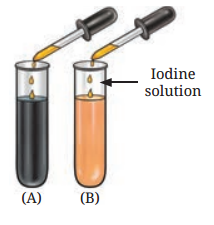
Yadu conducted an experiment to test his idea. He took two test tubes, A and B, and added a pinch of rich flour to the test tubes half-filled with water and stirred them properly. To test tube B, he added a few drops of saliva. He left the two test tubes for 35-45 min. After that, he added iodine solution into both the test tubes. Experimental results are as shown in Fig. What do you think he wants to test?
Image
View full solution
Paridhi and Anusha of Grade 7 started running for their morning workout. After they completed their running, they counted their breaths per minute. Anusha was breating faster than Paridhi. Provide at least two possible explanations for why Anusha was breathing faster than Paridhi.
View full solution
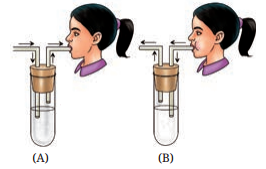
Rakshita designed an experiment taking two clean test tubes, A and B and filled them with lime water as shown in the figure. In test tube A, the surrounding air that we inhale was passed on by sucking air from the pipe, and in test tube B, the exhaled air was blown through the pipe (Fig.). What do you think she is trying to investigate? How can she confirm her findings?
Image
View full solution
Q 313 Marks Question3 Marks
Anil claims to his friend Sanvi that respiration and breathing are the same process. What question(s) Sanvi ask him to make him understand that he is not correct?
View full solution
Q 323 Marks Question3 Marks
Sahil placed some pices of chapati in test tube A. Neha placed chewed chapati in test tube B, and Santushti took boiled and mashed potato in test tube C. All of them added a few drops of iodine solution to their test tubes A, B, and C, respectively. What would be their observations? Give reasons.
View full solution
Q 353 Marks Question3 Marks
In a health awareness seminar, students learned that smoking affects the lungs by damaging the alveoli and reducing their surface area. This makes breathing difficult and reduces the amount of oxygen absorbed into the blood.
(i) Which part of the lungs gets damaged by smoking?
(ii) What happens when the alveoli are damaged?
(iii) Why is smoking dangerous for health?
View full solution
Name of the partFunctions
Q.1. NostrilsA. fresh air from outside enters
Q.2. Nasal passagesB. exchange of gases occurs
Q.3. WindpipeC. protects lungs
Q.4. AlveoliD. tiny hair and mucus help to trap dust and dirt from the
E. air we breathe air reaches our lungs through this part
View full solution
Column IColumn II
Q.1. LungsA. Site for gas exchange
Q.2. AlveoliB. Helps in breathing
Q.3. DiaphragmC. Breathing organs of fish
Q.4. GillsD. Tiny air sacs in lungs
View full solution
Column IColumn II
Q.1. Small intestineA. Produces bile
Q.2. Large intestineB. Produces pancreatic juice
Q.3. StomachC. Absorbs nutrients
Q.4. LiverD. Absorbs water
View full solution
Column AColumn B
Q.1. Gills(a) Helps in breathing
Q.2. Pancreas(b) Stores undigested food
Q.3. Rectum(c) Gas exchange in lungs
Q.4. Alveoli(d) Exchange of gases in fish
 (e) Secretes digestive enzymes
View full solution

Generate a Life Processes in Animals paper free

Pick question groups from the list above, set marks and difficulty, and export a branded PDF with step-by-step answer keys. First 3 chapters free — no signup.

Download App