Questions

3 Marks Question

🎯

Test yourself on this topic

12 questions · timed · auto-graded

Question 13 Marks
Anil claims to his friend Sanvi that respiration and breathing are the same process. What question(s) Sanvi ask him to make him understand that he is not correct?
Answer
Sanvi can ask the following questions to Anil to make him understand that breathing and respiration are not the same process:
1. Do plants breathe? How do they get oxygen?
2. Does the carbon dioxide we exhale come from respiration or breathing?
3. Can we perform respiration without breathing for a short time?
4. Can you give an example of a process that involves breathing but not respiration?
View full question & answer
Question 23 Marks
Sahil placed some pices of chapati in test tube A. Neha placed chewed chapati in test tube B, and Santushti took boiled and mashed potato in test tube C. All of them added a few drops of iodine solution to their test tubes A, B, and C, respectively. What would be their observations? Give reasons.
Answer
The observations can be explained by the given table :
MaterialIodine solutionObservationReason
Sahil – ChapatiYesBlue-black colourStarch is present and undigested
Neha – Chewed chapatiYesSlight or no colour changeStarch is partially digested into sugars by salivary amylase
Santushti – boiled and mashed potatoYesBlue-black colourPotato contains a lot of starch that reacts strongly with iodine
View full question & answer
Question 33 Marks
Explain the digestive system of a human being with the help of a labelled diagram.
Answer
The human digestive system begins at the mouth, where food is chewed and mixed with saliva. It then passes through the oesophagus to the stomach, where food is mixed with gastric juices and proteins are broken down. From the stomach, food moves into the small intestine, where enzymes and bile help digest food, and nutrients are absorbed into the blood. The remaining undigested food passes into the large intestine, where water is absorbed. Finally, waste is expelled through the rectum and anus.
View full question & answer
Question 43 Marks
Explain how the exchange of gases occurs in human beings.
Answer
In human beings, gas exchange occurs in the alveoli of the lungs. Oxygen from the inhaled air diffuses into the blood in the surrounding capillaries, while carbon dioxide from the blood diffuses into the alveoli to be exhaled. This process is called diffusion and ensures that oxygen reaches the body cells and carbon dioxide is removed efficiently.
View full question & answer
Question 53 Marks
In a health awareness seminar, students learned that smoking affects the lungs by damaging the alveoli and reducing their surface area. This makes breathing difficult and reduces the amount of oxygen absorbed into the blood.
(i) Which part of the lungs gets damaged by smoking?
(ii) What happens when the alveoli are damaged?
(iii) Why is smoking dangerous for health?
Answer
(i) Smoking damages the alveoli in the lungs.
(ii) When the alveoli are damaged, their surface area gets reduced, making breathing difficult and lowering the amount of oxygen absorbed into the blood.
(iii) Smoking is dangerous for health as it can lead to serious diseases such as lung cancer, heart disease, and respiratory problems, and can also harm others through passive smoking. It is considered a major cause of preventable death worldwide.
View full question & answer
Question 63 Marks
Rahul noticed that when he chewed a piece of bread for a long time, it started tasting sweet. His teacher explained that it happens because enzymes in saliva start breaking down starch into sugar.
(i). Name the type of nutrient present in the bread.
(ii) What did Rahul notice after chewing bread for a while?
(iii) What helps in the breaking down of starch in the mouth?
Answer
(i) Bread contains a nutrient called starch.
(ii) Rahul noticed that the bread started tasting sweet after he chewed it for a long time.
(iii) The saliva helps in the breaking down of starch in the mouth.
View full question & answer
Question 73 Marks
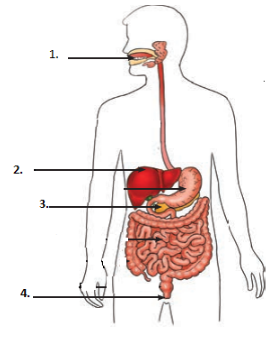
Refer to the diagram of the human digestive system and answer the following Question:
(a) Label the parts marked as 1, 2, 3 and 4.
(b) Name the longest part of alimentary canal.
Image
Answer
(a) (1) Mouth 2. Liver 3. Pancreas 4. Anus,
(b) Small intestine.
View full question & answer
Question 83 Marks
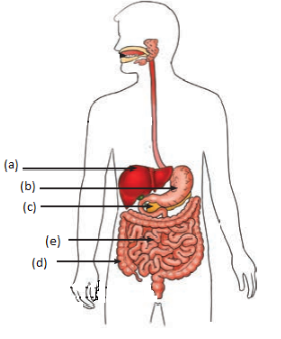
Label the following parts and name them.
Image
(a) Secretes bile that breaks down fats and neutralises acids.
(b) Breaks down proteins using digestive juice, acid, and mucus.
(c) Secretes pancreatic juice that digests carbohydrates, proteins, and fats.
(d) Absorbs water and salts; stores stool before egestion.
(e) Receives digestive juices and absorbs nutrients through finger-like projections.
Answer

Image
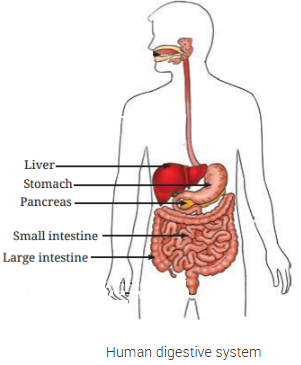
(a) Liver
(b) Stomach
(c) Pancreas
(d) Large intestine
(e) Small intestine
View full question & answer
Question 93 Marks
Describe the different parts of the digestive system.
Answer
The different parts of the digestive system are as follows:
1. Digestion starts in the mouth, where teeth chew the food and saliva changes starch into sugar.
2. The food moves through the oesophagus to the stomach.
3. In the stomach, food is mixed and churned. Digestive juices break down proteins, acid kills germs, and mucus protects the stomach.
4. The food then goes to the small intestine, where juices from the liver, pancreas, and the intestine digest fats, proteins, and carbohydrates.
5. The inner lining of the small intestine has finger-like projections that absorbs the digested nutrients into the blood.
6. The leftover food moves to the large intestine, where water and salts are absorbed.
7. The solid waste (stool) is stored in the rectum and passed out through the anus. This process is called egestion.
View full question & answer
Question 103 Marks
How does chewing food properly help in digestion?
Answer
→ Chewing food properly is crucial for efficient digestion.
→ It breaks down large pieces of food into smaller particles, significantly increasing the surface area for digestive enzymes to act upon.
→ This process also mixes the food thoroughly with saliva, which contains enzymes like amylase that begin the digestion of carbohydrates in the mouth.
→ Properly chewed food is softer and moister, making it easier to swallow and reducing the strain on the stomach.
→ Additionally, chewing sends signals to the digestive system, preparing the stomach and intestines to release the necessary enzymes and acids for further breakdown.
→ Overall, thorough chewing ensures that food is processed more effectively, leading to better nutrient absorption and reduced digestive discomfort.
View full question & answer
Question 113 Marks
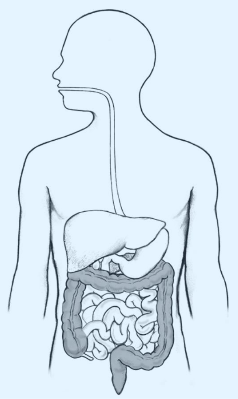
Observe the given picture.
Image
1. Label stomach, liver, pancreas, small intestine.
2. Name two organs that secrete digestive juices.
3. Mention the function of the organ that is longest.
Answer
self
View full question & answer
Question 123 Marks
Read the passage and answer the questions :
Rakshita conducted an experiment with lime water and exhaled air. When she exhaled in lime water, it changed its appearance. Based on her observations, choose the correct option for each question below:
Q.1.  What did Rakshita observe when she passed exhaled air into lime water?
(a) The lime water became clear
(b) The lime water turned blue
(c) The lime water turned milky
(d) The lime water evaporated
Q.2. What does the change in lime water indicate about exhaled air?
(a) It contains more oxygen than inhaled air
(b) It contains nitrogen gas
(c) It contains more carbon dioxide than inhaled air
(d) It is cooler than inhaled air
Q.3. How is this experiment helpful in understanding respiration?
(a) It shows that oxygen is produced during respiration
(b) It shows that carbon dioxide is a product of respiration
(c) It confirms that air does not affect lime water
(d) It demonstrates that carbon dioxide dissolves lime water.
Answer
(c) The lime water turned milky.
(c) It contains more carbon dioxide than inhaled air.
(b) It shows that carbon dioxide is a product of respiration.
View full question & answer
3 Marks Question - Science STD 7 Questions - Vidyadip