Question types

Light: Shadows and Reflections question types

176 questions across 9 question groups — pick any mix to generate a Science paper with step-by-step answer keys.

176
Questions
9
Question groups
5
Question types
Sample Questions

Light: Shadows and Reflections questions

One sample from each question group in this chapter. Select any group above to see the full set with answer keys.

Q 2MCQ (1 Marks)1 Mark
If an object is placed at a distance of 0.5 m in front of a plane mirror, the distance between the object and the image formed by the mirror will be
  • A
    2 m
  • 1 m
  • C
    0.5 m
  • D
    0.25 m

Answer: B.

View full solution
Assertion (A): The image formed by a plane mirror is laterally inverted.
Reason (R): A plane mirror reverses the left and right sides of the object.
  • Both A and R are true and R is the correct explanation of A.
  • B
    Both A and R are true but R is not the correct explanation of A.
  • C
    A is true but R is false.
  • D
    A is false but R is true.

Answer: A.

View full solution
Statement A: Image formed by a plane mirror is laterally inverted.
Statement B: Images of alphabets T and O appear identical to themselves in a plane mirror.
  • Both statements are true
  • B
    Both statements are false
  • C
    Statement A is true, but statement B is false
  • D
    Statement A is false, but statement B is true

Answer: A.

View full solution
Assertion (A): In mirror image, the left side of the object is seen as the right side in the image.
Reason (R): The capital English letter ‘H’ does not show a lateral inversion.
  • A
    Both A and R are true and R is the correct explanation of A.
  • Both A and R are true but R is not the correct explanation of A.
  • C
    A is true but R is false.
  • D
    A is false but R is true.

Answer: B.

View full solution
Assertion (A): Never look directly at the sun it may be extremely harmful for our eyes.
Reason (R): Pin hole camera can be used for brightly little objects.
  • A
    Both A and R are true and R is the correct explanation of A.
  • Both A and R are true but R is not the correct explanation of A.
  • C
    A is true but R is false.
  • D
    A is false but R is true.

Answer: B.

View full solution
Assertion (A): The objects which allow the light to pass through them are called translucent objects.
Reason (R): Glass sheets, water, and air are examples of transparent objects.
  • A
    Both A and R are true and R is the correct explanation of A.
  • B
    Both A and R are true but R is not the correct explanation of A.
  • C
    A is true but R is false.
  • A is false but R is true.

Answer: D.

View full solution
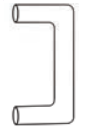
Suppose you are given a tube of the shape shown in the Fig. and two plane mirrors smaller than the diameter of the tube. Can this tube be used to make a periscope? If yes, mark where you will fix the plane mirrors.
Image
View full solution
Measure the length of your shadow at 9 AM, 12 PM, and 4 PM with the help of your friend. Write down your observations :
(i) At which of the given times is your shadow the shortest?
(ii) Why do you think this happens?
View full solution
Write your name on a piece of paper and hold it in front of a plane mirror such that the paper is parallel to the mirror. Sketch the image. What difference do you notice? Explain the reason for the difference.
View full solution
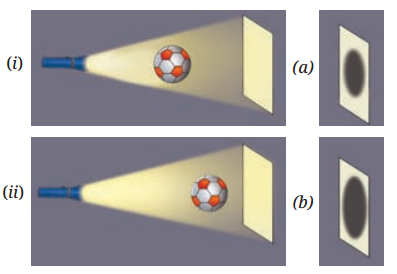
The shadow of a ball is formed on a wall by placing the ball in front of a fixed torch as shown in Fig. In scenario (i) the ball is closer to the torch, while in scenario (ii) the ball is closer to the wall. Choose the most accurate representation of the shadows formed in both scenarios from the options provided (a and b).
Image
View full solution
Column AColumn B
Q.1. If the torch is close to the ball(a) The shadow would be smaller
Q.2. If the torch is far away(b) The shadow would be larger
Q.3. If the ball is removed from the set-up(c) Two shadows would appear on the screen
Q.4. If two torches are present in the set-up on the left side of the ball(d) A bright spot would appear on the screen


View full solution
Column AColumn B
Q.1. Pinhole(a) Blocks light completely camera
Q.2. Opaque object(b) The dark region formed behind the object
Q.3. Transparent object(c) Forms an inverted image
Q.4. Shadow(d) Light passes almost completely through it
View full solution
Column AColumn B
Q.1. Pinhole(a) Blocks light completely camera
Q.2. Opaque object(b) The dark region formed behind the object
Q.3. Transparent object(c) Forms an inverted image
Q.4. Shadow(d) Light passes almost completely through it
View full solution
Column AColumn B
Q.1. Plane mirror(a) Forms inverted image
Q.2. Shadow(b) Transparent material
Q.3. Glass(c) Formed behind opaque body
Q.4. Pinhole camera(d) Translucent material
 (e) Virtual and laterally inverted image
View full solution

Generate a Light: Shadows and Reflections paper free

Pick question groups from the list above, set marks and difficulty, and export a branded PDF with step-by-step answer keys. First 3 chapters free — no signup.

Download App