Questions

1 Marks Question

🎯

Test yourself on this topic

26 questions · timed · auto-graded

Question 11 Mark
An erect and enlarged image of an object is formed on a screen. Explain how this could be possible?
Answer
An erect and enlarged image of an object is formed only by the concave mirror or convex lens when it is placed very close to the object.
View full question & answer
Question 21 Mark
Does the white light consist of seven colours?
Answer
Yes, white light splits into seven colours when it passes through a prism. So, we can say that white light consist of seven colours.
View full question & answer
Question 41 Mark
A shiny and polished bell forms an image which is erect and diminished. Can you recognise the type of the mirror?
Answer
Convex mirror always forms an erect and diminished image of an object.
View full question & answer
Question 51 Mark
The image is of the same size as object whether the mirror is small or large. Why?
Answer
The plane mirror always forms an erect and same size image as of object size. The properties and characteristics of the mirror does not depend on the size of mirror.
View full question & answer
Question 61 Mark
Does the mirror change the direction of light that falls on it?
Answer
Yes, when a ray of light is incident on the mirror surface, then the mirror changes the direction of light.
View full question & answer
Question 71 Mark
What happens when light falls on a polished or shiny surface?
Answer
When light falls on a polished or shiny surface like mirror, then it reflects and change the path of light.
View full question & answer
Question 81 Mark
How can we change the path of light?
Answer
The way to change the direction or path of light is to let it fall on a shiny surface or mirror.
View full question & answer
Question 91 Mark
Why was Boojho not able to see the candle flame through a bent pipe?
Answer
Light always travels in a straight path. That's why, he does not able to see the candle flame through a bent pipe.
View full question & answer
Question 101 Mark
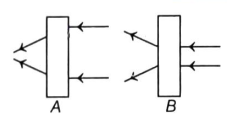
The given figures show the path of light through lenses of two different types represented by rectangular boxes A and B. What is the nature of lenses A and B?
Image
Answer
In first case light rays are converging towards a point, so the lens A will be convex and in case of lens B, light rays diverge or spread out. So, the lens will be concave lens.
View full question & answer
Question 111 Mark
State in brief what we can demonstrate by rotating Newton's colour disc very fastly.
Answer
By rotating Newton's colour disc, we can demonstrate that when seven colours are mixed together, then a white colour is formed.
View full question & answer
Question 121 Mark
Consider if one half of a convex lens is covered with a black paper, then state whether this lens produces a complete image of the object.
Answer
If one half of a convex lens is covered with a black paper, then also, the convex lens will produce the complete image of the object.
View full question & answer
Question 131 Mark
Mention the name of lens which can converge the sun's rays to a point and burn a hole in the piece of paper.
Answer
Convex lens is a lens which can converge the sun's rays to a point and burn a hole in the piece of paper.
View full question & answer
Question 141 Mark
As we know that an image is formed by the actual intersection of rays and can be obtained on the screen. So, state whether it is real or virtual image.
Answer
After the actual intersection of rays, the image obtained on the screen is always real image.
View full question & answer
Question 151 Mark
Name the phenomenon that is involved in the formation of image of an object by a concave mirror.
Answer
Reflection of light is the phenomenon which is involved in the formation of image of an object by a concave mirror.
View full question & answer
Question 161 Mark
Briefly tell that how many reflected rays can be obtained from a single incident ray in respect of a plane mirror?
Answer
For a single incident ray, there will be only one reflected ray that can be obtained in respect of a plane mirror.
View full question & answer
Question 171 Mark
Briefly mention what makes things visible to us.
Answer
When a light ray after getting reflected by an object falls on our eyes, it allows us to see things around us.
View full question & answer
Question 181 Mark
Give the form of energy that produces the sensation of vision.
Answer
Light energy is the form of energy which produces the sensation of vision.
View full question & answer
Question 211 Mark
What is a virtual image? Give one situation, where a virtual image is formed.
Answer
An image that cannot be obtained on a screen is called virtual image.
In case of plane mirror, virtual image is formed.
View full question & answer
Question 221 Mark
What is the cause of rainbow formation?
Answer
A rainbow is formed due to the refraction, dispersion, and reflection of sunlight in water droplets present in the atmosphere.
View full question & answer
Question 231 Mark
Concave lens is called a diverging lens. Is it correct?
Answer
True
A concave lens is called a diverging lens because it spreads out (diverges) parallel rays of light passing through it.
View full question & answer
Question 241 Mark
Explain that a convex lens converges the sun rays to a single point.
Answer
A convex lens is a converging lens, so it bends (refracts) parallel rays of sunlight and makes them meet at a single point called the focus.
View full question & answer
Question 251 Mark
A shopkeeper wanted to fix a mirror which will give a maximum view of his shop. What type of mirror should he use? Give reason.
Answer
The shopkeeper should use a concave mirror.
A concave mirror can give a magnified and wider view of the shop when the object is within its focal length, helping the shopkeeper to see more area.
View full question & answer
1 Marks Question - Science STD 7 Questions - Vidyadip