Question types

Light question types

122 questions across 9 question groups — pick any mix to generate a Science paper with step-by-step answer keys.

122
Questions
9
Question groups
5
Question types
Sample Questions

Light questions

One sample from each question group in this chapter. Select any group above to see the full set with answer keys.

Q 1MCQ (1 Marks)1 Mark
You are provided with a concave mirror, a convex mirror, a concave lens and a convex lens. To obtain an enlarged image of an object, you can use either
  • A
    concave mirror or convex mirror
  • concave mirror or convex lens
  • C
    concave mirror or concave lens
  • D
    concave lens or convex lens

Answer: B.

View full solution
Q 2MCQ (1 Marks)1 Mark
If an object is placed at a distance of 0.5 m in front of a plane mirror, the distance between the object and the image formed by the mirror will be
  • A
    2 m
  • 1 m
  • C
    0.5 m
  • D
    0.25 m

Answer: B.

View full solution
Q 3MCQ (1 Marks)1 Mark
Which of the following can be used to form a real image?
  • Only concave mirror
  • B
    Only plane mirror
  • C
    Only convex mirror
  • D
    Both concave and convex mirrors

Answer: A.

View full solution
Q 4MCQ (1 Marks)1 Mark
You are provided with a convex mirror, a concave mirror, a convex lens and a concave lens. You can get an inverted image from
  • A
    both concave lens and convex lens
  • B
    both concave mirror and convex mirror
  • both concave mirror and convex lens
  • D
    both convex mirror and concave lens

Answer: C.

View full solution
Q 5MCQ (1 Marks)1 Mark
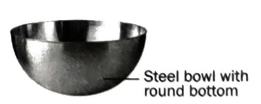
Alice looks inside a round steel bowl very closely. She sees her image on the inside of the bowl.
Image

What type of image is formed inside the bowl?
  • A
    Real and small
  • B
    Virtual and small
  • C
    Real and enlarged
  • Virtual and enlarged

Answer: D.

View full solution
Assertion (A) A white light consists of seven different colours.
Reason (R) When a white light passes through a prism, it splits into seven colours.
  • Both A and R are true and R is the correct explanation of A.
  • B
    Both A and R are true but R is not the correct explanation of A
  • C
    A is true but R is false.
  • D
    A is false but R is true.

Answer: A.

View full solution
Assertion (A) Concave mirrors are used as a shaving mirror in barber shop.
Reason (R) Concave mirror forms enlarged image of the object when it is placed very close to the object.
  • Both A and R are true and R is the correct explanation of A.
  • B
    Both A and R are true but R is not the correct explanation of A
  • C
    A is true but R is false.
  • D
    A is false but R is true.

Answer: A.

View full solution
Assertion (A) A plane mirror forms a virtual and erect image.
Reason (R) The size of image is diminished than the size of object in plane mirror.
  • A
    Both A and R are true and R is the correct explanation of A.
  • B
    Both A and R are true but R is not the correct explanation of A
  • A is true but R is false.
  • D
    A is false but R is true.

Answer: C.

View full solution
Assertion (A) Light cannot visible through a bent rubber pipe.
Reason (R) Light travels in a straight path.
  • A
    Both A and R are true and R is the correct explanation of A.
  • Both A and R are true but R is not the correct explanation of A
  • C
    A is true but R is false.
  • D
    A is false but R is true.

Answer: B.

View full solution
Assertion (A) The image which is formed behind the mirror is called virtual image
Reason (R) When the light rays meet virtually, then it forms virtual image.
  • Both A and R are true and R is the correct explanation of A
  • B
    Both A and R are true but R is not the correct explanation of A.
  • C
    A is true but R is false.
  • D
    A is false but R is true.

Answer: A.

View full solution
It was observed that when the distance between an object and a lens decreases, the size of the image increases. What is the nature of this lens? If you keep on decreasing the distance between the object and the lens, will you still able to obtain the image on the screen? Explain.
View full solution
The image formed by a lens is always virtual, erect and smaller in size for an object kept at different positions in front of it. Identify the nature of the lens.
View full solution
Q 313 Marks Question3 Marks
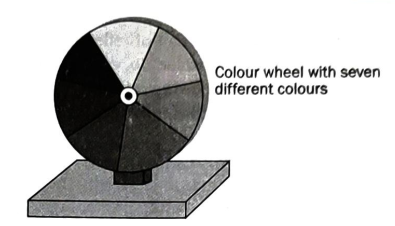
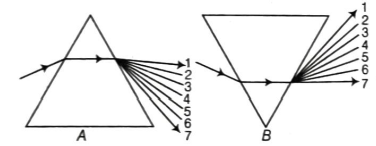
When white light is reflected from the surface of a Compact Disc (CD), many colours are seen. When we blow soap bubbles, they appear colourful. The disc painted with seven colours of the spectrum is called Newton's disc.
Image

David spins a multicoloured wheel rapidly.
(i) What colour will the rapidly spinning wheel appear to be?
(ii) What acts like a prism in the formation of a rainbow in nature?
(iii) What happen when we pass a red laser light through the prism?
View full solution
Q 343 Marks Question3 Marks
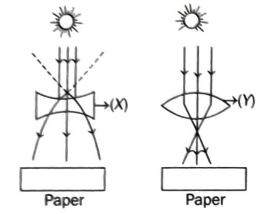
A student is asked to focus sunlight using two different lenses onto a paper.
Image

Observe the image carefully and answer the following questions.
(i) State the name for the shape of lenses X and Y.
(ii) Which of these two lenses can be used to magnify images?
(iii) Explain the changes that happen to the paper kept under both the lenses.
View full solution
Q 353 Marks Question3 Marks
Last Sunday Girish's mother, Priyanka was preparing the dinner in her kitchen for Girish and his father. Both of them were feeling so much hungry and they sat ideally on their respective chairs and having empty plates and spoons on their dinning table. They were shouting like a 5 years old child that they wanted the dinner so eagerly to fulfil their stomach. After sometime, Girish's mother served the cooked food to both of them and when Girish was just about to eat the rice with the help of spoon, he noticed that the spoon has such a shining surface that it reflected the light rays incident on it.
(i) Explain the importance of shining surface in the reflection of light.
(ii) Name the type of spherical mirror represented by the shining steel spoon.
(iii) Mention the values shown by Priyanka here towards her family
View full solution
Column IColumn II
(a) Erect image(i) Cannot be formed on the screen
(b) Diminished image(ii) Upside down image
(c) Virtual image(iil) Smaller than the object
(d) Inverted image(iv) Upright image
 (v) Formed on the screen
View full solution
Column IColumn II
(a) A plane mirror(i) Used as a magnifying glass.
(b) A convex mirror(ii) Can form image of objects spread over a large area.
(c) A convex lens(iii) Used by dentists to see enlarged image of teeth.
(d) A concave mirror(iv) The image is always inverted and magnified.
 (v) The image is erect and of the same size as the object.
 (vi) The image is erect and smaller in size than the object.
View full solution

Generate a Light paper free

Pick question groups from the list above, set marks and difficulty, and export a branded PDF with step-by-step answer keys. First 3 chapters free — no signup.

Download App