Questions

3 Marks Question

🎯

Test yourself on this topic

7 questions · timed · auto-graded

Question 13 Marks
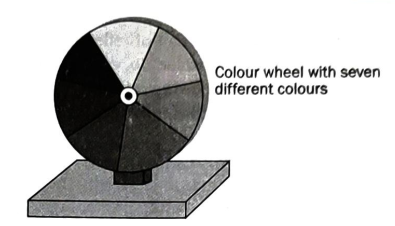
When white light is reflected from the surface of a Compact Disc (CD), many colours are seen. When we blow soap bubbles, they appear colourful. The disc painted with seven colours of the spectrum is called Newton's disc.
Image

David spins a multicoloured wheel rapidly.
(i) What colour will the rapidly spinning wheel appear to be?
(ii) What acts like a prism in the formation of a rainbow in nature?
(iii) What happen when we pass a red laser light through the prism?
Answer
(i) It will appear to white as all colours mix due to rotation and give white light.
(ii) Raindrops act like prisms when sunlight passes through them to form a rainbow.
(iii) When a red laser light passes through a prism, it stays together and appears as one colour, i.e. red.
View full question & answer
Question 23 Marks
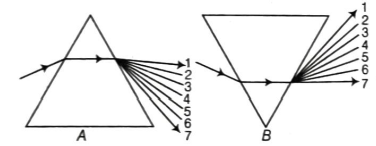
State the correct sequence (1-7) of colours in the spectrum formed by the prisms A and B shown in the figure.
Image
Answer
When white light is passed through a prism, it disperses into its seven constituent colours.
For AFor B
1. → Red1. → Violet
2. → Orange2. → Indigo
3. → Yellow3. → Blue
4. → Green4. → Green
5. →  Blue5. → Yellow
6. →  Indigo6. → Orange
7. → Violet7. → Red
View full question & answer
Question 33 Marks
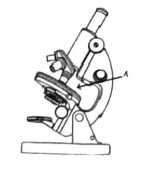
Label A denotes the lens used in microscope to see objects. Which type of lenses are used in the microscope which helps to see the microbes?
Image
Answer
Microscope uses convex lens in order to focus light. A convex lens of short focal length is used to see magnified images of microbes.
View full question & answer
Question 43 Marks
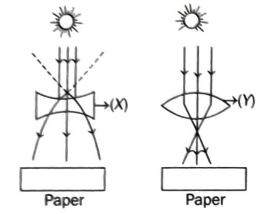
A student is asked to focus sunlight using two different lenses onto a paper.
Image

Observe the image carefully and answer the following questions.
(i) State the name for the shape of lenses X and Y.
(ii) Which of these two lenses can be used to magnify images?
(iii) Explain the changes that happen to the paper kept under both the lenses.
Answer
(i) Lens X → Concave
Lens Y → Convex
(ii) Lens Y is convex in nature. Hence, it can be used to magnify images.
(iii) The paper under lens X will remain as it is. But in case of lens Y, due to its converging nature, the sun rays will be focussed at a point. Ultimately, the paper will start burning.
View full question & answer
Question 53 Marks
Last Sunday Girish's mother, Priyanka was preparing the dinner in her kitchen for Girish and his father. Both of them were feeling so much hungry and they sat ideally on their respective chairs and having empty plates and spoons on their dinning table. They were shouting like a 5 years old child that they wanted the dinner so eagerly to fulfil their stomach. After sometime, Girish's mother served the cooked food to both of them and when Girish was just about to eat the rice with the help of spoon, he noticed that the spoon has such a shining surface that it reflected the light rays incident on it.
(i) Explain the importance of shining surface in the reflection of light.
(ii) Name the type of spherical mirror represented by the shining steel spoon.
(iii) Mention the values shown by Priyanka here towards her family
Answer
(i) As we know that, the extent of reflection depends upon the shining of surface. So, greater the shining of the surface, more will be the reflection.
(ii) Both convex and concave mirrors are represented by the shining steel spoon.
(iii) The value shown by Priyanka here is concern and satisfaction that she gets after serving the cooked food for her son and her husband.
View full question & answer
Question 63 Marks
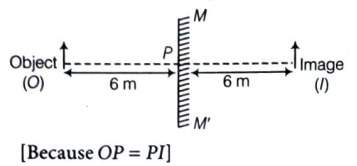
Assume, a person is standing in front of a plane mirror. The distance between the mirror and his image is 6m. If the person moves 2 m towards the plane mirror, what would be the distance between the person and his image?
Answer
The image is 6 m away from the plane mirror. It means that the object is also 6 m away from the mirror.
Image

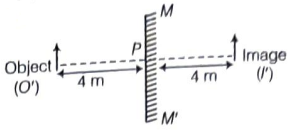
When the person moves 2 m towards the plane mirror, then the distance between the person and the plane mirror will be equal to (6 m - 2 m) = 4 m, this means that distance between the image and the mirror will be 4 m.Image

The distance between the person and his image
$=P O^{\prime}+P I^{\prime}=4+4=8 m$
View full question & answer
Question 73 Marks
One day, Ramesh's friends were performing their respective experiments given by their teacher. While sitting in the practical lab instead of performing experiment, Ramesh was playing with his meter scale. All of the sudden, he held the scale in his hand and started moving in front of tubelight, then he observed the seven colours of white light. After sometimes, he got scolded by his lab teacher for not performing the experiment.
(i) Give the name of phenomenon that leads to the formation of band of seven colours.
(ii) Name the constituent colours of white light.
(iii) Mention the values shown by Ramesh here.
Answer
(i) Dispersion of white light is the name of phenomenon which leads to the formation of band of seven colours.
(ii) There are seven constituent colours of white light.
They are Violet, Indigo, Blue, Green, Yellow, Orange, Red, i.e. VIBGYOR
(iii) Ramesh seems to be quite innovative with respect to the scientific methods and also very eager to learn science regarding phenomena.
View full question & answer
3 Marks Question - Science STD 7 Questions - Vidyadip