Sample QuestionsExponents and Powers questions
One sample from each question group in this chapter. Select any group above to see the full set with answer keys.
The mass of Earth is $5.97 \times 10^{24} kg$, whereas Jupiter has a mass of $1.8986 \times 10^{27} kg$. About how many times massive is Jupiter than
Answer: D.
View full solution →The distance of planet Neptune from the Sun is 4495000000000000 km . Which of the following can be another way of representing the distance (in km ) between the Neptune and the Sun?
- A
$4.495 \times 10^{14}$
- ✓
$4.495 \times 10^{15}$
- C
$4.495 \times 10^{16}$
- D
$4.495 \times 10^{17}$
Answer: B.
View full solution →Multiplicative inverse of $\left(2^{-2}+3^{-2}+4^{-2}\right)^{-1}$ is
- ✓
$\frac{61}{144}$
- B
$\frac{144}{61}$
- C
$\frac{-61}{144}$
- D
$-\frac{144}{61}$
Answer: A.
View full solution →The value of $\left(5^6+5^9\right) \times 5^{-5}$ is equal to
- A
$5^9$
- ✓
$5^{-8}$
- C
$5^8$
- D
$5^{-9}$
Answer: B.
View full solution →If $x=(50)^{1-6}+(50)^{-2}$, then the value of $x^{-3}$ is
- ✓
$50^9$
- B
$\frac{1}{50^9}$
- C
$-50^9$
- D
$\frac{-1}{50^9}$
Answer: A.
View full solution →$\left(\frac{7}{9}\right)^{-2} \times\left(\frac{7}{9}\right)^{-8}=\left(\frac{7}{9}\right)^{15}$
View full solution →$\left(-\frac{9}{2}\right)^0=0$
View full solution →The value of $\frac{1}{7^{-3}}$ is equal to 216 .
View full solution →The reciprocal of $\left(\frac{3}{2}\right)^3$ is not equal to $\binom{3}{2}^{-3}$.
View full solution →The multiplicative inverse of (-3)-2 is 3-2.
Assertion (A) When you raise a number to the power of zero, the result is always zero.
Reason (R) Any number raised to the power of zero equals one.
- A
Both A and R are correct and R is the correct explanation of A.
- B
Both A and R are correct but R is not the correct explanation of A .
- ✓
A is false but R is true.
- D
A is true but R is false.
Answer: C.
View full solution →Assertion (A) When you multiply two numbers with the same base and they have different exponents, you can add the exponents together.
Reason (R) This is because the product rule of exponents states that $a^m \times a^n=a^{m+n}$.
- ✓
Both A and R are correct and R is the correct explanation of A.
- B
Both A and R are correct but R is not the correct explanation of A .
- C
A is false but R is true.
- D
A is true but R is false.
Answer: A.
View full solution →Simplify and write in exponential form.
(i) $(-2)^{-3} \times(-2)^{-4}$
(ii) $p^3 \times p^{-10}$
(iii) $3^2 \times 3^{-5} \times 3^6$
View full solution →Expand the following numbers using exponents.
(i) 1025.63 $\qquad$ (ii) 1256.249
View full solution →Find the multiplicative inverse of the following
(i) $2^{-4}$ $\qquad$ (ii) $10^{-5}$ $\qquad$ (iii) $7^{-2}$
(iv) $5^{-3}$ $\qquad$ (v) $10^{-100}$
View full solution →Simplify
(i) $\frac{25 \times t^{-4}}{5^{-3} \times 10 \times t^{-8}}(t \neq 0)$
(ii) $\frac{3^{-5} \times 10^{-5} \times 125}{5^{-7} \times 6^{-5}}$
View full solution →Evaluate.
(i) $\left\{\left(\frac{1}{3}\right)^{-1}-\left(\frac{1}{4}\right)^{-1}\right\}^{-1}$
(ii) $\left(\frac{5}{8}\right)^{-7} \times\left(\frac{8}{5}\right)^{-4}$
View full solution →In a stack, there are 5 books each of thickness 20 mm and 5 paper sheets each of thickness 0.016 mm . What is the total thickness of the stack?
The cells of a bacteria double in every 30 min . A scientist begins with a single cell.
(i) How many cells will be there after
(a) 10 h ? $\qquad$ (b) 25 h ?
(ii) What type of value is depicted by the cells of bacteria?
View full solution →Consider a quantity of a radioactive substance. The fraction of this quantity that remains after $t$ half-lives can be found using the expression $3^{-t}$.
(i) What fraction of substance remains after 7 half-lives ?
(ii) After how many half-lives, will the fraction be $\frac{1}{243}$ of the original ?
View full solution →To make ballot papers cut a sheet of paper into three. Stack the three pleces and cut the stack into three. Stack all the pieces and cut the stack into three again.
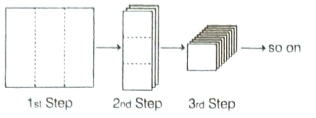
(i) Complete the table to show the number of ballot papers after five such steps :| Number of steps | Number of ballot paper |
| 1 | 3 |
| 2 | |
| 3 | |
| 4 | |
| 5 | |
(ii) Suppose you continue this process. How many ballot papers would you have after 15 steps? How many would you have after $n$ cuts?
(iii) How many steps would it take to make atleast one lakh ballot papers? View full solution →Find the value of $x^{-3}$, if $x=(100)^{1-4}+(100)^0$.
View full solution →Write all the facts given in the standard
Express the number appearing in the following statements in standard form.
(i) 1 micron is equal to $\frac{1}{1000000} m$.
(ii) Charge of an electron is 0.00000000000000000016 coulomb.
(iii) Size of a bacteria is 0.0000005 m .
(iv) Size of a plant cell is 0.00001275 m .
(v) Thickness of a thick paper is 0.07 mm .
View full solution →Express the following numbers in usual form.
(i) $3.02 \times 10^{-6}$
(ii) $4.5 \times 10^4$
(iii) $3 \times 10^{-8}$
(iv) $1.0001 \times 10^9$
(v) $5.8 \times 10^{12}$
(vi) $3.61492 \times 10^6$
View full solution →Express the following numbers in standard form.
(i) 0.0000000000085
(ii) 0.00000000000942
(iii) 6020000000000000
(iv) 0.00000000837
(v) 31860000000
Find the value of
(i) $\left(3^0+4^{-1}\right) \times 2^2$
(ii) $\left(2^{-1} \times 4^{-1}\right)+2^{-2}$
(iii) $\left(\frac{1}{2}\right)^{-2}+\left(\frac{1}{3}\right)^{-2}+\left(\frac{1}{4}\right)^{-2}$
(iv) $\left(3^{-1}+4^{-1}+5^{-1}\right)^0$
(v) $\left\{\left(\frac{-2}{3}\right)^{-2}\right\}^2$
View full solution →Write the usual form of $2.8 \times 10^{-10}$.
View full solution →Write 0.0000056789 in the standard form.
Find the standard form of 32500000000 .
The value of $\left[2^{-1}+3^{-1}+4^{-1}+5^{-1}\right]^0$ is _________
View full solution →The standard form of $\frac{1}{10000000000}$ is _________
View full solution →The standard form of 12345000000 is _________
The value of $\left(4^{-1}+2^{-1}+3^{-1}\right)^{-1}$ is _________
View full solution →The value of $\left(\frac{1}{2^3}\right)^2$ is equal to _________
View full solution →Write the following numbers in standard form.
(i) 0.000000564
(ii) 0.0000021
(iii) 21600000
(iv) 15240000
The given table shows the crop production of a state in the year 2008 and 2009. Observe, the table given below and answer the given questions.| Crop | 2008 Harvest (in hectare) | Increase/Decrease in 2009 (in hectare) |
| Bajra | $1.4 \times 10^3$ | -100 |
| Jowar | $1.7 \times 10^6$ | -440000 |
| Rice | $3.7 \times 10^3$ | -100 |
| Wheat | $5.1 \times 10^5$ | 190000 |
(i) For which crop(s) did the production decrease?
(ii) Write the production of all the crops in 2009 in their standard form.
(iii) Assuming the same decrease in rice production each year as in 2009, how many acres will be harvested in 2015 ? Write in standard form. View full solution →