Questions

3 Marks Question

🎯

Test yourself on this topic

7 questions · timed · auto-graded

Question 13 Marks
In a stack, there are 5 books each of thickness 20 mm and 5 paper sheets each of thickness 0.016 mm . What is the total thickness of the stack?
Answer
Given, thickness of each book $=20 mm$
$\therefore$ Thickness of 5 books $=20 \times 5=100 mm$
Thickness of each paper sheet $=0.016 mm$
$\therefore$ Thickness of 5 paper sheets $=5 \times 0.016$ $=0.08 mm$
Hence, the total thickness of the stack
$=$ Thickness of 5 books
+Thickness of 5 paper sheets
$=100+0.08=100.08$
$=10008 \times 10^2$
Hence, the total thickness of the stack is $10008 \times 10^2 mm$.
View full question & answer
Question 23 Marks
The cells of a bacteria double in every 30 min . A scientist begins with a single cell.
(i) How many cells will be there after
(a) 10 h ? $\qquad$ (b) 25 h ?
(ii) What type of value is depicted by the cells of bacteria?
Answer
(i) The cells of a bacteria double in every 30 min i.e. number of cells of a bacteria after $30 min=2$
$\therefore$ Number of cells of a bacteria after 1 h
$
=2 \times 2=2^2=2^{2 \times 1}
$
Number of cells of a bacteria after $1 \frac{1}{2} h$
$
=2 \times 2^2=2^3=2^{2 \times \frac{3}{2}}
$
and number of cells of a bacteria after 2 h
$
=2 \times 2^3=2^4=2^{2 \times 2}
$
(a) Thus, the number of cells after 10 h
$
=2^{2 \times 10}=2^{20}
$
(b) The number of cells after 25 h
$
=2^{2 \times 25}=2^{50}
$
(ii) The value depicted by the cells of bacteria here is that it double itself after 30 min or it grows itself in $t$ h by $2^{2 \times t}$.
View full question & answer
Question 33 Marks
Consider a quantity of a radioactive substance. The fraction of this quantity that remains after $t$ half-lives can be found using the expression $3^{-t}$.
(i) What fraction of substance remains after 7 half-lives ?
(ii) After how many half-lives, will the fraction be $\frac{1}{243}$ of the original ?
Answer
(i) The fraction of substance remains after
$
7 \text { half-lives }=3^{-7}=\frac{1}{3^7}
$
(ii) Let after $x$ half-lives, the fraction will be $\frac{1}{243}$ of the original.
$\therefore \quad 3^{-x}=\frac{1}{243}=\frac{1}{3 \times 3 \times 3 \times 3 \times 3}=\frac{1}{3^5}$
$\begin{array}{lcl}\Rightarrow & 3^{-x}=3^{-5} \\ \Rightarrow & (3)^{-x}=(3)^{-5} & \\ \Rightarrow & -x=-5 & {[\because \text { bases are same }]} \\ \Rightarrow & x=5 & \end{array}$
View full question & answer
Question 43 Marks
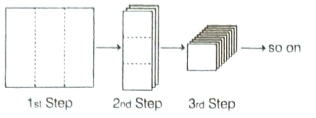
To make ballot papers cut a sheet of paper into three. Stack the three pleces and cut the stack into three. Stack all the pieces and cut the stack into three again.
Image
(i) Complete the table to show the number of ballot papers after five such steps :
Number of stepsNumber of ballot paper
13
2
3
4
5
(ii) Suppose you continue this process. How many ballot papers would you have after 15 steps? How many would you have after $n$ cuts?
(iii) How many steps would it take to make atleast one lakh ballot papers?
Answer
(i)
Number of stepsNumber of ballot paper
13
29
327
481
5243
(ii) $14,348,907,3^n$
(iii) $n \geq 11$
View full question & answer
Question 53 Marks
Find the value of $x^{-3}$, if $x=(100)^{1-4}+(100)^0$.
Answer
Given, $x=(100)^{1-4}+(100)^0$
$x=(100)^{-3}+1 \quad\left[\because(a)^0=1\right]$
$\Rightarrow \quad x=(100)^{-3} \times \frac{1}{1}$
$\Rightarrow \quad x=\frac{1}{(100)^3} \times \frac{1}{1} \quad\left[\because a^{-m}=\frac{1}{a^m}\right]$
$\Rightarrow \quad x=\frac{1}{(100)^3}$
Now, $\quad x^{-3}=\left(\frac{1}{(100)^3}\right)^{-3}$
$\Rightarrow \quad x^{-3}=\frac{1}{\left(100^3\right)^{-3}}$
$\Rightarrow \quad x^{-3}=\frac{1}{(100)^{-9}} \Rightarrow x^{-3}=(100)^9$
View full question & answer
Question 63 Marks
Investigating Solar System The table shows the average distance from each planet in our solar system to the Sun.
PlanetDistance from Sun (km)Distance from Sun in (km) Standard Notation
Earth149600000
Jupiter778300000
Mars227900000
Mercury57900000
Neptune4497000000
Pluto5900000000
Saturn1427000000
Uranus2870000000
Venus108200000
(i) Write the distance from each planet to the Sun in standard notation.
(ii) Arrange the planets from closest to the Sun to farthest from the Sun.
Answer
(i) Earth $=1.496 \times 10^8 km$, Jupiter $=7.783 \times 10^8 km$ Mars $=2.279 \times 10^8 km$, Mercury $=5.79 \times 10^7 km$ Neptune $=4.497 \times 10^9 km$, Pluto $=5.9 \times 10^9 km$ Saturn $=1.427 \times 10^9 km$, Uranus $=2.87 \times 10^9 km$ Venus $=1.082 \times 10^8 km$
(ii) On arranging the planets from closest to the Sun to farthest from the Sun, we get following order Mercury, Venus, Earth, Mars, Jupiter, Saturn, Uranus, Neptune, Pluto.
View full question & answer
Question 73 Marks
Astronomy The table shows the mass of the planets, the Sun and the Moon in our solar system.
Celestial BodyMass (kg)Mass (kg) in Standard Notation
Sun1990000000000000000000000000000
Mercury330000000000000000000000
Venus4870000000000000000000000
Earth5970000000000000000000000
Mars642000000000000000000000000000
Jupiter1900000000000000000000000000
Saturn568000000000000000000000000
Uranus86800000000000000000000000
Neptune102800000000000000000000000
Pluto12700000000000000000000
Moon73500000000000000000000
(i) Write the mass of each celestial body in standard notation.
(ii) Arrange the planets and the Moon according to their mass, from least to greatest.
(iii) Which planet has same mass as the Earth?
Answer
(i) Mass of each celestial body in standard in notation is given below.
Mass of Sun $=1.99 \times 10^{30} kg$
Mass of Mercury $=3.3 \times 10^{23} kg$
Mass of Venus $=4.870 \times 10^{24} kg$
Mass of Earth $=5.970 \times 10^{24} kg$
Mass of Mars $=6.42 \times 10^{29} kg$
Mass of Jupiter $=1.9 \times 10^{27} kg$
Mass of Saturn $=5.68 \times 10^{26} kg$
Mass of Uranus $=8.68 \times 10^{25} kg$
Mass of Neptune $=1.02 \times 10^{26} kg$
Mass of Pluto $=1.27 \times 10^{22} kg$
Mass of Moon $=7.35 \times 10^{22} kg$
(ii) On observing the masses of the all given planets and the Moon in the exponent form, we see that the order of planets and the Moon by mass from least to greatest is
Pluto < Moon < Mercury < Venus < Earth
< Uranus < Neptune < Saturn < Jupiter < Mars
(iii) $\because$ Mass of Earth $=5.970 \times 10^{24} kg$
and mass of Venus $=4.870 \times 10^{24} kg$
Thus, we can say that planet Venus has about same mass as the Earth.
View full question & answer
3 Marks Question - MATHS STD 8 Questions - Vidyadip