Questions

2 Marks Questions

🎯

Test yourself on this topic

23 questions · timed · auto-graded

Question 12 Marks
Take a cut-out of a parallelogram, say $A B C D$ in adjoining figure. Let its diagonals $\overline{A C}$ and $\overline{D B}$ meet at O.
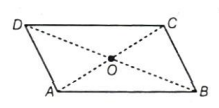
Image
Find the mid-point of $\overline{A C}$ by a fold, placing $C$ on $A$. Is the mid-point same as O?
Does this show that diagonal $\overline{D B}$ bisects the diagonal $\overline{A C}$ at the point $O$ ? Discuss it with your friends.
Repeat the activity to find, where the mid-point of $\overline{D B}$ could lie.
Answer
To find the mid-point of $\overline{A C}$ we fold it by placing $C$ on $A$. Then, we get the point $O$ which is the intersecting point of diagonals $\overline{A C}$ and $\overline{D B}$.
Thus, it shows that diagonal $\overline{D B}$ bisects the diagonal $\overline{A C}$ at the point $O$.
View full question & answer
Question 22 Marks
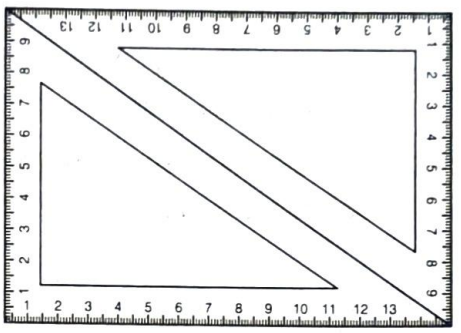
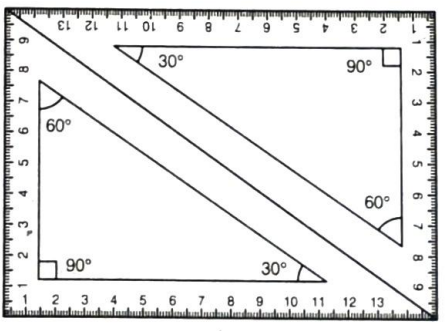
Take two identical $30^{\circ}-60^{\circ}-90^{\circ}$ set squares and form a parallelogram as before. Does the following figure obtained help you to confirm the above property?
Image
Answer
On placing two identical set squares with angles $30^{\circ}-60^{\circ}-90^{\circ}$ adjacently, we get a parallelogram as shown in the figure.
Then, this figure helps us to confirm the property that opposite angles of a parallelogram are of equal measures.
[in this figure, each angle is equal to $90^{\circ}$]
View full question & answer
Question 32 Marks
Take two identical set squares with angles $30^{\circ}-60^{\circ}-90^{\circ}$ and place them adjacently to form a parallelogram as shown in the following figure. Does this help you to verify the above property?
Image
Answer
From the given figure, it is clear that opposite sides of parallelogram are of equal length.
View full question & answer
Question 42 Marks
Take four set-squares from your and your friend's Instrument boxes. Use different numbers of them to place side-by-side and obtain different trapeziums.
If the non-parallel sides of a trapezium are of equal length, we call it an Isosceles trapezium. Did you get an isosceles trapezium in any of your Investigations given above?
Answer
Yes, we will get an isosceles trapezium.
View full question & answer
Question 52 Marks
Can a trapezium have all angles equal? Can it have all sides equal? Explain.
Answer
Yes, a trapezium can have all angles equal because in this case, it becomes a square or rectangle. Also, it can have all sides equal, because in this case it becomes a rhombus or square.
View full question & answer
Question 62 Marks
A square was defined as a rectangle with all sides equal. Can we define it is rhombus with equal angles? Explore this idea.
View full question & answer
Question 72 Marks
A mason has made a concrete slab. He needs it to be rectangular. In what different ways can he make sure that it is rectangular?
Answer
A mason has made a concrete slab. He makes sure that this should be rectangular, using the following different ways
(i) its opposite sides are equal.
(ii) its diagonals are equal.
(iii) each of its angles is a right angle.
View full question & answer
Question 82 Marks
(i) What is the minimum interior angle possible for a regular polygon? Why?
(ii) What is the maximum exterior angle possible for a regular polygon?
Answer
(i) We know that a regular polygon is both equiangular and equilateral i.e. a regular polygon has all sides and all angles are equal. So, the equilateral triangle is a regular polygon of 3 sides and the minimum interior angle is $60^{\circ}$.
(ii) Since, an equilateral triangle has minimum interior angles, so the maximum exterior angle possible for a regular polygon $=180^{\circ}-60^{\circ}=120^{\circ}$.
View full question & answer
Question 92 Marks
(i) Is it possible to have a regular polygon with measure of each exterior angle as $22^{\circ}?$
(ii) Can it be an interior angle of a regular polygon? Why?
Answer
(i) Given, each exterior angle $=22^{\circ}$
We know that the sum of all exterior angles of a regular polygon is $360^{\circ}$.
$\therefore$ Number of sides of a polygon $=\frac{360^{\circ}}{\text { Each exterior angle }}$
$=\frac{360^{\circ}}{22^{\circ}}$
$=\frac{180^{\circ}}{11^{\circ}}$
which is not a whole number.
Hence, $22^{\circ}$ cannot be an exterior angle of a regular polygon.
(ii) No, it cannot be an interior angle of a regular polygon because if interior angle is $22^{\circ}$, then each exterior angle is $\left(180^{\circ}-22^{\circ}\right)=158^{\circ}$ which is not a divisor of $360^{\circ}$.
View full question & answer
Question 102 Marks
How many sides does a regular polygon have, if each of its interior angles is $165^{\circ}$?
Answer
We know that the sum of Interior angles of any polygon is $180^{\circ}$.
exterior angles= $180^{\circ}$- $165^{\circ}$$=15^{\circ}$
Given, each exterior angle $=15^{\circ}$
$\therefore \quad$ Number of exterior angles $=\frac{360^{\circ}}{\text { Each exterior angle }}$
$=\frac{360^{\circ}}{15^{\circ}}=24$
Hence, the number of sides of a regular polygon is 24.
View full question & answer
Question 112 Marks
How many sides does a regular polygon have, if an exterior angle is $24^{\circ}$ ?
Answer
We know that the sum of exterior angles of any polygon is $360^{\circ}$.
Given, each exterior angle $=24^{\circ}$
$\therefore \quad$ Number of exterior angles $=\frac{360^{\circ}}{\text { Each exterior angle }}$
$=\frac{360^{\circ}}{24^{\circ}}=15$
Hence, the number of sides of a regular polygon is 15 .
View full question & answer
Question 122 Marks
Find each exterior angle of a regular polygon of
(i) 9 sides $\quad$ (ii) 15 sides
Answer
We know that the sum of exterior angles of any polygon is $360^{\circ}$.
(i) Given, number of sides of a polygon $=9$
i.e. number of exterior angles $=9$
and $\quad$ sum of all exterior angle $=360^{\circ}$
$\therefore$ Each exterior angle $=\frac{360^{\circ}}{9}=40^{\circ}$
(ii) Given, number of sides of a polygon $=15$
i.e. number of exterior angles $=15$
and sum of all exterior angles $=360^{\circ}$
$\therefore$ Each exterior angle $=\frac{360^{\circ}}{15}=24^{\circ}$
View full question & answer
Question 132 Marks
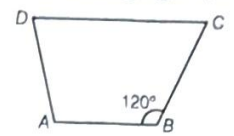
FInd $m \angle C$ In the following figure, if $\overline{A B} \| \overline{D C}$.
Image
Answer
We know that if two parallel lines are cut by a tranversal, then each pair of interior angles on the same side of the transversal are supplementary.
Here, $\overline{A B} \| \overline{D C}$ and $B C$ is a transversal, also $\angle A B C=120^{\circ}$.
So, $\quad m \angle B+m \angle C=180^{\circ}$
$\Rightarrow \quad 120^{\circ}+m \angle C=180^{\circ}$
$\Rightarrow \quad m \angle C=180^{\circ}-120^{\circ}$
$\Rightarrow \quad m \angle C=60^{\circ}$
Hence, the measure of $\angle C$ is $60^{\circ}$.
View full question & answer
Question 142 Marks
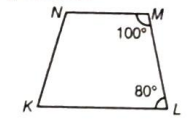
Explain, how this figure is a trapezium? Which of its two sides are parallel?
Image
Answer
In the given figure, $\angle L=80^{\circ}, \angle M=100^{\circ}$
and $\angle L+\angle M=80^{\circ}+100^{\circ}=180^{\circ}$
We know that when a transversal cuts two lines such that pair of interior angles on the same side of the transversal are supplementary, then lines have to be parallel.
Here, transversal $L M$ cut two lines $N M$ and $K L$ and pair of interior $\angle L$ and $\angle M$ are supplementary, so $N M \| K L$.
Hence, it is a trapezium. $\quad[\because$ other two sides are not parallel$]$
View full question & answer
Question 152 Marks
Two adjacent angles of a parallelogram have equal measure. Find the measure of each of the angles of the parallelogram.
Answer
Let $A B C D$ be a parallelogram in which two adjacent angles $\angle A$ and $\angle B$ are equal, say $x$.
Then, $m \angle A=x$ and $m \angle B=x$
We know that two adjacent angles in a parallelogram are supplementary.
$\therefore m \angle A+m \angle B=180^{\circ}$
$\Rightarrow \quad x+x=180^{\circ}$
$\Rightarrow \quad 2 x=180^{\circ}$
$\Rightarrow \quad x=\frac{180^{\circ}}{2}=90^{\circ}$
So, $m \angle A=90^{\circ}$ and $m \angle B=90^{\circ}$
Also, the opposite angles of a parallelogram are equal.
Therefore, $m \angle C=m \angle A=90^{\circ}$ and $m \angle D=m \angle B=90^{\circ}$.
Hence, each of the angles of the parallelogram is $90^{\circ}$.
View full question & answer
Question 162 Marks
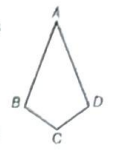
Draw a rough figure of a quadrilateral that is not a parallelogram, but has exactly two equal opposite angles.
Answer
A rough figure of a quadrilateral $A B C D$ that is not a parallelogram but has exactly two equal opposite angles.
Image
Here, $A B C D$ is a kite in which $\angle B=\angle D$.
View full question & answer
Question 172 Marks
One of the diagonals of a rhombus and its sides are equal. Find the angles of the rhombus.
View full question & answer
Question 182 Marks
The ratio of exterior angle to interior angle of a regular polygon is 1: 4. Find the number of sides of the polygon.
Answer
Let the exterior angle of the polygon be $x$.
Then, the interior angle of the polygon $=\left(180^{\circ}-x\right)$
According to the question,
$\frac{x}{\left(180^{\circ}-x\right)}=\frac{1}{4} \Rightarrow 4 x=180^{\circ}-x \Rightarrow 5 x=180^{\circ}$
$\Rightarrow \quad x=\frac{180^{\circ}}{5} \Rightarrow x=36^{\circ}$
$\begin{aligned} \therefore \text { Number of sides of polygon } & =\frac{360^{\circ}}{\text { Exterior angle }} \\ & =\frac{360^{\circ}}{36^{\circ}}=10\end{aligned}$
View full question & answer
Question 192 Marks
Find each interior angle of a regular nonagon.
Answer
Exterior angle of a regular nonagon $=\frac{360^{\circ}}{9}=40^{\circ}\quad$ [in nonagon, sides are 9]
$\therefore$ Interior angle of a regular nonagon $=180^{\circ}-40^{\circ}=140^{\circ}$
Alternate Method
$\because$ Sum of all the interior angles of a nonagon
$=(n-2) \times 180^{\circ}=(9-2) \times 180^{\circ}=1260^{\circ}$
$\therefore$ Each interior angle of the nonagon $=\frac{1260^{\circ}}{9}=140^{\circ}$
View full question & answer
Question 202 Marks
Answer
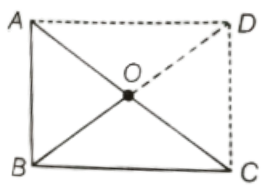
Given, $\triangle A B C$ is a right angled triangle and $O$ is the mid-point of the side $A C$. Now, produce $B O$ to $D$ such that $O B=O D$ and then join $A D$ and $C D$.
Thus, $A B C D$ is a rectangle, $B D$ and $A C$ are its diagonals which intersect each other at $O$. We know that in a rectangle, the diagonals are equal in length and bisect each other.
$\therefore \quad O A=O C$ and $O B=O D$
Also, $\quad A C=B D$
Therefore, $O A=O B=O C=O D$
Thus, $O$ is equidistant from $A, B$ and $C$.
View full question & answer
Question 212 Marks
Explain, why a rectangle is a convex quadrilateral?
Answer
We know that a convex quadrilateral have angle less than $180^{\circ}$ and no portions of their diagonals in their exteriors. So, a rectangle is a convex quadrilateral because its each angle is less than $180^{\circ}$ and both the diagonals lie in its interior.
View full question & answer
Question 222 Marks
Name the quadrilaterals whose diagonals
(i) bisect each other.
(ii) are perpendicular bisectors of each other.
(iii) are equal.
Answer
(i) A parallelogram of a rhombus or a square or a rectangle.
(ii) A rhombus or a square.
(iii) A square or a rectangle.
View full question & answer
Question 232 Marks
Identify all the quadrilaterals that have
(i) four sides of equal length. $\quad$ (ii) four right angles.
Answer
(i) A square or a rhombus. $\quad$ (ii) A square or a rectangle.
View full question & answer
2 Marks Questions - MATHS STD 8 Questions - Vidyadip