Questions

4 Mark Question

🎯

Test yourself on this topic

18 questions · timed · auto-graded

Question 14 Marks
Take identical cut-outs of congruent triangles of sides 3 cm, 4 cm and 5 cm . Arrange them as shown in the figure.
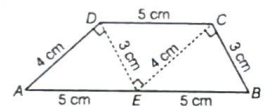
Image
You get a trapezium (check it!) which are the parallel sides here? Should the non-parallel sides be equal? You can get two more trapeziums using the same set of triangles. Find out them and discuss their shapes.
Answer
Given, three cut-outs of congruent triangles of sides 3 cm , 4 cm and 5 cm . On arranging them, we get a trapezium from the given figure, we have
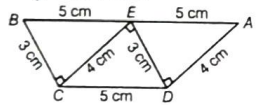
Image
after rearranging the triangles, we get
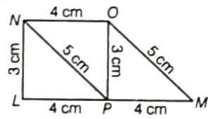
Image
$\angle D E C=\angle E C B=90^{\circ} \quad$ [alternate angles]
$\therefore \quad D E \| B C$
and $\quad D E=B C=3 cm$
Also, $E B=D C=5 cm$
So, $E B C D$ is a parallelogram.
$\therefore \quad E B \| D C$
Also, $A E B$ is a straight line, so $A E B \| D C$.
Therefore, in trapezium $A B C D$, sides $A B$ and $D C$ are parallel and non-parallel sides $A D$ and $B C$ are unequal.
Also, non-parallel sides of a trapezium may or may not be equal.
By using, the same set of triangles, we can get two more trapeziums.
View full question & answer
Question 24 Marks
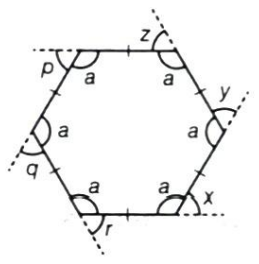
Take a regular hexagon, in the given figure.
Image
(i) What is the sum of the measures of its exterior angles $x, y, z, p, q$ and $r$ ?
(ii) Is $x=y=z=p=q=r$ ? Why?
(iii) What is the measure of each?
(a) Exterior angle$\qquad$$\quad$ (b) Interior angle
(iv) Repeat this activity for the cases of
(a) A regular octagon $\quad$ (b) A regular 20-gon
Answer
(i) We know that the sum of the exterior angles of any polygon is $360^{\circ}$.
Here, exterior angles are $x, y, z, p, q$ and $r$.
$\therefore x+y+z+p+q+r=360^{\circ}$
(ii) Yes, $x=y=z=p=q=r$, because each of them is equal to $180^{\circ}-\angle a$.
(iii) (a) Here, all exterior angles are equal and their sum is $360^{\circ}$, so each exterior angle is
$x=\frac{360^{\circ}}{6}=60^{\circ} .$
(b) All interior angles are also equal to each other, where interior angle is $a=180^{\circ}-r$ [by linear pair]
$\therefore$ Each interior angle $=180^{\circ}-60^{\circ}=120^{\circ}$
(iv)(a) The regular octagon having 8 equal sides.
$\therefore$ All the exterior angles are equal, say $x$.
Then, $\quad 8 x=360^{\circ}$
Since, sum of the external angles of any polygon is $360^{\circ}$.
$\therefore \quad x=\frac{360^{\circ}}{8}=45^{\circ}$
Therefore, each exterior angle $=45^{\circ}$
and each interior angle $=180^{\circ}-45^{\circ}=135^{\circ}$
(b) The regular 20 -gon polygon has 20 equal sides.
$\therefore$ All the exterior angles are equal, say $x$.
Then, $\quad 20 x=360^{\circ}$
Since, sum of the external angles of any polygon is $360^{\circ}$.
$\therefore \quad x=\frac{360^{\circ}}{20}=18^{\circ}$
Therefore, each exterior angle $=18^{\circ}$
and each interior angle $=180^{\circ}-18^{\circ}=162^{\circ}$
View full question & answer
Question 34 Marks
Image
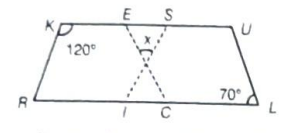
In the above figure, both RISK and CLUE are parallelograms, find the value of $x$.
Answer
Given, RISK and CLUE are two parallelograms, in which $\angle R K S=120^{\circ}$ and $\angle C L U=70^{\circ}$.
Let $I S$ and $E C$ intersect each other at $O$.
In parallelogram RISK,
$\angle R K S+\angle I S K=180^{\circ} \quad[\because$ sum of any two adjacent angles of a parallelogram is $180^{\circ}$]
$\Rightarrow 120^{\circ}+\angle I S K=180^{\circ}$
$\Rightarrow \angle I S K=180^{\circ}-120^{\circ}$
or $\quad \angle O S E=60^{\circ}$
Also, in parallelogram CLUE,
$\angle C E U=\angle C L U\quad$ [$\because$ opposite angles of a parallelogram are equal]
Then, $\angle C E U=\angle C L U=70^{\circ}$ or $\angle O E S=70^{\circ}$
We know that sum of three angles of a triangle is $180^{\circ}$.
In $\triangle O E S, \angle O E S+\angle E S O+x=180^{\circ}$
$\Rightarrow \quad 70^{\circ}+60^{\circ}+x=180^{\circ}\quad$ $\left[\begin{array}{ll}\because & \angle O E S=\angle C E U=70^{\circ} \\ \text { and } & \angle E S O=\angle I S K=60^{\circ}\end{array}\right]$
$\Rightarrow \quad 130^{\circ}+x=180^{\circ} \Rightarrow x=180^{\circ}-130^{\circ}$
$\Rightarrow \quad x=50^{\circ}$
Hence, the value of $x$ is $50^{\circ}$.
View full question & answer
Question 44 Marks
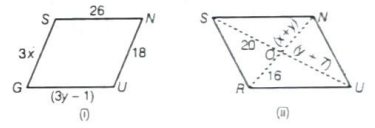
The following figures GUNS and RUNS are parallelograms. Find $x$ and $y$. (lengths are in cm)
Image
Answer
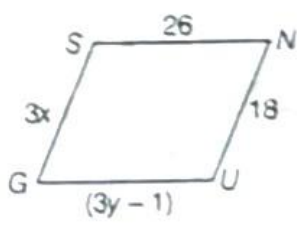
(i) Given, GUNS is a parallelogram, in which $S G=3 x ~cm$, $S N=26 cm, N U=18 cm$ and $G U=(3 y-1) cm$.
We know that opposite sides of a parallelogram are equal.
Image
$\begin{array}{l}\therefore \quad G U=N S \Rightarrow 3 y-1=26 \\ \Rightarrow \quad 3 y=26+1 \Rightarrow 3 y=27 \\ \Rightarrow \quad y=\frac{27}{3}=9 \text { and } S G=N U \\ \Rightarrow \quad 3 x=18 \Rightarrow x=\frac{18}{3}=6\end{array}$
Hence, the values of $x$ and $y$ are 6 and 9 , respectively.
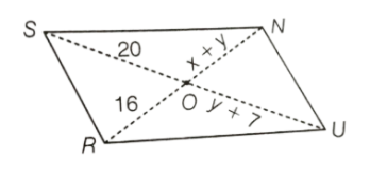
(ii) Given, RUNS is a parallelogram and $S U, R N$ intersect each other at O . Then, $OS =20 cm, OU =(y+7) cm$, $O R=16 cm$ and $O N=(x+y) cm$
We know that diagonals of a parallelogram bisect each other.
Image
$\therefore \quad O U=O S \Rightarrow y+7=20$
$\Rightarrow \quad y=20-7=13$ and $O N=O R$
$\Rightarrow x+y=16 \Rightarrow x+13=16 \quad[\because y=13 cm]$
$\Rightarrow \quad x=16-13=3$
Hence, the values of $x$ and $y$ are 3 cm and 13 cm , respectively.
View full question & answer
Question 54 Marks
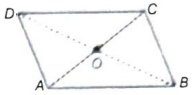
Given a parallelogram ABCD Complete each statement along with the definition or property used.
Image
(i) $A D=$ _____________ $\qquad\text{ }$ (ii) $\angle D C B=$ _____________
(iii) $O C=$ _____________$\qquad$ (iv) $m \angle D A B+m \angle C D A=$ _____________
Answer
(i) $A D=B C$, since in a parallelogram, opposite sides are equal.
(ii) $\angle D C B=\angle D A B$, since in a parallelogram, opposite angles are equal.
(iii) $O C=O A$, since the diagonals of a parallelogram bisect each other.
(iv) $m \angle D A B+m \angle C D A=180^{\circ}$, since in a parallelogram, the sum of any two adjacent angle is $180^{\circ}$.
View full question & answer
Question 64 Marks
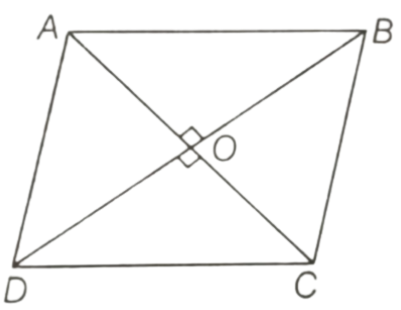
The diagonals of a rhombus are 8 cm and 15 cm . Find its side.
Answer
Let $A B C D$ be a rhombus.
Image
Then, $\quad B D=8 cm, A C=15 cm$
and $\quad A B=B C=C D=D A$
We know that in a rhombus, diagonals bisect each other at right angles.
So, $\quad D O=O B$ and $A O=O C$
$\therefore \quad D O=4 cm$ and $O C=7.5 cm$
Now, we see that a $\triangle D O C$ is formed such that
$\angle D O C=90^{\circ}$
$\therefore \quad(D C)^2=(D O)^2+(O C)^2\quad$ $[\because$ in a right angled triangle, the square of the side opposite to the right angle is equal to the sum of the squares of other two sides]
$(D C)^2=(4)^2+(7.5)^2=16+56.25$
$=72.25 cm^2$
or $\quad D C=\sqrt{72.25}=8.5 cm$
Thus, side of the rhombus is 8.5 cm.
View full question & answer
Question 74 Marks
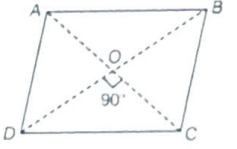
Two sticks each of length 7 cm are crossing each other such that they bisect each other at right angles. What shape is formed by joining their end points? Give reason.
Answer
Let AC and BD be two sticks, each of the length 7 cm.
On joining their end points A, B, C and D, we will get a shape of a rhombus.
[since, in a rhombus diagonals bisect each other at right angle].
Image
Now, we will see whether it is a square or not
Let O be the intersection point of AC and BD.
Now, we see that AO = BO = CO = DO
Since, both AC and BD are of equal length and bisected by O.
Further in $\triangle A B O$, we see that
$\angle A O B=90^{\circ}$
and $\quad A O=O B$
which implies that $\angle O A B=\angle O B A=x$ (say)
$\therefore \quad 90^{\circ}+x+x=180^{\circ}\quad$ [angle sum property of a triangle]
$\Rightarrow \quad 2 x=90^{\circ} \Rightarrow x=45^{\circ}$
Similarly, we see that $\angle O B C, \angle O C B, \ldots$ etc are $45^{\circ}$.
So, finally we can say that the shape, so obtained will be of a square.
Note A square is a rhombus but a rhombus is not a square.
View full question & answer
Question 84 Marks
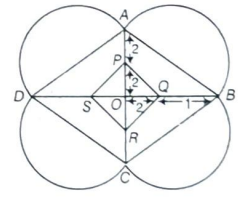
A rangoli has been drawn on the floor of a school's main gate. Participant of Class VIIIth girls for making rangoli, all bring different types of colour from market to colour the rangoli (as shown below), where ABCD and PQRS both are in the shape of a rhombus. Find the radius of semi-circle drawn on each side of rhombus ABCD.
Image
Answer
In rhombus ABCD.
$A O=O P+P A=2+2 \Rightarrow A O=4$
and $\quad O B=O Q+Q B=2+1 \Rightarrow O B=3$
In $\triangle O A B$
$(A B)^2=(O A)^2+(O B)^2\quad$ [by Pythagoras theorem]
$\Rightarrow (A B)^2=(4)^2+(3)^2=25$
$\Rightarrow A B=5$
Since, $A B$ is diameter of semi-circle.
$\therefore \quad \text { Radius }=\frac{5}{2}=2.5$
Hence, radius of the semi-circle is 2.5 .
View full question & answer
Question 94 Marks
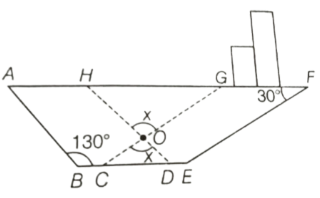
In the following figure of a ship. ABDH and CEFG are two parallelogram. Find the value of x.
Image
Answer
We have, two parallelograms ABDH and EFGC.
$\therefore \quad \angle A B D=\angle A H D=130^{\circ}\quad$ [opposite angles of a parallelogram]
and $ \angle G H D=180^{\circ}-\angle A H D=180^{\circ}-130^{\circ}$
$\Rightarrow \quad 50^{\circ}=\angle GHO$
Also, $\angle E F G+\angle F G C=180^{\circ}\quad$ [adjacent angles of a parallelogram]
$\Rightarrow \quad 30^{\circ}+\angle F G C=180^{\circ}$
$\Rightarrow \quad \angle F G C=180^{\circ}-30^{\circ}=150^{\circ}$
$\therefore \quad \angle H G C=180^{\circ}-\angle F G C=180^{\circ}-150^{\circ}$
$=30^{\circ}=\angle H G O$
Now, in $\triangle H G O$, using angle sum property,
$\angle O H G+\angle H G O+\angle H O G=180^{\circ}$
$\Rightarrow \quad 50^{\circ}+30^{\circ}+x^{\circ}=180^{\circ}$
$\Rightarrow \quad x^{\circ}=180^{\circ}-80^{\circ}=100^{\circ}$
View full question & answer
Question 104 Marks
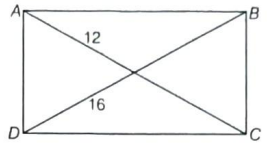
A photo frame is in the shape of a quadrilateral with one diagonal longer than the other.
(i) Is it a rectangle? Why or why not?
(ii) If it is a rhombus and AC = 12 cm and BD = 16 cm, then find the perimeter of rhombus.
Answer
(a) Let $A B C D$ be the shape of given photo frame as shown below:
Image
It is given that $A C \neq B D$
Since, we know that in a rectangle diagonals are equal to each other i.e. $A C$ should be equal to $B D$ which is not the case here. So, $A B C D$ is not a rectangle.
(b) We know that perimeter of a rhombus
$\begin{array}{l}=2 \sqrt{d_1^2+d_2^2}=2 \times \sqrt{(12)^2+(16)^2} \\ =2 \times \sqrt{144+256}=2 \times \sqrt{400} \\ =2 \times 20=40 cm\end{array}$
View full question & answer
Question 114 Marks
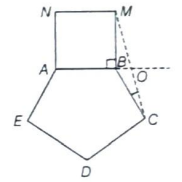
A regular pentagon $A B C D E$ and a square $A B M N$ are formed on opposite sides of $A B$. Find the value of $\angle B C M$.
Image
Answer
We have, given a regular pentagon ABCDE and a square ABMN.
$\therefore A B=B C=C D=D E=E A=A N=N M=M B$
Also, each interior angle of the regular pentagon
$=\frac{(5-2) \times 180^{\circ}}{5}=\frac{540^{\circ}}{5}=108^{\circ}$
$\therefore \quad \angle C B A=108^{\circ}$
Now, draw CM.
Also, extend further which intersect $C M$ at point $O$.
Now, in $\triangle B M C$
Here, $\angle M B O=90^{\circ}$
and $\quad \angle O B C=180^{\circ}-\angle A B M$
$=180^{\circ}-108^{\circ}=72^{\circ}$
$\therefore \quad \angle M B C=\angle M B O+\angle O B C$
$=90^{\circ}+72^{\circ}=162^{\circ}$
Also, we have $M B=B C\quad$ [given]
$\therefore \quad \angle B C M=\angle C M B=x\quad$ [say]
So, $\quad \angle C B M+\angle B M C+\angle M C B=180^{\circ}$
$\Rightarrow \quad 162^{\circ}+x+x=180^{\circ}$
$\Rightarrow \quad 2 x=180^{\circ}-162^{\circ}=18^{\circ}$
$\Rightarrow \quad x=\frac{18^{\circ}}{2}=9^{\circ}$
$\therefore \quad \angle B C M=9^{\circ}$
View full question & answer
Question 124 Marks
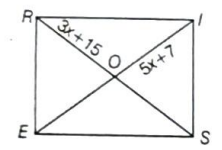
RISE is a rectangle and its diagonals meet at O. If RO = (3x + 15) and IO = (5x + 7), then find the value of x.
Answer
Since, in a parallelogram diagonals bisect each other and we know that rectangle is a parallelogram.
So, RO = OS and IO = OE
Image
or $\quad R S=2 R O$ and $I E=2 O I$
$\therefore \quad R S=2 \times(3 x+15)$ and $I E=2 \times(5 x+7)$
or $\quad R S=6 x+30$ and $\quad I E=10 x+14$
Now, we again know that in a rectangle diagonals are equal.
So, $\quad R S=I E$
$\Rightarrow 6 x+30 =10 x+14$
$\Rightarrow 30-14 =10 x-6 x$
$\Rightarrow 16 =4 x$
$\Rightarrow 16 \times \frac{1}{4}=x$
$\Rightarrow 4=x$
$\Rightarrow x =4$
View full question & answer
Question 134 Marks
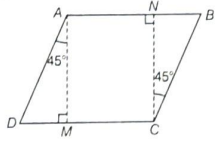
The angle between the two altitudes of a parallelogram through the vertex of an obtuse angle of the parallelogram is $45^{\circ}$. Find the measure of the obtuse angle.
Answer
Let $A B C D$ be a parallelogram and the obtuse angles of the parallelogram are $\angle A$ and $\angle C$.
Image
Let $A M$ be the altitude drawn from the vertex $A$ on $D C$ and $C N$ be the altitude drawn from the vertex $C$ on $A B$.
$\therefore \quad \angle D A M=45^{\circ}$ and $\angle N C B=45^{\circ} \quad$ [given]
In $\triangle A M D$, we know that sum of the interior angles of a triangle is $180^{\circ}$.
$\therefore \quad \quad \angle D+45^{\circ}+90^{\circ}=180^{\circ}$
$\Rightarrow \quad \angle D=180^{\circ}-45^{\circ}-90^{\circ}$
$=180^{\circ}-135^{\circ}=45^{\circ}$
Similarly, in $\triangle C N B$
$\angle B=45^{\circ}$
Now, $\quad \angle A+\angle D=180^{\circ}\quad$ [sum of adjacent angles in a parallelogram is $180^{\circ}$]
$\therefore \angle A+45^{\circ}=180^{\circ} \quad\left[\because \angle D=45^{\circ}\right]$
$\Rightarrow \quad \angle A=180^{\circ}-45^{\circ}=135^{\circ}$
Also, $\quad \angle A=\angle C\quad$ $[\because$ opposite angles of a parallelogram are equal$]$
$\therefore \quad \angle C=135^{\circ}$
Thus, the obtuse angle of the parallelogram is $135^{\circ}$.
View full question & answer
Question 144 Marks
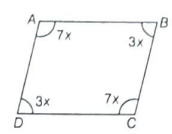
If two adjacent angles of a parallelogram are in the ratio $3: 7$, then find the measure of all the angles of the parallelogram.
Answer
Let the adjacent angles be $3 x$ and $7 x$, respectively. We know that in a parallelogram sum of two adjacent angles is $180^{\circ}$.
Image
$\therefore \quad 3 x+7 x=180^{\circ} \Rightarrow 10 x=180^{\circ}$
$\Rightarrow \quad x=180^{\circ} \times \frac{1}{10} \Rightarrow x=18^{\circ}$
So, the adjacent angles are
$3 \times 18^{\circ}=54^{\circ}$ and $7 \times 18^{\circ}=126^{\circ}$
Also, we know that in a parallelogram opposite angles are equal.
Thus, all the angles of the parallelogram are $54^{\circ}, 126^{\circ}$, $54^{\circ}, 126^{\circ}$.
View full question & answer
Question 154 Marks
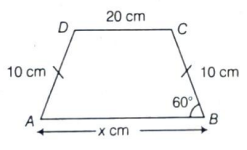
In the following figure, $AB\|DC$ and AD = BC. Find the value of x.
Image
Answer
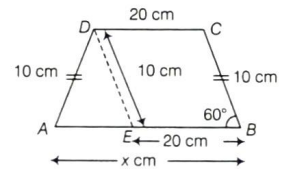
Draw a line parallel to $B C$ from $D$ which cuts $A B$ at $E$.
Image
Thus, $D C \| E B$ and $B C \| D E$
which gives a parallelogram $D C B E$.
$\therefore \quad D C=E B=20 cm$ and $B C=D E=10 cm$
Now, in $\triangle A D E$, we have
$A D=D E=10 cm$
$\therefore \quad \angle D A E=\angle D E A=60^{\circ}$
So, by angle sum property in $\triangle A D E$, we have
$\angle D A E+\angle A E D+\angle E D A=180^{\circ}$
or $\angle E D A=180^{\circ}-(\angle D A E+\angle A E D)$
$=180^{\circ}\left(60^{\circ}+60^{\circ}\right)=180^{\circ}-120^{\circ}=60^{\circ}$
So, $A D E$ is an equilateral triangle.
Now, $A D=D E=E A=10 cm$
$\therefore \quad A B=A E+E B$
or $\quad x=10+20=30 cm$
So, the value of x is 30 cm .
View full question & answer
Question 164 Marks
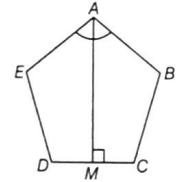
ABCDE is a regular pentagon. The bisector of angle A meets the side CD at M. Find $\angle \text{AMC}.$
Answer
In a regular pentagon,
Exterior angle $=\frac{360^{\circ}}{5}=72^{\circ}$
Image
and interior angle $=180^{\circ}-72^{\circ}=108^{\circ}$
$\therefore \quad \angle E A B=2 \angle E A M\quad$ $[\because A M$ is the bisector of $\angle A]$
$\Rightarrow \quad 108^{\circ}=2 \angle E A M$
$\Rightarrow \quad \angle E A M=\frac{108^{\circ}}{2}=54^{\circ}$
Now, in quadrilateral EAMD,
$\angle M A E+\angle A E D+\angle E D M+\angle D M \Lambda=360^{\circ}$
$\Rightarrow \quad 54^{\circ}+108^{\circ}+108^{\circ}+\angle D M A=360^{\circ}$
$\Rightarrow \quad 270^{\circ}+\angle D M A=360^{\circ}$
$\Rightarrow \quad \angle D M A=360^{\circ}-270^{\circ}=90^{\circ}$
$\therefore \quad \angle A M C=180^{\circ}-\angle D M A$
$=180^{\circ}-90^{\circ}=90^{\circ}$
View full question & answer
Question 174 Marks
The ratio between exterior angle and interior angle of a regular polygon is $1: 3$. Find the number of sides of the polygon. Also, find each of the interior and exterior angles.
Answer
Let the regular polygon have n sides.
$\therefore$ Exterior angle $=\frac{360^{\circ}}{n}$
and interior angle $=180^{\circ}-\frac{360^{\circ}}{n}=\frac{180^{\circ} n-360^{\circ}}{n}$
According to the question,
$\frac{360^{\circ}}{n}: \frac{180^{\circ} n-360^{\circ}}{n}=1: 3$
$\Rightarrow \quad \frac{360^{\circ}}{n} \times \frac{n}{180^{\circ} n-360^{\circ}}=\frac{1}{3}$
$\Rightarrow \quad 360^{\circ} \times 3=180^{\circ} n-360^{\circ}$
$\Rightarrow \quad 1080^{\circ}+360^{\circ}=180^{\circ} n$
$\Rightarrow \quad \frac{1440^{\circ}}{180^{\circ}}=n$
$\Rightarrow \quad n=8$
$\therefore \quad$ Exterior angle $=\frac{360^{\circ}}{n}=\frac{360^{\circ}}{8}=45^{\circ}$
and $\quad$ interior angle $=180^{\circ}-45^{\circ}=135^{\circ}$
View full question & answer
Question 184 Marks
Explain, how a square is
(i) a quadrilateral? $\quad$ (ii) a parallelogram?
(iii) a rhombus? $\qquad$ (iv) a rectangle?
Answer
(i) A square has four sides, so it is a quadrilateral.
(ii) A square has its opposite sides parallel and equal, so it is a parallelogram.
(iii) A square is a parallelogram with all four sides of equal length, so it is a rhombus.
(iv) A square is a parallelogram with each angles a right angle, so it is a rectangle.
View full question & answer
4 Mark Question - MATHS STD 8 Questions - Vidyadip