Question 15 Marks
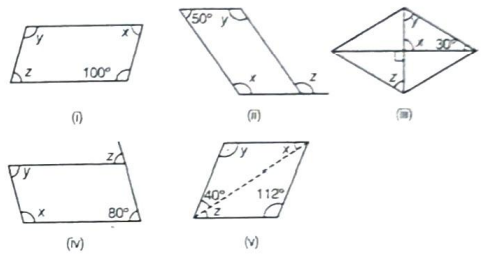
Consider the following parallelograms. Find the values of the unknowns $x, y$ and $z$
Answer
View full question & answer→(i) Given, $A B C D$ is a parallelogram in which $\angle B=100^{\circ}$.
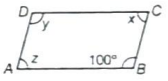
We know that the sum of any two adjacent angles of a parallelogram is $180^{\circ}$.
$\therefore \quad \angle A+\angle B=180^{\circ}\quad$ $[\because \angle A$ and $\angle B$ are adjacent angles]
$\Rightarrow \quad z+100^{\circ}=180^{\circ}$
$\Rightarrow z=180^{\circ}-100^{\circ}=80^{\circ}$
Also, opposite angles of a parallelogram are equal.
$\therefore \quad \quad \angle D=\angle B \Rightarrow y=100^{\circ}$
and $\quad \angle C=\angle A \Rightarrow x=z=80^{\circ}$
Hence, the values of $x, y$ and $z$ are $80^{\circ}, 100^{\circ}$ and $80^{\circ}$, respectively.
(ii) Let a parallelogram be $A B C D$ in which $\angle D=50^{\circ}$.
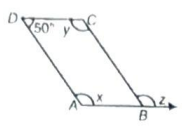
We know that the sum of any two adjacent angles of a parallelogram is $180^{\circ}$.
$\therefore \quad \angle A+\angle D=50^{\circ}$
$\Rightarrow \quad x+50^{\circ}=180^{\circ}$
$\Rightarrow x=180^{\circ}-50^{\circ}=130^{\circ}$
Also, opposite angles of a parallelogram are equal.
$\therefore \angle C=\angle A \Rightarrow y=x=130^{\circ}$ and $\angle B=\angle D=50^{\circ}$
Now, $\angle B+$ Exterior $\angle B=180^{\circ}$
$\Rightarrow \quad 50^{\circ}+z=180^{\circ} \quad$ [by linear pair angle]
$\Rightarrow \quad z=180^{\circ}-50^{\circ}=130^{\circ}$
Hence, the measure of angles $x, y$ and $z$ are $130^{\circ}, 130^{\circ}$ and $130^{\circ}$, respectively.
(iii) Let a parallelogram be $A B C D$, in which $\angle C B O=30^{\circ}$. Here, $A C$ and $B D$ intersect each other at $O$ and $\angle A O D=90^{\circ}$.
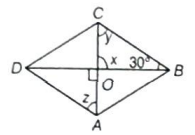
$\therefore \angle C O B=\angle A O D=90^{\circ}$ [vertically opposite angles]
We know that the sum of three angles of a triangle is $180^{\circ}$.
In $\Delta O B C$
$\angle C O B+\angle O C B+\angle C B O=180^{\circ}$
$\Rightarrow \quad 90^{\circ}+y+30^{\circ}=180^{\circ}$
$\Rightarrow \quad y+120^{\circ}=180^{\circ}$
$\therefore \quad y=180^{\circ}-120^{\circ}=60^{\circ}$
As, $A D \| B C$ and $A C$ is a transversal.
$\therefore y=z=60^{\circ} \quad$ [alternate interior angles]
Hence, the angles $x, y$ and $z$ are $90^{\circ}, 60^{\circ}$ and $60^{\circ}$, respectively.
(iv) Let parallelogram be $A B C D$, in which $\angle B=80^{\circ}$
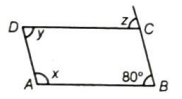
We know that the sum of any two adjacent angles of a parallelogram is $180^{\circ}$.
$\therefore \quad \angle B+\angle C=180^{\circ}$
$\Rightarrow \quad 80^{\circ}+\angle C=180^{\circ}$
$\Rightarrow \quad \angle C=180^{\circ}-80^{\circ}=100^{\circ}$
Also, $\angle C+$ Exterior $\angle C=180^{\circ}\quad$ [by linear pair]
$\therefore$ Exterior $\angle C$ or $z=180^{\circ}-100^{\circ}=80^{\circ}$
Also, opposite angles of a parallelogram are equal.
So, $\angle A=\angle C \Rightarrow x=100^{\circ}$
and $\angle D=\angle B \Rightarrow y=80^{\circ}$
Hence, the angles $x, y$ and $z$ are $100^{\circ}, 80^{\circ}$ and $80^{\circ}$, respectively.
(v) Let parallelogram be $A B C D$, in which $\angle B=112^{\circ}$ and $\angle D A C=40^{\circ}$.
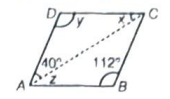
We know that the sum of any two adjacent angles of a parallelogram is $180^{\circ}$.
$\therefore \quad \angle A+\angle B=180^{\circ}$
$\begin{array}{rr}\Rightarrow & \left(40^{\circ}+z\right)+112^{\circ}=180^{\circ} \\ \Rightarrow & 40^{\circ}+z+112^{\circ}=180^{\circ} \\ \Rightarrow & z+152^{\circ}=180^{\circ} \\ \Rightarrow & z=180^{\circ}-152^{\circ}=28^{\circ}\end{array}$
Also, opposite angles of a parallelogram are equal.
So, $\angle D=\angle B$
$\Rightarrow \quad y=112^{\circ}$
Now, in $\triangle A C D$, using angle sum property of a triangle,
$\angle C A D+\angle D+\angle D C A=180^{\circ}$
$\Rightarrow 40^{\circ}+y+x=180^{\circ}$
$\Rightarrow 40^{\circ}+112^{\circ}+x=180^{\circ}$
$\Rightarrow 152^{\circ}+x=180^{\circ}$
$\Rightarrow x=180^{\circ}-152^{\circ}=28^{\circ}$
Hence, the values of $x, y$ and $z$ are $28^{\circ}, 112^{\circ}$ and $28^{\circ}$, respectively.
We know that the sum of any two adjacent angles of a parallelogram is $180^{\circ}$.
$\therefore \quad \angle A+\angle B=180^{\circ}\quad$ $[\because \angle A$ and $\angle B$ are adjacent angles]
$\Rightarrow \quad z+100^{\circ}=180^{\circ}$
$\Rightarrow z=180^{\circ}-100^{\circ}=80^{\circ}$
Also, opposite angles of a parallelogram are equal.
$\therefore \quad \quad \angle D=\angle B \Rightarrow y=100^{\circ}$
and $\quad \angle C=\angle A \Rightarrow x=z=80^{\circ}$
Hence, the values of $x, y$ and $z$ are $80^{\circ}, 100^{\circ}$ and $80^{\circ}$, respectively.
(ii) Let a parallelogram be $A B C D$ in which $\angle D=50^{\circ}$.
We know that the sum of any two adjacent angles of a parallelogram is $180^{\circ}$.
$\therefore \quad \angle A+\angle D=50^{\circ}$
$\Rightarrow \quad x+50^{\circ}=180^{\circ}$
$\Rightarrow x=180^{\circ}-50^{\circ}=130^{\circ}$
Also, opposite angles of a parallelogram are equal.
$\therefore \angle C=\angle A \Rightarrow y=x=130^{\circ}$ and $\angle B=\angle D=50^{\circ}$
Now, $\angle B+$ Exterior $\angle B=180^{\circ}$
$\Rightarrow \quad 50^{\circ}+z=180^{\circ} \quad$ [by linear pair angle]
$\Rightarrow \quad z=180^{\circ}-50^{\circ}=130^{\circ}$
Hence, the measure of angles $x, y$ and $z$ are $130^{\circ}, 130^{\circ}$ and $130^{\circ}$, respectively.
(iii) Let a parallelogram be $A B C D$, in which $\angle C B O=30^{\circ}$. Here, $A C$ and $B D$ intersect each other at $O$ and $\angle A O D=90^{\circ}$.
$\therefore \angle C O B=\angle A O D=90^{\circ}$ [vertically opposite angles]
We know that the sum of three angles of a triangle is $180^{\circ}$.
In $\Delta O B C$
$\angle C O B+\angle O C B+\angle C B O=180^{\circ}$
$\Rightarrow \quad 90^{\circ}+y+30^{\circ}=180^{\circ}$
$\Rightarrow \quad y+120^{\circ}=180^{\circ}$
$\therefore \quad y=180^{\circ}-120^{\circ}=60^{\circ}$
As, $A D \| B C$ and $A C$ is a transversal.
$\therefore y=z=60^{\circ} \quad$ [alternate interior angles]
Hence, the angles $x, y$ and $z$ are $90^{\circ}, 60^{\circ}$ and $60^{\circ}$, respectively.
(iv) Let parallelogram be $A B C D$, in which $\angle B=80^{\circ}$
We know that the sum of any two adjacent angles of a parallelogram is $180^{\circ}$.
$\therefore \quad \angle B+\angle C=180^{\circ}$
$\Rightarrow \quad 80^{\circ}+\angle C=180^{\circ}$
$\Rightarrow \quad \angle C=180^{\circ}-80^{\circ}=100^{\circ}$
Also, $\angle C+$ Exterior $\angle C=180^{\circ}\quad$ [by linear pair]
$\therefore$ Exterior $\angle C$ or $z=180^{\circ}-100^{\circ}=80^{\circ}$
Also, opposite angles of a parallelogram are equal.
So, $\angle A=\angle C \Rightarrow x=100^{\circ}$
and $\angle D=\angle B \Rightarrow y=80^{\circ}$
Hence, the angles $x, y$ and $z$ are $100^{\circ}, 80^{\circ}$ and $80^{\circ}$, respectively.
(v) Let parallelogram be $A B C D$, in which $\angle B=112^{\circ}$ and $\angle D A C=40^{\circ}$.
We know that the sum of any two adjacent angles of a parallelogram is $180^{\circ}$.
$\therefore \quad \angle A+\angle B=180^{\circ}$
$\begin{array}{rr}\Rightarrow & \left(40^{\circ}+z\right)+112^{\circ}=180^{\circ} \\ \Rightarrow & 40^{\circ}+z+112^{\circ}=180^{\circ} \\ \Rightarrow & z+152^{\circ}=180^{\circ} \\ \Rightarrow & z=180^{\circ}-152^{\circ}=28^{\circ}\end{array}$
Also, opposite angles of a parallelogram are equal.
So, $\angle D=\angle B$
$\Rightarrow \quad y=112^{\circ}$
Now, in $\triangle A C D$, using angle sum property of a triangle,
$\angle C A D+\angle D+\angle D C A=180^{\circ}$
$\Rightarrow 40^{\circ}+y+x=180^{\circ}$
$\Rightarrow 40^{\circ}+112^{\circ}+x=180^{\circ}$
$\Rightarrow 152^{\circ}+x=180^{\circ}$
$\Rightarrow x=180^{\circ}-152^{\circ}=28^{\circ}$
Hence, the values of $x, y$ and $z$ are $28^{\circ}, 112^{\circ}$ and $28^{\circ}$, respectively.