Questions · Page 2 of 3

4 Marks Questions

Question 514 Marks
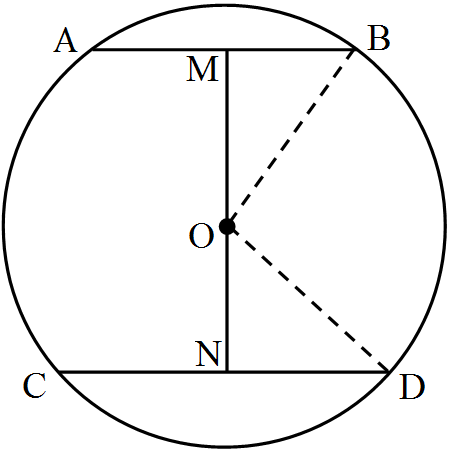
A circle has radius $\sqrt{2}\text{cm}.$ It is divided into two segments by a chord of length 2cm. Prove that the angle subtended by the chord at a point in major segment is 45°.
Answer
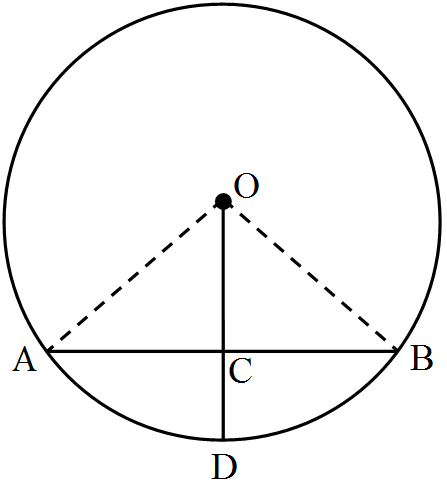
Draw a circle having centre O. Let AB = 2cm be a chord of a circle. A chord AB is divided by the line OM in two equal segments.
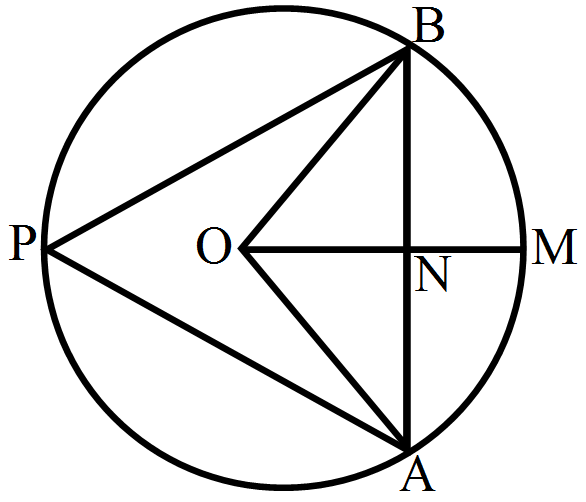
To prove, $\angle\text{APB}=45^\circ$
Here, AN = NB = 1cm
and $\text{OB}=\sqrt{2}\text{cm}$
In $\triangle\text{ONB},\ \ \text{OB}^2=\text{ON}^2+\text{NB}^2$ [use pythagoras theorem]
$\Rightarrow(\sqrt{2})^2=\text{NO}^2+(1)^2$
$\Rightarrow\text{ON}^2=2-1=1$
$\Rightarrow\text{ON}=1\text{cm}$ [taking positive square root, because distance is always positive]
Also, $\angle\text{ONB}=90^\circ$ [ON is the perpendicular bisector of the chord AB]
$\therefore\angle\text{NOB}=\angle\text{NBO}=45^\circ$
Similarly, $\angle\text{AON}=45^\circ$
Now, $\angle\text{AOB}=\angle\text{AON}+\angle\text{NOB}$
$=45^\circ+45^\circ=90^\circ$
We know that, chord subtends an angle to the circle is half the angle subtended by it to the centre.
$\therefore\angle\text{APB}=\frac{1}{2}\angle\text{AOB}$
$=\frac{90^\circ}{2}=45^\circ$
Hence, proved.
View full question & answer
Question 524 Marks
Prove that the angle in a segment shorter than a semicircle is greater than a right angle.
Answer

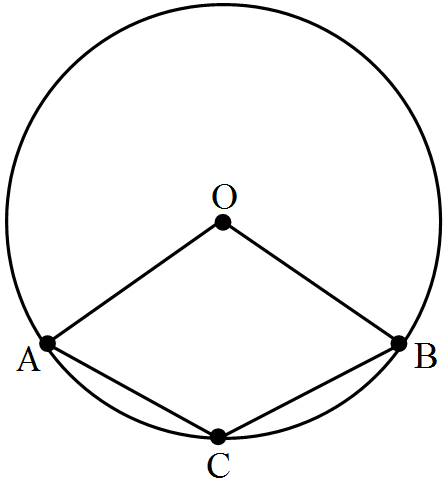
Given: $\angle\text{ACB}$ is an angle in minor segment.
To prove: $\angle\text{ACB}>90^\circ$
Proof: By degree measure theorem
Reflex $\angle\text{AOB}=2\angle\text{ACB}$
And reflex $\angle\text{AOB}>180^\circ$
Then, $2\angle\text{ACB}>180^\circ$
$\Rightarrow\angle\text{ACB}>\frac{180^\circ}{2}$
$\Rightarrow\angle\text{ACB}>90^\circ$
View full question & answer
Question 534 Marks
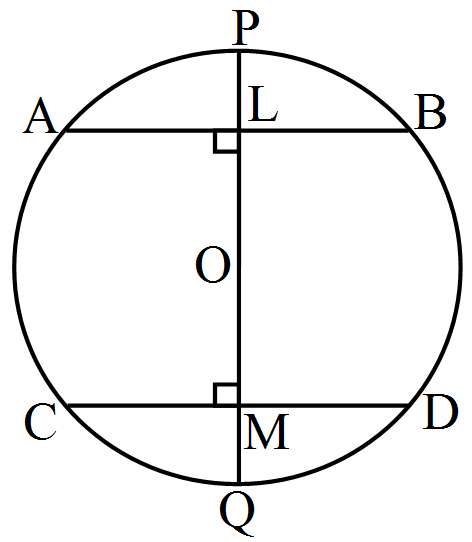
If a line segment joining mid-points of two chords of a circle passes through the centre of the circle, prove that the two chords are parallel.
Answer
Given: AB and CD are two chords of a circle whose centre of O. The mid-points of AB and CD are L and M respectively.

To prove: AB || CD
Proof: $\because$ L is the mid-point of chord AB $\therefore\text{OL}\bot\text{AB},\ \text{or}\ \angle\text{ALO}=90^\circ$
[$\because$ The line joining the centre of a circle to the mid-point of a chord is perpendicular to the chord]
Similarly, $\angle\text{CMO}=90^\circ$
$\therefore\angle\text{ALO}=\angle\text{CMO}$
But, these are corresponding angles.
So, AB || CD.
Hence, proved.
View full question & answer
Question 544 Marks
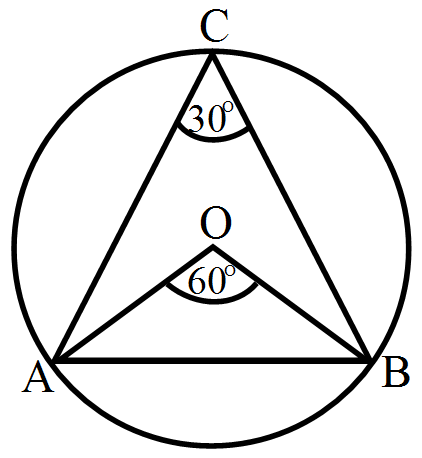
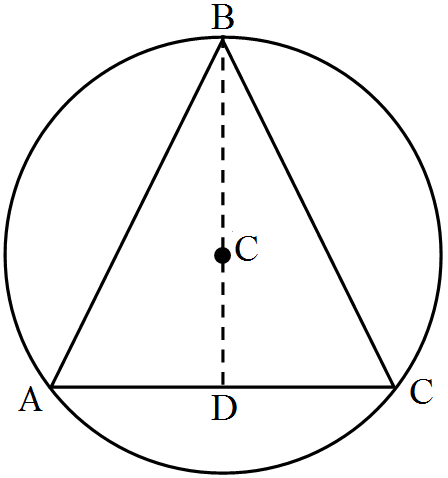
A chord of a circle is equal to its radius. Find the angle subtended by this chord at a point in major segment.
Answer
Since chord of a circle is equal radius, so we have AB = OA = OB.
Therefore, ABC is an equilateral triangle.

Since each angle of an equilateral triangle is 60°, so we have $\angle\text{AOB}=60^\circ$ Since angle subtended by an arc at the centre is double the angle subtended by it at any point on the remaining part of the circle, so we have
$\angle\text{AOB}=2\angle\text{ACB}$.
Hence, $\angle\text{ACB}=\frac{1}{2}\angle\text{AOB}=\frac{1}{2}\times60^\circ=30^\circ$
View full question & answer
Question 554 Marks
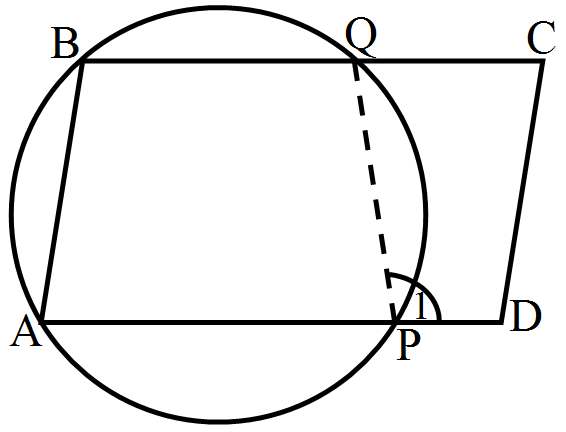
ABCD is a parallelogram. A circle through A, B is so drawn that it intersects AD at P and BC at Q. Prove that P, Q, C and D are concyclic.
Answer
ABCD is a parallelogram. A circle through A, B is so drawn that intersects AD at P and BC at Q. We have to prove that P, Q, C and D are concyclic. Join PQ.

Now, side AP of the cyclic quadrilateral APQB produced to D.
$\therefore\ \text{Ext. }\angle1=\text{int.opp. }\angle\text{B}$
$\because$ BA || CD and BC cuts them
$\therefore\angle\text{B}+\angle\text{C}=180^\circ$
$\because$ sum of int. $\angle\text{s}$ on the same side of the transversal is 180°]
or $\angle1+\angle\text{C}=180^\circ\ [\therefore\angle1=\angle\text{B}\ (\text{proved})]$
$\therefore$ PDCQ is cyclic quadrilateral.
Hence, the point P, Q, and are concyclic.
View full question & answer
Question 564 Marks
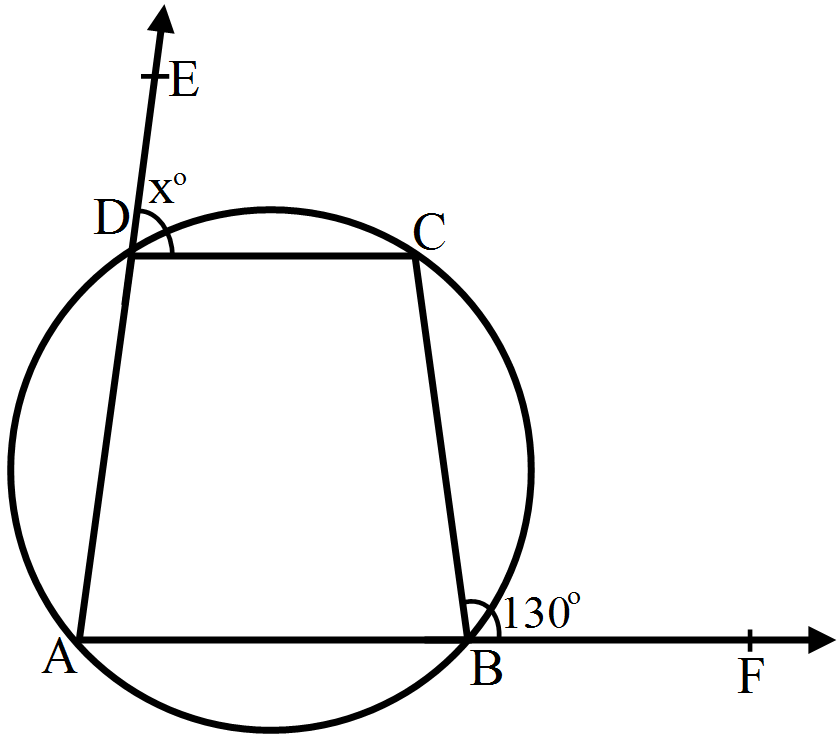
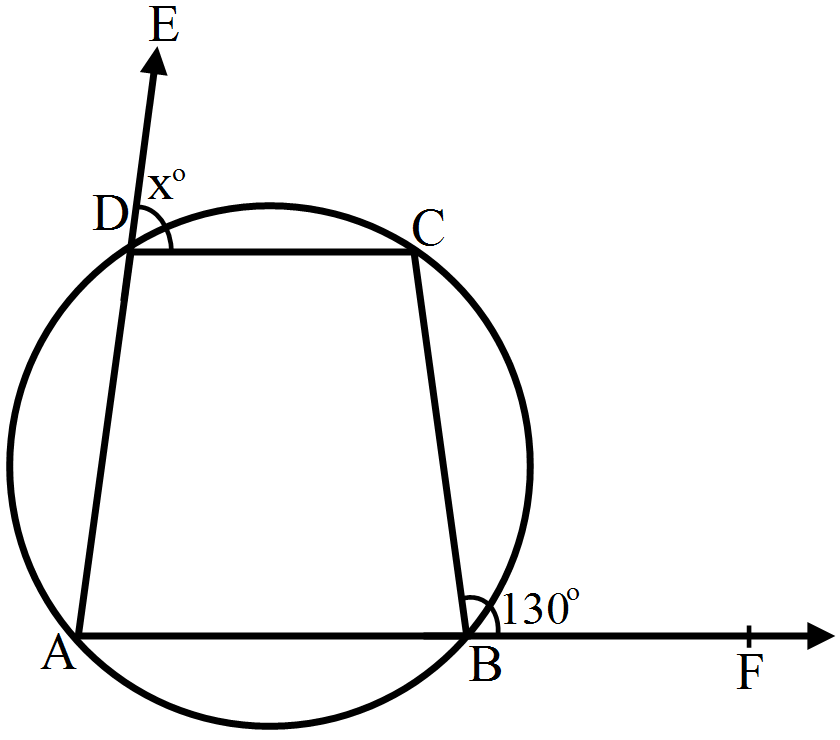
In the given figure, sides AD and AB of cyclic quadrilateral ABCD are produced to E and Frespectively. If $\angle\text{CBF}=130^\circ$ and $\angle\text{CDE}=\text{x}^\circ,$ find the value of x.

Answer
ABCD is a cyclic quadrilateral.
We know that in a cyclic quadrilateral, the exterior angle = interior opposite angle.
$\therefore\ \angle\text{CBF}=\angle\text{CDA}=(180^\circ-\text{x})$
$\Rightarrow\ 130^\circ=180^\circ-\text{x}$
$\Rightarrow\ \text{x}=180^\circ-130^\circ=50^\circ$
$\Rightarrow\ \text{x}=50^\circ$

View full question & answer
Question 574 Marks
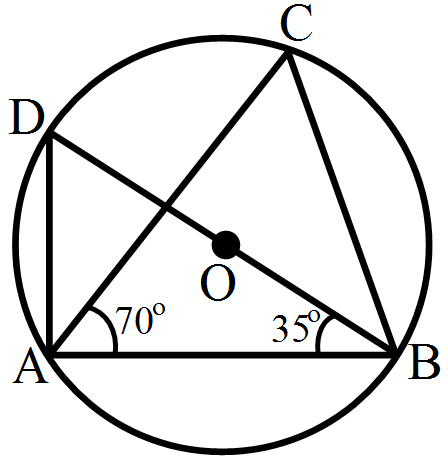
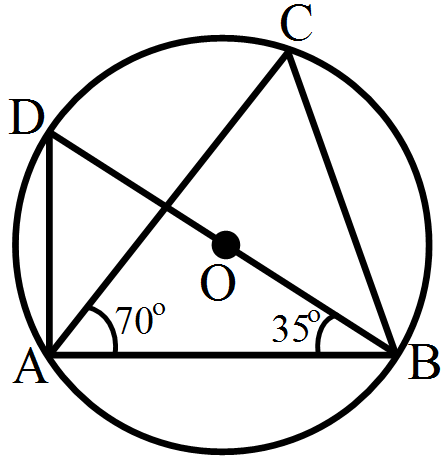
In the given figure, O is the centre of the circle. If $\angle\text{ABD}=35^\circ$ and $\angle\text{BAC}=70^\circ,$find $\angle\text{ACB}.$

Answer

It is clear that BD is the diameter of the circle.
Also, we know that the angle in a semicircle is a right angle.
i.e., $\angle\text{BAD}=90^\circ$
Now, considering the $\triangle\text{BAD},$ we have:
$\angle\text{ADB}+\angle\text{BAD}+\angle\text{ABD}=180^\circ$ [Angle sum property of a triangle]
$\Rightarrow\ \angle\text{ADB}+90^\circ+35^\circ=180^\circ$
$\Rightarrow\ \angle\text{ADB}=(180^\circ-125^\circ)=55^\circ$
Angles in the same segment of a circle are equal.
Hence, $\angle\text{ACB}=\angle\text{ADB}=55^\circ$
View full question & answer
Question 584 Marks
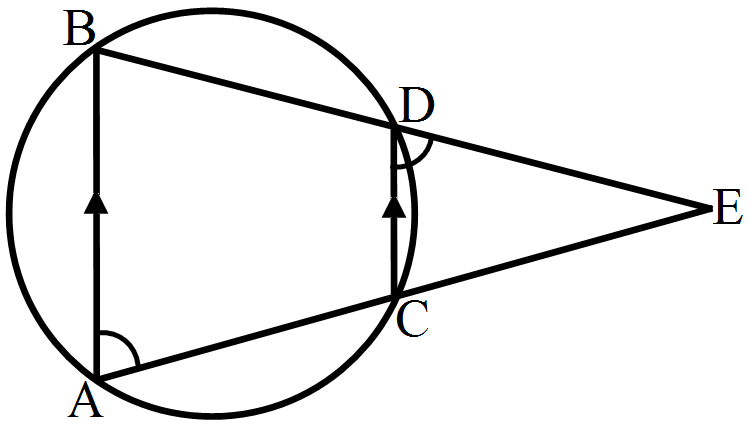
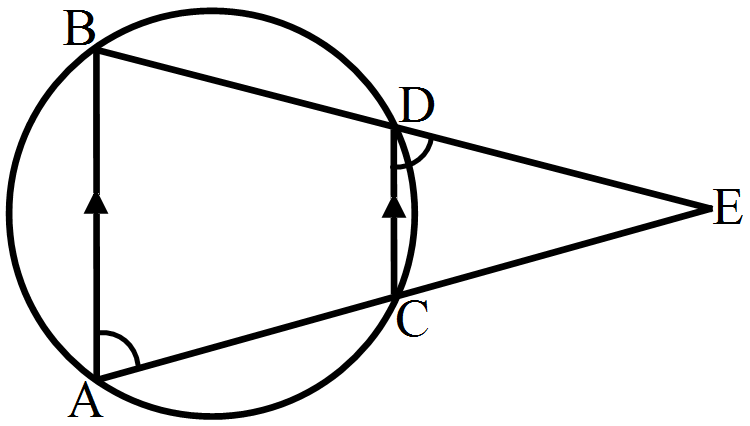
In the given figure, AB and CD are two parallel chords of a circle. If BDE and ACE are straight lines, intersecting at E, prove that $\triangle\text{AEB}$ is isosceles.

Answer

AB and CD are two parallel chords of a circle. BDE and ACE are two straight lines that intersect at E.
If one side of a cyclic quadrilateral is produced, then the exterior angle is equal to the interior opposite angle.
$\therefore$ Exteriore $\angle\text{EDC}=\angle\text{A}\dots(\text{i})$
 Exteriore $\angle\text{DCE}=\angle\text{B}\dots(\text{ii})$​​​​​​​
Also, AB parallel to CD.
Then, $\angle\text{EDC}=\angle\text{B}$ [Corresponding angles]
$\angle\text{DCE}=\angle\text{A}$ [Corresponding angles]
$\therefore\ \angle\text{A}=\angle\text{B}$ [From (i) and (ii)]
Hence, $\triangle\text{AEB}$ is isosceles.
View full question & answer
Question 594 Marks
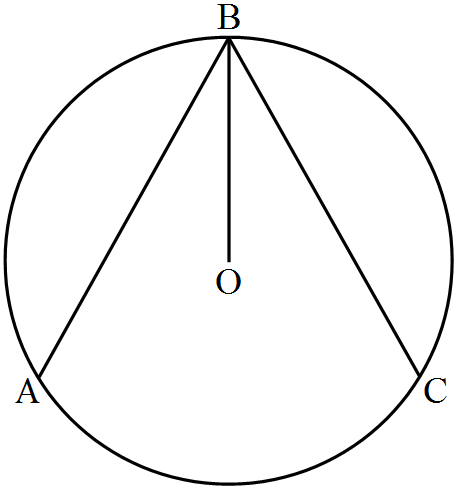
In figure, O is the centre of the circle, BO is the bisector of $\angle\text{ABC}.$ Show that AB = AC.

Answer
Given, BO is the bisector of $\angle\text{ABC}$
To prove AB = BC
Proof:
Since, BO is the bisector of $\angle\text{ABC}$
Then, $\angle\text{ABO}=\angle\text{CBO}\dots(\text{i})$
Since, OB = OA [Radius of circle]
Then, $\angle\text{ABO}=\angle\text{DAB}\dots(\text{ii})$ [opposite angles to equal sides]
Since OB = OC [Radius of circle]
Then, $\angle\text{OAB}=\angle\text{OCB}\dots(\text{iii})$ [opposite angles to equal sides]
Compare equations (i), (ii) and (iii)
$\angle\text{OAB}=\angle\text{OCB}\dots(\text{iii})$
In $\triangle\text{OAB}$ and $\triangle\text{OCB}$
$\angle\text{OAB}=\angle\text{OCB}$ [From (iv)]
$\angle\text{OBA}=\angle\text{OBC}$ [Given]
OB = OB [Common]
Then, $\triangle\text{OAB}\cong\triangle\text{OCB}$ [By AAS condition]
$\therefore\text{AB}=\text{BC}$ [C.P.C.T.]
View full question & answer
Question 604 Marks
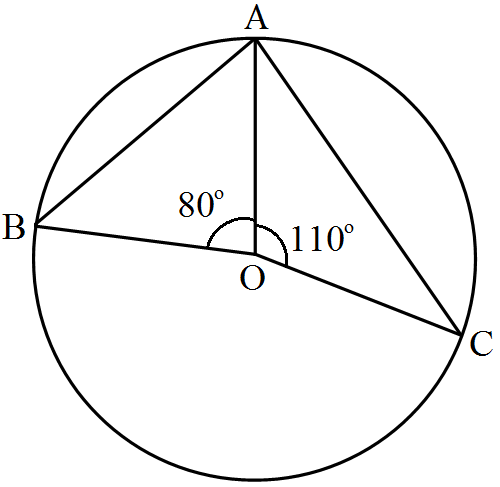
In figure, O is the centre of the circle. Find $\angle\text{BAC}.$

Answer
We have $\angle\text{AOB}=80^\circ$

And $\angle\text{AOC}=110^\circ$

Therefore, $\angle\text{AOB}+\angle\text{AOC}+\angle\text{BOC}=360^\circ$ [Complete angle]

$\Rightarrow80^\circ+100^\circ+\angle\text{BOC}=360^\circ$

$\Rightarrow\angle\text{BOC}=360^\circ-80^\circ-110^\circ$

$\Rightarrow\angle\text{BOC}=170^\circ$

By degree measure theorem

$\angle\text{BOC}=2\angle\text{BAC}$

$\Rightarrow170^\circ=2\angle\text{BAC}$

$\Rightarrow\angle\text{BAC}=\frac{170^\circ}{2}=85^\circ$

View full question & answer
Question 614 Marks
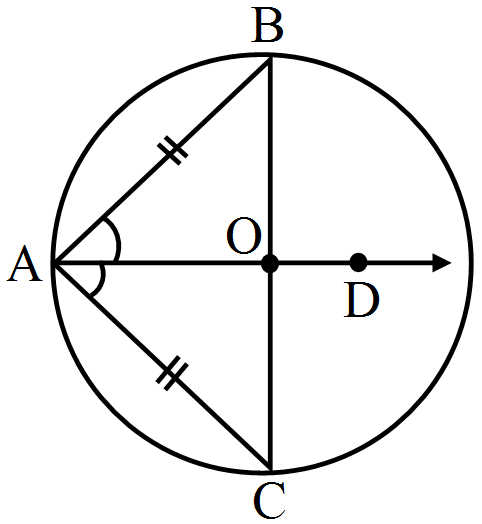
AB and AC are two equal chords of a circle. Prove that the bisector of the angle BAC passes through the centre of the circle.
Answer
Given: AS and AC are two equal chords whose centre is O.

To prove: Centre O lies on the bisector of $\angle\text{BAC}.$
Construction: Join SC, draw bisector AD of $\angle\text{BAC}.$
Proof In $\angle\text{SAM}$ and $\angle\text{CAM},$
AS = AC [given]
$\angle\text{BAM} = \angle\text{CAM}$ [given]
and AM = AM [common side]
$\therefore\triangle\text{BAM}=\triangle\text{CAM}$ [by SAS congruence rule]
$\Rightarrow\text{BM}=\text{CM}$ [by CPCT]
and $\angle\text{MBA}=\angle\text{CMA}$ [by CPCT]
So, BM = CM and $\angle\text{BMA}=\angle\text{CMA}=90^\circ$
So, AM is the perpendicular bisector of the chord BC.
Hence, bisector of $\angle\text{BAC}$ i.e., AM passes through the centre O.
View full question & answer
Question 624 Marks
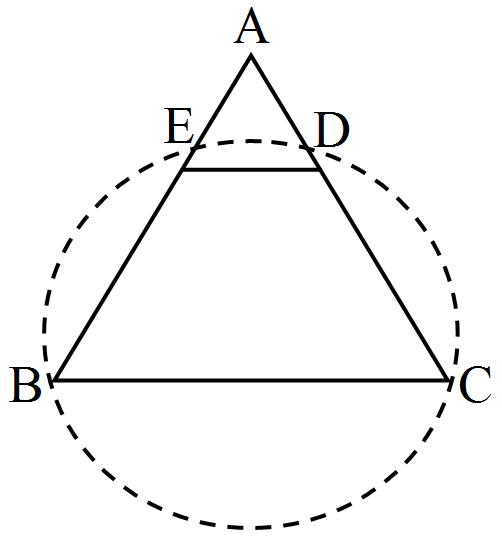
If a line is drawn parallel to the base of an isosceles triangle to intersect its equal sides, prove that the quadrilateral so formed is cyclic.
Answer
Given: $\triangle\text{ABC}$ is an isosceles triangle such that AB = AC and also DE || SC.
To prove: Quadrilateral BCDE is a cyclic quadrilateral.
Construction: Draw a circle passes through the points B, C, D and E.

Proof: In $\triangle\text{ABC},\ \ \text{AB}=\text{AC}$ [equal sides of an isosceles triangle]
$\Rightarrow\angle\text{ACB}=\angle\text{ABC}\ \ ...(\text{i})$
[angles opposite to the equal sides are equal]
Since, DE || BC
$\Rightarrow\angle\text{ADE}=\angle\text{ACB}$ [corresponding angles] ....(ii)
On adding both sides by $\angle\text{EDC}$ in Eq. (ii), we get,
$\angle\text{ADE}+\angle\text{EDC}=\angle\text{ACB}+\angle\text{EDC}$
$\Rightarrow180^\circ=\angle\text{ACB}+\angle\text{EDC}$ [$\angle\text{ADE}$ and $\angle\text{EDC}$ from linear pair aniom]
$\Rightarrow\angle\text{EDC}+\angle\text{ABC}=180^\circ$ [from Eq. (i)]
Hence, BCDE is cyclic quadrilateral, because sum opposite angles is 180°.
View full question & answer
Question 634 Marks
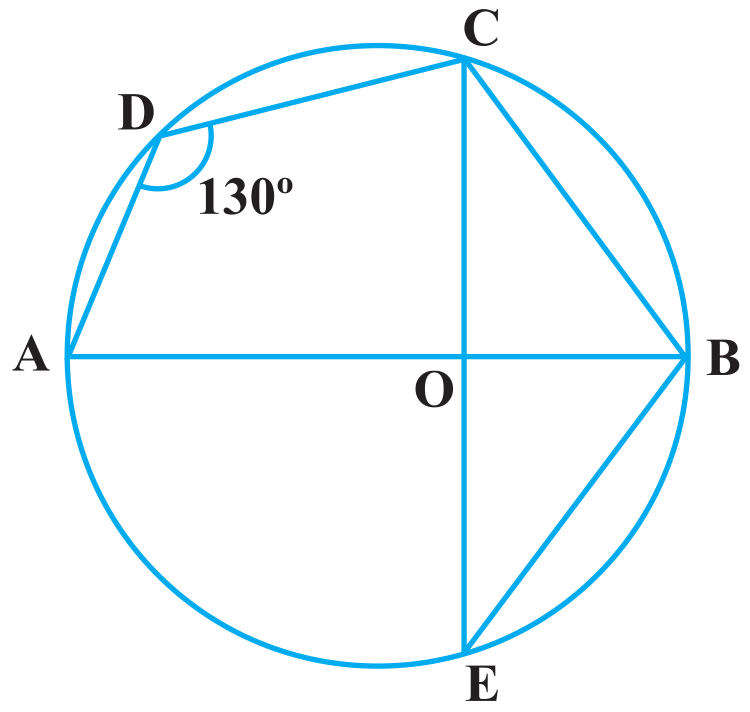
In Fig. $\angle\text{ADC}=130^\circ$ and chord BC = chord BE. Find $\angle\text{CBE}.$

Answer
In the given figure, we have $\angle\text{ADC}=130^\circ$ and chord BC = BE. We have to find $\angle\text{CBE}.$ Since ABCD is a cyclic quadrilateral and the opposite angles of a cyclic quadrilateral are supplementary.
$\therefore\angle\text{D}+\angle\text{ABC}=180^\circ$
$\Rightarrow130^\circ+\angle\text{ABC}=180^\circ$
$\Rightarrow\angle\text{ABC}=180^\circ-130^\circ=50^\circ$
$\Rightarrow\angle\text{OBC}=50^\circ....(1)$
In $\triangle\text{OBC}$ and $\triangle\text{OBE},$ we have
BC = BE [Given]
OC = OE [Radii of same circle]
OB = OB [Common side]
$\therefore\triangle\text{OBC}\cong\triangle\text{OBE}$ [By SSS cong. Rule]
$\angle\text{OBC}+\angle\text{OBE}=50^\circ$ $\big[$By C.P.C.T. and by (1) $\angle\text{OBC}=50^\circ\big]$
$\therefore\angle\text{OBC}+\angle\text{OBE}=50^\circ+50^\circ=100^\circ$
Hence, $\angle\text{CBE}=100^\circ$
View full question & answer
Question 644 Marks
Prove that the perpendicular bisectors of the sides of a cyclic quadrilateral are concurrent.
Answer
Let ABCD be a cyclic quadrilateral and let O be the centre of the circle passing through A, B, C, D.
Then each of AB, BC, CD, and DA being a chord of the circle, its right bisector must pass through O.
$\therefore$ the right bisectors of AB, BC, CD and DA pass through and are concurrent.

View full question & answer
Question 654 Marks
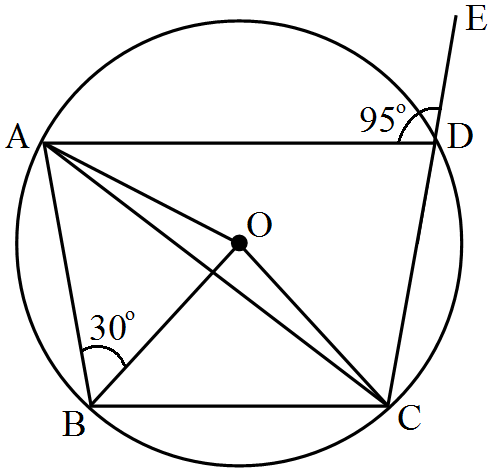
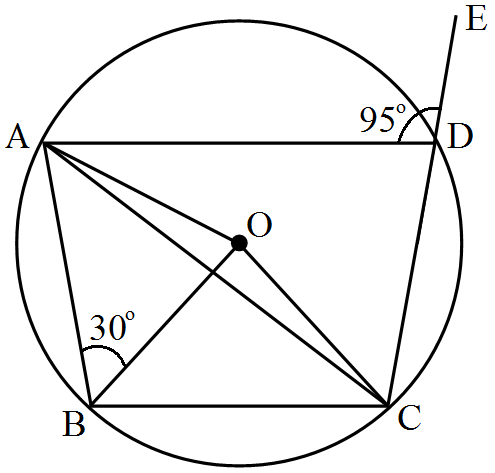
In the given figure, ABCD is a quadrilateral inscribed in a circle with centre O. CD is produced to E such that $\angle\text{AED} = 95^\circ$ and $\angle\text{OBA} = 30^\circ$ Find $\angle\text{OAC.}$

Answer
We are given ABCD is a quadrilateral with center O, $\angle\text{ADE}=95^\circ$ and $\angle\text{OBA}=30^\circ$
We need to find $\angle\text{OAC}$
We are given the following figure:

Since $\angle\text{ADE}=95^\circ$
$\Rightarrow\angle\text{ADC}=180^\circ-95^\circ=85^\circ$
Since squo; ABCD is cyclic quadrilateral
This means
$\angle\text{ABC}+\angle\text{ADC}=180^\circ$
$\Rightarrow\angle\text{ABO}+\angle\text{OBC}+\angle\text{ADC}=180^\circ$
$\Rightarrow30^\circ+\angle\text{OBC}+85^\circ=180^\circ$
$\Rightarrow\angle\text{OBC}=180^\circ-115^\circ=65^\circ$
Since OB = OC (radius)
$\Rightarrow\angle\text{OBC}+\angle\text{OCB}=65^\circ$
In $\triangle\text{OBC}$
$\angle\text{BOC}+\angle\text{OBC}+\angle\text{OBC}=180^\circ$
$\angle\text{BOC}+2\angle\text{OBC}=180^\circ$
$\angle\text{BOC}+2\times65^\circ=180^\circ$
$\angle\text{BOC}=180^\circ-130^\circ$
$\angle\text{BOC}=50^\circ$
Since DBAC and DBOC are formed on the same base which is chord.
So,
$\angle\text{BAC}=\frac{\angle\text{BOC}}{2}$
$=\frac{50^\circ}{2}$
$\angle\text{BAC}=25^\circ$
Consider $\triangle\text{BOA}$ which is isosceles triangle.
$\angle\text{OAB}=30^\circ$
$\Rightarrow\angle\text{OAC}+\angle\text{BAC}=30^\circ$
$\Rightarrow\angle\text{OAC}+25^\circ=30^\circ$
$\Rightarrow\angle\text{OAC}=5^\circ$
View full question & answer
Question 664 Marks
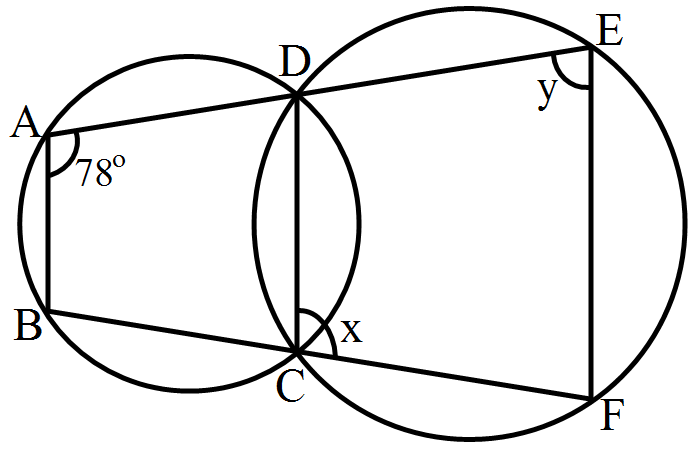
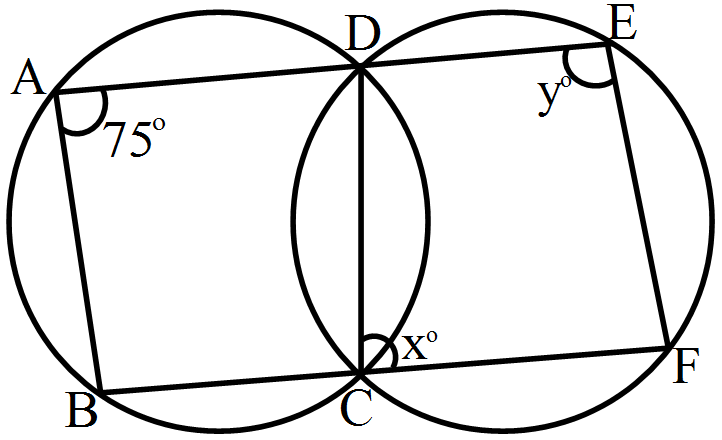
In the given figure, $\angle\text{BAD}=78^\circ,\angle\text{DCF}=\text{x}^\circ$ and $\angle\text{DEF}=\text{y}^\circ.$ Find the values of x and y.

Answer
We have, $\angle\text{BAD}=78^\circ,\angle\text{DCF}=\text{x}^\circ$ and $\angle\text{DEF}=\text{y}^\circ.$
Since, ABCD is a cyclic quadrilateral.
Then, $\angle\text{BAD}+\angle\text{BCD}=180^\circ$
$\Rightarrow78^\circ+\angle\text{BCD}=180^\circ$
$\Rightarrow​​\angle\text{BCD}=180^\circ-78^\circ=102^\circ$
Now, $\angle\text{BCD}+\angle\text{DCF}=180^\circ$ [Linear pair of angles]
$\Rightarrow102^\circ=\text{x}^\circ=180^\circ$
$\Rightarrow\text{x}=180^\circ-102^\circ=78^\circ$
Since, DCEF is a cyclic quadrilateral
Then, x + y = 180º
⇒ 78º + y = 180º
⇒ y = 180º - 78º = 102º
View full question & answer
Question 674 Marks
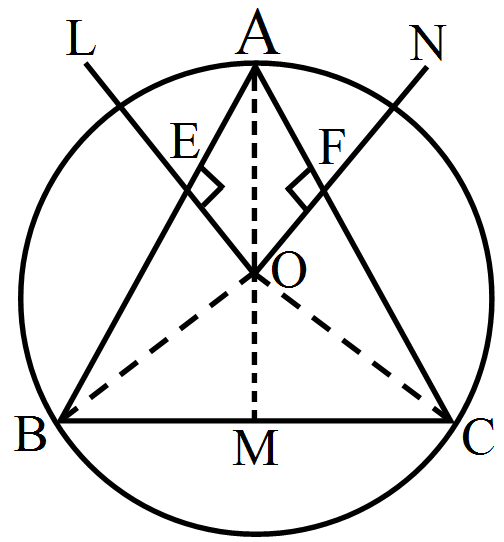
A, B and C are three points on a circle. Prove that the perpendicular bisectors of AB, BC and CA are concurrent.
Answer
Given A circle passing through three points A, B and C.
Construction: Draw perpendicular bisectors of AB and AC and they meet at a point O. Join OA, OB and OC.
To prove: Perpendicular bisector of BC, also passes through O i.e., LO, ON and OM are concurrent.
Proof: In $\triangle\text{QEA}$ and $\triangle\text{OEB},$

AE = BE [OL is the perpendicular bisector of AB]
$\angle\text{AEO}=\angle\text{BEO}\ \ \ [\text{each } 90^\circ]$
and $\text{OE}=\text{OE}$ [common side]
$\therefore\triangle\text{OEA}\cong\text{OEB}$ [by SAS congruence rule]
$\therefore\text{OA}=\text{OB}$
Similarly $\triangle\text{OFA}=\triangle\text{OFC}$ [by SAS congruence rule]
$\therefore\text{OA}=\text{OC}$ [by CPCT]
$\therefore\text{OA}=\text{OB}=\text{OC}=\text{r}$ [say]
Now, we draw a perpendicular from O to the BC and join them.
In $\triangle\text{OMB}$ and $\triangle\text{OMC},$
$\text{OB}=\text{OC}$ [proved above]
$\text{OM}=\text{OM}$ [common side]
and $\angle\text{OMB}=\angle\text{OMC}$ [each 90°]
$\therefore\triangle\text{OMB}\equiv\triangle\text{OMC}$ [by RHS congruence rule]
$\Rightarrow\text{BM}=\text{MC}$ [by CPCT]
Hence, OM is the perpendicular bisector of BC.
Hence, OL, ON and OM are concurret.
View full question & answer
Question 684 Marks
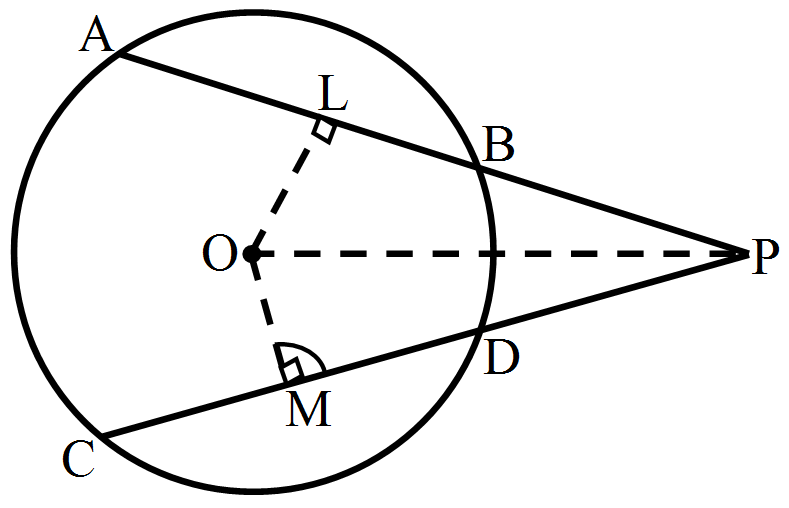
Two equal chords AB and CD of a circle when produced intersect at a point P. Prove that PB = PD
Answer
Given: Two equal chords AB and CD of a circle intersecting at a point P.

To prove: PB = PD
Construction: Join OP, draw $\text{OL}\bot\text{AB}$ and $\text{OM}\bot\text{CD}$
Proof: We have, AB = CD
$\Rightarrow\text{OL}=\text{OM}$ [equal chords are equidistant from the centre]
In $\triangle\text{OLP}$ and $\triangle\text{OMP}\ \ \text{OL}=\text{OM}$ [proved above]
$\angle\text{OLP}=\angle\text{OMP}$ [each 90°]
and OP = OP [common side]
$\therefore\triangle\text{OLP}=\triangle\text{OMP}$ [by RHS congruence rule]
$\Rightarrow\text{LP}=\text{MP}$ [by CPCT] ...(i)
Now, AB = CD
$\Rightarrow\frac{1}{2}(\text{AB})=\frac{1}{2}(\text{CD})$ [dividing both sides by 2]
$\Rightarrow\text{BL}=\text{DM}\ \ ...(\text{ii})$
[perpendicular drawn from centre to the circle bisects the chord i.e., AL = LB and CM = MD]
On subtracting Eq. (ii) from Eq. (ii) we get
LP - BL = MP - DM ⇒ PB = PD
Hence proved.
View full question & answer
Question 694 Marks
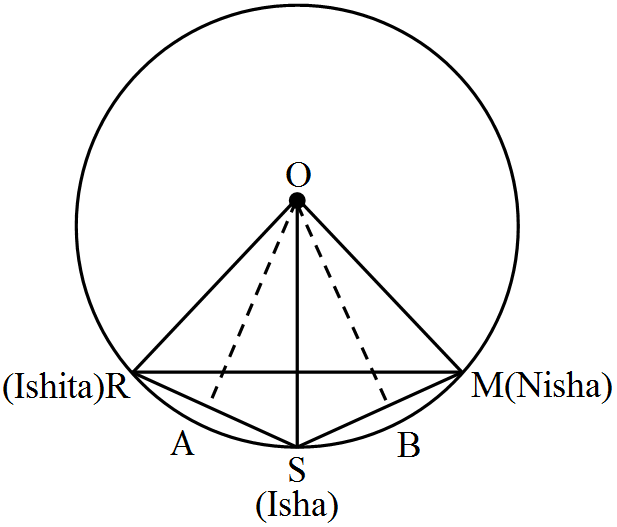
Three girls Ishita, Isha and Nisha are playing a game by standing on a circle of radius 20m drawn in a park. Ishita throws a ball to Isha, Isha to Nisha and Nisha to Ishita. If the distance between Ishita and Isha and between Isha and Nisha is 24m each, what is the distance between Ishita and Nisha.
Answer
Let R, S and M be the position of Ishita, Isha and Nisha respectively.

$\text{AR}=\text{AS}=\frac{24}{2}=12\text{cm}$

OR = OS = OM = 20 cm [Radii of circle]

In $\triangle\text{OAR,}$

OA2 + AR2 = OR2

OA2 + 122 = 202

OA2 = 400 - 144 = 256m2

OA = 16m

We know that, in an isosceles triangle altitude divides the base.

So in $\triangle\text{RSM},\angle\text{RCS}=90^\circ$ and RC = CM

Area of $\triangle\text{ORS}=\frac{1}{2}\times\text{OA}\times\text{RS}$

$\Rightarrow\frac{1}{2}\times\text{RC}\times\text{OS}$

$=\frac{1}{2}\times16\times24$

$\Rightarrow\text{RC}\times20=16\times24$

$\Rightarrow\text{RC}=19.2$

$\Rightarrow\text{RM}=2(19.2)=38.4\text{m}$

So, the distance between Ishita and Nisha is 38.4m.

View full question & answer
Question 704 Marks
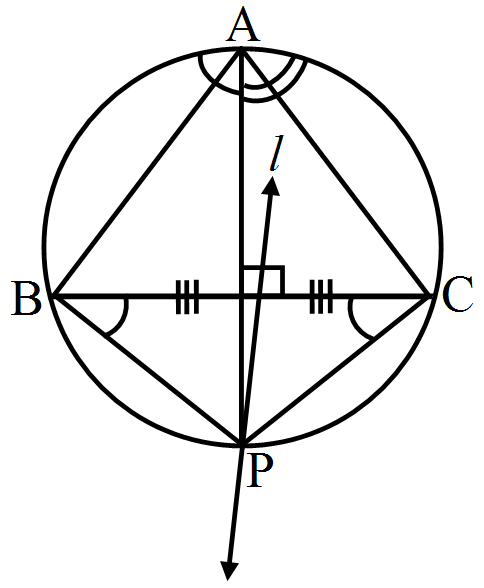
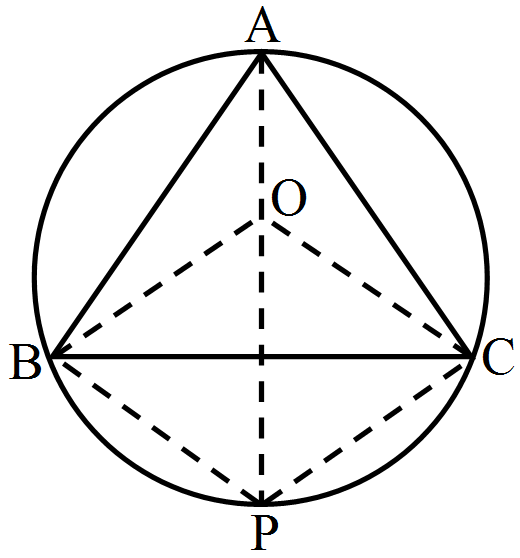
Prove that angle bisector of any angle of a triangle and perpendicular bisector of the opposite side if intersect, they will intersect on the circumcircle of the triangle.
Answer
Given: $\triangle\text{ABC}$ and l is perpendicular bisector of BC.

To prove: Angles bisector of $\angle\text{A}$ and perpendicular bisector of BC intersect on the circumcircle of $\triangle\text{ABC}.$
Proof: Let the angle bisector of $\angle\text{A}$ intersect circumcircle of $\triangle\text{ABC}$ at P. Join BP and CP.
$\Rightarrow\angle\text{BAP}=\angle\text{BCP}$ [Angles in the same segment are equal]
$\Rightarrow\angle\text{BAP}=\angle\text{BCP}=\frac{1}{2}\angle\text{A}\ ...(1)$ [AP is bisector of $\angle\text{A}$]
Similary, we have
$\angle\text{PAC}=\angle\text{PBC}=\frac{1}{2}\angle\text{A}\ \ ...(2)$
From equation (1) and (2), we have
$\angle\text{BCP}=\angle\text{PBC}$
$\Rightarrow\text{BP}=\text{CP}$
[$\because$ If the angles subtended by two chords of a circle at the centre are equal, the chords are equal]
⇒ P is on perpendicular bisector of BC.
Hence, angle bisector of $\angle\text{A}$ and perpendicular bisector of BC intersect on the circumcircle of $\triangle\text{ABC}.$
View full question & answer
Question 714 Marks
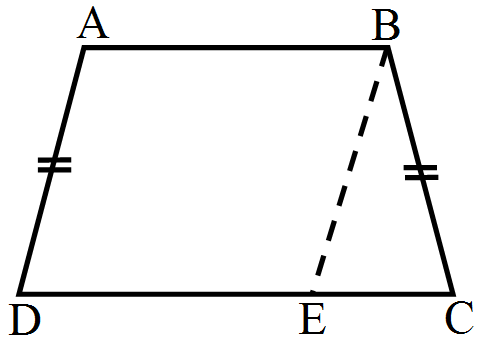
If non-parallel sides of a trapezium are equal, prove that it is cyclic.
Answer
Given: ABCD is a trapezium whose non-parallel sides AD and BC are equal.

To prove: Trapezium ABCD is a cyclic
Join BE, where BE || AD.
Proof: Since, AB || DE and AD || BE
Since, the quadrilateral ABCD is a parallelogram,
$\therefore\angle\text{BAD}=\angle\text{BED}\ \ ...(\text{i})$ [opposite angles of a parallelogram are equal]
and AD = BE ...(ii) [opposite sides of a parallelogram are equal]
But, AD = BC [given] ...(iii)
From Eqs. (ii) and (iii), BC = BE
$\Rightarrow\angle\text{BEC}=\angle\text{BCE}\ \ ...\text{(iv)}$ [angle opposite to equal sides are equal]
Also, $\angle\text{BEC}+\angle\text{BED}=180^\circ$ [linear pair axiom]
$\therefore\angle\text{BCE}+\angle\text{BAD}=180^\circ$ [from Eqs. (i) and (iv)]
If sum of opposite angles of a quadrilateral is 180°, then quadrilateral is cyclic.
Hence, trapezium ABCD is a cyclic.
Hence proved.
View full question & answer
Question 724 Marks
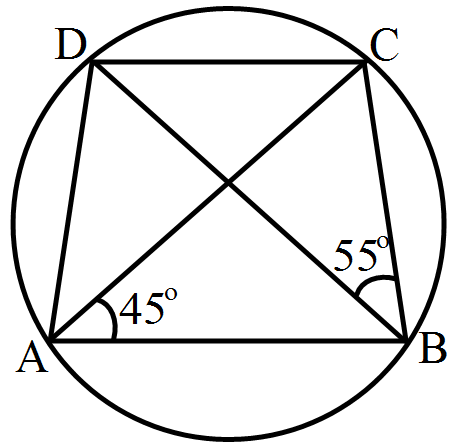
In the given figure, ABCD is a cyclic quadrilateral in which AC and BD are its diagonals. If $\angle\text{DBC}=55^\circ$ and $\angle\text{BAC}=45^\circ,$ find $\angle\text{BCD}.$

Answer
Since angles in the same segment of a circle are equal.
$\therefore\angle\text{CAD}=\angle\text{DBC}=55^\circ$
$\therefore\angle\text{DAB}=\angle\text{CAD} +\angle\text{BAC}=55^\circ +45^\circ=100^\circ$
But, $\angle\text{DAB}+\angle\text{BCD}=180^\circ$ [Opposite angles of a cyclic quadrilateral]
$\therefore\angle\text{BCD}=180^\circ-100^\circ=80^\circ$
View full question & answer
Question 734 Marks
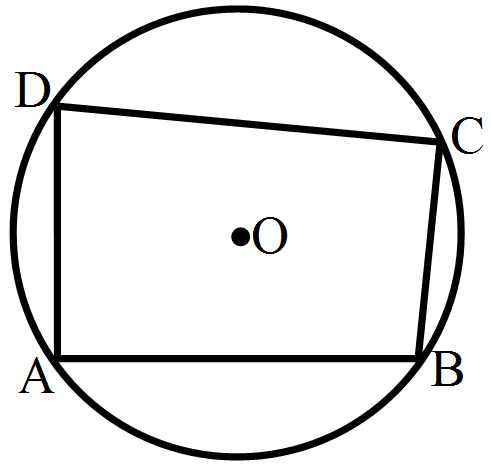
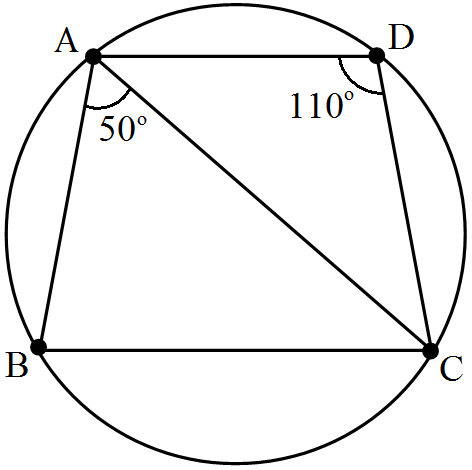
ABCD is a cyclic qudrilateral in which:
$\text{BC}\parallel\text{AD},\ \angle\text{ADC}=110^\circ$ and $\angle\text{BAC}=50^\circ.$ Find $\angle\text{DAC}.$
Answer

Since, ABCD is a cyclic quadrilateral.
Then, $\angle\text{ABC}+\angle\text{ADC}=180^\circ$
$\Rightarrow\angle\text{ABC}+110^\circ=180^\circ$
$\Rightarrow\angle\text{ABC}=180^\circ-110^\circ=70^\circ$
Since, AD || BC
Then, $\angle\text{DAB}+\angle\text{ABC}=180^\circ$ [Co-interior angles]
$\Rightarrow\angle\text{DAC}+50^\circ+70^\circ=180^\circ$
$\Rightarrow\angle\text{DAC}=180^\circ-50^\circ-70^\circ=60^\circ$
View full question & answer
Question 744 Marks
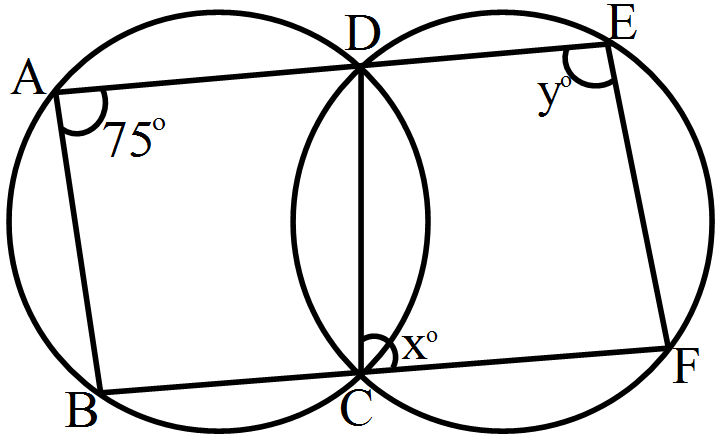
In the given figure, $\angle\text{BAD}=75^\circ,\angle\text{DCF}=\text{x}^\circ$ and $\angle\text{DEF}=\text{y}^\circ.$ Find the values of x and y.

Answer

We know that if one side of a cyclic quadrilateral is produced, then the exterior angle is equal to the interior opposite angle
$\text{i.e.},\angle\text{BAD}=\angle\text{DCF}=75^\circ$
$\Rightarrow\ \angle\text{DCF}=\text{x}=75^\circ$
Again, the sum of opposite angles in a cyclic quadrilateral is 180°.
Thus, $\angle\text{DCF}=\angle\text{DEF}=180^\circ$
$\Rightarrow\ 75^\circ+\text{y}=180^\circ$
$\Rightarrow\ \text{y}=(180^\circ-75^\circ)=105^\circ$
Hence, $\text{x}=75^\circ$ and $\text{y}=105^\circ.$
View full question & answer
Question 754 Marks
If ABC is an equilateral triangle inscribed in a circle and P be any point on the minor arc BC which does not coincide with B or C, prove that PA is angle bisector of $\angle\text{BPC}.$
Answer
Since equal choeds of a circle subtends equal angle at the centre, so we have chord AB = chord AC [Given]
So, $\angle\text{AOB}=\angle\text{AOC}\ \ ...(1)$
Since the angle subtended by an arc at the centre is double the angle subtended by it any point on the remaining part of the circle,

$\therefore\angle\text{APC}=\frac{1}{2}\angle\text{AOC}\ ...(2)$
and $\angle\text{APB}=\frac{1}{2}\angle\text{AOB}\ ...(3)$
$\therefore\angle\text{APC}=\angle\text{APB}$ [From (1), (2) and (3)]
Hence, PA is the bisector of $\angle\text{BPC}.$
View full question & answer
Question 764 Marks
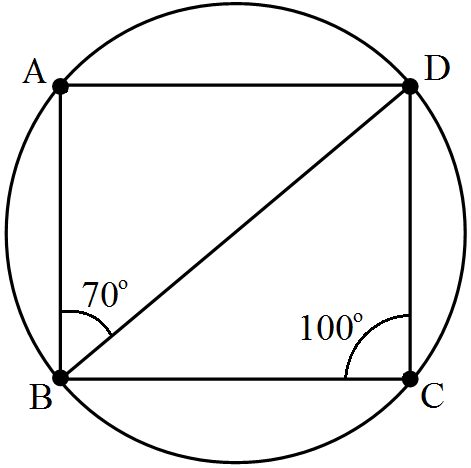
ABCD is a cyclic qudrilateral in which:
$\angle\text{BCD}=100^\circ$ and $\angle\text{ABD}=70^\circ$ find $\angle\text{ADB}.$
Answer

Since, ABCD is a cyclic quadrilateral.
Then, $\angle\text{BAD}+\angle\text{BCD}=180^\circ$
 $\Rightarrow\angle\text{BAD}+100^\circ=180^\circ$
$\Rightarrow\angle\text{BAD}=180^\circ-100^\circ=80^\circ$
In  by angle sum property
$\angle\text{ABD}+\angle\text{ADB}+\angle\text{BAD}=180^\circ$
$\Rightarrow70^\circ+\angle\text{ADB}+80^\circ=180^\circ$
$\Rightarrow\angle\text{ADB}=180^\circ-70^\circ-80^\circ=30^\circ$
View full question & answer
Question 774 Marks
Two chords AB and CD of lengths 5cm and 11cm respectively of a circle are parallel to each other and are opposite side of its centre. If the distance between AB and CD is 6cm, find the radius of the circle.
Answer
Draw $\text{OM}\perp\text{AB}$ and $\text{ON}\perp\text{CD}.$

Join OB and OD.

$\text{BM}=\frac{\text{AB}}{2}=\frac{5}{2}$ [Perpendicular from the centre bisects the chord]

$\text{ND}=\frac{\text{CD}}{2}=\frac{11}{2}$

Let ON be x, so OM will be 6 - x.

$\triangle\text{MOB}$

$\text{OM}^2+\text{MB}^2=\text{OB}^2$

$(6-\text{x})^2+\Big(\frac{5}{2}\Big)^2+\text{OB}^2$

$36+\text{x}^2-12\text{x}+\frac{25}{4}=\text{OB}^2\dots(\text{i})$

In $\triangle\text{NOD}$

$\text{ON}^2+\text{ND}^2=\text{OD}^2$

$\text{x}^2+\Big(\frac{11}{2}\Big)^2=\text{OD}^2$

$\text{x}^2+\frac{121}{4}=\text{OD}^2\dots(\text{ii})$

We have OB = OD. [Radii of same circle]

So, from equation (i) and (ii).

$36+\text{x}^2-\text{12x}+\frac{25}{4}=\text{x}^2+\frac{121}{2}$

$\Rightarrow\text{12x}=36+\frac{25}{4}-\frac{121}{4}$

$=\frac{144+25-121}{4}$

$=\frac{48}{4}=12$

$\text{x}=1$

From equation (ii)

$(1)^2+\Big(\frac{121}{4}\Big)=\text{OD}^2$

$\text{OD}^2=1+\frac{121}{4}=\frac{125}{4}$

$\text{OD}=\frac{5\sqrt{5}}2{}$

So, the radius of the circle is found to be $55\sqrt{2}\text{cm}.$

View full question & answer
Question 784 Marks
In a cyclic quadrilateral ABCD, if $(\angle\text{B}-\angle\text{D})=60^\circ,$ show that the smaller of the two is 60°
Answer
ABCD is a cyclic quadrilateral
$\angle\text{B}-\angle\text{D}=60^\circ\dots(\text{i})$
And
$\angle\text{B}+\angle\text{D}=180^\circ\dots(\text{ii})$
Adding (i) and (ii) we get,
$2\angle\text{B}=240^\circ$
$\therefore\ \angle\text{B}=\frac{240}{2}=120^\circ$
Substituting the value of $\angle\text{B}=120^\circ$ in (i) we get
$120^\circ-\angle\text{D}=60^\circ$
$\Rightarrow\ \angle\text{D}=120^\circ-60^\circ=60^\circ$
The smaller of the two angles i.e. $\angle\text{D}=60^\circ.$
View full question & answer
Question 794 Marks
O is the circumcentre of the triangle ABC and D is the mid-point of the base BC. Prove that $\angle\text{BOD}=\angle\text{A}.$
Answer
Given: In a $\triangle\text{ABC}$ a circle is circumscribed having centre O.

Also, D is the mid-point of BC.
To prove: $\angle\text{BOD}=\angle\text{A}\ \ \text{or}\ \ \angle\text{BOD}=\angle\text{BAC}$
Construction: Join OB, OD and OC.
Proof: In $\triangle\text{BOD}$ and $\triangle\text{COD}$,
OB = OC [both are the radius of circle]
BD = DC [D is the mid-point of BC]
and OD = OD [common side]
$\therefore\triangle\text{BOD}\cong\triangle\text{COD}$ [by SSS congruence rule]
$\therefore\angle\text{BOD}=\angle\text{COD}$ [by CPCT] ....(i)
We know that, in a circle, the angle subtended by an arc at the centre is twice the angle subtended by it at the remaining part of the circle.
$\therefore2\angle\text{BAC}=\angle\text{BOC}$
$\Rightarrow\angle\text{BAC}=\frac{2}{2}\angle\text{BOD}$ $[\because\angle\text{BOC}=2\angle\text{BOD}]$ [from Eq. (i)]
$\Rightarrow\angle\text{BAC}=\angle\text{BOD}$
Hence proved.
View full question & answer
Question 804 Marks
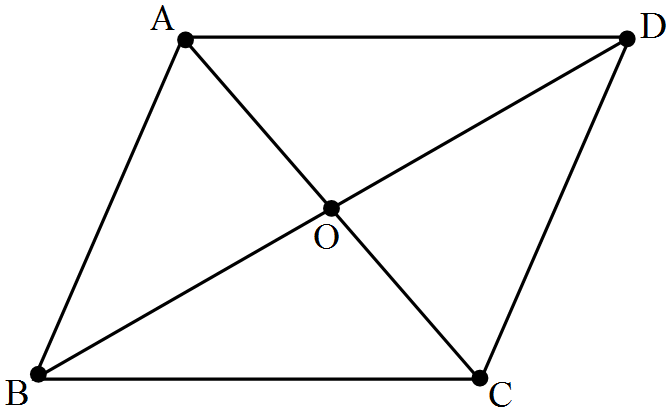
Prove that the circles described on the four sides of a rhombus as diameters, pass through the point of intersection of its diagonals.
Answer

LetABCD be a rhombus such that its diagonals AC and BD intersect at O. Since, the diagonals of a rhombus intersect at right angle.
$\therefore\angle\text{AOB}=\angle\text{BOC}$
$\angle\text{COD}=\angle\text{DOA}=90^\circ$
Now, $\angle\text{AOB}=90^\circ\Rightarrow$ circle described on AB as diameter will pass through O.
Similarly, all the circles described on BC, AD and CD as diameters pass through O.
View full question & answer
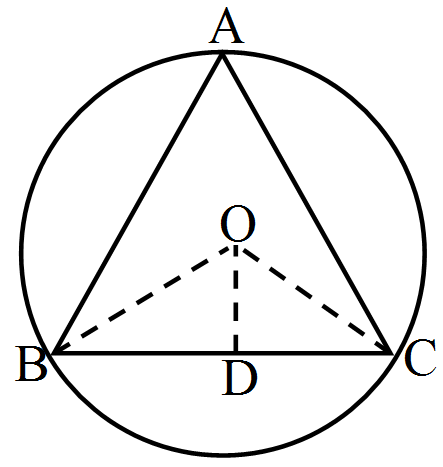
Question 814 Marks
An equilateral triangle of side 9cm is inscribed in a circle. Find the radius of the circle.
Answer
Let ABC be an equilateral triangle of side 9cm and let AD is one of its median.

Let G be the centroid of $\triangle\text{ABC}$ Then AG : GD = 2 : 1

We know that in an equilateral triangle, centroid coincides with the circum centre.

Therefore, G is the centre of the circumference with circum radius GA.

Also G is the centre and GD is perpendicular to BC.

Therefore, In right triangle ADB, we have

AB2 = AD2 + DB2

⇒ 92 = AD2 + DB2

$\Rightarrow\text{AD}=\sqrt{81-\frac{81}{4}}=\frac{9\sqrt3}{2}\text{cm}$

$\therefore\text{Radius}=\text{AG}=\frac{2}{3}\text{AD}$

$=3\sqrt3\text{cm}.$

View full question & answer
Question 824 Marks
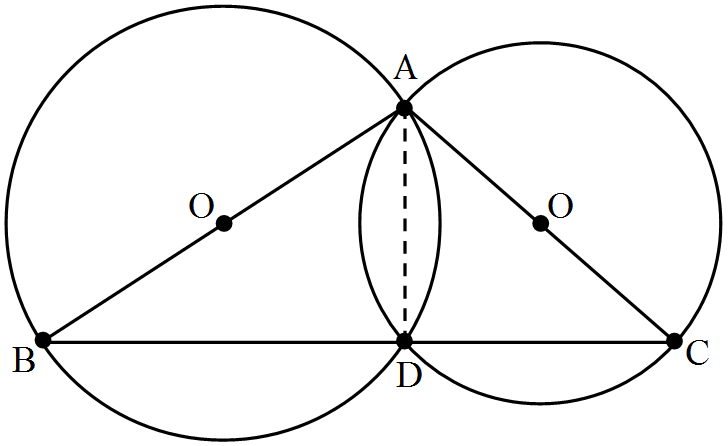
Circles are described on the sides of a triangle as diameters. Proved that the circle on any two sides intersect each other on the third side (or third side produced).
Answer

Since, AB is a diameter
Then, $\angle\text{ADB}=90^\circ\dots(1)$ [Angles in semicircle]
Since, AC is a diameter
Then, $\angle\text{ADC}=90^\circ\dots(2)$ [Angles in semicircle]
Add equations (1) and (2)
$\angle\text{ADB}+\angle\text{ADC}=90^\circ+90^\circ$
$\Rightarrow\angle\text{BDC}=180^\circ$
Then, BDC is a line
Hence, the circles on any two sides intersect each other on the third side.
View full question & answer
Question 834 Marks
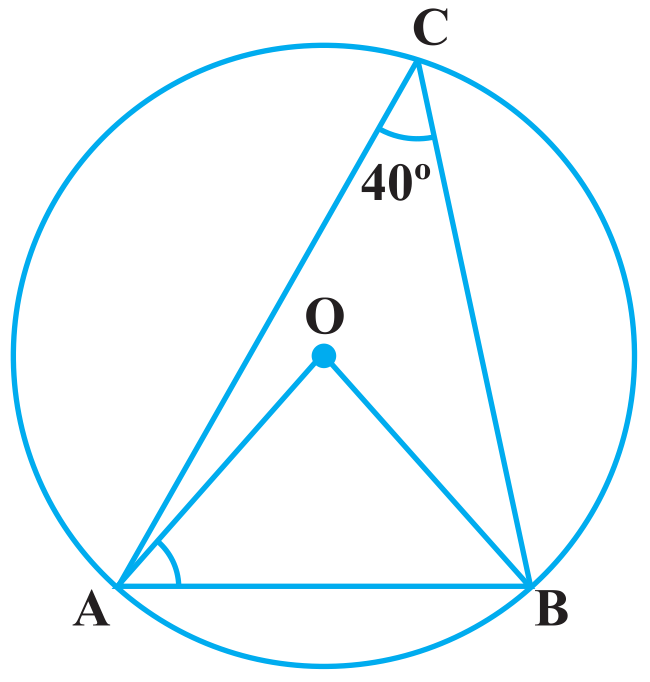
In Fig. $\angle\text{ACB}=40^\circ$. Find $\angle\text{OAB}.$

Answer
Given, $\angle\text{ACB}=40^\circ$
We know that, a segment subtends an angle to the circle is half the angle subtends to the centre.
$\therefore\angle\text{AOB}=2\angle\text{ACB}$
$\Rightarrow\angle\text{ACB}=\frac{\angle\text{AOB}}{2}$
$\Rightarrow40^\circ=\frac{1}{2}\angle\text{AOB}$
$\Rightarrow\angle\text{AOB}=80^\circ\ \ \ ...(\text{i})$
In $\triangle\text{AOB},\ \text{AO}=\text{BO}$ [both are the radius of a circle]
$\Rightarrow\angle\text{OBA}=\angle\text{OAB}\ \ ...(\text{ii})$ [angle opposite to the equal sides are equal]
We know that, the sum of all three angles in a triangle AOB is 180°.
$\therefore\angle\text{AOB}+\angle\text{OBA}+\angle\text{OAB}=180^\circ$
$\Rightarrow80^\circ+\angle\text{OAB}+\angle\text{OAB}=180^\circ$ [from Eqs. (i) and (ii)]
$\Rightarrow2\angle\text{OAB}=180^\circ-80^\circ$
$\Rightarrow2\angle\text{OAB}=100^\circ$
$\therefore\angle\text{OAB}=\frac{100^\circ}{2}=50^\circ$
View full question & answer
Question 844 Marks
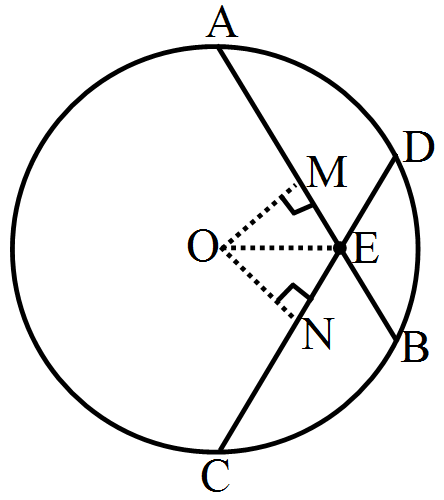
If two equal chords of a circle intersect, prove that the parts of one chord are separately equal to the parts of the other chord.
Answer
Given: Consider AB and CD are two equal chords of a circle, which meet at point E.
To prove: AE = CE and BE = DE
Construction: Draw $\text{OM}\bot\text{AB}$ and $\text{ON}\bot\text{CD}$ and join OE where O is the centre of circle.

Proof: In $\triangle\text{OME}$ and $\triangle\text{ONE}.$
OM = ON [equal chords are equidistant from the centre]
OE = OE [common side]
and $\angle\text{OME}=\angle\text{ONE}$ [each 90°]
$\therefore\triangle\text{OME}\cong\triangle\text{ONE}$ [by RHS congurence rule]
$\Rightarrow\text{EM}=\text{EN}$ [by CPCT] ...(i)
Now, $\text{AB} = \text{CD}$
On dividing both sides by 2, we get,
$\frac{\text{AB}}{2}=\frac{\text{CD}}{2}\Rightarrow\text{AM}=\text{CN}\ \ ...(\text{ii})$
[Since, perpendicular drawn from centre of circle to chord to chord bisects the chord i.e., AM = MB and CN = ND]
On adding Eqs. (i) and (ii), we get
$\text{EM} + \text{AM} = \text{EN} + \text{CN}$
$\Rightarrow\text{AE}=\text{CE}\ \ \ ...(\text{iii})$
Now, $\text{AB} = \text{CD}$
On subtracting both sides by AE, we get
$\text{AB} - \text{AE} = \text{CD} - \text{AE}$
$\Rightarrow\text{BE}=\text{CD}-\text{CE}$ [from Eq. (iii)]
$\Rightarrow\text{BE}=\text{DE}$
Hence, proved.
View full question & answer
Question 854 Marks
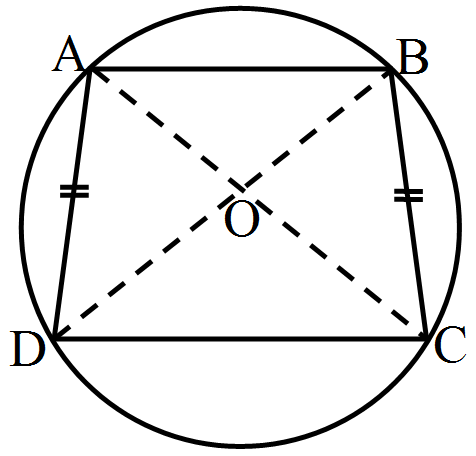
If a pair of opposite sides of a cyclic quadrilateral are equal, prove that its diagonals are also equal.
Answer
Given: Let ABCD be a cyclic quadrilateral and AD = BC.

Join AC and BD.
To prove: AC = BD
Proof: In $\triangle\text{AOD}$ and $\triangle\text{BOC},$
$\triangle\text{OAD} = \angle\text{OBC}$ and $\angle\text{ODA} = \angle\text{OCB}$ [since, same segments subtends equal angle to the circle]
AB = BC [given]
$\triangle\text{AOD} = \triangle\text{BOC}$ [by ASA congruence rule]
Adding is DOC on both sides, we get,
$\triangle\text{AOD}+ \triangle\text{DOC} \cong \triangle\text{BOC} + \triangle\text{DOC}$
$\Rightarrow \triangle\text{ADC} \cong \triangle\text{BCD}$
AC = BD [by CPCT]
View full question & answer
Question 864 Marks
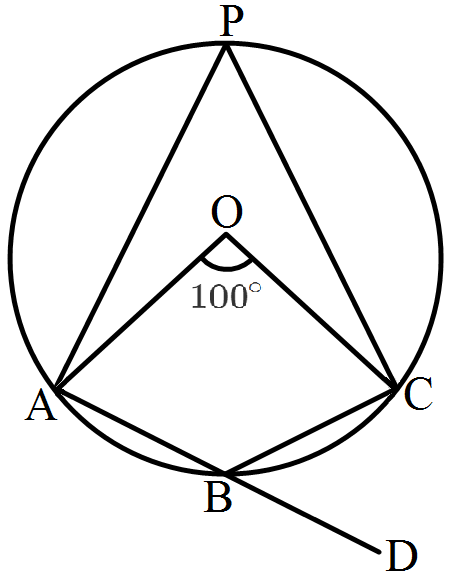
In the given figure, O is the center of the circle. Find $\angle\text{CBD}.$

Answer
We have, $\angle\text{AOC}=100^\circ$
By degree measure theorem
$\angle\text{AOC}=2\angle\text{APC}$
$\Rightarrow100^\circ=2\angle\text{APC}$
$\Rightarrow\angle\text{APC}=\frac{100^\circ}{2}=50^\circ$
$\therefore\angle\text{APC}+\angle\text{ABC}=180^\circ$ [Opposite angles of cyclic quad.]
$\Rightarrow50^\circ+\angle\text{ABC}=180^\circ$
$\Rightarrow\angle\text{ABC}=180^\circ-50^\circ=130^\circ$
$\therefore\angle\text{ABC}+\angle\text{CBD}=180^\circ$ [Linear pair of angles]
$\Rightarrow130^\circ+\angle\text{CBD}=180^\circ$
$\Rightarrow\angle\text{CBD}=180^\circ-130^\circ=50^\circ$
View full question & answer
Question 874 Marks
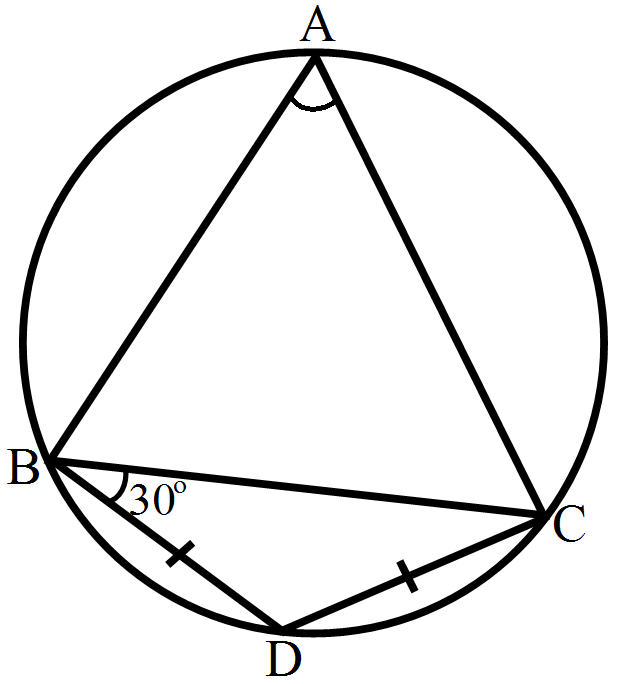
In the given figure, BD = DC and $\angle\text{CBD}=30^\circ,$ find $\angle\text{BAC}.$

Answer

BD = DC
$\Rightarrow\ \angle\text{BCD}=\angle\text{CBD}=30^\circ$
In $\triangle\text{BCD},$ we have:
$\angle\text{BCD}+\angle\text{CBD}+\angle\text{CDB}=180^\circ$ [Angle sum property of a triangle]
$\Rightarrow\ 30^\circ+30^\circ+\angle\text{CDB}=180^\circ$
$\Rightarrow\ \angle\text{CDB}=(180^\circ-60^\circ)=120^\circ$
The opposite angles of a cyclic quadrilateral are supplementary.
Thus, $\angle\text{CDB}+\angle\text{BAC}=180^\circ$
$\Rightarrow\ 120^\circ+\angle\text{BAC}=180^\circ$
$\Rightarrow\ \angle\text{BAC}=(180^\circ-120^\circ)=60^\circ$
$\therefore\ \angle\text{BAC}=60^\circ$
View full question & answer
Question 884 Marks
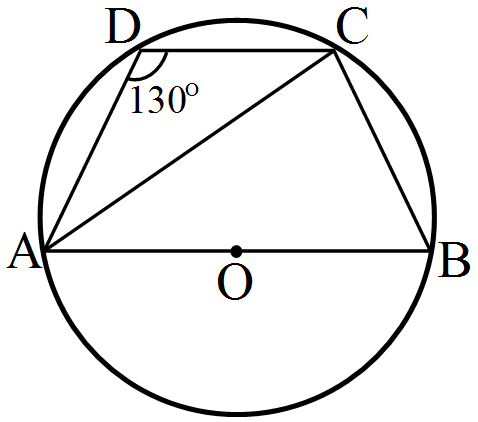
A quadrilateral ABCD is inscribed in a circle such that AB is a diameter and $\angle\text{ADC}=130^\circ.$ Find $\angle\text{BAC}.$
Answer

Draw a quadrilateral ABCD inscribed in a circle having centre O. Given, $\angle\text{ADC}=130^\circ$
Since, ABCD is a quadrilateral. inscribed in a circle, therefore ABCD becomes a cyclic quadrilateral.
$\because$ Since, the sum of opposite angle of a cyclic quadrilateral is 180°.
$\therefore\angle\text{ADC}+\angle\text{ABC}=180^\circ$
$\Rightarrow130^\circ+\angle\text{ABC}=180^\circ$
$\Rightarrow\angle\text{ABC}=50^\circ$
Since, AB is a diameter of a circle, then AB subtends an angle to the circle is right angle.
$\therefore\angle\text{ACB}=90^\circ$
In $\triangle\text{ABC},\ \ \angle\text{BAC}+\angle\text{ACB}+\angle\text{ABC}=180^\circ$ [by angle sum property of a triangle]
$\Rightarrow\angle\text{BAC}+90^\circ+50^\circ=180^\circ$
$\Rightarrow\angle\text{BAC}=180^\circ-(90^\circ+50^\circ)$
$=180^\circ-140^\circ=40^\circ$
View full question & answer
Question 894 Marks
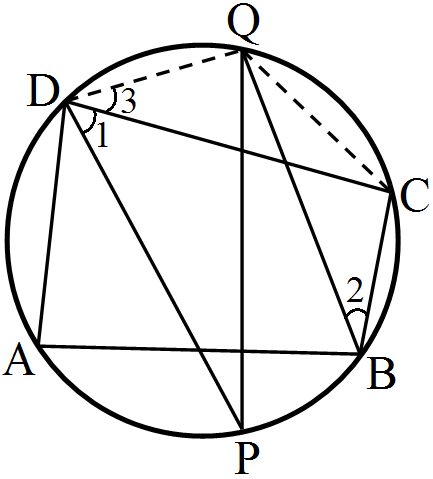
If bisectors of opposite angles of a cyclic quadrilateral ABCD intersect the circle, circumscribing it at the points P and Q, prove that PQ is a diameter of the circle.
Answer
Given: ABCD is a cyclic quadrilateral.
DP and QB are the bisectors of $\angle\text{D}$ and $\angle\text{B},$ respectively.
To prove: PQ is the diameter of a circle.
Construction: Join QD and QC.

Proof: Since, ABCD is a cyclic quadrilateral.
$\therefore\angle\text{CDA}+\angle\text{CBA}=180^\circ$ [sum of opposite angles of cylic quadrilateral is 180°]
On dividing both sides by 2, we get,
$\frac{1}{2}\angle\text{CDA}+\frac{1}{2}\angle\text{CBA}=\frac{1}{2}\times180^\circ=90^\circ$
$\Rightarrow\angle1+\angle2=90^\circ\ ...(\text{i})$ $\big[\angle1=\frac{1}{2}\angle\text{CDA and}\ \angle2=\frac{1}{2}\angle\text{CBA}\big]$
But, $\angle2=\angle3$ [angles in the same segment QC are equal] ...(ii)
$\angle1+\angle3=90^\circ$
From Eqe. (i) and (ii), $\angle\text{PDQ}=90^\circ$
Hence, PQ is a diameter of a circle, because diameter of the circle.
Subtends a right angle at the circumference.
View full question & answer
Question 904 Marks
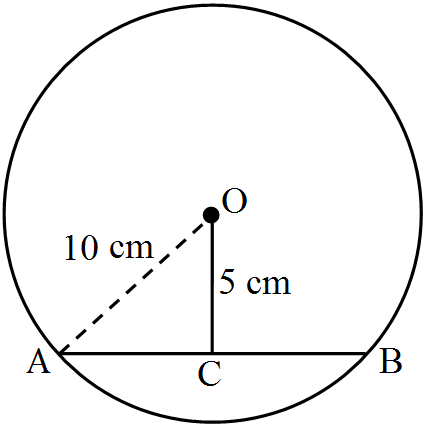
Find the length of a chord which is at a distance of 5cm from the centre of a circle of radius 10cm.
Answer
Given that,

Distance (OC) = 5cm

Radius of the circle (OA) = 10cm

In $\triangle\text{OCA,}$ by Pythagoras theorem

OC+ AC= OA2

⇒ 52 + AC2 = 102

⇒ 25 + AC2 = 100

⇒ AC2 = 100 - 25

⇒ AC2 = 75

$\Rightarrow\text{AC}=\sqrt{75}$

⇒ AC = 8.66cm

We know that, the perpendicular from the centre to chord bisects the chord

Therefore, AC = BC = 8.66cm

Then the chord AB = 8.66 + 8.66

= 17.32cm

View full question & answer
Question 914 Marks
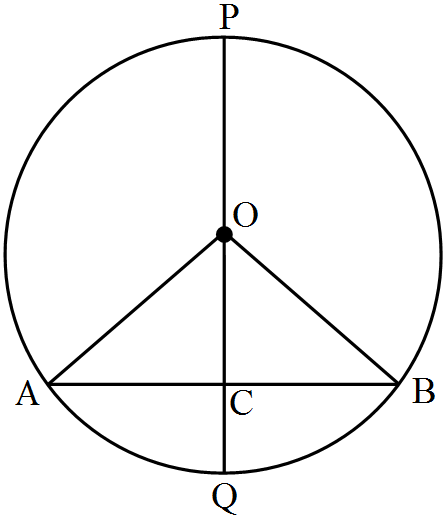
Prove that a diameter of a circle which bisects a chord of the circle also bisects the angle subtended by the chord at the centre of the circle.
Answer
Given:

PQ is a diameter of circle which bisects the chord AB at C.
To Prove: PQ bisects $\angle\text{AOB}$
Proof:
In $\angle\text{AOC}$ and $\angle\text{BOC}$
OA = OB [Radius of circle]
OC = OC [Common]
AC = BC [Given]
Then $\triangle\text{AOC}\cong\triangle\text{BOC}$ [By SSS condition]
$\angle\text{AOC}=\angle\text{BOC}$ [C.P.C.T]
Hence PQ bisects $\angle\text{AOB}.$
View full question & answer
Question 924 Marks
Given an arc of a circle, complete the circle.
Answer

Steps of Construction:

  1. Take three points A, B and C on the given arc.
  2. Join AB and BC.
  3. Draw the perpendicular bisectors of chords AB and BC which intersect each other at point O. Then O will be the required centre of the required circle.
  4. Join OA.
  5. With centre O and radius OA, complete the circle.
View full question & answer
Question 934 Marks
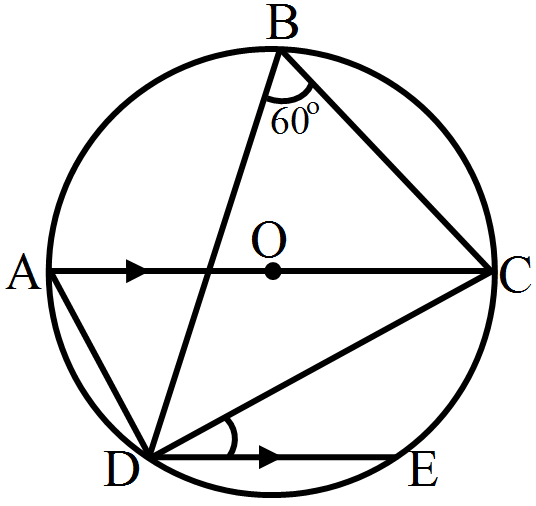
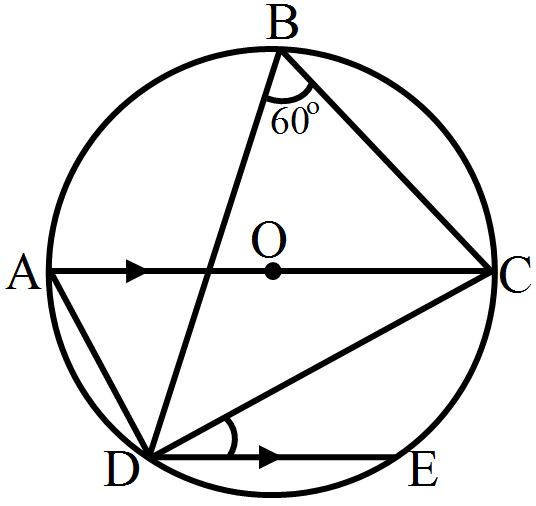
In the adjoining figure, DE is a chord parallel to diameter AC of the circle with centre O. If $\angle\text{CBD}=60^\circ,$calculate $\angle\text{CDE}.$

Answer

Angles in the same segment of a circle are equal.
$\text{i.e},\angle\text{CAD}=\angle\text{CBD}=60^\circ$
We know that an angle in a semicircle is a right angle.
$\text{i.e},\angle\text{ACD}=90^\circ$
In $\triangle\text{ADC},$ we have:
$\angle\text{ACD}+\angle\text{ADC}+\angle\text{CAD}=180^\circ$ [Angle sum property of a triangle]
$\Rightarrow\ \angle\text{ACD}+90^\circ+60^\circ=180^\circ$
$\Rightarrow\ \angle\text{ACD}=180^\circ-(90^\circ+60^\circ)$
$=(180^\circ-150^\circ)=30^\circ$
$\Rightarrow\ \angle\text{CDE}=\angle\text{ACD}=30^\circ$ [Alternate angles as AC parallel to DE]
Hence, $\angle\text{CDE}=30^\circ$
View full question & answer
Question 944 Marks
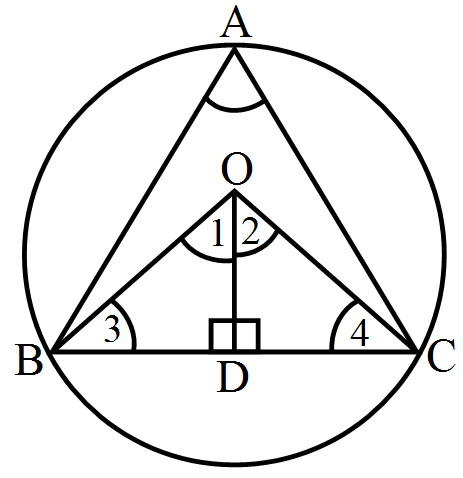
The circumcentre of the triangle ABC is O. Prove that $\angle\text{OBC} + \angle\text{BAC} = 90^\circ.$
Answer
ABC is a triangle and O is the circumcentre.

Draw $\text{OD}\bot\text{BC}.$ Join OB and OC.
In right $\triangle\text{OBD}$ and right $\triangle\text{OCD}$, we have
hyp. OB = hyp. OC [Raddi of the same circle]
OD = OD [Common side]
$\therefore\triangle\text{OBD}\cong\triangle\text{OCD}$ [By RHS cong. Rule]
$\therefore\angle1=\angle2$ and $\angle1=\angle4$ [By C.P.C.T.]
Now, $\angle\text{BOC}=2\angle1$ and $\angle\text{BOC}=2\angle\text{A}$
$\therefore2\angle1=2\angle\text{A}\Rightarrow\angle1=\angle\text{A}$
$\therefore\angle\text{A}=\angle2\ ....(1)\ \ \ [\because\angle1=\angle2]$
$\Rightarrow\angle\text{A}+\angle4=\angle2+\angle4$ [Adding $\angle4$ to both sides]
$\Rightarrow\angle\text{A}+\angle3=90^\circ\ \ [\because\angle2+\angle4=90^\circ\ \text{and}\ \angle4=\angle3]$
$\Rightarrow\angle\text{BOC}=\angle\text{A}=90^\circ$
Hence, proved.
View full question & answer
Question 954 Marks
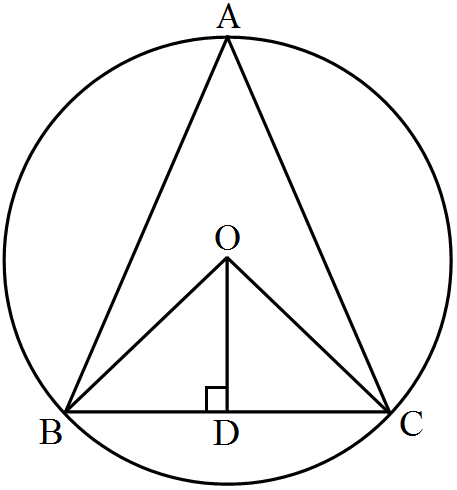
O is the circumference of the triangle ABC and OD is perpendicular on BC. Prove that $\angle\text{BOD}=\angle\text{A}.$
Answer
Given O is the circum centre of triangle ABC and $\text{OD}\perp\text{BC}$

To prove $\angle\text{BOD}=2\angle\text{A}$

Proof:

In $\triangle\text{OBD}$ and $\triangle\text{OCD}$

$\angle\text{ODB}=\angle\text{ODC}$ [Each 90°]

OB = OC [Radius of circle]

OD = OD [Common]

Then $\triangle\text{OBD}\cong\triangle\text{OCD}$ [By RHS Condition].

$\therefore\angle\text{BOD}=\angle\text{COD}\dots(\text{i})$ [PCT]. 

By degree measure theorem

$\angle\text{BOC}=2\angle\text{BAC}$

$\Rightarrow2\angle\text{BOD}=2\angle\text{BAC}$ [By using (i)]

$\Rightarrow\angle\text{BOD}=\angle\text{BAC}$

View full question & answer
Question 964 Marks
Prove that the line joining the mid-point of a chord to the centre of the circle passes through the mid-point of the corresponding minor arc.
Answer
Given:

C is the mid-point of chord AB.
To prove: D is the mid-point of arc AB.
Proof:
In $\triangle\text{OAC}$ and $\triangle\text{OBC}$
OA = OB [Radius of circle]
OC = OC [Common]
AC = BC [C is the mid-point of AB]
Then $\triangle\text{OAC}\cong\triangle\text{OBC}$ [By SSS condition]
$\therefore\angle\text{AOC}=\angle\text{BOC}$
$\Rightarrow\text{m}\overline{\text{A}}\text{D}\cong\text{m}\overline{\text{B}}\text{D}$
$\Rightarrow\overline{\text{A}}\text{D}\cong\overline{\text{B}}\text{D}$
Hence, D is the mid-point of arc AB.
View full question & answer
Question 974 Marks
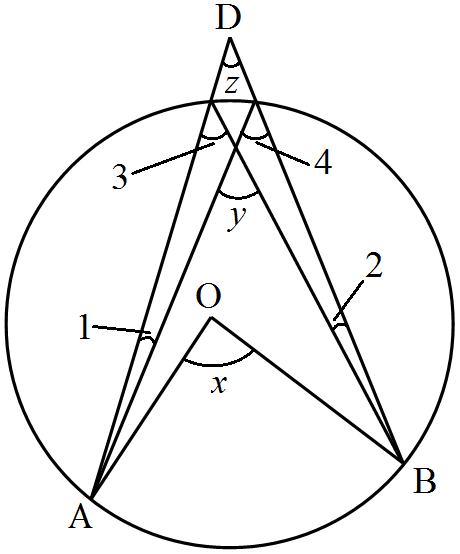
In figure, O is the centre of the circle, then prove that $\angle\text{x}=\angle\text{y}+\angle\text{z}.$

Answer
We have,
$\angle3=\angle4$ [Angles in same segment]
$\therefore\angle\text{x}=2\angle3$ [By degree measure theorem]
$\Rightarrow\angle\text{X}=\angle3+\angle3$
$\Rightarrow\angle\text{X}=\angle3+\angle4\dots(\text{i})$ $[\angle3=\angle4]$
But $​​\angle\text{y}=\angle3+\angle1$ [By exterior angle property]
$\Rightarrow\angle3=\angle\text{y}-\angle1\dots(\text{ii})$
From (i) and (ii)
$\angle\text{x}=\angle\text{y}-\angle1+\angle4$
$\Rightarrow\angle\text{x}=\angle\text{y}+\angle4-\angle1$
$\Rightarrow\angle\text{x}=\angle\text{y}+\angle\text{z}+\angle1-\angle1$ [By exterior angle property]
$\Rightarrow\angle\text{x}=\angle\text{y}+\angle\text{z}$
View full question & answer
Question 984 Marks
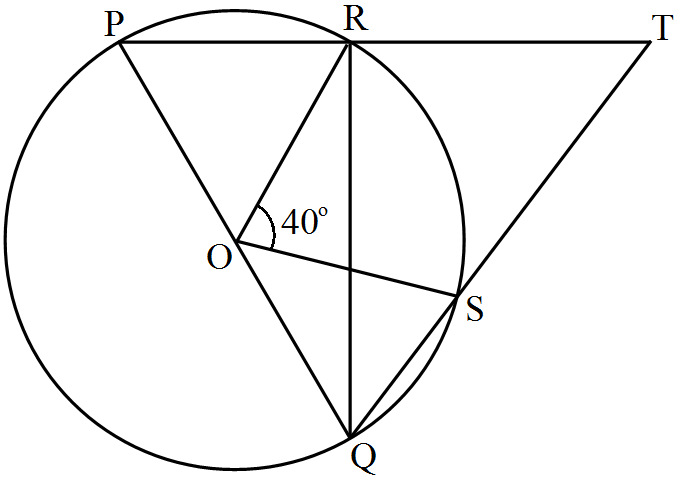
In figure, O is the centre of a circle and PQ is a diameter. If $\angle\text{ROS} = 40^\circ, $ find $\angle\text{RTS}.$

Answer
Since PQ is diameter
Then,
$\angle\text{PRQ} = 90^\circ$ [Angle in semicircle]
$\therefore\angle\text{PRQ}+\angle\text{TRQ}=180^\circ$ [Linear pair of angle]
$900+\angle\text{TRQ}=180^\circ$
$\angle\text{TRQ}=180^\circ-90^\circ=90^\circ$
By degree measure theorem
$\angle\text{ROS}=2\angle\text{RQS}$
$\Rightarrow40^\circ=2\angle\text{RQS}$
$\Rightarrow\angle\text{RQS}=\frac{40^\circ}{2}=20^\circ$
In $\triangle\text{RQT},$ by Angle sum property
$\angle\text{RQT}+\angle\text{QRT}+\angle\text{RTS}=180^\circ$
$\Rightarrow20^\circ+90^\circ+\angle\text{RTS}=180^\circ$
$\Rightarrow\angle\text{RTS}=180^\circ-20^\circ-90^\circ=70^\circ$
View full question & answer
Question 994 Marks
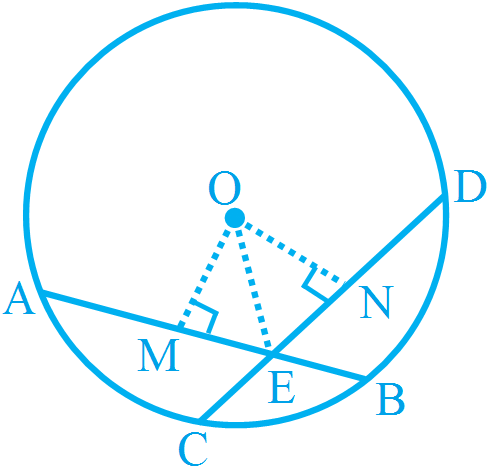
If two equal chords of a circle intersect within the circle, prove that the segments of one chord are equal to corresponding segments of the other chord.
Answer
Given,

AB and CD are chords intersecting at E.

AB = CD

To prove,

AE = DE and CE = BE

Construction,

$\text{OM}\perp\text{AB}$ and $\text{ON}\perp\text{CD}. \text{OE}$ is joined.

Proof,
OM bisects AB $(\text{OM}\perp\text{AB})$

ON bisects CD $(\text{ON}\perp\text{CD})$

As AB = CD thus,

AM = ND ...(i)

and MB = CN ...(ii)

In $\triangle\text{OME}$ and $\triangle\text{ONE},$

$\angle\text{OME}=\angle\text{ONE}$ (Perpendiculars)

OE = OE (Common)

OM = ON (AB = CD and thus equidistant from the centre)

$\triangle\text{OME}\cong\triangle\text{ONE}$ by RHS congruence condition.

ME = EN by CPCT ...(iii)

From (i) and (ii) we get,

AM + ME = ND + EN

⇒ AE = ED

From (ii) and (iii) we get,

MB - ME = CN - EN

⇒ EB = CE

View full question & answer
Question 1004 Marks
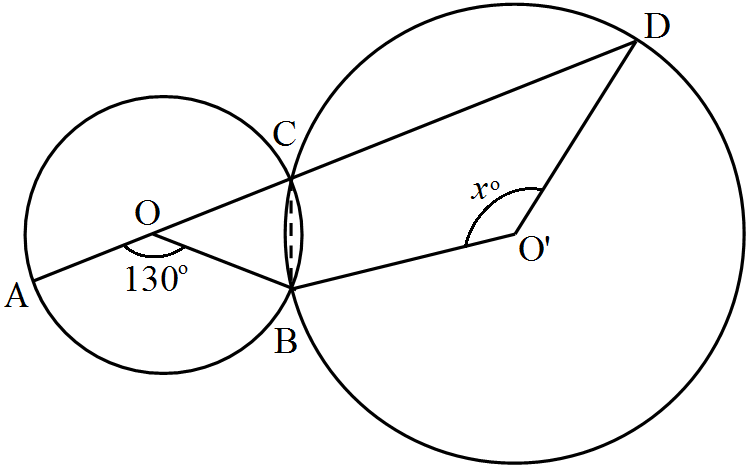
In the given figure, O and O' are centers of two circles intersecting at B and C. ACD is a straight line, find x.

Answer
By degree measure theorem

$\angle\text{AOB} = 2\angle\text{ACB}$

$\Rightarrow130^\circ=2\angle\text{ACB}$

$\Rightarrow\angle\text{ACB}=\frac{130^\circ}{2}=65^\circ$ [Liner a pair of angles]

$\Rightarrow65^\circ+\angle\text{BCD}=180^\circ$

$\Rightarrow\angle\text{BCD}=180^\circ-65^\circ=115^\circ$ By degree measure theorem reflex

$\angle\text{BOD}=2\angle\text{BCD}$

$\Rightarrow\text{reflex }\angle\text{BOD}=2\times115^\circ=230^\circ$

Now, reflex $\angle\text{BOD}+\angle\text{BO}'\text{D}=360^\circ$ [Complex angle]

$\Rightarrow230^\circ+\text{x}=360^\circ$

$\Rightarrow\text{x}=360^\circ-230^\circ$

$\therefore\text{x}=130^\circ$

View full question & answer
4 Marks Questions - Page 2 - Maths STD 9 Questions - Vidyadip