Questions · Page 3 of 3

4 Marks Questions

Question 1014 Marks
AB and AC are two chords of a circle of radius r such that AB = 2AC. If p and q are the distances of AB and AC from the centre, prove that 4q2 = p2 + 3r2.
Answer
Given: In a circlr of radius r, there are two chords AB and AC such that AB = 2AC, Also, the distance of AB and AC from the centre are P and q, respectively.
To prove: $\text{4q}^2+\text{p}^2+3\text{r}^2,$
Proof: Let AC = a, then AB = 2a
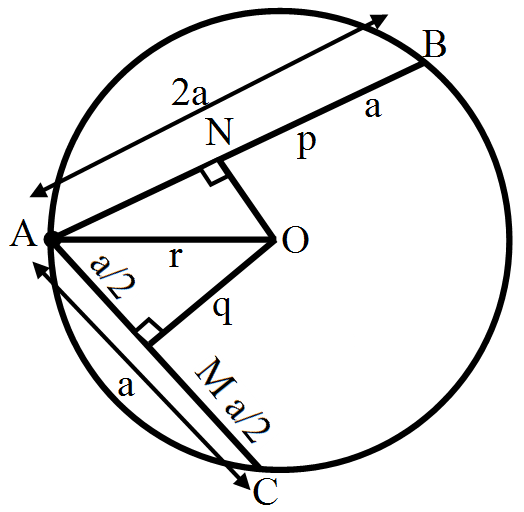
From centre O, perpendicular is drawn to the chords AC and AB at M and N, respectively.
$\therefore\text{AM}=\text{MC}=\frac{\text{a}}{2}$
$\text{AN}=\text{NB}=\text{a}$
In $\triangle\text{OAM},\ \ \text{AO}^2=\text{AM}^2+\text{MO}^2$ [by pythagoras theorem]
$\Rightarrow\text{AO}^2=\Big(\frac{\text{a}}{2}\Big)^2+\text{q}^2\ \ ...\text{(i)}$
In $\triangle\text{OAN},$ use pythagoras theorem,
$\text{AO}^2=(\text{AN})^2+(\text{NO})^2$
$\Rightarrow\text{AO}^2=(\text{a})^2+\text{p}^2\ \ \ ...(\text{ii})$
From Eqs. (i) and (ii),
$\Big(\frac{\text{a}}{2}\Big)^2+\text{q}^2=\text{a}^2+\text{p}^2$
$\Rightarrow\frac{\text{a}^2}{4}+\text{q}^2=\text{a}^2+\text{p}^2$
$\Rightarrow\text{a}^2+4\text{q}^2=4\text{a}^2+4\text{p}^2$ [multiplying both sides by 4]
$\Rightarrow4\text{q}^2=3\text{a}^2+4\text{p}^2$
$\Rightarrow4\text{q}^2=\text{p}^2+3(\text{a}^2+\text{p}^2)$
$\Rightarrow4\text{q}^2=\text{p}^2+3\text{r}^2$ $\big[$In right angled $\triangle\text{OAN},\ \text{r}^2=\text{a}^2+\text{p}^2\big]$
Hence proved.
View full question & answer
Question 1024 Marks
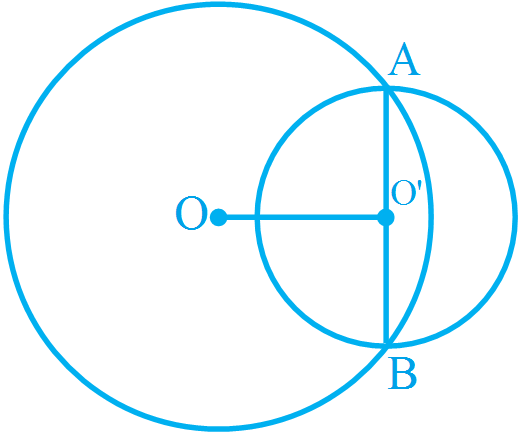
Two circles of radii 5cm and 3cm intersect at two points and the distance between their centres is 4cm. Find the length of the common chord.
Answer

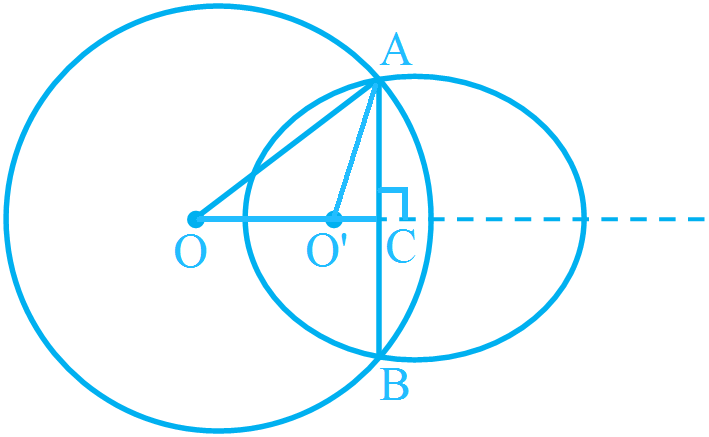
Let the radius of the circle centered at O and O' be 5 cm and 3 cm respectively.

OA = OB = 5cm

O'A = O'B = 3cm

OO' will be the perpendicular bisector of chord AB.

$\therefore$ AC = CB

It is given that, OO' = 4cm

Let OC be x. Therefore, O'C will be x − 4

In $\triangle\text{OAC},$

OA= AC2 + OC2

⇒ 52 = AC2 + x2

⇒ 25 − x2 = AC2 ...(1)

In $\triangle\text{O}'\text{AC},$

O'A2 = AC2 + O'C2

⇒ 32 = AC2 + (x − 4)2

⇒ 9 = AC2 + x2 + 16 − 8x

⇒ AC2 = −x2 −7 + 8x ...(2)

From equations (1) and (2), we obtain

25 − x= −x2 −7 + 8x

8x = 32

x = 4

Therefore, the common chord will pass through the centre of the smaller circle i.e., O' and hence, it will be the diameter of the smaller circle.


Length of the common chord AB = 2 O'A = (2 × 3)cm = 6cm

View full question & answer
Question 1034 Marks
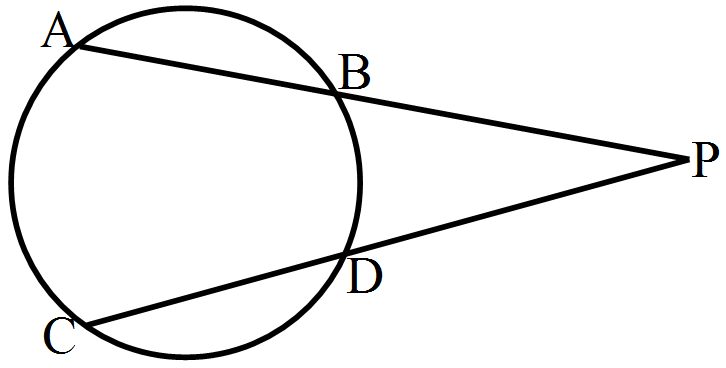
Two chords AB and CD of a circle intersect each other at P outside the circle. If AB = 6cm, BP = 2cm and PD = 25cm, find CD.

Answer

AB and CD are two chords of a circle which intersect each other at P outside the circle.
AB = 6cm, BP = 2cm and PD = 2.5cm
$\therefore$ AP × BP = CP × DP
⇒ 8 × 2 = (CD + 2.5) × 2.5 $[\because$ CP = CD + DP$]$
Let CD = xcm
Thus, 8 × 2 = (CD + 2.5) × 2.5 
⇒ 16 = 2.5x + 6.25
⇒ 2.5x = (16 - 6.25) = 9.75
$\Rightarrow\ \text{x}=\frac{9.75}{2.5}=3.9$
Hence, CD = 3.9cm
View full question & answer
Question 1044 Marks
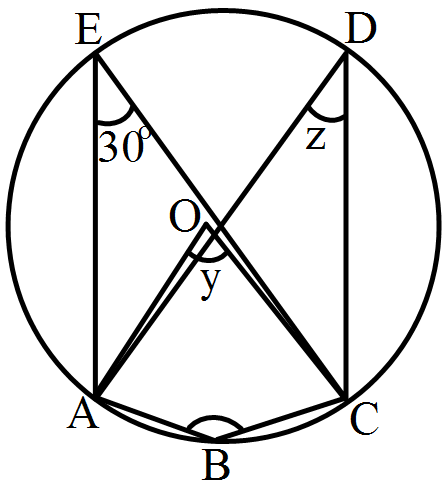
In the given figure, O is the center of the circle. If $\angle\text{CEA}=30^\circ,$ find the value of x, y and z.

Answer
We have, $\angle\text{CEA}=30^\circ$
Since, quad. ABCE is a cyclic quadrilateral.
Then, $\angle\text{ABC}+\angle\text{CEA}=180^\circ$
$\Rightarrow\text{x}+30^\circ=180^\circ$
$\Rightarrow\text{x}=180^\circ-30^\circ=150^\circ$
By degree measure theorem
$\angle\text{AOC}=2\angle\text{CEA}$
$\Rightarrow\text{y}=2\times30^\circ=60^\circ$
$\therefore\angle\text{ADC}=\angle\text{CEA}$ [Angle in same segment]
$\Rightarrow\text{z}=30^\circ$
View full question & answer
Question 1054 Marks
In a cyclic quadrilateral ABCD, if $\angle\text{A}-\angle\text{C}=60^\circ,$ prove that the smaller of two is 60º
Answer
We have
$\angle\text{A}-\angle\text{C}=60^\circ\dots(1)$
Since, ABCD is a cyclic quadrilateral
Then $\angle\text{A}+\angle\text{C}=180^\circ\dots(2)$
Add equations (1) and (2)
$\angle\text{A}-\angle\text{C}+\angle\text{A}+\angle\text{C}=60^\circ+180^\circ$
$\Rightarrow2\angle\text{A}=240^\circ$
$\Rightarrow\angle\text{A}=\frac{240^\circ}{2}=120^\circ$
Put value of $\angle\text{A}$ in equation (2)
$120^\circ+\angle\text{C}=180^\circ$
$\Rightarrow\angle\text{C}=180^\circ-120^\circ=60^\circ$
View full question & answer
Question 1064 Marks
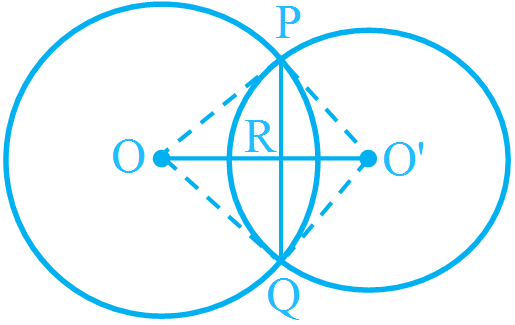
If two circles intersect at two points, prove that their centres lie on the perpendicular bisector of the common chord.
Answer

Given,

Two circles which intersect each other at P and Q.

To prove,

OO' is perpendicular bisector of PQ.

Proof,

In $\triangle\text{POO}'$ and $\triangle\text{QOO}',$

OP = OQ (Radii)

OO' = OO' (Common)

O'P = OQ (Radii)

$\therefore\triangle\text{POO}'\cong\triangle\text{QOO}'$ (SSS congruence condition)

Thus,

$\angle\text{POO}'=\angle\text{QOO};...(1)$

In $\triangle\text{POR}$ and $\triangle\text{QOR}$

OP = OQ (Radii)

$\angle\text{POR}=\angle\text{QOR}$ (from i)

OR = OR (Common)

$\therefore\triangle\text{POR}\cong\triangle\text{QOR}$ (SAS congruence condition)

Thus

$\angle\text{PRO}=\angle\text{QRO}$

also,

$\angle\text{PRO}+\angle\text{QRO}=180^\circ$

$\Rightarrow\angle\text{PRO}=\angle\text{QRO}=\frac{180^\circ}{2}=90^\circ$

Hence,

OO' is perpendicular bisector of PQ.

View full question & answer
Question 1074 Marks
A line segment AB is of length 5cm. Draw a circle of radius 4cm passing through A and B. Can you draw a circle of radius 2cm passing through A and B? Give reason in support of your answer.
Answer
  1. Draw a line segment AB of 5cm.
  2. Draw the perpendicular bisectors of AB.
  3. With centre A and radius of 4cm, draw an arc which intersects the perpendicular bisector at point O. The point O will be the required centre.
  4. Join OA.
  5. With centre O and radius OA, draw a circle.

No, we cannot draw a circle of radius 2cm passing through A and B because when we draw an arc of radius 2cm with centre A, the arc will not intersect the perpendicular bisector and we will not find the centre.

View full question & answer
4 Marks Questions - Page 3 - Maths STD 9 Questions - Vidyadip