Questions

Case study (4 Marks)

🎯

Test yourself on this topic

13 questions · timed · auto-graded

Question 14 Marks
Answer
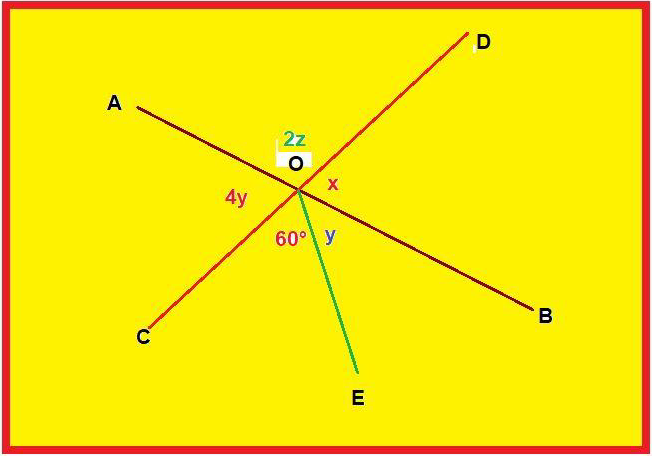
(i)(a)30°
(ii)(c)60°
(iii)(d)90°
(iv)(a)120°
(v)(b)180°
View full question & answer
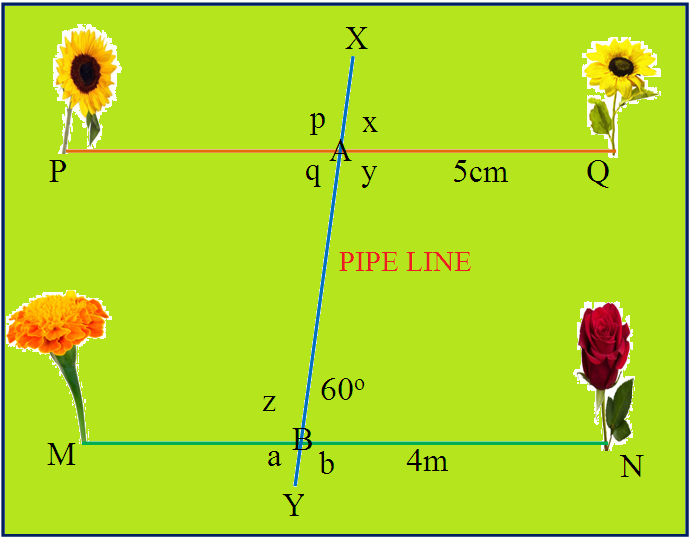
Question 24 Marks
Answer
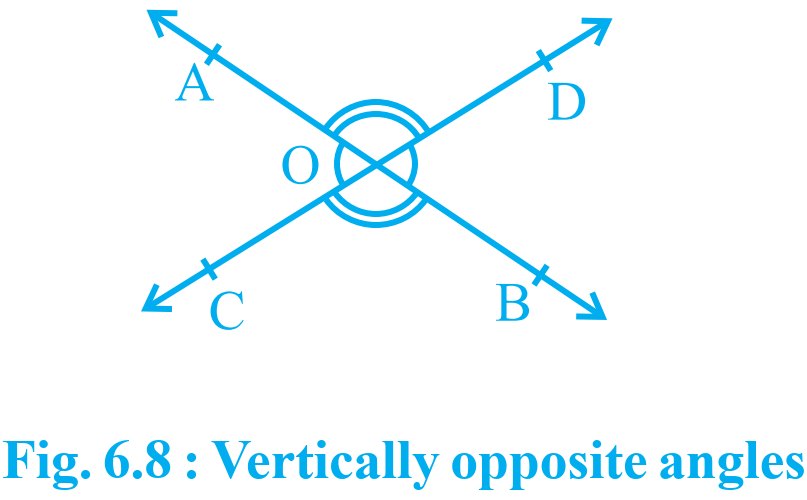
(i) (b) 120°
(ii) (a) 60°
(iii) (c) 180°
(iv) (d) $\angle\text{q}$
(v) (a) 60°
View full question & answer
Question 34 Marks
Answer
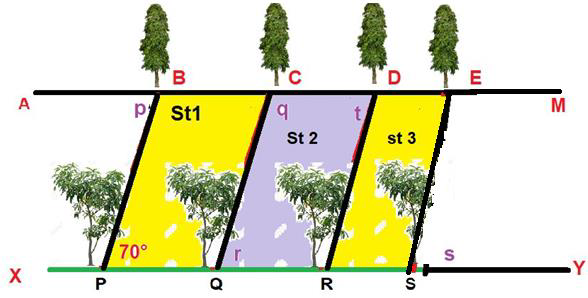
(i)(b)70°
(ii)(d)110°
(iii)(a)50°
(iv)(c)70°
(v)(b)100°
View full question & answer
Question 44 Marks
Answer
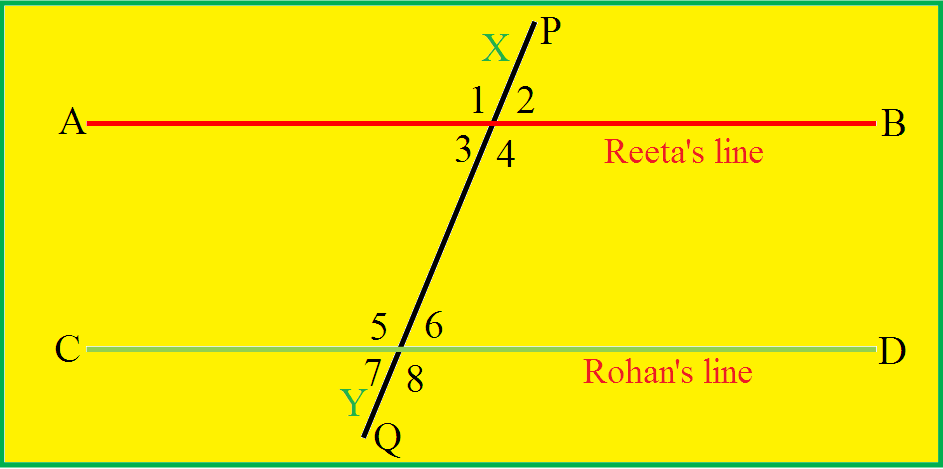
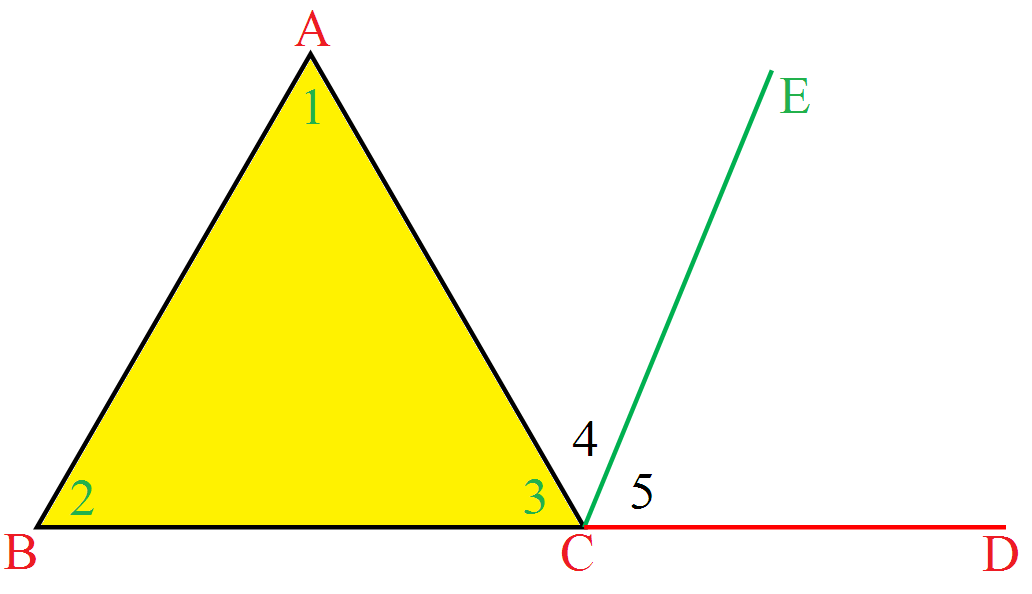
(i)(c)$\angle3$
(ii)(b)$\angle5$
(iii)(d)60°
(iv)(a)180°
(v)(c)$\angle4\text{ and }\angle\text{8}$
View full question & answer
Question 54 Marks
Answer
(i)(b)96°
(ii)(d)24°
(iii)(c)42°
(iv)(c)180°
(v)(a)2y + z = 90°
View full question & answer
Question 64 Marks
Answer
8. Writes either isosceles or obtuse or both. Reasoning involves symmetry or measure of angle or both.
● Isosceles, as the design is symmetrical.
● Obtuse, as one of the angle is greater than 90°.
9. D. 120° 
10. Valid mathematical proof involving properties of triangles.
● IG is perpendicular to BC, thus triangle IGC is a right-angled triangle.
Measure of ∠ICG = 30°.
Hence, ∠CIG = 60°.
The sides of the triangle IGC are in the ratio 2:1.
View full question & answer
Question 74 Marks
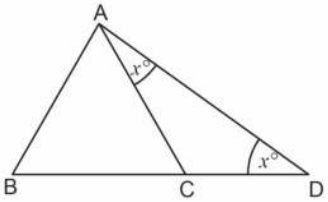
In the igure below, BC = AC.

Image

7. What is the measure of ∠BAD?
  A. 30°
  B. 60°
  C. 75°
  D. 90°
Answer
7. D. 90°
View full question & answer
Question 84 Marks
The game of billiards is played with balls placed on a rectangular table. One ball is struck with the
end of a stick, called a cue. The ball bounces into other balls and relects off the sides of the table. In a real game, the ball may spin, but for mathematical purposes, it is considered that the ball travels in a straight line with the same relection and incidence angles.

Image

On a billiard table ABCD, the ball placed at O is struck with the cue.
1. What is the value of ∠a + ∠d?
2. Why is the line OM parallel to PN?
Answer
1. 90
   90°
2. Mathematically valid proof
● Let angles on line AMB be a, x and b and angles on line BNC be c, y and d.
x = 180 – (a + b) …..1
y = 180 – (c + d) …...2
 Adding 1 and 2,
x + y = 360 – (a + b + c + d)
  = 360 – (2a + 2c)
  = 360 – 2 × 90 = 180
Thus, lines OM and NP are parallel. 
View full question & answer
Question 94 Marks
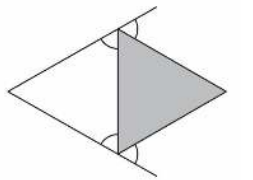
The figure below shows an equilateral triangle bounded by two straight lines. 

Image
5. What is the sum of the four marked angles?
  A. 180°
  B. 240°
  C. 270°
  D. 360°
Answer
5. B. 240
View full question & answer
Question 104 Marks
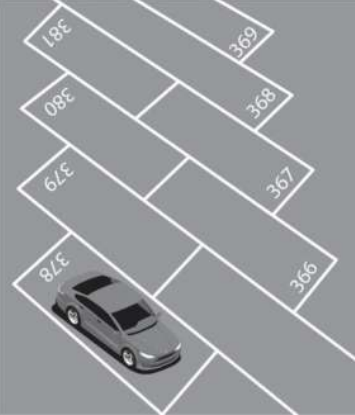
A parking lot for a city mall is shown below. The painted lines that separate the parking spaces are parallel.

Image
3. Parking space number 378 is inclined at 60° to the horizon line. At what angle is parking space 380 inclined to the horizontal line? Why?

Answer
3. 60°, reasoning includes properties of parallel lines.
● 60°, as the lines are parallel, thus corresponding angles will be equal.
View full question & answer
Question 114 Marks
Answer
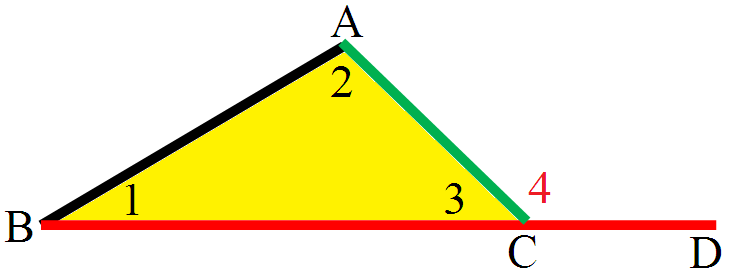
(i)(c)$\angle4$
(ii)(d)$\angle5$
(iii)(a)180°
(iv)(b)$\angle1+\angle2$
(v)(a)$\angle3+\angle4+\angle5=180^\circ$
View full question & answer
Question 124 Marks
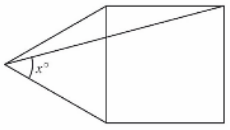
The igure below consists of a square and an equilateral triangle connected together with a
common side. 

Image
6. What is the measure of ‘x’?
  A. 15
  B. 30
  C. 45
  D. 60
Answer
6. C. 45
View full question & answer
Question 134 Marks
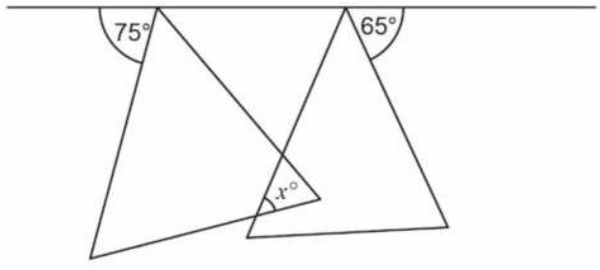
Two equilateral triangles on a straight line are shown below.

Image
4.What is the measure of ‘x’?
  A. 30
  B. 40
  C. 60
  D. 65
Answer
4. B. 40 
View full question & answer
Case study (4 Marks) - Maths STD 9 Questions - Vidyadip